
The Non-Technical Founder’s Guide to Building Software


In this article
- What’s the best way for a non-technical founder to get software built?
- Prototype it yourself with AI before you hire anyone
- How do you know if your MVP is too big when you can’t estimate?
- Should you outsource or hire in-house?
- How do you tell if a developer is any good when you can’t read code?
- Why you need a general contractor, not just a good electrician
- What’s your job once the developers start?
- Frequently asked questions
Quick Answer: The best way for a non-technical founder to build software is to prototype with AI first, then hire the person whose job is judging developer work for you, not judge it yourself. Skip trying to read code: judge whether a developer explains decisions in plain English and check their commit history against billed hours. A fractional CTO plus an offshore developer at $5,600 to $8,000 a month still costs less than one $30,000-a-month US agency hire. Full Scale builds the execution side of that plan and leaves the judging to someone on your team.
What’s the best way for a non-technical founder to get software built?
You are about to spend real money on a decision you cannot personally evaluate.
That’s the actual problem for a non-technical founder trying to get software built, and hiring someone doesn’t make it go away. Every choice that follows, how big to scope the first version, whether to hire an agency or bring someone on staff, whether the developer you just hired is any good, is the same problem wearing a different hat: how do you judge work you can’t do yourself?
Almost nobody tells you this part before you start writing checks. The number one reason startups fail isn’t bad code. It’s founders who think they already know what needs to be built, and spend months and real money building it before anyone bothers to ask a customer. I’ve watched this sink startups from the outside for twenty years. I’ve also watched it happen to Full Scale’s own clients, people who hired us to build the thing when the thing itself was never actually validated. Whether the developer could write good code was never the issue, because nobody had talked to a customer first.
There’s a cheaper move than hiring anybody, and it comes before any of the decisions below.
Prototype it yourself with AI before you hire anyone
Finding out if your idea is worth building takes a customer’s honest reaction. AI just made getting that reaction almost free, no developer required.
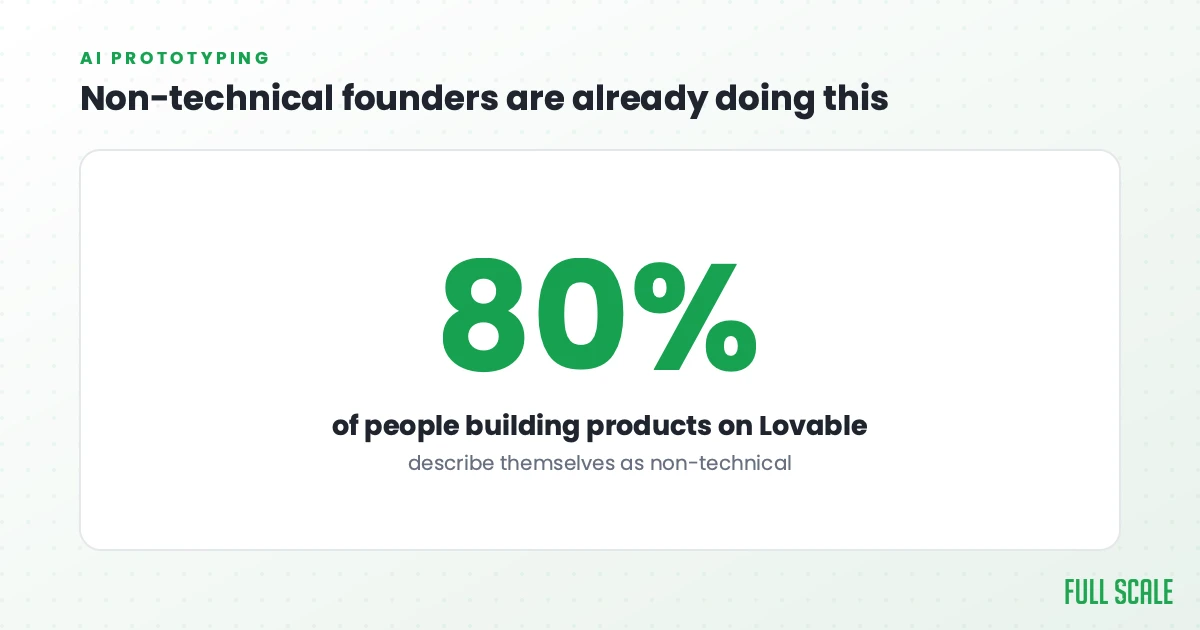
“Vibe coding,” building an app by describing it in plain English to an AI tool instead of writing code, is mainstream enough now that it barely counts as a hack. Lovable’s own build economy report found that 80% of the people building products on its platform describe themselves as non-technical. Most people building software this way in 2026 have never written a line of code, so you’d be in good company.
Use that. Build a rough, clickable version of your idea over a weekend and put it in front of five real prospects. Watch their faces while they use it. The point right now is finding out whether anyone actually wants this, well before you worry about shipping something finished, and before you’ve spent a dollar on development.
The catch
The catch shows up faster than people expect. The prototype works fine right up until a real customer signs up and starts finding the edges, bugs, missing pieces, the stuff you never noticed because nobody had paid money yet. That’s usually the moment a vibe-coded app needs to turn into real, maintained software, and by then you’re the one stuck explaining a codebase you wrote at midnight to whoever takes it over. I wrote more about that exact hand-off point in a newsletter issue on vibe coding.
It matters more today than it did a few years ago. A Cloud Security Alliance research note citing Veracode’s 2025 GenAI Code Security Report found that AI-generated code flunks an OWASP Top 10 security check, the industry’s standard vulnerability checklist, nearly half the time. A separate CSO Online review of 15 apps built with popular AI coding tools turned up 69 vulnerabilities between them. The tool that got you a working demo in a weekend is a different animal from the one that should be holding your customers’ data six months from now.
AI didn’t hand you a new skill so much as make an old one cheaper to test: knowing when you’re out of your depth. Figuring that out used to cost real money and months of build time. Now it costs a weekend.
How do you know if your MVP is too big when you can’t estimate?
You can’t tell from the estimate, so assume your first version is too big and cut it until a small team can ship it. Once the prototype has done its job, meaning real people have reacted to it, you’re going to have to scope an actual build. This is where a non-technical founder hits a wall: you have no way to tell if “a few weeks” is an honest estimate or a fantasy.
Software has an old rule of thumb that holds up depressingly well: the first 90% of a project takes 90% of the time, and the last 10% takes the other 90%. Whatever your developer quotes you, plan for it to run long. Estimates blow past their targets even from people who’ve been doing this for decades.
The number in front of you is probably wrong. The actual method for getting it right, cutting scope down to something a small team can ship, what to cut first, how to spot bloat before you build it, deserves its own conversation, and I’ve written the full playbook in MVP development strategy. Read that before you write a single spec.
Should you outsource or hire in-house?
Once you roughly know what you’re building, you’ve got three real options: hire someone directly, hire a freelancer, or work with an agency. The tradeoff comes down to who’s managing whom.
Hire directly and the moment you sign the contract, you’ve become an engineering manager, whether you wanted the job or not. That’s not a metaphor. Hire a carpenter or a doctor the same way and the same thing happens: you’re suddenly the boss of someone whose actual work you can’t evaluate. A freelancer splits the difference, usually cheaper than an agency, but you’re still doing the managing, and there’s no bench of other skills behind them if the project grows.
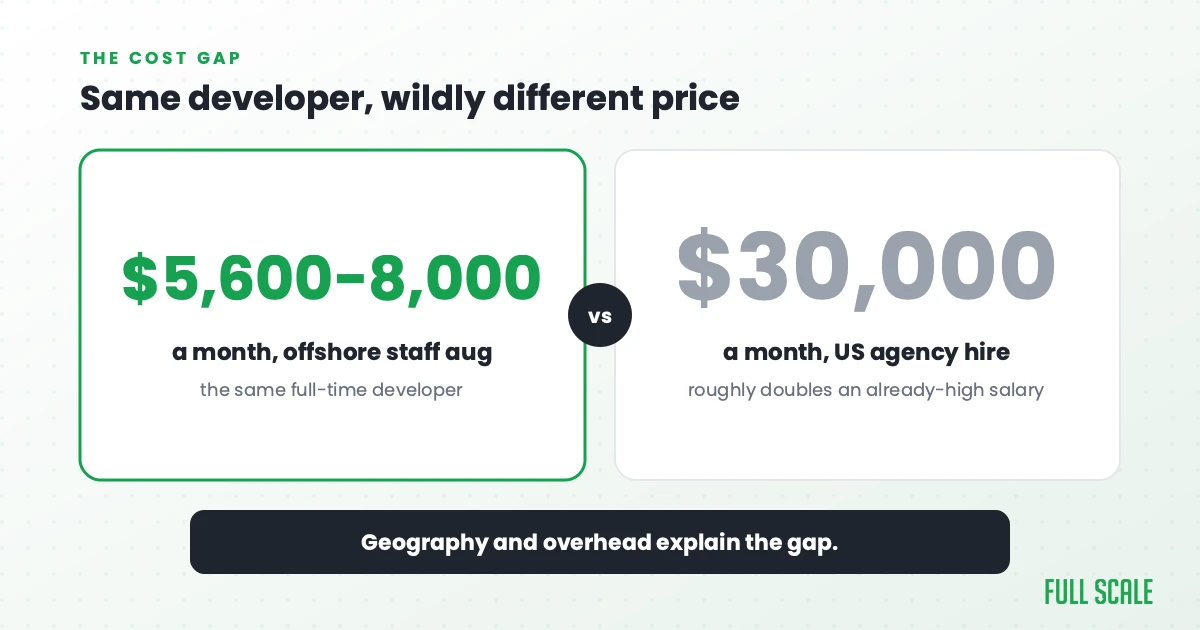
An agency costs more, and you’re paying for exactly what direct hiring skips: a bench of other skills when you need them, and usually a trial period where you see the work before you’re locked in. A friend of mine runs a development agency here in Kansas City. Hiring one of his developers full-time for a month runs about $30,000, because he’s roughly doubling an already-high American salary just to keep the business standing. Go the offshore staff-augmentation route instead and the same full-time developer runs $5,600 to $8,000 a month. That gap comes down to geography and overhead, and either way, you’re still the one managing the relationship, just at very different price points.
How do you tell if a developer is any good when you can’t read code?
Skip the code entirely. It was never going to tell you what you needed to know anyway.
What you’re actually checking for is judgment, not code you couldn’t read anyway. Fred Brooks made that case back in 1986, in an essay called “No Silver Bullet.” Tools have gotten better every decade since, compilers, frameworks, now AI, and none of them have touched the part of software that’s hard because the problem itself is hard. Tools speed up the typing. Deciding what to build, and who it’s for, is still a person’s job. The code was never the mountain. The people who’d use it were. I dug into that same idea more in a newsletter piece on what AI actually replaces.
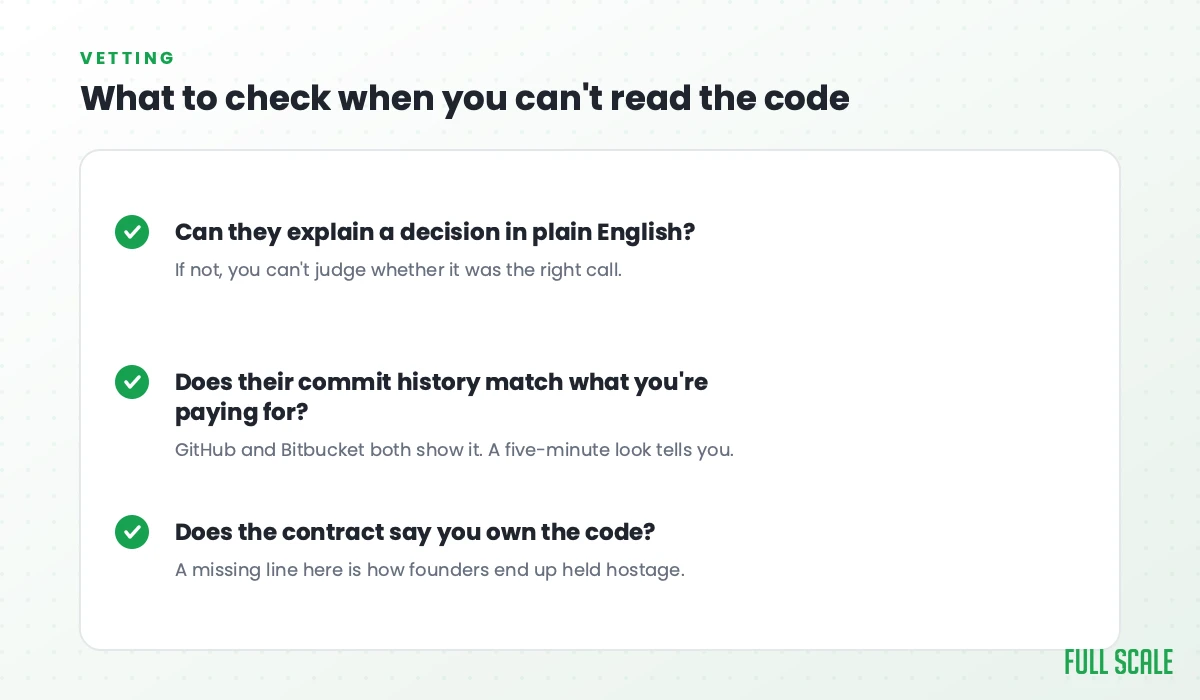
Judge whether a developer can explain a decision to you in plain English. Then check whether their commit history matches what you’re paying for. Sean Parsons, a consultant who coaches non-technical founders, told me about developers who bill a client full-time while quietly splitting their hours across two or three other projects. GitHub and Bitbucket both show commit history, and a five-minute look tells you whether the person billing you for 40 hours a week actually showed up. Sean had also seen a founder two years into a simple app, held hostage by a single developer nobody else understood the codebase well enough to replace, in one case because the code lived only in that developer’s own private repository. Skill wasn’t the problem there. An uncaught dependency was, and a missing line in the contract that should have said the founder owns the code, no exceptions.
Why you need a general contractor, not just a good electrician
You cannot grade your own homework. Learning how to vet a developer more carefully helps, but it has a ceiling, since you’re still the one deciding whether the explanation you just heard sounded convincing. What actually solves it is someone on your side of the table whose entire job is judging the work so you don’t have to, and that person has a name: a fractional CTO.
Think of it like remodeling a house. You hire a general contractor, and the GC hires and manages the electrician, the plumber, the carpenter. You never personally verify the wiring meets code, because you hired someone whose whole job is knowing what meeting code even looks like. A fractional CTO plays that role for software. They work for you, on your payroll or your retainer, holding whoever’s building your product accountable, whether that’s a freelancer, an agency, or a staff-augmentation partner like us. Most founders find one through their own network first, an investor, another founder, a local startup community, before ever posting a job.
Here is the honest answer to when you need a fractional CTO. Already know exactly what you’re building? Staff augmentation multiplies your ability to build it. Still working that out? That calls for a consultant who can help you think it through, the same reason you’d hire one instead of just another pair of hands, but the decision, and the reason behind it, still has to be yours. At Full Scale we routinely turn away leads who want someone else to make that call for them. That’s judgment work, priced differently for a reason.
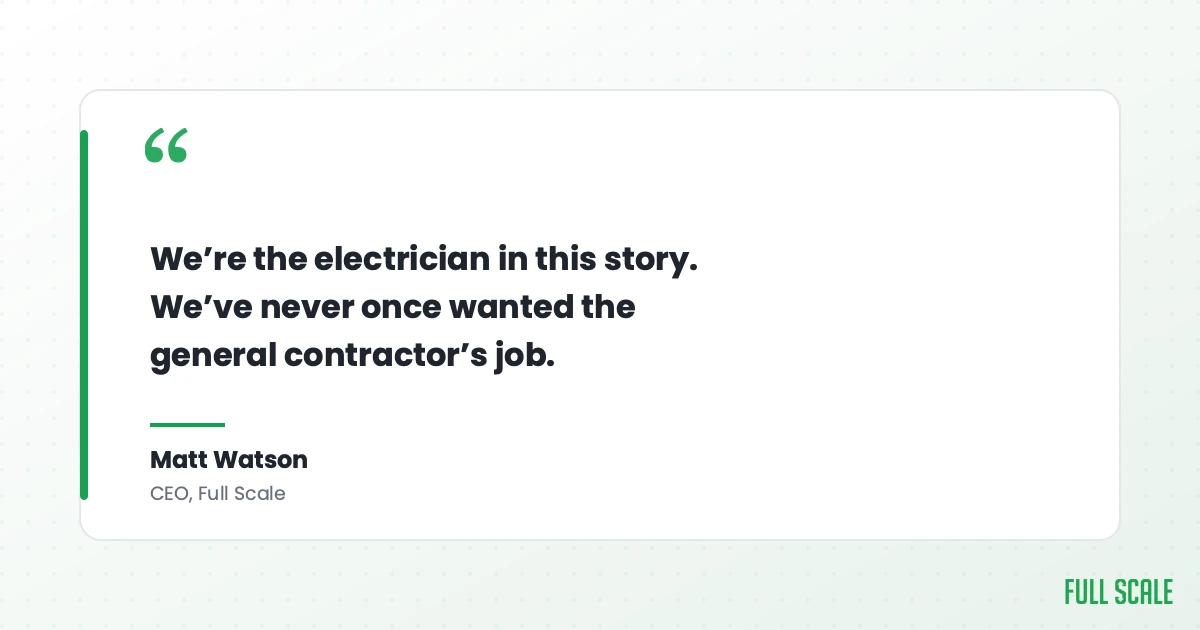
We’ve worked alongside client-side fractional CTOs on plenty of engagements, and it consistently beats the alternative. Someone who actually understands the work is checking it, instead of us grading our own homework. We’re the electrician in this story. We’ve never once wanted the general contractor’s job.
Fractional leadership isn’t some fringe option either. More than 140,000 LinkedIn profiles now carry the word “fractional” in the job title, and a big share of that growth is founders realizing a six-to-nine-month search for a full-time CTO is a bad trade when a fractional one can start next week.
Fractional CTO vs. technical co-founder
| A fractional CTO | A technical co-founder | |
|---|---|---|
| Commitment | Paid, defined-term engagement | Permanent, owns equity |
| Cost | A few thousand a month, or a few hundred an hour | No cash cost, but real equity |
| Best fit | You want judgment now and don’t want to give up equity to get it | Pre-seed, no cash for a retainer, and you’d rather trade equity for a full-time partner |
Neither one replaces the other. A technical co-founder is the right call when you have no capital for a retainer and can find someone willing to trade equity for full-time commitment before you have a product. A fractional CTO is the right call everywhere else, when you’d rather pay for judgment than give away ownership, or you need it now and can’t wait for a co-founder match.
What’s your job once the developers start?
Your job is to hand the team a plan, keep the scope small, and stay closer to your customers than anyone else in the building.
Every feature you ask for is one more thing in your backpack on the way up the mountain. It needs documentation, it needs maintenance, and eventually it’ll get bugs. I’ve watched teams burn a full week arguing over some obscure edge case, and when you look at the feature causing it, you have to wonder why anyone built it in the first place. The backpack gets heavy fast, and most of what’s weighing it down was never load-bearing.
Then there’s the mistake where you’re the problem. Picture carpenters remodeling your kitchen, and every single day you walk in and tell them to build different cabinets. They’d quit. Nobody builds well under constant redirection, developers included, so give them a plan and then give them the room to actually run it.
Where I still get this wrong
I’ll be honest, I’ve done exactly this myself. I’ve walked over to developers with a new idea I was excited about, and they had no way of knowing whether I meant “drop everything and build this” or “I’m just thinking out loud.” That’s not their problem to solve. It’s mine, and it’s the same mistake this whole piece has been warning you about: mistaking your own idea for validated demand.
The building can be bought. Hire it out, staff it up, vibe-code the first version yourself at midnight, doesn’t matter. What can’t be bought is knowing what to build, and that only comes from one place: the customers you actually talked to, not the features you dreamed up on your own at 2 a.m. Whether it’s you and an AI tool tonight or a full team six months from now, staying closer to your customers than anyone else in the building is the one job that was always yours.
Frequently asked questions
Should I get a fractional CTO or a technical co-founder?
Get a co-founder if you’re pre-seed, have no cash for a retainer, and can find someone willing to trade equity for a full-time commitment before there’s a product. Get a fractional CTO if you’d rather pay for judgment than give up ownership, or you need the help now and don’t want to wait on a co-founder match. Most founders end up choosing the fractional CTO simply because the timing works better.
How much does all this actually cost?
A fractional CTO usually runs a few thousand dollars a month for a part-time retainer, up to a few hundred dollars an hour for project work. Pair that with an offshore developer at $5,600 to $8,000 a month and the combined cost is still less than one $30,000-a-month US agency hire. It’s priced like the judgment call it is, not like staffing.
Should I learn to code before hiring developers?
You don’t need to. What actually helps is understanding your customers well enough to explain what they need clearly, plus knowing how to check whether the person building it for you is doing what they said. Their commit history will tell you more than their code ever would.
Who should a non-technical founder hire to build an AI product?
Start with a rough AI-built prototype and put it in front of five real prospects before you hire anyone. Once people have reacted to it, hire a fractional CTO, the person whose job is judging the work for you, and let them hold whoever builds the product accountable, whether that’s a freelancer, an agency, or a staff-augmentation partner like Full Scale. A technical co-founder is the other route when you have no cash for a retainer.
How should a non-technical founder manage developers?
Give them a plan, then give them room to run it, because nobody builds well under constant redirection. Say plainly whether a new idea means “drop everything and build this” or “I’m just thinking out loud.” To check the work without reading code, ask them to explain decisions in plain English and compare their commit history against billed hours, and put a fractional CTO between you and the developers if you can’t judge the answers yourself.
Full Scale builds the execution side of this: staff augmentation with developers your fractional CTO, technical co-founder, or you can hold accountable. If you’ve validated the idea and you’re ready to build it right, schedule a call.