
Types of Software Engineers: Which Ones Your Startup Actually Needs to Hire

In this article
- A quick map before the details
- Hire these engineers first: your core product team
- Hire these as you grow, and stop hiring some of them too early
- Specialized engineers you hire only when the product demands it
- How AI is changing which engineers you hire
- How to staff these roles without overspending
- Frequently asked questions
- Ready to add the right engineers to your team?
Almost every article about the types of software engineers is written for someone trying to pick a career. This one isn’t. It’s written for the person signing the offer letters. That starts with the difference between a software engineer and a software developer, which matters less every year AI writes more of the code. It applies role by role, including a senior Android developer job description.
I’ve hired across pretty much every role on this list. I built the engineering team at VinSolutions, the auto-industry CRM I co-founded and sold for $147 million in 2011. I did it again at Stackify, the developer-tools company I started and later exited. And now at Full Scale, we’ve made more than 700 developer placements with clients since 2018, so I get a daily look at which roles companies actually ask for and which ones they think they need but don’t.
Here’s what I’ve learned: the question is almost never “what types of software engineers exist.” The question is which ones you need, in what order, and which ones you’re about to hire a year too early. Once you know which roles you need, the next step is figuring out how to hire the right software engineer for each one.
So that’s how I’ve organized this. Three tiers, ordered by when a growing team actually needs each role rather than by alphabet.
A quick map before the details
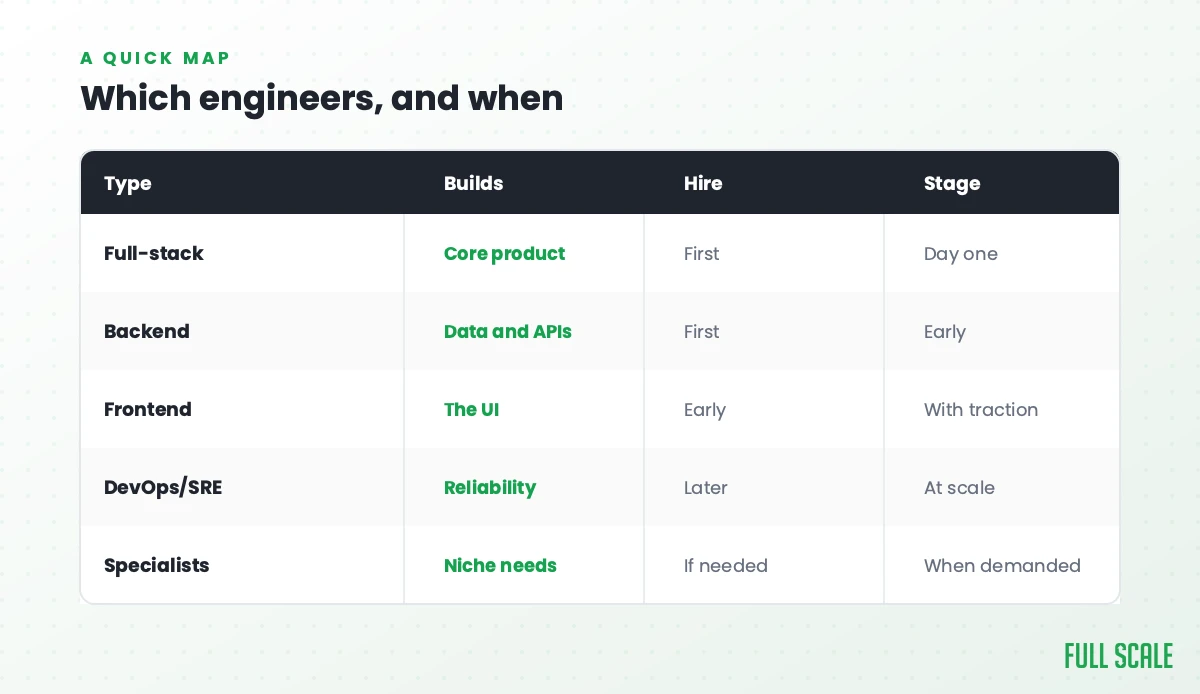
If you only have 30 seconds, this is the shape of it: the main types of software engineering work, and when each one earns a place on your team.
| Tier | Roles | When to hire |
|---|---|---|
| Core product team | Full stack, backend, frontend, mobile | From day one. These build and ship your product. |
| Hire as you grow | QA, DevOps, cloud, SRE, data, security, software architect | Once you have real scale, real traffic, or real risk. Several of these get hired too early. |
| Specialized | AI/ML, embedded, IoT, blockchain, robotics, game | Only when your product is literally about that thing. |
Now the part that matters: why, and how to avoid wasting a hire.
Hire these engineers first: your core product team
These are the people who turn an idea into a working product. If you’re building almost any web or mobile software, your first few hires come from this group.
Full stack engineers
A full stack engineer works on both the front end (what users see) and the back end (the servers, logic, and databases behind it). If you are still sorting out the difference between frontend and backend developers, a full stack engineer is the person who handles both. They can take a feature from the screen to the database and back without a handoff.
For an early-stage company, this is usually your first hire and your best one. A strong generalist who can own a feature end to end is worth more than two specialists who each do half the job and wait on each other. Speed in the early days comes from one person holding the whole picture in their head.
Hire a senior generalist before you hire any specialist. You can add depth later. What you need first is someone who can ship.
Backend engineers
The backend developer builds the server side: the business logic, the database design, the APIs that everything else talks to. They’re responsible for whether your app is fast, correct, and still standing when traffic spikes.
Hire a dedicated backend engineer when the logic gets complicated enough that your generalists are spending most of their time there anyway. Payments, complex data models, integrations with other systems. That’s the signal. You can also hire backend developers on a dedicated basis to add depth without a long local search. If that backend runs on PHP, which MVC framework you build on shapes the hiring pool as much as the architecture does.
Frontend engineers
A frontend engineer builds the part of the product people actually touch. They work in HTML, CSS, and JavaScript frameworks like React or Vue to turn designs into interfaces that feel fast and obvious to use.
Bring one on when the experience becomes something users choose you for. If people stay partly because the product feels good, a dedicated frontend specialist earns their salary. Teams betting on Vue.js for their frontend can hire offshore Vue.js engineers who specialize in component architecture and bring the same product focus that drives interface quality.
Mobile engineers
A mobile developer builds apps for iOS and Android, either with platform-native languages (Swift, Kotlin) or cross-platform frameworks like Flutter and React Native.
The rule here is simple. If your product is a mobile app, this is a day-one hire. If mobile is a secondary channel, a cross-platform engineer can cover both stores until the volume justifies a specialist per platform.
Hire these as you grow, and stop hiring some of them too early
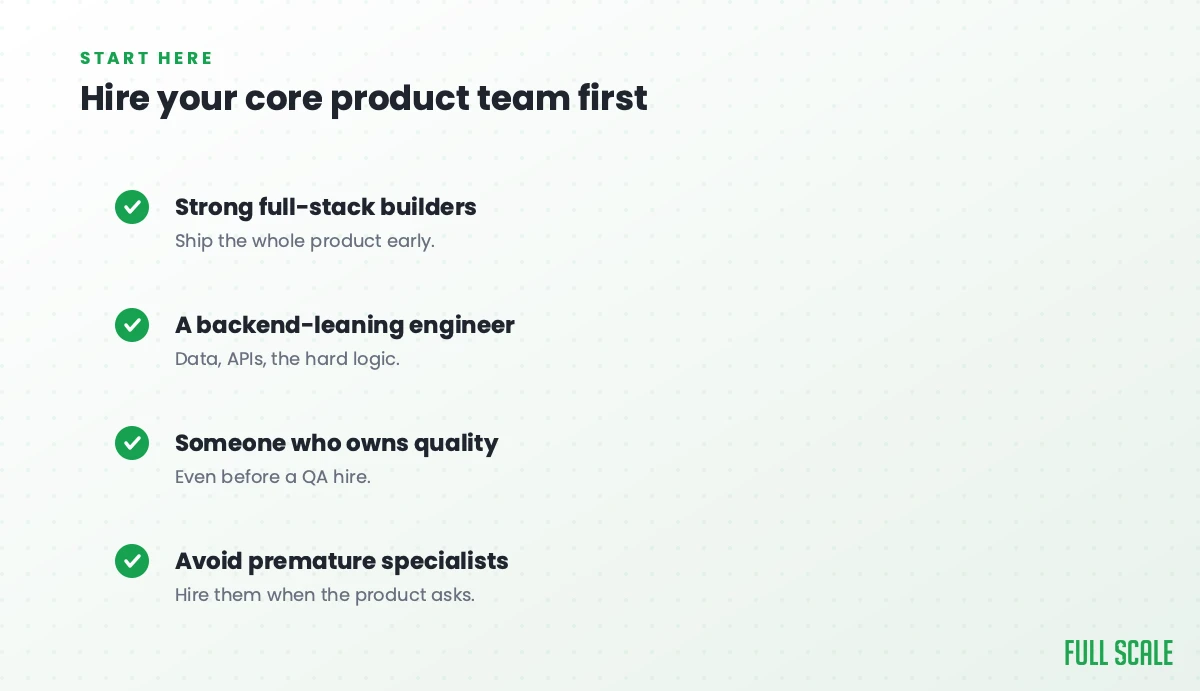
This is the tier where founders waste the most money. Every role below is real and valuable. The mistake is hiring for them before your product has the scale that makes them necessary.
QA engineers
A QA engineer tests your software, builds test automation, and catches bugs before your users do. Good QA is the difference between a release you trust and a release you pray over.
But a dedicated QA hire is one of the most common too-early hires I see. I exited a $150 million company with zero unit tests. I’m not recommending that as a strategy, and I’ve changed my mind on testing since. The point is that quality early on comes from engineers who own their own work, not from standing up a separate QA function before the product is even stable.
Build testing into your engineering team first. Hire dedicated QA when the cost of a bad release gets bigger than the cost of catching it.
DevOps engineers
A DevOps engineer connects how you build software with how you run it. They automate your deployment pipeline so the team can ship reliably and often, the practice known as continuous integration and continuous delivery.
Here’s where I’ll push back on the instinct to hire one immediately. Modern cloud platforms handle an enormous amount of what a dedicated DevOps hire used to do. Keep it simple and boring until you can’t. Most early teams are better off with managed services and one engineer who knows them well than with a full-time DevOps specialist babysitting infrastructure that isn’t under any real load yet.
Cloud engineers
A cloud engineer designs and manages your infrastructure on AWS, Azure, or Google Cloud. They handle scaling, cost, and reliability of the systems your product runs on.
I’ll say it plainly: cloud is someone else’s servers. That’s a feature. It means you can defer hiring a dedicated cloud engineer for a long time, because the platform does most of the heavy lifting. Hire one when your cloud bill or your reliability needs get big enough that someone has to own them full time. That’s usually later than founders assume.
Site reliability engineers
Site reliability engineers (SREs) keep large systems up, fast, and able to handle load. They live in monitoring, alerting, and the gap between “it works on my machine” and “it works for ten million users.”
This is an at-scale role. If you’re asking whether you need an SRE, you almost certainly don’t yet. You need one when downtime starts costing you real money and a real reputation.
Data engineers
A data engineer builds the pipelines that move and store your data so it’s clean, reliable, and ready to use. They’re the foundation under any analytics or machine learning you do later.
Hire one when data becomes something you act on. If you’re making real decisions off your data, or selling insights back to customers, a data engineer is what keeps that foundation trustworthy.
Security engineers
A security engineer protects your applications and data from attack. They handle secure coding practices, penetration testing, and the controls that keep a breach from ending your company.
When you need this depends almost entirely on what you hold. If you’re storing health records, payment data, or anything regulated, security expertise is an early need. For most other early products, it’s a responsibility your senior engineers carry until the risk grows enough to dedicate a role to it.
Software architects
A software architect makes the high-level design decisions: how the system is structured, which technologies it’s built on, how the pieces fit so it can grow.
In a startup, this usually isn’t a separate hire at all. It’s a hat your most senior engineer wears. Naming a dedicated architect before you have a system big enough to need one tends to create diagrams nobody builds from. Let a strong senior engineer own architecture, and add the title when the org is large enough that someone has to coordinate across many teams.
Specialized engineers you hire only when the product demands it
These roles are valuable and, in the right company, essential. The filter is whether your product is genuinely about the thing they specialize in. If it isn’t, you’re hiring a niche skill you’ll struggle to keep busy.
AI and machine learning engineers
AI and machine learning engineers build systems that learn from data: recommendation engines, fraud detection, natural language features, computer vision. They sit at the intersection of software engineering and applied statistics.
Demand for this role is climbing fast, and it’s tempting to hire one because AI is on every roadmap. Resist that unless you have a real machine learning problem and the data to feed it. Bolting an ML engineer onto a product with no clear ML use case is how you end up paying a premium salary for someone with nothing to train.
The rest: embedded, IoT, blockchain, robotics, and game
These are the most specialized engineers on the list, and they’re product-defining when they fit.
Embedded systems engineers write software for devices with limited resources: medical equipment, cars, appliances. IoT engineers connect physical devices to the cloud. Blockchain engineers build decentralized applications. Robotics engineers program machines that act in the physical world. Game developers build games on engines like Unity and Unreal.
You hire these when they are the product. A connected-hardware startup needs embedded and IoT engineers on day one. A SaaS company almost never does. That single question is the test.
How AI is changing which engineers you hire
The roles above aren’t disappearing, but the mix is shifting, and you should hire with that in mind.
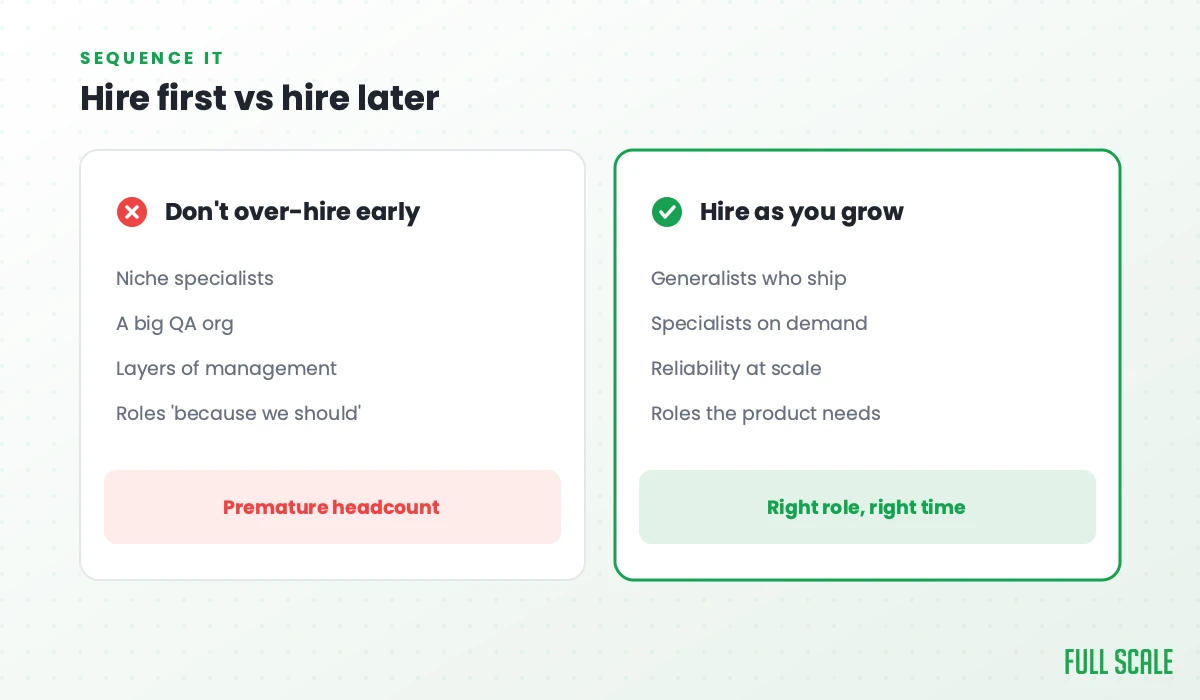
The mechanical part of writing code is getting automated. 84% of developers now use or plan to use AI coding tools, but nearly half don’t trust what those tools produce. That gap is exactly where the value moves: to the engineer who can tell when the AI is wrong. I tell my team that the thing that keeps you safe is curiosity: stay curious about how AI affects your job and how you can use it, and you’ll adapt. The engineers worth hiring now are the ones who understand the problem, not just the syntax.
Pure coders will be replaced by AI. Problem solvers will run technology organizations.
That’s the core of what I argue in my book, Product Driven: as the typing gets cheap, the human skills decide who wins. Communication, curiosity, and courage. When you read a resume now, weight those over the specific framework someone used three years ago. A curious generalist who communicates well will out-earn their cost across every one of these roles.
How to staff these roles without overspending
Knowing which engineers you need is half the problem. The other half is that good ones are expensive and slow to find.
A senior software engineer in the US runs a median base salary around $133,000, with senior engineers landing between $150,000 and $185,000. And base salary isn’t the real number. Once you add benefits, payroll taxes, equipment, and overhead, the fully loaded cost runs about 1.25 to 1.4 times base, which puts a senior US hire near $200,000 a year all in. Multiply that across the tiers above and the math gets heavy fast.
This is why so many companies build their teams globally, and it has little to do with talent scarcity. Roughly 90% of the world’s developers live outside the US, and you can hire excellent ones for a fraction of US rates because the cost of living where they are is lower. There are smart people all over the world.
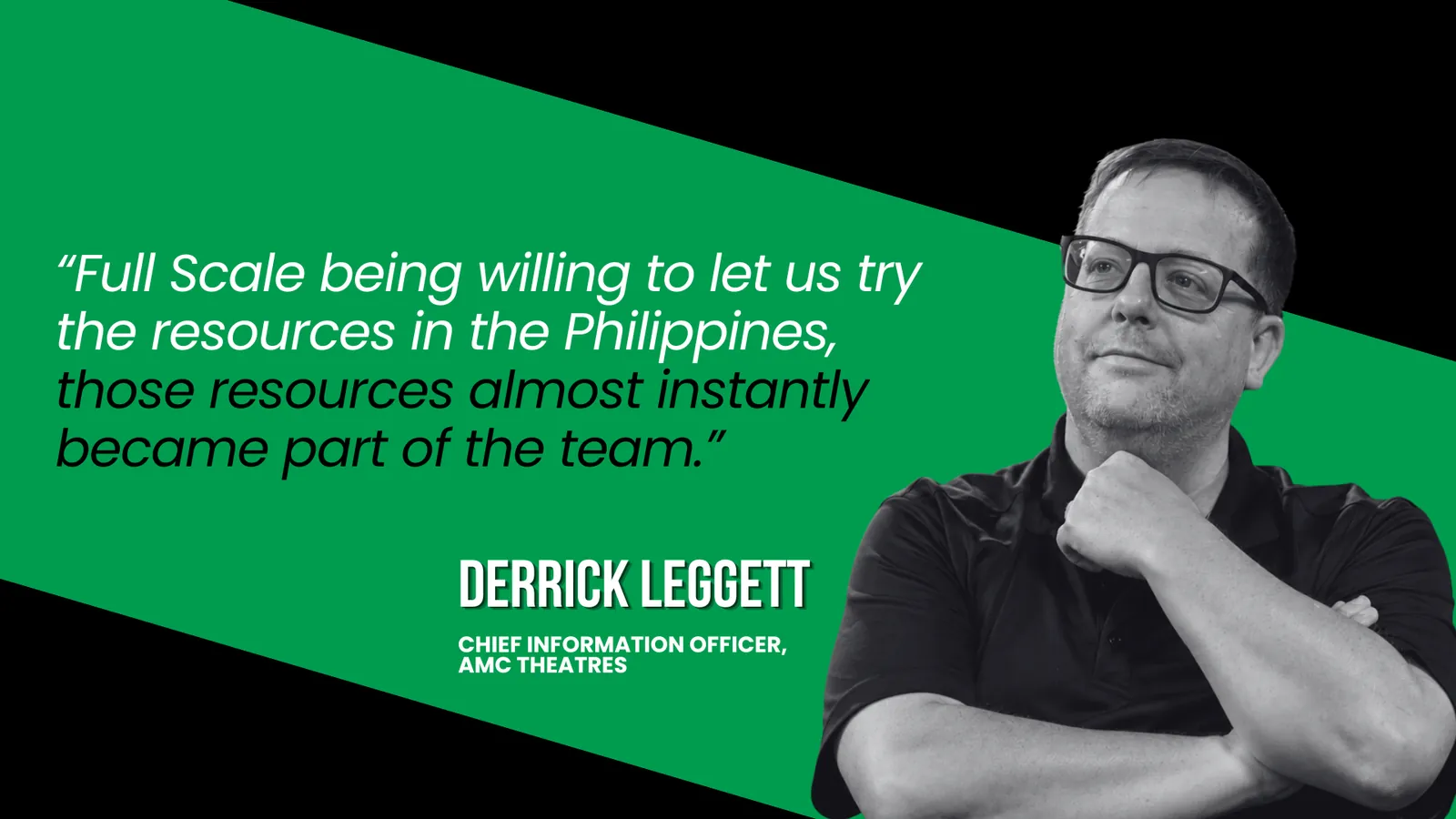
The model I’d argue for is staff augmentation: hiring dedicated engineers who work directly for you on a long-term basis, the way you’d hire locally, instead of handing a spec to a project shop and hoping it comes back right. That’s what we do at Full Scale, and it’s how a company like AMC Theatres runs Filipino engineers as full members of its team. Their CIO, Derrick Leggett, put it better than I can: “It’s a fully integrated team. It’s just some of the people happen to be living in the Philippines.” If your team works well remotely, it’ll work well globally too.
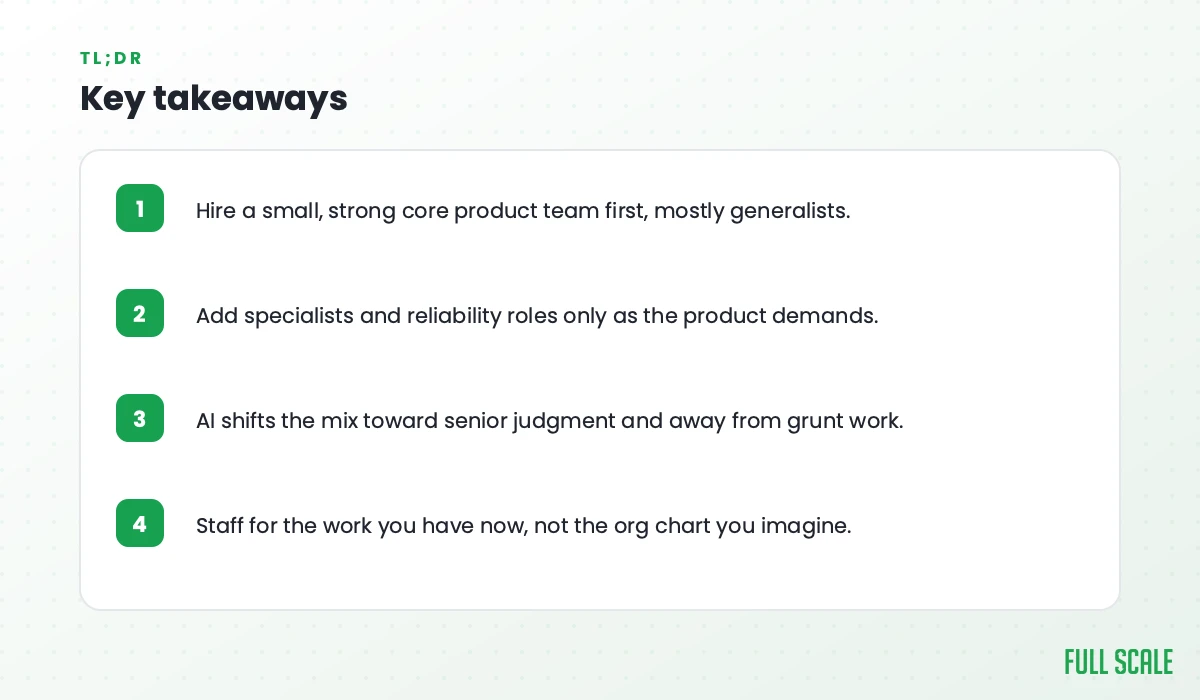
Whether you hire locally or augment your team with offshore engineers, the discipline is the same. Hire the core roles first, resist the specialized ones until the product calls for them, and weight every hire toward people who can think, not just type.
Frequently asked questions
What are the main types and areas of software engineering?
The most common types are full stack, backend, frontend, and mobile engineers, who build the product itself, followed by QA, DevOps, cloud, site reliability, data, and security engineers, who support and scale it. Beyond those sit specialized roles like AI/ML, embedded, IoT, blockchain, robotics, and game developers that you hire only when your product centers on that technology.
Which type of software engineer should I hire first?
For most early-stage products, hire a senior full stack engineer first. A strong generalist who can work across the front end and back end lets you ship features end to end without handoffs, which matters far more than specialization when you’re small. Add specialists once the product and team grow enough to keep them busy.
How many types of software engineers are there?
There’s no fixed number, and lists range from about 10 to 25 depending on how finely you split roles. What matters for hiring isn’t the count but the grouping: a handful of core building roles, a set of scaling and support roles, and a tier of specialized roles tied to specific products.
Do I really need a DevOps or cloud engineer early on?
Usually not. Modern managed cloud services handle most of what a dedicated DevOps or cloud engineer used to do by hand. Most early teams are better served by one engineer who knows those services well than by a full-time infrastructure specialist. Hire the dedicated role when your scale, cost, or reliability needs grow big enough that someone has to own them full time.
What’s the difference between a software engineer and a software architect?
A software engineer builds the software. A software architect makes the high-level design decisions about how the whole system is structured and which technologies it uses. In a startup, architecture is usually owned by your most senior engineer rather than a separate hire, and the dedicated architect role appears only when the organization is large enough to need someone coordinating design across many teams.
Ready to add the right engineers to your team?
You don’t have to figure out the hiring sequence alone, or pay US rates to get senior talent. Full Scale places vetted, senior engineers across every role on this list, working as dedicated members of your team. Book a 15-minute discovery call and we’ll talk through which engineers your roadmap actually needs.