
How to Hire a Developer When You're Not Technical

In this article
- How to hire a developer when you're not technical starts with the first two weeks
- Define the job as results you can see before you sign
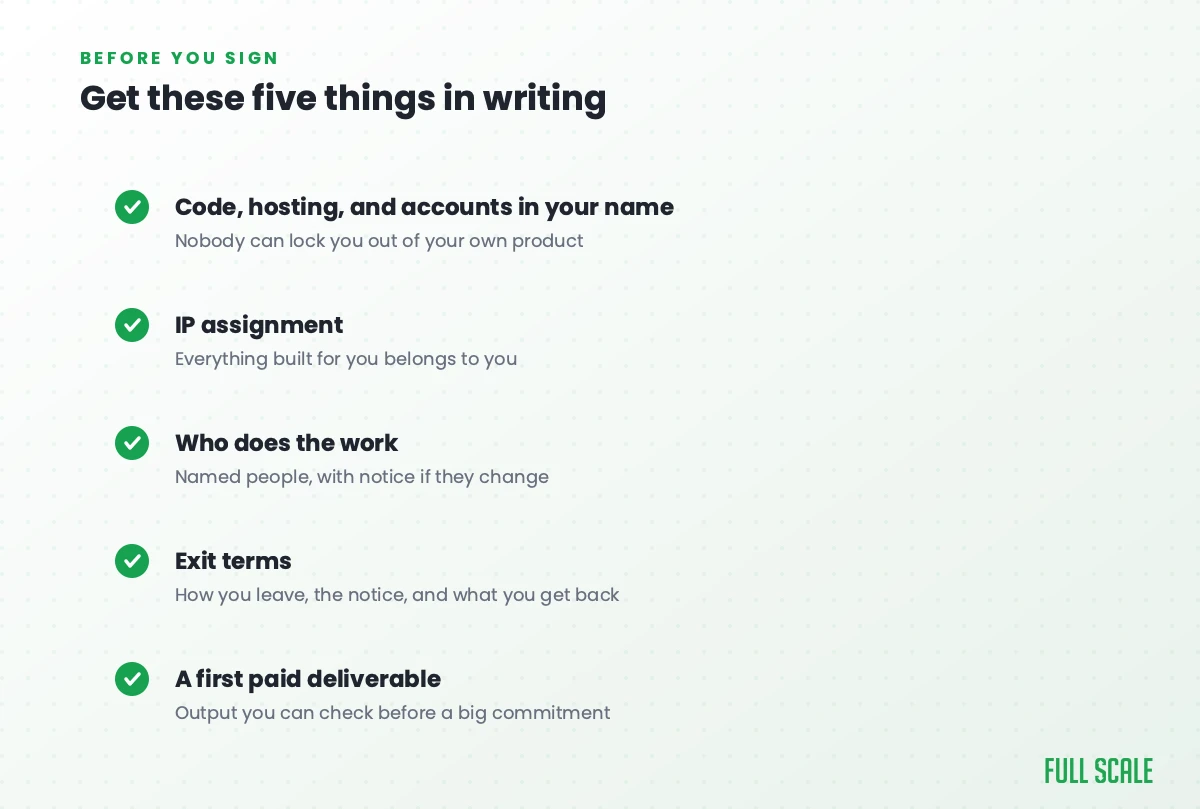
- Get these five things in writing before you sign
- Vetting without reading code: what the interview can and can't tell you
- What to watch in the first two weeks
- What the first two weeks can't tell you
- How to evaluate a developer's work when AI wrote half of it
- Hiring offshore developers when you're not technical: what changes in week one
- What to do at the end of week two
- Frequently asked questions
- Hire developers you can check on in week one
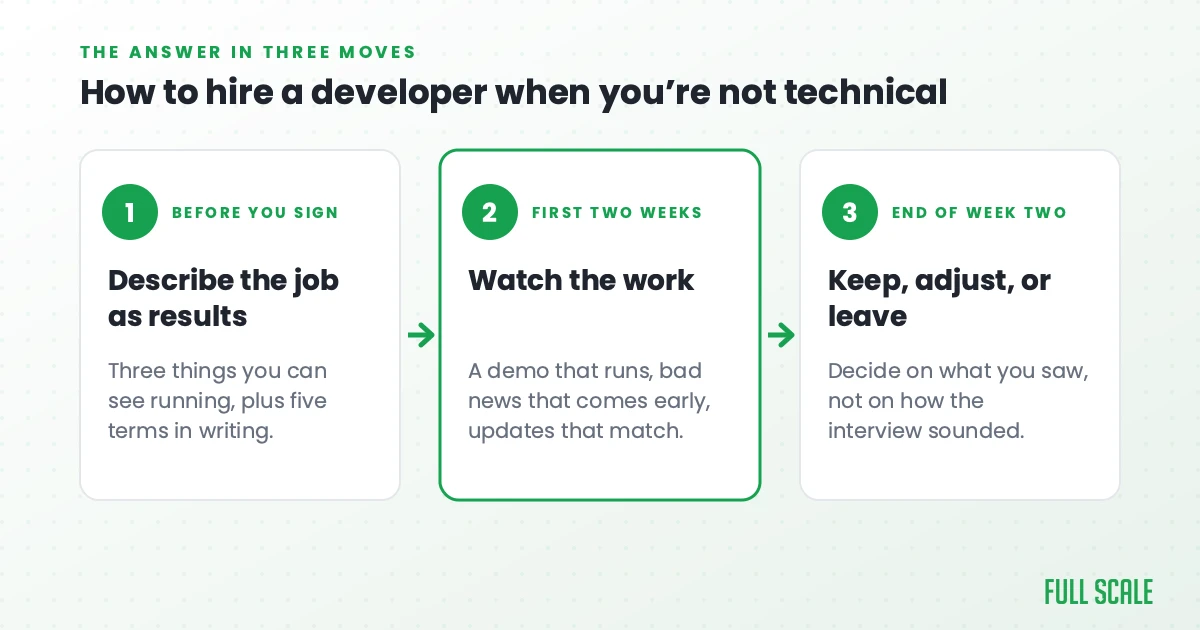
Quick Answer: How to hire a developer when you're not technical comes down to two moves: describe the job as results you can see running, then treat your first two weeks of working together as the real test, since a one-hour interview only shows how someone talks about work. Watch for a working demo, plain written updates that match what runs, and early questions. Full Scale's two-week money-back guarantee covers that stretch.
How to hire a developer when you're not technical starts with the first two weeks
You can't grade code you can't read, so watch what a new developer does once real work starts. A polished talker and a quietly excellent builder sound identical in a one-hour call, which is why an interview can only screen people out.
The first two weeks decide who stays.
I run Full Scale, which places developers, so I'm not neutral about where you find one. I co-founded VinSolutions, which was acquired, and I've hired and managed engineers for 20+ years. The checks below work with any developer, from any source.
Before you sign, you describe the job and get five things in writing. After you sign, you watch a short list of signals and decide whether to keep the developer, adjust, or leave.
Define the job as results you can see before you sign
A job title describes a person. "Full-stack developer" tells a candidate nothing about what you want built, and it gives you nothing to measure them against later.
Write the job as three answers instead:
- What should a customer be able to do by the end of the first month?
- What should you be able to click through by the end of the first week?
- Who decides when a piece of work is done?
Say your product is an invoicing tool. Your first-month answer is "A customer can create an account, upload an invoice, and see it in a list." Now every status update has something to be checked against.
The third answer matters most, and it has to be a named person. Whoever it is will sign off on finished work and turn down requests that don't belong in the first version. That can be you if you know your customers. If nobody on your side can do it yet, a new developer won't fix that, and the non-technical founder guide covers who can fill the gap.
Get these five things in writing before you sign
Each of these costs nothing to ask for before the contract and a lot to fight about after it. The contract terms that matter explain the clauses in more depth.
- Code, hosting, and accounts in your name. Your code repository, cloud hosting, and domain accounts belong to your company from day one, with the developer added as a user, so nobody can lock you out of your own product.
- IP assignment. A signed clause says everything built for you belongs to you.
- Who does the work. The contract names the people writing your code and requires notice if they change.
- Exit terms. It states how you leave, how much notice you give, and what you get back.
- A first paid deliverable. A small piece of work with a clear definition of done, paid for on its own, shows you output before you commit to a large engagement.
Hiring a freelancer or a direct hire with no money-back clause? Make item five a small paid task and pay weekly, so leaving stays cheap.
Vetting without reading code: what the interview can and can't tell you
Lean on someone who has seen the person's work. An engineer who reviewed their code, or a company that answers for the result, will tell you more than the candidate can. The startup hiring post walks through those options. You should still talk to whoever you're hiring. At Full Scale you can talk to an engineer before you commit, and that call works as a first filter, never a verdict.
What to watch in the first two weeks
A working demo, bad news that arrives before you ask, and written updates that match the product are the signals that matter most. At Full Scale, our engineer screening rubric is derived from analyzing real client interviews, and it scores behaviors like whether the engineer writes clearly, flags blockers early, delivers what they committed to, and checks what the AI hands them. The table below is a buyer's version of those behaviors, listed as things you can see in the first two weeks without reading code.
| What the developer does in the first two weeks | What it usually means | What you do |
|---|---|---|
| Asks for access and context in the first couple of days | Plans to own the work | Give access the same day |
| Asks what done looks like for the first ticket | Cares about scope | Answer in writing |
| Has something small running where you can click it before the first week is over | Real progress | Click through it yourself |
| Ships changes in small pieces most days | Steady work that is easy to check | Ask for a weekly list of what shipped, in plain English |
| Shows only screenshots, or says "almost there" for days | Nothing is running yet | Ask for a live demo within two working days |
| Tells you about a blocker before you ask | Healthy communication | Thank them, and mean it |
| Lets you learn about a delay from someone else | A delivery risk | Raise it in writing right away |
| Sends short, plain updates that match what you can run | Honest reporting | Ask for the same format every week |
| Gives a different answer when asked to walk through the same change a day later | May not understand what the AI wrote for them | Ask for a walkthrough of one change and what they edited from the AI's first draft |
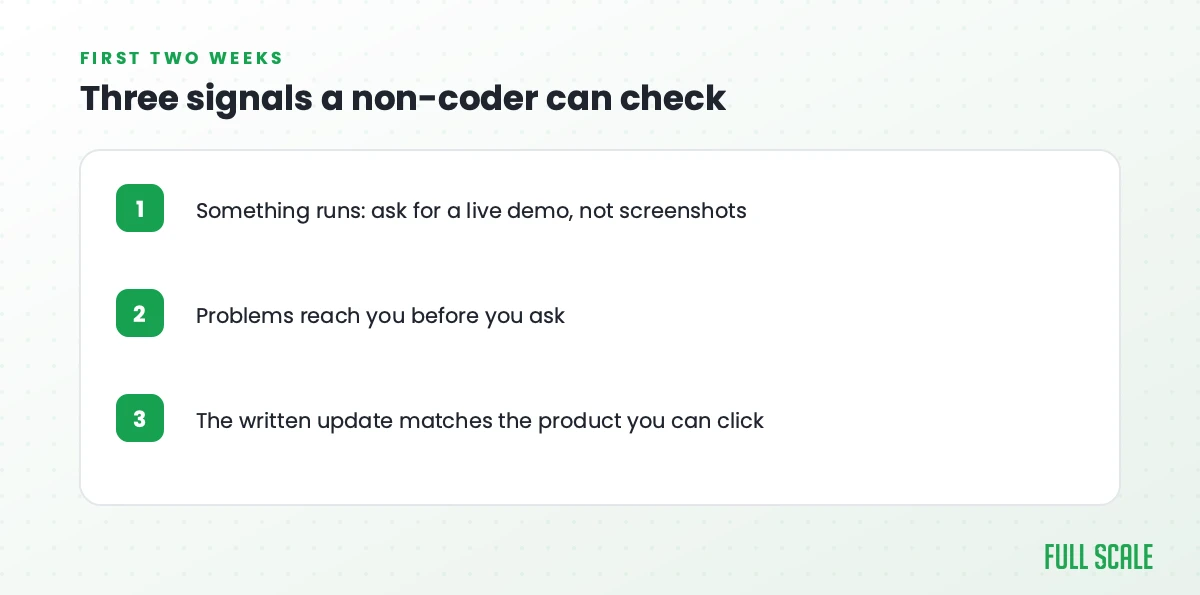
Three signals are the easiest for a non-coder to check.
Something runs. A working demo in the first week, even a tiny one, beats confident talk. Ask them to share their screen and click through it with you, because a demo made of screenshots is a painting of a car. If "almost there" is the whole update for a week, treat it as a sign that nothing is running yet. If your work is back-end or infrastructure, there may be nothing to click, so ask to see the output live instead, such as an API call or a report. Weeks one and two include setup, so judge the trend across both weeks, and don't count a miss that your own slow access caused.
Problems reach you before you ask. Communication is where this shows first, and the earliest sign of a good hire is who tells you about a problem. A developer who surfaces a blocker on day four is cheaper than one who surfaces it on day twenty. Ask for risks in every update, and react well the first time you get bad news, or you won't get it again.
The written update matches the thing you can click. Read the update, then open the product. When the two agree, you can trust the next update a little more. When they come apart, you've learned something no interview would have shown you.
The tech lead's side of these two weeks, the access setup and the first merged change, is in the developer onboarding guide. You're the person watching from the outside.
What the first two weeks can't tell you
A polished developer can pass every row in that table and still ship fragile code. Five things slip through:
- A demo can be staged. A mocked-up screen looks live in a quick click-through, so ask them to change one small thing while you watch it update.
- Written updates are easy to polish now that AI can smooth any paragraph. When the prose and the product disagree, believe the product.
- Shortcuts that work today and break in month six look identical to good work in week two.
- A missing signal is a prompt to ask. Before you judge, say what you expected to see and listen to the answer, because sometimes the cause is your access or an unclear ticket.
- Around day 30, pay an experienced engineer for a few hours to read the code and check the setup. That review costs little next to a rebuild.
How to evaluate a developer's work when AI wrote half of it
Many developers use AI tools now, so you will be evaluating work that an AI helped write. That's fine, and it changes what you ask.
You usually can't tell whether someone used AI, and you shouldn't care. What you can check is whether they stand behind the result. Four questions work without reading a line of code:
- Walk me through one change. Ask what the AI gave them first and what they edited. A developer who owns the work has an answer.
- What did the AI get wrong this week? "Nothing" means they either aren't looking or aren't telling you.
- Can I click it? Passing tests are a start, and something running where you can see it is proof you can actually judge.
- Who looks at your work before it reaches me? A second set of eyes is one of the cheapest forms of quality control.
At Full Scale, we screen for whether an engineer uses AI with a validation step and can describe a case where it was wrong. How we assess developers now goes into how.
The evidence backs this up. Developers are wary of AI output themselves: in Stack Overflow's 2025 developer survey, about two-thirds of respondents called AI answers that are "almost right, but not quite" a frustration.
A vendor study found a gap too. CodeRabbit, which sells AI code review, compared 470 open-source pull requests and found the AI-co-authored ones averaged 10.83 issues each against 6.45 for human-only ones. Its authors say they couldn't confirm every "human-only" pull request had no AI help, so treat it as a hint.
Hiring teams test for it as well. In CoderPad's 2026 State of Tech Hiring report, a vendor survey of about 650 participants, 66% named catching and fixing AI mistakes as a signal of real skill when AI is allowed.
The 2025 DORA report on AI-assisted software development says it plainly. AI is "an amplifier, magnifying an organization's existing strengths and weaknesses." A careful developer gets faster, and a careless one just gets careless faster. Anyone who says a non-technical founder can build the whole product with AI alone has probably never explained an outage to a customer.
Hiring offshore developers when you're not technical: what changes in week one
An offshore hire is usually several time zones away, so the first-two-weeks signals matter more and three checks get added.
First, agree on a few hours each day when you're both online, so a question you ask in the morning gets answered that day. If you're hiring developers in the Philippines, raise it in the first conversation.
Second, ask for a short written update every day. With no hallway time, the written update is how you see the work.
Third, confirm the person who starts is the person you interviewed, using the identity checks in how to interview offshore developers, before and after the start date.
Before you sign, also ask whether you can message the engineer who writes your code. If every question goes through an account manager, a problem has to survive two retellings before it reaches you, and that handoff is where offshore communication breaks down.
Choosing on the lowest rate is a separate mistake, one I call cheapshoring. A low rate with none of these signals gets expensive fast.
What to do at the end of week two
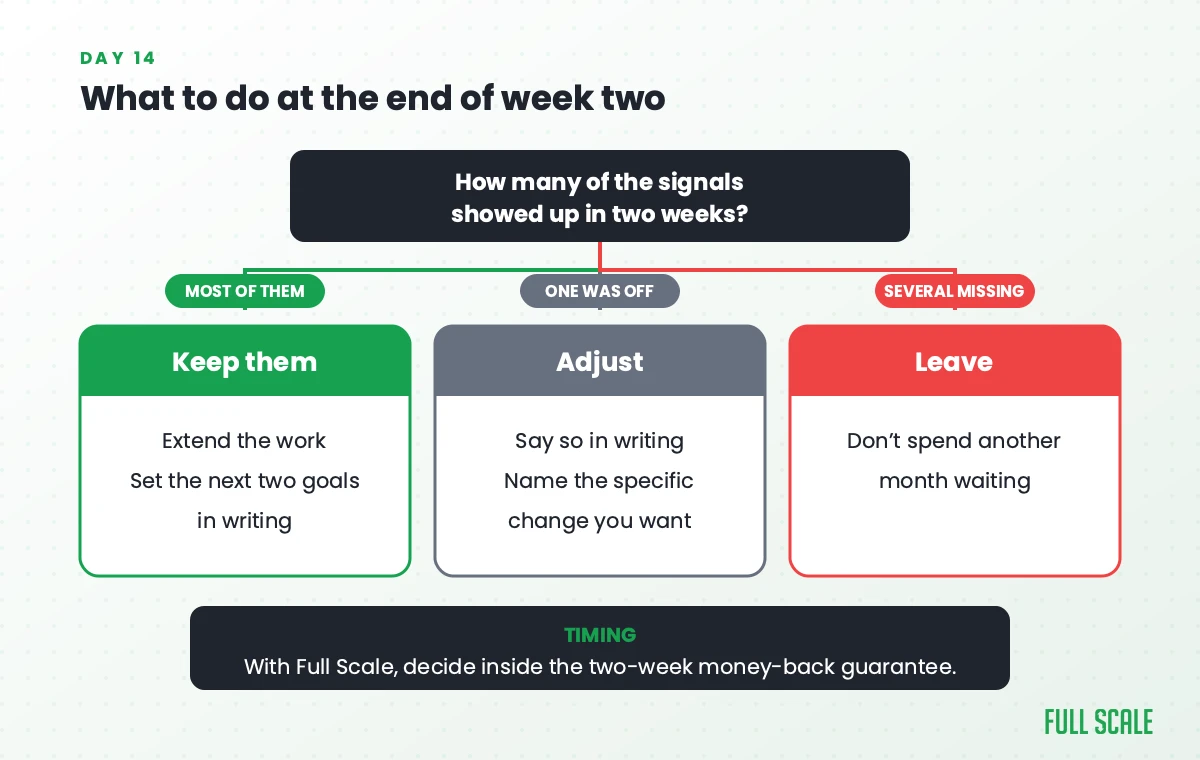
By the end of the second week you'll have seen enough to decide, and there are three outcomes. With Full Scale, make the call inside the two-week money-back guarantee, since leaving after that means serving notice and getting no refund.
- If the signals showed up, keep them, extend the work, and set the next two goals in writing.
- If one thing was off, like slow updates or a vague demo, say so in writing with the specific change you want.
- If several signals were missing, leave rather than spend another month waiting.
Those are Full Scale's terms. If it isn't working out within the first two weeks, a client gets their money back, and after that a developer can be dropped with 30 days' notice and no long-term contract. We don't offer a replacement guarantee. When it isn't working out explains why.
Read the exit terms before you pay the first invoice. They tell you more than a pitch does.
Frequently asked questions
How do I hire a programmer if I can't code?
Describe the job as results you can see running, lean on someone who has seen the person's work (an engineer's referral, a technical advisor, or a company that answers for the result), and then let the first two weeks of actual work do the judging. You can't grade code you can't read, but you can tell whether something runs, whether bad news reaches you early, and whether the written updates match what you see.
Can I hire a developer with no technical experience of my own?
A person with no technical background can hire a developer, as long as one person on your side signs off on finished work and turns down requests that don't belong in the first version. That can be you if you know your customers well. If you can't judge the answers you get, a fractional CTO can review the work for you while you keep talking to the developer directly, and the non-technical founder guide covers when that makes sense.
How do I know if a developer is good if I don't understand code?
To tell whether a developer is good without understanding code, watch behavior instead of code. A good developer asks for context early, shows you something that actually runs in the first week, tells you about a problem before you find it, and explains a change in plain English. If several of those are missing after two weeks, you have no reason to keep paying.
How long does it take to know if a developer is working out?
Two weeks is enough to see the early signals, though not enough to know how good a developer will be a year from now. Full Scale's two-week money-back guarantee covers that stretch, and the exit after it is 30 days' notice with no long-term contract.
Is AI-written code a red flag?
AI-written code is not a red flag, since many developers use AI tools now. The red flag is a developer who can't explain what the AI produced, can't name one thing it got wrong this week, or ships code that nobody else has reviewed. Ask for a walkthrough of one change and what they edited from the AI's first answer.
How do I evaluate an offshore developer when I'm not technical?
To evaluate an offshore developer without technical knowledge, use the first-two-weeks signals (a working demo, bad news that arrives early, written updates that match the product) and add three offshore checks: a few hours each day when you are both online, a short written update every day, and confirmation that the person who starts is the person you interviewed. Before you sign, also ask whether you can message the engineer who writes your code, because answers that pass through an account manager reach you late.
Hire developers you can check on in week one
Full Scale places engineers through staff augmentation, and you can interview every one of them first. If you want a hire you can watch from day one, with a two-week money-back guarantee behind it, schedule a call.