
The Real Challenges in Offshore Recruitment in Another Country

In this article
- You don’t actually know what people earn there
- Every country is different, and you can’t read one you don’t live in
- The best people aren’t looking for a job
- The best people won’t take a freelance gig
- Even when you land someone, keeping them is the next fight
- Why Upwork and one-off freelancers break down
- How to recruit offshore without flying blind
- Frequently asked questions
I talk to engineering leaders every week who tell me their offshore developers aren’t very good. The first thing I ask is what they pay. The number that comes back is usually 50 to 100 percent above the local market rate for that country.
So they’re overpaying and unhappy at the same time. That’s not a talent problem, it’s a market problem.
Here’s the thing most advice on offshore recruitment skips right over. Recruiting gets harder when the evaluation step is weak, so I explained why technical interviews don’t work and what to do instead.
You can’t recruit well in a country whose job market you can’t read.
I’ve hired developers in four countries: Russia, Uruguay, Colombia, and the Philippines, going back to my Stackify days. I run Full Scale, which has 350+ employees in the Philippines today. And I’ll still tell you straight up that the hardest part of offshore recruitment was never finding people who could code. It was everything I couldn’t see from the outside: what people actually earn, how to judge them, what they want from a job, and how to keep them once they say yes. Part of how we solved that was launching a university partnership program that builds a pipeline straight from Cebu’s top schools.
These are the challenges in offshore recruitment that the generic checklists never get to. Here are the ones that actually cost you. Domestically, many teams turn to recruitment agencies for software developers, which solves sourcing but leaves you owning retention.
You don’t actually know what people earn there
When you hire in your own country, you have a gut sense for pay. You know a number that’s insulting, a number that’s fair, and a number that means you got fleeced. You lose all of that the moment you cross a border.
A good Filipino software developer earns somewhere around $15 to $30 an hour locally, depending on experience. That’s a strong, professional wage there. To put it in perspective, my brother-in-law in the Philippines works at Jollibee, the country’s biggest fast food chain, for about $1.25 an hour. My sister-in-law works as a virtual assistant for around $5 an hour. A senior engineering salary is life-changing money in that context.
Now compare that to the US median software developer salary of about $133,000 a year, before you even add benefits and overhead. You can hire developers in the Philippines for 50 to 70 percent less than US rates. But here’s the trap: when you don’t know the local number, you guess high to feel safe, and a high guess doesn’t buy you better people. It just tells the market you don’t know what you’re doing.
Pay also swings hard by region inside a country, and foreigners almost never see it. A developer in Southern California makes 40 to 50 percent more than one doing the same work in Kansas City, where I live. The same gap exists in India between the big tech hubs and everywhere else, and in the Philippines between Manila and the provinces. Knowing those dynamics can change an offer by a huge margin.
It’s nearly impossible to know any of this as an outsider. That’s the first challenge, and it’s the one that quietly costs the most.
Every country is different, and you can’t read one you don’t live in
Interviewing someone is one skill. Judging them inside the norms of their own country is a completely different one.
A software developer from the Philippines looks, communicates, and carries themselves differently than one from the United States, Pakistan, or Poland. Neither is better or worse, they’re just different in communication style, personality, and the way they handle disagreement or admit when they’re stuck. If you judge every candidate against the American engineer in your head, you’ll pass on great people and hire the wrong ones. Your whole software developer hiring process has to flex to the country you’re hiring in.
The operational norms differ just as much, and they’ll bite you in ways you never expected. I’ve heard story after story about hiring in India, where 30, 60, and 90 day notice periods are normal. Once a candidate has your offer locked in, a lot of them keep interviewing to find an even better one, because they know they’ve got you waiting. You sit there for two or three months expecting someone to start, and a big share of the time they take another job instead. People will switch for an extra couple of dollars. It’s madness when you’re on the other end of it.
I don’t see those same problems in the Philippines. People there tend to be far more loyal to an employer. That isn’t a knock on anyone. The markets are simply that different from one country to the next.
Here’s the honest part. I’ve hired in four countries and I still wouldn’t have the first clue how to recruit a developer in Uruguay or Vietnam from scratch today. Nobody can read every market. That’s the real argument for working with a local offshore development company that already knows the country, the culture, and the norms. You either spend a year becoming an expert in a foreign labor market, or you find a partner who already is one. If Vietnam is on your shortlist next to the Philippines, our philippines vs vietnam outsourcing comparison walks through what actually differs.
One more thing to watch for. At a lot of offshore shops, you only ever talk to one technical project manager, and every other developer hides behind that person. Sometimes it’s an English gap, sometimes it’s a cultural rule about who speaks to the client. Either way, you can’t judge a team you’re not allowed to talk to. It’s one of the quieter offshore software development challenges, and it’s a real one.
The best people aren’t looking for a job
This is the challenge nobody puts on their list, and it’s the one I’d most want you to remember.
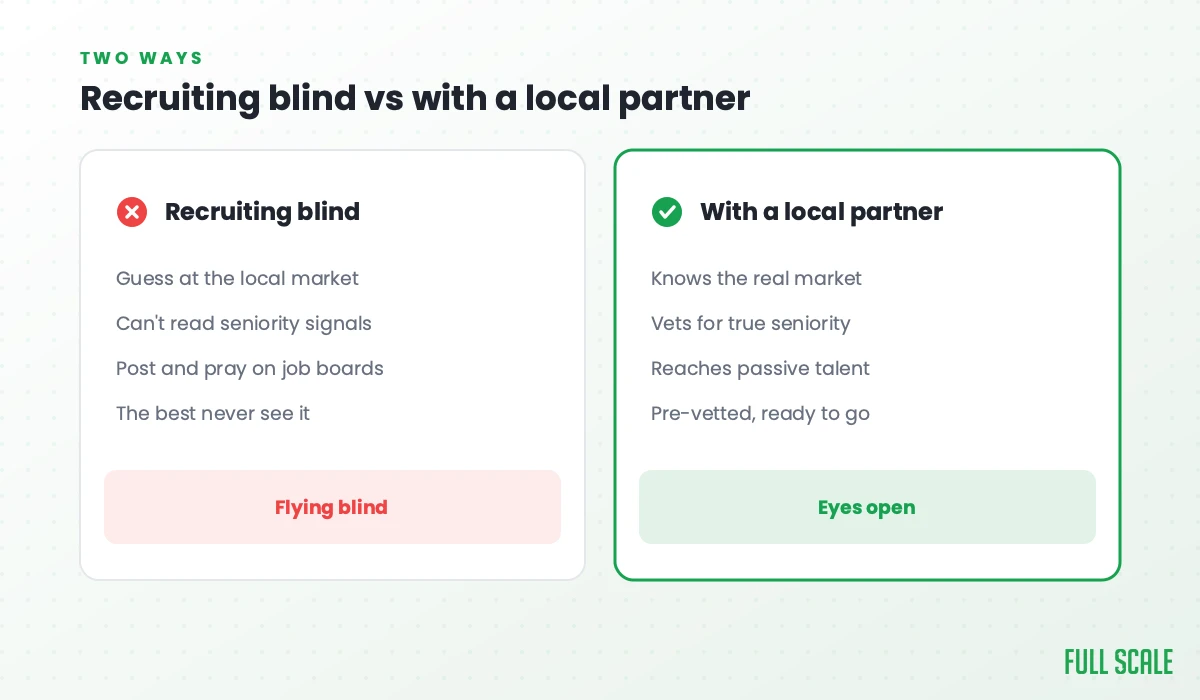
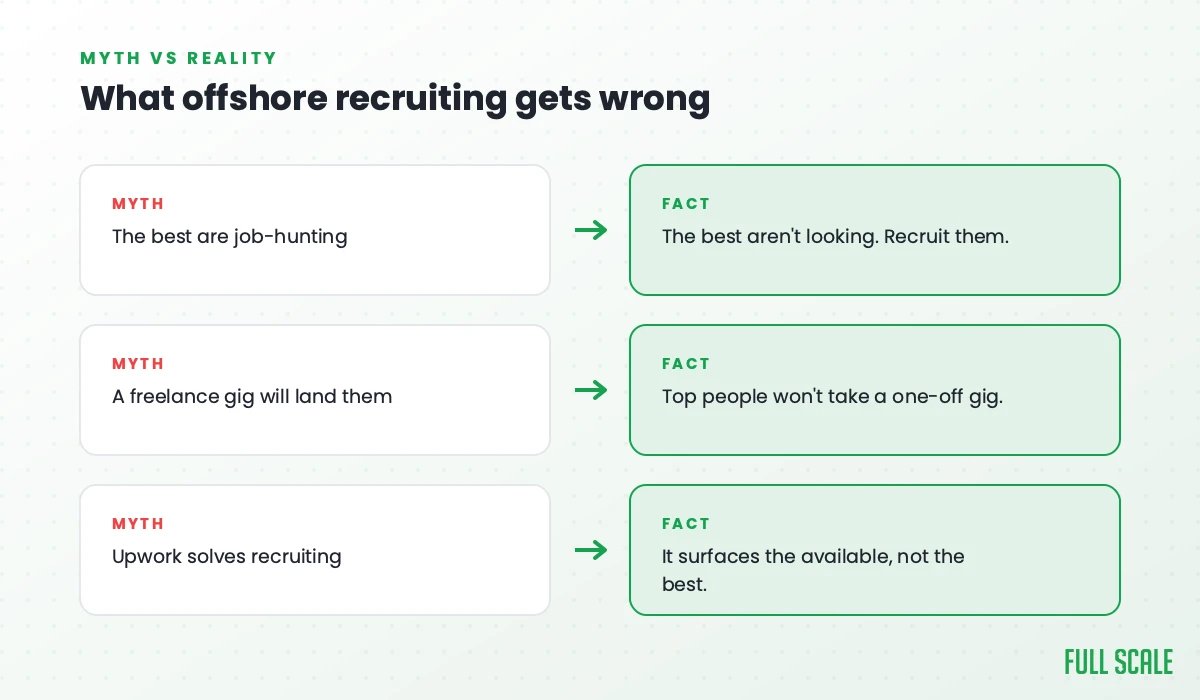
Really good developers almost always already have a job. They don’t sit around unemployed, sending out resumes. They get recruited away to the next company before they ever hit the open market. There are plenty of good people who are actively applying, and you can find them. But the strongest engineers are usually working somewhere right now, and somebody is already trying to poach them. It’s the main reason a single in-house recruiter rarely fills senior engineering seats on its own.
The developers you most want to hire are not the ones sending you a resume.
So hiring technical talent offshore is less about sorting through applicants and more about reaching people who aren’t applying at all. That takes muscle most companies simply don’t have in a country where they have no presence, no network, and no name recognition.
This is where having people on the ground changes everything. Full Scale has 350+ employees in the Philippines, and they all know other strong developers. Referrals from people who already work for you are worth their weight in gold, because your best engineers know who the other good engineers are. A solo recruiter working a foreign market from a laptop halfway around the world has none of that.
If your entire pipeline is people who found your job post and applied from afar, you’re fishing in the wrong pond.
The best people won’t take a freelance gig
Even when you find someone great, you have to convince them to take the job. And the kind of job you can offer from across the world is usually not the kind the best people want.
When you recruit a random person in another country and pay them directly, they’re basically a freelancer, a 1099 contractor in US terms. All the risk sits on them. They get no benefits, no protection, and no guarantee the work lasts past this month. Some developers are fine with that, because they think they’ll make more money jumping from gig to gig. But just like in the United States, a lot of strong people want the security of a real job. They want to be a W-2 employee, not a contractor scrambling for the next thing.
That’s a big part of why we built Full Scale the way we did, around dedicated teams in a staff augmentation model instead of one-off contractors. Our developers go through full local labor law. They get real benefits. They become what’s called a regularized employee in the Philippines, which gives them protections like separation pay if we ever let them go. And if one of our clients no longer needs a developer, that person usually stays employed with us. We move them to another client or keep them on our bench. They don’t get thrown out on the street because one engagement ended.
The security you can offer decides the caliber of tech talent you can attract. If all you’ve got is freelance risk, you’re recruiting from the slice of the market that’s okay with freelance risk, and that’s rarely where the best people are.
Even when you land someone, keeping them is the next fight
Recruiting doesn’t end when someone signs. If you can’t keep people, you’re just going to be recruiting again in six months, from zero.
Here’s what happens with a lone developer you hired directly in another country. Someone offers them a dollar an hour more, and they jump. Why wouldn’t they? There’s no relationship holding them, no career path, no reason to be loyal to a company they’ve never visited and barely know. They’re just trying to make more money, and I don’t blame them.
Our developer retention at Full Scale is about 93 percent. Plenty of our people have been with us for more than five years and treat it as a real career, not a stepping stone. That doesn’t happen by accident. We have a real presence in the Philippines, and we put serious work into training, mentoring, and employee engagement. We’re Great Place to Work Certified there, with 95 percent of our employees saying it’s a great place to work, against 65 percent at a typical company in the Philippines.
For context on how hard that is, voluntary attrition in the Philippine call center and outsourcing industry has run around 30 percent or higher in recent years. Keeping people is not the default. You have to earn it.
Retention is the recruitment cost nobody budgets for. Every developer who walks resets you to the beginning.
Why Upwork and one-off freelancers break down
A lot of the people who come to us got burned somewhere first, and that somewhere is often Upwork or a similar marketplace.
The pattern is always the same. You find a random freelancer. Sometimes they’re great. Sometimes they vanish mid-project or turn in work you have to redo. You get all the headaches of managing a freelancer, plus the distance, plus the time zones, plus the fact that you still can’t tell a good local rate from a bad one. It works often enough to keep you trying and fails often enough to wear you down. The marketplace isn’t the only expensive dead end, either. Plenty of people also try local IT recruiters, who can charge up to six months of a developer’s salary for a single placement.
But the deeper issue is that hiring a couple of freelancers is a completely different thing from building a team. They’re separate problems. Freelancers are fine for a small, scoped project with a clear finish line. They are a terrible way to build the ongoing engineering capacity a product company actually needs.
What I see over and over is people grinding through the freelancer route until they’re exhausted by it, and then coming to a partner and saying some version of: I’m done dealing with this, I just want someone I trust to help me find and build the team I need, and to help me fix it when something breaks. That’s the moment the headache turns into a relationship. It’s the same idea I wrote about in Product Driven: the work that matters is building something durable, not stacking up quick wins that fall apart.
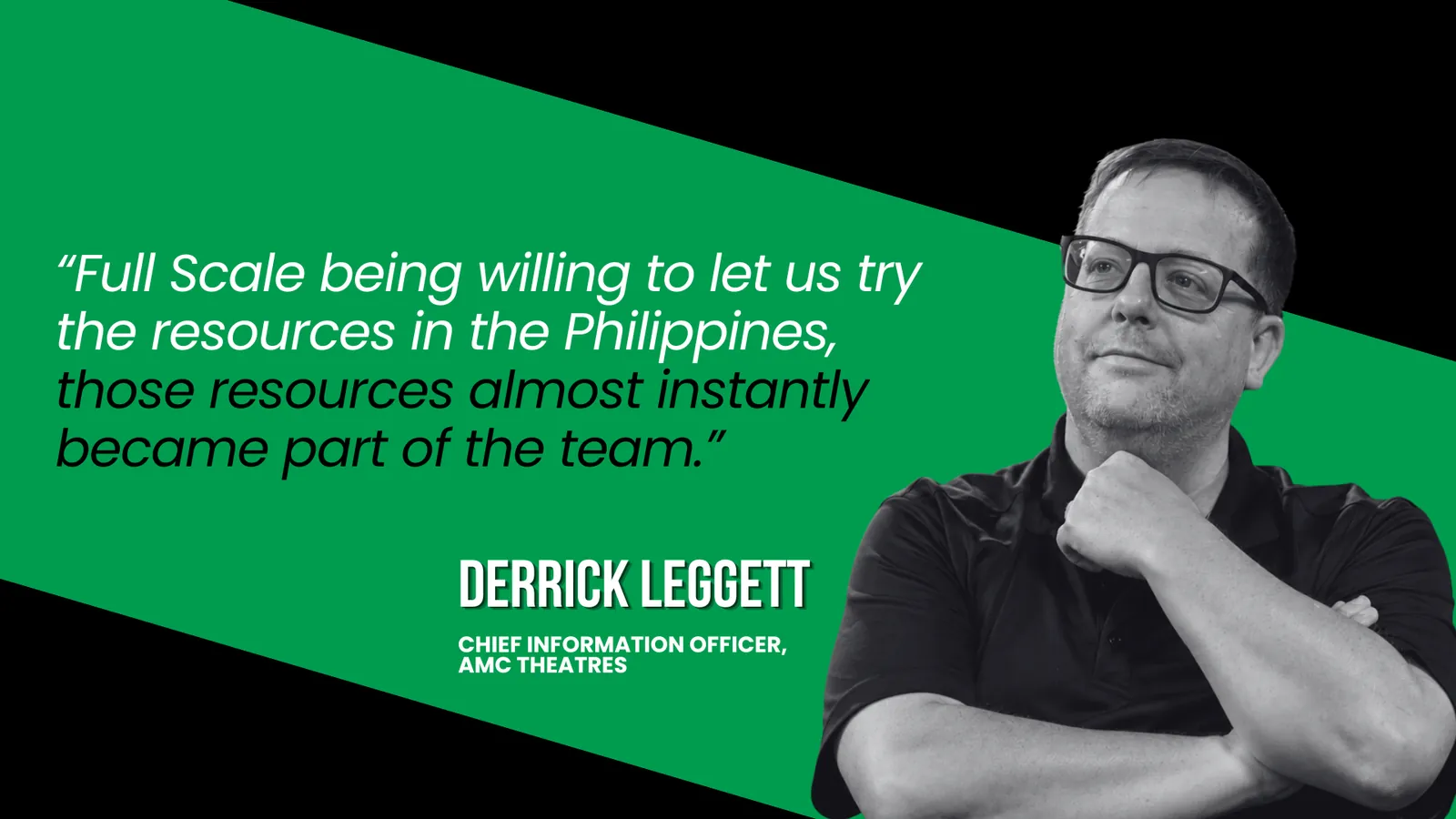
When it works, the offshore line on the org chart disappears. AMC Theatres has built its engineering org this way, with our Philippine developers treated as full members of the team. As their CIO, Derrick Leggett, puts it: “It’s a fully integrated team. It’s just some of the people happen to be living in the Philippines.” That’s the goal, and it’s the opposite of a freelancer you found last week.
How to recruit offshore without flying blind
If you’re going to recruit in another country, here’s the short version of what actually helps.
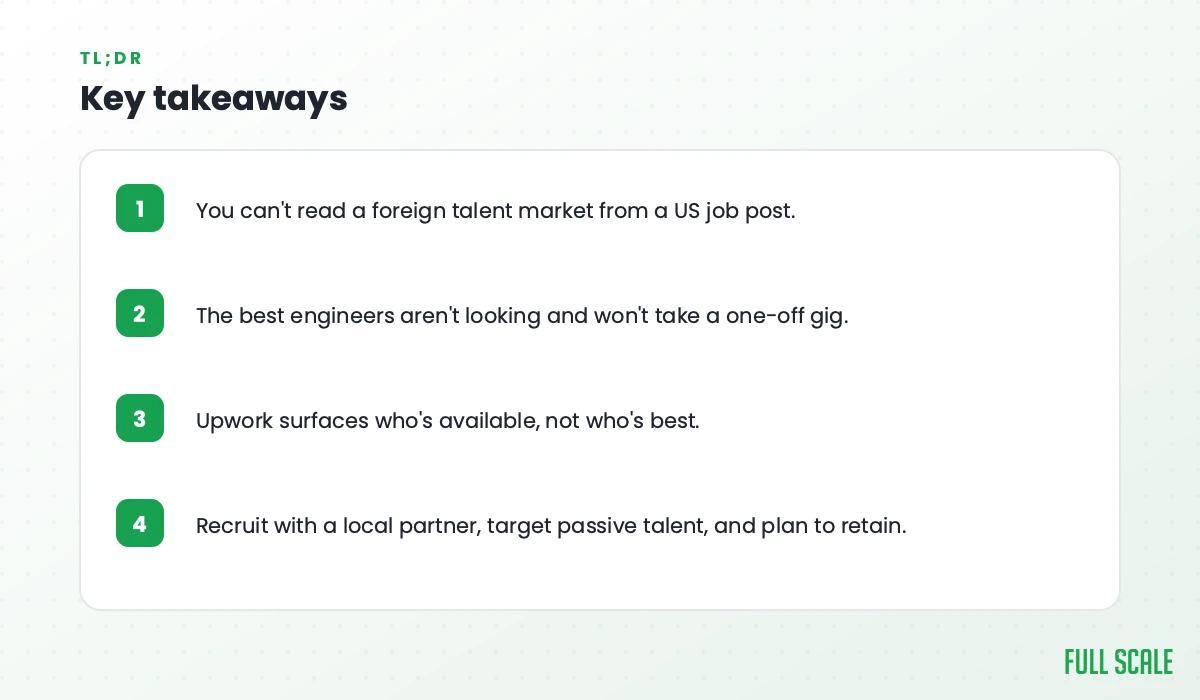
Learn the real local pay rate before you post anything, including the regional differences inside that country. Judge candidates against local norms instead of against the engineer in your head. Be honest with yourself about whether you’re hiring for a scoped project or building a team, because the answer changes everything. Offer real security if you want to attract people who have other options. And weight retention as heavily as the hire itself, because a developer who leaves in six months was never really a win. If you want a deeper walk through the mechanics, we’ve written separately on how to hire offshore developers and how to hire offshore staff the right way.
The honest truth is that most of this is hard to do well from the outside, in a market you don’t live in. There’s no shortcut where you skip the local knowledge and it still works out. Someone has to do the learning, and the only real choice is whether that’s you or a partner who did it years ago.
That’s the whole reason a company like ours exists. We’ve spent years learning one market deeply so you don’t have to learn it the expensive way. If you’d rather talk it through than figure it out alone, schedule a call with us and we’ll tell you honestly what makes sense for your situation.

Frequently asked questions
What are the biggest challenges in offshore recruitment?
The hardest challenges in offshore recruitment are the ones you can’t see from outside the country: not knowing the real local pay rate, struggling to judge candidates against their own cultural and professional norms, which is why interviewing offshore developers deserves its own playbook, reaching the strong developers who aren’t actively job hunting, offering enough job security to attract them, and keeping them once they’re hired. Finding people who can code is rarely the actual problem.
How much do offshore software developers actually cost?
A skilled software developer in the Philippines typically earns around $15 to $30 an hour locally, depending on experience, which lets companies hire strong talent for roughly 50 to 70 percent less than US rates. Pay also varies a lot by region within a country, the same way Southern California pays more than Kansas City, so a national average can be misleading.
Is it better to hire offshore developers directly or through a partner?
Hiring directly can work for a one-off, well-scoped project, but it puts the burden of reading a foreign labor market entirely on you: local pay, cultural fit, legal compliance, and retention. A local partner already knows the market and can offer developers real employment and security, which matters most when you’re building an ongoing team rather than filling a short gap.
Why do offshore developers leave, and how do you keep them?
A developer you hired directly with no benefits or career path will often leave for a small pay bump, because nothing anchors them to your company. Retention comes from real employment, training, mentoring, and engagement on the ground. Full Scale keeps about 93 percent of its developers, with many staying more than five years, because they treat the role as a long-term career.
What’s the difference between hiring freelancers and building an offshore team?
Freelancers suit small, scoped projects with a clear finish line, but they come with the usual freelancer risks of inconsistent quality and people disappearing. Building a team means hiring dedicated, employed developers who stick with your product over time, integrate with your processes, and grow with you. They are two different problems that require two different approaches. That is why we put so much into vetting developers before anyone ever reaches a client. Part of that is verifying who a candidate actually is before they ever reach a client.