
Offshore Angular Development – Hire Trusted, Affordable Talent from the Philippines

In this article
- Why Angular’s Strictness Makes Offshore Teams More Predictable
- The Angular Quality Gap
- Philippines for Angular
- What to Evaluate in an Offshore Angular Developer
- Staff Augmentation or Project Outsourcing?
- What AI Changes About Offshore Angular Work
- What the Cost Comparison Looks Like
- Frequently Asked Questions
- Ready to Add Angular Engineers to Your Team?
Quick Answer: Offshore Angular development means hiring Angular engineers outside your country, and it works well because Angular’s enforced TypeScript, dependency injection, and module structure keep code predictable across time zones. The risk is the quality gap between engineers who know Angular’s design and engineers who have only used it. Full Scale staffs senior Angular engineers in the Philippines at $30 to $40 an hour, with onboarding in about 14 days.
There is a consistent pattern in how companies choose their JavaScript framework. Startups tend to pick React, and enterprise teams tend to pick Angular. Many of those React startups standardize on Next.js as they scale, and they hire dedicated Next.js developers to run it. It also shapes what an Angular developer actually does now. A common reason teams engage offshore Angular help is an AngularJS to Angular migration.
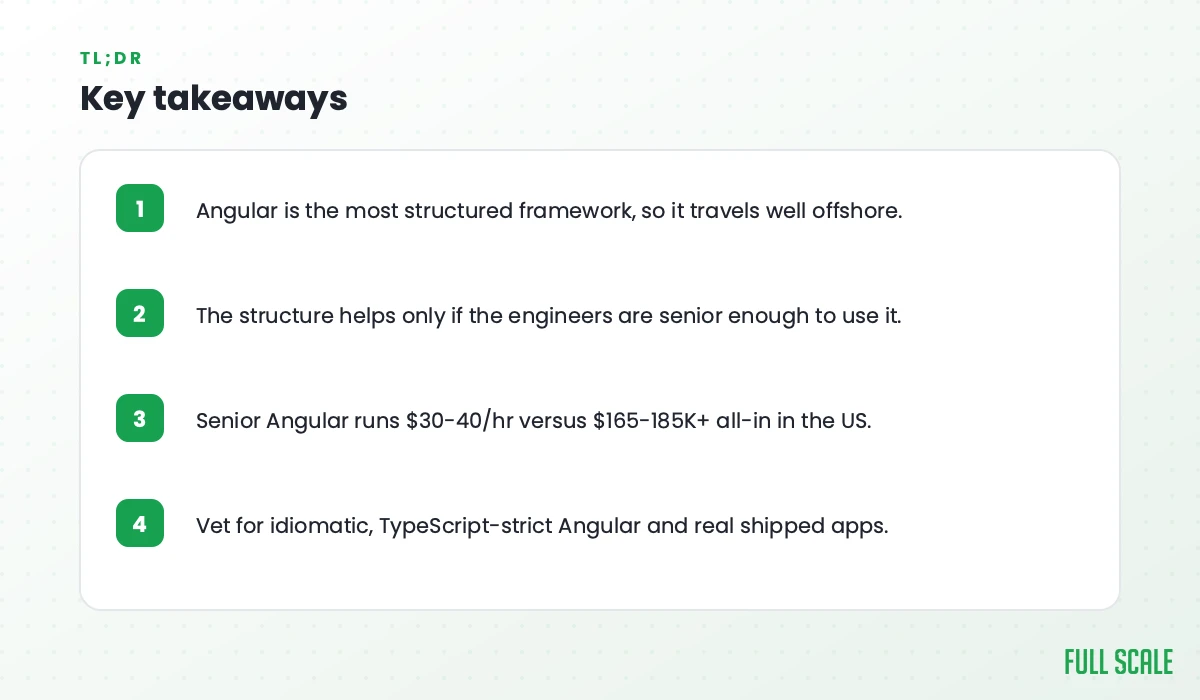
The reason is structure. Angular is Google’s opinionated full framework: TypeScript throughout, decorators for everything, dependency injection as the standard wiring pattern, RxJS for async data, and a module system that defines how the application is organized. There is no optional TypeScript in Angular. There is no choosing your own state management approach. The framework makes most of those decisions, and for teams building large applications that multiple developers will maintain over years, that is a feature.
That same structure is what makes Angular offshore teams work better than most people expect.
I run Full Scale, which staffs offshore software development teams in the Philippines. Angular is one of our enterprise stacks. Here is what the operator experience of staffing Angular teams offshore has taught me about why Angular travels better than React or Vue across time zones.
Why Angular’s Strictness Makes Offshore Teams More Predictable
The challenge of distributed software development is consistency. When engineers are working across time zones, the shared language of the codebase matters more than when everyone is in the same room. Teams that work co-located can resolve inconsistencies in real time. Distributed teams pay a higher overhead for architectural divergence.
Angular does not give developers many ways to diverge. TypeScript is mandatory. Dependency injection is how services connect. Components, services, directives, and pipes each have specific roles and specific patterns for implementing them. RxJS Observables handle async data in a way that Angular engineers recognize across any codebase. The NgModule system (or the newer standalone component architecture) defines application boundaries.
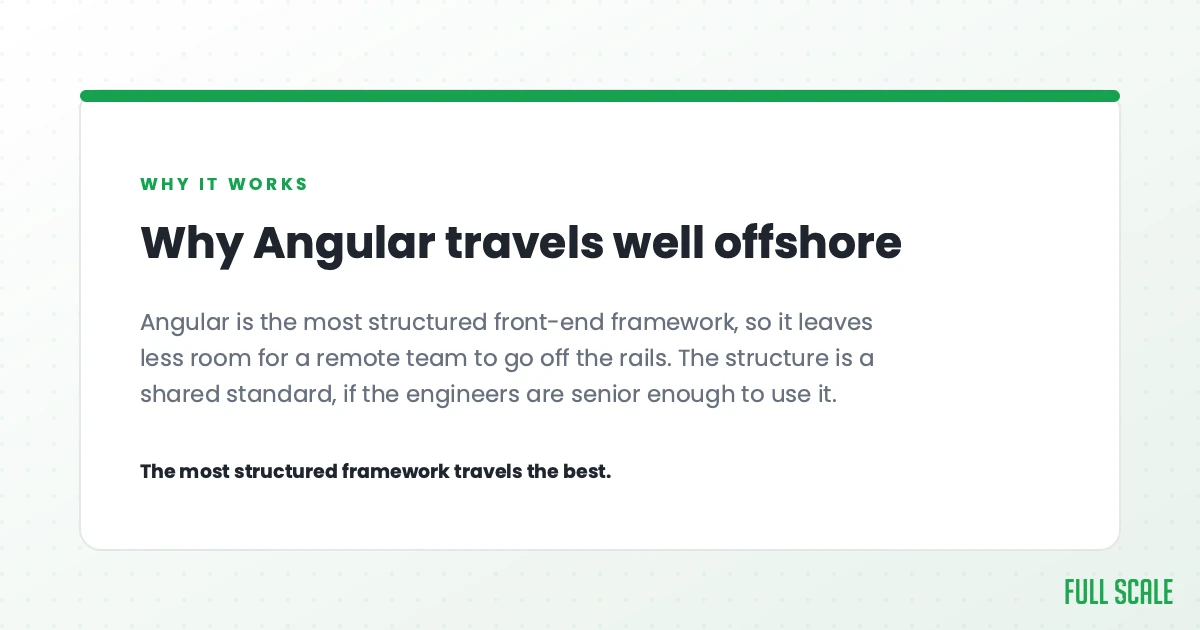
A good Angular engineer who joins an existing Angular codebase recognizes the structure before reading a line of business logic. That recognizability is the offshore advantage: the framework enforces a shared language that is more prescriptive than any JavaScript framework outside of Angular. A React codebase can organize state management ten different ways. An Angular codebase follows Angular’s patterns.
This is why Angular is the best JavaScript framework to offshore among the major options. It is not more talented engineers. It is more predictable architecture.
The Angular Quality Gap
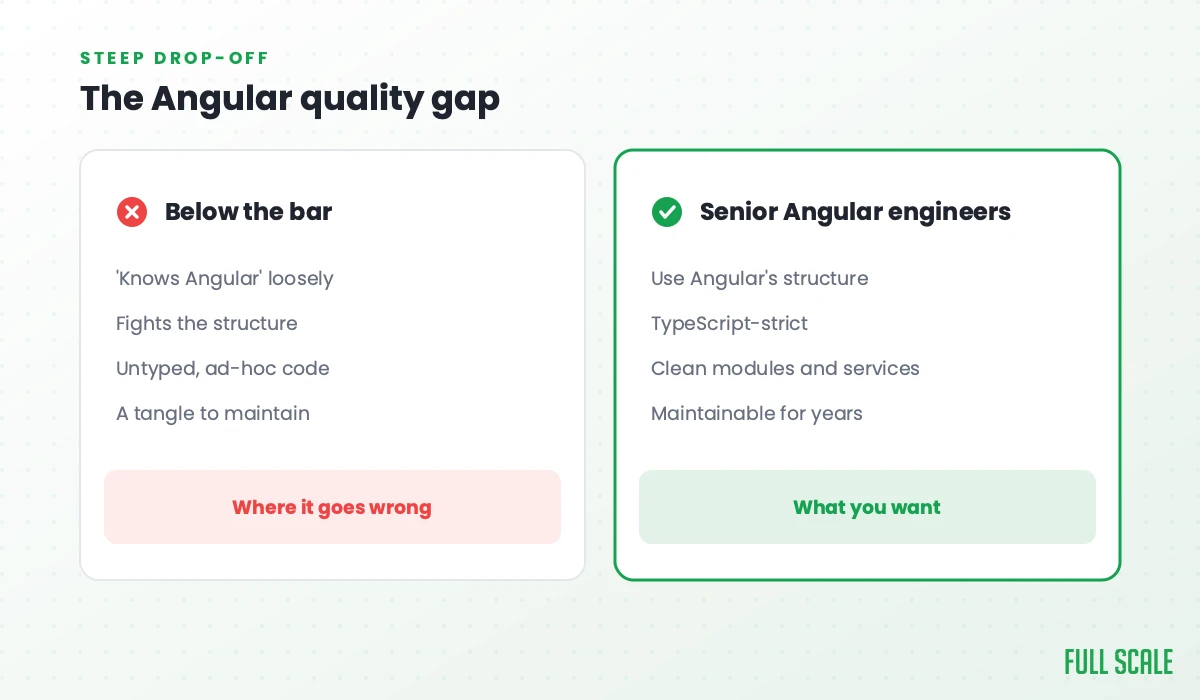
Offshore Angular hiring gets expensive when you cannot tell an engineer who knows the framework deeply from one who has worked with it superficially. Angular’s complexity makes that gap visible, and it is the main risk in any Angular team you build abroad.
The two most common signatures of a weak Angular hire are dependency injection misuse and RxJS subscription mismanagement.
Dependency injection is how Angular wires the application together. It is powerful and easy to misuse. Engineers who do not understand Angular’s DI system either inject too much into components (creating tight coupling that makes testing and refactoring expensive) or recreate the problem DI was designed to solve by passing data through component inputs in ways that fight the framework. The code runs. The technical debt accumulates.
RxJS subscription management is the other tell. Angular uses Observables throughout: HTTP responses, route parameters, form value changes. An engineer who does not manage Observable subscriptions correctly creates memory leaks that only manifest under production load, long after the code shipped. The pattern is detectable in code review, and it is a reliable indicator of how deeply the engineer understands Angular’s async model.
I call this cheapshoring: hiring the cheapest Angular developer in a market where the gap between “has used Angular” and “understands Angular’s design” is wide. The framework’s complexity makes that gap larger than in most JavaScript frameworks. The offshore evaluation process for Angular needs to probe DI patterns and RxJS usage directly.
Philippines for Angular
Angular has been the dominant enterprise JavaScript framework since Google released Angular 2 in 2016. The Filipino engineers who have been working in enterprise development environments for the last decade grew into Angular during the same period most enterprise JavaScript development ran on Angular. The Philippines’ IT sector serves large enterprise clients across North America and Europe, and those clients have been building Angular applications.
The Philippines is the third-largest English-speaking country in the world. Everything around Angular is English-first: the documentation, the community Slack, the conference talks, the training resources. Filipino Angular engineers are native participants in that community, not translating between it and another language context.
The Philippine IT-BPM industry generates $40 billion in annual export revenue and employs 1.8 million workers. The enterprise Angular talent in that workforce is real and well-tested.
At Full Scale, the Spartan Training Academy keeps our Angular engineers current with AI-era development workflows. The Claude Masterclass series covers practical Angular patterns: using Claude Code for real-time Angular debugging and refactoring in the terminal, MCP integrations connecting Claude to GitHub and component libraries, and agentic workflows for Angular testing with Jasmine, Karma, or Jest. Weekly five-minute training videos and bi-weekly thirty-minute sessions, most recorded by Full Scale engineers.
What to Evaluate in an Offshore Angular Developer
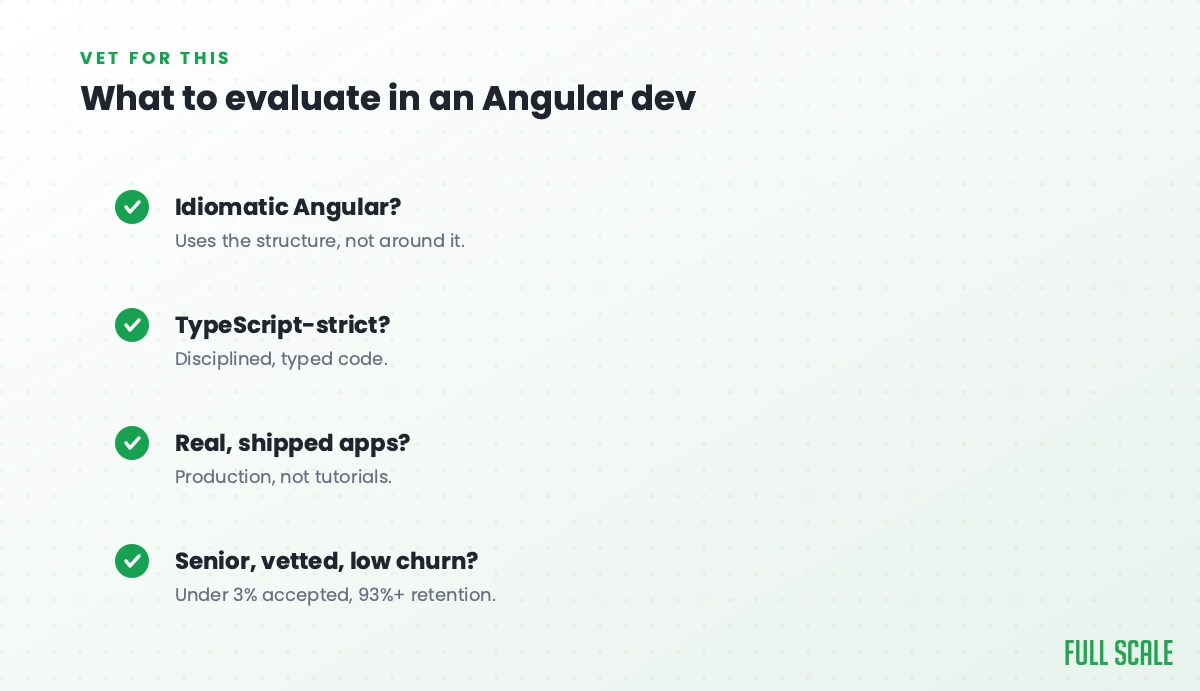
Angular’s complexity makes the evaluation more specific than for most JavaScript frameworks. Generic frontend interview questions miss the patterns that matter.
Dependency injection architecture. Ask candidates how they structure services in a large Angular application. Ask when they use singleton services versus feature-provided services. Ask how they approach testing a component that depends on multiple services. Engineers who understand Angular’s DI system will have opinions. Engineers who have used Angular without understanding DI will describe what they have done without being able to explain why.
RxJS subscription management. Ask candidates how they handle Observable subscriptions in Angular components. Ask whether they use the async pipe, takeUntil, or takeUntilDestroyed. Ask what happens when a component subscribes to an Observable and gets destroyed before the Observable completes. The engineers who can answer these questions without hesitation have built production Angular applications at scale. The engineers who cannot have not.
Module versus standalone component architecture. Standalone components are now the default for new Angular code: Angular 19 made standalone the default for components, directives, and pipes. Ask candidates their opinion on when to use NgModules versus standalone components, and how they would approach migrating an existing NgModule-based application. The engineers who have worked with both will have a considered view. The engineers who only know one will tell you the one they know is correct.
Testing philosophy. Angular ships with a full testing setup. Ask what good Angular tests look like. Ask how they test services that make HTTP calls. The difference between a software engineer and a software developer shows up in whether they write tests that catch real problems or tests that pass.
Staff Augmentation or Project Outsourcing?
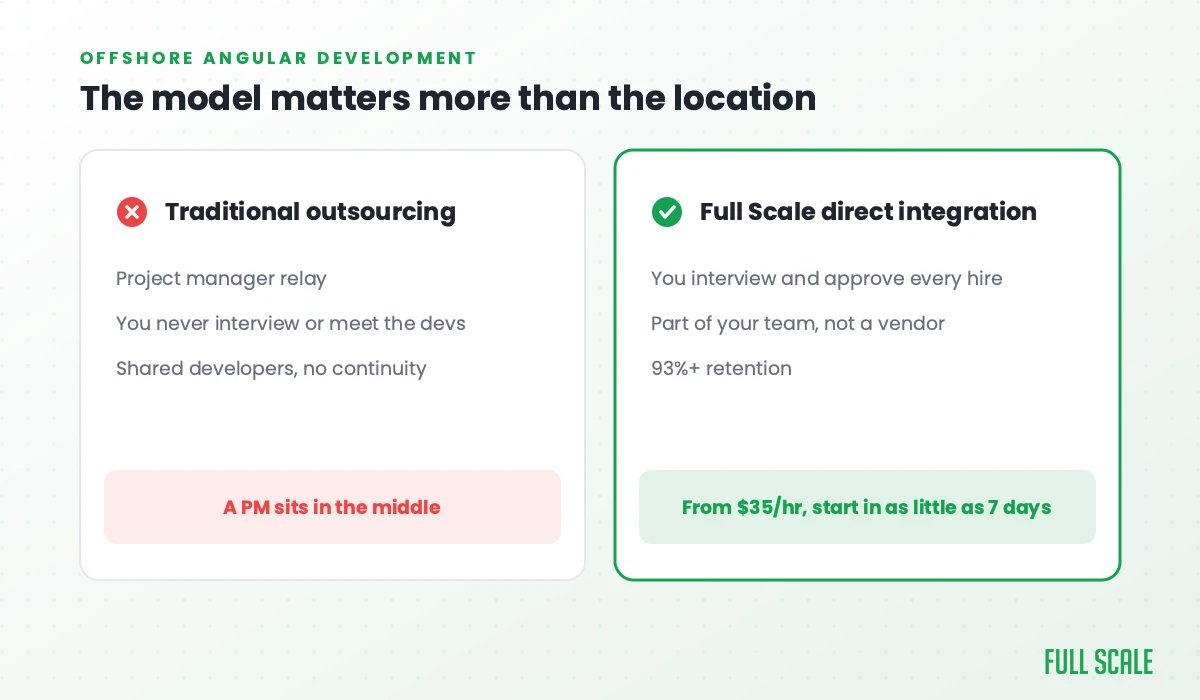
For enterprise Angular applications that will keep evolving, staff augmentation is the model that works. An Angular engineer who joins your team, learns your module architecture, understands your service layer and your RxJS patterns, and contributes to your roadmap over time is the one who makes offshore cost savings real. Angular’s conventions mean they spend less time learning “how this team organized things” than on most other frameworks, which accelerates their ramp.
For genuinely scoped Angular work with a locked spec, project outsourcing can work. A specific component with a documented API contract. A one-time migration with a clear before-and-after state. The same scoped-work logic applies here as in every other framework.
If you are evaluating whether to outsource an Angular project or build a long-term team, our outsource Angular development guide covers the model decision end to end.
What AI Changes About Offshore Angular Work
AI raises the review bar on offshore Angular work. Angular’s boilerplate is verbose: a component decorator, the imports array, the constructor with injected services, the lifecycle hooks, the template with Angular-specific syntax. All of it is recognizable and repetitive, which is exactly the kind of output AI tools generate readily.
An AI-generated Angular service might inject dependencies incorrectly. An AI-generated component might subscribe to an Observable without managing cleanup. An AI-generated module might import things it does not need.
The Angular engineers who catch these problems are the ones who understand the framework well enough to see immediately when AI output diverges from idiomatic Angular. That is what Product Driven is about: building engineers who own what they build, not engineers who ship whatever AI generates. In a framework as structured as Angular, the engineers who understand the structure are the ones whose output AI cannot replace.
What the Cost Comparison Looks Like
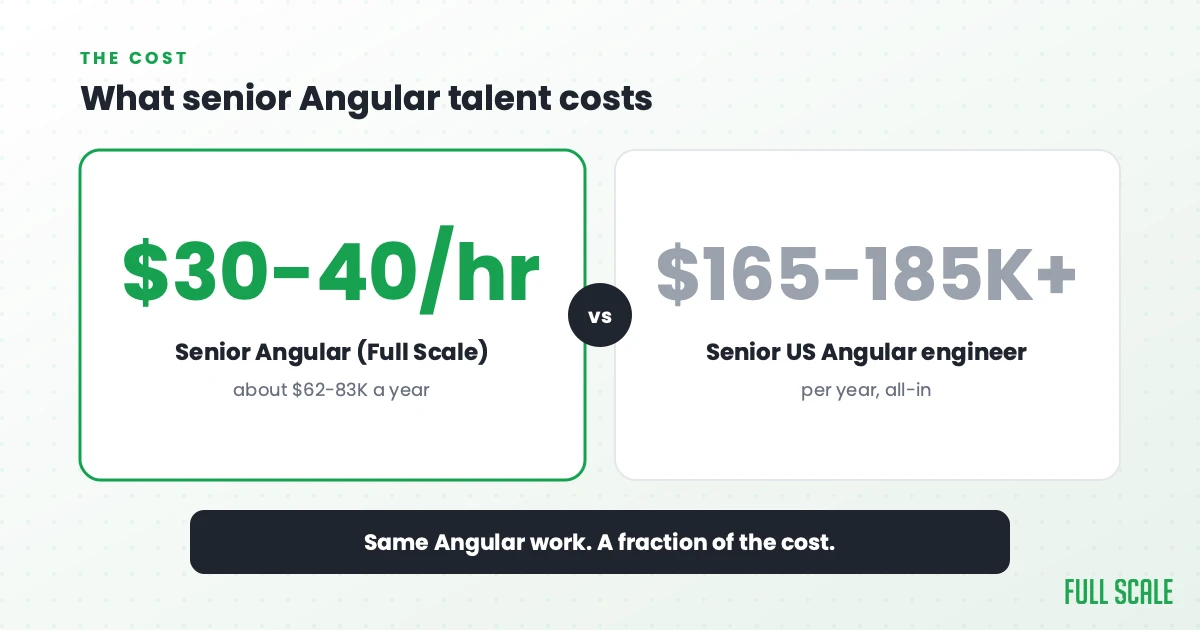
Full Scale clients pay $30 to $40 per hour for senior Angular engineers in the Philippines. A comparable engineer in the US earns a BLS median of around $133,000 per year in base salary, with an all-in cost of $165,000 to $185,000 or more when you add benefits, payroll taxes, and overhead (what MIT research estimates at 1.25 to 1.4 times base salary).
| Full Scale (Angular, Philippines) | US Senior Angular Engineer | |
|---|---|---|
| Hourly / annual cost | $30-$40/hr (~$62K-$83K/yr) | $133K base → ~$165K-$185K all-in |
| Time to staff | ~14 days | 6-12 weeks |
| Recruiting fee | None | 20-25% of first-year salary |
Angular engineers in the Philippines are priced at the TypeScript/frontend rate, and enterprise demand for Angular keeps the talent pool quality high relative to volume. Over a multi-year engagement the savings compound: an Angular engineer who already knows your module architecture and RxJS patterns is worth far more than the same seat re-hired every eighteen months at a US loaded cost.
Frequently Asked Questions
What is offshore Angular development?
Offshore Angular development means engaging Angular engineers based outside your country to build, maintain, or extend your Angular applications. The model can be staff augmentation (engineers embedded in your team) or project outsourcing (a vendor delivers a defined scope). For most enterprise Angular applications that will keep evolving, staff augmentation produces better outcomes because the engineers accumulate knowledge of your specific module architecture, service layer, and RxJS patterns.
Why is Angular well-suited for offshore development?
Angular’s strictness is the reason. The framework enforces TypeScript, dependency injection, and module structure in ways that make a good Angular engineer’s code recognizable across any codebase. That shared framework language travels across time zones more reliably than in React or Vue, where architectural decisions are more team-specific. The conventions reduce the ambiguity that creates problems in distributed teams.
How do you evaluate offshore Angular developers?
Focus on dependency injection architecture and RxJS subscription management. Ask candidates how they structure services across a large Angular application and how they handle Observable cleanup in components. These two areas are where deep framework knowledge separates Angular engineers from developers who have used Angular without understanding it. Also ask about their view on NgModules versus standalone components and how they approach Angular testing.
How much does offshore Angular development cost?
At Full Scale, senior Angular engineers in the Philippines are staffed at $30 to $40 per hour, with onboarding timelines of roughly 14 days. A comparable US engineer costs $133,000 or more in base salary before benefits and overhead. Angular’s enterprise positioning means the developers who stay with the framework are typically senior, which keeps the quality floor higher than in more casual JavaScript frameworks.
Ready to Add Angular Engineers to Your Team?
Full Scale has been staffing offshore software development teams since 2018. We have placed 700+ developers with clients across 200+ tech companies. Our Angular engineers work inside enterprise product organizations across North America, maintaining and extending production Angular applications.
If you want to hire Angular developers who understand the framework’s conventions and work inside your team, that is what we staff.
Schedule a call to talk through your Angular team needs.