
Offshore Talent: What It Is and How to Hire It

In this article
I have hired engineers in four countries and built offshore teams at three companies. I want to define offshore talent the way it actually works, not the way a staffing brochure describes it. The case gets stronger still once you account for what AI changed about offshore development over the last two years. This connects directly to why the US leans on offshore and immigrant talent in the first place. The same logic explains which companies outsource to the Philippines and why.
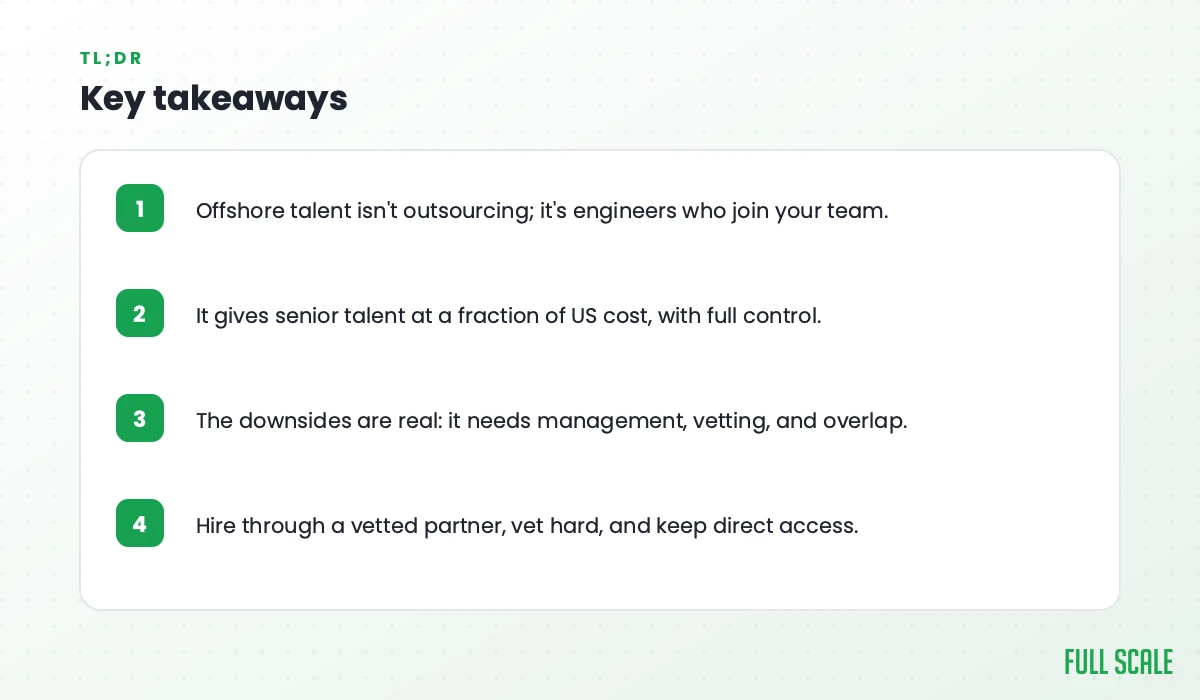
Offshore talent is skilled people you hire to work full-time for your company from another country, usually one where salaries are lower. You manage them directly. They sit in your standups, use your tools, and learn your product. The only thing that changes is where they log in from. That fits the current trends in IT outsourcing, where the value is moving from cheap hands to people who own the work.
That last part is what most people miss. Offshore talent is your team in a different time zone, not a vendor you hand a spec to. Hiring one good person is only the start, which is why an offshore developer alone is not good enough without that team around them.
Offshore talent vs outsourcing (they are not the same thing)
People use these words like they mean the same thing, and that mistake is why a lot of offshore projects fail.
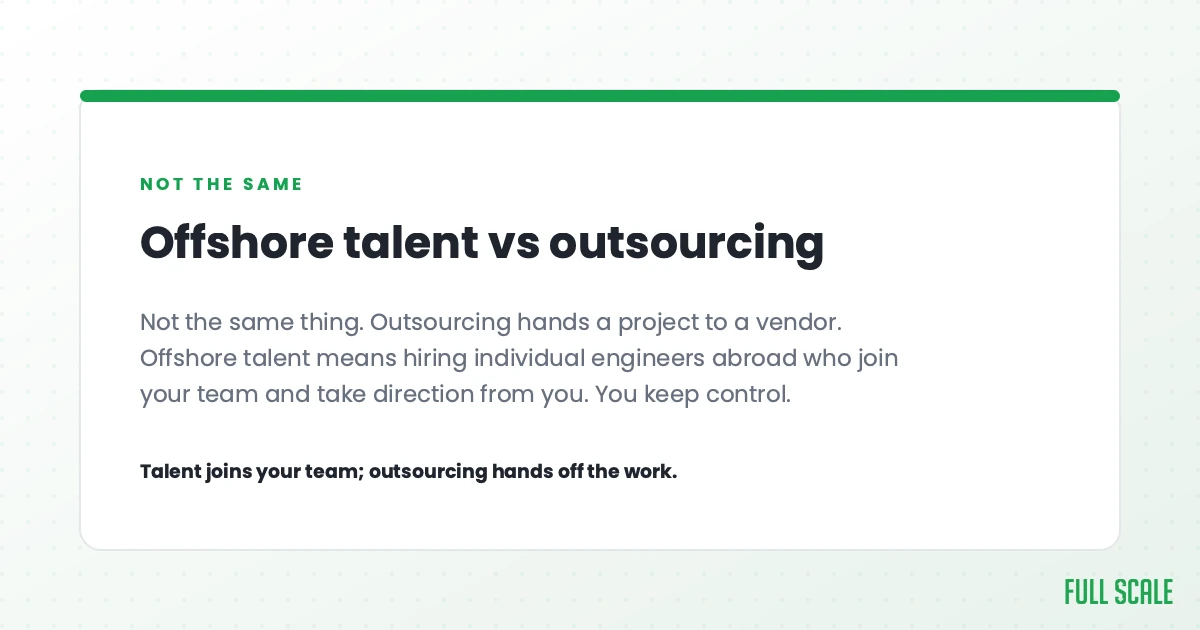
When you outsource, a third party takes over a function and runs it their way. You get a deliverable, not a teammate. When you hire offshore talent, you keep control of the work, the priorities, and the people. I broke this down in detail in offshoring vs outsourcing, because getting it wrong costs companies real money.
The short version: outsourcing rents you an output, offshore talent gives you an employee who happens to live abroad.
I learned this the hard way early on. The outsourced project shops billed for ten engineers when three were doing the work, and nobody on my side could see it. Direct offshore hiring fixed that, because I was managing the people myself.
Why companies use offshore talent
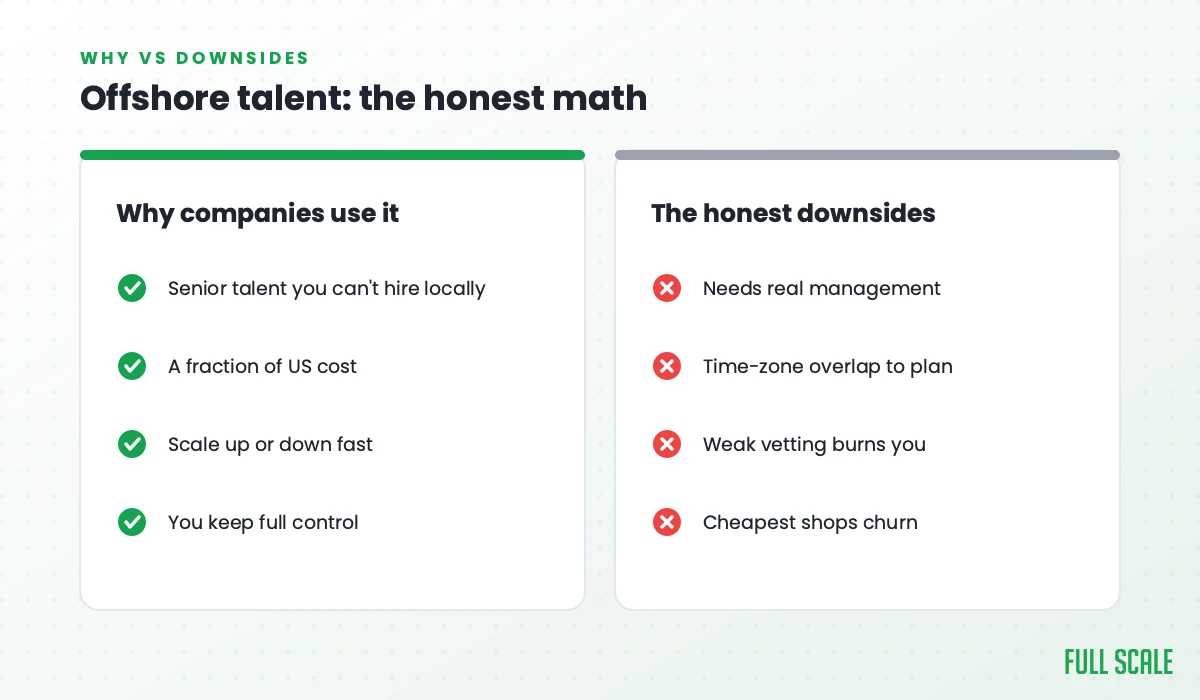
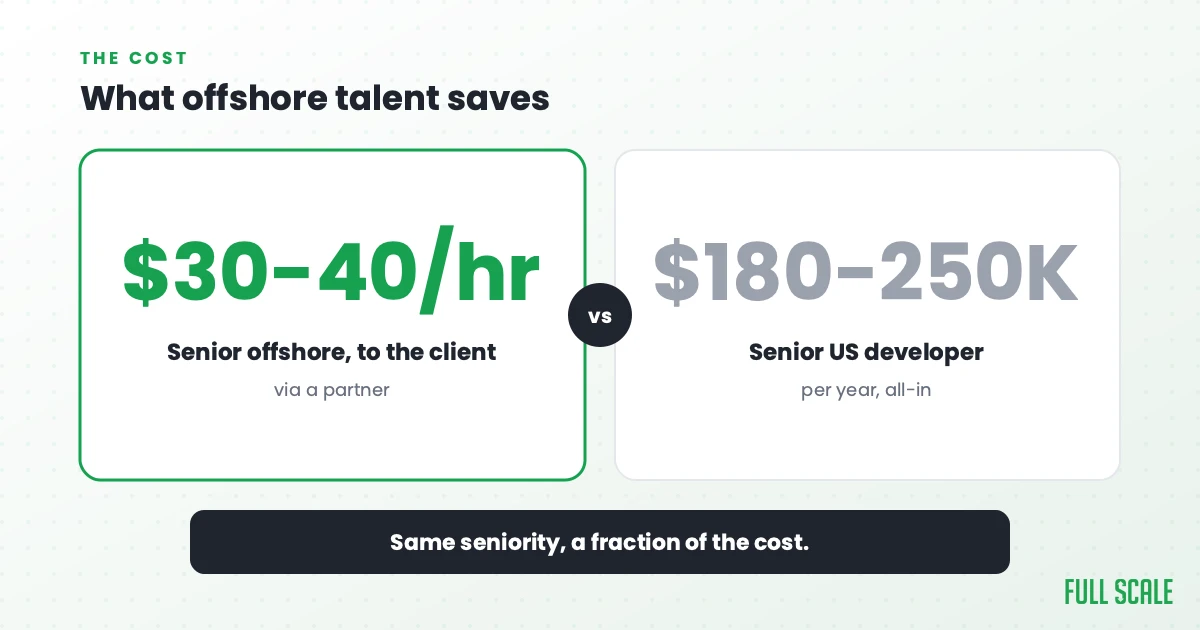
The headline reason is cost, and it is a real one. A senior US developer runs me $180,000 to $250,000 all-in once you count salary, benefits, payroll tax, and equipment. The same seniority offshore costs a fraction of that.
But cost is the easy answer. Here is what actually keeps me hiring offshore.
The talent pool is bigger than your zip code. US engineering hiring has not gotten easier, with software developer jobs projected to grow much faster than the average occupation through 2034, and waiting six months for one local senior hire is a tax on your roadmap. Offshore talent lets you fill the seat in weeks.
You also get people who stay. At Full Scale our Filipino engineers stick around far longer than the nine-to-twelve month average I saw at bad shops, because we treat them like staff, not headcount on someone else’s spreadsheet.
If you want the full case with numbers, I wrote out the real advantages of offshoring I have lived through. There is also a deeper breakdown of rates by country if cost is your main question.
The honest downsides of offshore talent
Every guide lists the same disadvantages and then never deals with them. Let me actually deal with them.
Time zones are the real constraint, not the cost. You need at least three to four hours of daily overlap with your offshore talent, or the back-and-forth turns into a one-message-a-day crawl. The Philippines gives US teams a workable morning or evening window, which is a big reason I hire there.
Communication friction is next. Written English fluency matters more than spoken, because most of the work happens in tickets, pull requests, and Slack. This is one place the Philippines stands out, since it is the third-largest English-speaking country in the world.
Cultural differences are real but manageable. The fix is the same fix you use for any team: clear expectations, written context, and a manager who actually manages. If you do not have technical leadership on your side, offshore talent will struggle, and that is on you, not them. I covered why in common offshore development challenges.
Quality control is a downside only if you hire like you are buying a commodity. Hire for seniority and judgment, not the cheapest hourly rate, and the quality problem mostly disappears.
The hardest objection is about onshore jobs. Some people see offshore hiring as exporting work that should stay home. I think the honest answer is that most of the companies I work with could not afford to hire the local engineer in the first place, so the choice was offshore talent or no engineer at all.
How to source and hire offshore talent
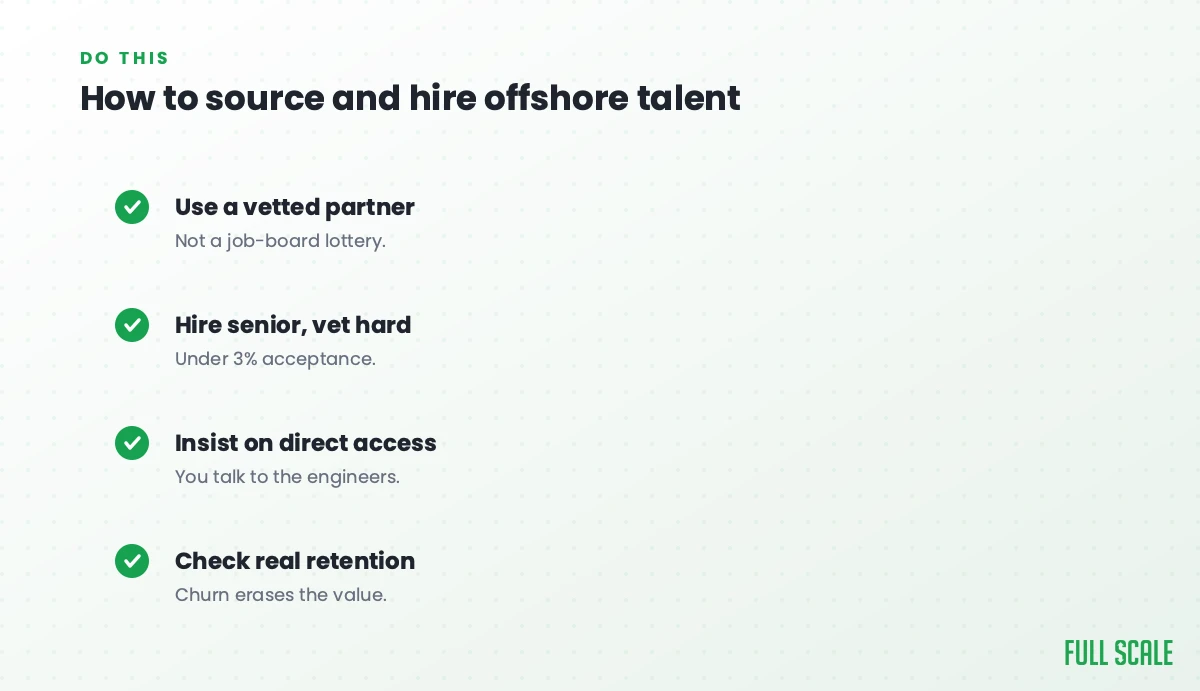
The best way to hire tech talent offshore comes down to two paths, and the right one depends on how much hiring infrastructure you already have.
The first path is doing it yourself. You post the role in the offshore market, screen candidates across a time zone gap, and handle local payroll, contracts, and equipment. It works, but it is slow and the compliance side is easy to get wrong.
The second path is hiring through an offshore partner who already has the recruiting pipeline, payroll, and HR in place. That is what we do at Full Scale, and it is the difference between filling a seat this month and starting a recruiting project from scratch.
Whichever path you take, start with the skills you actually need, not a generic job post. Define the core stack, the seniority, and the communication bar before you talk to anyone.
A few things I always screen for in offshore talent:
- Senior judgment, not just years on a resume
- Strong written communication, since that is how remote work happens
- Real overlap with your working hours
- Experience shipping in a team, not solo contract gigs
If you would rather skip the search entirely, this is the whole point of hiring dedicated developers in the Philippines through a partner. You interview pre-vetted engineers and pick the ones you want.
How to manage offshore talent once you have it
Hiring is the easy part. Keeping offshore talent productive is where most teams either win or quietly give up.
Manage offshore talent exactly like you manage the people in your office, with one extra rule: write everything down. Remote teams in different time zones cannot rely on hallway conversations, so context that lives in someone’s head is context that gets lost.
Put your engineers in the daily standup. Give them direct access to product decisions. Let them own features end to end instead of handing them isolated tickets. That sense of ownership is the core idea in my book Product Driven, and it matters even more across a time zone gap.
This is also why the integrated model beats the staffing-agency model. When offshore talent is treated as a real part of the team, you get the retention and quality you were promised. I unpacked the mechanics of that in what an offshore team actually is and in our guide to offshore staff augmentation.
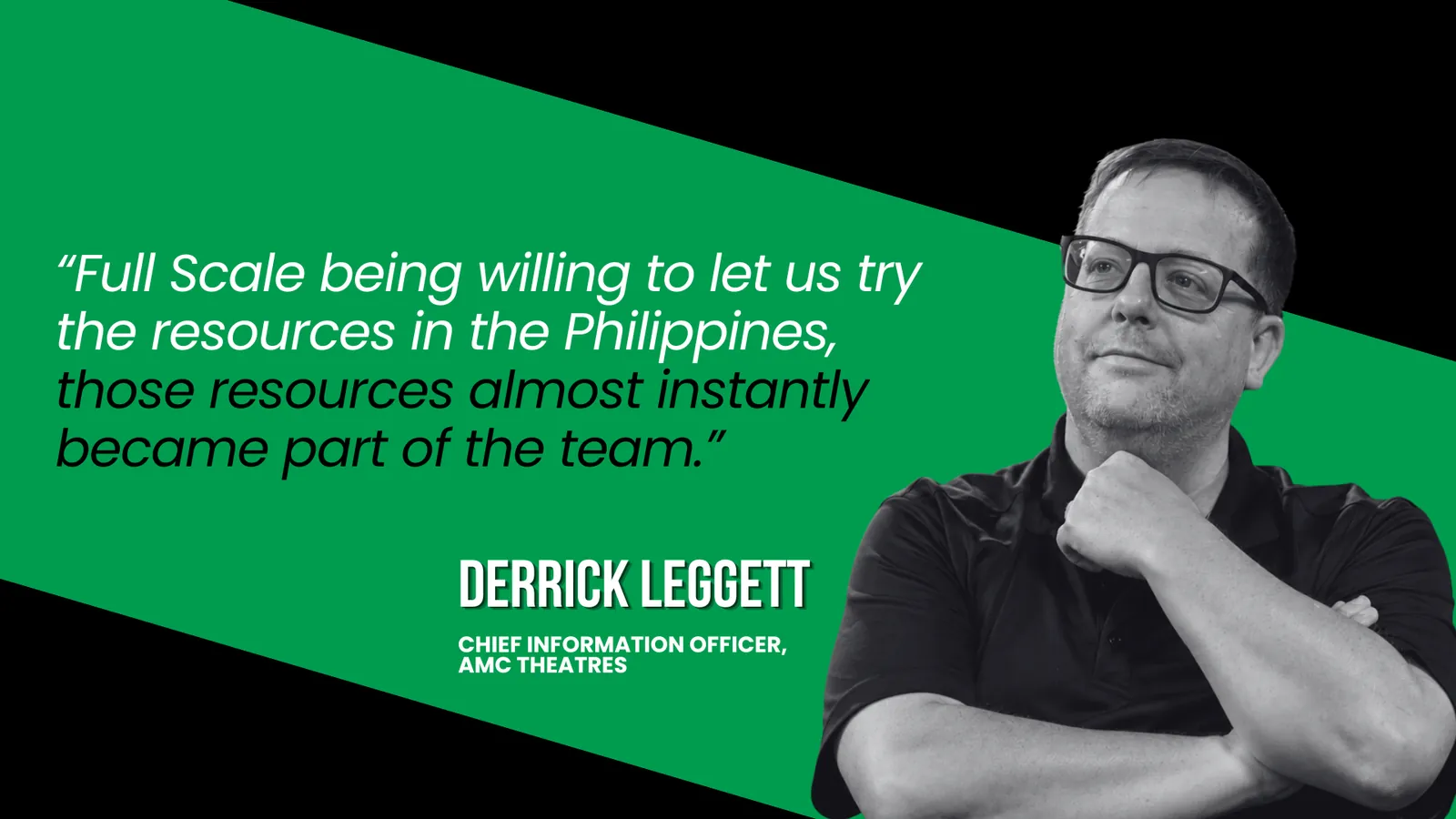
It works at scale, too. AMC Theatres scaled engineering across hundreds of locations using integrated global teams instead of traditional outsourcing, and NavMD shipped its benefits platform the same way.
Is offshore talent right for your company?
If you have technical leadership who can manage people and you need to add engineering capacity without paying US salaries, offshore talent is one of the best moves you can make. Full Scale has helped over 200 tech companies do exactly that, and we have been on the Inc. 5000 five years running.
If you have no one to manage the work and you are hoping to hand off a project and walk away, offshore talent is the wrong call for you. You want a different model, and you should read about offshore staff augmentation before you spend a dollar.
The companies that win with offshore talent are the ones that treat it as hiring, not as buying. Do that, and the geography stops being the interesting part.
Frequently Asked Questions
What does offshore talent mean?
Offshore talent means skilled professionals you hire to work full-time for your company from another country, usually one with lower labor costs, while you keep direct control over their work and priorities.
Is offshore talent the same as outsourcing?
No. With outsourcing, a third party owns the function and delivers a result. With offshore talent, the people work for you, sit on your team, and follow your direction. You manage them the way you manage any employee.
How much does offshore talent cost?
It varies by country and seniority, but offshore talent typically costs a fraction of a comparable US hire, where a senior developer can run $180,000 to $250,000 all-in. The bigger savings come from skipping a months-long local search.
How do you hire offshore talent?
You can recruit, contract, and pay people yourself in the offshore market, or hire through a partner that already has recruiting, payroll, and HR in place. The second path is faster and avoids most of the compliance risk. It’s exactly why most founders come to us to find offshore developers instead of building that function from scratch.
Which country is best for offshore talent?
It depends on your stack and your hours, but the Philippines is a strong default for US teams thanks to English fluency, time-zone overlap, and a deep engineering pool. The honest answer is that communication matters more than the country on the map.