
An Offshore Developer Is Not Good Enough

In this article
“An offshore developer is not good enough.” I believed that for years. It is the same instinct behind why a dev team does not want to work with bad offshore developers.
Before I started Full Scale, I heard the same offshore outsourcing horror stories everyone hears, about code that came back broken, deadlines that blew up, and calls where nobody could understand each other. So I avoided offshore development for a long time, the same way most engineering leaders do, because the downside felt bigger than the savings.
Then I actually tried it. At Stackify I hired developers in four countries: Uruguay, Colombia, Russia, and the Philippines. Some of those engagements were excellent. One of them turned into Full Scale. And over a longer career I’ve worked with developers in Russia, Belarus, Latin America, India, Pakistan, and the Philippines.
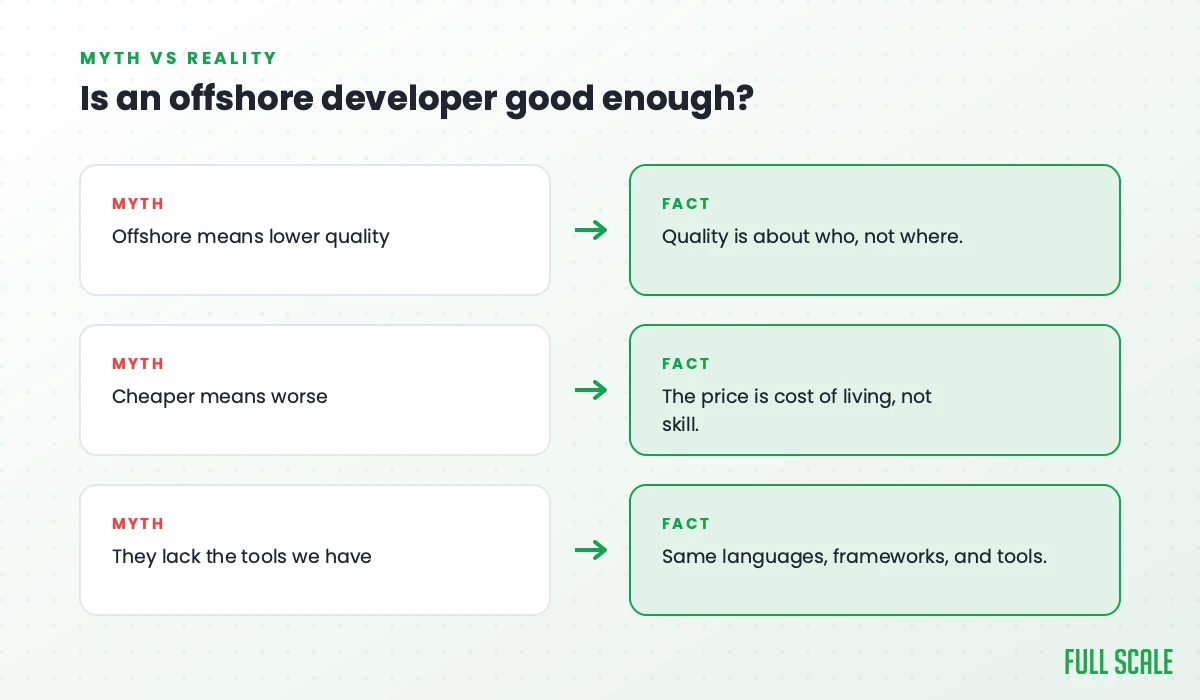
Here’s what I learned the hard way: the problem was never that an offshore developer isn’t good enough. Roughly 90 percent of software developers don’t live in the United States. There are smart people all over the world. The problem is everything that happens around the developer. Most of the real challenges of offshore recruitment live there, not in the code.
The myth costs you more than the bad hire does
The stigma is easy to repeat. An offshore developer is some coder in a far-off country who ships sloppy work, misses the point of the project, and goes quiet when you ask a question.
I get why the story sticks. A lot of people lived it. But they blamed the wrong thing.
When an offshore engagement falls apart, the cause is almost always communication. Software development is about communication more than anything else. English fluency matters, cultural fit matters, and whether a developer will speak up when they don’t understand something or push back when the spec is wrong matters more than the hourly rate on their invoice. None of that shows up on a resume, so people who hire on rate alone keep getting burned and keep blaming the talent.
The real reason offshore goes wrong
I’ve talked to plenty of founders running teams overseas who have only ever spoken to one person: the technical project manager. Every other developer hides behind that person. Sometimes it’s a language gap, sometimes it’s a cultural rule about who is allowed to talk to the client. Either way, you end up with a team you can’t actually communicate with, and a middleman in the way of every decision.
That middleman model is what most offshore firms sell, and it’s the most common way offshore breaks. Not every offshore development company is built around that middleman, though, and the model it runs matters more than the country it’s in. But it isn’t the only one. A handful of common offshore software development challenges show up again and again, and none of them is about how good the developer is:
- Handing over requirements and waiting. This is where most offshore collaboration fails. You treat it like a project to throw over the wall instead of a team to manage, so the spec disappears into a black box and what comes back weeks later isn’t what you meant.
- Hiring on rate alone. The cheapest developer in the cheapest country looks great on a spreadsheet until you can’t have a real working conversation with them. Communication should be the first thing you screen for, well ahead of price.
- No technical leadership in-house. Someone on your side has to own the architecture and set the priorities. If nobody in-house can tell good work from bad, no offshore team can save the project, and your strongest engineers get frustrated and leave.
- Treating it as a short-term gig. Hire people for a three-month project and you get three-month effort. The teams that actually work are the ones you commit to for the long haul, because they learn your product and stay.
Then everyone agrees the offshore developers weren’t good enough. They were probably fine, the setup was broken.
What actually makes offshore work
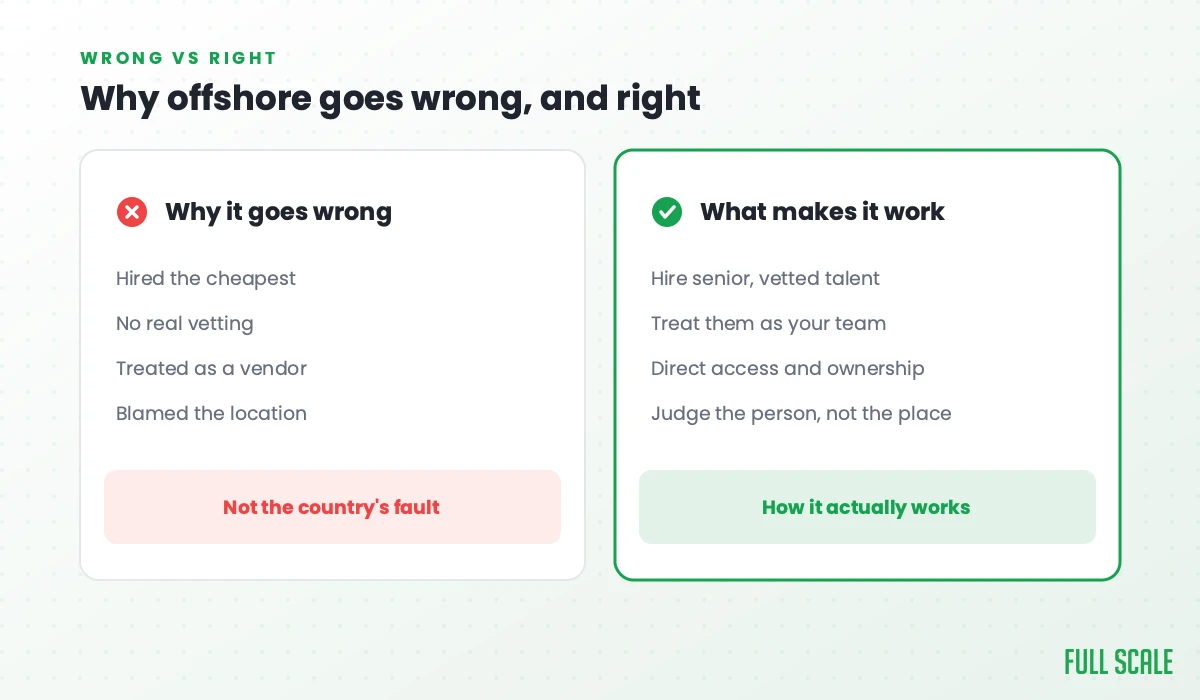
The fix is simple to say and harder to do: put the developers on your team and get rid of the middleman.
That’s the whole idea behind Full Scale. We do staff augmentation and build long-term dedicated teams. The engineers we place work directly for you, on your standups, in your Slack, accountable to your product manager. There’s no account manager relaying decisions and no project manager the developers hide behind. They care about your product the same way your in-house engineers do, because they’re treated like part of the team, not a vendor on the other side of a wall. It’s also the only setup I’ve seen produce offshore engineers your in-house team actually loves working with.
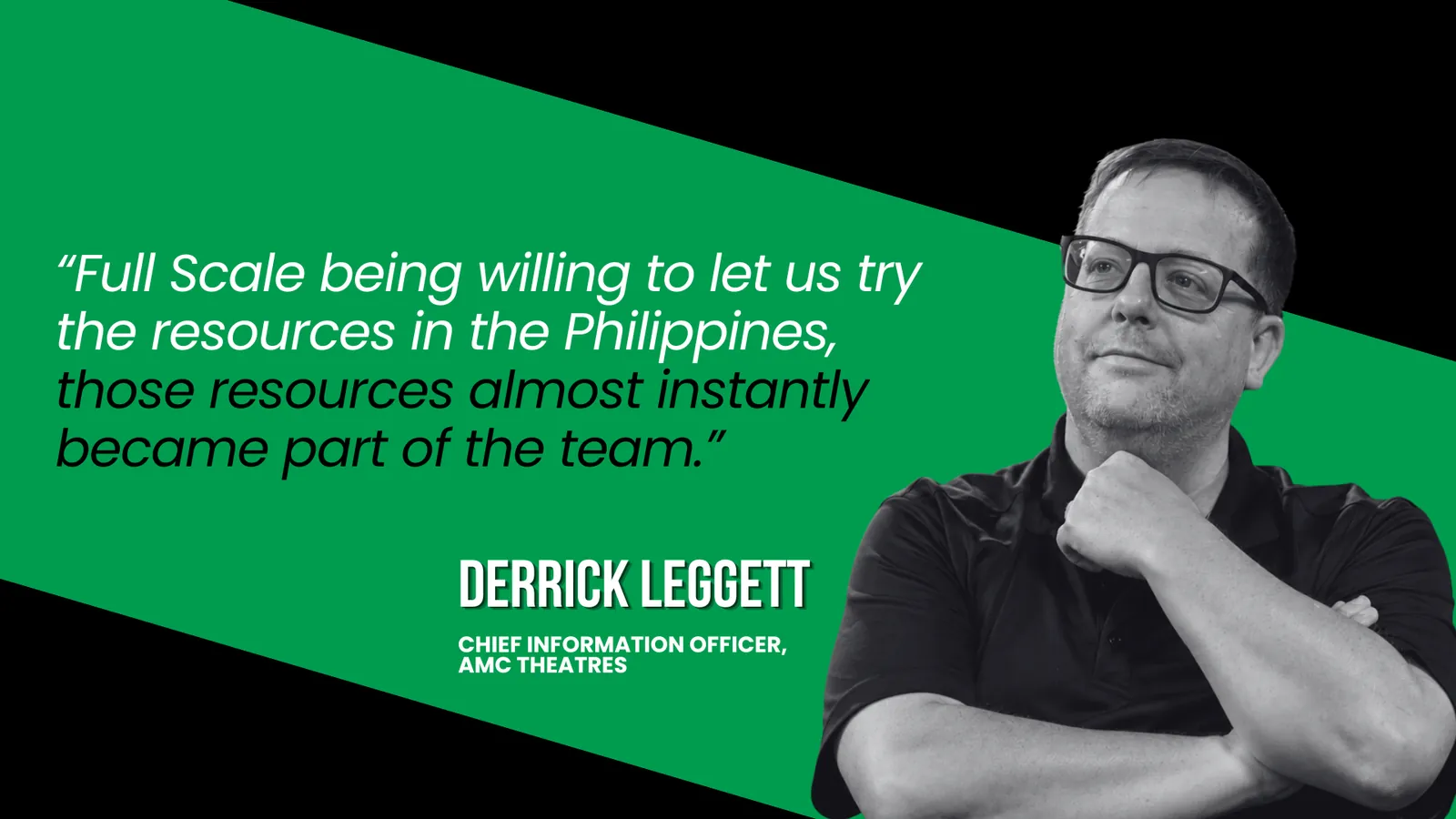
AMC Theatres is the example I point to most. The developers we placed in the Philippines are treated as full AMC engineers, with the same code review, the same standards, and the same roadmap as the Kansas City team. Their CIO, Derrick Leggett, put it better than I could:
“It’s a fully integrated team. It’s just some of the people happen to be living in the Philippines.”
Where offshore goes right or wrong is mostly about how you set up the team. The country and the hourly rate matter a lot less than people think, and most of what I’ve learned running dedicated offshore teams comes back to that one structural choice.
Why the Philippines
You can find good developers almost anywhere if you hire the right people. The Philippines is special though.
There’s no language barrier. Filipinos speak English fluently and grow up consuming American culture, so they understand the references and the working style without a translation layer. Their communication is top notch. The Philippines is the third-largest English-speaking country in the world, and the same friendliness that makes Filipinos dominate service jobs around the globe carries straight into remote engineering work. They want to do a great job and have fun doing it. That’s the perfect personality for building a remote team, and I give Filipino developers most of the credit for why Full Scale has done as well as it has. I’ve written before about how the Philippines compares to India for offshore work, and it comes down to the same thing: communication.
The time zone question usually comes up here, and it comes down to working hours, not the country. Our engineers work whatever schedule the client needs:
- Half-day overlap. Three to four hours of shared working time with your US team. Most clients find this is plenty.
- Full US hours. A developer on US business hours when a role needs real-time collaboration.
- Async-first. A daily standup overlap, then independent ship-and-pick-up work the rest of the day.
The price is about cost of living, not talent
Here’s the part people get backward. Companies don’t hire globally because they can’t find talent at home. They hire globally because of cost of living.
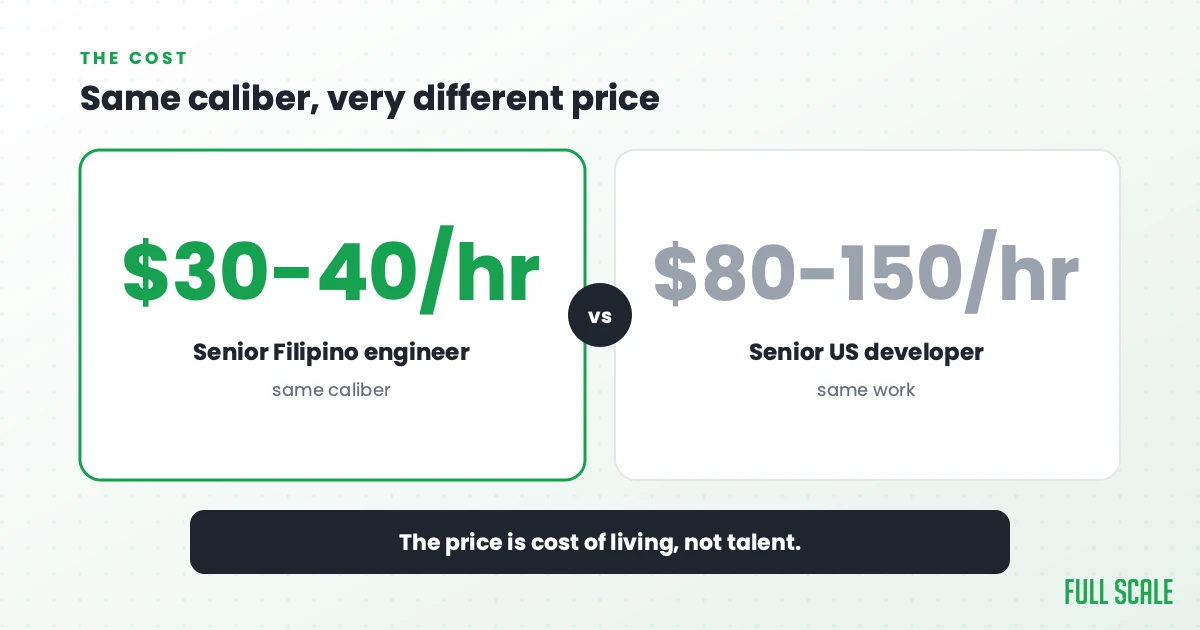
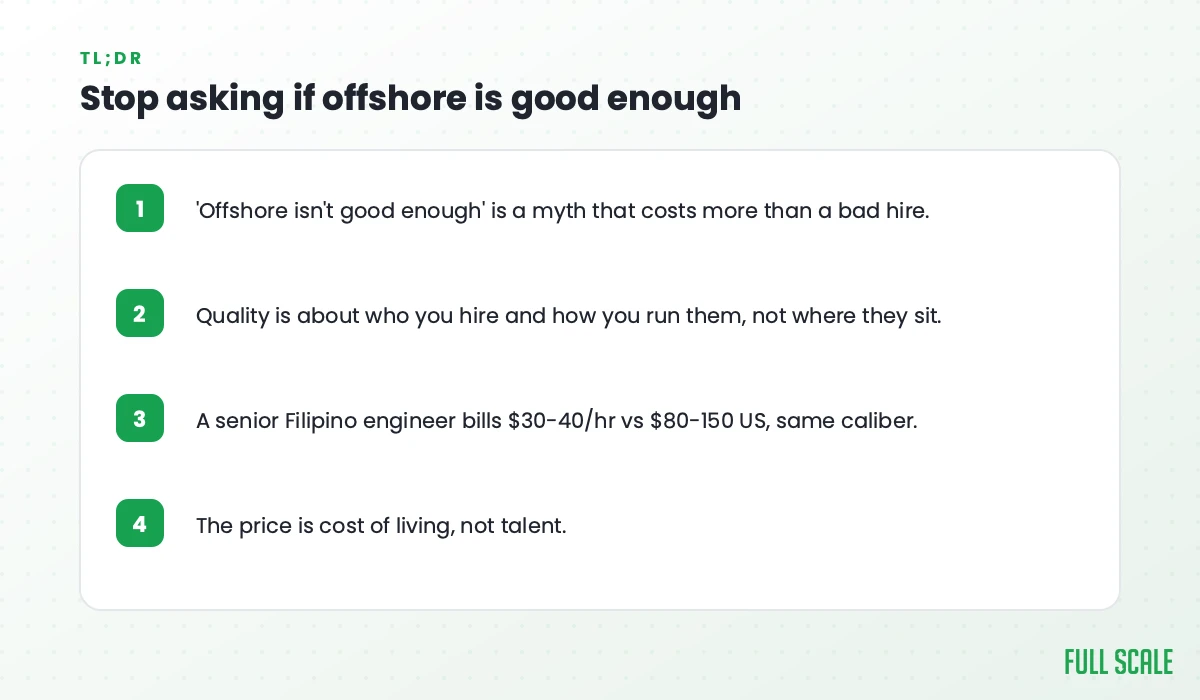
A senior US developer runs you $80 to $150 an hour. A senior Filipino engineer of the same caliber bills $30 to $40. That gap comes from the cost of living in Manila versus the cost of living in San Francisco, not from any difference in skill, and it lets you hire global talent for 50 to 70 percent less than US rates without lowering the bar on who you hire.
On whether paying offshore rates is fair, I take that question head-on in the ethics of offshoring.
What “good enough” actually depends on
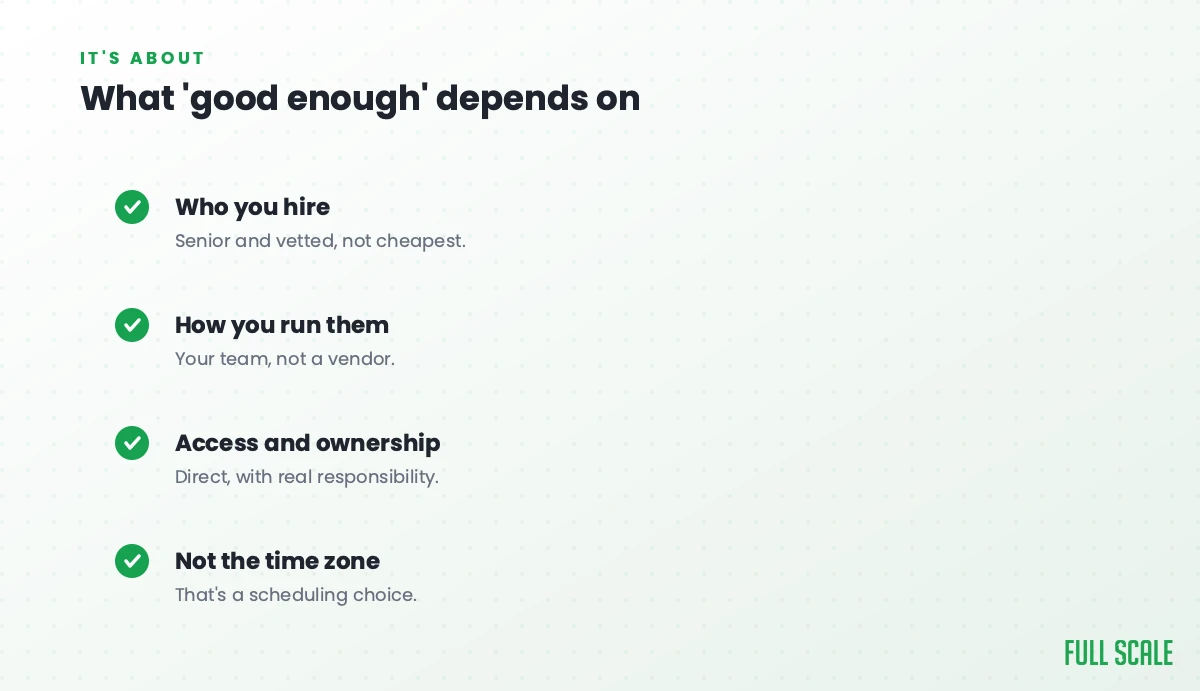
So is an offshore developer good enough? That’s the wrong question to start with, because the developer was rarely the problem.
The real question is whether you can find the right people and build a team they can actually do their best work on. That’s the hard part, and it’s the part we’ve spent years getting right. Full Scale has served 200+ tech companies, keeps 93 percent developer retention, and has made the Inc. 5000 list five years running. Our team in the Philippines is Great Place to Work Certified, with 95 percent of employees saying it’s a great place to work versus 65 percent at a typical company. Happy engineers stay, and a stable team is the whole point when you’re trusting someone with your long-term roadmap.
I wrote a whole book, Product Driven, about why teams succeed or fail, and almost none of it comes down to raw coding skill. It comes down to whether engineers understand the product, talk to each other, and own the outcome. Geography has nothing to do with that.
An offshore developer is not good enough on their own, dropped into a broken setup, hidden behind a middleman. Neither is a developer down the hall. Put good people on a real team and get out of their way, and where they sit stops mattering.
Frequently asked questions
Are offshore developers as skilled as US developers?
Yes. About 90 percent of software developers live outside the United States, and skill is not tied to geography. A developer in Manila has access to the same languages, frameworks, and tools as one in Silicon Valley. When an offshore engagement fails, it’s almost always a communication or management problem, not a skill gap. Most of the offshore development team mistakes worth worrying about are about how you set up and run the team, not who you hired.
Why do so many offshore projects fail then?
Most failures come from the setup, not the developers. The common pattern is a middleman model where you only ever talk to a project manager while the actual developers stay hidden. That kills communication, slows every decision, and leaves you with a team you can’t build a real relationship with. Putting developers directly on your team fixes most of it. Fixing that setup is also the foundation for motivating your offshore team, because people invest when they are treated as part of the team.
How much do offshore developers cost compared to US developers?
A senior US developer typically costs $80 to $150 an hour. A comparable senior Filipino engineer bills around $30 to $40. The gap reflects cost of living, not a difference in skill, which is why you can save 50 to 70 percent without compromising on quality.
Why does Full Scale focus on the Philippines?
English fluency, communication culture, and a temperament built for remote work all line up in the Philippines in a way they don’t most places. It’s the third-largest English-speaking country in the world, and Filipino engineers communicate clearly and care about the work. Cost of living is a bonus, not the reason.
Stop asking if offshore developers are good enough
Build a real team, kill the middleman, and hire for communication as hard as you hire for code. Do that, and the question answers itself. Do that consistently and you’ll find it’s not hard to hire offshore developers who clear that bar.