
Trump’s War on IT Outsourcing Keeps Losing in Court. The Economics Show Why.

In this article
- There was never a ban, but there were real attempts
- The jobs that already left aren’t coming back
- There was never enough talent to bring home
- Outsourcing is what lets small companies grow into big employers
- The US economy already runs on outsourced talent
- And it lifts the other side, too
- What this means if you build software
- Frequently asked questions
Every few months I get the same question from a founder or an engineering leader. “Is the government about to ban offshoring? Should I pull my team back to the States?”
The fear is real, so let me answer it plainly. There is no ban on IT outsourcing, and there never was one. The closest thing to it was a rumor that started with an activist online, not a bill or an order.
What is real is a set of moves meant to make offshoring more expensive. The part most coverage misses: courts have already ruled the two biggest ones unlawful, and the one bill that would actually tax outsourcing can’t get a second sponsor.
I run Full Scale, a company that staffs US software teams with engineers in the Philippines. So I have a stake here. But I want to argue this on the economics, not on politics, because the economics are what actually decide it. Even if every one of these measures stuck, they would backfire. They would not bring the work home. They would make it more expensive to build software in America, and that costs American jobs, not the other way around.
This fight is not new. Reshoring rhetoric has flared up every time offshoring accelerated since the 1960s, and the economics have won every round so far. The history of offshoring covers why.
Quick Answer: There is no ban on IT outsourcing, and none has ever been proposed. The real measures, a $100,000 H-1B visa fee and broad tariffs, have both been struck down in court, and the one bill that would actually tax offshored work, the HIRE Act, is stalled in committee with no cosponsors. Even where a measure survives, the underlying math does not change: the US has a structural shortage of software talent, and offshoring is what lets smaller companies afford to grow into bigger US employers. Full Scale staffs offshore engineering teams for US companies and has watched this policy fight play out from that vantage point.
There was never a ban, but there were real attempts
Start with what is true today, because it changes month to month.
The “outsourcing ban” idea traces back to an activist, Laura Loomer, not to any law or executive order. No such ban was ever proposed. If you are arguing against a ban, you are arguing against something that does not exist.
The real measures are narrower, and most of them are not doing well. Here is where the big ones actually stand.
| Measure | What it does | Status (June 2026) |
|---|---|---|
| $100,000 H-1B visa fee | $100K per new H-1B petition | A district court ruled it an unconstitutional tax; the First Circuit refused to stay that ruling on July 24, 2026, so the fee is not in effect while the appeal continues |
| “Liberation Day” tariffs | Broad tariffs on imports | Struck down by the Supreme Court; replaced with smaller, temporary ones |
| HIRE Act (S. 2976) | 25% excise tax on offshored work | Stalled in committee, no cosponsors |
| Wage-weighted H-1B lottery | Favors higher-paid roles | In effect |
| Section 174 R&D tax change | Favors US-based R&D spending | In effect |
The $100,000 fee on new H-1B visa petitions was signed by proclamation in September 2025. On June 8, 2026, a federal judge ruled it an unconstitutional tax and threw it out, on the principle that only Congress can impose a tax. He briefly paused his own order while the government appealed, which put the fee back in force for a few weeks, but on July 24, 2026 the First Circuit Court of Appeals refused to stay that ruling, so the fee is not in effect as I write this and its fate now sits with the appeal itself. The legal merits went against it twice in a row. Whether it survives the appeal is the open question.
The “Liberation Day” tariffs went the same way, harder. In February 2026 the Supreme Court struck them down on the same logic: the power to regulate trade does not include the power to tax. They were replaced with smaller, time-limited ones.
The HIRE Act is the bill that would actually bite, a 25% excise tax on payments for offshored work. It was introduced in late 2025 and stalled on its first procedural step. It still has no cosponsors.
The pattern is hard to miss. Courts keep rejecting these moves because the same principle keeps applying: you cannot tax your way out of outsourcing by executive order. That takes Congress, and Congress has not moved.
One more thing matters for software specifically. Tariffs apply to physical goods, not services. A line of code crossing a border is not a shipping container. So the tariff fight, whatever happens to it, was never going to touch software offshoring at all.
The one rule that quietly survived is a change to the H-1B lottery that favors higher-paid roles. Read that carefully. It makes it harder to bring junior and mid-level foreign engineers to the US, which pushes that exact work offshore instead.
A policy meant to protect American jobs makes offshoring the rational choice.
One measure does cut the other way, and I should be straight about it. The 2025 tax law changed how companies write off research and development. Money spent on software development inside the US can now be deducted right away, while the same work done offshore gets spread out over fifteen years. The exact treatment depends on your situation, so that one is a question for your accountant, not me. On paper, it is a genuine reason to keep development at home.
Here is what I can tell you from actually running an offshore firm. Not one of our clients has ever brought it up. Not once. Maybe their accountants handle it quietly, maybe nobody is following it closely, maybe it is just too small to change a hiring decision. I cannot tell you which. What I can tell you is that the tax break exists and nobody seems to care, because the talent math still wins.
The jobs that already left aren’t coming back
We have run this experiment before, with manufacturing. Software is not manufacturing, and I am not claiming it is. I am using it because it is the clearest test we have of whether policy can drag work back home once it has left. The answer is not encouraging for the “bring it home” crowd.
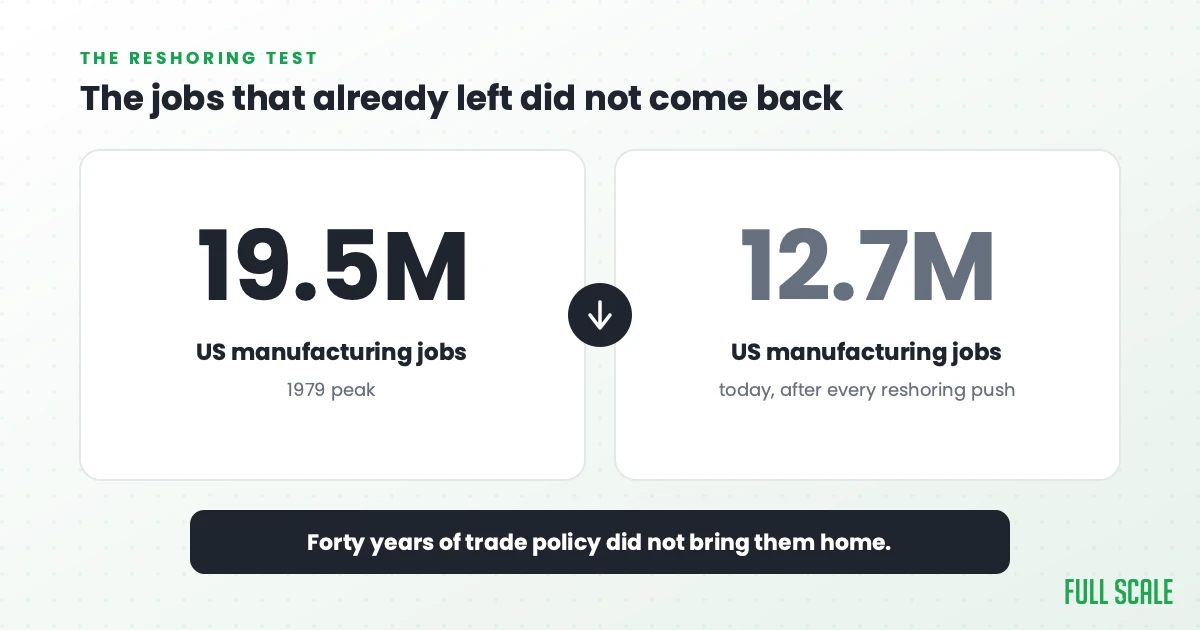
US manufacturing employment peaked at about 19.5 million jobs in 1979. Today it sits around 12.7 million. That decline ran through every kind of trade policy, from both parties, for forty years.
The recent tariff push has not reversed it. Manufacturing employment is actually down about 82,000 jobs since the January 2025 inauguration, even with aggressive tariffs in place. The Reshoring Initiative, a group that exists to promote bringing jobs back, reports that of more than two million jobs announced since 2010, only about 1.7 million were ever actually filled.
The reason is not a lack of patriotism. It is automation and productivity. The work that left did so because the math changed, and a tariff does not change the math back. Economists who studied the “China Shock” found it cost the US roughly two million jobs, and almost none of those came back when policy tried to summon them.
Services left for the same structural reasons manufacturing did. Call centers, back-office processing, and routine software work moved to where it could be done well and affordably. Wishing them home does not make them come home. It just raises the cost of the companies that depend on them.
There was never enough talent to bring home
Every “bring the jobs back” speech ignores the same thing. For a lot of skilled work, the talent to bring home was never here in the first place.
That is the entire reason the H-1B visa exists. About 65% of approved H-1B petitions go to computer-related jobs, and the program is so oversubscribed that recent lotteries drew hundreds of thousands of registrations for about 85,000 slots. That is not a program companies use for fun. It is companies competing for people who are genuinely scarce.
Look at who actually writes software in this country. The foreign-born share of computer and math jobs rose from about 18% in 2000 to 26% by 2019, and for software engineering specifically it is close to 40%.
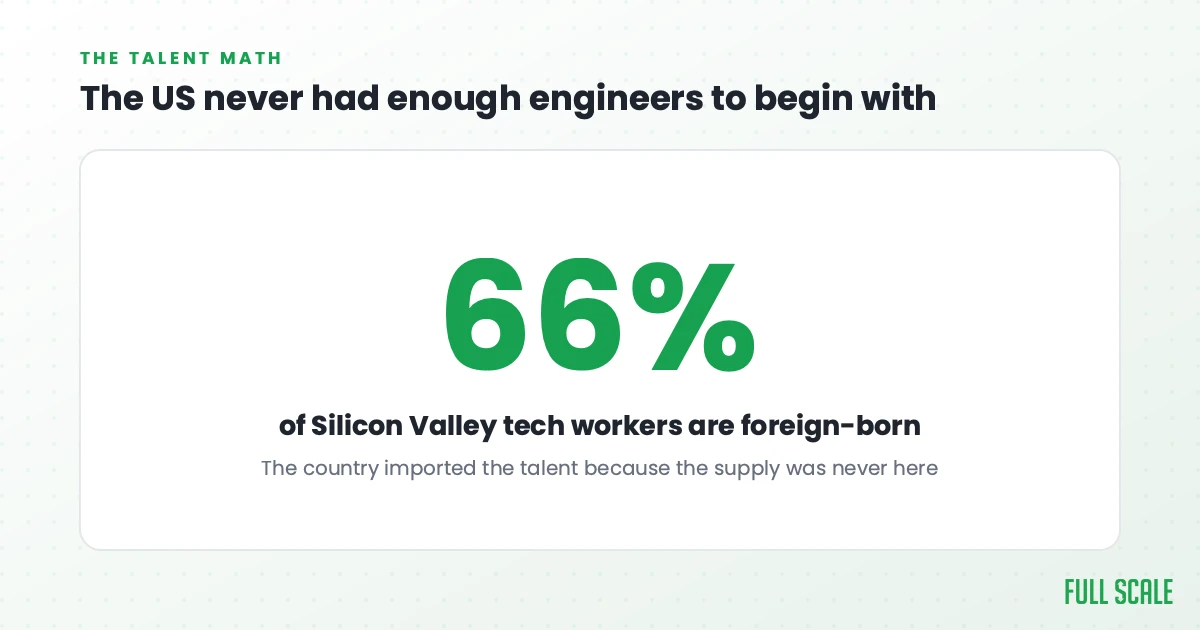
I see it with my own eyes. In Kansas City, where I am based, most of the developers I meet were born here. Go to the coasts and that flips completely. Two-thirds of Silicon Valley’s tech workers are foreign-born. The country did not import that talent for sport. It imported it because there were never enough engineers born here to do the work.
Go one level deeper. Only a small share of people can do this kind of work at all. Just about a quarter of US workers are in any STEM field, and the people who can do software are the same people who become doctors, lawyers, accountants, and other engineers. That pool is finite, and software competes with every other demanding profession for it.
The supply gap shows up in the numbers. We graduate around 108,000 computer science bachelor’s degrees a year against roughly 129,000 software openings a year. The gap does not close because we passed a law.
I will be honest about the other side of this. The market softened recently, with about 152,000 tech layoffs in 2024 and 122,000 in 2025. The near-term hiring picture is cooler than it was.
But that is a cycle. The structural shortage of people who can build software is not going anywhere, and a $100,000 fee to bring one of them into the country does not fix it. It just makes building the team somewhere else the smarter move.
This is why I say software talent is everywhere except where you need it. You go find it where it lives, which increasingly means building a team in places like the Philippines.
Outsourcing is what lets small companies grow into big employers
The “outsourcing destroys American jobs” argument has the chain of cause and effect backwards.
Think about a startup. It cannot pay $50,000 a year for a marketer, a support rep, or a junior developer. So without a lower-cost option, it does not hire that role at all. It just goes without, grows slower, and sometimes dies.
Give that same company an affordable offshore option and, done well, something different happens. It fills the role, ships faster, wins customers, and grows. A growing company then hires more people, including the expensive senior staff in the US it could only afford because the rest of the work got done.
This is not a hopeful theory. When economists studied US multinationals, they found that expanding abroad went with more investment and higher pay at home, not less. A 10% rise in their foreign investment lined up with a 2.6% rise in their domestic investment. Foreign and domestic work turned out to be complements far more often than substitutes. To be fair, it depends on the type of work. When a company ships the exact same job overseas, it can substitute. When it sends different work, the home team grows.
None of this means nobody gets hurt. Offshoring is a net gain for the economy, but the gains and the losses land on different people, and the worker whose job moved is real. The honest fight is about who bears that cost. A tariff or a fee does not help that worker either. It just raises the price of building software for everyone else.
I have lived this. When I first started hiring developers in the Philippines, I sat down with my senior engineers in the US and told them the truth. The only reason I could pay them $140,000 a year was that I could hire three developers in the Philippines for that same amount, and those three did work my senior engineers led and managed. That was the only way the math worked. Take away the offshore team and I could not have afforded those local salaries at all.
I am not unusual. Some of the biggest names in software grew with global teams too. The lower-cost team is what makes the growth possible, and that growth is what creates the high-paying American jobs.
There is a wrong way to do it, and I have a name for it. I call it cheapshoring, hiring the cheapest body you can find and hoping for the best. Most offshore work fails because someone hands a pile of requirements to a vendor and expects a finished product back. That is not what works. What works is hiring people who work directly for you, on your team, for the long haul. Augmenting a team you already have with offshore talent is almost always the best formula.
The US economy already runs on outsourced talent
Look at the scale of what these bills would disrupt.
North America is the largest buyer of business process outsourcing in the world, somewhere around a third of the global market. Outsourced talent is woven into how American companies run, from the support desk to the data pipeline to the codebase.
The practical problem is bigger still. Most large companies are not American firms that happen to send work abroad. They are global companies. How would a tax on offshored work even apply to a business like Google, with employees in dozens of countries? A lot of those people are not there to save money. They are there because the company has customers there.
I ran into this directly. One reason my first company set up a headquarters in the Philippines was time zones, not cost. We had customers in 60 different countries, and I needed people who were awake when Australia was awake. You cannot serve a global customer base from one office in the US, and no tax changes that.
You cannot pull that out overnight and call it protection. Switching all of it off would not be a tariff on foreign workers. It would be a tax on every American company that depends on them, which is most of them. That is the kind of self-inflicted wound that good outsourcing strategy is supposed to avoid, not cause.
And it lifts the other side, too
A fairness question sits under all of this. Let me take it head-on.
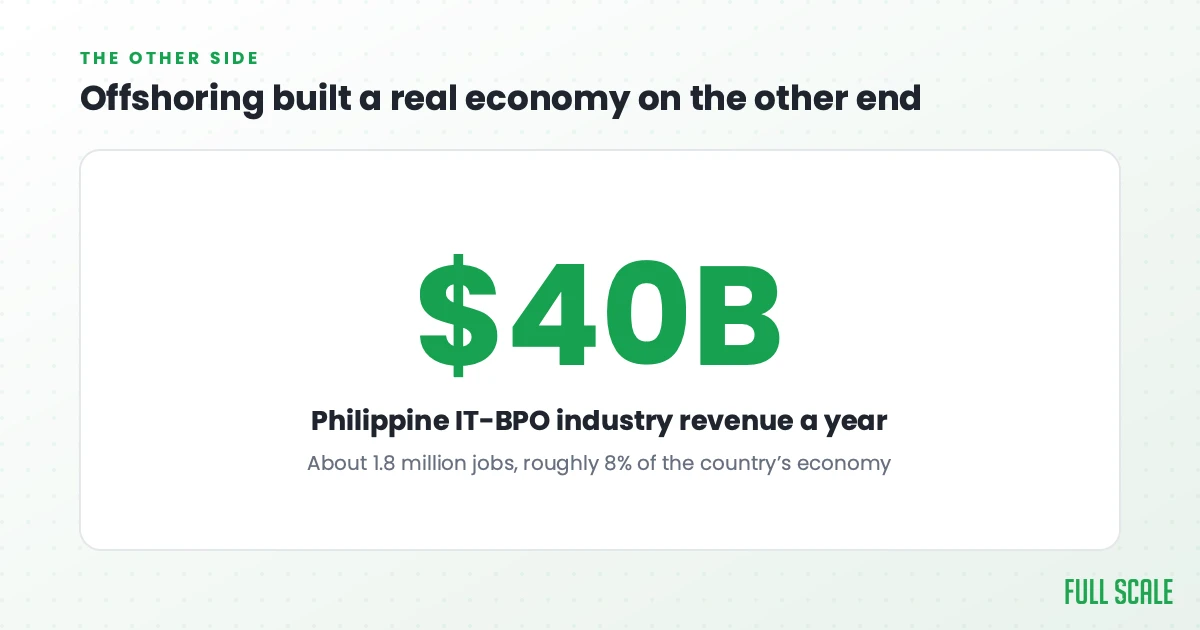
The Philippines, where my company hires, now runs an IT and business process industry worth around $40 billion a year that employs roughly 1.8 million people. That is around 8% of the country’s economy, about the same size as the money Filipinos working abroad send home. Industry estimates put the indirect jobs created around it at something like two to three more for every direct one.
The World Bank ties the country’s shift into these higher-paying service jobs directly to falling poverty. The Philippines is special that way. The work is not a handout and it is not a loss for anyone. It is a real economy lifting real families.
Some people will call this exploitation. That is a longer argument with a real answer, and I have made the full case on the ethics of offshoring elsewhere. For here, the simple point stands: the bills aimed at punishing this trade would hurt American buyers and Filipino workers at the same time, to bring home jobs that were never going to come home.
What this means if you build software
So here is where I land, as the person who has to make these decisions with real money.
The political noise will keep coming, and some of it will keep getting struck down. None of it changes the underlying math. There are not enough software engineers in the US, the ones we have are expensive, and the work moves to where the talent and the value are. That has been true for twenty years, and a fee or a tax does not undo it.
If anything, AI raises the stakes. As AI makes writing code cheaper, the scarce skill shifts to judgment, communication, and product sense. That is what a strong, integrated team gives you, and it is the opposite of cheap, routine execution. It makes a good offshore team more valuable than ever.
The question was never whether to build with global talent. It is whether you do it well. Done badly, as cheapshoring, it fails and earns the bad reputation. Done well, as staff augmentation where engineers work directly on your team for the long term, it is how a smaller company competes with a bigger one.
That is the part I care about most, and it is the heart of what I wrote about in Product Driven: the leaders who win are the ones who build the right team to ship the right thing, wherever that team happens to live. We keep 93% of our engineers year over year and have built that way since 2018, because integrated long-term teams beat disposable ones every time.
The war on outsourcing keeps losing in court. It loses on the balance sheet too.
Frequently asked questions
Will Trump ban IT outsourcing?
No. There is no law or executive order banning IT outsourcing, and none has been proposed. The “ban” idea came from an online activist, not from policy. The real measures were a $100,000 H-1B visa fee and tariffs. Courts ruled both unlawful in 2026, and an appeals court has since refused to let the visa fee take effect while the government appeals, and the HIRE Act, a bill to tax outsourcing payments, is stalled with no cosponsors. Tariffs also apply only to physical goods, not to software or services.
Is it still worth outsourcing software development right now?
Yes, for most companies it still makes sense, and the current policy fights do not change the core reasons. The US has a structural shortage of software talent, US salaries are high, and global teams let smaller companies build and grow. The risk to manage is not policy, it is execution: hire people who work directly on your team for the long term rather than handing requirements to a faceless vendor.
Does outsourcing software development cost American jobs?
The evidence points the other way for most companies. Research on US multinationals found that expanding work abroad went with more domestic investment and higher domestic pay, because growing companies hire more people overall. Affordable offshore talent often lets a startup survive and scale, which creates the high-paying US jobs it could not have funded otherwise.
Why do US tech companies rely on H-1B visas and offshore developers?
Because the talent is genuinely scarce. About 65% of H-1B petitions are for computer-related roles, and the program is heavily oversubscribed. Foreign-born workers make up close to 40% of software engineers, and two-thirds of Silicon Valley’s tech workforce was born outside the US. Companies hire globally and sponsor visas because there are not enough domestic engineers to fill the work.
Building a software team and weighing whether offshore talent fits your plan? Schedule a call with Full Scale and we will talk through what it actually takes to do it well.