
Toptal vs Gigster: Pick the Model, Not the Brand

In this article
- These aren’t competitors. They’re two different models.
- Toptal in one line: rent a vetted individual
- Gigster in one line: hand over the whole project
- Toptal vs Gigster: where each one actually wins
- The question both models dodge: who owns the product when they leave?
- The third model: a dedicated team that works for you
- So which should you choose?
- Frequently asked questions
- Neither one leaves you a team you can keep
Search “Toptal vs Gigster” and almost every result asks the same question: which one is better? It’s the wrong question.
I’ve hired developers through both of these models. I’ve used a marketplace where you pick a vetted individual and point them at your work, and I’ve used a managed shop that takes the whole project off your hands. Over the years I’ve hired developers in Russia, Uruguay, Colombia, and the Philippines, with different levels of success in all of them. I’ve built and sold two companies on offshore talent, and I run Full Scale, a company that does a third thing entirely. In all of that, the brand on the invoice was never what decided whether the work succeeded. If you want an honest Toptal review before you pick a model, I wrote one.
The model decided it.
Toptal and Gigster are both good at what they do. They are also two completely different things wearing the same “premium tech talent” label. One rents you a person. The other runs the project for you. Picking between them on price, vetting claims, or which homepage looks shinier misses the only thing that matters: which model fits the work you actually have.
So let’s compare them honestly, and then talk about the option neither one is.
These aren’t competitors. They’re two different models.
Here’s the cleanest way to hold the difference in your head.
Toptal is a freelance marketplace. You stay in charge. You describe the role, Toptal matches you with a senior freelancer from their network, and from there you manage that person the way you’d manage any contractor. You set the work, you run the standups, you decide what “done” looks like. If you are not sure a managed shop or a marketplace is even right, I broke down which Toptal alternative fits which job.
Gigster is a managed delivery shop. They take charge. You bring a project, Gigster assembles a team around it (developers, designers, a project manager, QA), and they run the delivery. You’re the client receiving a deliverable, and Gigster runs the team day to day.
That single difference (who’s actually steering the work) drives everything else: cost, control, how knowledge sticks around, and what happens when the engagement ends. Everything that follows comes back to it.
Toptal in one line: rent a vetted individual
Toptal launched in 2010 and built its reputation on one promise: the “top 3%” of freelance talent across software, design, product, and finance. The vetting is real, and the bar is high. There’s usually a short no-risk trial period too, so you can replace a poor match early. When you need a specific, senior skill set fast, a marketplace like this earns its rates. If your real alternative is the open market rather than another managed shop, I also broke down Toptal vs Upwork.
This is a different thing from a broad marketplace like Upwork, where you sort through everyone from ten-dollar-an-hour generalists to senior specialists and do all the vetting yourself. I broke down where Upwork itself fits, and where it doesn’t, in a full guide to Upwork alternatives. (I’ve seen plenty of founders learn the hard way how that goes wrong.) Toptal’s whole pitch is that it does the filtering up front.
I’ve done the marketplace thing myself. When I had a quick, well-scoped piece of work (a WordPress build, an Elasticsearch project) I handed it to a freelancer and it worked fine, because the job had clear edges and a clear end. That’s the sweet spot. For an AI-vetted network instead of a managed shop, see how Toptal and Turing compare.
Toptal fits when the work is scoped, specialized, and short. You need a senior React engineer for a three-month push, or a data scientist to build one model, and you have the technical leadership in-house to direct them. Rates commonly land somewhere around $60 to $200 an hour depending on the skill, which is premium for freelance but reasonable for genuinely senior help on a defined task. Toptal has also expanded into team and managed options, but the individual you pick and direct is still its core model.
The catch is built into the model itself.
Freelancers are transient by design. They juggle several clients, they’re already lining up the next gig, and when your engagement ends, everything they learned about your codebase, your product, and your customers walks out the door with them. You also carry all the management overhead yourself. The marketplace finds you the person. After that, the hard part (keeping them, directing them, retaining what they know) is on you.
For a one-off, that’s fine. For a product you’re going to keep building, it’s a slow leak.
Gigster in one line: hand over the whole project
Gigster solves the opposite problem. Instead of handing you a person to manage, it manages the work for you. Today the company pitches three flavors (fully managed projects, dedicated teams, and on-demand specialists) drawn from a network it describes as around 50,000 vetted experts, with a heavy current focus on AI development. The fully managed version promises delivery “across scope, time and budget.”
If you’re a non-technical founder or an enterprise team that needs a defined thing built and has nobody internal to run engineers, that’s genuinely useful. You’re buying a finished outcome instead of running a hire yourself.
But the managed model has a failure mode I’ve watched play out for years.
In my experience, the most common way these projects go sideways is also the simplest: someone hands a pile of requirements over the wall and expects a finished product to come back. Software doesn’t work like that. Requirements are never complete, the right answers surface mid-build, and the people who learn those answers are the ones doing the work. In a managed engagement, those people aren’t yours. The institutional knowledge accrues to the vendor, and you talk to a project manager instead of the engineers.
That distance is the real cost, and it’s bigger than the invoice. I write about this trap in my book, Product Driven: the further the people building the product get from the people who understand the customer, the worse the product gets. A black box, however well run, puts that distance at the center of the engagement.
To be fair, for a true one-and-done build with a clean handoff and solid documentation, that distance can be a price worth paying. You weren’t going to keep the team anyway. The trouble is that most software isn’t one-and-done, which is the whole boundary this decision turns on.
Gigster also doesn’t publish pricing, so the real comparison happens on a sales call. That’s normal for managed services. Just go in knowing you’re buying a one-time project rather than an ongoing team.
Toptal vs Gigster: where each one actually wins
| Toptal | Gigster | |
|---|---|---|
| What you get | A vetted individual freelancer | A managed team and a delivered project |
| Who manages the work | You do | Gigster does |
| Best-fit work | Scoped, specialized, short-term tasks | Defined projects when you have no internal engineering |
| Time to start | Often within days | Weeks, to scope and staff the team |
| Who owns the knowledge | The freelancer (it leaves when they do) | The vendor (it stays with them) |
| Pricing | Roughly $60–$200/hr, commonly reported | Not public; quoted per project |
| Control | High, but all management is on you | Low; you receive a deliverable |
| When you change direction | Re-brief or re-hire the freelancer | Re-scope through the vendor |
| What’s left after it ends | Whatever you documented yourself | A finished project, but no standing team |
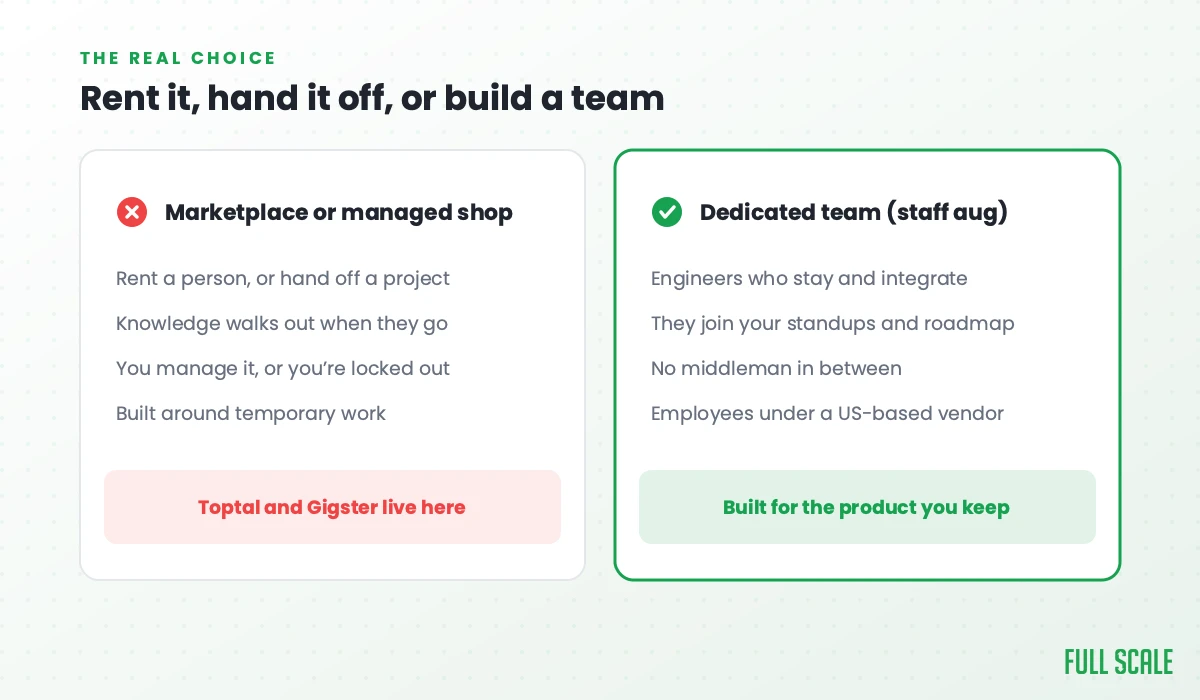
Look down that table and a pattern shows up. Both models are built around temporary. Toptal lends you a person for a while. Gigster delivers a project and moves on. Neither one is designed to leave you with a team that’s actually yours.
For a lot of work, temporary is exactly right. For the most common case I see, it isn’t.
The question both models dodge: who owns the product when they leave?
Most companies aren’t trying to ship one feature and walk away. They’re building a product they’ll keep building for years. The roadmap doesn’t end. The codebase compounds. The hardest, most valuable knowledge (why the system is built the way it is, what customers actually do, what broke last time) lives in the people who’ve been there a while.
We aren’t in this for some three-month project, and neither are most of the companies worth building.
That’s the gap. A rented freelancer optimizes for their next gig. A managed vendor optimizes for delivering scope and protecting its margin. In both cases, the moment the engagement ends, the thing you most needed to keep (continuity) is the thing that leaves.
If you’re building something durable, renting a person or outsourcing a project both fall short. You need engineers who work like they’re yours, because for all practical purposes they are.
The third model: a dedicated team that works for you
This is the model Full Scale runs, so read the rest with that in mind. I’m not a neutral party. But I built the company around this approach precisely because I’d watched the other two models leave the same gap.
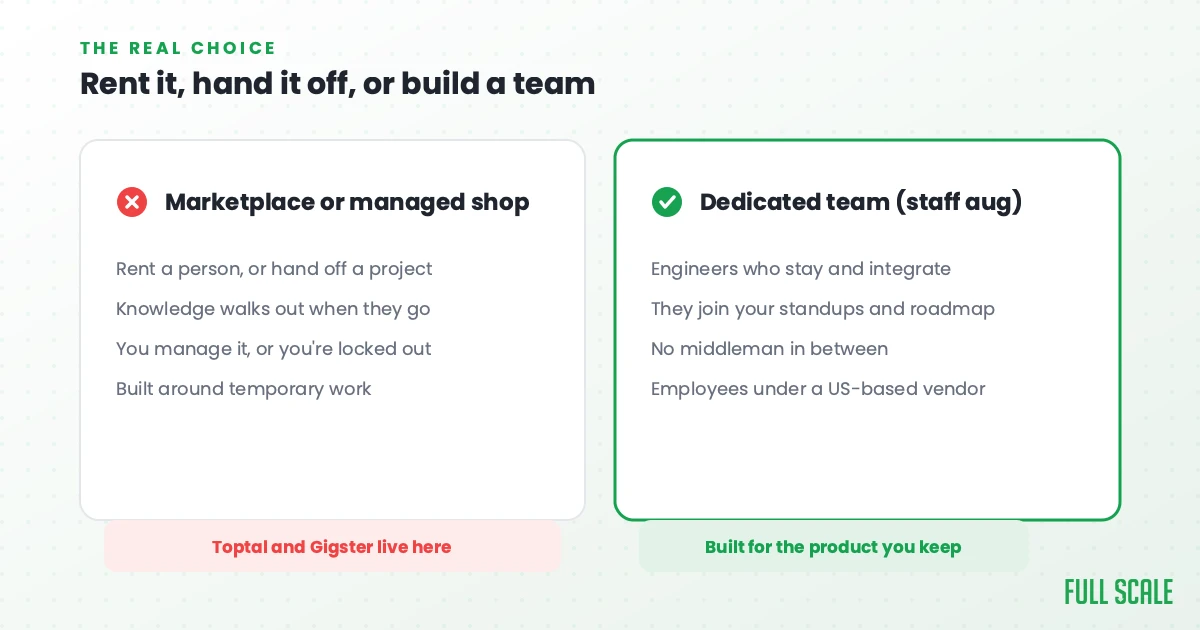
It’s called staff augmentation, sometimes a dedicated team model, and the structure is simple. You get dedicated engineers who join your standups, your tools, your code reviews, and your roadmap. There’s no middleman and no project manager standing between you and the people writing the code. You direct them like your own team. They stick around long enough to learn your product deeply, because they’re full-time employees of the vendor rather than gig workers cycling through.
That last point is where the accountability lives. Our developers are Full Scale employees, which means contracts, IP assignment, and confidentiality run through a US-based company under US law, not through an individual freelancer abroad who can disappear. In the history of the company, we’ve never had a single IP or confidentiality issue. A freelancer can ghost a client. An employee answers to their employer.
You can see the difference in how the relationship behaves over time.
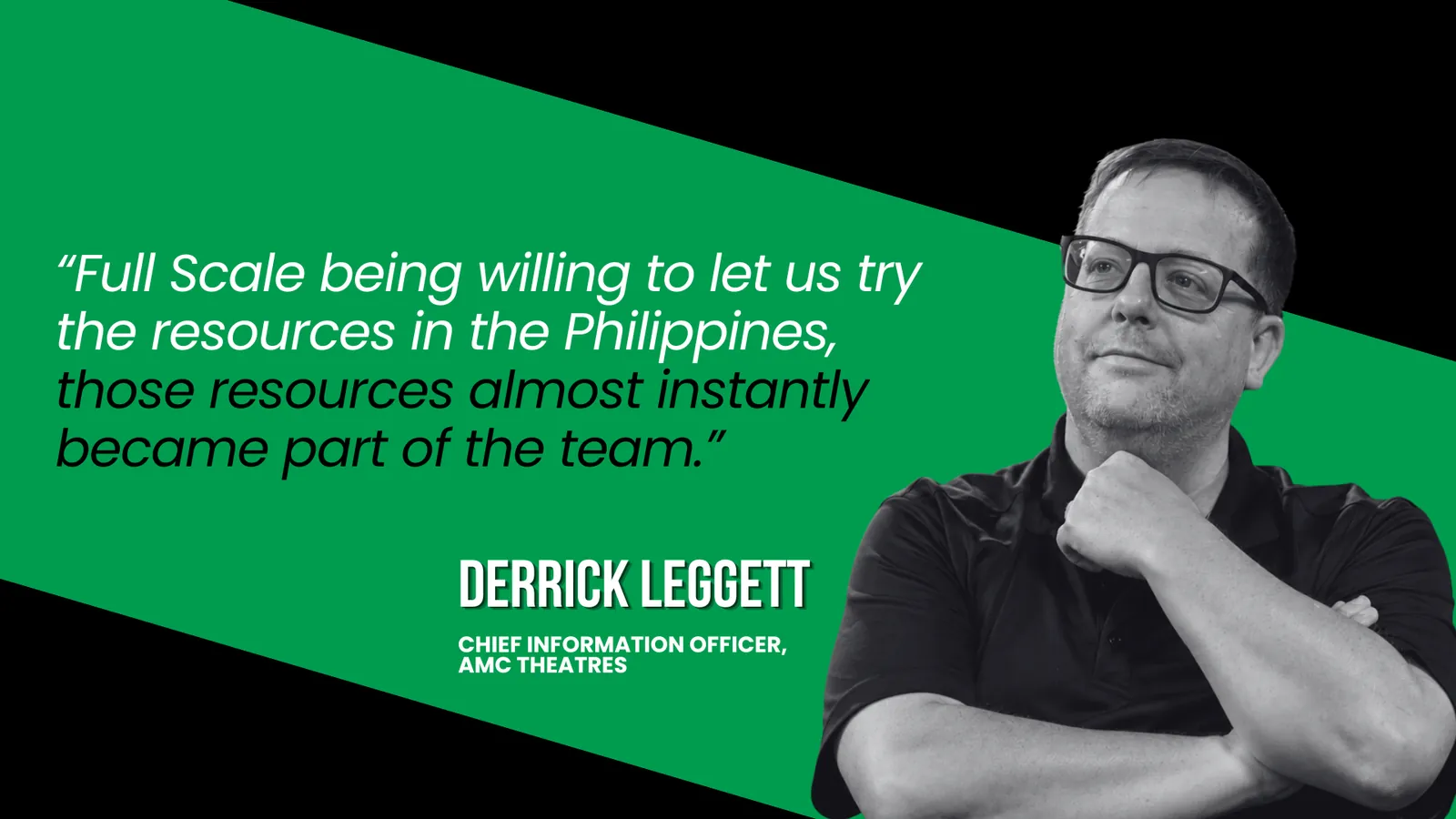
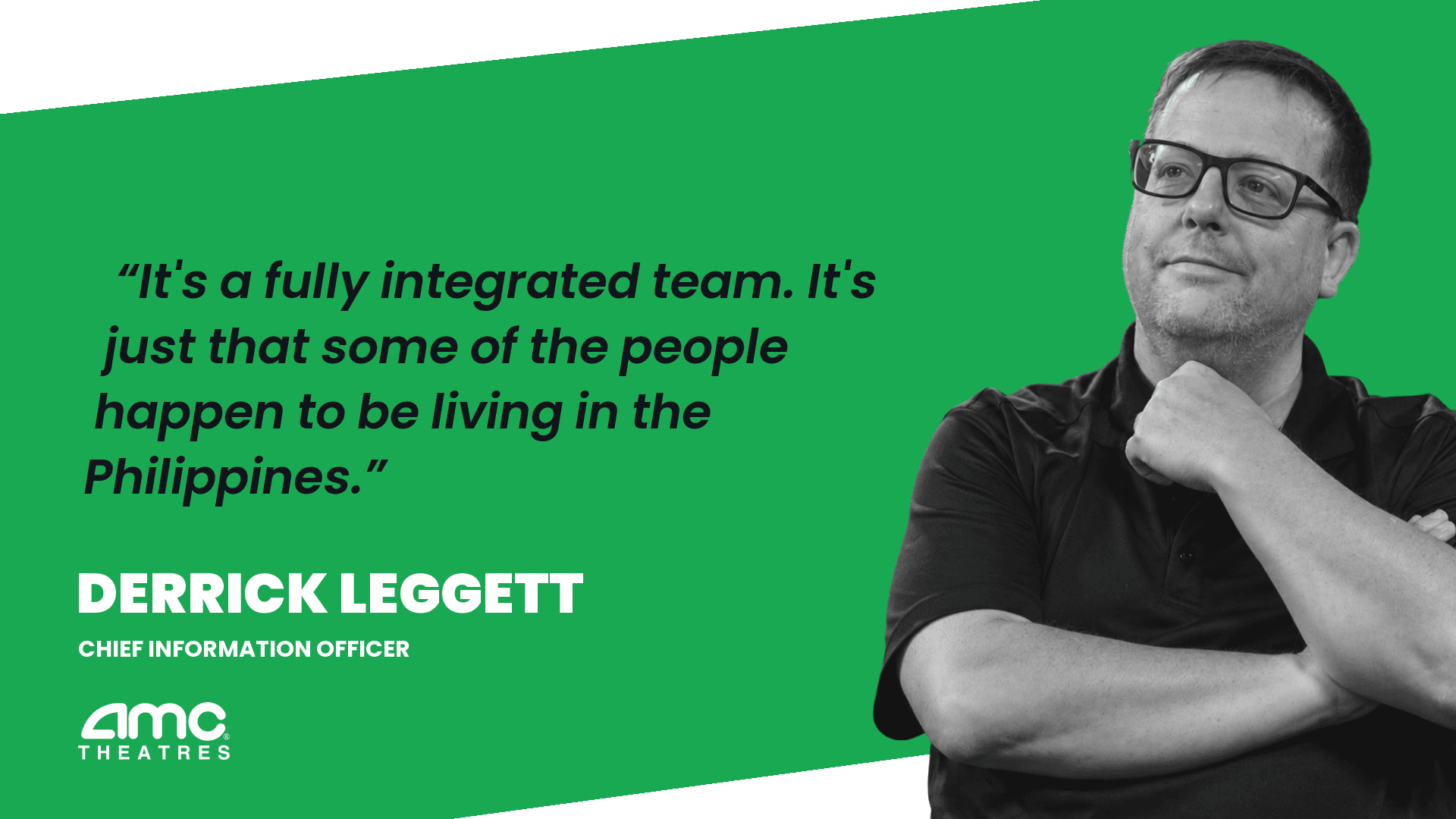
At AMC Theatres, our developers in the Philippines join the same standups and own the same roadmap as the Kansas City engineers. Their CIO, Derrick Leggett, put it this way: “It’s a fully integrated team. It’s just some of the people happen to be living in the Philippines.” No freelancer relationship sounds like that, and neither does a managed black box.
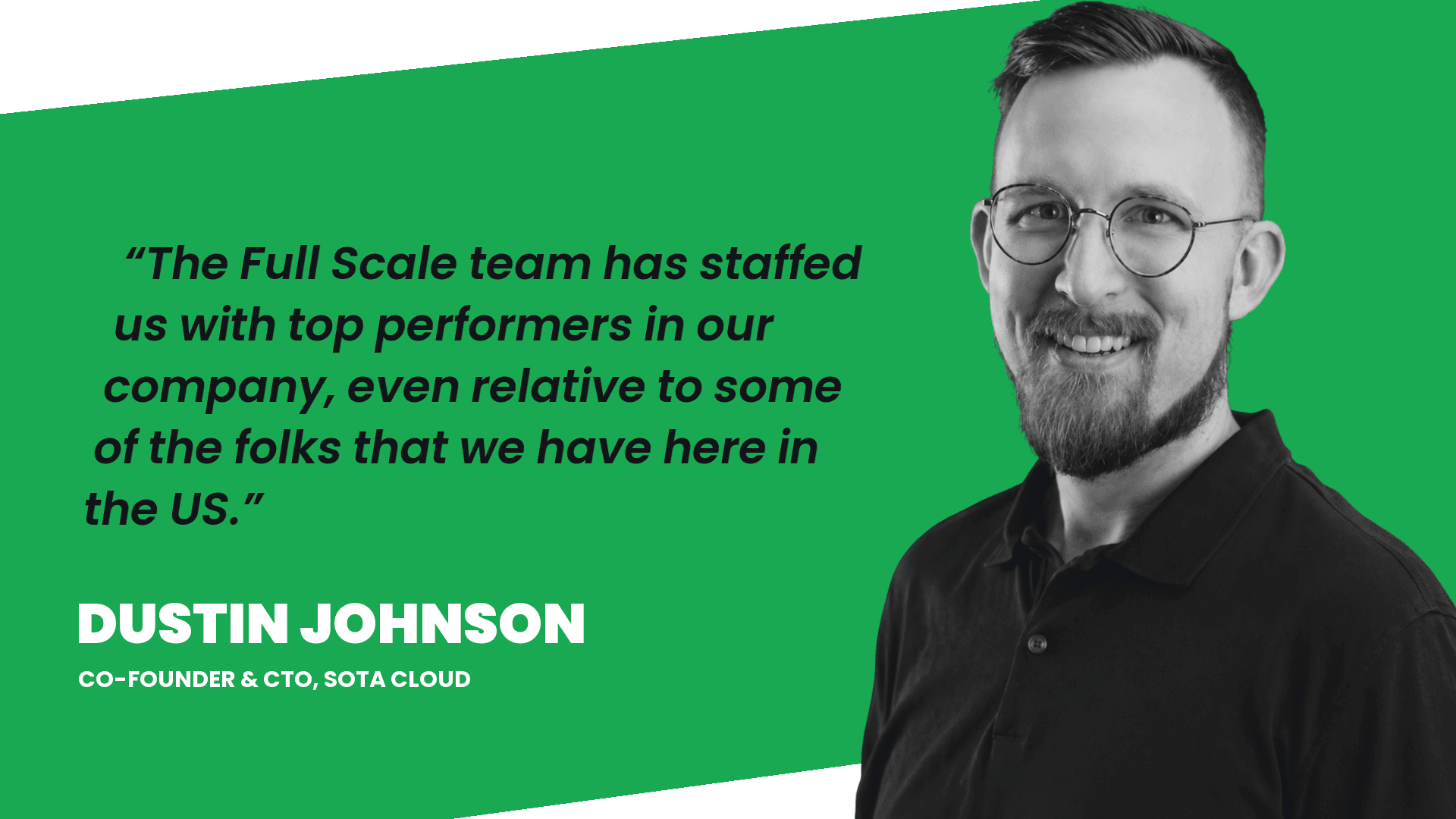
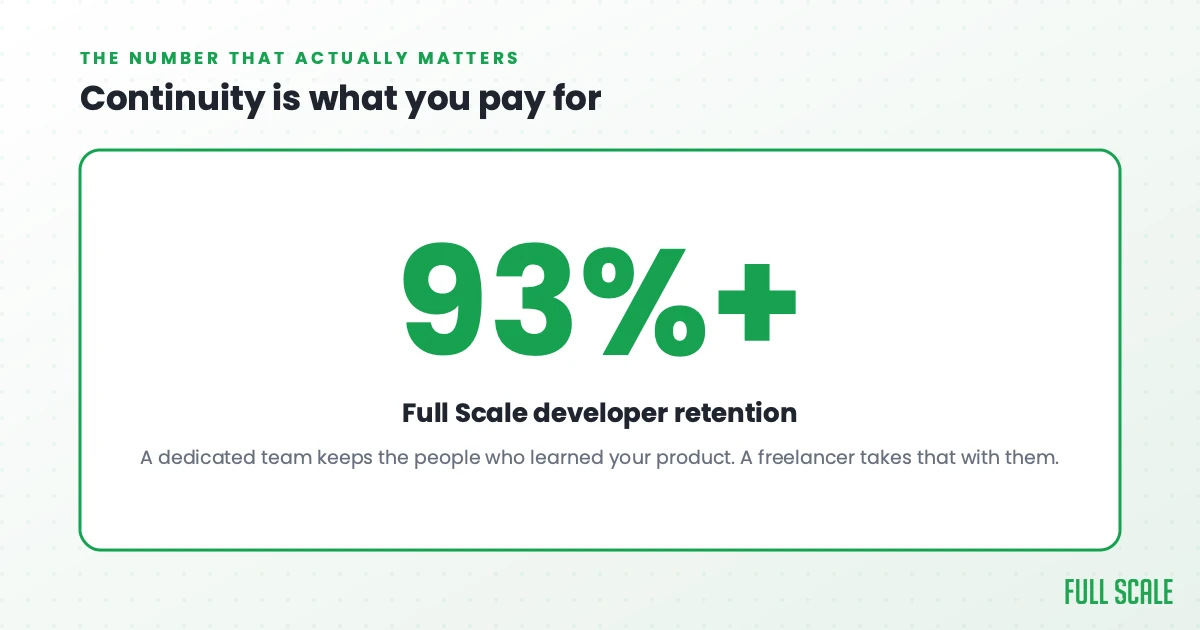
At SOTA Cloud, CTO Dustin Johnson describes the same thing from the talent and retention angle: “The Full Scale team has staffed us with top performers in our company, even relative to some of the folks that we have here in the US.” Retention matters because the value is in continuity. We hold 93% developer retention, so the engineer who learned your system last year is still on it this year.
One honest caveat, because it cuts against my own pitch: don’t read “dedicated team” as “go find the cheapest developers you can.” Hiring the absolute cheapest help is its own expensive mistake, one I call cheapshoring. The arbitrage that works is high-quality talent globally at a fair, fully-loaded rate (ours is $35 an hour), not the bottom of the market. A premium brand like Toptal or Gigster won’t save you from a model mismatch, and a bargain-basement shop won’t save you money. Pick the right model first, then a partner you can trust inside it.
So which should you choose?
Skip the “which brand wins” debate. Match the model to the work.
- Scoped, specialized, and short, with the engineering leadership in-house to manage a contractor? A marketplace like Toptal does this best. Hire the individual, point them at the task, wrap it up.
- A defined project, little or no internal engineering, and you’d rather buy an outcome than build a team? A managed shop like Gigster is built for that, and for the right project it’s worth the premium.
- Building a product you’ll keep building, and you want the engineers and their knowledge to stay in-house? A dedicated team fits. This is most companies, more often than the first two crowds will admit.
Since I sell the third model, here’s the honest disqualifier for it. A dedicated team is the wrong call when the work is a genuine one-off with a hard end date, when the task is small enough to wrap in a few weeks, or when you have nobody internal to point engineers at. Those are the marketplace and managed-shop cases, and forcing a standing team onto them just burns money.
The brands will keep marketing at each other. Your job is to ignore that and pick the model. Get that right and almost any decent partner inside it will work. Get it wrong and the best brand on the market won’t save the project.
Frequently asked questions
Is Toptal better than Gigster?
Neither is “better” because they solve different problems. Toptal matches you with an individual freelancer you manage yourself, which suits scoped, specialized, short-term work. Gigster runs a managed team and delivers a whole project, which suits companies with a defined build and no internal engineering. The right choice depends entirely on whether you want to direct the work or hand it off.
Is Gigster worth the cost?
For a clearly defined project where you have nobody internal to manage engineers, a managed shop can be worth it because you’re buying a finished outcome instead of a hiring and management process. The tradeoff is control and knowledge: the team and everything it learns belong to the vendor, not to you. If you’ll keep building the product after launch, that lost continuity often costs more than the project fee saved.
What’s the difference between Toptal and Gigster?
Toptal is a freelance marketplace where you select and manage a vetted individual. Gigster is a managed delivery service where the vendor assembles and runs a full team to deliver a project. The core difference is who steers the work: with Toptal it’s you, with Gigster it’s them. That one distinction drives the differences in cost, control, and what you’re left with when the engagement ends.
Are there alternatives to Toptal and Gigster?
Yes. The most common alternative for companies building an ongoing product is staff augmentation, where you get dedicated engineers who work directly inside your team long-term rather than a rented freelancer or an outsourced project. Other options range from broad marketplaces like Upwork to vetted networks like Turing and Arc, plus traditional staffing agencies and direct offshore hiring. The work you have should decide the model.
Can I hire a whole development team through Toptal?
Toptal has added team and managed options, but its core model is matching you with individual freelancers you manage as separate contractors. Stitching several of them together isn’t the same as a team that has actually worked as one unit. If you want a cohesive team that stays together long-term and learns your product, a dedicated team model fits that better, and I ran the direct head-to-head in Toptal vs staff augmentation.
Neither one leaves you a team you can keep
Toptal and Gigster both solve real problems. They just solve different ones, and neither is built to leave you with a team you can keep. If you’re building a product for the long haul, that’s the gap that matters most.
If that sounds like your situation, let’s talk about what a dedicated team would look like for you.