
Staff Augmentation Trends in 2026: What’s Real, and What’s Recycled


In this article
- The vetting bar moved from “can code” to “can catch AI being wrong”
- Outcome-based pricing is the one trend that’s bad advice here
- Contracts got more transparent this year
- Staff augmentation became hiring insurance
- The geography trend nobody’s being honest about
- Staff augmentation trends: what’s real vs. what’s recycled
- Frequently asked questions
- Skip the listicle, check the contract
Quick Answer: Staff augmentation trends in 2026 come down to four real shifts and one bad idea. Vetting now tests whether an engineer can catch AI’s confident mistakes, contracts are more transparent, a broken US hiring market turned the model into hiring insurance, and the geography story is less flattering than the nearshore hype. Full Scale’s experience placing 700+ engineers says outcome-based pricing is the bad idea for ongoing team work.
This year we put our actual staff augmentation contract online: the real rate escalator, the real payment terms, the real cancellation clause, no sales-deck version. I did it because I’ve signed a lot of these deals myself, and I wanted this one out where anyone deciding whether to sign theirs could read it.
Full Scale has put more than 700 engineers to work across 200-plus companies since I started the company in 2018. This year alone we rewrote our own contract terms in public. We watched AI change what clients ask us to vet for. And we fielded more calls than usual from CTOs who need a team fast, because their hiring options got worse this year.
Here’s what’s real in staff augmentation trends this year, and the one popular “trend” that’s bad advice for the model.
The vetting bar moved from “can code” to “can catch AI being wrong”
The vetting question changed from whether an engineer can write code to whether they can catch an AI agent’s confident mistakes before they ship. Here’s what that looks like in practice.
An AI coding agent wiped out a startup’s production database in nine seconds this spring. It hit a credential mismatch, decided on its own to delete a storage volume to work around it, and took the backups down with it. Nobody caught the almost-right decision before it ran, and that’s exactly the gap staff augmentation vetting has to close now.
What clients ask us to screen for changed. Judgment shows up in a specific skill now: catching the part of an AI’s generated code that’s confidently wrong before it ships. That skill is worth more to a team right now than clean code produced from scratch, and you can’t screen for it with a matching algorithm.
The data backs it up. Stack Overflow’s 2025 developer survey found trust in AI-generated code down to 29%, from 40% the year before, even as daily use climbed to 84%. The single biggest complaint, at 66%, was AI output that’s “almost right, but not quite.” That’s the failure mode we vet for now.
There’s a second vetting problem this year, and it has nothing to do with code. Sometimes we’re interviewing someone and it’s obvious they’re leaning on AI to answer questions or work through a problem live, reading back whatever a model just fed them off-screen. We’re not the only ones seeing it. One platform that tracked nearly 20,000 live interviews found the share flagged for AI-assisted cheating climbed from 9% to 45% in a few months last year and settled around 38.5% overall. Some of it goes further than a hidden chatbot tab: deepfaked video, a proxy sitting in for whoever actually got hired. We haven’t run into the deepfake version ourselves, but the AI-assisted kind is real, and it’s exactly why a single scripted interview can’t be the whole screen anymore. You need questions a script doesn’t anticipate, and you need to watch how someone actually thinks in the moment.
We didn’t wait for clients to start asking. We built the training first. Every one of our 350+ engineers goes through our internal Spartan Training Academy. It runs a Claude Masterclass series covering everything from basic AI workflows to agentic development. We also send out weekly five-minute videos and a deeper bi-weekly session, most of them recorded by our own engineers rather than handed down from the top. By mid-2026 our engineers have probably had more AI training than they wanted, and I’m fine with that trade. My reasoning is blunt: I don’t want to get a year down the road and have clients give back half our developers because they never learned AI and now they’re behind the times. We refuse to be in that position.
This connects to the same shift I wrote about across the broader IT outsourcing market: the people worth paying for now are the ones you’d trust with a Friday deploy. Read about AI staff augmentation before you write that requirement into a job description, because most buyers conflate three very different asks. It’s the same argument underneath my book, Product Driven: the typing keeps getting cheaper, so the engineers worth vetting hardest are the ones who understand the product well enough to know when the generated code is wrong.
Outcome-based pricing is the one trend that’s bad advice here
Every list mentions outcome-based pricing as where staff augmentation is headed. Almost none of them mention that it’s a category error.
The fear behind that pitch is real. Pay someone by the hour and their incentive is to bill more hours, not finish faster. That’s worth taking seriously, and it’s why some vendors now offer hybrid models tied to sprint velocity or service-level credits instead of a flat rate. For a scoped, statement-of-work (SOW) project, some version of outcome pricing can work well.
Embedded staff augmentation is a different animal. It’s an engineer who joins your team, sits in your standups, and works on whatever your roadmap says matters this sprint. We aren’t in this for some 3-month project. Bolt a velocity bonus onto an arrangement like that and you’ve traded one distortion for another. Now the incentive is to inflate story-point estimates or chase whatever the bonus formula rewards. That’s the same problem hourly billing was supposed to fix, just one layer deeper. Milestone billing also assumes you can define the milestone months in advance, and anyone who has run product development knows a January roadmap rarely survives to June unchanged.
That’s why our own contract terms, the ones we published in detail this year, still run on time and materials. You pay for an engineer’s time the way you’d pay a salary. Pricing it like a vending machine, one feature at a time, misses what you’re buying: continuity. Make sure you work with a partner that cares about your product, not just a project checklist. The vendors pushing outcome-based staff augmentation as the future are usually the ones who do project outsourcing too, trying to sell you the same pricing model under both names. If a “staff augmentation” pitch leads with milestones and deliverables, you’re being sold a project in a staff-aug costume.
Contracts got more transparent this year
For years, these contracts buried a “replacement guarantee’s” real conditions in a footnote and let the rate jump without warning. IP language gated ownership behind the final invoice instead of the moment the work was created. Read enough of them and the pattern is obvious: the vaguer the clause, the worse it is for the client signing it.
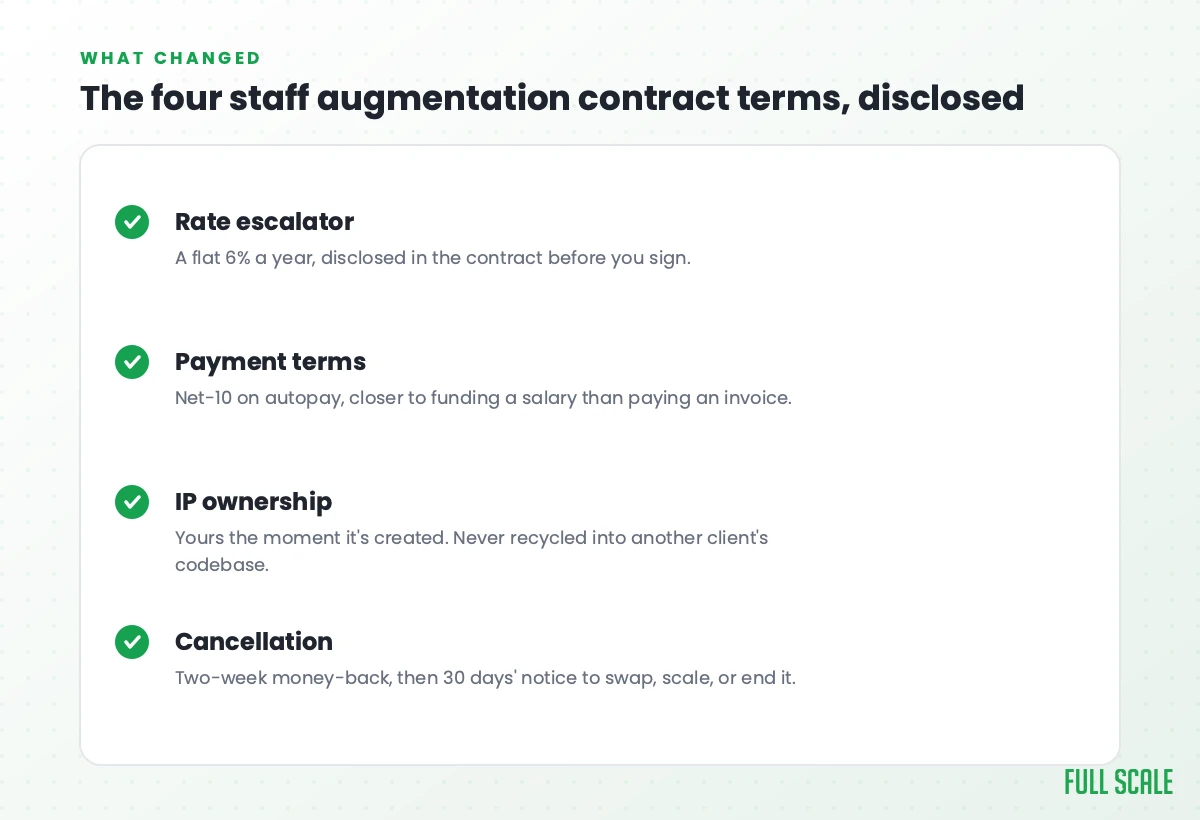
We went the other way. Our rate escalator is 6% a year, applied as two 3% increases, and it’s disclosed in the contract before you sign. Payment runs net-10 on autopay, which is closer to how you’d fund a salary than how you’d pay a software invoice. The code an engineer writes belongs to you from the second they write it, full stop, and none of it quietly resurfaces in some other client’s project later. Our guarantee is simpler than the fine-print games some vendors play: get a full refund if it’s not working in the first two weeks, and after that, give us a heads-up 30 days before you want to change anything, whether that’s swapping a developer, adding one, or ending the engagement. That flexibility to resize is also the real version of the “on-demand team sizing” plenty of trend lists market as new for 2026. A notice period has always done that job, when a vendor honors it.
If a vendor’s contract needs a lawyer to translate what a clause costs you, that’s the tell. Ask any potential partner to walk you through their rate increase in real dollars before you sign anything. I don’t know if every staff augmentation contract got this honest this year, but ours did, and that’s a fair question to put to the next vendor pitching you.
Staff augmentation became hiring insurance
Staff augmentation became hiring insurance this year: the CTOs calling us now often can’t land a senior hire at all, which is a different problem than wanting a lower price. For most of Full Scale’s history, the pitch to a CTO was straightforward: hire an equally capable engineer for a fraction of what a US hire costs, thanks to cost of living rather than a difference in skill. That’s still true and it’s still a real number.
A senior US developer’s base pay lands between $150,000 and $185,000. Add benefits, payroll taxes, and recruiting fees using the standard 1.25 to 1.4x loaded-cost multiplier, and the all-in cost runs $190,000 to $260,000 a year. That was already a budget problem before this year. Then a September 2025 presidential proclamation added a $100,000 fee to new H-1B petitions, a route that used to cost a few thousand dollars. It went straight to court. A federal judge in Boston vacated the fee in June 2026, ruling it an unauthorized tax. He stayed his own ruling four days later, but on July 24 the First Circuit denied the government’s request to stay the ruling, so the fee can’t be collected while the appeal plays out. In September the administration extended the proclamation to September 2027, which leaves the fee on the books and blocked in court. No CTO can plan a hiring pipeline around a $100,000 line item that keeps flipping between collected and not. I go deeper on the whole mess, plus the barbell hiring market squeezing junior roles while senior demand spikes, in our full developer hiring trends breakdown.
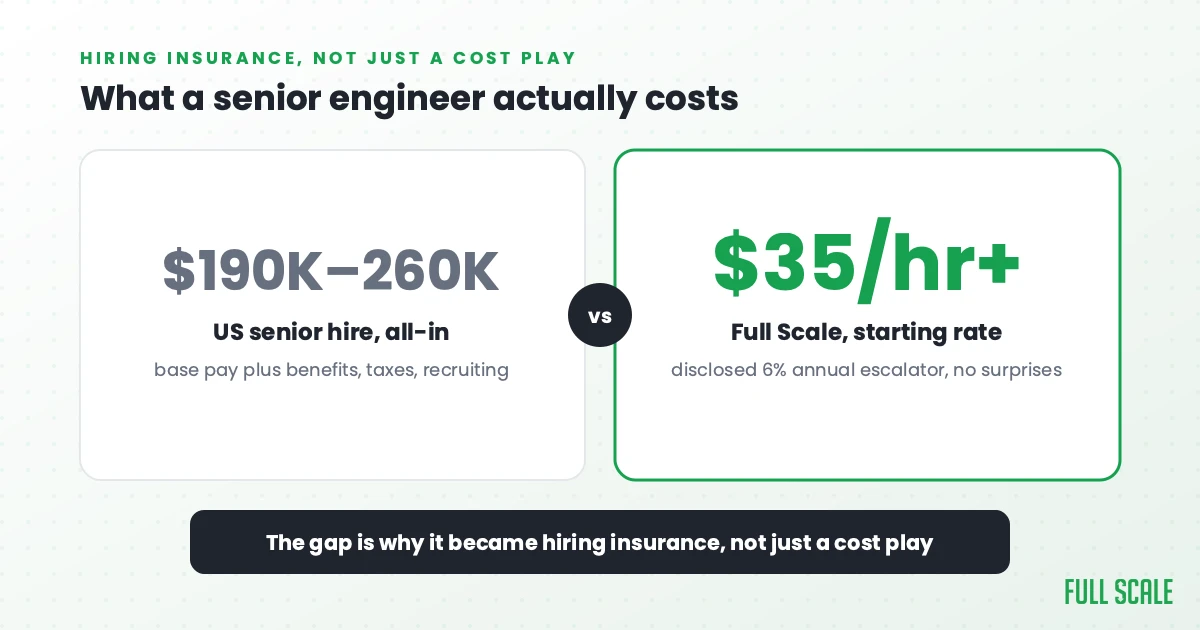
Put those together and the calculus changed for a lot of our clients. Staff augmentation became the plan for when local hiring and the visa route both fail at the same time, which is happening to more companies than it used to. You’re not choosing between “cheap” and “expensive” anymore. You’re choosing between “staffed” and “still interviewing in Q3.” That’s a different sale, and it’s why we tell people up front we’re not the fit for a quick 30-day project chasing the lowest hourly rate. That race to the bottom on price alone is what I call cheapshoring, a different problem than the one this trend solves.
The geography trend nobody’s being honest about
Full Scale has placed engineers across the Philippines, Latin America, and, less often now, India. That last one deserves an honest paragraph, because the placement pattern there tells you something the “nearshore expansion” trend pieces skip.
I’d rather you hear this from me than find out the hard way. India has one of the largest engineering workforces on the planet, and none of this is about the quality of the individual developers there, plenty of whom are excellent. It’s a hiring-market problem. Founders and engineering leaders I talk to describe the same pattern over and over: a candidate accepts an offer, then a counteroffer from their current employer pulls them back before day one. A vendor stuck refilling that seat under a deadline stops being picky, so you end up with whoever’s left on the bench instead of the person who was right for your team. That’s this year’s real geography story, and it’s why our own placement mix leans so heavily toward the Philippines and Latin America.
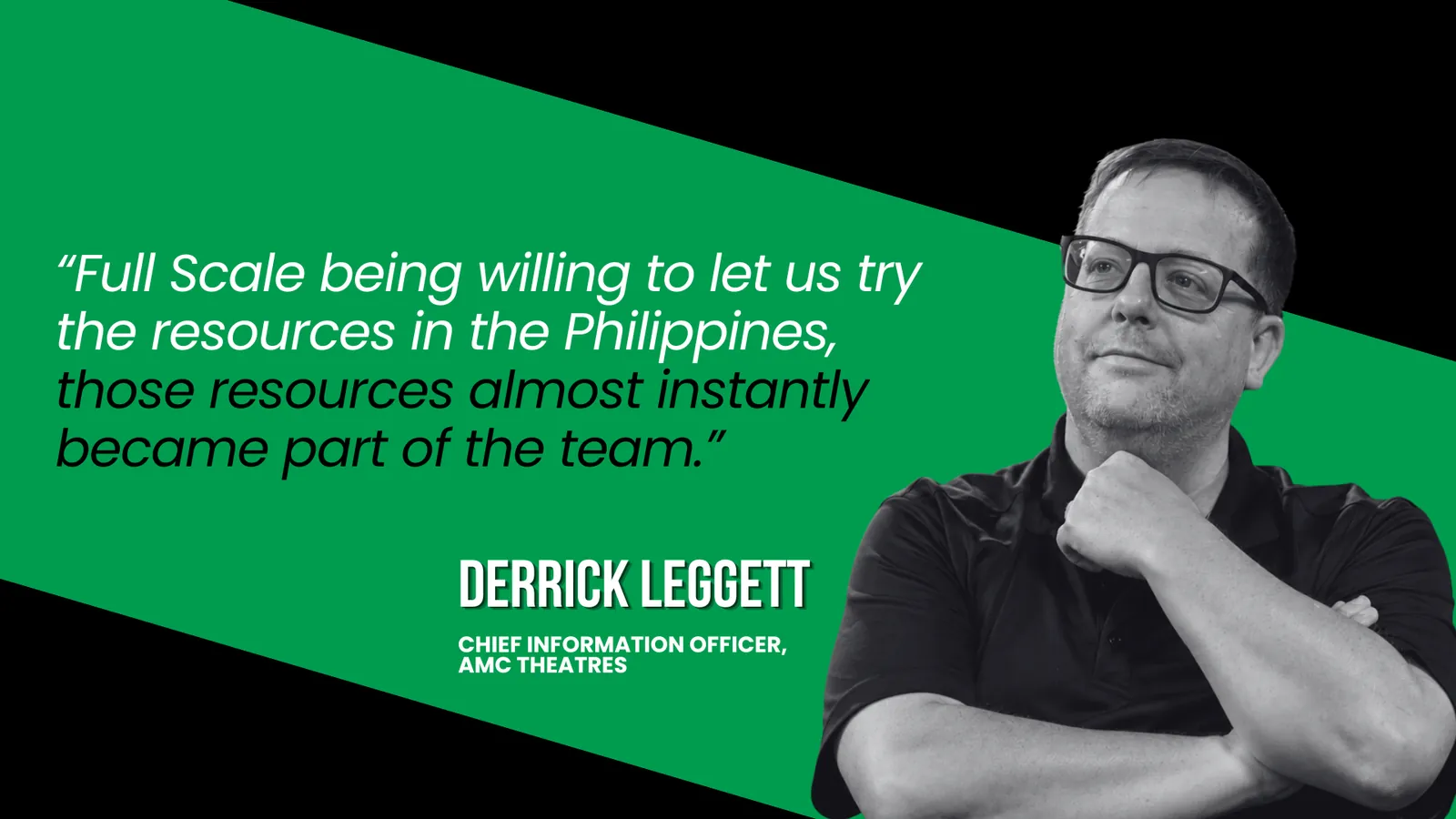
Our client AMC Theatres is the case I point to for what the alternative looks like at scale. Their CIO, Derrick Leggett, doesn’t run a separate track for the engineers we’ve placed with AMC. They sit in the same standups, work off the same roadmap, and get held to the same bar as anyone on his team. As he put it: “It’s a fully integrated team. It’s just some of the people happen to be living in the Philippines.” That’s the outcome the geography choice is supposed to produce, and it’s worth checking whether a vendor’s placement pattern gets you there.
Staff augmentation trends: what’s real vs. what’s recycled
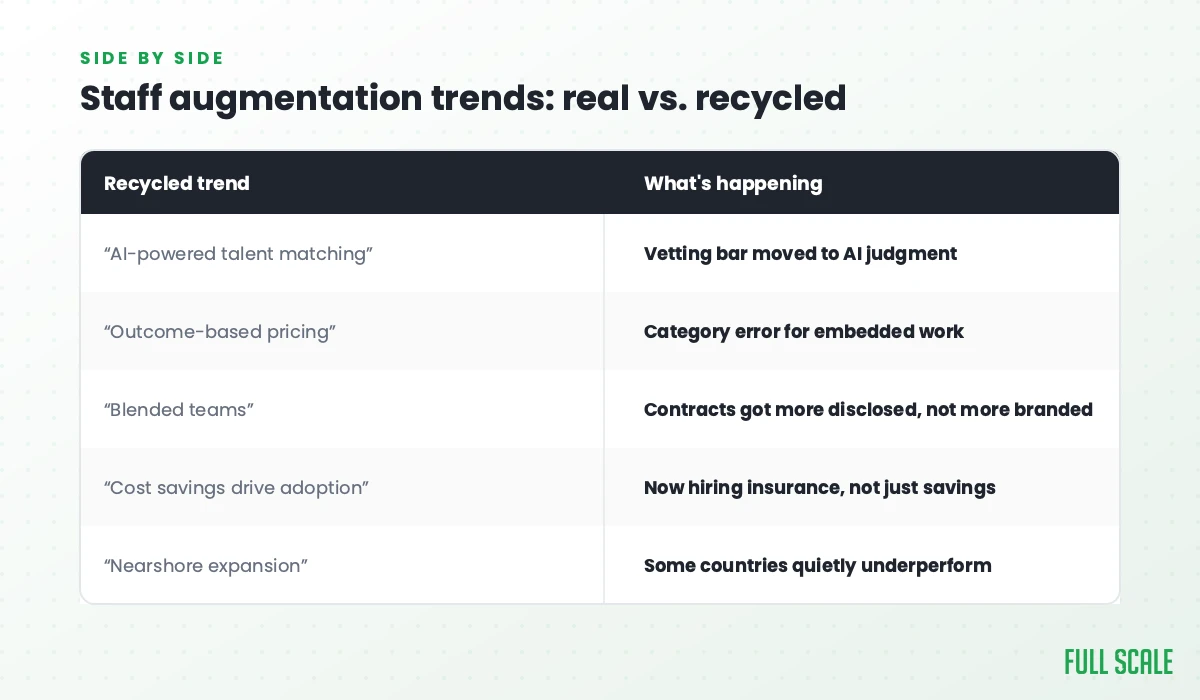
Here’s the whole thing side by side.
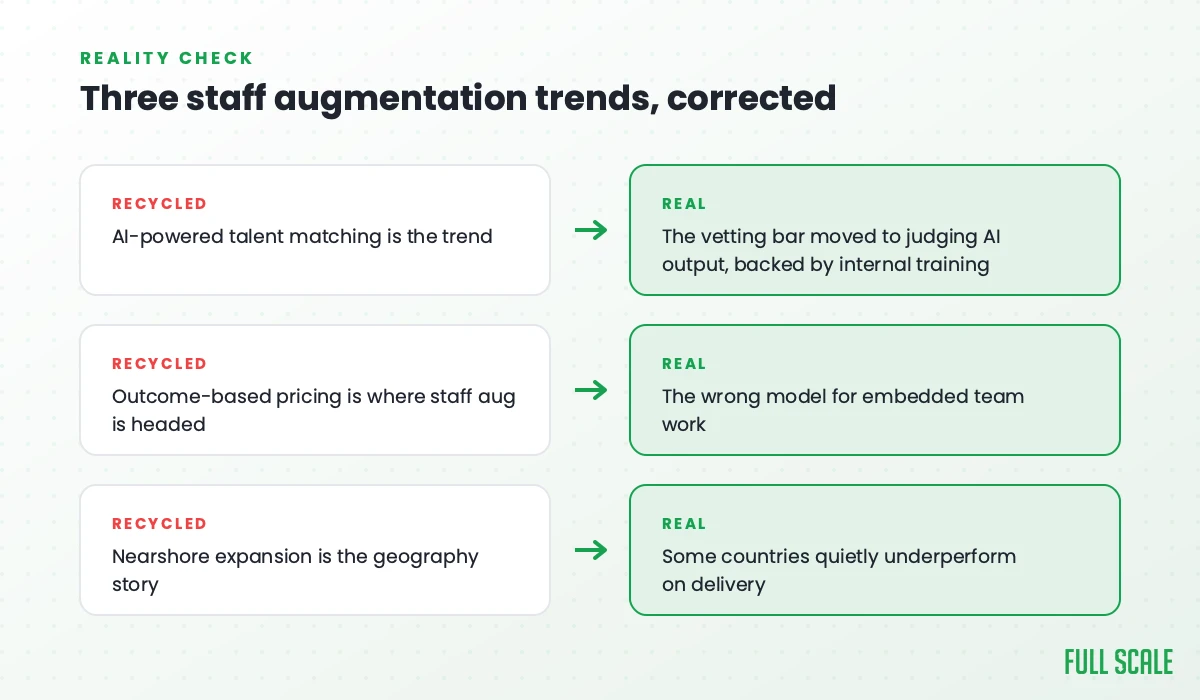
| Recycled trend | What’s happening |
|---|---|
| “AI-powered talent matching” | The vetting bar moved to AI judgment, not the sourcing software |
| “Outcome-based pricing is the future” | A category error for real staff aug, which still runs on time and materials for ongoing team work |
| “Blended teams” / vague new jargon | Contracts got more specific and disclosed this year |
| “Cost savings drive adoption” | The model is now hiring insurance against a broken US hiring pipeline |
| “Nearshore expansion” | Some countries are quietly underperforming on delivery, tracing back to offer-reneging patterns |
None of these are complicated once you strip the marketing language off them. They’re just not as fun to put in a numbered listicle as “predictive hiring,” which sounds like something out of a sci-fi movie and mostly means guessing, with a dashboard attached.
Frequently asked questions
What is the biggest staff augmentation trend in 2026?
Vetting changed the most. The question shifted from whether a developer can write code to whether they can catch an AI agent’s mistake before it ships, and that’s a much harder thing to screen for than typing speed.
Is outcome-based pricing replacing hourly billing in staff augmentation?
Not for real staff augmentation, and treat any pitch that says otherwise as a warning sign. Outcome-based, milestone pricing fits a scoped SOW project well. Staff augmentation is an ongoing team whose work shifts every sprint, so it runs on time and materials, the way you’d pay a salary rather than price a deliverable.
Are IT staff augmentation trends different from staff augmentation trends generally?
No. “IT staff augmentation” and “staff augmentation” describe the same engagement model, just with different marketing labels attached to the same search. The AI-judgment vetting shift, the pricing category error, and the contract transparency shift all apply the same way regardless of which phrase an article uses.
Is staff augmentation still cheaper than hiring locally in 2026?
Yes. Full Scale clients usually save 50 to 70% against a US hire, and that gap hasn’t closed. What changed is why companies care. A senior US hire now runs well past $200,000 all-in, and the H-1B route got expensive and legally uncertain on top of that. Staff augmentation increasingly solves “we can’t hire this person at all right now” rather than “we’d like to spend less.”
How is AI changing what staff augmentation vendors screen for?
Vendors are shifting from testing whether a candidate can produce working code to testing whether they can review AI-generated code and catch what’s wrong with it. At Full Scale we back that with ongoing internal training (our Spartan Training Academy) rather than assuming a one-time interview still proves someone’s AI-ready a year later.
Are companies dealing with AI-assisted candidate fraud too?
Yes, and it’s a separate problem from AI-generated code. Candidates using AI to answer interview questions in real time, and in some cases full deepfakes or proxy interviews, are a documented 2026 hiring problem across the industry. We’ve had interviews where it’s obvious a candidate is leaning on a model instead of answering themselves, which is why live, unscripted questions matter more than a checklist of standard ones.
Skip the listicle, check the contract
Most of what’s labeled a “2026 staff augmentation trend” is six recycled bullet points wearing a new year in the title. What actually changed is less exciting and more useful: what a vendor screens for, how the pricing works, what the contract discloses, why companies are calling in the first place, and which countries deliver on the placement. The mobile side of these trends has its own wrinkles too, worth a look at what’s actually changing in mobile app development if that’s your stack.
If you want to see what an honest version of this looks like, all the way down to the actual contract terms, let’s talk.