
Software Outsourcing Challenges, in the Order They'll Actually Hit You

In this article
- Software outsourcing challenges by stage: the timeline
- Before you sign: the problems you're buying without knowing it
- The first 30 days: the problems that start on your side
- Months two through six: communication challenges in outsourcing show up as rework
- After month six: turnover, knowledge loss, and cost creep
- How to overcome outsourcing challenges: process fix or model fix
- When a different model won't save you
- Frequently asked questions
- Plan for the challenges you'll actually face
Quick Answer: Software outsourcing challenges show up in a predictable order. Before you sign, the risks are vetting, pricing, and exit terms. In the first 30 days, they're unclear requirements, overlap hours, and system access. Between months two and six, communication gaps turn into rework. After that, turnover, knowledge loss, and creeping costs take over. Full Scale's view is that most early problems respond to better process, while most late ones are built into the project-outsourcing model.
Software outsourcing challenges don't all hit at once. They show up on a schedule, and the timing tells you more than the symptom does.
A communication problem in week two usually means your requirements were thin. Hear the same complaint in month nine and it's a different problem: the people who understood your product have left, and somebody new is guessing.
I've been working with developers outside the US since 2012, first at Stackify and then at Full Scale. Full Scale has placed engineers with US companies since 2018. Today we work with 80+ active clients. I should be upfront about my bias. Full Scale sells staff augmentation, and this article argues that the model you choose decides which challenges you get stuck with. Judge the argument with that in mind.
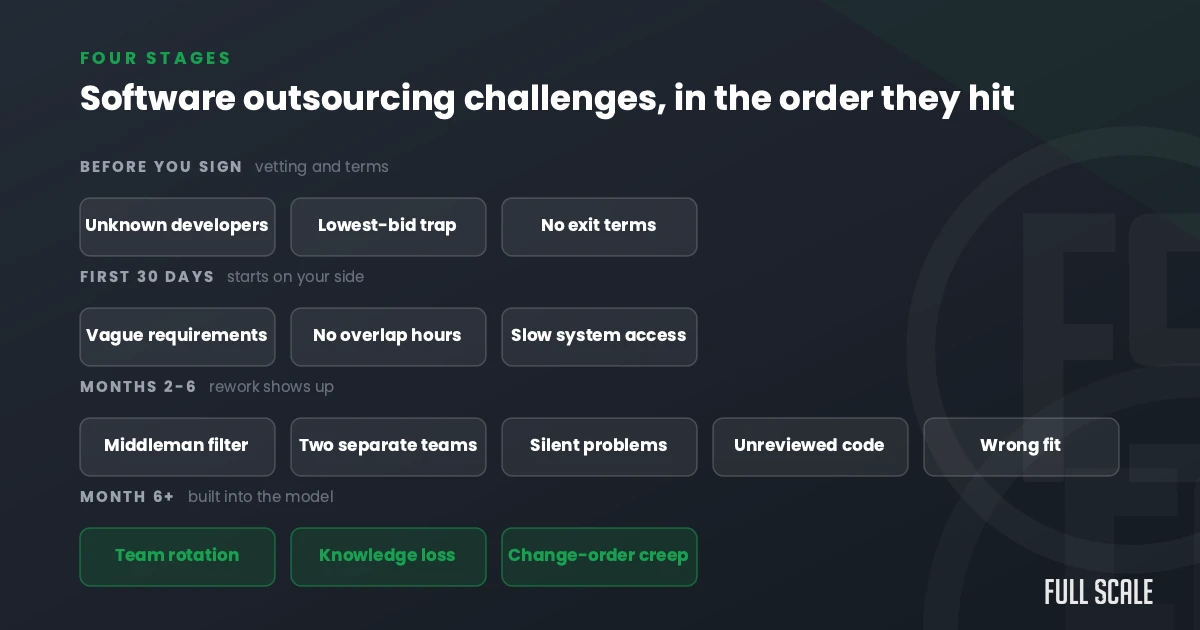
Software outsourcing challenges by stage: the timeline
The table below lays out software outsourcing challenges in the order they tend to arrive. The last column sorts each one with a simple test: a process fix is something you control, and a model fix is a problem the vendor's business model keeps alive.
| Stage | Software outsourcing challenge | What it usually means | Process fix or model fix? |
|---|---|---|---|
| Before you sign | You can't tell who will write the code | The vendor is selling a team you'll never meet | Model |
| Before you sign | The lowest bid wins | Hidden costs show up later as rework | Process |
| Before you sign | No exit terms | You haven't negotiated who owns the code | Process |
| First 30 days | Requirements get misread | The spec only made sense inside your head | Process |
| First 30 days | Little or no overlap in working hours | Nobody set a shared schedule | Process |
| First 30 days | Developers wait days for access | Your own IT and security queue is the bottleneck | Process |
| Months 2-6 | Work comes back wrong and gets redone | A middleman is filtering every conversation | Model |
| Months 2-6 | The outsourced group becomes a separate team | Nobody pulled them into your daily routine | Process |
| Months 2-6 | Nobody tells you when something is wrong | Nobody made it clear that pushback is wanted | Process |
| Months 2-6 | Quality drops as volume rises | Nobody who works for you owns code review | Process |
| Months 2-6 | One developer isn't a fit | The match is wrong, which isn't the same as a bad developer | Process |
| Month 6+ | Turnover on the vendor's team | Developers get moved to keep everyone billable | Model |
| Month 6+ | Knowledge leaves with each departure | Nothing is documented, and nobody on your side owns the code | Both |
| Month 6+ | Costs creep with change orders | A fixed-scope contract is being used for ongoing work | Model |
Nine of the fourteen are process problems. That's encouraging, because it means most of what goes wrong early is fixable without firing anybody.
Before you sign: the problems you're buying without knowing it
The first software outsourcing challenges are hard to see because you haven't met the team yet. You're reading a proposal.
You don't know who will actually write the code
Most outsourcing proposals spend pages on the company's process and certifications. What they rarely tell you is which developers will touch your code, and whether those people will still be on your project in six months.
At many firms, you talk to a project manager and a salesperson while the developers stay hidden behind them. Ask who's on the team and you get some version of "Don't worry, we have great people." Maybe they do. You'll find out after the contract is signed.
Even picking the developers yourself doesn't guarantee they show up. At Stackify, we made offers to developers through an outside engagement in India and waited out their 60-to-90-day notice periods. Partway through, we found out a candidate had taken a counter-offer and was never coming. As I've put it before: "The individual developers were never the problem; you lose trust in the process itself, and that's the key." That's the deeper story behind why outsourcing to India fails so often.
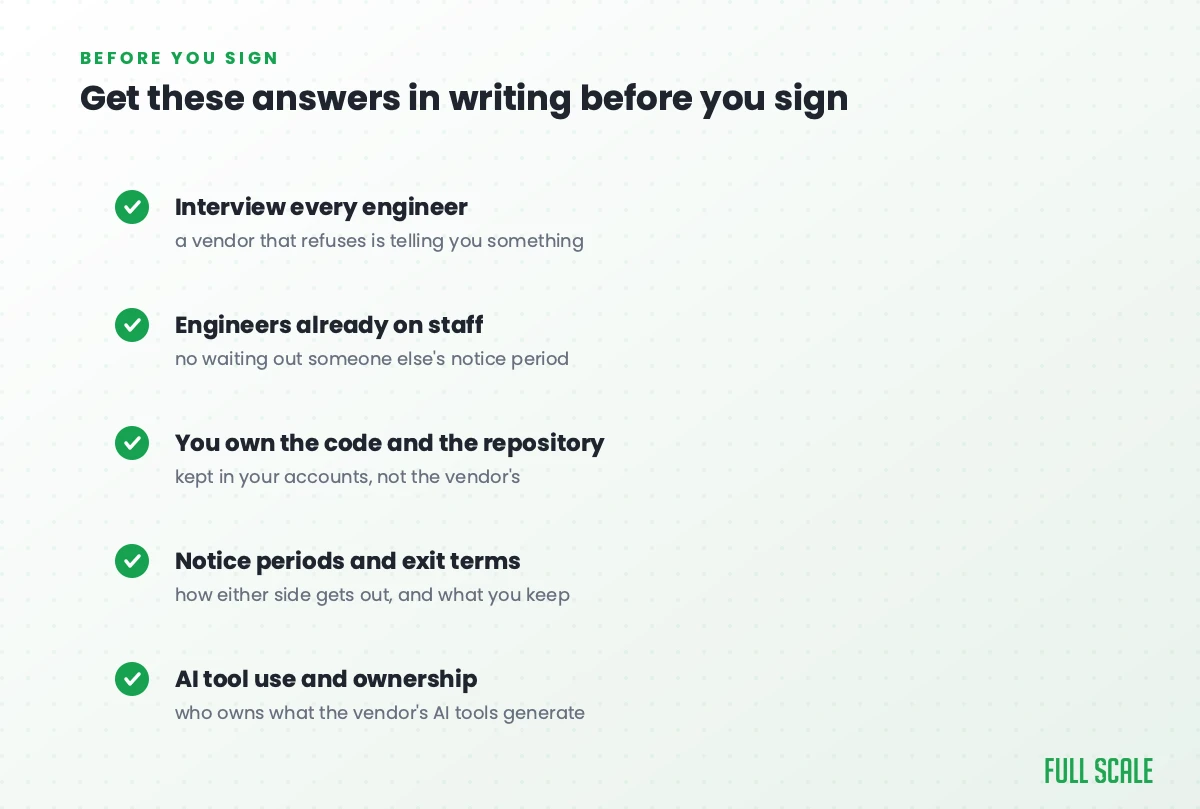
The real risk there was waiting months on people who weren't employed by anyone yet. A partner whose engineers are already on staff removes that wait. Then comes the second protection: meeting the engineers yourself before day one. Put each one through the same technical interview you'd give a direct hire. If they wouldn't pass it as an employee, they shouldn't pass it here, and a vendor that won't let you ask is telling you something. We wrote up how we interview developers at Full Scale if you want a starting point.
The cheapest bid has hidden costs of outsourcing baked in
Picking the lowest rate feels responsible. It usually isn't. A rate far below the market means junior developers or developers split across several clients. Sometimes it means a vendor that plans to make its money back on change orders.
I call this cheapshoring: offshoring for cost alone. With cheapshoring, you pay twice, once on the invoice and again in the rework. In my experience, the happiest clients found good people at a fair rate and then stopped shopping.
Buyers seem to be figuring this out. Deloitte's 2024 Global Outsourcing Survey shows cost is no longer the only reason companies outsource. Access to skilled people and the ability to move faster rank right next to it.
Nobody wrote down how you get out
Vendor lock-in starts the day you sign a contract with no exit plan. If the contract doesn't say who owns the code or where the repository lives, you're locked in before the first line of code. The same goes for notice periods and what happens to your documentation when you leave.
In 2026, add one more question to that list: how the vendor uses AI tools on your code, and who owns what those tools generate. A lot of contract templates were written before anybody thought to ask.
Get those answers in writing before you sign. Our breakdown of staff augmentation contract terms covers the clauses that matter.
The first 30 days: the problems that start on your side
The first month is when the challenges of outsourcing software development get real. Most of them start on the buyer's side of the table, so you can fix them yourself.
The requirements only make sense inside your head
You know your product, your customers, and the three weird edge cases that broke production last year. The new team knows none of it. A requirement that reads as obvious to you reads as a riddle to someone who started on Monday.
Plenty of founders think a few bullet points and a strong opinion count as a detailed spec. They don't.
Scope creep begins right here. The team builds what the ticket says, you realize the ticket didn't say what you meant, and the correction becomes a change request.
Spend the first weeks handing over context along with the tickets. Tell the team who the customer is and why the feature matters. Agree on what "done" looks like before anyone writes code. A team that understands the why catches the bad requirement before it ships.
Overlap hours get decided now, or never
The Philippines is 13 to 14 hours ahead of Kansas City, depending on daylight saving. That sounds terrible until you learn that many Filipino developers work evening or overnight shifts so they overlap with US teams. When I first hired developers in the Philippines for Stackify, they shifted their schedules to overlap about half their workday with ours. That team eventually passed 20 developers and helped carry Stackify to its 2021 exit.
Whatever the location, agree on the shared hours in week one and put standups and code reviews inside them, because a schedule nobody sets never sorts itself out.
Access and security wait on your own team
The new developers are ready on day one. Then they wait four days for a VPN account and permission to see the repository.
The invoice started on day one, of course.
Have accounts and access rules ready before anyone starts. If the real worry is someone walking off with your code, the answer is mostly paperwork and permissions. Keep the repository in your own accounts and give each developer only the access their work needs. The contract should assign all IP to you. Our IP protection framework goes through each control in detail. Those controls protect you far more than the vendor's location does. It also helps when the developer answers to a local employer. A freelancer who disappears costs you a contractor, and an employee who does it answers to their employer. At Full Scale, we've never had a single IP or confidentiality issue in the history of the company.
Months two through six: communication challenges in outsourcing show up as rework
This is the stretch where problems with outsourcing software development stop being theoretical. The work is flowing, and some of it is coming back wrong.
The middleman becomes the problem
When every question goes through one project manager, every answer arrives a day late and slightly changed. Developers can't get a quick answer on why a feature exists, so they guess, and details get lost along the way.
Early in my career, before I'd hired anyone offshore, I kept hearing the same complaint from people who had: "It was easier to just do the work myself." Ouch. Project managers getting in the way showed up on that list of complaints too.
Rework in months two through six is mostly a communication structure problem, and more meetings won't fix a structure problem.
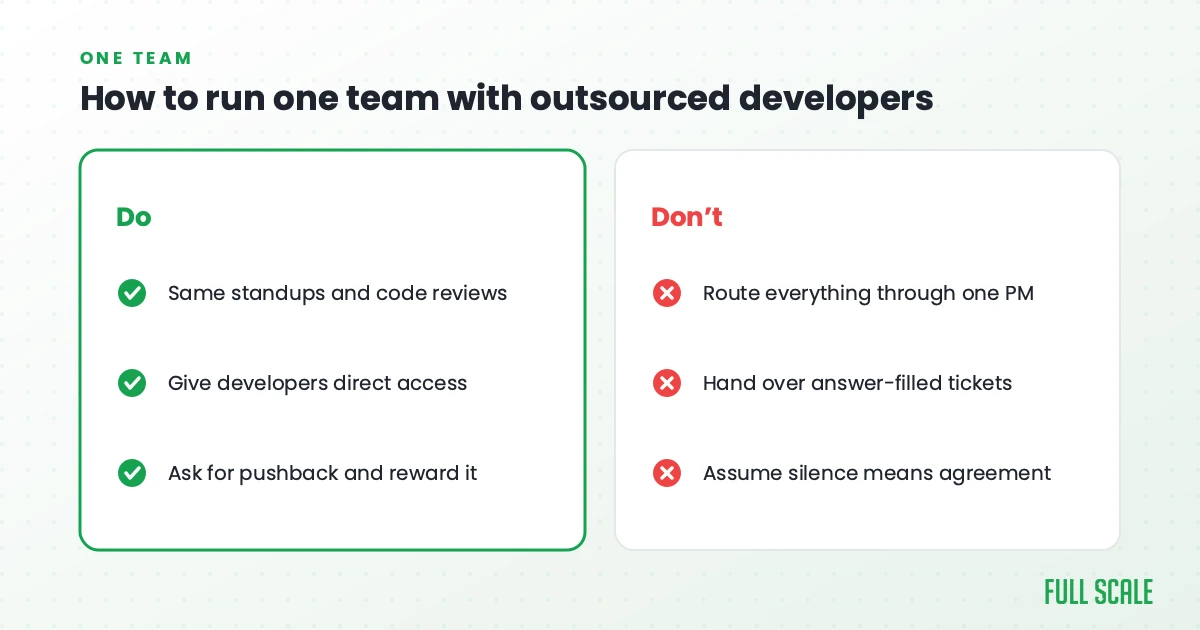
Direct access fixes it. Put your developers in your Slack and your standups, talking to the people who make product decisions. That's a model choice, and it's the main difference between staff augmentation and project outsourcing.
The outsourced group becomes its own team
Outsourced developers can have direct access and still end up as a separate group. The in-house people get the hallway questions and the quick calls, while the outsourced engineers get tickets. A few months later, you're the only person who talks to both sides.
The answer is boring, and it works: run one team. The outsourced developers sit in your standups, their pull requests get reviewed like everyone else's, and nobody gets a pass when the work is late. We go deeper on this in managing distributed teams. Every offshore group at Stackify reported to a developer sitting in Kansas City, with no more than five people per lead, and at our peak we had four of those groups going.
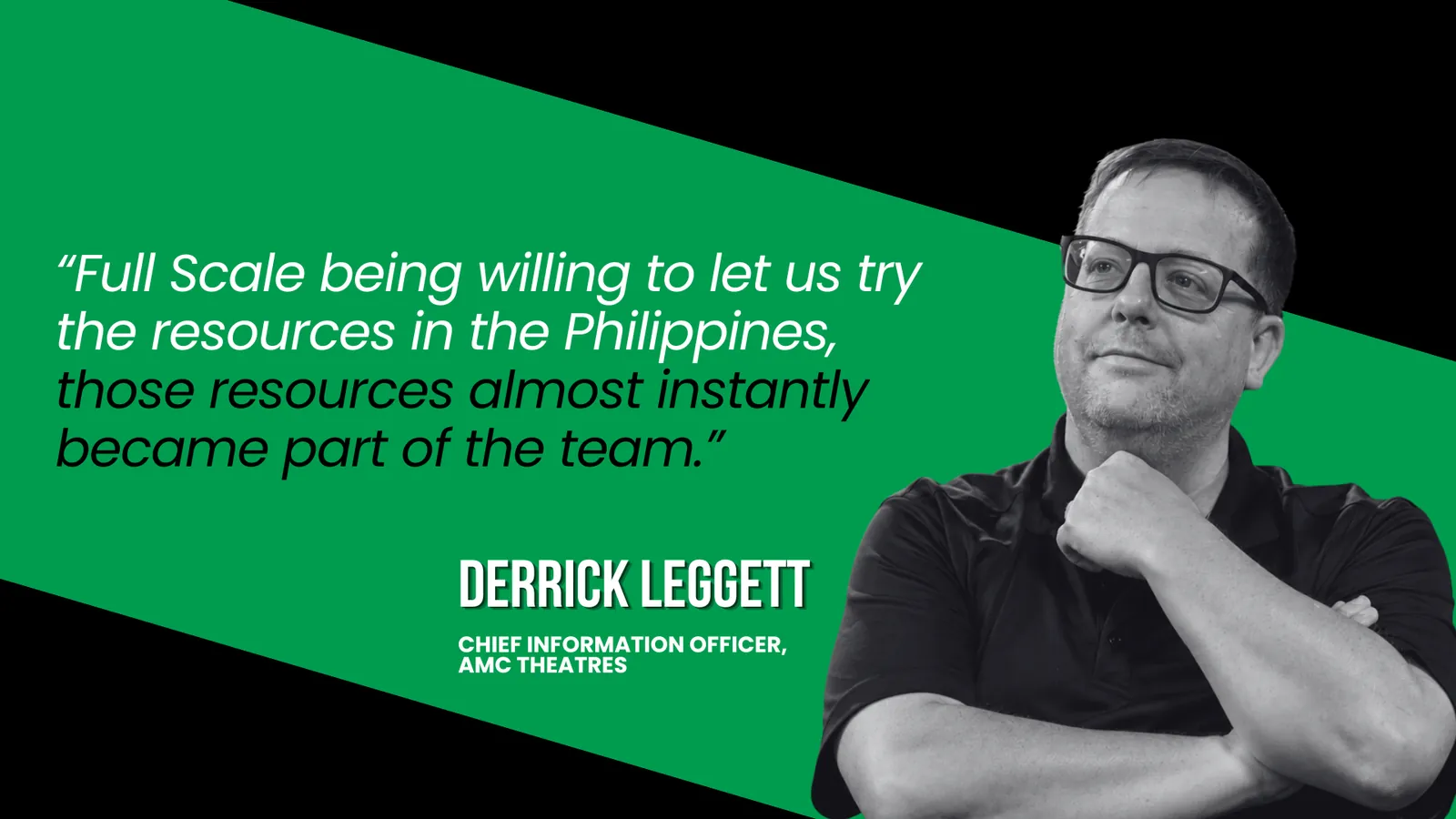
AMC Theatres is the best current example I know. Their CIO, Derrick Leggett, treats the Full Scale developers on his team as AMC engineers. In his words: "It's a fully integrated team. It's just that some of the people happen to be living in the Philippines."
One team also means letting the outsourced developers think. Ownership is one of the pillars in my book, Product Driven. If every ticket arrives with the answer already written in, developers learn to stop asking questions, including the ones that would have caught a bad idea.
Nobody tells you when something is wrong
Culture shows up here too, just not how people expect. Full Scale runs internal training for its customer success managers on the differences between Filipino and US work norms. The short version is that Filipino work culture tends to be polite and indirect. It values harmony and respects hierarchy, while US teams expect people to speak up regardless of seniority.
In practice, that means a developer may not tell you your plan has a problem unless you've made it clear you want to hear it. Ask directly and make a fuss over the first person who pushes back. The habit changes faster than you'd think.
Quality slips when nobody on your side owns code review
Outsourcing vendors are using AI as much as everyone else. Deloitte's survey found 83% of executives already use AI as part of their outsourced services.
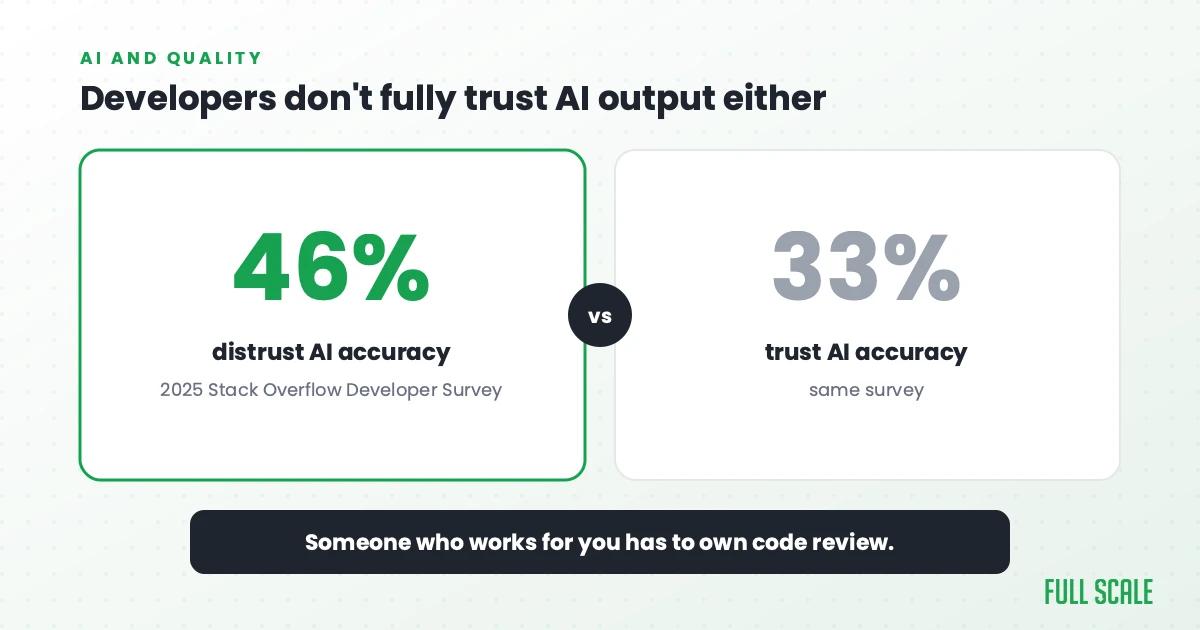
The 2025 DORA report describes AI as an amplifier of whatever strengths and weaknesses a team already has. Developers themselves aren't convinced the output is right, either. In the 2025 Stack Overflow Developer Survey, 46% said they distrust the accuracy of AI output, compared with 33% who trust it.
A weak outsourced team with AI produces more code, faster, that nobody has really checked. More code is only good news if somebody reads it. CISQ estimated in 2022 that poor software quality costs US companies at least $2.41 trillion a year. Someone who works for you, and not for the vendor, has to own code review.
One developer isn't working out
Sometimes the problem really is one person. Even then, it's more often a fit problem than a talent problem.
Running Full Scale has taught me that much of this business is matchmaking. A developer who's out of their depth on an aerospace-grade system can be the best person on the team maintaining an internal tool. Nobody should settle for below-average developers, but the match matters as much as the résumé. By our estimate, fewer than 1 in 20 of our hires turn out to be the wrong fit.
It's also why interviews only get you so far. We recommend an on-the-job trial, which is why Full Scale offers a two-week money-back guarantee. Our post on what happens when a developer isn't working out explains how we handle it.
After month six: turnover, knowledge loss, and cost creep
The late-stage software development outsourcing challenges cost the most, and better process won't fix most of them, because they come from how the vendor makes money.
The team keeps changing
Many project outsourcing shops move developers between clients to keep everyone billable. Your best developer gets reassigned to a bigger account, and a new person shows up who has to learn everything again.
The vendor typically pays to recruit the replacement. You pay for everything else, mostly the months of ramp-up while the new person learns what the last one knew. Gallup estimates that replacing an employee costs one-half to two times their annual salary in total, and a big share of that is lost productivity and knowledge, which is the part that lands on you.
Full Scale's model is designed around this challenge. Nearly all Full Scale engineers work full-time for Full Scale, dedicated to one client's team, and they sign a contract requiring 90 days' notice if they leave. Full Scale's retention rate is 93%+.
Your product knowledge leaves with each person
When nobody on your side owns the code and nothing is documented, each person who leaves takes part of your product with them. By year two, you can end up with a codebase nobody fully understands, including the vendor.
If the only people who understand your code work for someone else, you're renting your own product.
Keep technical leadership in-house and the repository in your own accounts. Then make documentation part of the definition of done. Our guide to knowledge transfer in software development covers the mechanics.
Costs creep, one change order at a time
Fixed-price contracts work well for fixed scope. Ongoing product work doesn't have one, which means every new idea becomes a change order, every change order becomes a negotiation, and the original quote becomes a nice memory.
The vendor isn't necessarily being shady; the contract just doesn't fit ongoing work. If your product will keep changing (it will), a team you direct fits better than a project contract that charges for every new idea.
When these late-stage problems pile up, switching vendors is a real option. Our guide on switching offshore development providers covers how to do it without losing momentum.
How to overcome outsourcing challenges: process fix or model fix
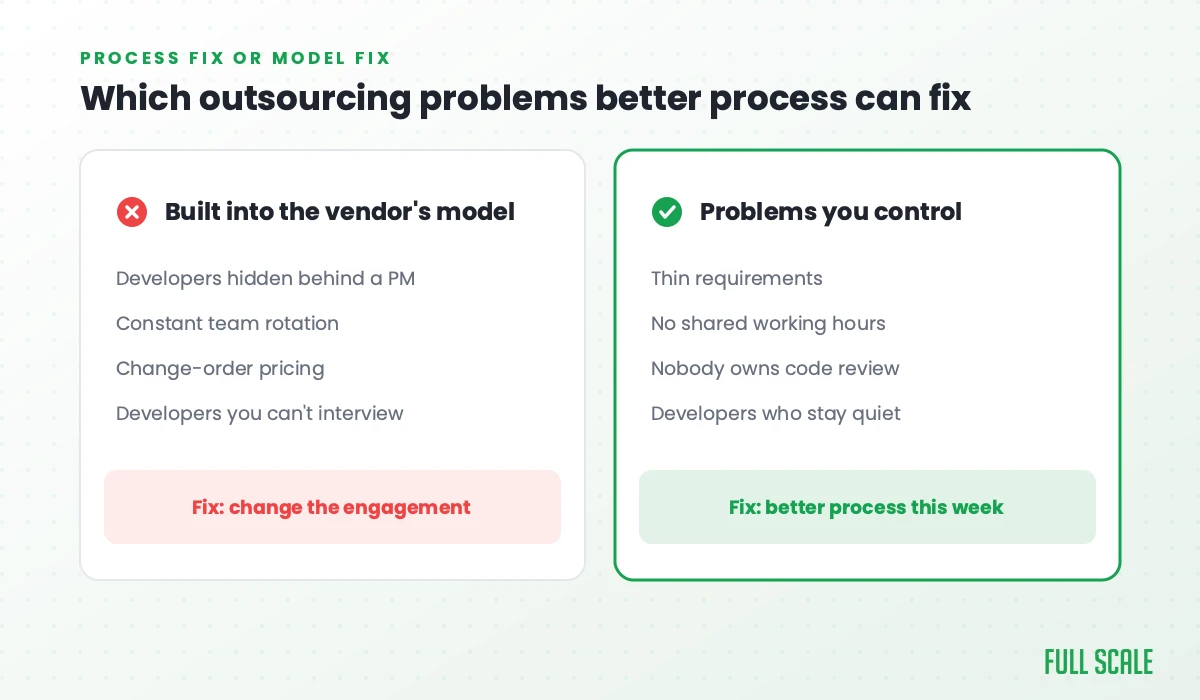
The most useful question about any outsourcing problem is whether better process can fix it. Plenty of buyers skip it and go straight to the outsourcing mistakes that make things worse, like swapping vendors without changing the model. If you control the cause, fix it this week; if the vendor's business model depends on it, no amount of process will out-work the vendor's incentives.
Common situations sort out like this:
| If your situation is... | What to do |
|---|---|
| The work misses the mark in the first month | Process fix: give context, write acceptance criteria, review early work daily |
| You have little overlap with the team | Process fix: set shared hours in week one and hold standups inside them |
| Developers never push back or flag problems | Process fix: ask directly and reward the first person who disagrees |
| Code quality is slipping as output rises | Process fix: make someone who works for you responsible for code review |
| One developer is struggling | Process fix: give direct feedback fast, then rematch if it doesn't improve |
| You can only talk to a project manager | Model fix: move to direct access to your developers |
| The team changes every few months | Model fix: pick a partner with full-time engineers and low turnover, or hire key roles in-house |
| Every new idea becomes a change order | Model fix: move ongoing product work to a dedicated team, in-house or augmented |
| You couldn't interview the developers | Model fix: work only with vendors who let you interview and choose each engineer |
When a different model won't save you
Switching models can backfire too. Sometimes the model you already have fits the work, and sometimes the gap is on your side, where no vendor can fill it.
When outsourcing a project is the right call
Project outsourcing isn't always the wrong answer. I've handed off a couple of WordPress sites and an Elasticsearch search build myself. Nobody on those jobs needed to understand my customers. They needed to know the tool cold, and they did.
The best project engagement I ever had worked because the firm owned the decisions, not just the code. It was a shop in Uruguay building a side product while I stayed focused on Stackify, and their proxy product owner turned my rough ideas into a real plan. A couple of their developers later joined Stackify.
Project outsourcing tends to work when:
- The scope is fixed and you can describe "done" before work starts.
- The work won't need ongoing changes from people who know your business.
- The vendor owns the outcome, including product decisions, instead of executing your tickets.
When staff augmentation won't fix it either
Staff augmentation has its own cost: you carry the management load. The developers work for you day to day, so somebody on your side has to set direction and make product calls. Full Scale handles the recruiting and HR side, but we can't own your roadmap.
If you have no technical leader and no one who owns the product, adding augmented developers just gives you more people waiting for direction. Fix that gap first, even with a fractional CTO. If you hire a firm to own a scoped project instead, you still need someone who works for you to judge the work. Our complete guide to software outsourcing walks through each model and when it fits.
Frequently asked questions
What are the biggest software outsourcing challenges?
The biggest software outsourcing challenges are not knowing who will write the code, unclear requirements, communication filtered through a middleman, slipping quality, developer turnover, and costs that creep through change orders. They tend to show up in roughly that order. Vetting problems come before you sign, requirement and access problems hit in the first month, rework tends to show up between months two and six, and turnover and knowledge loss take over after that.
How do you overcome outsourcing challenges?
You overcome outsourcing challenges by sorting each one into a process problem or a model problem. Process problems are the ones you control, like thin requirements or missing overlap hours, and better onboarding fixes them. Model problems are the ones the vendor's business depends on, like hidden developers, constant rotation, and change-order pricing. Those only go away when you change the engagement itself, usually by moving ongoing product work to a team you direct.
Why do so many software outsourcing projects fail?
Many software outsourcing projects fail because a fixed-scope project contract gets used for ongoing product work. The vendor builds to the spec, the spec changes, and every change turns into a negotiation. Add a project manager filtering every conversation and developers who rotate to other accounts, and by month nine the people who understood the product are gone. The developers themselves are rarely the root cause of a failed engagement.
What are the hidden costs of outsourcing software development?
The hidden costs of outsourcing software development include rework from misunderstood requirements, change orders on fixed-price contracts, ramp-up time every time a developer is replaced, and the product knowledge that leaves with each person. The vendor usually pays to recruit a replacement, but the client pays for the slowdown. Gallup puts the total cost of replacing one employee at half to twice their annual salary, and on an outsourced team the lost productivity and knowledge in that figure show up as slower delivery.
Plan for the challenges you'll actually face
Every engagement hits problems. The ones that work fix the early stuff with process and pick a model that doesn't manufacture the late stuff. If you're in month eight and the team keeps changing, that's a model problem.
At Full Scale, you interview and pick your developers, and they work inside your team for years, not until the next reassignment. If you're planning an engagement or fixing one that's struggling, schedule a call with Full Scale and tell us what you're building.