
Philippines vs Vietnam Software Development: One Clear Winner

In this article
- Philippines vs Vietnam Outsourcing: Why They’re on the Same Shortlist
- Vietnam Has More Developers Than You’d Guess
- Who Each Country’s Outsourcing Industry Was Actually Built to Serve
- Rates: The Numbers Are Closer Than the Reputation
- English and Communication: Where the Real Gap Shows Up
- Where Vietnam Genuinely Has the Edge
- The Verdict
- FAQ
Quick Answer: Philippines vs Vietnam for software development comes down to communication, not cost. Both countries land in nearly the same range on rate: $20 to $30 an hour in developer pay, $30 to $50 billed, where Full Scale sits at $35. The Philippines scores 569 on the EF English Proficiency Index against Vietnam’s 500, and its outsourcing industry was built for US clients while Vietnam’s skews toward Japan and Korea. Vietnam has the bigger, faster-growing developer pipeline, but that edge doesn’t close the communication gap.
I want to say upfront: I haven’t personally hired a developer in Vietnam. Every other country comparison I’ve written comes from actually staffing a team there. I’ve done that in Russia, Belarus, Uruguay, Colombia, India, and Pakistan, on top of building Full Scale in the Philippines. Vietnam’s the one gap, and I still don’t have a story about it to tell you over coffee. This one’s different from how I usually write these. There’s no war story here, just the numbers, laid out honestly, with a real answer at the end instead of the usual “it depends.”
Go read the top ten results for this exact comparison and count how many of them actually pick a side. I got to zero. Half are written by a Vietnamese dev shop trying to sell you Vietnam. The other half are BPO directories, comparing call centers instead of software teams.
I run a company that only staffs the Philippines, so I’m not neutral either. I’ll show you the numbers and let you check my math.
For a US company hiring a software team, the Philippines wins. Not because Vietnam is weak. Vietnam is genuinely impressive, and I’ll show you exactly why. But “impressive” and “the right pick for you” are different questions, and almost nobody separates them.
Philippines vs Vietnam Outsourcing: Why They’re on the Same Shortlist
The Philippines vs Vietnam question comes up because they solve the same problem from opposite directions. Both are Asian countries with English-speaking tech workforces and rates well under US pay. Both show up near the top of every “best countries for offshore software development” list, including ours. Beyond that, they’re not really the same animal.
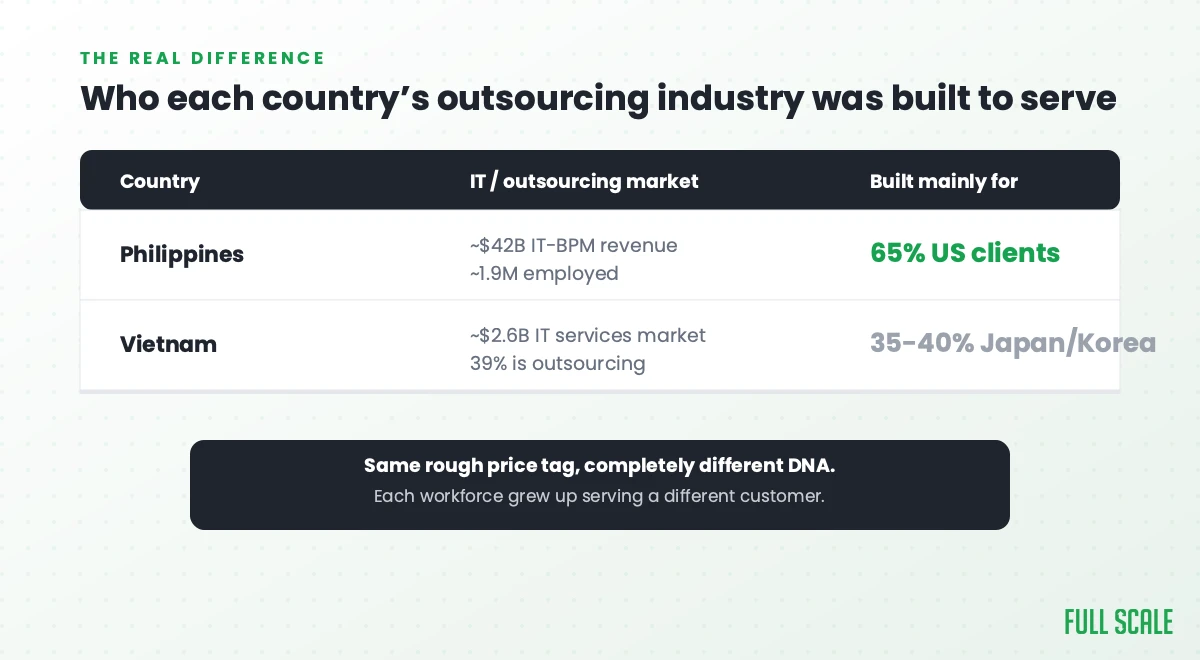
The Philippines built its tech workforce on the back of a business process outsourcing (BPO) industry that’s been serving American companies since the 1990s. Vietnam built its tech workforce on the back of a government push to turn engineering graduates into an export product, aimed less at America and more at Japan. Same rough price tag, completely different DNA. That difference is where this whole comparison actually lives.
Vietnam Has More Developers Than You’d Guess
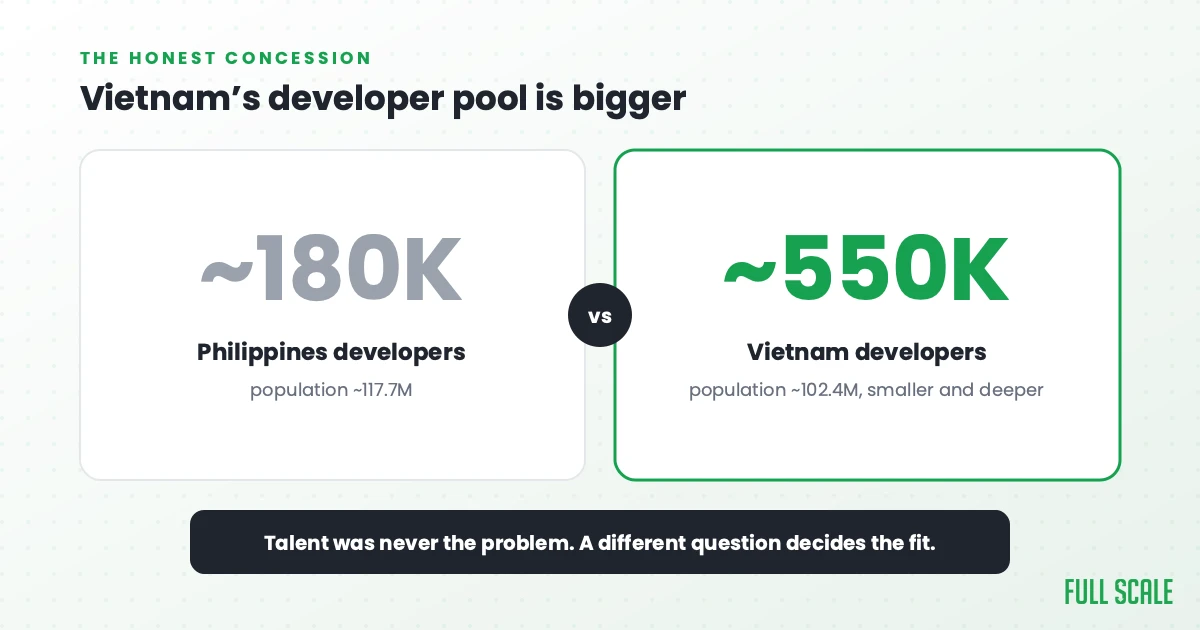
Here’s the concession I have to make first, because it’s true and hiding it would make the rest of this useless to you: Vietnam has a bigger, faster-growing developer pool than the Philippines.
| Country | Population (2026) | Developer talent pool | English (EF EPI 2025) |
|---|---|---|---|
| Philippines | ~117.7M | ~180K | High band, 569 (Manila 603) |
| Vietnam | ~102.4M | ~550K | Moderate band, 500 |
Vietnam has fewer people and roughly three times as many developers. Vietnam is a country that decided software would be an export industry and built the pipeline for it: more than 73,800 IT businesses and 1.26 million IT workers already, with the government targeting 100,000 new ICT graduates a year by 2030. If you need volume, or engineers who came up strong on mobile and modern web frameworks, Vietnam’s bench is deep and getting deeper.
I’ll say the same thing about Vietnam that I say about India: talent was never the problem. There are smart developers everywhere. A different question decides whether the engagement actually works.
Who Each Country’s Outsourcing Industry Was Actually Built to Serve
The Philippines’ broader IT-BPM industry, the umbrella that includes the call centers and back-office work software development grew up alongside, is projected near $42 billion in revenue this year, employing close to 1.9 million people. Roughly 65 percent of that revenue comes from the US, with North America overall at about 70 percent. That’s not an accident. Since the industry’s earliest days, it was built call center by call center around American time zones, American accents, and American customer-service expectations, and the software side of the industry grew up in that same American-facing culture.
Vietnam’s software outsourcing industry took a different road. Its IT services market runs around $2.6 billion, with outsourcing making up about 39 percent of that. Japan and South Korea together account for 35 to 40 percent of Vietnam’s outsourcing revenue, historically more than the US. Vietnam grew up as Japan’s back office for software, decades before it built much of a relationship with American clients at all. That’s a fine business to be in, but the muscle memory, the client-facing habits, and the cultural rhythm of the workforce developed around a different customer than the one reading this article.
You can hire great engineers in Vietnam. You’ll be one of the clients they had to learn to work with, instead of the client the whole industry was built around.
Rates: The Numbers Are Closer Than the Reputation
Philippines and Vietnam cost almost the same for a US buyer: senior developers earn $18 to $30 an hour in Vietnam and $20 to $30 in the Philippines, and clients are billed $30 to $50 in both.
| Country | Developer earns (senior, /hr) | Client bills (senior, /hr) |
|---|---|---|
| Philippines | $20-30 | $30-50 (Full Scale $35) |
| Vietnam | $18-30 | $30-50 |
Anyone telling you Vietnam is dramatically cheaper is selling you something, probably Vietnam. Both countries save a US company somewhere in the 50 to 70 percent range against a fully loaded US hire. At that point, the rate card stops being the deciding factor. This is exactly the cheapshoring trap: picking a country because the invoice looks a little smaller, then finding out the real cost was never on the invoice.
English and Communication: Where the Real Gap Shows Up
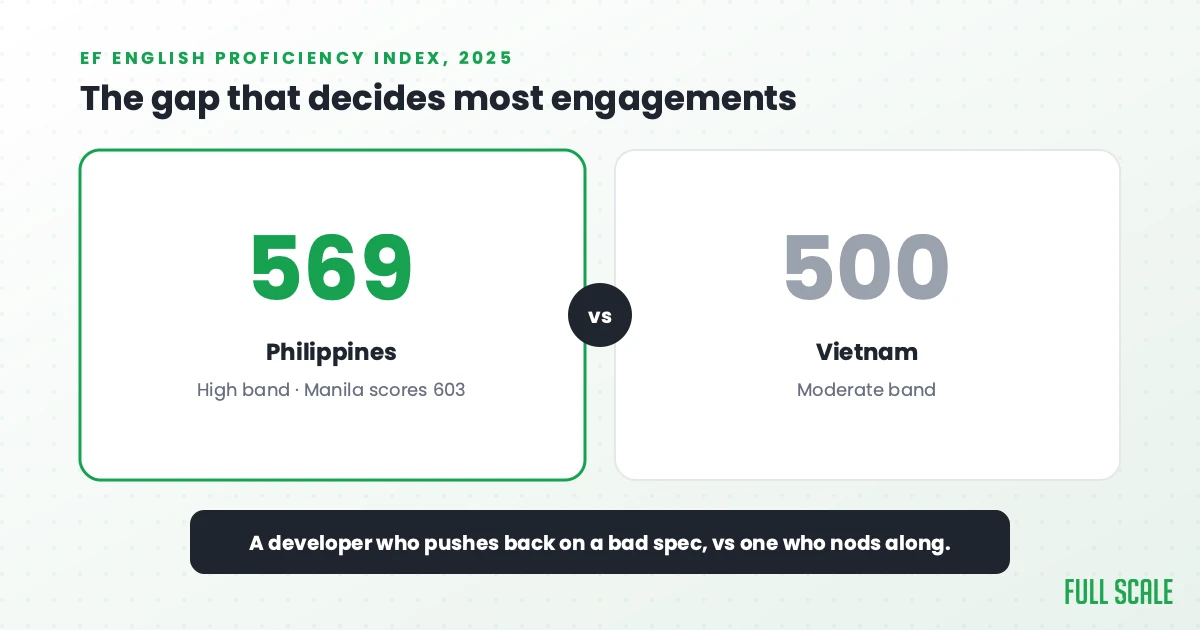
The EF English Proficiency Index puts the Philippines in the “High” band at 569, with Manila alone hitting 603, a “Very High” score that beats most European capitals. Vietnam sits in the “Moderate” band at 500. That’s not a small gap. It’s the difference between a developer who can push back on a bad spec in a standup and one who nods along and hopes it works out.
Time zone doesn’t change much here, unlike the case against Latin America. The Philippines runs 12 to 15 hours ahead of US business hours, Vietnam 11 to 14. Both need the same kind of scheduling, a half-day overlap shift, full US hours, or an async setup, so neither country has a real edge on the clock.
Software development is about communication more than anything else. I’ve said that about every country I’ve hired in, and it holds here too. The failure mode I see over and over with offshore teams has nothing to do with a developer’s coding ability. It’s a spec that got misread, a question that never got asked, a problem that got quietly worked around instead of flagged. A wider language gap means more of that, and more of it means slower ships and more rework, which erases the savings from the rate card faster than any invoice will admit.
Where Vietnam Genuinely Has the Edge
Vietnam is the better pick in three specific situations, and the Philippines is the better pick for most of the rest.
| Your situation | Better pick | Why |
|---|---|---|
| You need serious engineering headcount fast, especially for mobile or modern web | Vietnam | Its talent pool is about 550K developers against about 180K |
| A meaningful share of your business runs through Japan or Korea, or you already operate in Vietnam | Vietnam | Its outsourcing industry grew up serving those clients |
| Your team writes tight specs and needs little back-and-forth | Vietnam | The English gap matters less when you lean on it less |
| You want a long-term team that pushes back on a bad spec in standups | Philippines | Higher English fluency, and an industry built around US clients |
| A US product manager runs the team day to day | Philippines | Full Scale developers report to your PM and sit inside your own channels and meetings |
The first three are real, specific situations, but most US companies hiring a long-term software team don’t fall into any of them. Most need a team that talks, asks questions, and pushes back when something’s wrong.
The Verdict
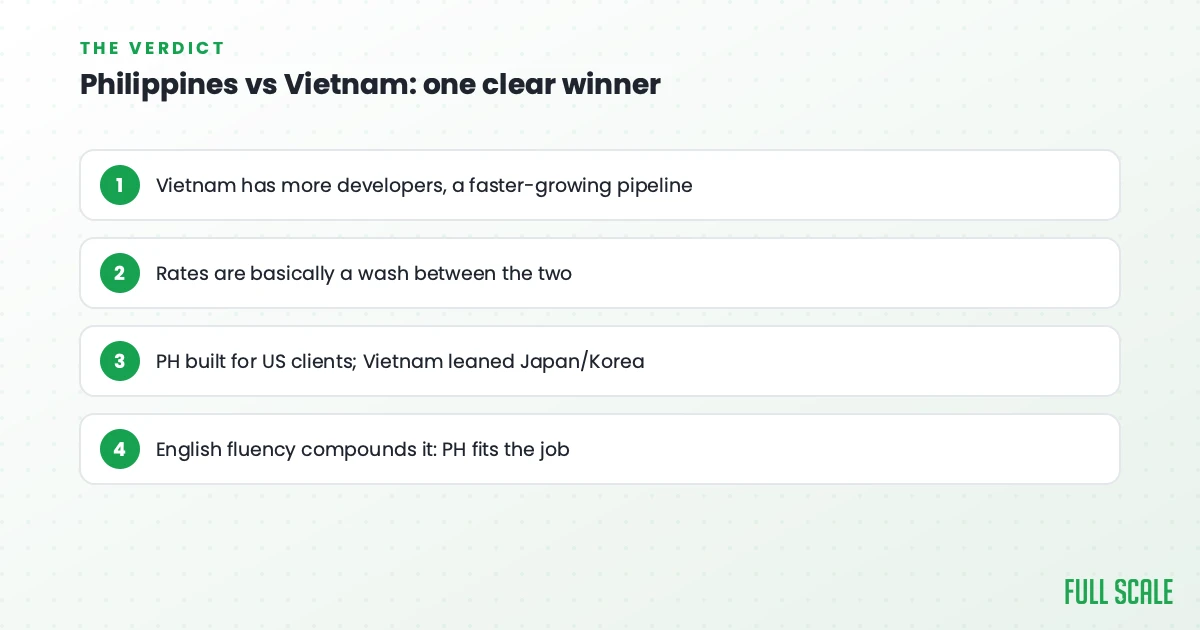
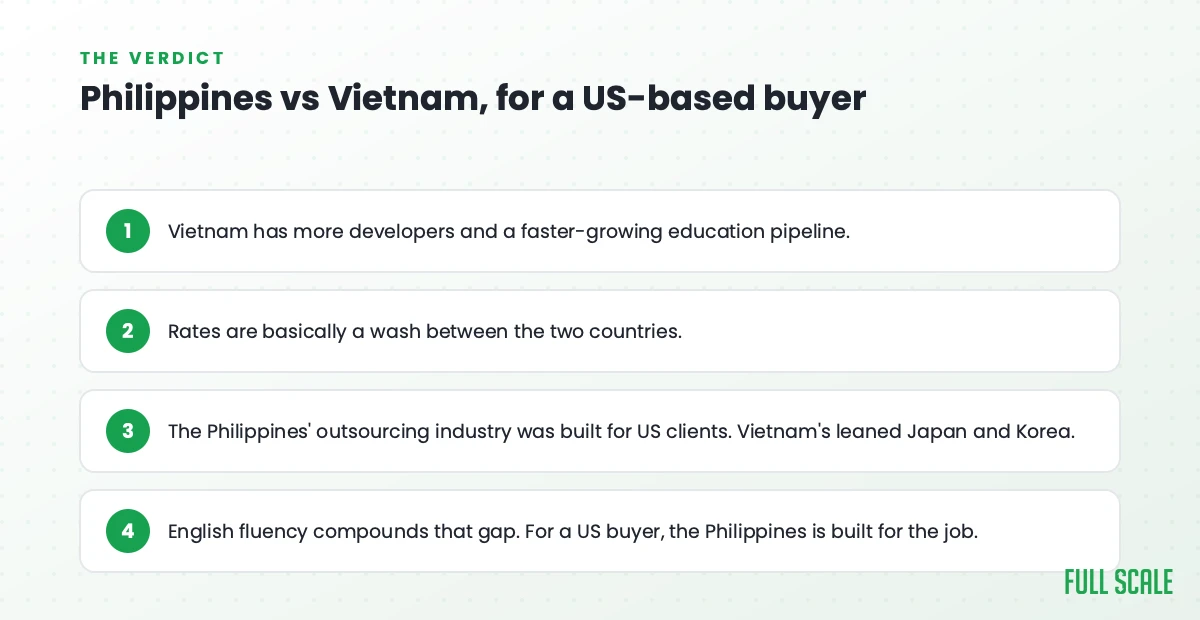
Vietnam has more developers, a faster-growing education pipeline, and rates that are basically a wash with the Philippines. None of that changes the answer, because none of it is what decides whether an offshore engagement actually works.
What decides it is whether the team you hire was built to communicate with you.
The Philippines’ entire tech workforce grew up inside an industry built for American clients. Vietnam’s grew up inside an industry built mostly for Japanese and Korean ones. Add the English gap on top of that, and for a US-based company, the Philippines is the country actually built for the job you’re hiring for.
There’s another wrinkle that favors the Philippines as AI takes over the grunt work of coding. If all you need is a team that builds exactly what you hand them, you don’t need an offshore team anymore, you need an AI. What you actually need asks the right questions and pushes back when the spec is wrong, and that’s a communication skill first.
When you hire developers in the Philippines through Full Scale, they report to your product manager and sit inside your own team’s channels and meetings, the same setup we used staffing AMC Theatres’s .NET team. Nobody’s routing your questions through a vendor-side manager first.
Want a broader look at the whole field before you commit? Our rundown of the best countries for offshore software development, rate table included, covers the rest of the map. That includes how the Philippines stacks up against Indian outsourcing and against Latin American outsourcing.
If you want to talk through what your specific team needs, schedule a call and we’ll walk through it.
FAQ
Is outsourcing to Vietnam a good idea?
For some companies, yes. Vietnam has a large, fast-growing developer pool and rates close to the Philippines. It’s a strong pick if you need mobile or modern web development specifically, or you already have business ties to Japan or South Korea, where most of Vietnam’s outsourcing industry has historically served. It’s a weaker pick for a US company that needs a team comfortable pushing back in fluent English without a lot of hand-holding.
Is Vietnam cheaper than the Philippines for software development?
Barely, and not in a way that should decide anything. Senior Vietnamese developers earn $18 to $30 an hour and bill clients $30 to $50. Senior Philippine developers earn $20 to $30 and bill $30 to $50, with Full Scale’s own rate at $35. The two countries land in almost the same range. Anyone pitching Vietnam as the dramatically cheaper option is rounding up the difference to make a sale.
Which country has more software developers, Vietnam or the Philippines?
Vietnam, by a wide margin. Vietnam has roughly 550,000 developers against the Philippines’ 180,000, despite having a smaller total population. The government has built ICT education into a deliberate export strategy, with over 73,800 IT businesses already running and a target of 100,000 new ICT graduates a year by 2030. Talent depth is genuinely Vietnam’s biggest edge in this comparison, and it’s the one most Philippines-favoring posts undersell.
Does Vietnam’s outsourcing industry mainly work with US companies?
Less than you’d think. Japan and South Korea together account for 35 to 40 percent of Vietnam’s IT outsourcing revenue, a legacy of Vietnam’s Asia-facing outsourcing roots. The Philippines’ broader IT-BPM industry runs the opposite way: about 65 percent US revenue, built specifically around American clients since the 1990s. That history shapes how each workforce learned to communicate with a client, not just where the invoices get sent.
Is the Philippines or Vietnam better for a long-term dedicated team?
The Philippines, for most US companies. A long-term dedicated team lives or dies on daily communication: standups, code review, a developer who’ll tell you the ticket is wrong before writing the code anyway. The Philippines’ English fluency and decades of US-facing outsourcing experience are built for exactly that. Vietnam is a stronger fit for teams that can operate with tighter specs and less real-time back-and-forth, or that already have a reason to be working with Asia-facing talent.
Is it better to hire developers in Vietnam or Latin America?
It depends on whether time-zone overlap or talent depth matters more to you. Latin America works your hours, so standups and code review happen live. Vietnam runs 11 to 14 hours ahead of US business hours, so you need a half-day overlap shift or an async setup, but it offers a developer pool of roughly 550,000 at rates close to the Philippines. If you want strong English and a team built around US clients, the Philippines is the third option, and our Latin America vs Philippines comparison covers that trade-off.