
Questions to Ask Before Hiring an Offshore Development Company (Checklist)

In this article
- Why Most Offshore Development Due Diligence Fails
- The 8-Category Framework for Offshore Development Due Diligence
- Offshore Development Red Flags That Should End the Conversation
- How to Use This Offshore Development Due Diligence Process
- What Our Data Shows About Offshore Success
- What Good Answers Actually Sound Like
- Why Partner With Full Scale
- Frequently Asked Questions
Quick Answer: Offshore development due diligence means testing a vendor on what they can’t fake, not on headcount or headline rates. Ask for their 3-year developer retention rate, whether you get direct Slack and standup access to the actual developers, who owns your IP and under which country’s law, and the true hourly cost once setup fees and turnover costs are added in. Vague answers on retention, blocked developer access, or opaque pricing are the clearest signs the partnership fails.
Here’s the problem with most offshore development due diligence: You’re asking the wrong questions.
You ask, “How many developers do you have?” They answer, “Over 500!” You feel reassured.
But here’s what you should have asked: “What’s your developer retention rate over 3 years?” Watch them squirm.
I learned this the hard way. Back in 2015, I hired an offshore team that checked every box on paper. Senior developers, competitive rates, great references. The stakes are highest with offshore backend developers, whose mistakes hide in the data model where you cannot see them.
Six months and $180K later, I had code that didn’t work. The “senior” developer had 18 months of experience. Every question took 3 days because of the project manager’s buffer.
That disaster led to Full Scale. And this offshore development due diligence checklist.
Most offshore companies survive on high turnover. They churn developers, churn clients, and definitely don’t want you asking questions that expose it. Let’s fix your offshore development due diligence process. Much of this applies directly to choosing an IT company in the Philippines, where the gap between a real engineering shop and a body shop is wide.
According to a 2024 Deloitte study, 59% of companies reported dissatisfaction with their offshore partnerships. The reason? They evaluated based on cost and size, not the factors that actually predict success.
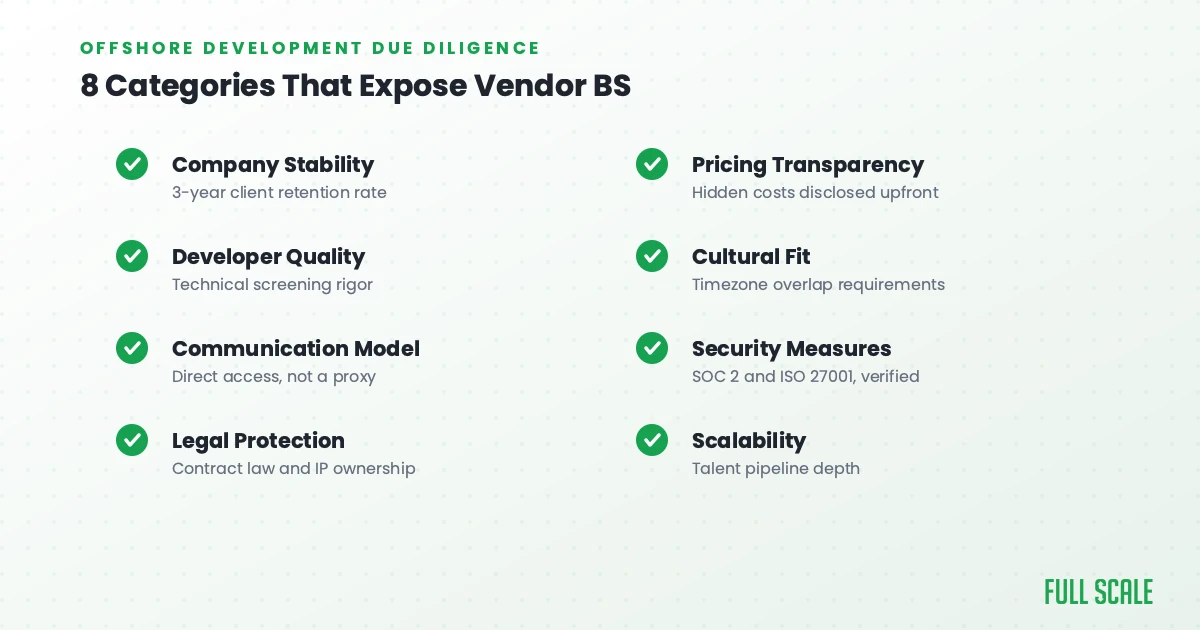
When evaluating offshore development companies, assess these 8 critical areas: company stability, developer quality, communication model, legal protection, pricing transparency, cultural fit, security measures, and scalability. Each category requires specific verification questions to cut through marketing claims. Legal protection is the category most buyers skim, so read up on offshore compliance in the Philippines before you start asking vendors about it.
Why Most Offshore Development Due Diligence Fails
Every offshore company has a polished website. They all claim to be senior developers. They promise seamless communication.
And they’re all saying the exact same thing.
The problem isn’t that you’re not doing research. The problem is you’re asking questions they’ve trained their sales team to handle. You need questions that reveal what they don’t want you to know.
I’ve seen CTOs spend weeks evaluating offshore development companies, only to discover 6 months later that everything they were promised was fiction. The developers weren’t senior. The communication wasn’t seamless. The retention rate was terrible.
This framework changes that. It’s designed to expose BS before you sign a contract. Proper offshore development due diligence saves you from expensive mistakes that cost six months and a significant budget.
The 8-Category Framework for Offshore Development Due Diligence
This table shows what matters when vetting offshore software companies. Most checklists focus on surface-level questions. This framework digs into factors that actually predict success or failure in your offshore development due diligence efforts. Ask each vendor to show you what a real background report contains rather than telling you they run one.
| Category | Why It Matters | Key Questions |
|---|---|---|
| Company Stability | Predicts if they’ll exist in 2 years | 3-year client retention rate |
| Developer Quality | Separates senior talent from juniors | Technical vetting process |
| Communication Model | Determines real integration level | Direct access vs. middlemen |
| Legal Protection | Protects your IP and investment | Contract jurisdiction location |
| Pricing Transparency | Reveals hidden costs upfront | Total cost breakdown |
| Cultural Fit | Affects daily collaboration | Working hours overlap |
| Security Measures | Protects sensitive data | SOC 2 Type II, ISO 27001 (verified, not claimed) |
| Scalability | Supports future growth | Talent pipeline depth |
Let’s break down each category with specific questions. These are designed to get past rehearsed sales pitches and reveal actual operational reality.
Category 1: Company Stability and Track Record
This is where most offshore development due diligence starts wrong. People ask, “How long have you been in business?” That’s the wrong question.
Critical Questions to Ask:
- What’s your 3-year client retention rate? Demand a specific number.
- Can you provide 5 references from clients who’ve worked with you for over 2 years?
- What’s your average client relationship length? If it’s under 18 months, that’s a red flag.
Good answers sound like this: “Our 3-year retention is 93 percent. Here are 8 references, all over 2 years.” Bad answers sound like this: “We focus on building long-term partnerships.” That’s corporate speak for terrible retention.
According to Clutch’s 2024 research, the average offshore relationship lasts only 14 months. Reading their Clutch, G2, and GoodFirms profiles the right way matters just as much as that number. If they’re beating that by a lot, they’re doing something right.
Category 2: Developer Quality and Vetting Process
Everyone claims they have senior developers. Cool story. Prove it.
This chart shows the developer vetting funnel that separates quality partners from volume shops:
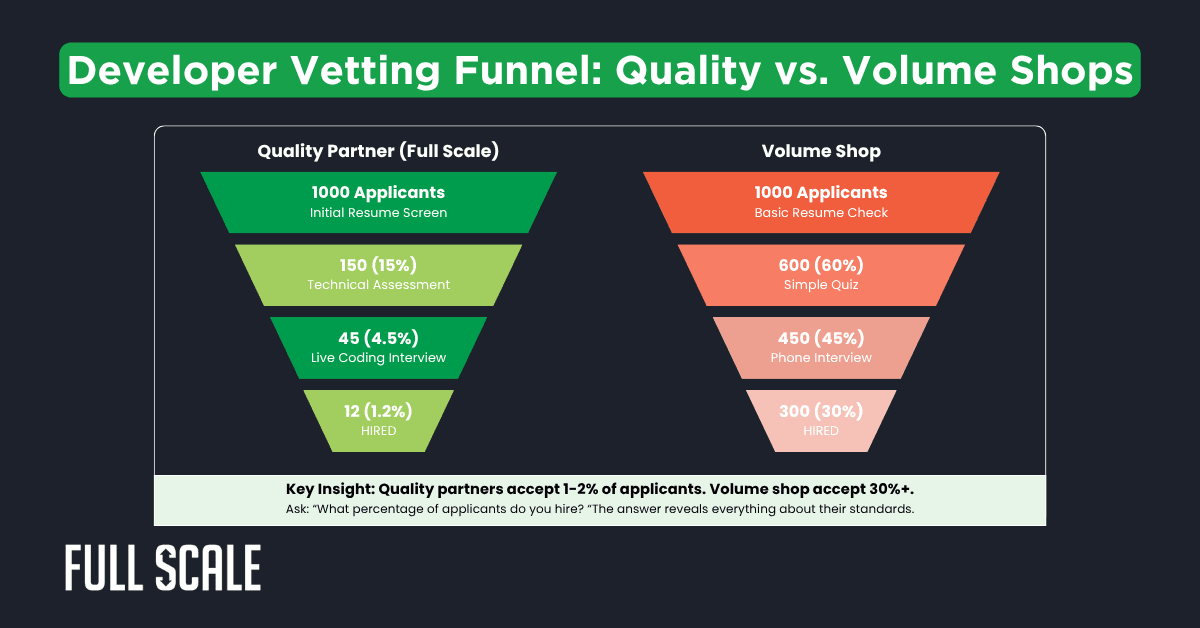
The funnel shows acceptance rates that matter. Quality partners are selective. Volume shops need bodies to fill seats.
Critical Questions for How to Vet Offshore Developers:
- Walk me through your exact technical screening process. I want steps, not buzzwords.
- Can I interview 3 developers before signing anything? If they say no, end the conversation.
- What percentage of applicants pass your screening? If it’s over 15 percent, their bar is too low.
Here’s the reality: If they won’t let you talk to actual developers before commitment, they’re hiding something. Learn more about how to build remote development teams effectively.
Category 3: Communication and Integration Model
This is where the rubber meets the road for choosing an offshore development partner’s success. And where most companies hide their biggest flaw: middlemen.
Critical Questions:
- Will I have direct Slack or Microsoft Teams access to my developers? Not their manager, the actual developers.
- Can developers attend our daily standups and sprint planning? If there’s a project manager buffer, that’s a problem.
- What’s the average response time for developer questions? Measure in hours, not days.
Good looks like this: your offshore developers are in your Slack. They’re in your standups. They commit directly to your GitHub. They’re indistinguishable from your local team except for the time zone.
Bad looks like this: you email a project manager. They relay it to developers. Developers respond to the PM. PM emails you back. You’ve just added 48 hours to every conversation.
Category 4: Legal Protection and Contract Structure
This is where you protect yourself when things go wrong. And trust me, you want this locked down before you need it. Proper offshore development due diligence includes legal verification.
Critical Questions:
- Is the contract governed by US law? If it’s governed by laws in its country, you have no recourse.
- Who owns the IP? It should be you, immediately upon creation, not after payment.
- What’s your NDA structure? They should sign yours, not the other way around.
This matters more than you think. When there’s a problem, you want to be able to enforce agreements in a US court. Otherwise, good luck.
Category 5: Pricing Transparency and Contract Terms
That is where the hidden costs live. Every offshore company advertises a low hourly rate. Few tell you about the extras.
Here’s what typically gets layered on top of that quoted rate:
- Setup fees per developer, often $1,000-$5,000, billed before anyone starts work.
- Management fee percentage, typically 15-30 percent stacked on top of the hourly rate.
- Turnover and replacement costs. A high-turnover vendor quietly passes its own retraining costs to you every time a developer leaves.
Add those up and that attractive hourly rate is probably 30-40 percent higher once you factor in hidden costs. Compare that to Full Scale’s transparent pricing, where all costs are broken down upfront. No surprises. No hidden fees.
Categories 6-8: Cultural Fit, Security, and Scalability
Cultural and Operational Fit requires at least 4 hours of daily time zone overlap. Developers need the ability to work their core hours when needed. Ask about their asynchronous communication system.
Security and Data Protection demands SOC 2 and ISO 27001 certifications at a minimum, and you should know what each one actually proves before you take a vendor’s word for it. A SOC 2 Type II report means an independent auditor watched their controls operate over months, not a snapshot. ISO 27001 certifies they run a managed information security program end to end. Neither one guarantees nothing goes wrong. Ask for the actual report or certificate, not a logo on their website, and confirm an ISO claim against the issuing body’s own registry. A certification is a floor, not a guarantee, and it doesn’t even apply to every offshore engagement model — see who actually needs their own SOC 2 certification. What actually stops a breach is who they let touch your systems and how fast access gets cut when someone leaves, which is the part I break down in how we secure a distributed engineering team. Verify VPN access, 2FA requirements, and device management protocols. Request their incident response plan in writing.
Scalability and Long-Term Growth mean a 2-3 week timeline to add developers, not 2-3 months. They should have pre-vetted talent ready, and you should still know what to ask offshore developers when they put someone in front of you. Make sure the terms are clear: what happens if a hire is not a fit early on, and that you are not locked into a long contract.
Offshore Development Red Flags That Should End the Conversation
These are dealbreakers. If you see any of these offshore development red flags, walk away. I don’t care how good the sales pitch sounds.
This diagram shows the red flags that predict offshore partnership failure:
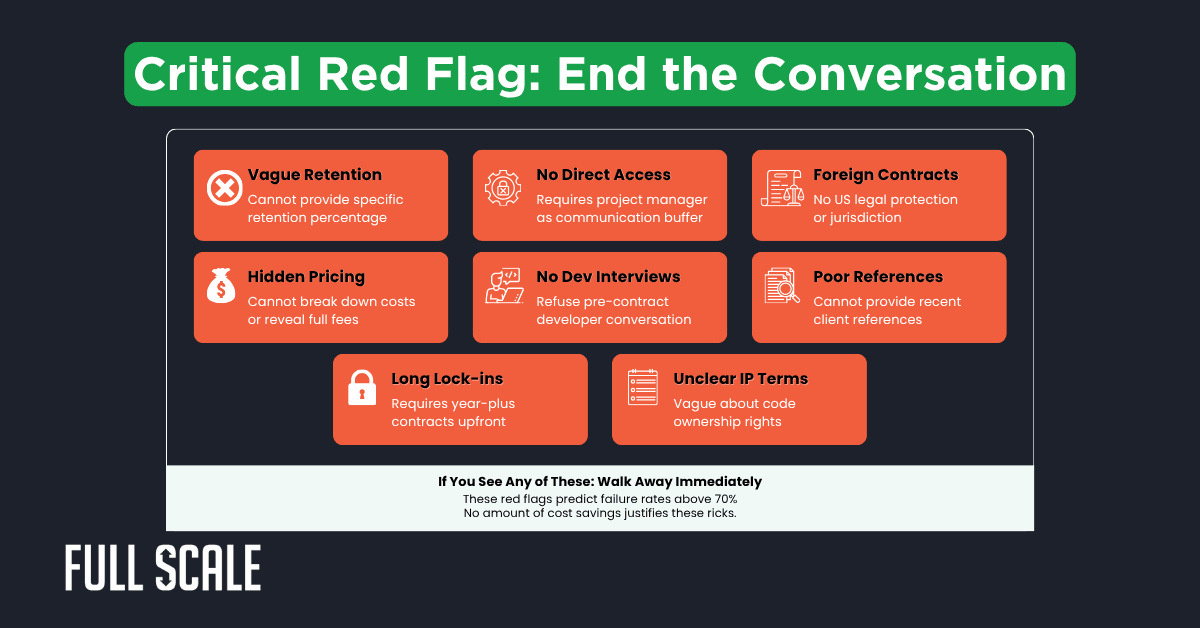
Each red flag predicts problems. Multiple red flags predict disaster. What each one means:
- Vague Retention Answers – They don’t want you to know the real number. And guess what? They’re lying about it being good.
- No Direct Developer Access – Hiding developer quality or maximizing billable hours through middlemen.
- Offshore-Only Contracts – You have zero recourse when things go wrong.
- Opaque Pricing – Surprise! You’re about to get an invoice you didn’t expect.
- No Pre-Contract Interviews – Those developers aren’t senior. They might not even be competent.
- Can’t Provide Recent References – Their recent clients aren’t happy.
- Long Minimum Commitments – They expect you to want out. Why else lock you in?
- Unclear IP Ownership – Your code should be yours. Immediately. Forever.
How to Use This Offshore Development Due Diligence Process
Your action plan for implementing proper offshore development due diligence: This is how to evaluate software development vendors properly:
Step 1: Initial Screening – Use the first 5 categories as knockout questions. If they fail any, stop there.
Step 2: Reference Checks – Ask those references for other clients. The ones they didn’t give you are more honest.
Step 3: Developer Interviews – Talk to at least 3 developers. Ask technical questions and about their company experience.
Step 4: Contract Review – Have your lawyer focus on IP ownership, termination clauses, and jurisdiction.
Step 5: Pilot Project – Start small. One or two developers for 3 months before scaling.
This process takes time. That’s the point. Rushing offshore development due diligence costs more than the time you save.
What Our Data Shows About Offshore Success
I’ve watched more than 700 engineer placements with clients play out over Full Scale’s history, and the same handful of things separate the engagements that last from the ones that fall apart.
Teams that get direct access to their developers, in their own Slack and standups, stay far longer and report much higher satisfaction than teams stuck talking through a project manager. Month-to-month agreements outlast long lock-in contracts, because nobody is trapped and the work has to keep earning the renewal. Clients who interview developers before they commit almost always rate the talent higher, since they picked the people themselves. Contracts under US law avoid the IP and jurisdiction fights that sink so many offshore deals. And the partnerships that go the distance are the ones where retention is high enough that the same engineers are still on the team a year or two later. That is the same gap we found comparing rate and vetting across nearshore staffing platforms, including a full look at where BairesDev competitors like Full Scale stack up on price.
Those patterns drove every decision in our model. We built Full Scale to lean into what works and design out the ways these engagements usually fail.
What Good Answers Actually Sound Like
Most vendors have trained responses. How to tell real quality from rehearsed BS when asking questions to ask offshore development company representatives. If you want more ammunition, I put together 27 offshore company interview questions that dig past the rehearsed answers.
Question: “What’s your developer retention rate?”
Good Answer:
“Our 3-year retention is 93 percent. Here’s why we think we do better than average.”
Bad Answer:
“We have excellent retention and focus on developer satisfaction.”
Question: “Can I have direct access to developers?”
Good Answer:
“Yes, they’ll be in your Slack, your standups, everything. No middlemen.”
Bad Answer:
“We have a communication structure that ensures quality.”
Question: “What’s your technical vetting process?”
Good Answer:
“Resume screen, technical test, live coding session, architecture discussion. Less than 3 percent pass. Here’s the breakdown.”
Bad Answer:
“We have a rigorous multi-step process that ensures quality.”
That is the difference. Specifics vs. buzzwords. Numbers vs. platitudes.
Why Partner With Full Scale
We built Full Scale specifically to pass every item on this offshore development due diligence checklist. How we stack up when you’re evaluating what to look for in offshore partner selection:
- 93%+ retention rate – We treat developers like employees, not contractors
- US-based contracts – All agreements governed by US law in your favor
- Direct developer access – Your Slack, your standups, zero middlemen
- Month-to-month agreements – No long-term lock-ins or hidden fees
- Pre-contract interviews – Talk to developers before you commit
- Transparent pricing – All costs broken down at fullscale.io/pricing
- 3% acceptance rate – We’re selective about who we hire
- 2-week placement timeline – Fast scaling without sacrificing quality
We’re not perfect for everyone. But if this checklist matters to you, we designed our entire model around it. Learn more about our staff augmentation services.
“I wish I had this framework before my first offshore disaster. Would have saved us 8 months and $250K.”
— CTO, Series B SaaS Company
Secure Your IP. Scale Your Team Today. →
Frequently Asked Questions
What is the most important factor in offshore development due diligence?
Developer retention rate predicts everything else. If developers stay, the company treats them well, pays competitively, and has good management. High retention means quality.
Low retention means constant knowledge loss, training overhead, and inconsistent quality. Ask for specific 3-year retention numbers. Anything below 70% is a red flag.
How long should offshore development due diligence take?
Expect 3-4 weeks for a thorough evaluation. One week for initial research and screening calls. One week for reference checks and developer interviews. One week for contract review and pricing analysis.
Rushing this process costs more than the time you save. A bad offshore partner costs 6 months and a significant budget.
What questions should I ask before hiring an offshore development company?
Focus on four categories that actually predict whether an engagement lasts: developer retention rate with specific numbers, direct access to developers instead of a project manager in between, who owns the IP and under what law, and a full cost breakdown instead of just the hourly rate.
Push further before you sign: ask for their exact technical screening process and acceptance rate, request developer interviews before you commit, confirm the contract is governed by US law with clear IP terms, and get verified references from clients who’ve stayed more than 2 years. A vendor that gets vague on any of these already answered your question.
Should I use an offshore development company or hire locally?
It depends on your priorities. Local hiring offers easier collaboration but costs 2-3 times more. Quality offshore partners provide senior talent at lower costs with proper vetting. If you cannot personally judge that vetting, vetting a developer without a technical background is its own skill worth learning first.
The key is choosing an offshore development partner with the right model. Staff augmentation with direct integration works better than traditional project-based outsourcing. If you’re at that stage, here’s what to look for so you actually hire vetted offshore developers instead of just a vendor.
What security certifications should an offshore development company have?
SOC 2 Type II and ISO 27001 are the two that matter, and they answer different questions. SOC 2 Type II means an independent auditor verified their security controls actually worked over several months, not just on paper. ISO 27001 means they run a documented, managed information security program.
Ask to see the actual report or certificate, not a claim on their marketing page, and check an ISO 27001 claim against the issuing registry. Certifications are a floor, not a guarantee.
How do you verify an offshore developer’s identity and background?
Identity fraud among remote developers is documented, not hypothetical: the Justice Department has confirmed North Korean operatives used stolen identities to land remote IT jobs at more than 100 US companies. Video interviews, direct access to the developers you’re paying, and a formal background check before placement catch both problems at once.
Background checks aren’t standard practice across the industry, which is exactly what lets fraud through. Full Scale runs a formal check on identity, criminal history, and employment for every developer before placement — see the full process. Ask any vendor to walk you through theirs; a vague answer is the red flag.
Do offshore development companies require long-term contracts?
No, the reputable ones don’t. Full Scale’s engagements are month-to-month: a two-week money-back guarantee if it isn’t working out early, then 30 days’ notice to cancel after that, with no annual lock-in.
A vendor pushing a 12-month minimum before you’ve worked with a single developer is protecting their own revenue, not your risk. Ask about cancellation terms before you ask about the rate.