
How to Vet Software Development Companies Using Clutch, G2, GoodFirms, Etc.

In this article
- Vetting a software development company starts with trust, not star ratings
- Clutch makes it hard to fake a review, but not impossible
- G2’s review count says as much as its star rating
- GoodFirms calls reviewers back before it publishes anything
- What to check beyond the star rating
- Frequently asked questions
Quick Answer: Use Clutch, G2, and GoodFirms as a checklist to ask questions, not a benchmark to rely on. They all do at least some level of identity verification, and some form of outreach to the reviewer, so know how, and seek out the one bad review. An overwhelming number of five-star reviews is a red flag, not a green light. Look for video case studies, independent recognitions, employee retention rates, and ask for a reference call.
Vetting a software development company starts with trust, not star ratings
Trust is what drives every single vendor selection. Having worked at three different companies, I know from experience that the largest source of new business for each has always been referrals, because no one really trusts a random company until someone you know tells you it’s solid.
Clutch, G2, and GoodFirms are the next best options, and they’re very helpful resources. But let’s be clear on what they are: a vendor can populate its review page with its own advocates, and some have written fake reviews for themselves, which is part of why Clutch’s review submission process is fairly onerous. It’s unlawful now too, not just deceptive: the FTC issued a final rule in August 2024 that prohibits fake reviews and testimonials, with civil penalties up to $50,000 per violation.
Just like reading Amazon reviews, it’s tempting to scroll through dozens of them and feel well-informed before you buy. Except you’re not buying a blender. You’re spending a few hundred thousand dollars on software development, and making the wrong choice here costs a lot more than a broken pitcher.
Reviews still matter, they just aren’t the whole answer
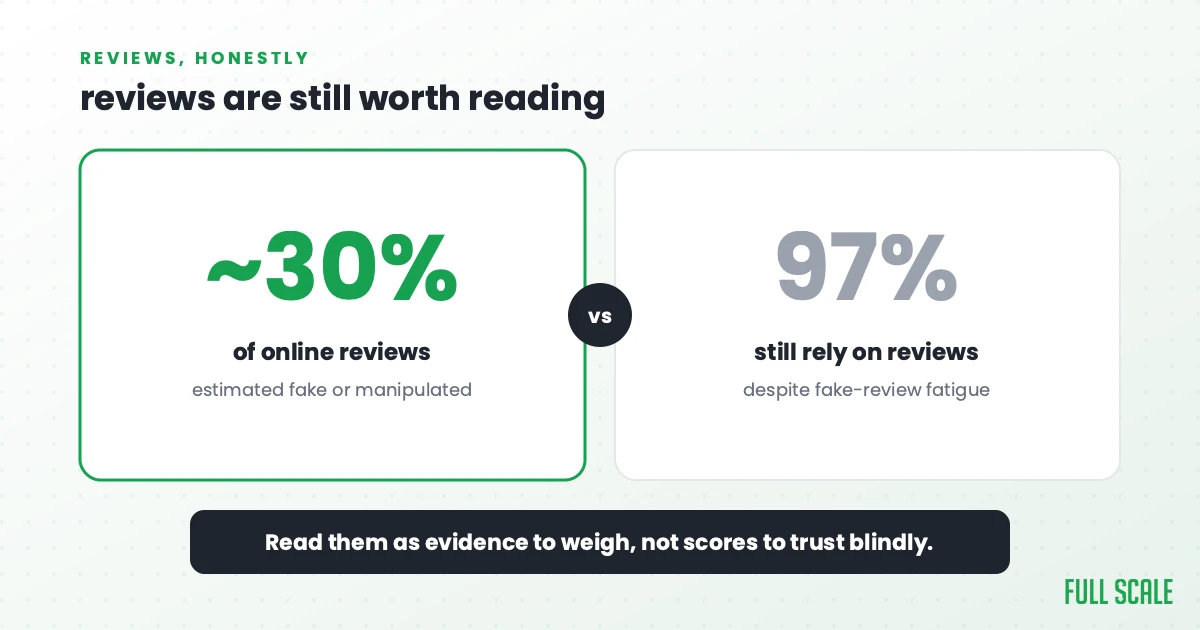
It’s estimated that roughly 30 percent of online reviews are fake or otherwise manipulated, on the top review sites. Even genuine reviews skew positive, because people tend to leave more glowing reviews when a business actively solicits feedback. BrightLocal’s 2026 consumer survey found that 97 percent of consumers still rely on reviews despite fake-review fatigue.
Worth naming up front: this entire piece uses Full Scale, our own company, as the working example. Full Scale provides the kinds of services outlined in this post, so weigh that as you read on. Every example here is something you can go check yourself, which is the point: you don’t have to take our word for it. One fair caveat: paid tiers on some of these platforms buy a vendor more visibility, like phone-verified reviews for Clutch’s Verified or sponsored accounts. The identity and human-review checks still happen regardless. The tier only changes how much extra help a vendor gets.
A good review page gives you a strong start on the third-party-evidence side of due diligence. But you still need to talk directly to the engineers you’ll be working with, verify whether you’ll have direct access or go through a project manager, and confirm who owns your IP and what the contract’s legal terms are. We’ve got a full due-diligence checklist for that process. Choosing a vendor just because it’s cheap is also a trap, which we’ve written about elsewhere as cheapshoring: optimizing for the lowest rate over the actual work.
Clutch makes it hard to fake a review, but not impossible
Clutch requires a reviewer to log in with a LinkedIn account, a Google account, or a verified company email before leaving anything at all. Vendors on a Verified or sponsored plan get one more layer: Clutch’s own team calls the client directly to collect the review. If it can’t confirm the reviewer’s identity or project details, the review either doesn’t get posted, or it goes up marked “Not Verified”.
Full Scale’s Clutch profile is a good example of what a legitimate profile looks like once you know how to evaluate it. There are seven reviews at 4.7 stars, three of which come from named reviewers at named businesses: Joel Johnson at Mixtape the Game, Luke Wade at Facility Ally, and Jeff Weiner at Realquantum. Six of the seven are rated a perfect 5.0.
Look for the review where something went wrong
That’s the one that’s the most valuable review on the page. A co-founder at a golf tech company gave it a 3.0. “It tended to take awhile and require rework,” he wrote, and the cost ended up higher than he expected too.
Full Scale didn’t ask Clutch to take that review down. It’s against Clutch’s own policy to remove a review just because the vendor doesn’t like it, so it wouldn’t have mattered anyway. The 3.0 sitting next to six 5.0s is worth more than a page of uniform praise. It shows what happens when a project gets bumpy, not just what happens when everything goes smoothly.
Go look for that review on any vendor’s Clutch page, the one that isn’t a perfect 5.0. If every single one is a flawless five stars, either the company genuinely never had a difficult project, about as likely as a restaurant with a perfect Yelp record, or the rough ones aren’t making it onto the page.
G2’s review count says as much as its star rating
A big pile of reviews on G2 says more about how hard a vendor chased them than about its quality. Reviewers verify through a LinkedIn account, a business email, or a personal email with a screenshot of the product, then go through manual review and automated fraud detection. A reviewer with a business relationship to the vendor can still post, but that review won’t count toward the score, and G2 excludes a company’s own employees outright.
Full Scale has a claimed G2 page but no reviews yet. That’s not a red flag. It just means we haven’t gone out and solicited a bunch of them, and getting an already-busy client with 80-plus active accounts to set up a login and write a paragraph is the hard part, not earning a good answer. A zero-review profile isn’t proof of anything bad, and a hundred-review profile isn’t proof of anything good, if you don’t know how those hundred people got asked.
GoodFirms calls reviewers back before it publishes anything
GoodFirms verifies identity using whatever information the reviewer provides, cross-checks it against their LinkedIn account, and randomly phones or video-calls a sample of reviewers before anything publishes. If it can’t verify a review, it doesn’t go live.
On Full Scale’s GoodFirms profile, there’s one review, from Jeff Weiner, CEO of Realquantum, the same client who reviewed Full Scale on Clutch. He describes the same engagement, staff augmentation for engineering and QA on a commercial real estate valuation platform, in his own words. Two platforms ran their own separate verification process and landed on the exact same story from the same person. Check that against any vendor you’re researching: does the client’s account hold up the same way across two different review sites?
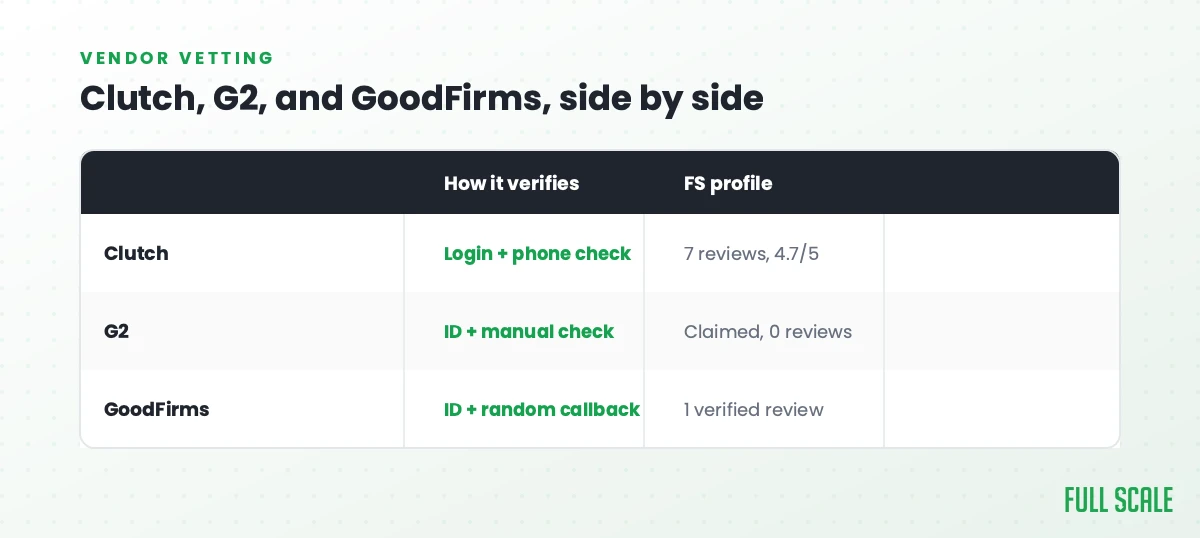
The three platforms stack up like this:
| Platform | Review verification | Full Scale’s profile |
|---|---|---|
| Clutch | LinkedIn, Google, or company email login; phone interviews for Verified and sponsored clients | 7 reviews, 4.7 / 5 |
| G2 | Identity verification, manual quality control (up to 3 business days), automated fraud detection | Claimed, 0 reviews |
| GoodFirms | Identity verification, LinkedIn cross-referencing, random phone or video callbacks | 1 verified review (Realquantum) |
What to check beyond the star rating
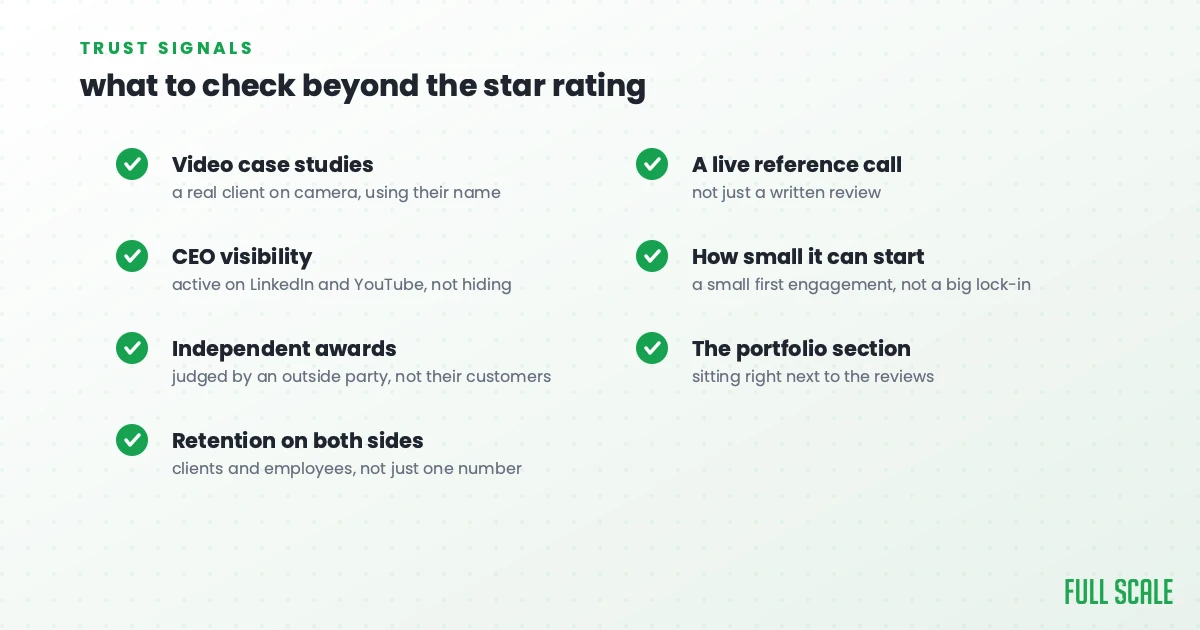
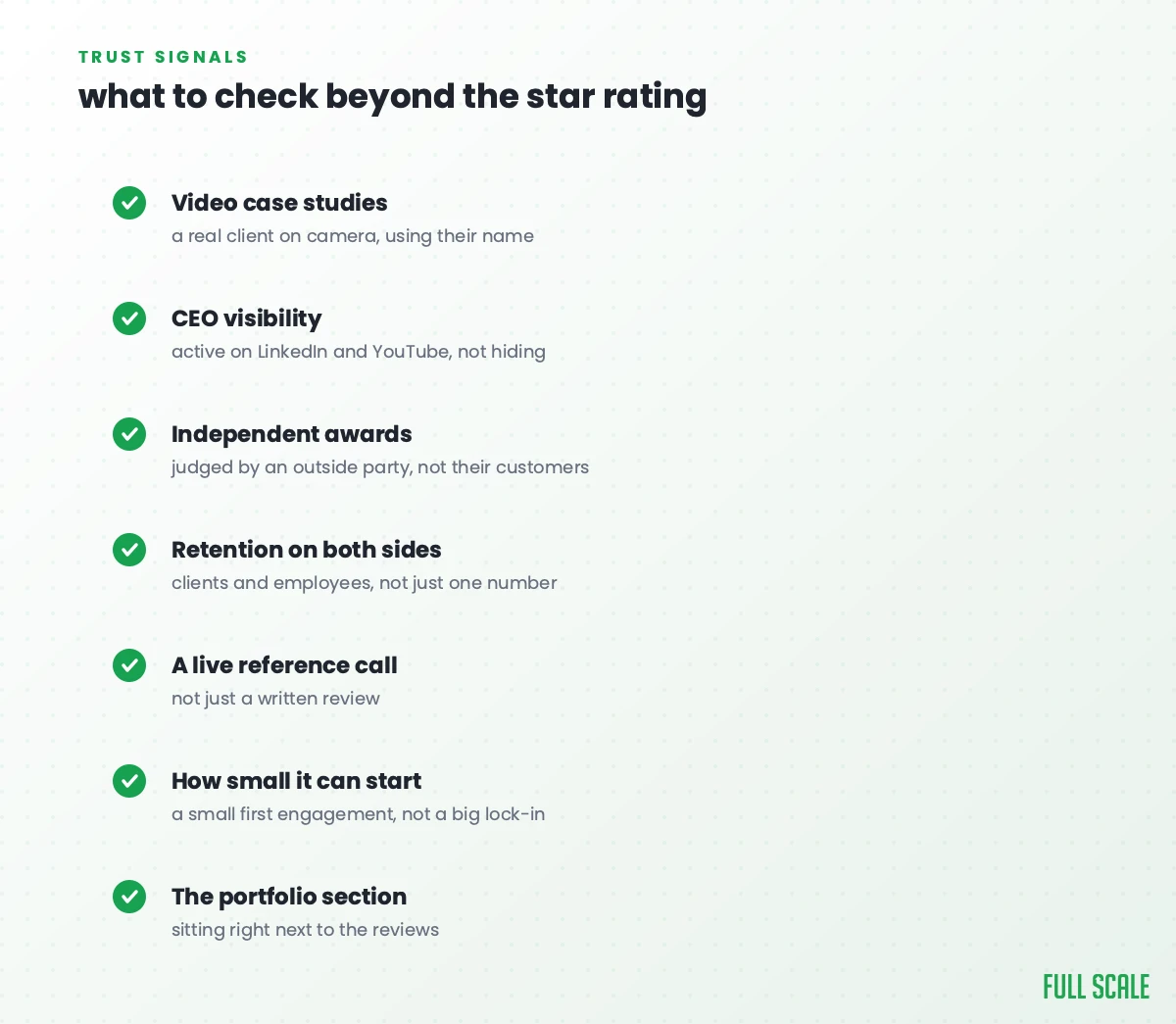
The star rating and the review count aren’t everything. A trustworthy vendor also demonstrates it through:
- Video case studies featuring a real client
- Public visibility from the CEO on social media and YouTube, and what they’re actually saying
- Independent, third-party-awarded recognition
- Client and employee retention, examined from both sides
- A live reference call, not just a written review
- How small a first engagement can start
- A portfolio section, sitting right next to the reviews
All of it is checkable with no login required.
A client on video is harder to fake than a paragraph of text
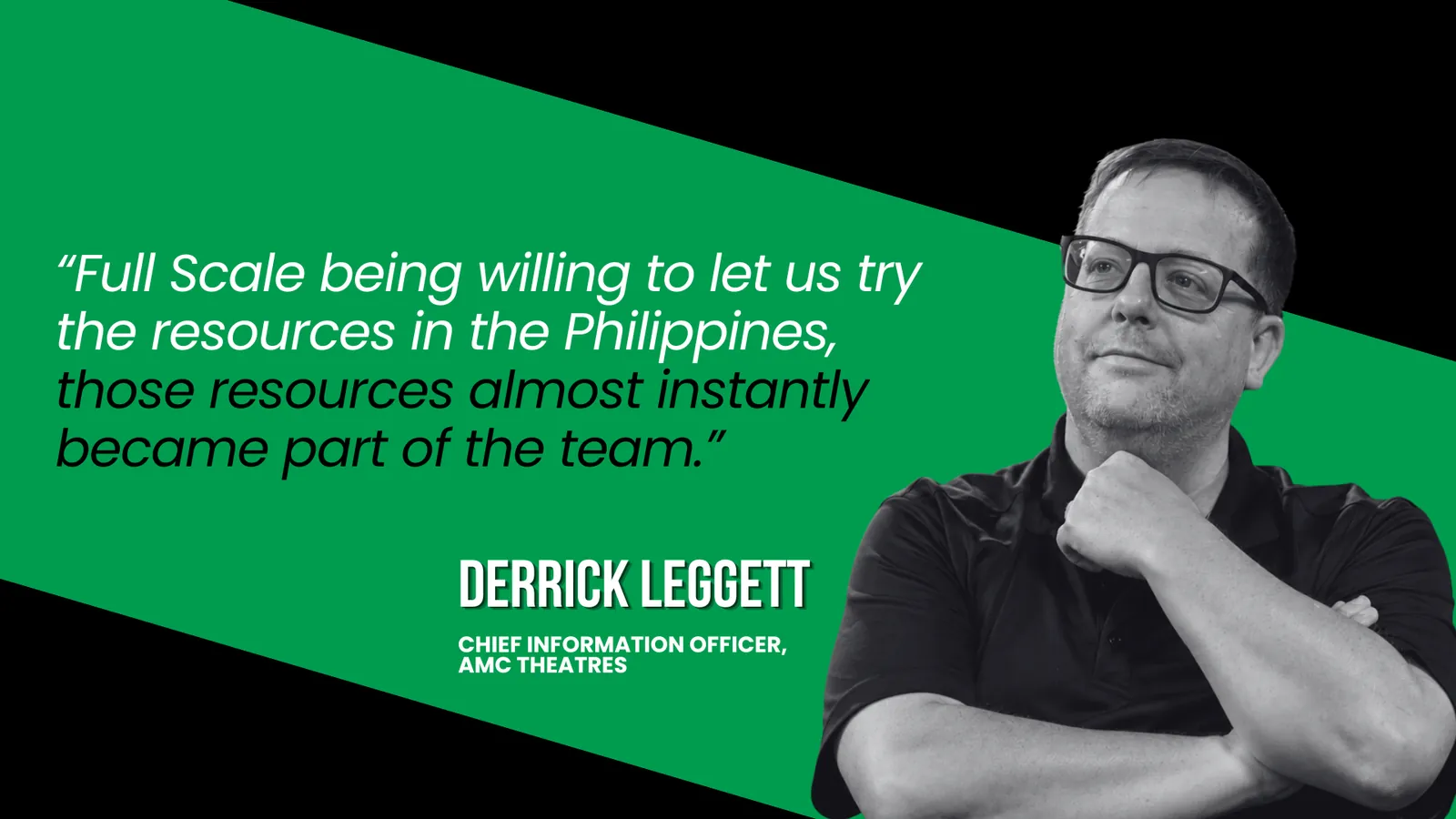
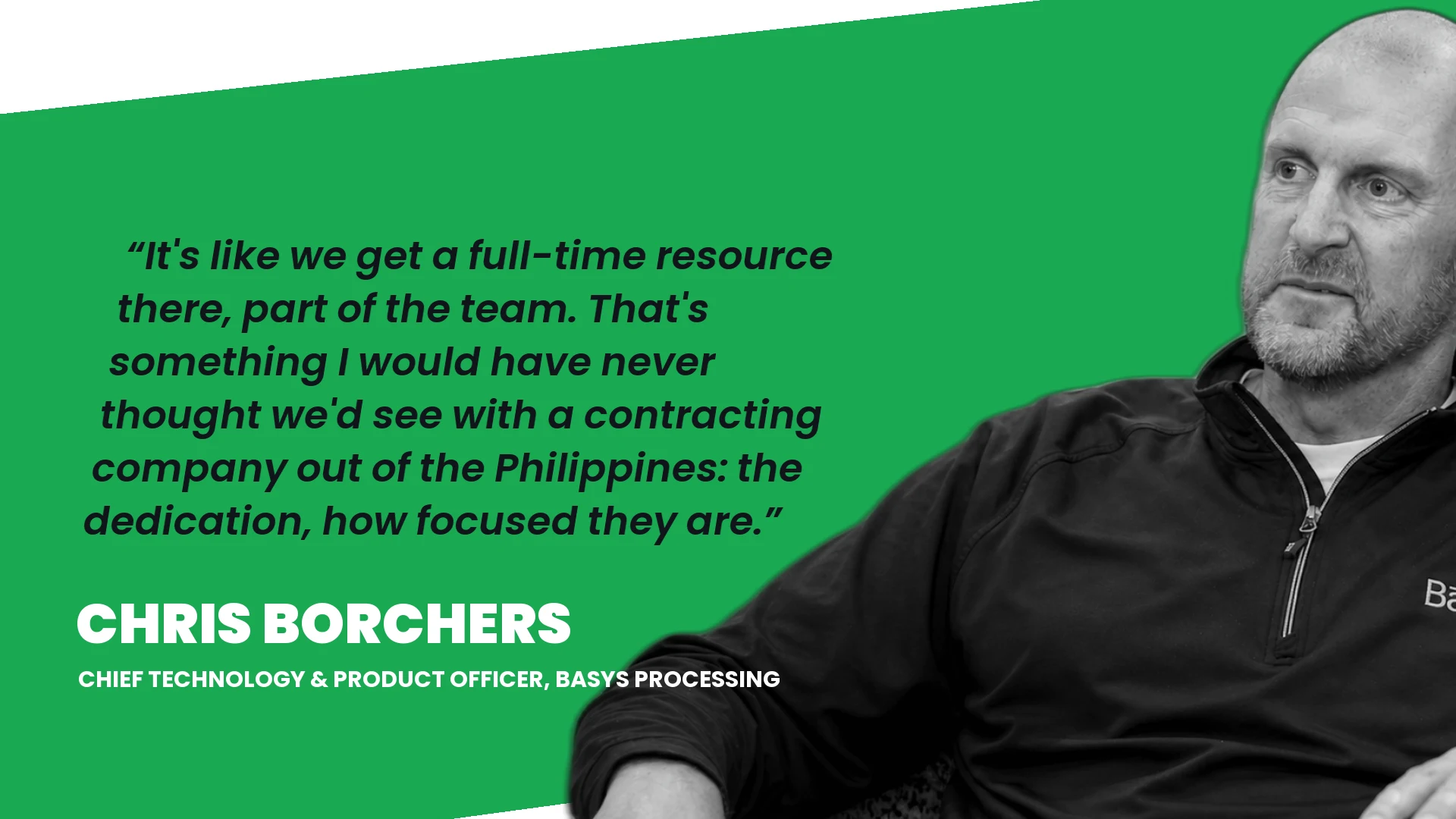
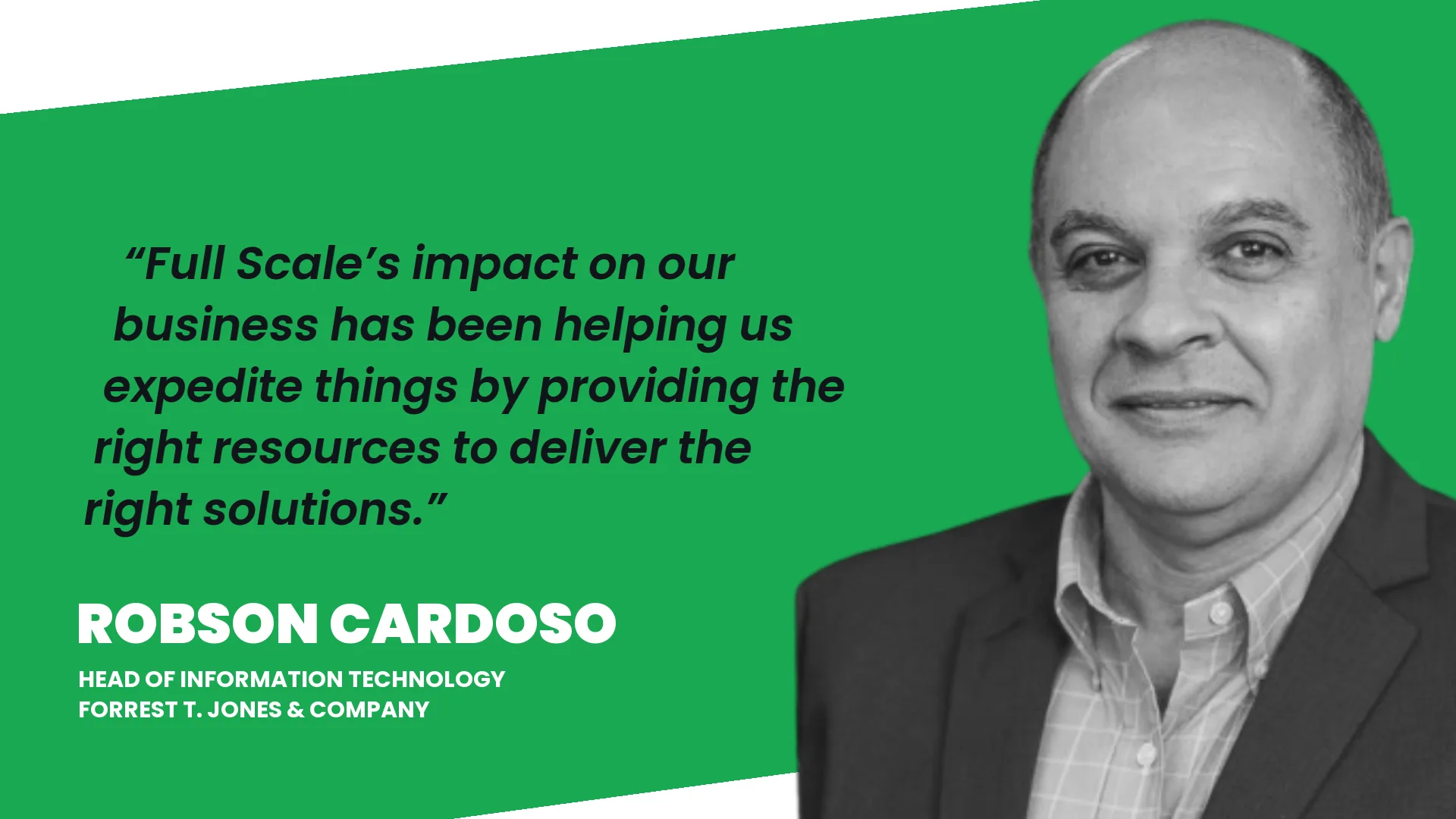
A text testimonial is easy to fabricate, or at least easy to commission someone to write. An on-camera one, using the person’s actual name and title, is not. Full Scale’s case study featuring Derrick Leggett, CIO of AMC Theatres, is the one we point to most: a legitimate executive at one of the largest movie-theater ticketing companies in the world, on video, saying “It’s a fully integrated team. It’s just that some of the people happen to be living in the Philippines.” Dustin Johnson at SOTA Cloud and Jeff Weiner at Realquantum echo the same sentiment in their own case study videos. None of these three can be fabricated the way a block of text can.
Look up the CEO before you sign anything
A vendor’s leadership showing their face on LinkedIn, in interviews, saying things that stand up to scrutiny, is a trust signal that no review site could ever measure. Matt Watson is right there on LinkedIn for exactly that reason, and it’s the same instinct behind the Product Driven philosophy he wrote a whole book on. An invisible CEO makes you wonder about something. So does a CEO you can actually go read.
This is genuinely how I size up a vendor myself, not just advice I’m handing out. I pull up the leadership team on social media and see who’s actually running the place, then search YouTube for whatever else surfaces, a conference talk, a product demo, an interview nobody paid them to give. A founder who shows up on the record somewhere you didn’t ask them to is a lot easier to trust than one you can only find through a sales deck.
Independent awards are a different kind of proof than a review badge
A badge on a review site is something a vendor is either paying for or has earned from its own customers. An award like the Inc. 5000 or Great Place to Work is judged by a third party based on its own criteria, making it a lot harder to game. Full Scale has made the Inc. 5000 list for five years straight. In the Philippines, Full Scale is also Great Place to Work Certified for two years in a row, with 95 percent of its employees there saying it’s a great place to work, versus 65 percent for an average Philippine company. Neither number was derived from a customer filling out a survey.
Check retention on both sides of the relationship
A vendor that fails to keep clients for more than a year has the same problem, except it shows up at the very beginning of the relationship. Clutch’s own research in 2024 put the average offshore relationship at just 14 months. Full Scale’s Clutch reviews show what long-term actually looks like: a relationship with Facility Ally dating back to January 2018, now more than eight years, and a steel manufacturer dating back to January 2017, now more than nine. These are actual dates on a real review, not a claim you have to trust blindly.
This test also works in reverse, and this time the number is company-wide rather than specific to one client. If a vendor can’t keep its own people around, it has the same problem, just coming from the opposite direction. Full Scale retains 93 percent or more of its employees, and employee sentiment matches the Great Place to Work numbers mentioned above. Look at that second one too, on Glassdoor if nowhere else. A company that treats its own employees badly will eventually treat its clients badly too, because the same culture drives both relationships.
Ask for a reference call, then notice the hesitation
A vendor confident in its own work will connect you to a current client without much friction. A written review is asynchronous and edited; a reference call is live, and it’s harder to fake in real time. One that stalls, or hands you a vague “we’ll see what we can do,” just gave you a more useful data point than anything a review platform verifies.
Start small before you commit six figures
Most Full Scale customers don’t start with a huge project scope. We usually have one or two developers assigned to a piece of their roadmap, long before anyone starts talking about growing the entire team. This isn’t a strategy to get a toe-hold into your company. We want our customers to engage us as partners over time, not just once. Starting with a small commitment lets both sides figure out whether we work together before scaling things up.
The terms align with that intention: a full refund if we’re not the right fit within the first two weeks, then 30 days’ notice to leave after that, no long-term contract required. Because we want the relationship to work over the long term, Full Scale’s incentives align with the customer’s. If it only worked by locking people in, there would be no alignment between us, which is why staff augmentation looks the way it does.
If the price point is what’s holding you back, Full Scale’s pricing is public, and we’ve written about how offshore development rates compare across countries before. If a vendor won’t let you start small, or offers only a long-term lock-in with no option to leave, it’s asking you to skip the step where you find out if this will work for you.
Check the portfolio section next to the reviews
Clutch, G2, and GoodFirms all include a portfolio section on a vendor’s profile page: screenshots of real delivered work and short write-ups, sitting right next to the star rating and comments. It’s worth checking on its own, separate from the rating. A review can say the work was great. A portfolio actually has to show something real. Compare it against whatever you’re evaluating.
Frequently asked questions
How do you choose a software development company?
Look at how Clutch, G2, and GoodFirms rate a vendor’s track record, then dig deeper. Are there video case studies? Has the vendor won an independent award? Can you see real retention numbers, or get a reference call? A star rating alone answers none of that.
How do you choose the right custom software development company for a specific project?
Weight the same signals by project size: third-party reviews, video proof, retention data, and a reference call. A small, fixed-scope project can tolerate more risk than a staff augmentation relationship that could run for years. Lean harder on the reference call and the portfolio section, and consider starting with a smaller piece of work before going bigger.
How do you choose the right software development company when every vendor looks the same on paper?
Find the details a vendor can’t fake: a mediocre review sitting next to the good ones, a named client on video, an award judged by someone other than the vendor’s own customers. It’s the same lens we use whenever we compare ourselves against specific competitors by name instead of by star rating, and vendors that look the same on paper rarely stay that way once you check.
What’s the best way to evaluate software vendors before signing a contract?
Request a phone consultation with a reference, get the terms of the contract in writing (how much notice for cancellation, who owns the intellectual property, and so on), make sure you know what happens in the first two weeks, and actually ask about their retention rate instead of relying on the oft-repeated “we build long-term relationships.”
Are Clutch, G2, and GoodFirms reviews trustworthy?
Treat each one as evidence to weigh, not a fact to accept outright. All three platforms do some identity verification and some form of human contact before a review goes live, which rules out the laziest fakes. But a vendor can still ask its happiest clients to leave reviews while its unhappy ones say nothing, so no single review count settles the question by itself.
None of this replaces actually talking to the company. Book a call with Full Scale and ask us the same questions you’d ask anyone else, then go check whether our answers hold up on Clutch, G2, and GoodFirms too.