
Do Offshore Development Companies Need SOC 2 Certification?

In this article
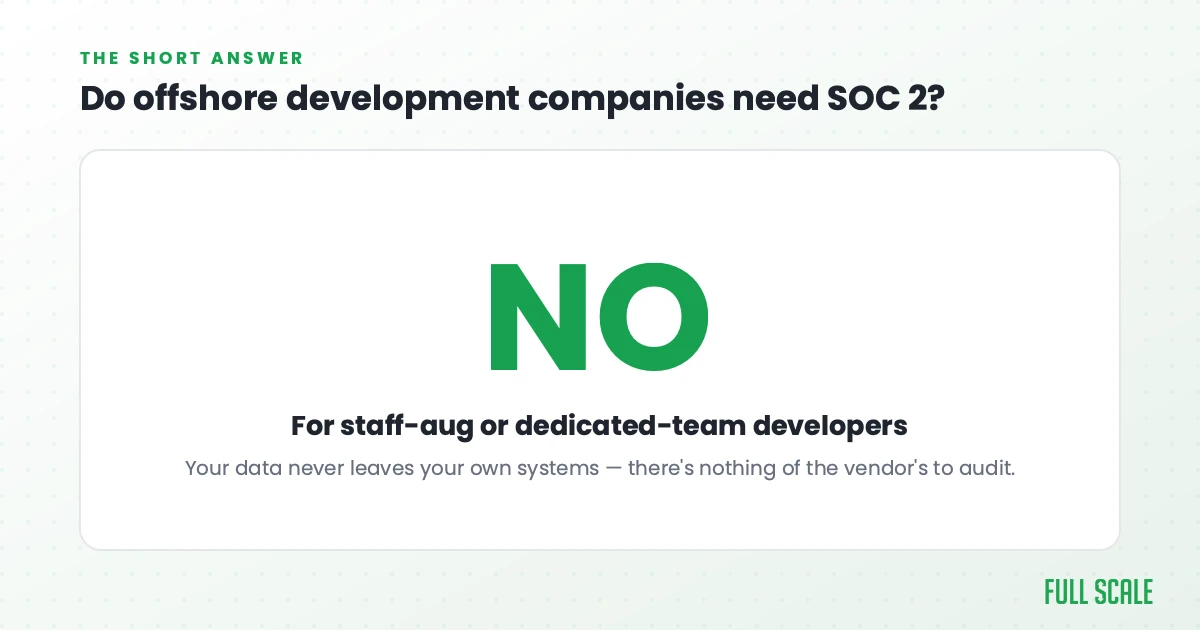
Quick Answer: A staff-augmentation or dedicated-team vendor doesn’t need its own SOC 2 certification. In this model, your developers work inside your own systems, using your own access controls, so your existing compliance rules govern the work. SOC 2 exists to audit a vendor’s IT, and here, none of your data ever touches the vendor’s IT.
Some prospects at Full Scale have asked if we can provide them with our SOC 2 report. We don’t have one, and we don’t plan to pursue it.
What SOC 2 Certification Actually Checks
SOC 2 is an audit standard the American Institute of Certified Public Accountants (AICPA) developed. It checks whether an organization keeps its systems secure and available, processes data with integrity, protects confidentiality and privacy, and manages change to its own software responsibly.
A Type I audit says the controls were in place at a specific point in time. A Type II audit says they were maintained for six to twelve months. You want the latter.
What’s actually being audited is the organization’s own infrastructure, its own log review, its own incident response process. That’s the part most “top offshore companies with SOC 2” articles skip past before diving straight into the logos, and it’s the distinction that decides whether you’re even asking your offshore partner for the right kind of certification.
Do Offshore Development Companies Need SOC 2 Certification, or Just the Client?
An offshore development company can mean two very different businesses, and which one you hired changes the answer.
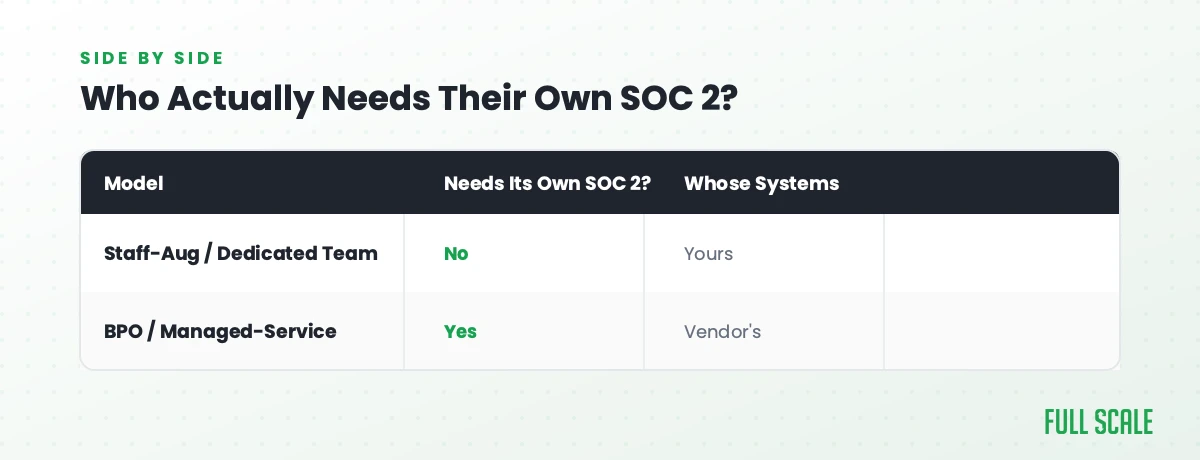
If you hired a BPO or managed-service provider, they do the work on their own infrastructure. Your code runs on their servers and lives in their database. Their developers log into systems you don’t have access to. Your data security depends on the vendor’s own controls, because you have no other way to know how your data is handled. A SOC 2 report is close to the only proof you’ll get. Asking for one is the right move.
If you hired staff augmentation or a dedicated team, things work differently. Our developers log into YOUR repositories, YOUR cloud infrastructure, and YOUR access controls. You provision the accounts, and you can turn them off on your own schedule. We’re not moving your production data through a separate environment Full Scale owns that would need its own audit. Our team follows whatever processes and procedures you already have. If you run SOC 2 controls, our developers operate inside them the same way any new employee on your team would.
There’s a fair objection buried in that setup: an engineer’s own laptop is still a device connecting to your systems, so doesn’t Full Scale’s own device security matter too? Yes, it does, and it’s a real answer, just not a SOC 2-shaped one. Every Full Scale developer works on a company laptop. Nobody’s out there on a home PC with the whole family’s photos and passwords stored on it. That’s the protection that actually matters here, not a certificate about it. We own the device. You own the permissions.
That’s the actual shape of the engagement, and it’s why most regulated work can run on a dedicated team. HIPAA work runs fine on a dedicated team. So does SOC 2 work, for the same reason: the compliance line gets drawn around your systems. That’s not true for every regulated category. Defense work that needs cleared personnel onsite is a genuine exception. But it holds for the two categories that come up most in this conversation.
Two Reasons People Actually Ask About This
We’ve fielded this question from enough clients to know it comes from two different places, and each one deserves its own answer.
The first is genuine uncertainty about whether offshore work brings some new flavor of risk. Fair question, and it’s related to a different one we’ve answered elsewhere: what remote teams actually need to do to stay compliant day to day. Put simply, your access controls and your compliance program apply to the engineers the same way they apply to anyone else with a login. Where the engineer sits doesn’t change that.
The quieter, more interesting motivation is the hope that sending the development offshore also sends the compliance headache offshore. Picture a mid-size company that’s never gone through a SOC 2 audit itself. A client security questionnaire lands, or a big enterprise deal suddenly requires one. Sending the build offshore looks, for a minute, like a way to hand that problem to someone else. If the vendor is already certified, maybe that certification fills the gap and the company gets to skip building its own compliance program. We get the appeal. It still doesn’t work that way. Since our developers operate inside your infrastructure, a SOC 2 audit of Full Scale’s own internal IT wouldn’t answer the question anyone was actually asking. Full Scale isn’t going to be anyone’s compliance workaround. Neither is any other staff-aug vendor running this model honestly, whether they say so out loud or just quietly decline to chase the certificate the way we do.
When a Vendor’s Own SOC 2 Certification Actually Matters
To be fair, there’s a real version of “offshore development company” where the vendor’s own certification is the right ask. Picture large-scale enterprise delivery, a vendor running 50 to 500 engineers on its own managed infrastructure at BPO scale. That’s much closer to the BPO model than the staff-augmentation one. ISO 27001 and SOC 2 at that scale are the vendor delivering compliance as part of the service, because the vendor’s systems really are in the loop. That’s the same reason HIPAA, SOC 2, and GDPR all show up together in our offshore IP protection framework. The moment a vendor’s own systems handle your data, the vendor’s own audits become the client’s real evidence.
The problem is applying that same logic to a dedicated-team engagement and expecting the wrong vendor to hand over the wrong document. Not sure which one you’re buying? One question settles it: whose systems will your data actually touch?
Even the offshore-security commentary that gets closest to this still stops short. The common line is that a certificate or report is necessary but not sufficient, since real security comes down to controls and enforcement. Fair, as far as it goes. For a staff-aug engagement specifically, we’d argue the certificate is checking the wrong company’s systems entirely.
What to Check Instead of a Certificate
A SOC 2 badge might actually help close a few more deals. Plenty of vendors chase it for exactly that reason, a badge for the website, not a control that changes anything about a staff-aug engagement. We’d rather earn the trust with things that actually apply to this model.
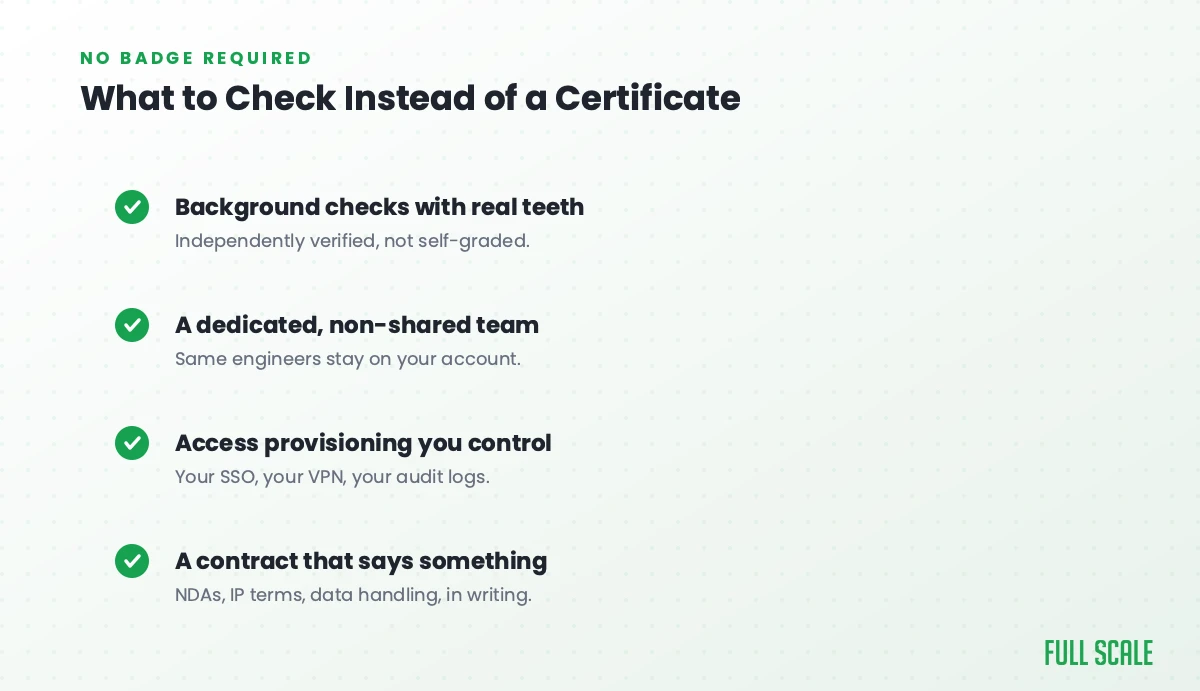
- Background checks that mean something. We run background checks on everyone we hire, every role, engineering included. They’re handled by Infovision Research Systems, an outside firm we have no business relationship with, so we’re not grading our own homework. It’s the same trust property a SOC 2 report is selling, just aimed at the people instead of the servers.
- A team that isn’t shared. Will the engineers on your project stay on your project, or get pulled onto whoever’s deadline is loudest that week? A revolving bench is a bigger practical risk than a missing certificate, and nobody puts that on a sales page.
- Access provisioning you control. When our engineers log into your SSO, your VPN, and your audit logs like any other member of your team, you already have the visibility a SOC 2 report exists to fake for a vendor operating as a black box.
- A contract that says something. NDAs, IP assignment, data-handling terms, in writing. Not a verbal promise that everything’s fine.
Check off those boxes and you’ve done more real diligence than a certification logo on a homepage ever bought you. For more on vetting a software development company beyond compliance specifically, our full guide covers the rest of the list. And if the engagement model itself is still the open question, that’s exactly what we cover in how staff augmentation works.
If your team is still deciding what to actually screen for, talk to Full Scale about how the dedicated-team model handles your specific compliance setup. No badge required.
FAQ
What’s the difference between SOC 2 Type I and SOC 2 Type II?
SOC 2 Type I means an organization’s security controls exist on a given day. SOC 2 Type II means the same controls stay in place over a six-to-twelve-month period, tested by an independent third party. Type II is the one worth trusting, because plenty can look good on any given day and fall apart the rest of the year.
Does ISO 27001 matter for offshore development the same way SOC 2 does?
ISO 27001 and SOC 2 both ask whether an organization takes reasonable steps to protect its information, audited through different frameworks. Both matter for the same kind of vendor: one hosting your data on its own infrastructure at real scale, like a large managed-service or BPO provider. For a staff-augmentation engagement where engineers build inside your own systems, neither certification measures what actually keeps your data safe.
How do I vet an offshore development company if I can’t rely on a SOC 2 report?
Check whose systems your data will actually touch, ask how the vendor runs its background checks and whether they’re independently verified, confirm the team stays dedicated rather than split across other clients, and get data-handling and IP terms written into the contract instead of just talked about. A vendor with no answer to any of this is the real red flag, not the absence of a certificate.