
Offshore Android App Development – Hire Trusted, Affordable Talent from the Philippines

In this article
- The Structural Mistake: Wrong Model for Android
- The 7 Reasons Offshore Android Projects Fail
- The Full Scale Direct Integration Model for Android
- The 5-Stage Vetting Process: Finding Senior Android Engineers
- The 7-Day Integration Framework for Android Teams
- The Real Cost of Offshore Android Development
- The Android Projects That Offshore Best
- When Offshore Android Makes Sense
- When It Doesn’t Make Sense
- Common Objections
- Why Full Scale for Offshore Android Development
- Frequently asked questions
My first Android development work was for VinSolutions, car dealership software, when we needed tools for salespeople tracking customer engagements out on the lot. Most of those salespeople were on Android. So most of that work shipped on Android. Android work is only half the picture; backend development for mobile apps handles the data and logic behind the screen. It also shapes how we think about what an Android developer actually does now.
This guide is the Android-specific deep dive. If you are weighing Android against iOS or a cross-platform stack, start with our broader offshore mobile app development guide, then come back here for the Android details. And if you are hiring on the Apple side, our interview questions for your iOS hires cover what to ask there.
That was around the Android Eclair era. Before the App Store and Google Play had the competitive dynamic they have today. Before Kotlin existed. Before anyone was using the word “Jetpack.”
I’ve been an Android user and builder ever since, not by default but by preference. I’ve written about why offshore development often goes wrong and what makes it work. Android has its own failure modes on top of the generic ones. Android gives you a platform where you can install what you want, sideload tools you’re testing, and configure the experience to match how you actually work. After twenty years in software, I still think that openness matters.
At Full Scale, we’ve placed Android engineers across the Philippines. The companies we work with have shipped consumer apps, enterprise field tools, IoT companion apps, and production systems at Fortune 500 scale. I know what a senior Android developer actually looks like in 2026 (someone who ships Kotlin, Jetpack Compose, and handles the Play Store submission process without needing a guide), and I know how big the gap is between that and what most offshore agencies are placing.
Here’s what most companies get wrong.
What you’ll learn in this guide:
- The structural mistake that makes most offshore Android projects fail
- The Jetpack Compose gap, the Android quality signal most companies don’t test for
- The Google Play Store complications that offshore project shops consistently miss
- Our 5-stage vetting process for Android engineers
- Real cost breakdown
- Which Android projects offshore well and which don’t
- When offshore Android development doesn’t make sense
The Structural Mistake: Wrong Model for Android
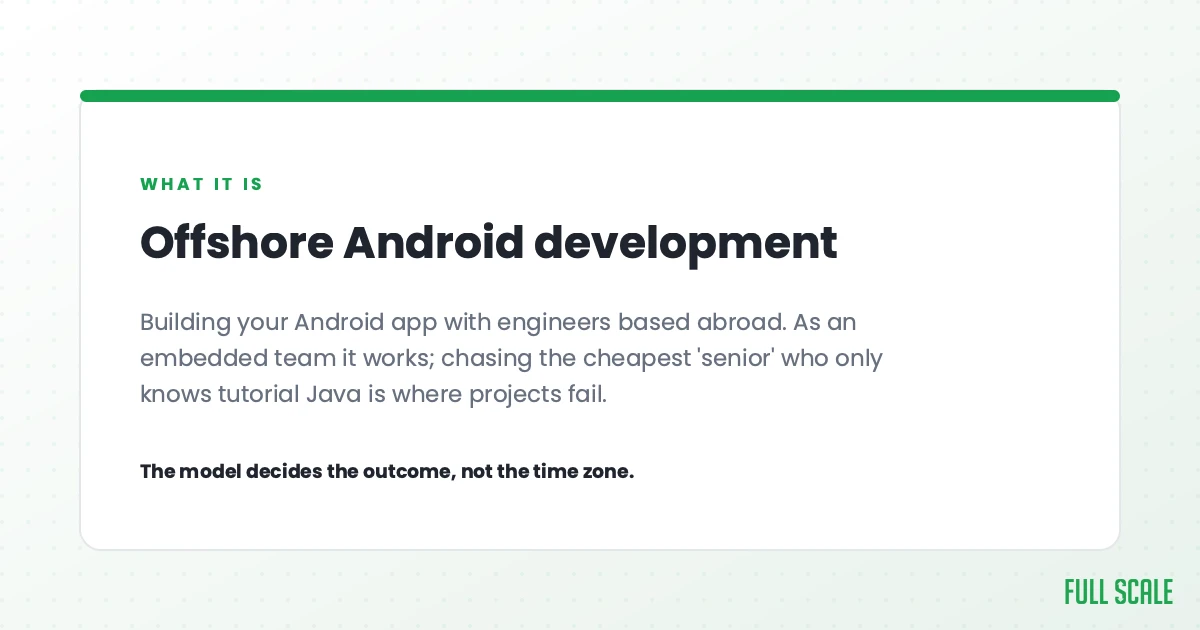
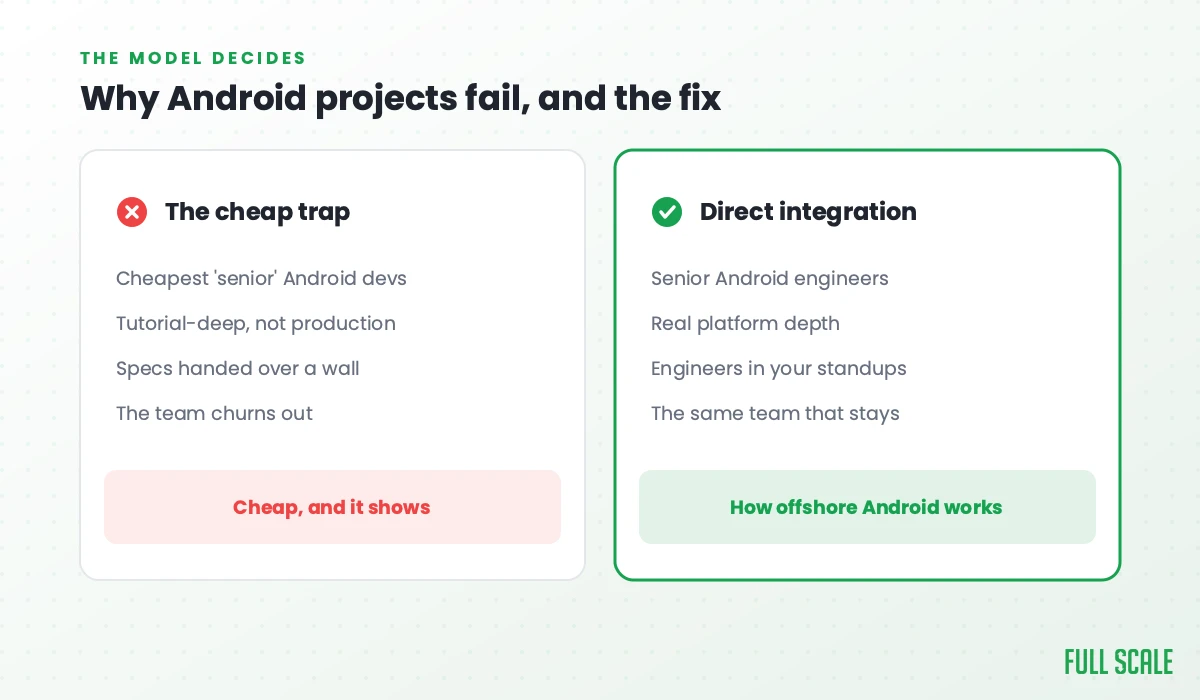
The most common offshore Android failure isn’t a bad developer. It’s a bad engagement model.
Project outsourcing routes your Android requirements through account managers and project managers before they reach the Kotlin developer writing your app. Android apps are architecturally complex. The lifecycle, the Compose state management, the Coroutine scope, the Room database schema, the Retrofit interceptor chain. Each of these requires real context to implement correctly. The telephone game between you and the developer strips that context out layer by layer.
You receive an APK that runs. The crash rate in production tells you the rest of the story.
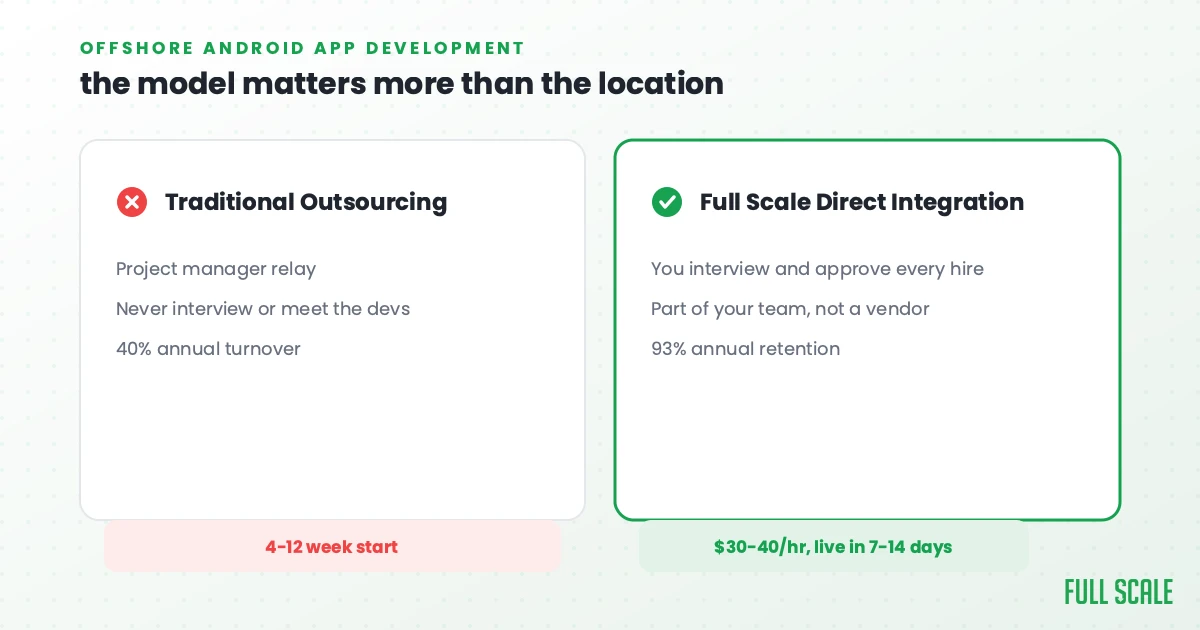
Direct integration / staff augmentation means your offshore Android developer is in your Slack, on your standups, working in your GitHub repo, committing to your main branch, going through your code review process. Full Scale handles payroll, HR, workspace, and equipment in the Philippines. You handle technical direction.
The results:
| Factor | Project Outsourcing | Direct Integration (Full Scale) |
|---|---|---|
| Architecture context | Filtered through PM | Discussed directly with your team |
| Jetpack Compose alignment | Shop’s patterns | Your patterns |
| Play Store knowledge | Often absent | Tested in vetting |
| Annual developer turnover | ~40% | ~7% (93% retention) |
| Start time | 4-12 weeks | 7-14 days |
The staff augmentation vs. outsourcing decision is the actual choice, regardless of how companies frame it when they start searching.
The 7 Reasons Offshore Android Projects Fail
Reason 1: The Jetpack Compose gap
This is the Android quality dividing line in 2026, and most companies don’t test for it.
Jetpack Compose replaced the XML view system as Android’s modern declarative UI framework. Google introduced it in 2021 and it’s now the standard for new Android development. The problem: a large share of Android developers who claim senior experience, including offshore developers at cheap agencies, learned Android in the Java/XML era and have either not learned Compose at all or have only worked through tutorials.
The gap shows up in production. Compose state management has different pitfalls than the old View system. Recomposition behavior, remember vs. rememberSaveable, lifecycle-aware collection, proper LaunchedEffect usage. These are things you get wrong in ways that don’t break unit tests but destroy the user experience under real conditions.
Our vetting process explicitly tests Compose production experience. We reject developers who’ve completed Compose tutorials but haven’t shipped a Compose screen to the Play Store.
Reason 2: Cheapshoring the Android stack
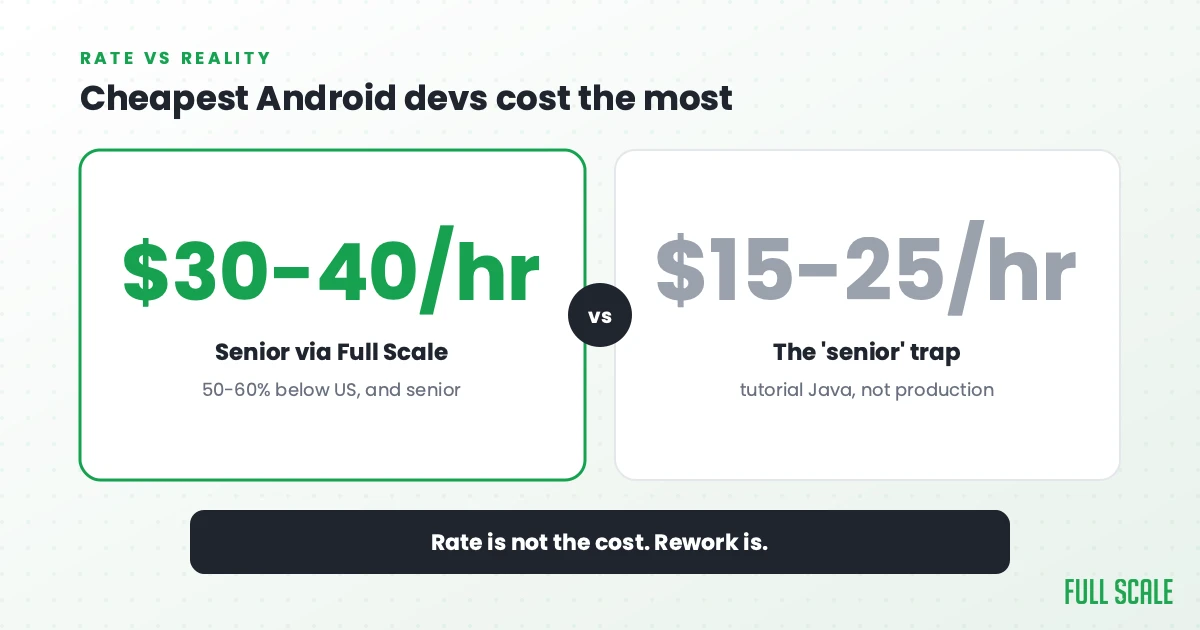
I call this cheapshoring: offshoring for cost alone, with no real quality bar. Android has a large offshore market at $15-25/hour for “senior” developers, many of whom know Java Android from 2015, haven’t shipped Kotlin Coroutines in production, and have never navigated Google Play’s submission process without it being handled by someone else.
Senior offshore Android developers at Full Scale cost $30-$40/hour. That’s still 50-60% below the all-in US equivalent. The $15/hour tier buys a different category of developer, and the cost of the technical debt they produce exceeds the rate difference.
Reason 3: No Google Play Store knowledge in the offshore team
This is the Android-specific failure that doesn’t exist for web development: the Google Play Store is a gatekeeper with its own requirements, review processes, and rejection criteria. Target API level compliance, Privacy Policy requirements, the Data Safety section, Google Play’s Content Policy, the app signing process, staged rollouts. These are all things a senior Android developer navigates routinely.
Offshore project shops frequently deliver working APKs from developers who’ve never actually submitted an app to the Play Store themselves. When you try to ship, you discover why.
Reason 4: Android fragmentation handled naively
Android runs on thousands of device configurations: different manufacturers, different OS versions, different screen densities, different hardware capabilities. Unlike iOS (where Apple controls the full hardware stack), Android fragmentation is real.
Developers who test on one emulator and call it done ship apps that break on specific Samsung configurations, fail on older OS versions still in your install base, or render incorrectly on unusual screen densities. Our vetting includes questions about fragmentation testing strategy and real device testing experience.
Reason 5: Coroutines and lifecycle misunderstood
Deloitte’s 2024 Global Outsourcing Survey found that outcomes and retention now matter more than cost as outsourcing drivers, because companies learned this lesson from Android projects that shipped ANR-prone apps. Application Not Responding errors are the most common production Android failure from offshore developers who don’t deeply understand Kotlin Coroutines and the Android lifecycle. Launching coroutines on the wrong scope, blocking the main thread, or mishandling lifecycle events creates ANR crashes that tank Play Store ratings.
Reason 6: Legacy Java/XML codebases offshore incorrectly
Many Android codebases are still partly in Java with XML layouts, built before Kotlin was the default, before Compose existed. Project shops handed these codebases frequently try a wholesale rewrite, which introduces regression bugs across the entire app. The right approach for legacy Android migration is incremental: Kotlin interop first, Compose adoption file by file, with the offshore team embedded and working alongside the local team who understands the existing behavior.
Reason 7: Treating offshore Android developers as short-term contractors
Android knowledge is deeply codebase-specific. Your ViewModel structure, your navigation graph, your data layer patterns, your custom Compose theming. These take time to understand and build on. Developers who leave in 12 months take that knowledge with them. Our 93% annual retention means the developers who learn your Android architecture stay long enough to become genuinely senior members of your mobile team. The developer retention strategies behind this aren’t complicated. They come down to treating offshore developers like the engineers they are.
The Full Scale Direct Integration Model for Android
Your offshore Android developer is in your Slack, in your Android Studio project, in your code review queue. They work in Kotlin with your linting rules, your architecture patterns, your Compose design system.
What Full Scale handles
Payroll, benefits, HR, legal compliance, background checks (more thorough than US standard, includes physical neighbor interviews as part of vetting), and workspace in the Philippines. If it isn’t working out in the first two weeks, you get your money back, with 30-day notice and no long-term contracts after that.
What you handle
Technical direction, code review, sprint planning, and architecture decisions. The offshore Android developers work for you, not through us.
AMC Theatres: consumer Android at scale
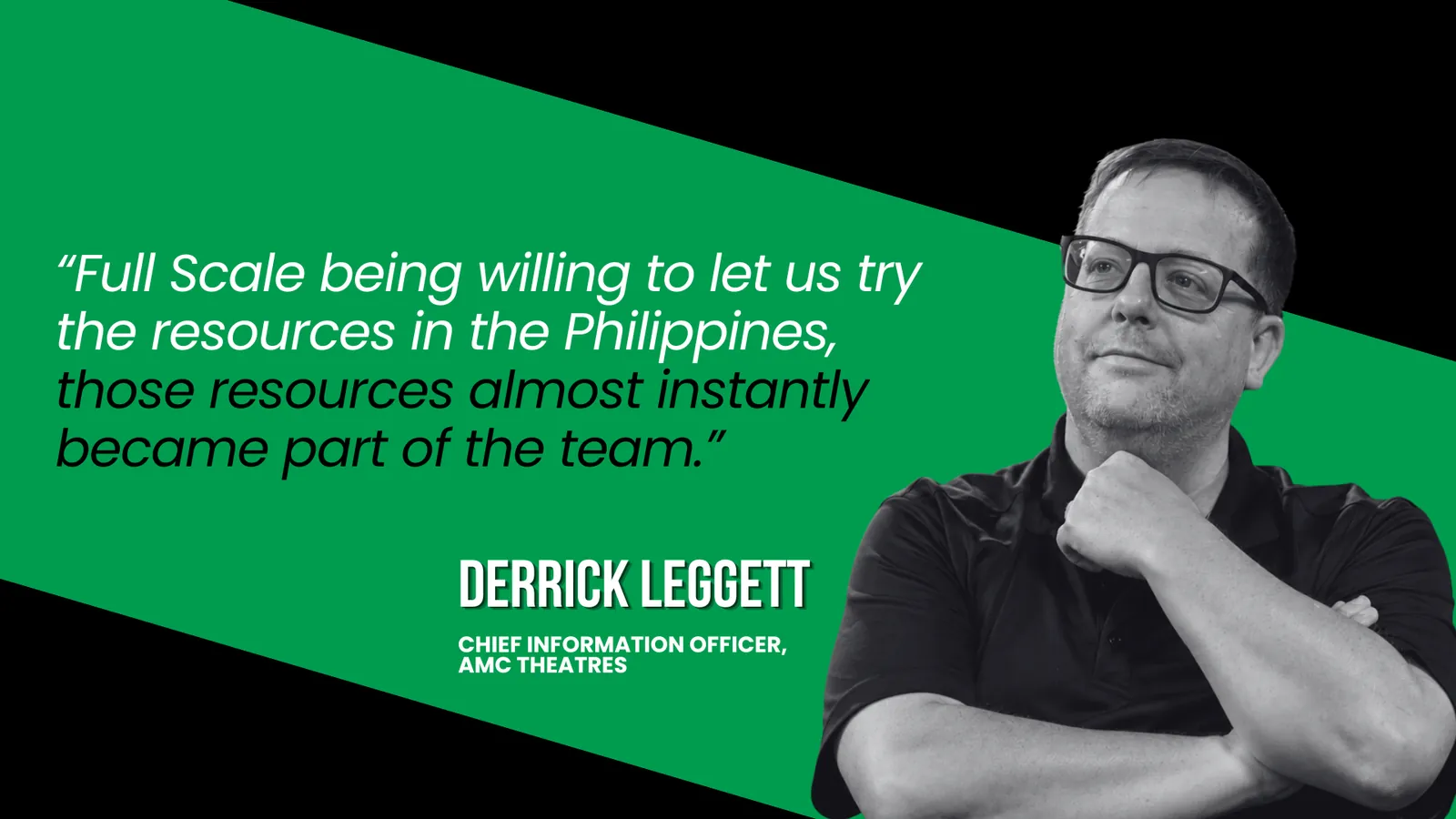
Derrick Leggett, CIO of AMC Theatres, describes his Full Scale-staffed engineering organization: “It’s a fully integrated team. It’s just some of the people happen to be living in the Philippines.”
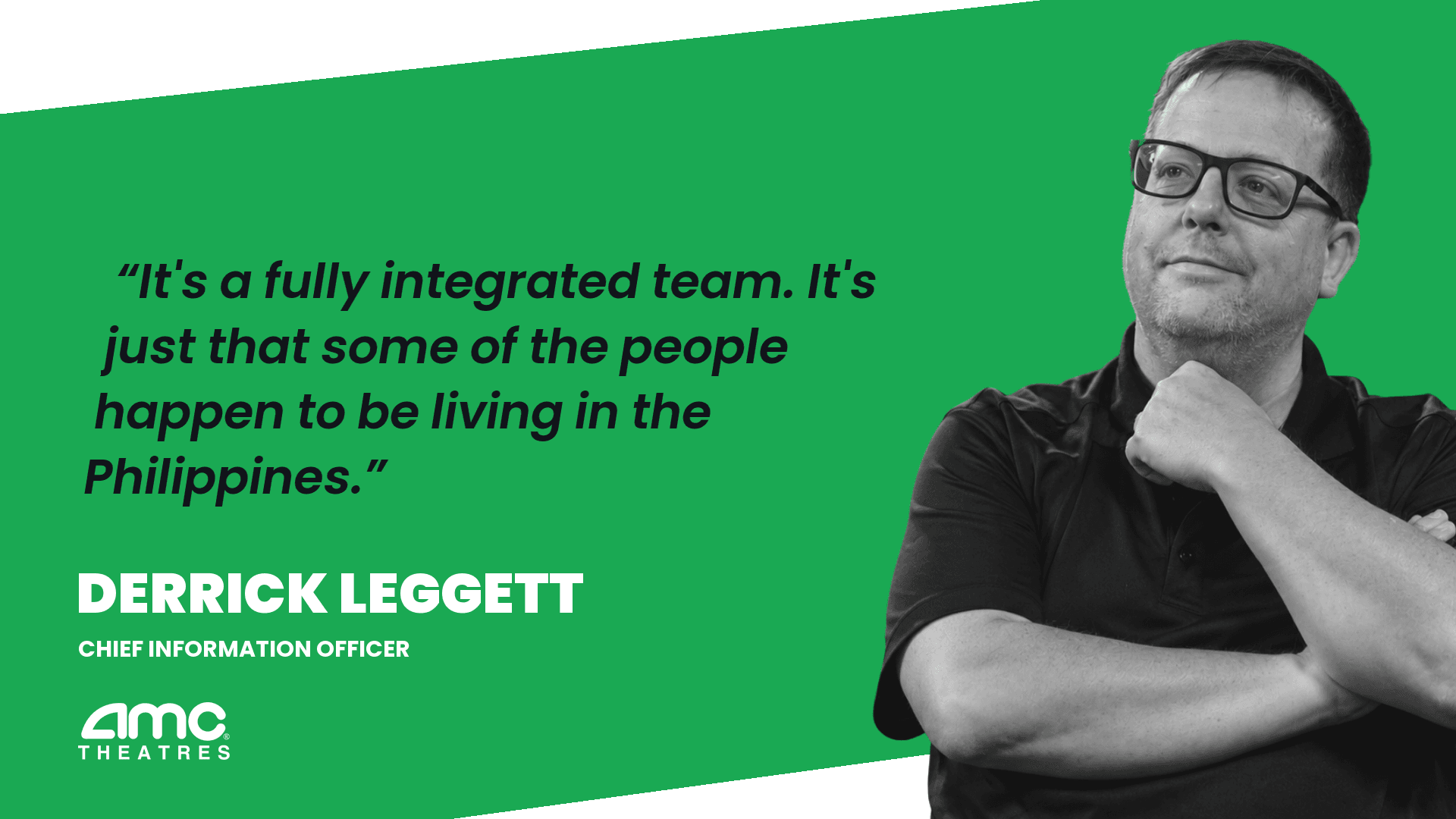
AMC’s consumer-facing Android app (ticketing, the A-List subscription, Stubs loyalty) runs on Android. Full Scale developers have been embedded in that engineering team. The AMC Theatres case study covers the full model. That’s the case study that demonstrates consumer-scale mobile development with offshore engineers integrated as actual team members.
The 5-Stage Vetting Process: Finding Senior Android Engineers
more than 97% of applicants don’t make it through. Here’s the process that produces 93% retention.
Stage 1: Resume and portfolio screening (55% rejected)
What we look for: 4+ years Android experience with production Kotlin, evidence of Jetpack Compose in shipped apps (not just tutorials), Google Play published work, GitHub with real Android code, English proficiency.
Red flags: “Android/iOS/Flutter developer” listed interchangeably (no Android depth), portfolio with only Java apps and no Kotlin, claims of Compose experience with no shipped app to point to.
Pass rate: 45%
Stage 2: Technical assessment (40% of Stage 1 rejected)
90 minutes. Kotlin language depth, Jetpack Compose production patterns, Android architecture (MVVM/MVI, ViewModel, StateFlow), Coroutines and lifecycle management, Room and Retrofit usage, Google Play Store process.
Sample questions:
- “Explain what causes recomposition in Jetpack Compose, and walk me through how you’d diagnose unnecessary recomposition in a production screen.”
- “What’s the difference between
viewModelScope,lifecycleScope, andGlobalScope, and when is each appropriate?” - “Walk me through what you check before submitting an app update to Google Play.”
- “How do you handle Android fragmentation in testing? What devices or configurations have caused you the most production issues?”
The Play Store question specifically surfaces developers who’ve actually submitted apps versus those who’ve only written code while someone else handled distribution.
Cumulative pass rate: 27%
Stage 3: Live coding exercise (30% of Stage 2 rejected)
Build a small Android feature in Kotlin and Compose under real conditions. We observe: is their Compose structure idiomatic? How do they handle state? Do they write tests? How do they handle the ViewModel/UI layer boundary?
No whiteboard puzzles. Real Android work.
Cumulative pass rate: 19%
Stage 4: Code review and architecture discussion (20% of Stage 3 rejected)
Review real code from their GitHub or Play Store work. “Walk me through the architecture of this screen.” “Why Hilt here and not manual DI?” “How did you handle the back stack on this flow?” “What’s the battery/performance implication of this pattern?”
Cumulative pass rate: 15%
Stage 5: Cultural fit and English proficiency (about 20% of Stage 4 rejected)
The Philippines is the third-largest English-speaking country in the world. We still test communication directly. An Android developer who can’t clearly articulate a UI state bug in a Slack message or a code review comment is a problem regardless of technical skill.
Our skills assessment framework covers the underlying methodology. The Philippines is the right offshore destination for mobile development because the developer quality is high and the English fluency is genuine, and we test both explicitly.
Final pass rate: under 3%
The 7-Day Integration Framework for Android Teams
Day 1: Environment and access
Android Studio setup, repository access, build environment, signing configuration understanding, Jira/project management access. Goal: developer can build and run the app by end of Day 1.
For Compose codebases specifically: walk through the design system (your custom composables, your theme tokens, your typography and color schemes) before the developer writes a single screen.
Days 2-3: Architecture walkthrough and pairing
Walk through the navigation graph. Explain the ViewModel and state management pattern. Pair on a small bug fix or UI tweak. First PR submitted and reviewed.
Days 4-5: First real feature
A small, well-scoped screen or flow. Active code review with explicit feedback on Compose structure, ViewModel boundaries, and Coroutine scope management.
Days 6-7: Process integration
Sprint planning or backlog review participation. Feedback session. Set expectations for the first 30 days.
Weeks 2-4: Ramp to full productivity
- Week 2: 60-70% velocity
- Week 3: 80-90% velocity
- Week 4: full productivity
Android developers who get proper architecture orientation hit this timeline. The ones dropped into an unfamiliar codebase take twice as long.
The Real Cost of Offshore Android Development
What you actually pay
Senior offshore Android developer at Full Scale: $30-$40/hour fully loaded (payroll, benefits, HR, workspace included). Annually: $62K-$83K. See Full Scale’s pricing page for the current rate card. A full offshore development cost analysis covers the ROI model in more depth.
US equivalent: senior mobile developers earn $130K-$155K in base salary. With the 1.25-1.4× loaded-cost multiplier: $160K-$215K+ annually. Recruiting fees add another 20-25% of first-year salary, $32K-$40K per placement.
| Cost Factor | US Senior Android Dev (3 years) | Full Scale Offshore (3 years) | Savings |
|---|---|---|---|
| Compensation | $480K-$615K | $186K-$249K | $294K-$366K |
| Recruiting | $32K-$40K | $0 | $32K-$40K |
| Onboarding | $12K | $6K | $6K |
| Turnover | $80K-$120K | $0 | $80K-$120K |
| Total | $604K-$775K | $192K-$255K | $412K-$520K |
The Android Projects That Offshore Best
Kotlin + Jetpack Compose apps with established architecture
The strongest offshore fit. Modern Android codebases with MVVM/MVI, Hilt, Coroutines, and Compose have enough enforced structure that a senior offshore developer can understand the codebase and contribute within a week. The Compose design system is the equivalent of a React design system. Document it before onboarding.
Enterprise and B2B field apps
Lower UI polish requirements, well-defined specifications, offline-first data requirements that are amenable to clear specs. These apps are built to contracts (feature lists, database schemas, sync behaviors) that translate well across communication boundaries.
Legacy Java/XML → Kotlin/Compose migrations
High demand, high complexity. Requires Android developers who understand both eras. This is embedded team work, offshore developers working alongside your local team who knows the existing behavior, not a migration project handed to a project shop.
IoT and hardware companion apps
Bluetooth, BLE, NFC, sensor integration. Requires Android-specific hardware API experience. Vet explicitly for the hardware APIs you need. Not all Android developers have worked with Bluetooth or NFC in production.
What doesn’t offshore as cleanly
Highly exploratory consumer UX where the design changes weekly. Pre-MVP apps where the core feature set is still being invented. These need tight designer-developer co-location. Once the UX patterns are established and the architecture is defined, offshore Android works.
When Offshore Android Makes Sense
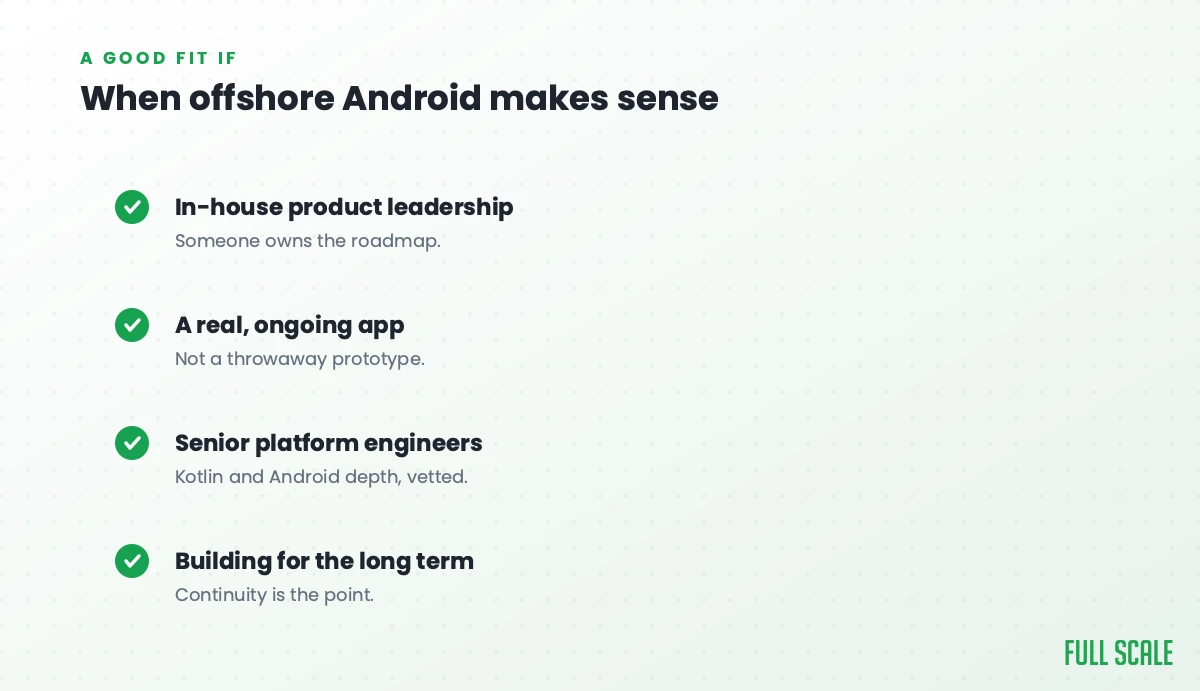
You have an established Android codebase. Kotlin is in place. Compose is adopted (or you’re migrating incrementally). The architecture pattern is defined. Offshore developers extend what exists rather than inventing conventions.
You’re scaling an ongoing product. Feature backlog, performance work, new flows, API integrations. Offshore staff augmentation was built for this. Read our guide on common offshore software development challenges to understand what to watch for when scaling the team.
You need Google Play expertise alongside development. Our developers have shipped to the Play Store. They know the submission process, the review criteria, the target API requirements. This isn’t an afterthought.
You need speed. Senior Android hiring in the US at the Kotlin/Compose level takes 60-90 days. Our timeline is 7-14 days.
When It Doesn’t Make Sense
Your architecture is undefined. Work out the ViewModel pattern, the navigation approach, and the Compose design system with your core team before adding offshore capacity.
You want project outsourcing for ongoing product development. Outsourcing Android development consistently produces Android apps that run and can’t be extended without fighting the original architecture.
You need iOS at the same time but want one team. Cross-platform (Flutter, React Native, Kotlin Multiplatform) is a separate question, and we have a plain-English breakdown of that call. Offshore works for those too, but native Android and native iOS with separate teams is often the right call for consumer apps at scale. For the cross-platform path, our Flutter app development team can staff that single codebase.
Common Objections
“How do I know the Compose experience is real?”
Our stage 2 assessment explicitly tests Jetpack Compose production patterns: recomposition behavior, state hoisting, remember and rememberSaveable, LaunchedEffect usage, ViewModel-to-UI boundary. Developers who’ve only done Compose tutorials fail this assessment. We only pass developers who can explain production Compose behavior, not just the API surface.
“What about Android fragmentation? Can offshore teams handle it?”
Our vetting specifically asks about fragmentation testing strategy and real device issues the developer has diagnosed. Developers who’ve shipped apps with a real install base have fragmentation stories. Developers who haven’t can only describe the theory.
“What about the Play Store submission process?”
This is in our stage 2 assessment: target API requirements, Data Safety form, app signing, staged rollouts, Google Play review policies. We reject developers who’ve only written code while someone else handled submissions.
“What about time zones?”
The Philippines has 8+ hours of overlap with US morning hours. Your Android developers are in your standups, on Slack in real time during your workday.
“IP and security?”
Full Scale is a US company, with US contracts, enforceable IP assignment, NDAs, background checks more thorough than US standard. See our offshore development due diligence checklist.
Why Full Scale for Offshore Android Development
I’ve been building on Android since Eclair. The VinSolutions Android tools I shipped in 2009 were for real users with a real constraint. The AMC Theatres mobile app is the consumer-scale proof that the model works. Our broader client case studies show how this plays out across industries and team sizes. And the Product Driven framework (Vision, Focus, Clarity, Ownership, Courage) is what our Android developers are trained on, so they ship features that serve users, not just features that pass tests. I know what a senior Kotlin/Compose developer looks like and what a legacy Java developer with a rebranded resume looks like, and that distinction drives every stage of our vetting.
Fewer than 3% of applicants make it through. Inc. 5000 for five consecutive years. Great Place to Work Certified in the Philippines. Month-to-month contracts.
If you’re ready to build an offshore Android team that works like part of yours, schedule a consultation.
Want to figure out whether to outsource a specific Android project or build a long-term team first? Read How to Outsource Android Development Without Getting Burned.
Frequently asked questions
What is offshore Android development?
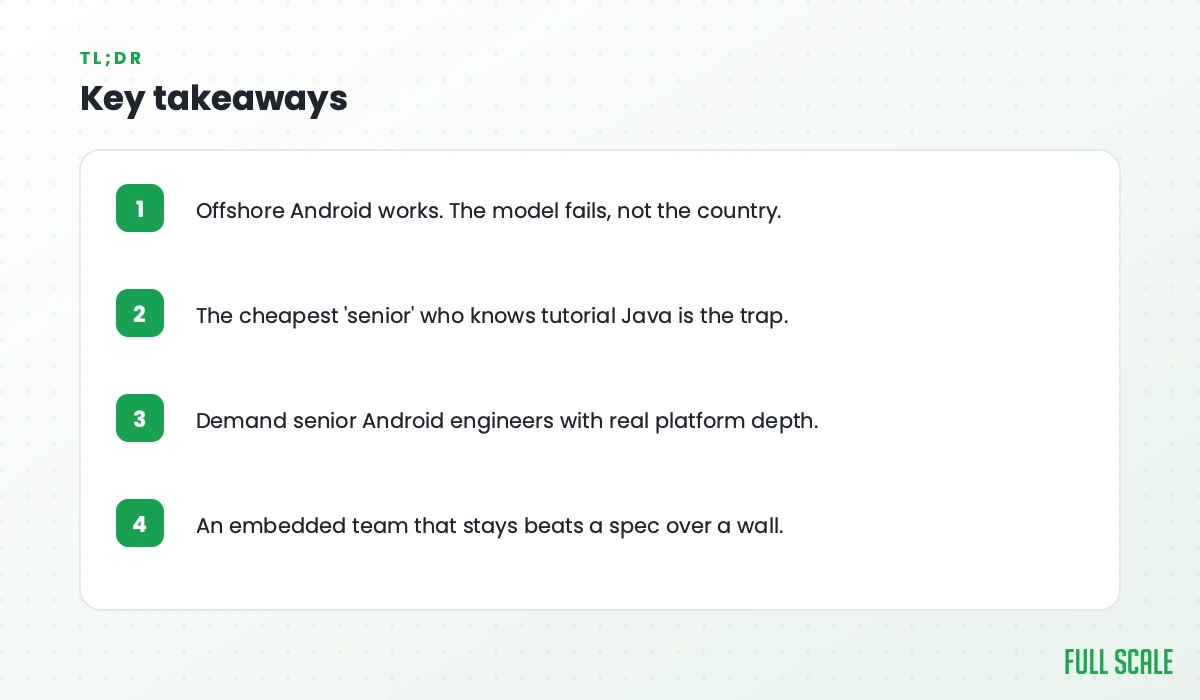
Offshore Android development is hiring Android engineers in another country to work on your mobile product. The model determines success more than the location: staff augmentation (developers integrated directly into your team) produces 93% annual retention at Full Scale versus 40% typical of project outsourcing agencies.
How much does offshore Android development cost?
Senior offshore Android developers at Full Scale cost $30-$40/hour fully loaded (payroll, benefits, HR, and workspace included). Annually that’s $62K-$83K, versus $160K-$215K+ for a fully loaded US senior Android engineer. Recruiting fees add another $32K-$40K per US placement.
How do you verify Jetpack Compose experience in vetting?
Our stage 2 technical assessment tests Compose production behavior specifically: recomposition, state hoisting patterns, remember vs. rememberSaveable, LaunchedEffect, ViewModel-to-Compose boundary. Stage 3 is a live Compose coding exercise. Developers who’ve only worked through Compose tutorials fail these assessments.
Can offshore Android developers handle Google Play Store submissions?
Yes, we test for this explicitly. Our stage 2 assessment includes questions about target API level compliance, the Data Safety form, app signing, staged rollouts, and Google Play review policies. Developers who’ve submitted apps themselves answer these questions differently than developers who’ve only written code.
How long does it take to hire offshore Android developers?
7-14 days from consultation to a developer working in your Android codebase. US Android hiring at the senior Kotlin/Compose level typically takes 60-90 days.
What’s the difference between offshore Android development and outsourcing an Android project?
Offshore staff augmentation: your Android developers join your team, use your tools, work in your GitHub repo, attend your standups, and build your product as direct extensions of your organization. Offshore project outsourcing: you hand a spec to an external Android team and receive an APK. Staff augmentation produces long-term system knowledge and 93% retention. Project outsourcing produces an APK that may or may not extend cleanly. Read our guide to outsourcing Android app development for when each model applies.