
Offshore Mobile App Development Services: Hire Trusted, Affordable Talent from the Philippines

In this article
- What offshore app development services actually are
- Why companies actually buy offshore development services
- What offshore app development services cost
- The engagement models, and which one actually works
- The Platform Depth Trap
- Our 5-Stage Vetting Process for Senior Mobile Engineers
- The Real Cost of Offshore Mobile App Development
- Which Mobile Projects Offshore Best
- Why most offshore engagements fail
- How to choose an offshore app development services partner
- What “done right” actually looks like
- Why Full Scale
- Schedule a call about your offshore app development
- Frequently Asked Questions
A CTO friend of mine just fired his offshore team. Productivity was a quarter of what his local engineers could do. There was no overlap with US hours. Every other thread turned into a misread spec or a missed point. I’ve heard that exact story a hundred times, and it’s why a lot of leaders quietly believe offshore app development services don’t work.
Here’s what I’ve learned after hiring hundreds of offshore developers over the last 15 years.
The developers are almost never the problem. It’s how the work gets set up.
Get that part right and an offshore team ships software as well as the one down the hall, for a fraction of the cost. Get it wrong and you’ll be firing a team in six months too. This guide is the version I wish my friend had read first. The same playbook covers desktop software development when the product runs natively on a machine.
Quick Answer: Offshore app development means hiring a software team based in another country, usually one with a much lower cost of living, to build and maintain your app as part of your own team instead of as an outside vendor. Full Scale places senior engineers in the Philippines this way, in your Slack, your codebase, and your standups, at $30 to $40 an hour instead of $80 to $150 for the same seniority in the US. Run as staff augmentation instead of a project handoff, it ships software as well as an in-house team, for a fraction of the cost.
What offshore app development services actually are
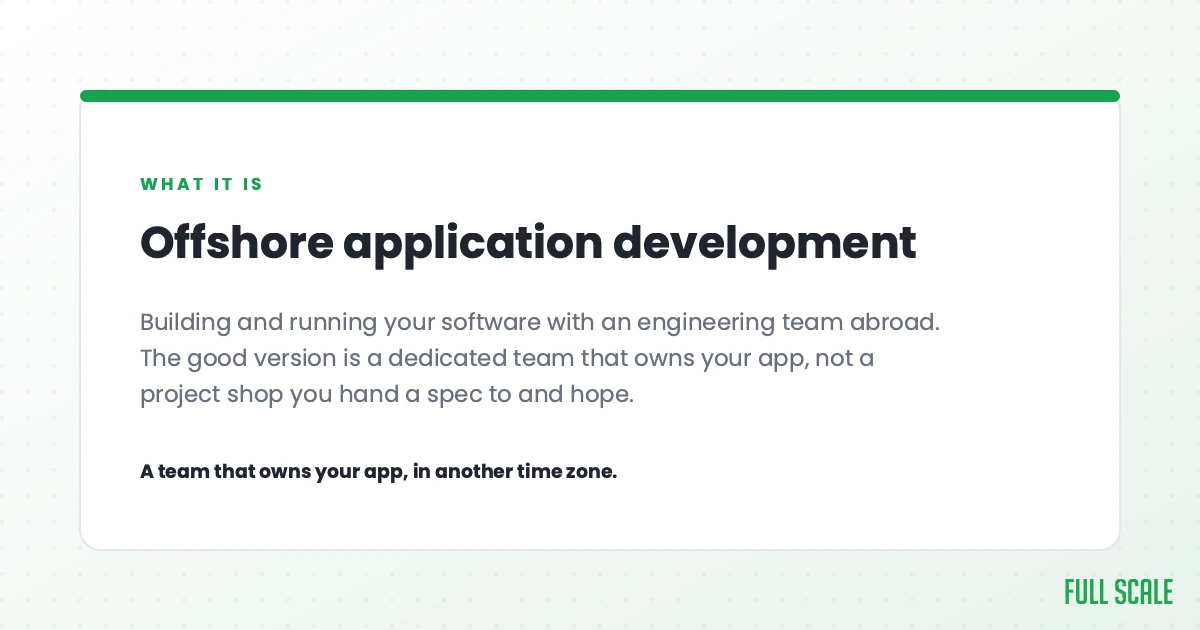
Offshore app development services mean building your software with a development team in another country, usually one with a much lower cost of living. That’s the simple version, and if you want the longer one, we’ve covered everything offshore development involves separately.
The part that trips people up is the difference between offshoring and outsourcing. They sound the same. They are not.
Outsourcing is handing a project to an outside firm and waiting for them to hand something back. You describe what you want, they go away, and you hope it comes back right. Offshoring, done the way I do it, means hiring developers who work directly for you, full time and long term. They sit in your standups, use your tools, and own real features instead of tickets.
I walked through this whole distinction years ago on my podcast, in an episode called Offshoring, 10 Tips, and the core point hasn’t changed. You want control over your own talent and your own code, not a vendor sitting in the middle of every decision. Staff augmentation is the right way to build software offshore.
Why companies actually buy offshore development services
Most companies don’t go offshore because it’s cheap. They go offshore because they’re stuck.
Take LendingStandard, a Kansas City company whose software processes about 30% of the affordable multifamily housing loans in the country. They were already successful. They just couldn’t hire fast enough locally, and when they did find someone, the cost of building the senior bench they needed didn’t scale. They tried vocational programs and recruiting straight out of college. None of it gave them the engineers they needed at the pace and price that actually worked.
There are smart people all over the world. Talent isn’t the constraint.
Companies hire globally because of what US talent costs.
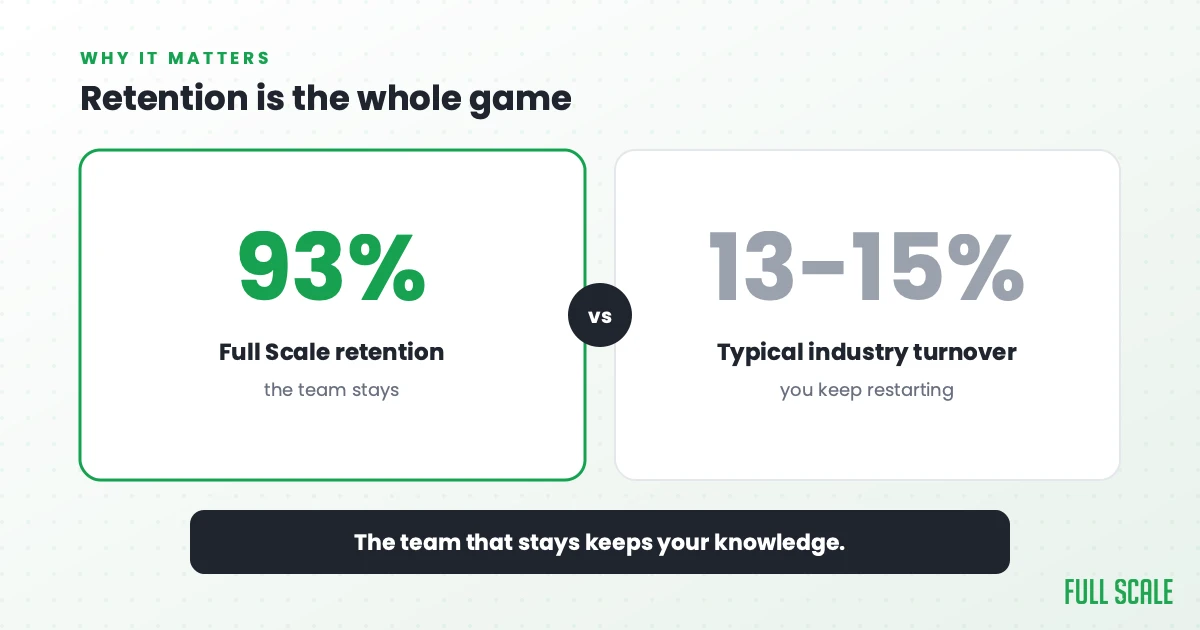
A senior engineer in Manila has the same skills as one in Austin and a fraction of the rent, so the same budget goes a lot further. The numbers line up with that. Around 90% of the world’s software developers live outside the United States, per the Stack Overflow Developer Survey. And US tech hiring hasn’t gotten easier. Turnover runs about 13 to 15% a year (BLS JOLTS), which means even when you do hire, you’re often just refilling a seat. That’s the same developer shortage pushing teams to look past their own zip code. I’ve made the broader case for hiring engineers abroad in a separate post.
What offshore app development services cost
A senior US developer runs $80 to $150 an hour, all in. A senior engineer in the Philippines doing the same work runs about $30 to $40 an hour through a partner like Full Scale. That’s the number everyone actually wants, and the gap is cost of living, not a discount on quality. The developers themselves earn good money by local standards, usually $15 to $30 an hour depending on experience.
Your offshore developer makes what they make because of where they live, not because of their skills. Full Scale’s own rate card lays out where that money actually goes:
| Senior developer (all-in) | Typical rate |
|---|---|
| United States | $80 to $150 / hour |
| Philippines (through Full Scale) | $30 to $40 / hour |
| What the Filipino developer earns locally | $15 to $30 / hour |
Let me make it real. One of the best engineers I’ve ever hired is based in Cebu. He spent six years at IBM before he joined us. He runs circles around developers I’ve paid triple. If you saw his work and not his invoice, you’d guess he was a $200,000 hire in San Francisco.
Across a full team, an offshore build usually lands you 50 to 70% under US rates. The mistake is treating that savings as the whole point. It isn’t. The savings are what let you afford more senior people and keep them longer, and that’s where the real return comes from.
The engagement models, and which one actually works
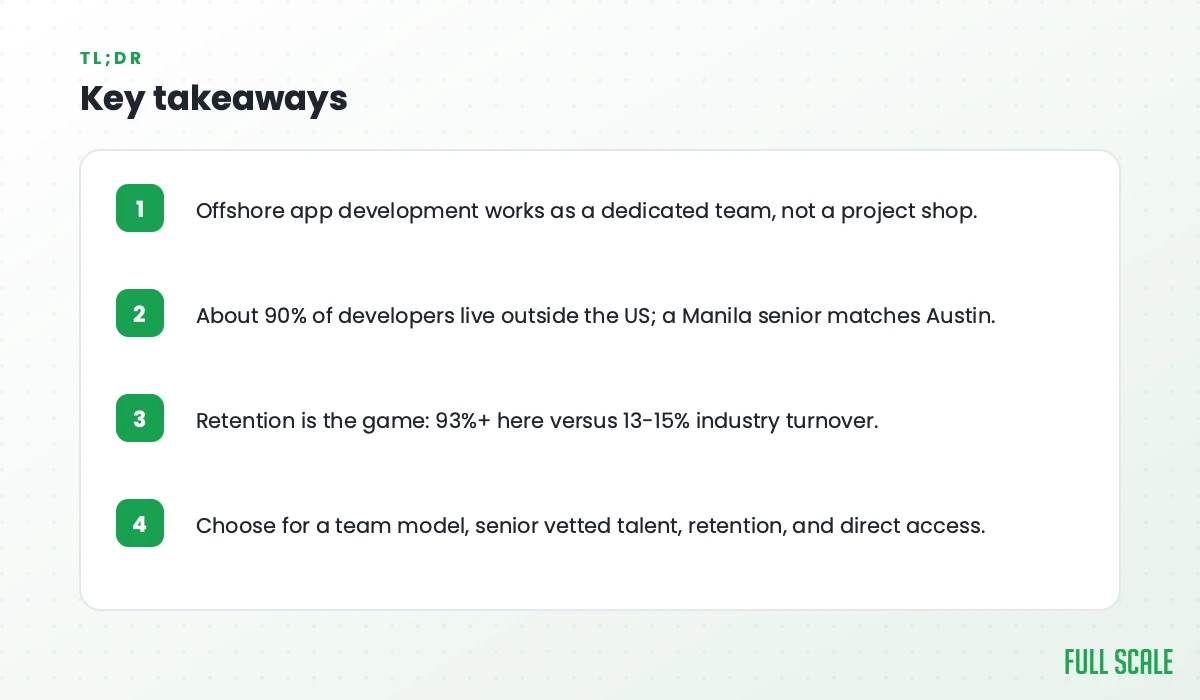
Offshore app development comes in three rough shapes, and staff augmentation is the one that actually wins. The shape matters more than most people realize.
Project-based is the classic outsourcing deal. You hand over a spec and a deadline and get a finished thing back. It works for small, scoped jobs. I’ve outsourced a WordPress build and a one-off search project this way myself. It does not work for your core product, because nobody on the other side cares whether your business succeeds after the invoice clears.
Offshore staff augmentation means adding offshore engineers directly to your existing team. They report to your leads, work your roadmap, and grow with the product. A dedicated development team is the same idea at larger scale: a whole squad that works only on your product, long term.
My honest take after 15 years of this is simple. Staff augmentation and dedicated teams win, and project shops lose, for anything that matters. We aren’t in this for some three-month project. Hire talent to work directly for you on a long-term basis, and don’t hire them just for a project. That one decision separates the engagements that work from the ones that get fired.
The Platform Depth Trap
Mobile app development spans four distinct platforms with different languages, toolchains, and store requirements, and treating “mobile developer” as one skill set is the single biggest offshore mobile mistake I see.
- Native iOS: Swift and SwiftUI (or UIKit on legacy code), Xcode, App Store Connect, TestFlight.
- Native Android: Kotlin and Jetpack Compose (or XML Views on legacy code), Android Studio, Google Play Console.
- Flutter: Dart, one codebase for iOS, Android, and web, usually with Firebase behind it.
- React Native: JavaScript or TypeScript on top of native UI components, Expo or the bare workflow.
A developer who’s strong in one of these is not automatically strong in the others. An iOS developer who “also does Android” may not know Kotlin Coroutines or Jetpack Compose. A React Native developer may never have touched native module bridging. A Flutter developer may have never navigated an App Store rejection. Full Scale’s vetting tests for the specific platform a client actually needs, not generic mobile experience, starting at the resume screen: years claimed on a platform have to be backed by published apps and real code written in that platform’s own conventions.
Where app store and Play store knowledge actually gets tested
Both stores have review requirements that a developer who has written mobile code but never shipped it to production won’t know exist. Apple’s App Review process comes with privacy manifest requirements that trip up developers who haven’t dealt with them before. Google Play adds its own version of the same problem: target API level compliance, the Data Safety section, and staged rollout tooling that a first-time submitter has never touched. None of it shows up in a coding interview. It shows up the week you try to ship, when a submission bounces back over something the developer has never seen.
Our 5-Stage Vetting Process for Senior Mobile Engineers
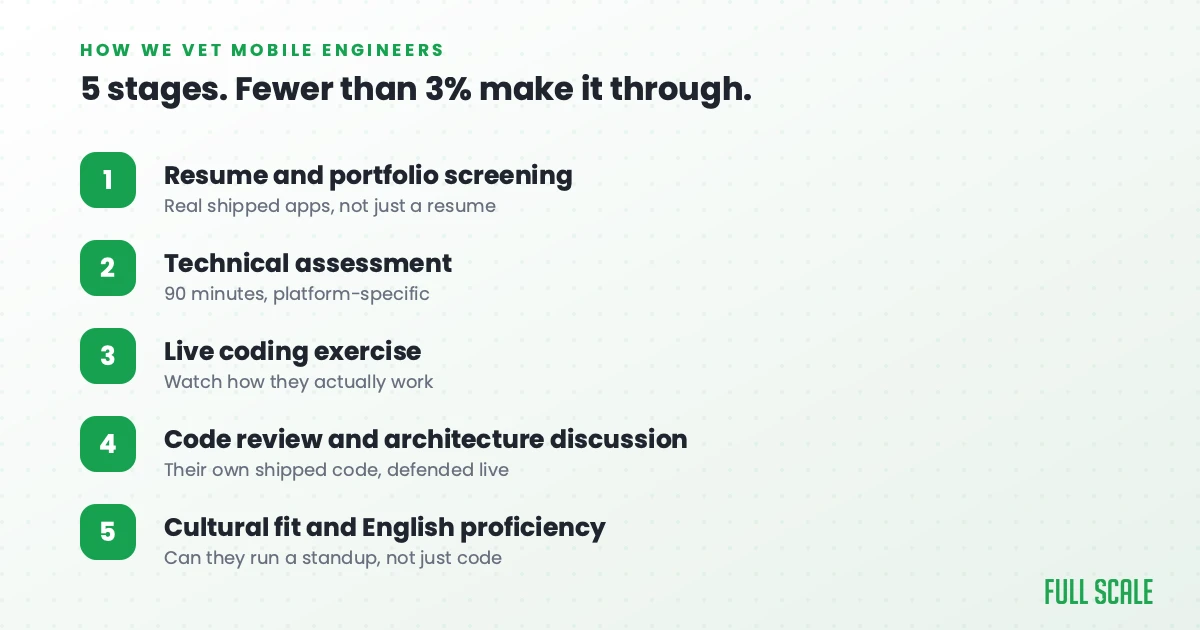
Full Scale runs mobile candidates through five stages built specifically for platform depth, and fewer than 3% of applicants make it through. Here’s what happens at each one.
Stage 1: Resume and portfolio screening
We check for platform-specific depth, not generic mobile experience. iOS candidates need Swift, not Objective-C as the primary language, plus SwiftUI or UIKit depth and published App Store apps. Android candidates need Kotlin, not Java-primary, plus Jetpack Compose or XML Views depth and published Play Store apps. Flutter candidates need real production apps, not tutorials, with real state-management depth. React Native candidates need TypeScript-first experience and awareness of the New Architecture. A tutorial app as the whole portfolio is a red flag on every platform. About 55% of applicants are rejected here.
Stage 2: Technical assessment
A 90-minute, platform-specific technical interview. An iOS candidate walks through app state handling when the system terminates a background process. An Android candidate explains what happens to a ViewModel on screen rotation. A Flutter candidate explains the difference between a StatefulWidget and a StatelessWidget and when it actually matters. Another 40% of the remaining pool doesn’t clear this stage.
Stage 3: Live coding exercise
The candidate builds a small mobile feature, a screen or a data flow, under real conditions, while we watch the architecture decisions and the error handling as much as the code itself. Another 30% is cut here.
Stage 4: Code review and architecture discussion
We review real code from the candidate’s own shipped App Store or Play Store apps and ask why they made the choices they made. Another 20% doesn’t make it past this conversation.
Stage 5: Cultural fit and English proficiency
Clear communication matters more in mobile than almost anywhere else in software, because a platform-specific bug needs a precise description to reproduce it. About 20% of what’s left is cut here.
Run the five stages together and fewer than 3 in 100 mobile applicants make it onto Full Scale’s bench.
The Real Cost of Offshore Mobile App Development
Full Scale’s senior offshore mobile developers run $30 to $40 an hour fully loaded, the same band as senior offshore developers generally, which works out to roughly $62,000 to $83,000 a year. A senior US mobile developer earns $130,000 to $155,000 in base salary alone, and once you load in benefits, taxes, and overhead using the standard 1.25 to 1.4x multiplier, that’s $160,000 to $215,000-plus a year before you’ve paid a single recruiting fee, which typically runs another 20 to 25% of first-year salary.
Stretch that out three years and add recruiting, onboarding, and the turnover a 13 to 15% annual rate guarantees you’ll eat at least once, and the real gap looks like this:
| Cost factor | US senior mobile dev (3 years) | Full Scale offshore (3 years) | Savings |
|---|---|---|---|
| Compensation | $480K-$615K | $186K-$249K | $294K-$366K |
| Recruiting | $32K-$40K | $0 | $32K-$40K |
| Onboarding | $12K | $6K | $6K |
| Turnover | $80K-$120K | $0 | $80K-$120K |
| Total | $604K-$775K | $192K-$255K | $412K-$520K |
That lands in the same 50 to 70% savings range as the rest of this post. It just compounds harder in mobile, because turnover costs more when the person leaving is the one who understood your push notification setup and your app’s entire lifecycle handling.
Which Mobile Projects Offshore Best
Not every mobile project is an equally good offshore fit, and knowing which one you have changes what “success” actually looks like.
Established apps with a defined architecture
iOS apps already running a working SwiftUI or UIKit architecture, and Android apps with MVVM or MVI and Compose already in place, offshore well. The patterns are set, so a new developer can be productive within a week instead of guessing at conventions.
Flutter apps with one cross-platform codebase
One codebase, one review process, one deployment pipeline. That’s a strong offshore fit for a team targeting both iOS and Android with shared business logic.
React Native apps for JavaScript-background teams
Teams with existing TypeScript or React expertise extending into mobile through React Native offshore cleanly, because the foundations an offshore React Native developer brings already match what the team knows.
Legacy Objective-C or Java modernization
Migrating an old iOS app off Objective-C onto Swift and SwiftUI, or an old Android app off Java onto Kotlin and Compose, is slower work that benefits from an offshore team working alongside your local engineers instead of replacing them outright.
What doesn’t offshore as cleanly
Apps where the UX is still being invented, games with heavy real-time rendering, and anything that needs constant hardware prototyping with physical devices need tight, in-person collaboration between designer, developer, and hardware until the patterns settle. Offshore extends a defined product. It doesn’t invent one from scratch.
Why most offshore engagements fail
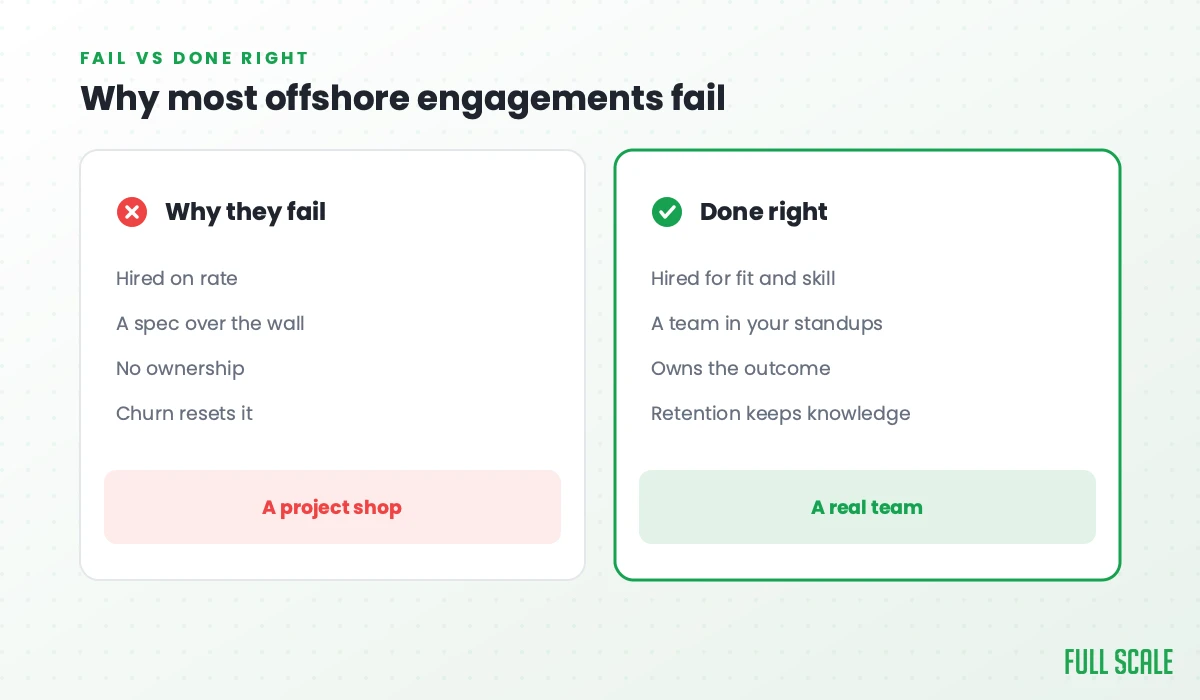
When offshore app development fails, it usually fails for reasons that have nothing to do with skill.
The biggest one is treating offshore developers like code monkeys instead of engineers. A company hires talented people from the Philippines, then hands them nothing but bug fixes and grunt work, because they assume cheap means low value. That’s backward. You bought a senior engineer, so give them real features to own, bring them into architecture decisions, and let them push back. Treat people like a vendor’s cheap labor and they’ll either act like it or leave.
The second failure is the middleman. A lot of offshore firms put a single technical project manager between you and the developers, so you never talk to the people writing your code. Every other developer hides behind that one person, sometimes because of an English gap, sometimes because of a rule about who’s allowed to speak to the client. You end up with a team you can’t actually communicate with and a middleman in the way of every decision. The fix is to take down the wall. There’s no middleman in between, and the devs care about the product the same way the in-house engineers do. That is what makes offshore actually work.
The third failure is the hand-off itself. Most offshore collaboration fails because people simply hand a pile of requirements to an outsourcing firm, then expect to get back a successful project. That’s the core of why staff augmentation beats outsourcing for a product you actually care about. Software gets built through constant communication, not a relay race.
And here’s the honest caveat, because offshore isn’t always the right call.
You always need technical leadership in-house.
If nobody on your side can set direction, review architecture, and own the product, no offshore team will save you. Offshore extends a healthy engineering org. It can’t replace one that doesn’t exist yet.
How to choose an offshore app development services partner
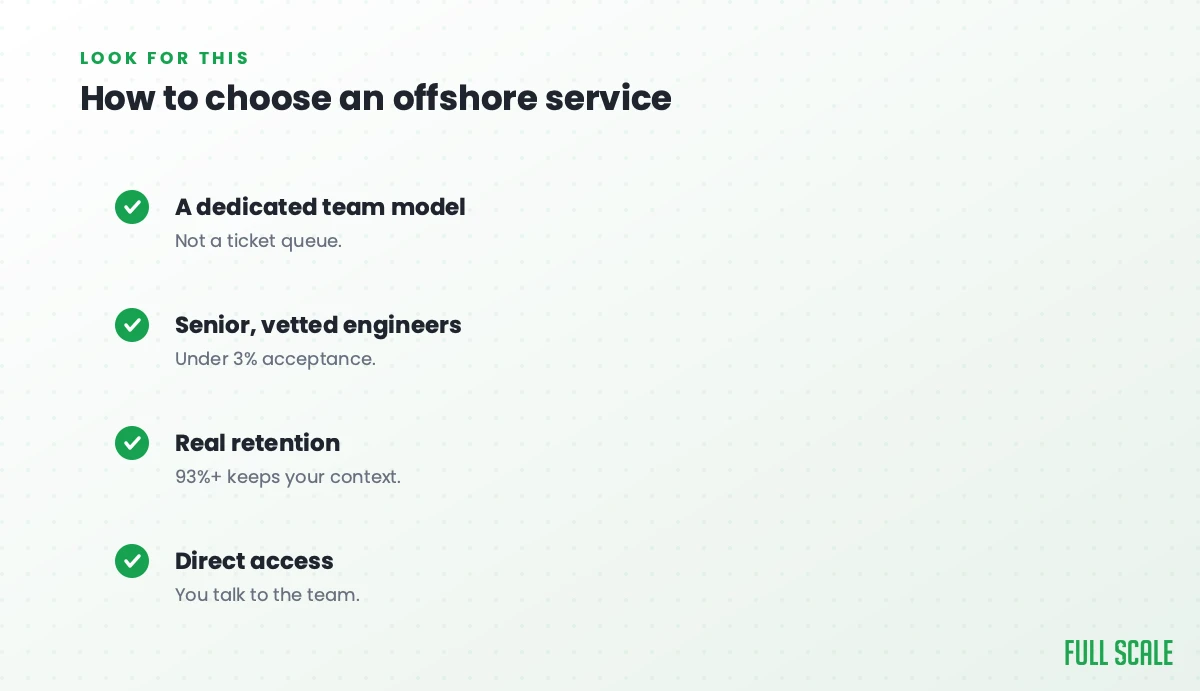
So how do you actually pick a partner? After hiring developers across Russia, Belarus, Latin America, India, Pakistan, and the Philippines, here’s what I’d check, roughly in order.
It also helps to know who you’re up against, so it’s worth comparing the top offshore development companies before you commit to anyone.
Start with communication, because software development is about communication more than anything else. Can the developers speak and write English well? Will they tell you when a spec is wrong, or just nod and build the wrong thing? English fluency, the willingness to push back, and clear writing matter more than the hourly rate on the invoice. It’s one reason I settled on the Philippines. Filipinos speak English fluently and grow up on American culture, and the country still ranks second in Asia for English proficiency, behind only Malaysia, in the 2025 EF English Proficiency Index. It’s also the third-largest English-speaking country in the world. If you’re weighing locations, I’ve broken down India versus the Philippines in detail.
Next, ask how the team integrates. Do the engineers join your standups, your Slack, and your repo? Or do they sit behind an account manager? You want the first one.
Then ask about retention. A team that turns over every nine months never builds real knowledge of your product. Ask the partner what their developer retention actually is. Ours is over 93%.
Finally, look at how they treat their own people. Engineers who are paid fairly, handed meaningful work, and treated like owners stay and do their best work. The ones treated like disposable labor don’t, and you inherit the churn.
What “done right” actually looks like
The best version of this isn’t theory for me. I watch it work every day.
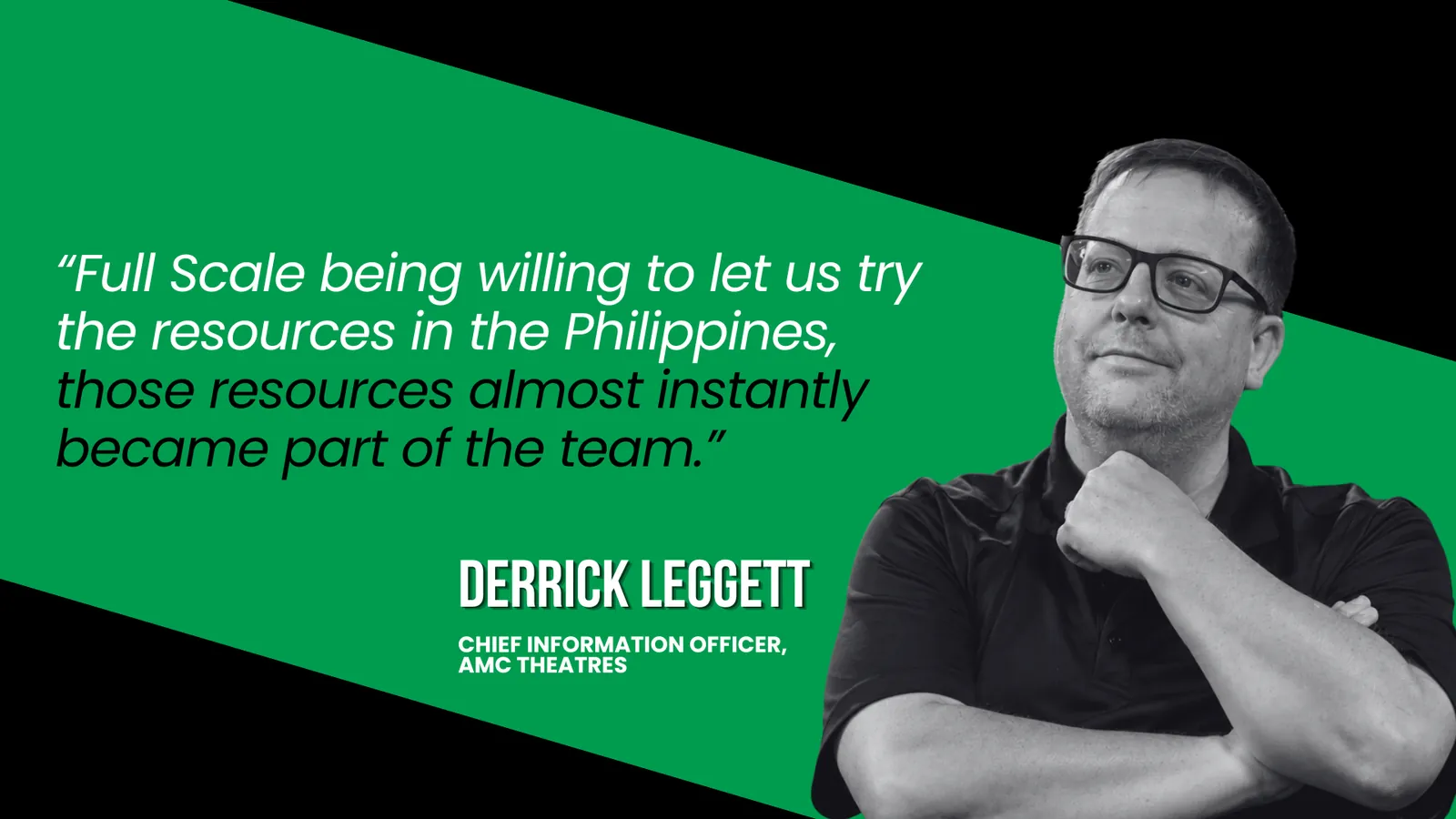
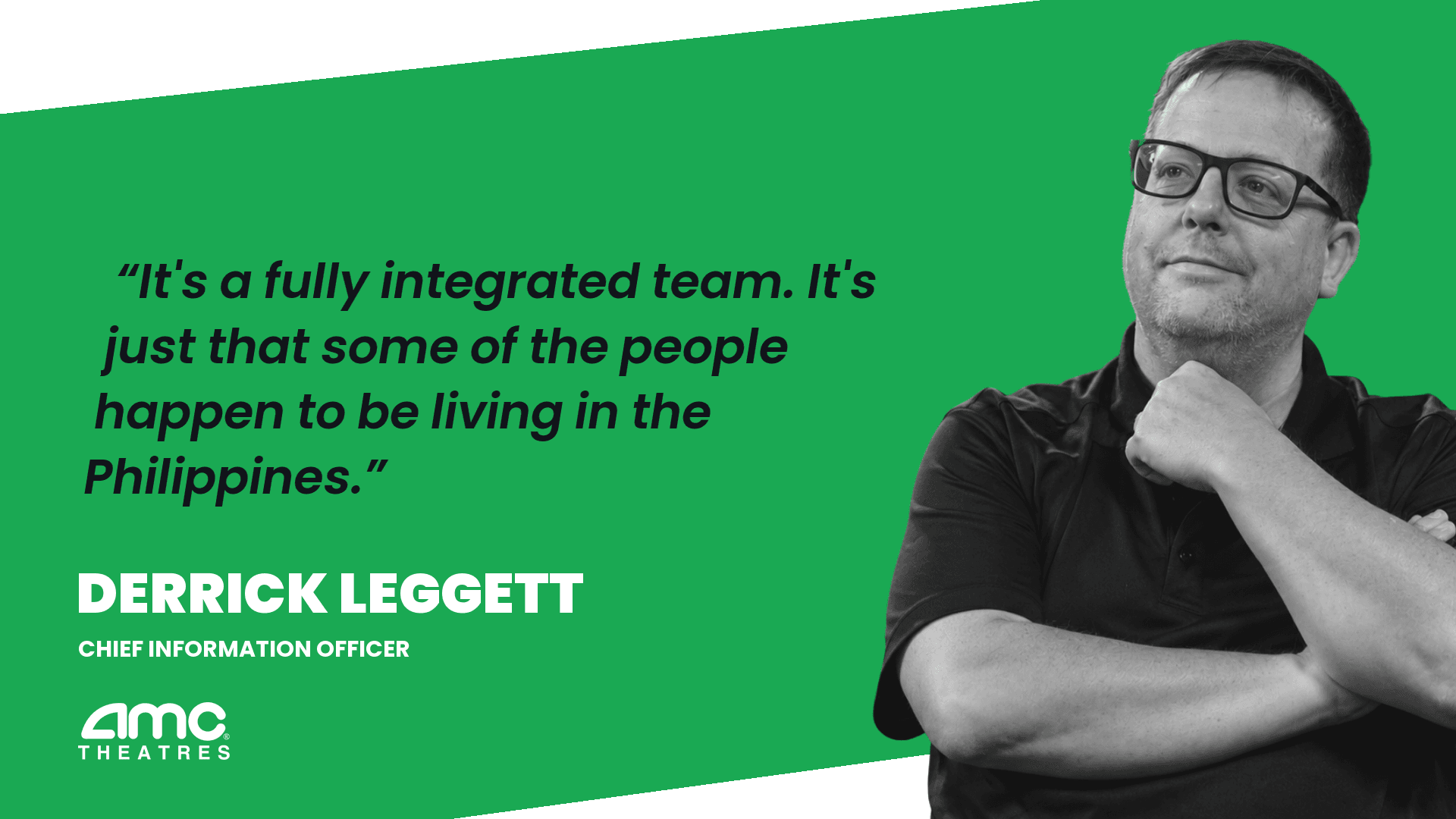
AMC Theatres is the clearest example. Their CIO, Derrick Leggett, has built a global engineering organization where developers in the Philippines are treated as full AMC engineers, not contractors behind a vendor login. AMC grew from around 170 theatres with no website and no app to more than 900 theatres running the largest movie-ticketing platform in the world, and the engineering behind it spans the US, South America, India, and the Philippines. The way Derrick puts it: “It’s a fully integrated team. It’s just some of the people happen to be living in the Philippines.”
PMI Rate Pro is a smaller version of the same lesson. They’d been burned by agencies before they came to us. Fresh investment meant rebuilding their platform from the ground up, and a brand-new CTO needed a real team fast. The agencies had failed them because they ran the project-shop model. A dedicated team that worked like their own engineers didn’t.
When it works, it works for everyone. We call it a win-win-win: a win for the developer who gets a real opportunity, a win for the client who gets senior engineering at a sustainable cost, and because of those two, a win for us.
Why Full Scale
I run an offshore development company, so take this section for what it is. Here’s the straight version.
Full Scale staffs senior developers from the Philippines onto your team, long term, with no middleman. We’ve helped more than 200 tech companies build and scale their engineering, with a team of 350-plus and developer retention over 93%. We’re Great Place to Work certified in the Philippines, where 95% of our people say it’s a great place to work compared with 65% at a typical local company, and we’ve made the Inc. 5000 list of fastest-growing private companies five years running. The way we run teams comes straight out of my book, Product Driven. You can also see the developers we hire in the Philippines and how we vet them.
None of that matters if the model isn’t right for you. If you don’t have technical leadership in-house yet, fix that first. If you do, offshore app development can give you more senior engineering than you thought you could afford.
Schedule a call about your offshore app development
Offshore app development services are just a team. Hire that team for the long run, treat them like your own, and keep your hand on the technical wheel, and they’ll build software as good as anything you’d ship at home.
That’s not the cheap version. It’s the version that actually works.
Ready to talk it through? Schedule a call and we’ll show you what a real offshore team looks like.
Frequently Asked Questions
What are offshore app development services?
Offshore app development services are software development teams based in another country, usually one with a lower cost of living, that build and maintain your apps. The strongest version isn’t a project handed to an outside firm. Full Scale runs it as staff augmentation: developers who work directly for you, full time, in your standups and your codebase, the same as your local engineers.
How much do offshore app development services cost?
A senior developer in the Philippines through a partner like Full Scale typically runs about $30 to $40 an hour, compared with $80 to $150 for a comparable US engineer. Across a full team that usually works out to 50 to 70% below US rates. The savings come from cost of living, not from lower skill, so you can afford more senior people for the same budget.
How do I hire offshore developers I can trust?
Start with communication. Hire developers who speak and write English well and who will tell you when something is wrong instead of quietly building it wrong. Make sure they integrate directly into your team rather than hiding behind an account manager, ask the partner what their real developer retention is, and confirm you have technical leadership in-house to set direction. Trust gets built by working together every day, not by signing a contract.
What is the difference between offshoring and outsourcing?
Outsourcing means handing a project to an outside firm and waiting for a finished product. Offshoring, done well, means hiring developers in another country who work directly for you, long term, as part of your own team. Outsourcing gives you a deliverable, while offshoring gives you a team. For your core product, the team model wins almost every time.
Is the Philippines a good place for offshore app development?
It’s my top pick, and it’s where I built my own teams. Filipino developers speak English fluently, the country ranks second in Asia for English proficiency, and the culture aligns closely with the US, which removes most of the communication friction that sinks offshore projects. That communication fit, more than the cost, is why it works.
How much does offshore mobile app development cost?
Full Scale’s senior offshore mobile developers run $30 to $40 an hour fully loaded, or about $62,000 to $83,000 a year, against $160,000 to $215,000-plus fully loaded for a comparable US senior mobile developer. Factor in the recruiting and turnover costs mobile teams eat more often, and the real three-year savings land in the same 50 to 70% range as offshore app development generally.
How do you vet mobile developers for platform-specific depth?
Full Scale runs mobile candidates through a 5-stage process built around the specific platform a client needs, not generic mobile experience: resume and portfolio screening, a 90-minute platform-specific technical assessment, a live coding exercise, a code review of the candidate’s own shipped apps, and a communication check. Fewer than 3% of applicants make it through all five stages.
How does mobile app development cost in the Philippines compare to India and Vietnam?
All three run well below US rates, and the gap between them matters less than picking a partner that actually vets for platform depth. The Philippines and Vietnam both land in a similar $25-45/hr senior range; India spans a wider band, from low-cost outsourcing shops up through rates that rival Eastern Europe. The real differentiator is English fluency and communication, where the Philippines consistently tests stronger, and retention, where high-turnover markets quietly erase the savings through re-onboarding. See our full India versus the Philippines and Vietnam versus the Philippines breakdowns for the detailed numbers.