
Mobile App Backend Development: What a Backend Engineer Wishes Founders Knew

In this article
- What a mobile app backend actually does
- Do you even need a custom backend
- The three ways to build a mobile app backend
- The real decision: when to start on BaaS and when to build your own
- The decisions that actually decide if your app scales
- How mobile app backends actually fail in production
- Who should build and own your mobile app backend
- The short version
- Frequently asked questions
I spent years building Stackify, a software monitoring product whose entire job was to watch other companies’ backends in production. We saw thousands of apps break in real time. The same mistakes came up again and again, and almost none of them were the ones founders worried about. When that backend runs on the Microsoft stack, you can hire offshore ASP.NET developers who have built APIs at real scale.
Here’s the one I saw most: a team would spend six months building a backend designed to handle millions of users before they had a hundred.
You can spend a year building infrastructure for a problem you don’t have yet, while the problem you do have is that nobody is using the app.
So this is the guide I wish someone had handed the founders I watched. Instead of another framework roundup, it walks through the decisions that actually matter in mobile app backend development, in the order they matter, from someone who has run backends at real scale and monitored plenty of other people’s.
Quick Answer: Mobile app backend development means choosing between three paths, stitching together third-party APIs, using a backend-as-a-service like Firebase or Supabase, or building a custom backend, and most apps should start on a BaaS and move to custom only when they hit a concrete, measurable wall. The most common mistake isn't picking the wrong framework, it's over-building infrastructure for scale a team doesn't have yet while the app still has no users. Any app with user accounts, shared data, or push notifications needs a backend; a purely on-device app doesn't. Full Scale builds mobile backends at the stage that actually fits, not the one that looks impressive.
What a mobile app backend actually does
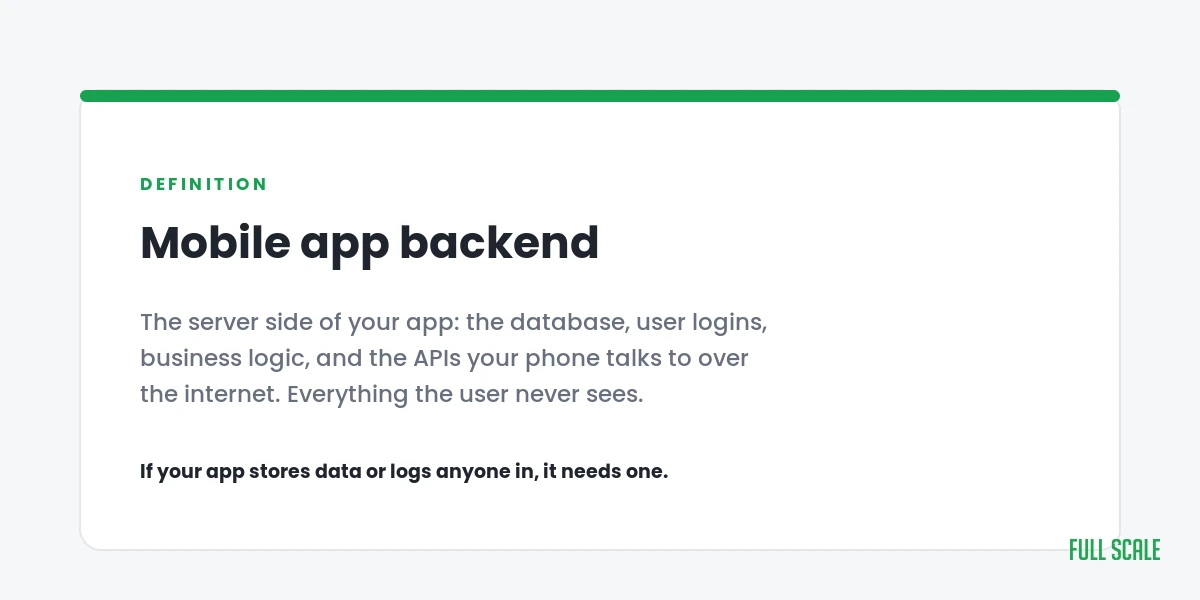
The frontend of your app is the part people touch: the screens, the buttons, the animations. The backend is everything that happens on a server somewhere else, the part nobody sees but the whole app depends on. If you want the longer version, we wrote a full breakdown of the difference between frontend and backend.
The backend does the work a phone can’t do well on its own. It stores your data so it survives when the user gets a new phone. It checks passwords and decides who’s allowed to see what. It runs the business logic, the rules that make your app yours. And it talks to the app through an API, which is just a contract for how the phone asks the server for something and what it gets back.
Picture buying shoes in a shopping app. You tap “buy.” The app sends a request through the API to the backend. The backend checks your account, talks to a payment provider, records the order, and sends a confirmation back to your screen. All of that is the backend. If that buy flow is your whole product, read our breakdown of e-commerce development services before you pick a backend, because the storefront is the easy part.
If your app stores anything, logs anyone in, or shows different data to different people, it needs a backend.
Do you even need a custom backend
A lot of founders assume the answer is yes and start hiring for it on day one. Sometimes that’s wrong.
Some apps genuinely don’t need a backend at all: a calculator, a flashlight, a single-player game that saves progress on the device, a simple note app. If everything lives on the phone and nothing syncs, you can ship without a server.
Most real apps do need one. Run through these questions:
- Do users log in or have accounts?
- Does the app save data that needs to survive a phone upgrade?
- Do two users ever see or share the same data?
- Do you send push notifications?
- Does content change without shipping a new app version?
Answer yes to any of those and you need a backend. But needing a backend is not the same as needing to build one from scratch, and that distinction is where most of the money gets wasted.
The three ways to build a mobile app backend
There are three real options, and they sit on a line from “buy it” to “build it.”
The first is stitching together third-party APIs. You don’t run a backend at all; you connect your app to services that already exist. A weather app pulls from a weather API. A content app pulls from a headless content system. This works when your app is mostly a nice interface on top of data someone else already manages.
The second is a backend-as-a-service, usually shortened to BaaS. Tools like Firebase, Supabase, and AWS Amplify give you the standard backend parts, a database, user logins, file storage, push notifications, out of the box. You write some configuration and a little code instead of building and running servers yourself. The space has matured fast: Firebase added a managed SQL option with Data Connect, and Supabase pulled in a lot of teams by being open source and built on Postgres, which makes it easier to move off later if you have to. This is where most apps should start.
The third is a custom backend: your own servers, your own database, your own code, built and maintained by engineers. This is the most flexible option and the most expensive one. You own everything, which means you also maintain everything.
Most founders should start on a backend-as-a-service and build custom only when something forces them to.
You can also mix these. Plenty of mature apps run a custom backend for the parts that are core to the business and lean on Firebase or a third-party API for the rest. That’s good engineering, not a compromise.
The real decision: when to start on BaaS and when to build your own
This is the choice the generic guides turn into a pros-and-cons table and leave you to figure out. Let me give you the actual rule I’d use.
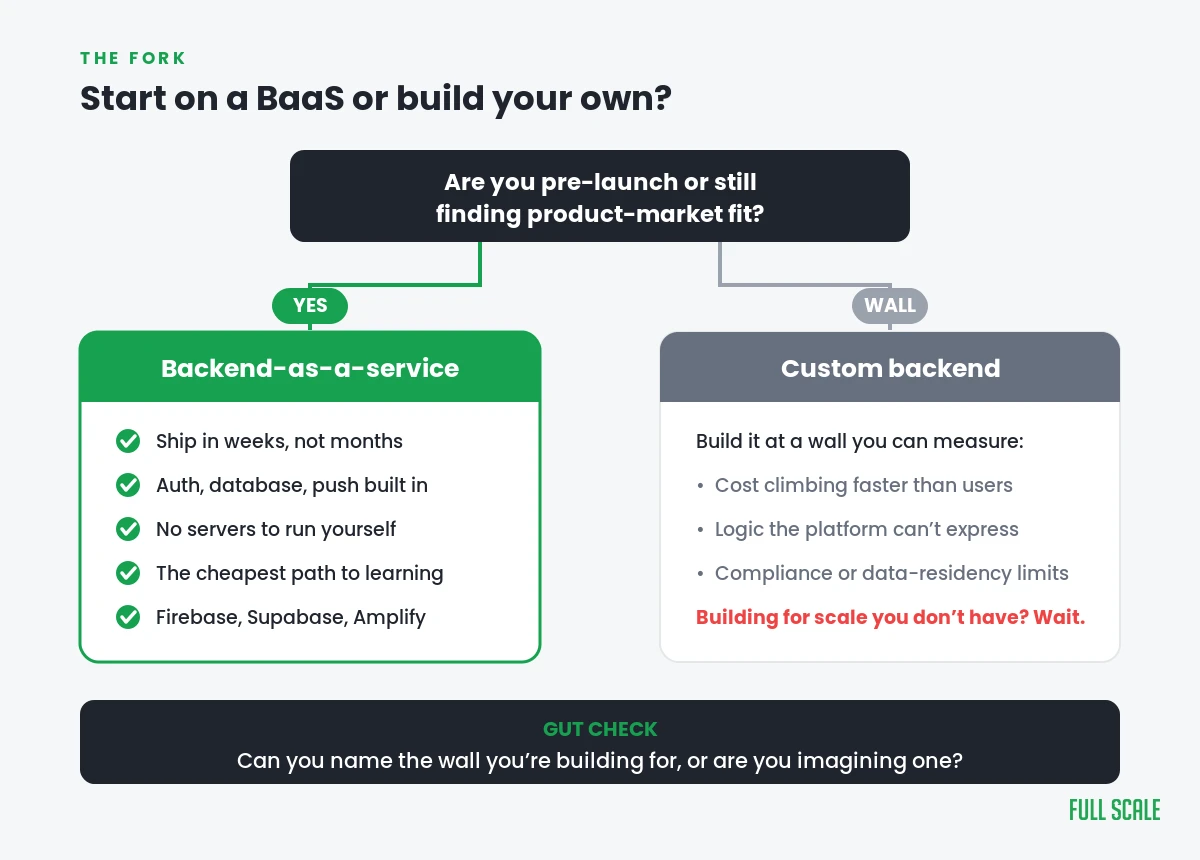
Start on a backend-as-a-service if you’re pre-launch, pre-revenue, or still figuring out whether people want the thing. A BaaS lets a small team ship a working app in weeks instead of months. You get authentication, a database, and push notifications without hiring a backend team to build them. At the early stage, your real risk is building something nobody wants, not picking the wrong database. Speed to learning beats everything.
This connects to something I wrote a whole book about, the Product Driven approach: the goal early on is to find out what customers actually use, as fast and cheaply as possible. A managed backend is the cheapest path to that answer.
Now, when do you build custom? When you hit a real wall, and you’ll know the wall when you hit it. The signs are concrete, not theoretical:
- Your BaaS bill is climbing faster than your user count, because these tools charge for usage and the math flips against you at scale.
- You need data or logic the platform can’t express, and you’re fighting the tool instead of using it.
- You have compliance or data-residency requirements the platform won’t meet.
- Performance matters in a way you can’t tune because you don’t control the servers.
Notice that none of those are “we might get big someday.” They’re problems you can measure. The mistake is building the custom backend in anticipation of walls you may never reach.
I’ve watched the over-building version play out many times. A team raises a little money, hires a couple of senior engineers, and spends the next six months on a microservices architecture and a Kubernetes cluster for an app with no users. The infrastructure is beautiful. The company runs out of runway before anyone needs it.
The decisions that actually decide if your app scales
Here’s the part the trendy advice gets backwards. People assume scaling means exotic architecture from day one. It usually means the opposite.
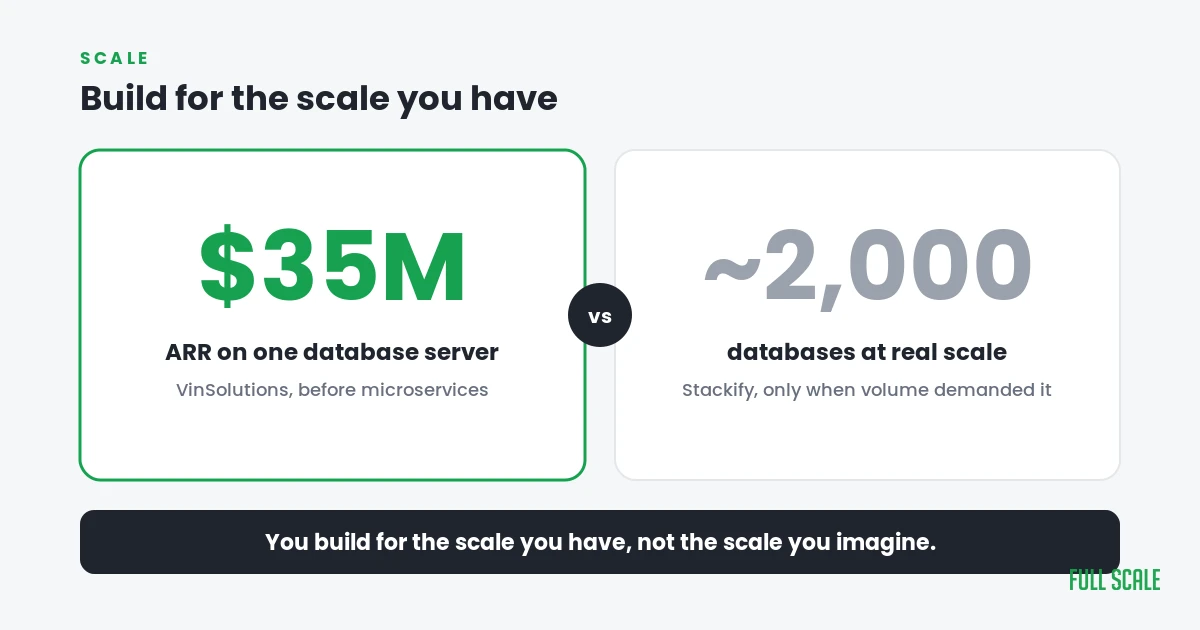
I scaled VinSolutions to about $35 million in annual recurring revenue running on essentially one big database server, a maxed-out Dell, plus some read replicas. This was before microservices were the default answer for everything. I babysat that one server because adding capacity meant a purchase order and a drive to the data center. It worked, and the company was worth nine figures.
You do not need exotic architecture to build a serious company. You need an architecture you can actually operate.
Later, at Stackify, we did run real scale. We had around 2,000 sharded SQL Server databases ingesting application logs and monitoring data, because the volume genuinely could not fit in one database. But we built that when we needed it, not before. The sharding existed because we’d hit the wall, not because it looked impressive on a diagram.
So when people ask what decisions determine whether an app scales, here’s my honest list, and it’s boring on purpose:
Pick a database and a stack your team actually knows how to run. Hosting is cheap and on-demand now; worldwide public cloud spending hit $723 billion in 2025 according to Gartner, and adding capacity is a slider instead of a road trip. The bottleneck is almost never the servers. It’s your team’s ability to understand what the system is doing.
Which brings me to the thing almost everyone skips.
Instrument it so you can see what’s happening. You cannot fix what you can’t see. The single biggest difference between teams that scale smoothly and teams that have a bad weekend every month is whether they can look at a dashboard and know which query is slow and why. That whole insight is why I built a monitoring company in the first place.
When an app does hit real volume, the interesting work moves into how the backend absorbs the flood. At Stackify we ingested server logs, traces, and metrics from thousands of applications, and our API endpoints got hammered all day long. What kept it standing was queuing: we accepted data fast, put it on a queue, and processed it behind the scenes, and over time we moved to real event streaming, first with Elasticsearch and later Azure Event Hubs. Most apps never get near that volume, but if yours does, that’s the pattern to reach for, and it’s one more reason the hard engineering on a product like this lives in the backend.
Keep the architecture as simple as the problem allows, and only add complexity when a measurement tells you to. If you want to go deeper on this, we have a full piece on software scalability and how to think about it without over-engineering.
How mobile app backends actually fail in production
Because we monitored so many backends at Stackify, I have a pretty clear picture of how they break. It’s rarely dramatic. It’s usually one of these:
The database query that was fine with a thousand rows falls over at a million, because nobody added an index or noticed the app was making the same call in a loop. This is the most common performance killer I ever saw, and it’s invisible until traffic finds it.
Authentication gets bolted on late and done badly, so a security problem ships with the app. Auth is one of the parts I’d actually trust to a BaaS early, because the platforms have spent years getting it right and you almost certainly won’t on your first try.
There’s no monitoring, so the first time the team learns the backend is slow is when users start leaving one-star reviews. By then you’re debugging in the dark during an outage instead of catching the warning a week earlier.
And vendor lock-in surprises people who didn’t read the pricing. A BaaS that’s nearly free at launch can get expensive at scale, which is fine if you saw it coming and planned the migration, and painful if you didn’t.
Every one of these comes down to the same two things: not being able to see your own system, and not knowing where you’ll hit a wall. The framework you picked has almost nothing to do with it.
If the framework genuinely is one of your variables, the current mobile app frameworks comparison covers Flutter, React Native, Kotlin Multiplatform, .NET MAUI, and native.
Who should build and own your mobile app backend
Whatever you choose, someone has to build it and then keep running it for years. This is where I’d push back on how a lot of founders think about it.
Your backend is not a project with an end date. It’s the part of your app you’ll be maintaining, fixing, and extending for as long as the app exists. So handing it to a freelancer or an agency that disappears after launch is how you end up with code nobody understands six months later. The instinct to save money by hiring the cheapest team you can find usually backfires the same way, something we call cheapshoring: the savings vanish the first time you have to rebuild work that was done wrong.
We aren’t in this for some 3-month project. The backend especially needs people who treat it as theirs.
If you’re a founder without a strong technical co-founder, the honest advice is to get real engineers who work as part of your team, not a shop that takes a spec and throws code back over the wall. You always need technical leadership in-house, even if the hands-on building happens elsewhere. The model that actually works is hiring dedicated developers long-term, which is the staff augmentation approach we built Full Scale around. If the term is new to you, here’s what staff augmentation actually means in practice.
Whether you need backend developers specifically, want to hire mobile app developers for the whole build, or need a broader mobile app development team, the point is the same: people who care about your product, not just your project.
If you’re earlier and weighing what a build like this costs, our pricing page lays out the math we use. And if you want help shaping the whole thing, custom software development is the broader version of this same work.
The short version
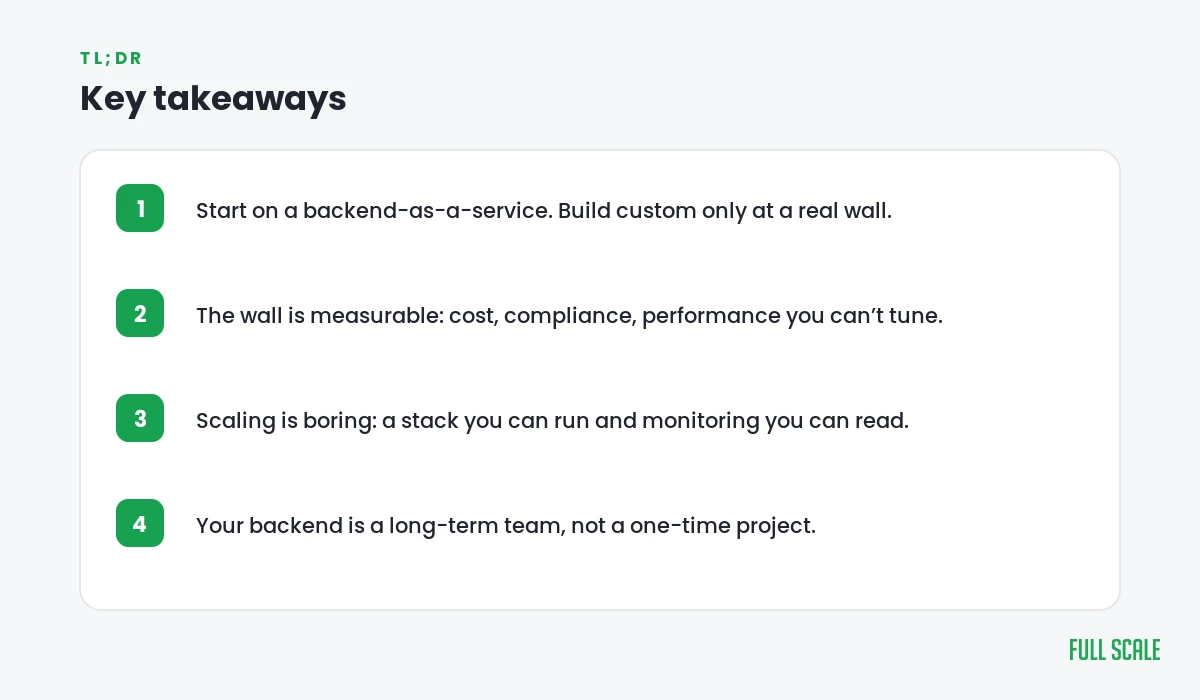
If you remember nothing else, remember this. Start simple and stay on a backend-as-a-service until it actually stops serving you, then build custom when you hit a wall you can measure rather than one you imagine. Keep the architecture as plain as the problem allows, and instrument everything so you see what breaks before your users do. And put your backend in the hands of people who will own it for years, because that’s how long you’ll have it.
The founders who got this right spent their first year learning what customers wanted instead of building for a scale they hadn’t earned yet. The fancy architecture never mattered as much as that did.
Frequently asked questions
Does every mobile app need a backend?
No. Apps that store everything on the device and don’t sync, like a calculator or an offline note app, can ship without one. But any app with user accounts, shared data, push notifications, or content that updates without an app release needs a backend.
What is the difference between a backend-as-a-service and a custom backend?
A backend-as-a-service like Firebase or Supabase gives you ready-made backend parts (database, logins, storage) that you configure instead of build, and the vendor runs the servers. A custom backend is your own code on your own servers, which gives you full control and full maintenance responsibility. Most apps should start on a BaaS and move to custom only when they hit a concrete limit.
How much does it cost to build a mobile app backend?
A backend-as-a-service can cost almost nothing to start and scales with usage, which is why early-stage apps lean on it. A custom backend’s cost is mostly the engineers who build and maintain it, so it’s an ongoing team cost rather than a one-time fee. The real driver is whether you’re paying for a managed platform or paying people to run your own.
What is the best backend language for a mobile app?
There’s no single best one. Node.js is the most common choice for mobile backends because the same language runs on the frontend, and Python, Go, Java, and C# are all solid depending on what your team already knows. The Stack Overflow Developer Survey tracks what’s popular, but the honest answer is to pick a stack your team can actually run well.
How does a mobile app connect to its backend?
Through an API, usually over HTTPS. The app sends a request (log this user in, fetch these orders), the backend does the work and sends back a response, typically as JSON. The API is the agreed-upon contract for what the app can ask and what it gets back. That backend choice is one piece of a bigger set of decisions; see what else is actually changing in mobile app development trends this year.