
IT Outsourcing Trends in 2026: What Actually Changed

In this article
Quick Answer: The biggest IT outsourcing trend in 2026 is not AI or cloud on their own, it is that cost stopped being the main reason companies outsource. AI reset what the work is worth, so partners now compete on judgment and communication instead of the lowest rate. The global IT outsourcing market still runs $500-700 billion a year and keeps growing, which is why Full Scale evaluates every engagement on thinking first and price second.
Most IT outsourcing trend lists repeat the same five things, usually written by a vendor who happens to sell exactly those things: AI, cloud, cybersecurity, nearshore, outcome-based pricing. The list isn’t wrong. It just skips the only change that matters to anyone actually making the decision. The team-process side of that shift, specifically whether Agile is still the right framework as AI writes more of the code, is where a lot of engineering leaders are re-evaluating their delivery model. The politics matter too: Trump’s push against IT outsourcing keeps losing in court while the economics hold. We track where the market is actually heading in our IT staffing trends report.
Here it is. For decades, companies outsourced IT to save money. That stopped being the main reason. The same shift applies at the stack level: companies that outsource Python development in 2026 are choosing it for talent access and team velocity, not just cost. On a Python stack, that is why more teams hire offshore Django developers through partners like Full Scale. Plenty of teams still lean on IT hiring agencies to fill technical roles, which works for short-term needs but not for a standing team.
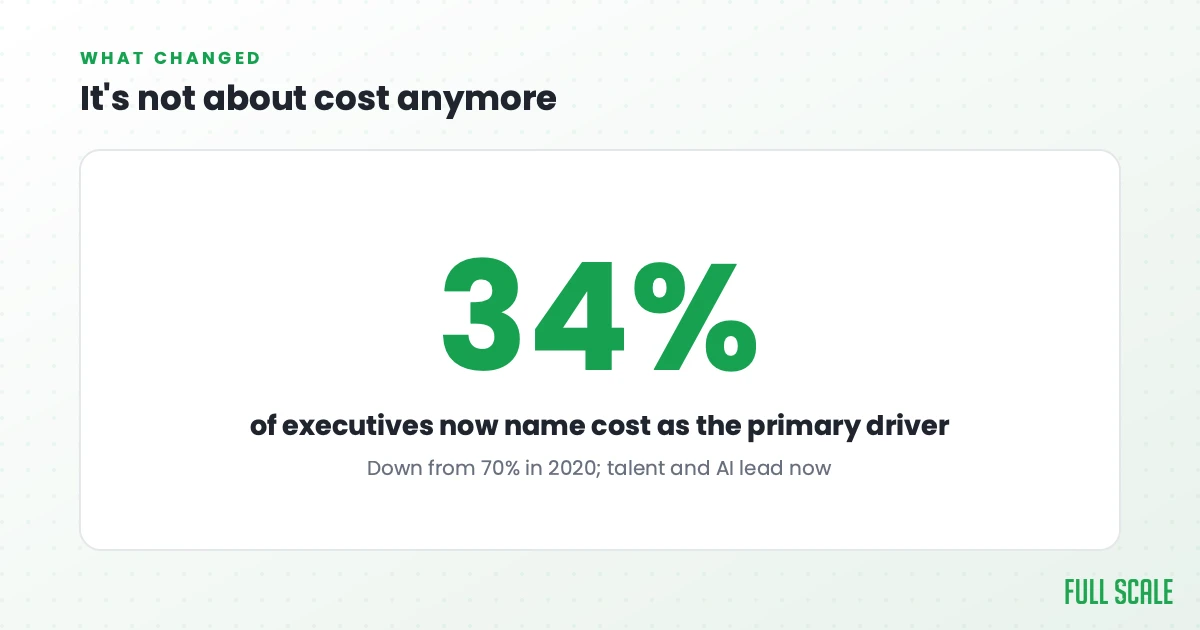
In Deloitte’s 2024 Global Outsourcing Survey, the share of executives naming cost reduction as their primary driver fell from 70% in 2020 to 34%. Talent access and speed now rank as high or higher. I run Full Scale, where we place 350+ engineers based in the Philippines onto our clients’ teams, and I watch this play out every week in who calls us and why. The buyers who win with outsourcing in 2026 are shopping for people who can think, not for the cheapest hands. That single shift sits underneath every trend on the list, so I’ll walk through the ones that are real and tell you what each one means when you’re the one signing the contract.
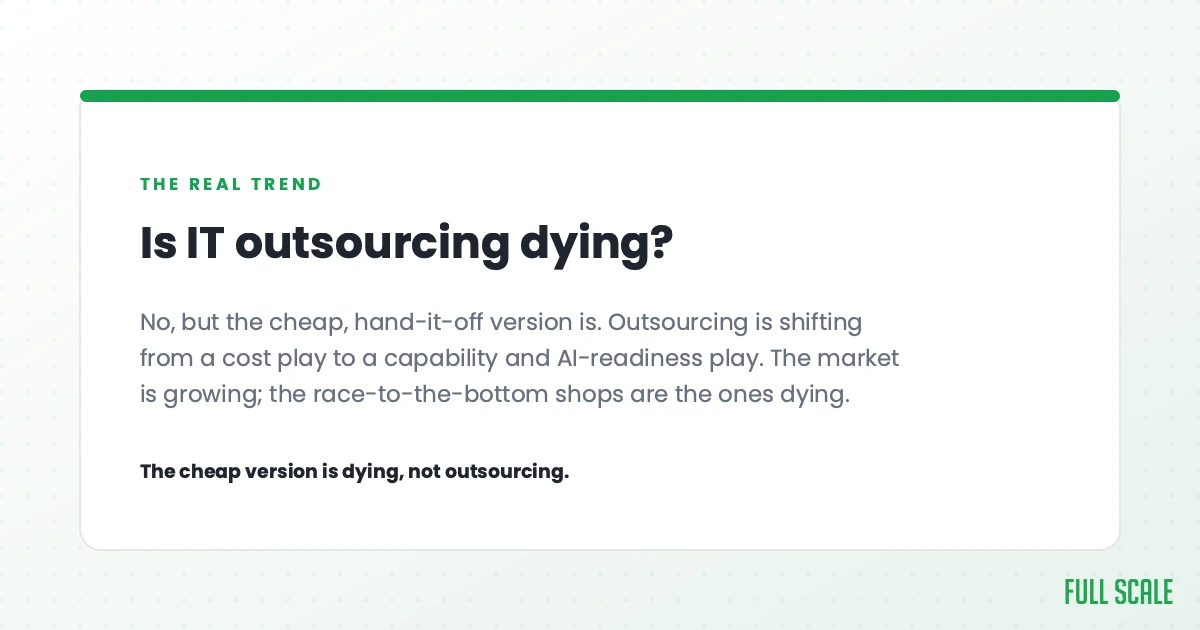
Is IT outsourcing dying? No, but the cheap version is
People have called IT outsourcing dead about once a year for as long as I’ve worked in software. The market keeps not cooperating. Most research firms put the global IT outsourcing market somewhere between $500 and $700 billion in 2026, still growing at a healthy clip. The Philippine IT and business process sector by itself pulled in roughly $40 billion of export revenue in 2025, on track for about $42 billion this year.
So no, it’s not dying.
What is dying is the version built on cheap, replaceable bodies. Years ago I used to farm out small jobs I didn’t want to touch myself, a WordPress build, an Elasticsearch project, work where I could hand over a tight spec and know exactly what I’d get back. For that kind of task it was great. What I could never farm out was anything that hinged on deciding what to build in the first place. The handoff model has no answer for that. That’s the part of outsourcing AI is now eating alive, and it’s why the rest of these trends point in the same direction.
The trends that actually matter in 2026
AI is the whole story now
Every other trend on this page is downstream of artificial intelligence (AI). Deloitte’s data shows how far the shift has already gone on the buyer side: 83% of executives report they’ve folded AI into the services they outsource. And those buyers increasingly want a partner who brings generative AI and automation, not just labor.
Here’s the catch most trend pieces won’t tell you.
Modern AI tools write code fast, and they’re confidently wrong often enough to be dangerous. In the 2025 Stack Overflow Developer Survey, developer trust in that output dropped to 29% even as daily use climbed. So the scarce skill isn’t typing speed anymore. It’s having someone who knows your product well enough to spot the bad answer and ask the question the model never thought to ask. That changes what you’re actually buying from an outsourcing partner. You’re not paying for a pair of hands that turns a spec into code, because a tool does that now. You’re paying for judgment you’d trust on a Friday deploy. I went deep on how this is reshaping offshore engineering teams in a separate piece on offshore software development trends. For IT outsourcing as a whole, the takeaway is simpler: this is the shift sitting underneath every other trend on the list.
Cost is no longer the headline (and “cheapshoring” is the trap)
The Deloitte number up top, cost falling from 70% to 34% as the main driver, isn’t just a statistic. It’s buyers learning a lesson the expensive way.
When cost is the only reason you outsource, you optimize for the wrong thing. You buy the cheapest hands you can find, the work comes back half-built, and you end up in the long line of people who tried outsourcing once, got burned, and swore it off. I call this cheapshoring, and I wrote a whole article on why it fails. Cost is a real and fair reason to look offshore. It’s cost-of-living arbitrage, not skill arbitrage, and a good Filipino senior engineer is every bit as capable as a US one. But when cheap is the *only* box you’re checking, you’re buying a project shop or a freelancer who vanishes mid-sprint. The trend in 2026 is that smart buyers already know this, which is why talent and speed climbed past cost on that survey. I unpacked the real reasons companies outsource development in a separate post, with the numbers behind the shift.
Cloud, cybersecurity, and infrastructure outsourcing keep growing
The infrastructure side of IT outsourcing is still where a lot of the money is. Companies outsource cloud migration, managed infrastructure, and increasingly cybersecurity, because the regulatory load (GDPR, CCPA, and a growing pile of state and industry rules) made security a specialty most teams can’t staff in-house. This is the “it infrastructure outsourcing” and “it services outsourcing” demand that shows up in search every day, and it’s real demand from leaders who’d rather rent deep expertise than build a security team from scratch.
The managed-services side is shifting under the same pressure. Companies used to outsource a help desk or an IT services desk to get cheaper bodies answering tickets. Now AI agents handle a chunk of that tier-one volume, so what you’re really buying is the team that handles the cases the bot can’t, plus the people who decide what the bot should do in the first place. The work is moving from staffing seats to owning an outcome.
The thing to watch: the same AI shift applies to security and infrastructure. That work is moving toward partners who can automate the routine monitoring and put their humans on the judgment calls, the incident that doesn’t fit the playbook, the architecture decision that locks you in for five years.
Geography: offshore is still the biggest model, but the map is wider
Offshore outsourcing, mostly to Asia-Pacific, still holds the largest share of the global IT outsourcing market, and the Philippines and India remain the centers of gravity. Nearshore and onshore haven’t replaced that. They’ve become options you pick for a reason: more time-zone overlap, tighter collaboration, sometimes a compliance requirement that won’t allow offshore at all.
My honest take after hiring developers in the Philippines, Latin America, and Eastern Europe over the years is that the geography matters less than people think once you get the model right. I’ve had different levels of success in all of them, and the variable was never the country. It was whether the people could own a problem instead of waiting for a ticket. Time-zone overlap is a real factor, but most of our clients find a half-day overlap of three to four hours is plenty.
Outcome-based and flexible pricing
Buyers are moving away from pure hourly billing toward models tied to deliverables and outcomes. The appeal is obvious: more predictable cost and a partner whose incentive is the result, not the timesheet. AI is pushing this along, too. When a tool can make a developer meaningfully faster, billing by the hour quietly punishes the partner who works efficiently, so both sides start looking for a way to price the outcome instead. It’s a good trend. Just know that outcome-based pricing only works when the scope is genuinely well-defined, the same condition that makes a fixed-price project shop a reasonable choice. For ongoing product work that changes week to week, a dedicated team you direct yourself is usually the better fit.
The skills that matter shifted from technical to human
The old listicles say outsourcing now values “soft skills.” That’s true but soft. Here’s the sharper version.
When AI does the mechanical part of the job, what’s left is the human part. For our own teams I boil that down to three things: communication, curiosity, and courage. Communication, because so much of the job now is getting to the real problem and talking to the people who have it. Curiosity, because the people who stay valuable are the ones who keep poking at what AI can and can’t do for them. Courage, because someone on the team has to be willing to say a requirement makes no sense. That’s the core argument of my book, Product Driven, and AI turned it from a nice idea into the thing that decides whether an outsourced team is worth paying for. For a practical breakdown, I wrote about what makes an outsourced development team succeed when the engagement is structured the right way.
What this means when you choose an IT outsourcing partner
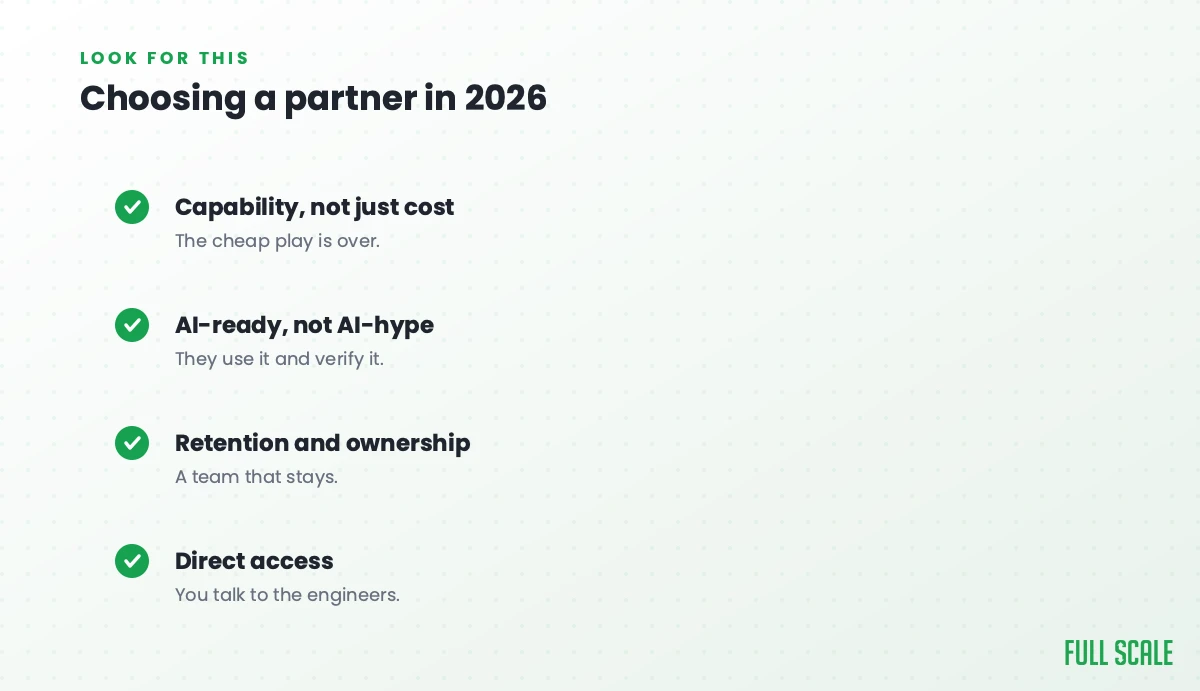
Here’s the part that actually decides whether outsourcing works for you, and it isn’t on any trend list. Before you sign with anyone, get an honest answer to one thing: are these people capable of independent thought, or do they need every detail spelled out before they’ll move?
A partner whose people can’t work without a perfect spec is selling you the one thing AI already does for free.
That single question sorts the whole field. A few concrete ways to pressure-test it:
- How do their developers use AI? Ask directly, and listen for whether they describe it as something they double-check and correct or something they trust to just hand them the answer. You want the first kind.
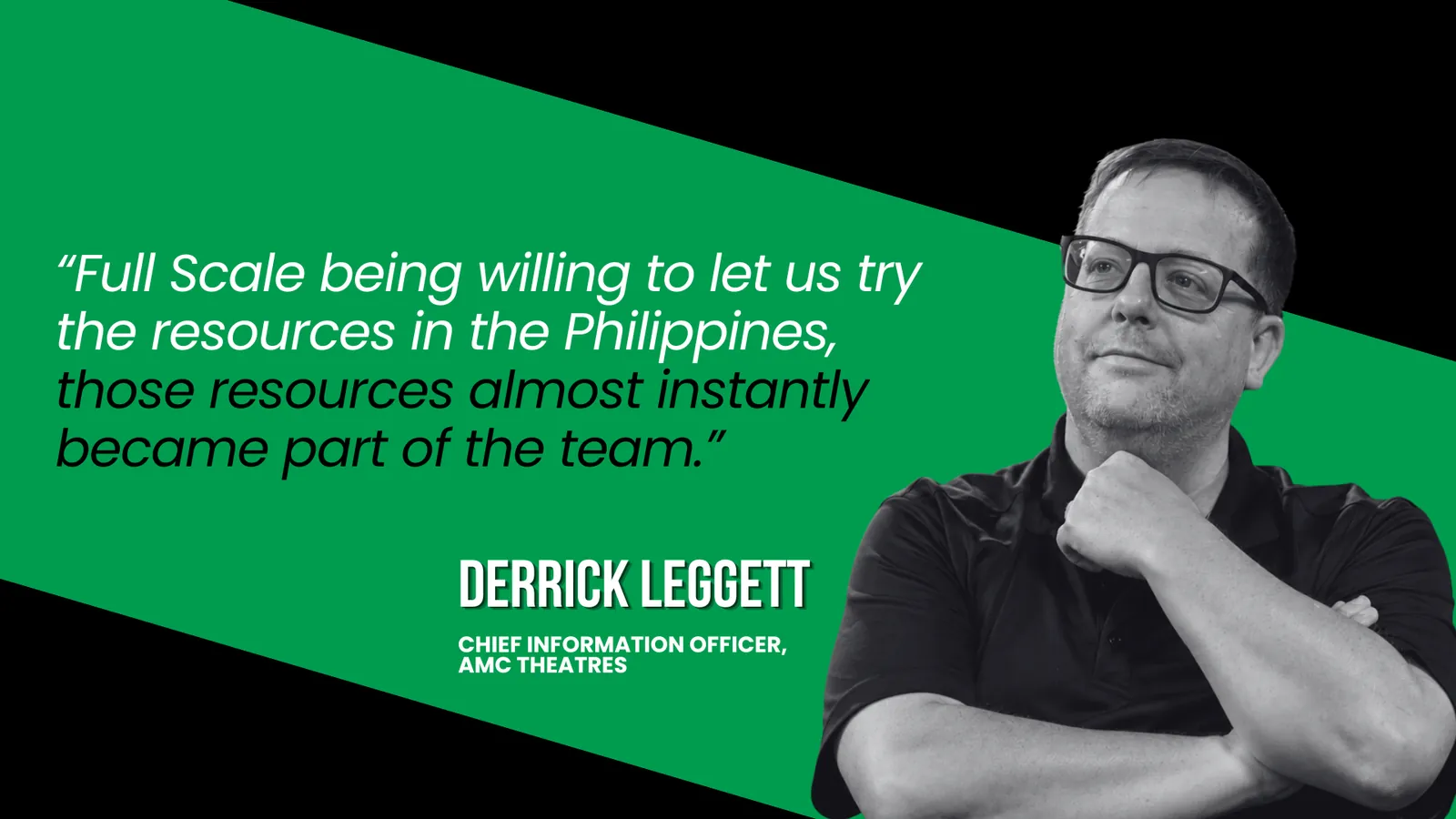
- Do the engineers join your team, or sit behind a project manager? The strongest engagements I see don’t look like the old vendor-and-client arrangement at all. Derrick Leggett, the CIO at AMC Theatres, describes the engineers we staff for him this way: “It’s a fully integrated team. It’s just some of the people happen to be living in the Philippines.” If the only person you ever speak to is an account manager, treat that as a warning sign.
- Will the team actually stay? Turnover quietly wrecks outsourced work. Voluntary attrition in the Philippine outsourcing industry runs around 30%. Our developer retention is 93%, and that stability is most of why an engagement works over years instead of months. Picking a partner is largely about evaluating an outsourcing company on the things that don’t show up on a rate card.
This is the staff augmentation model, and it’s the opposite of cheapshoring: you direct senior engineers who work as part of your own team, with the recruiting, management, and retention handled by a partner who’s What’s actually changing in staff augmentation this year is worth a separate look, since some of the loudest 2026 trend claims get this model wrong.
Frequently asked questions
How big is the IT outsourcing market in 2026?
Industry estimates put the global IT outsourcing market at roughly $500 to $700 billion in 2026, still growing at a healthy clip. The Philippine IT and business process sector alone pulled in about $40 billion in export revenue in 2025, on track for around $42 billion this year. The market is not shrinking; the reasons companies buy into it changed.
What are the benefits and risks of outsourcing software development in 2026?
The benefits are real: access to senior talent you cannot hire locally, faster delivery, and, done right, 50 to 70 percent lower cost than a comparable US hire. The risk is picking a partner on price alone, which is the cheapshoring trap: an $8-an-hour “steal” that turns into rework and churn costing more than a vetted $35-an-hour developer would have from the start. The honest tradeoff is that a new outsourced team needs real management attention in its first few months, which is easy to underbudget.
The bottom line on IT outsourcing trends
The IT outsourcing industry isn’t shrinking, and it isn’t standing still. AI reset what the work is worth, cost dropped off the top of the list, and the partners who win are the ones whose people bring judgment, not just hours. The future of IT outsourcing comes down to finding people who can think alongside the machines, not finding the lowest rate. If you’re weighing how to outsource IT in 2026, evaluate for thinking first and price second. That order is the whole trend.
If you want to talk through what that looks like for your team, let’s set up a call.