
The 2026 State of IT Staffing: Trends in Hiring, AI, and Offshore

In this article
- The state of IT staffing trends in 2026
- The broken entry ramp
- AI is decoupling headcount from output
- The real cost of staffing in 2026
- In-house, staff augmentation, or the cheapest offshore option
- Retention: the number the industry can’t fake
- The offshore reality, minus the marketing
- What holds up when everything else changes
- What I would do if I ran engineering in 2026
- Methodology
- Frequently asked questions
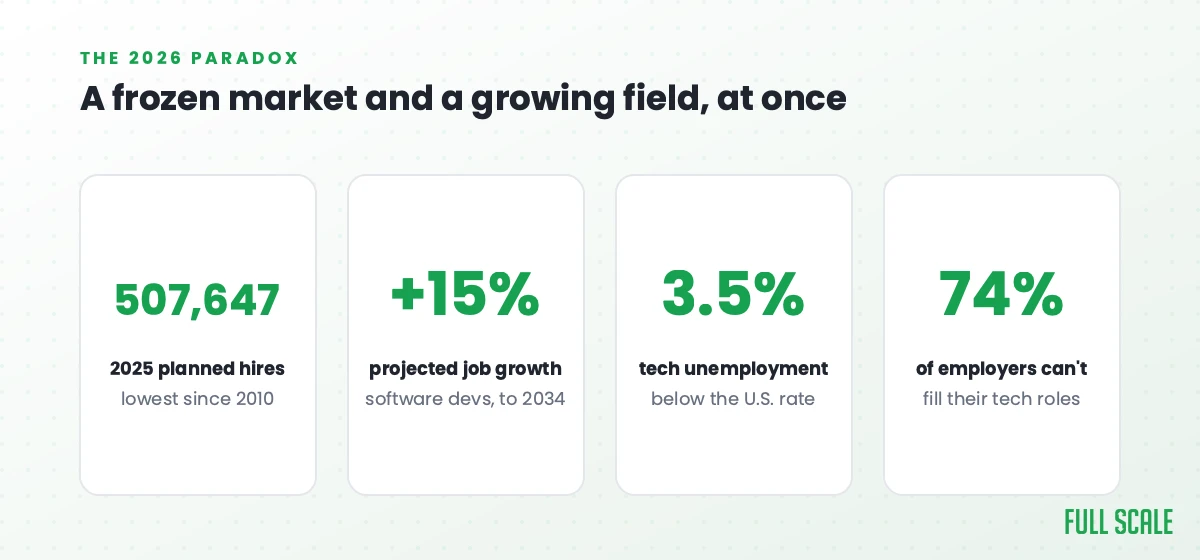
Read the headlines and you would think software is a dying career. U.S. employers announced only 507,647 planned hires in all of 2025, the lowest total since 2010 and down 34% from the year before (Challenger, Gray & Christmas, 2025 Year-End Report). Technology led private-sector job cuts with 154,445, up 15%. Then you look at the other set of numbers. The Bureau of Labor Statistics still projects software developer jobs to grow 15% through 2034, about four times the average occupation, at a median wage of $133,080 (BLS Occupational Outlook Handbook, May 2024). Tech unemployment sat at 3.5% in April 2026, below the national rate (CompTIA). And 74% of U.S. employers say they cannot fill their open tech roles, with the worst gaps in AI (Experis Tech Talent Outlook, Q2 2026). One role quietly in demand is a MarTech engineer, the developer who keeps the marketing stack running.
Both things are true. That is the whole story of IT staffing in 2026.
I have spent more than 20 years building software companies. Two of the ones I started, VinSolutions and Stackify, I sold; the current one, Full Scale, I have run since 2018, and it now fields a team of 300-plus engineers. Across those years we have put more than 700 engineers onto over 200 tech companies’ teams. That means I watch this market from inside the machine, in who calls us, what they ask for, and who we hire. What the data says lines up with what I see every week, and it points somewhere more hopeful than the layoff tracker suggests.
Here are the shifts that matter in 2026:
- The field is not shrinking. The entry-level ramp into it is breaking.
- AI has pulled hiring toward senior judgment and away from junior headcount.
- Companies are doing more with the same people, so appetite for software keeps climbing while headcount does not.
- Retention and vetting matter more than they ever have, because the cost of a bad or unstable hire went up.
- Software has never been cheaper to build, which makes this the best time in years to invest in it, not the worst.
The state of IT staffing trends in 2026
The staffing industry itself tells the macro story. U.S. staffing revenue is forecast to grow just 1% in 2026 to $180.2 billion, after three straight down years of -14%, -12%, and -3% (Staffing Industry Analysts, U.S. Staffing Industry Forecast, March 2026 Update). That is a market scraping along the bottom and starting to turn.
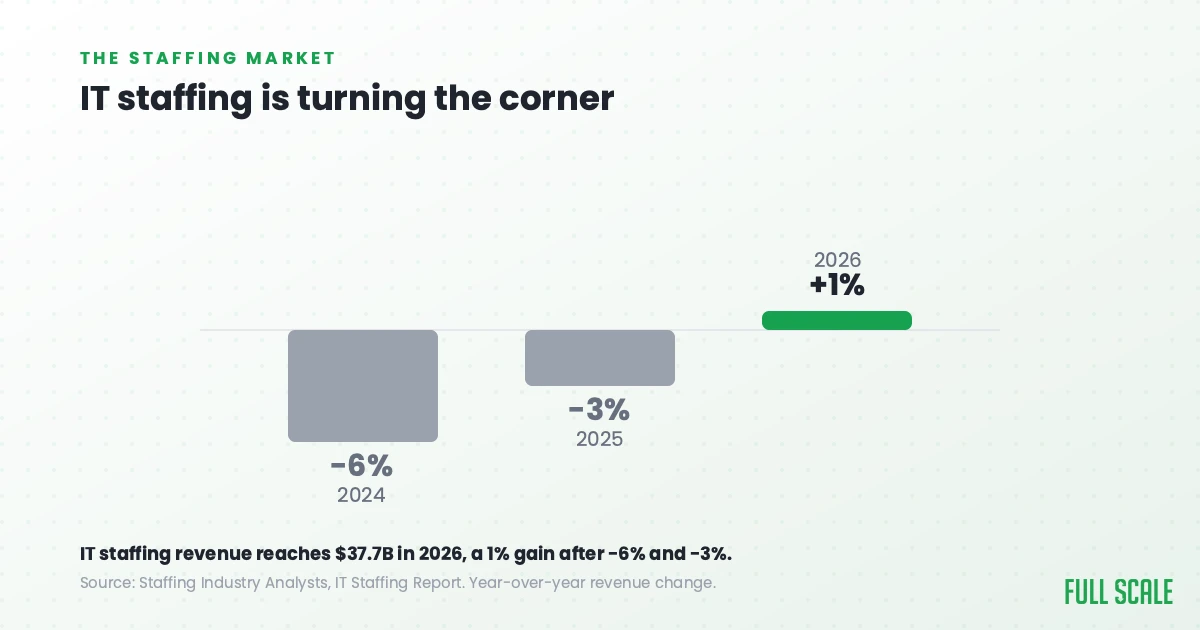
IT staffing specifically is turning a little faster. It is forecast to grow 1% in 2026 to $37.7 billion after milder declines of -6% in 2024 and -3% in 2025 (SIA IT Staffing Report). Worth being precise here, because it is easy to mix up: the deep -14% drop was the whole staffing market, not IT staffing. Tech held up better than the average through the downturn, and it is recovering first.
The near-real-time numbers agree. The ASA Staffing Index showed staffing employment up 4.8% to 5.6% year over year in mid-2026, and the first-quarter decline narrowed to -4.6% from -10.8% a year earlier (American Staffing Association, Staffing Index). The bleeding stopped. Demand is coming back.
The market is not dead. It is being rebuilt around a different shape of team, and that shape is the interesting part.
A fair question before we go further: how much of this is AI and how much is just the hangover from cheap money? Honestly, a lot of the 2022 to 2025 drop was the rate cycle and the unwinding of everyone over-hiring in 2021. Rates explain the timing. What AI explains is why the shape of hiring is not snapping back to normal as the market recovers, and in particular why the junior rung is not coming back with it.
The broken entry ramp
Here is the part the growth numbers hide. The door into this career is closing on new people.
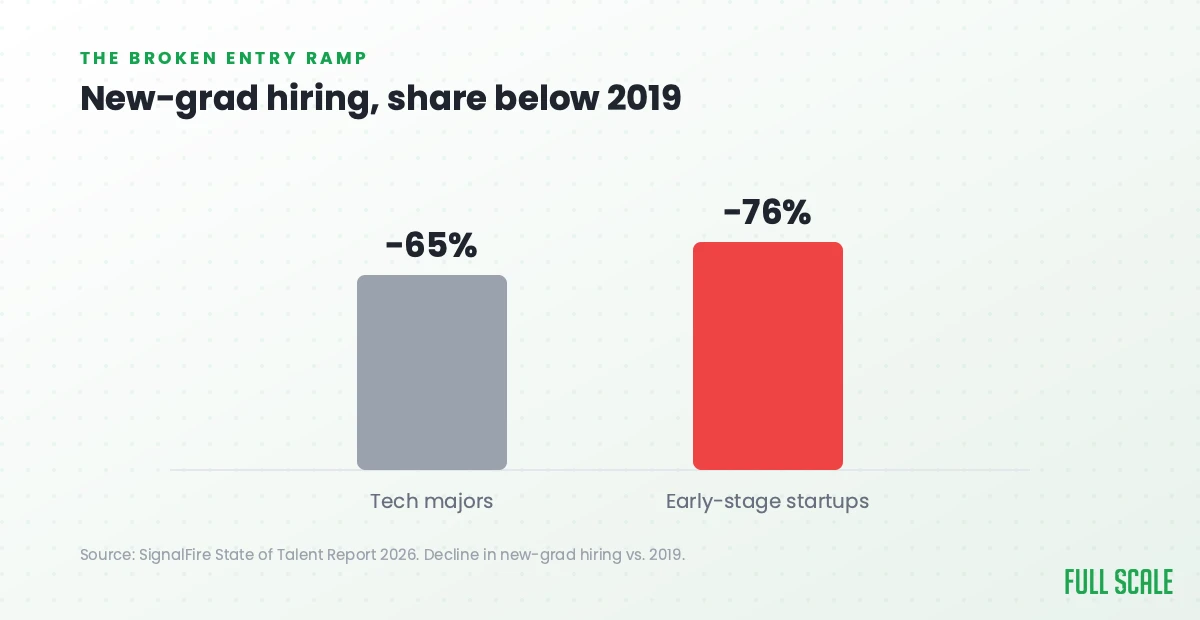
New-grad hiring at the biggest tech companies is down about 65% versus 2019, and down roughly 76% at early-stage startups (SignalFire State of Talent Report 2026). Graduates from top-20 computer science programs are 45% less likely to land a role at a tech major than the class of 2022 was. The Stanford Digital Economy Lab found employment for software developers aged 22 to 25 has fallen about 20% from its late-2022 peak, with the declines concentrated in exactly the work AI now does (Stanford Digital Economy Lab, November 2025).
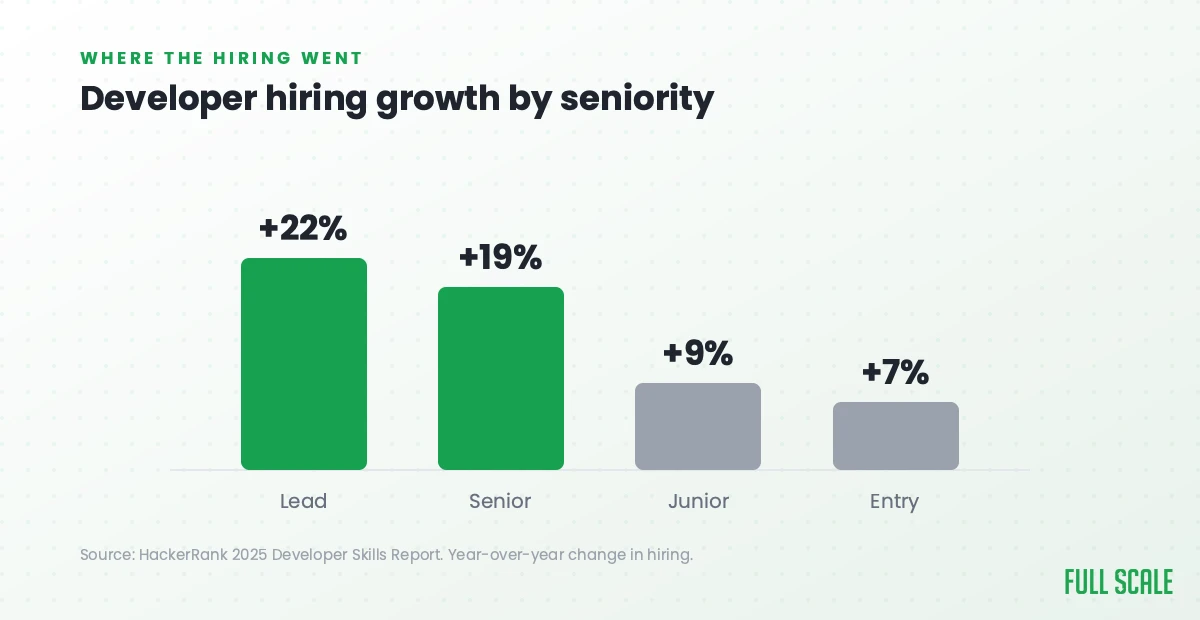
The hiring that is happening skews hard toward experience. On HackerRank’s platform, lead developer hiring rose 22% and senior 19%, while junior grew just 9% and entry-level was nearly flat at 7% (HackerRank 2025 Developer Skills Report). When software developer job postings rebounded, 71% of the increase came from senior roles and 37% mentioned AI (Indeed Hiring Lab, July 2026). Even the developers feel it: 61% of juniors call the market challenging, versus 54% of seniors (JetBrains State of Developer Ecosystem 2025).
The mechanism is not a mystery. The routine work a junior used to cut their teeth on, the first draft of a function, the unit tests, the small bug, is the exact work an AI tool now does in seconds. The rung of the ladder we all used to climb got sawed off. I do not have a tidy fix for that, and anyone who tells you they do is selling something. It is a real problem for a generation of engineers, and it deserves to be treated as one.
AI is decoupling headcount from output
The thing executives told themselves in 2024 was that AI would let them ship with fewer engineers. That is starting to show up in the numbers, and not just at hype conferences.
Look at India, the benchmark offshore market. Its tech industry grew revenue 6.1% in fiscal 2026, crossing $300 billion to reach about $315 billion, while headcount grew only 2.3% (NASSCOM Strategic Review 2026). NASSCOM attributes the gap directly to AI productivity. Grid Dynamics grew AI to 29.3% of its revenue with essentially flat headcount, adding a net 38 people year over year (Grid Dynamics, Q1 2026). Globant told investors its AI delivery model “by definition requires less people,” and its revenue per employee climbed past $90,000 (Globant, Q4 2025). Cognizant says about 40% of its code is now AI-assisted (Cognizant, Q1 2026).
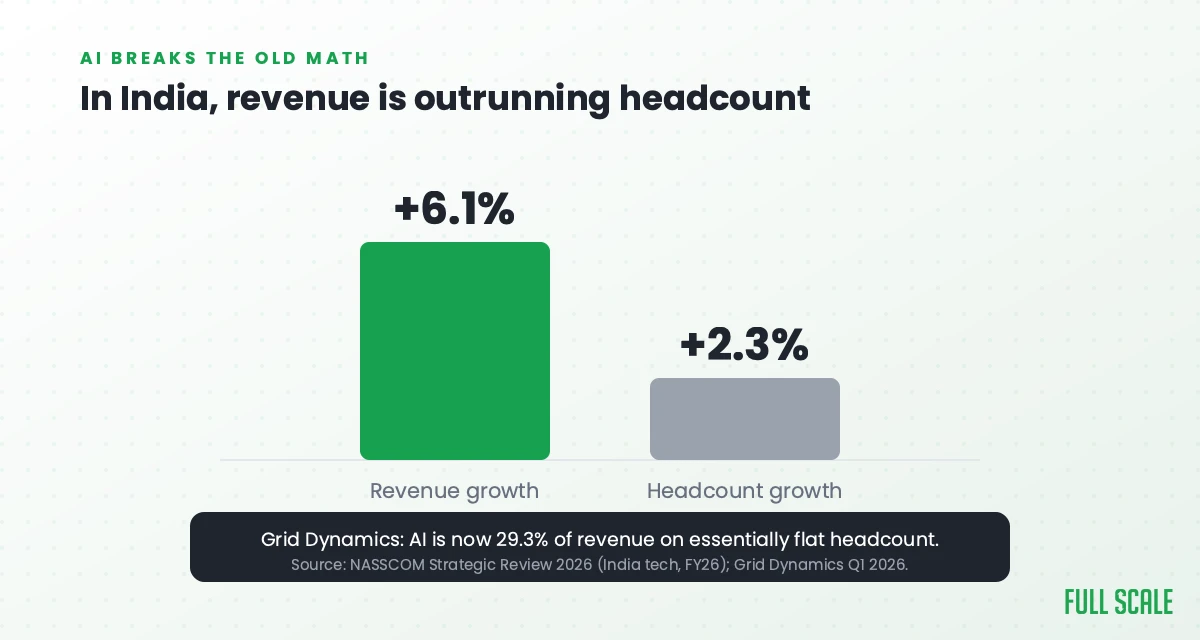
To be clear, that “decoupling” is my read on what the numbers add up to, not a phrase any of these firms used. But the pattern is hard to miss: revenue and headcount, which used to rise together in this business, have started to separate. That does not mean the appetite for software is shrinking. It means each engineer now produces more, so companies build more without adding seats at the old rate.
I see the small version of this inside our own book. We are growing and having a good year, but when one of our engineers resigns, and across 300-plus people one or two do most months, our clients are less likely to backfill the seat than they used to be. A couple of years ago almost all of them would have. Now more of them love the person, do not want to lose them, and once they know they are losing them, quietly decide to cover the work with AI or hold the budget instead. It is subtle. It is also the macro chart happening one seat at a time.
The other shift I hear on almost every call now is about AI itself. Clients ask what tools our engineers use and how good they are with them. Three years ago nobody asked. And here is the part that matters for how you staff: when a junior can generate a plausible draft in seconds, the scarce skill becomes knowing whether the draft is right. Domain knowledge and product thinking are worth more with AI, not less, because someone has to catch the confident wrong answer.
The developers know it too. AI use is close to universal now, 85% of developers in JetBrains’ survey, 97% in HackerRank’s, and nearly 80% of new GitHub developers use Copilot in their first week (GitHub Octoverse 2025). AI writes an average of 29% of developers’ code (HackerRank 2025). But trust is going the other way. Only about 33% of developers trust the accuracy of AI output and 46% actively distrust it (Stack Overflow 2025 Developer Survey). One small but careful controlled study found experienced developers were actually 19% slower using AI tools on code they already knew well, even though they believed they were about 20% faster (METR, July 2025).
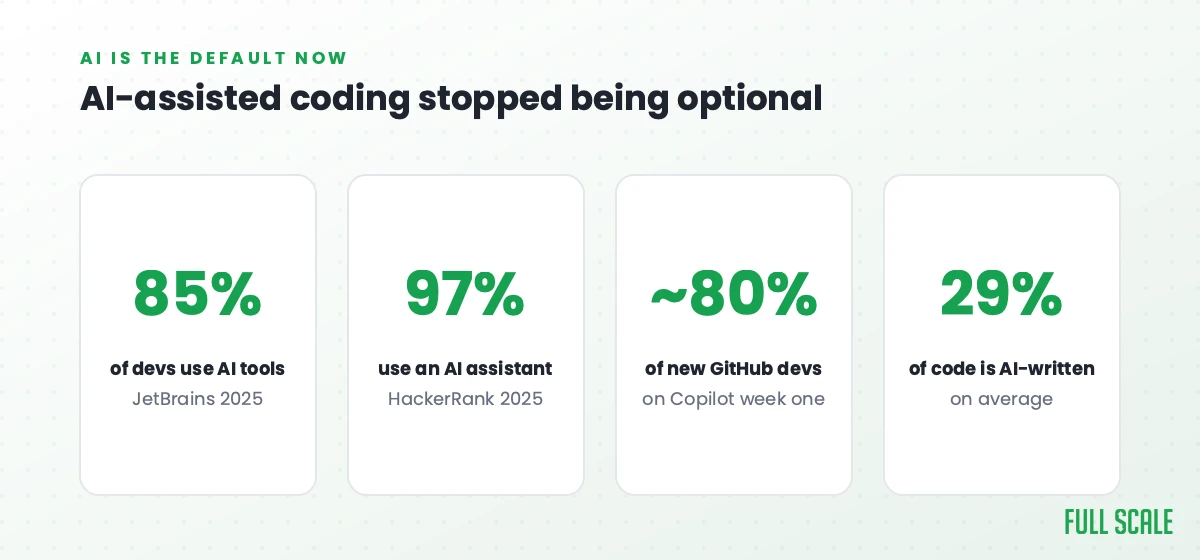
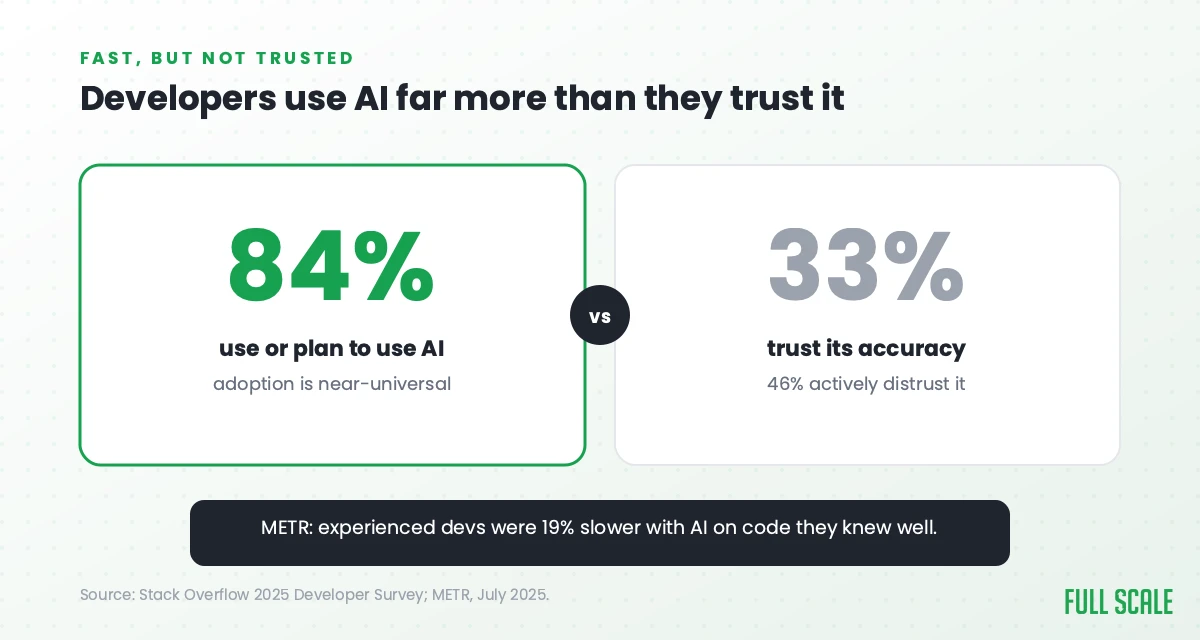
AI sped up the typing and left the judgment exactly as hard as it always was. That is why the value moved to the people who have it.
The real cost of staffing in 2026
Which brings us to money, because judgment at the senior level in the U.S. is expensive.
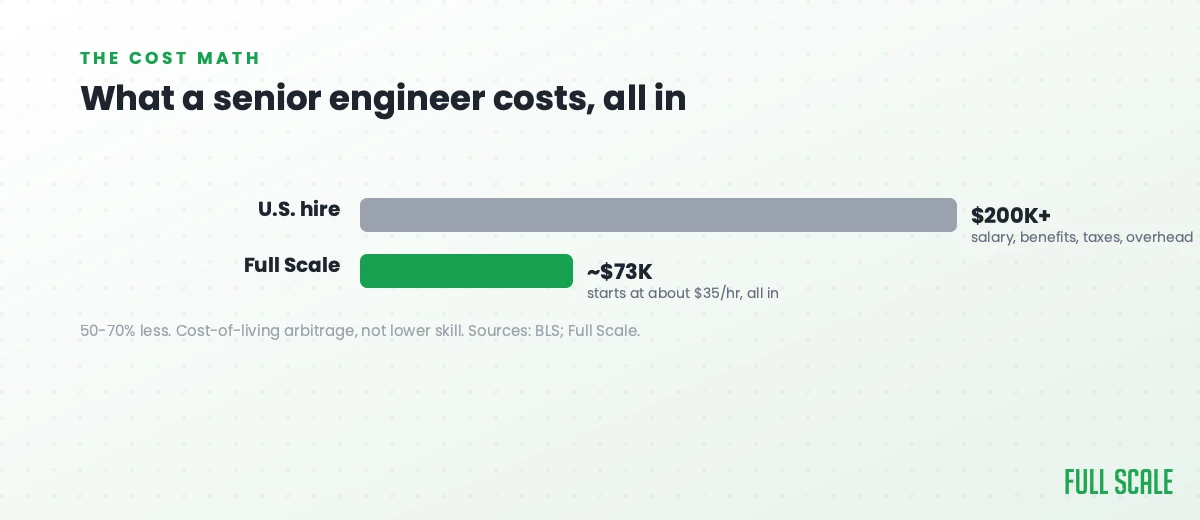
BLS puts the median software developer at $133,080 (May 2024). Dice pegs the average tech salary at $112,521 (Dice 2025 Tech Salary Report). Robert Half’s 2026 guide puts a software engineer between $109,250 and $175,500 depending on level (Robert Half 2026 Salary Guide). Levels.fyi, which skews toward big-tech pay, reports median total compensation around $191,000 to $195,000 (Levels.fyi 2025). Read those two as a range, not a contradiction, because they measure different populations. On the contract side, the average U.S. IT bill rate has held around $90 an hour for three straight years (Kforce, Q1 2026). Add benefits, taxes, recruiting, and overhead, and a senior U.S. hire lands well north of $200,000 all in.
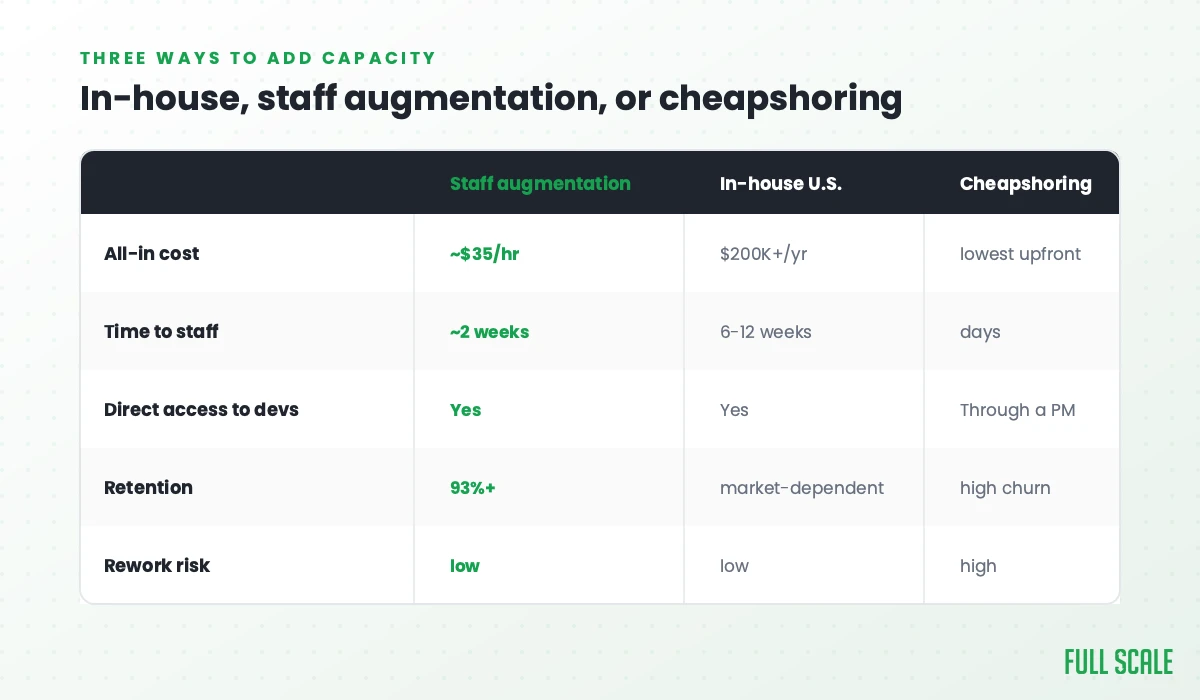
A senior engineer on an offshore contract runs on the order of $35 an hour all in, roughly $73,000 a year, a 50% to 70% saving versus a comparable U.S. hire.
That gap is cost-of-living arbitrage, not skill arbitrage. A senior engineer in Manila ships the same caliber of work as the US developer next to them; what is lower is the rent, not the ability. (For disclosure, the $35 figure is the range we see in our own book at Full Scale, and it lines up with IBPAP’s estimate of 70%-plus cost savings for the sector.) The mistake buyers make is chasing the cheapest hands they can find instead, which I call cheapshoring, and it costs more than it saves once you count the rework.
In-house, staff augmentation, or the cheapest offshore option
When senior talent is scarce and expensive at home, you have three ways to get it: hire in-house, add senior engineers through staff augmentation, or chase the cheapest offshore shop you can find. The data shows which way the market is moving, and we break down the staff augmentation trends specifically in a separate piece.
In-house is still the right call for some work. If you are in a deep regulatory or security spot that will not allow offshore, or your core team is under five people and every hire has to sit in the room, pay the premium and hire locally. I am not going to pretend a global team fits every role. Where it does fit is the far more common case: you need senior capacity in a known stack, you need it this quarter, and the local market is quoting you six months and $200,000.
Cost is no longer the top reason companies outsource. The share of executives who put cost first fell from 70% in 2020 to 34%, with talent and speed now ranking ahead of it (Deloitte Global Outsourcing Survey). Kforce reports that 60% of its top 25 clients now use offshore or multi-shore delivery, and that clients are greenlighting projects through flexible staffing rather than permanent hiring (Kforce, Q1 2026). One staffing firm, ASGN, watched its IT staffing revenue fall 12% while its consulting revenue rose 19% in the same quarter, which is the whole shift in one company: commodity bodies down, skilled and AI-adjacent work up (ASGN, Q1 2026). Robert Half says hiring timelines are still running 20% to 30% longer than normal (Robert Half, Q1 2026). And staffing firms that actually use AI are pulling ahead, 3.5 to 4.5 times more likely to have grown revenue (Bullhorn GRID 2026).
Then there is the funnel problem, which is where AI cuts against you. Robert Half says generative AI has flooded application volumes and made it harder to verify who is real. I can confirm it from our side. We run across candidates every single week who appear to be using AI to cheat their way through the interview. Our team is good at catching it, because it feels like someone reading from a script instead of giving real, personable answers. Fewer than 3% of applicants make it through our vetting, and in a market this noisy that screen matters more than ever. Anyone can find you a resume now. The hard part is knowing which human behind it can actually think.
This is where the model you pick decides everything. When an offshore engagement falls apart, the cause is almost never the distance or the skill. It is that the engineers were kept at arm’s length. Treat someone like a vendor on the far side of a wall and they leave; bring them onto your standups and into your code reviews and they stay. That is the difference between staff augmentation and the horror stories.
Retention: the number the industry can’t fake
Retention used to be a nice-to-have. In 2026 it is the whole game, because AI raised the cost of losing the person who holds the context.
Start with the public companies that do this work. EPAM reported 11.2% voluntary attrition, Cognizant 12.3%, Globant 13.6%, TCS 13.8%, Wipro 15.1% (each firm’s Q1 2026 or FY2025 filings). Across the public offshore field, the best case still loses about one in nine of its people every year. For comparison, our own book at Full Scale runs over 93% retention, closer to one in fourteen. That is a single firm’s self-reported number, so weigh it as one data point next to the audited public ones. But the size of the gap is the thing worth explaining.
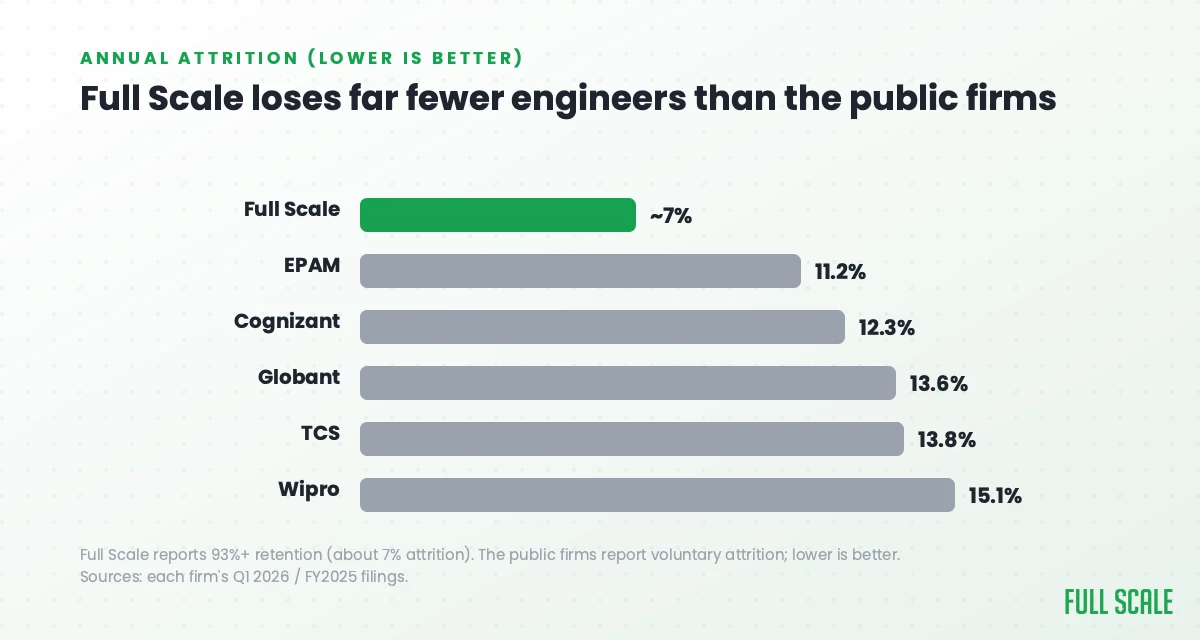
The reasons are not mysterious, and they are worth naming because they are things any employer can control. Some of the gap is cultural: in the Philippines, engineers tend to stay with a company that treats them well. The rest is deliberate, competitive pay, real career growth, and steady engagement rather than a job left to run itself. The takeaway for a buyer is not the number, it is that retention is a variable you can move, and most companies do not treat it as one.
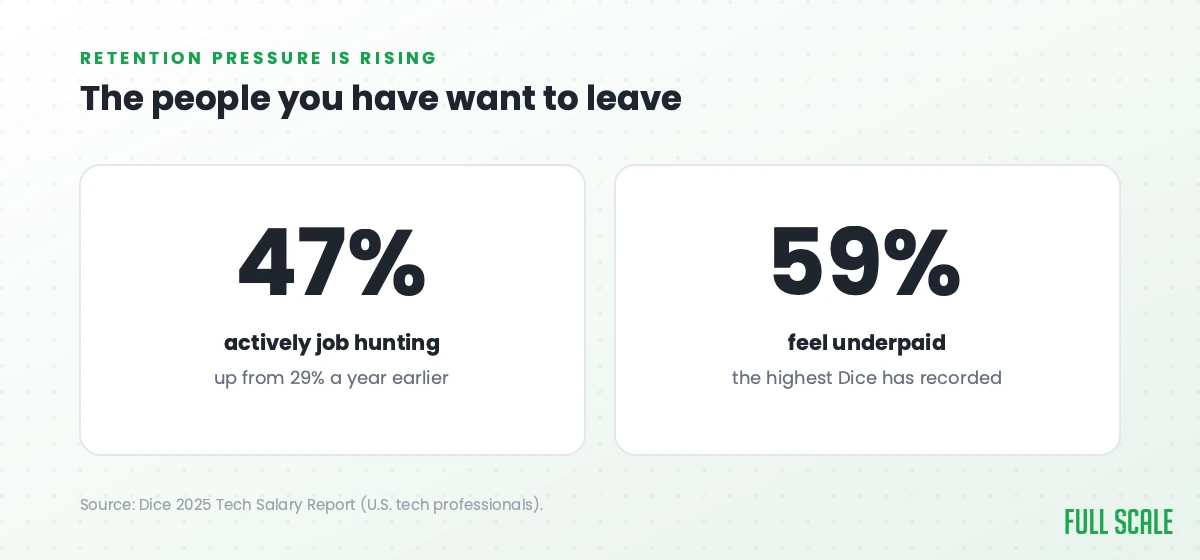
The wider market makes the point by contrast. U.S. voluntary turnover was 13% in 2025, down from a brutal 24.7% in 2022 (Mercer 2025 Turnover Survey). And 47% of tech professionals are actively job hunting, up from 29% a year earlier, with 59% saying they feel underpaid, the highest Dice has ever recorded (Dice 2025). The flight risk on a typical team is high and rising. When a person walks, the domain knowledge walks with them, and in an AI-heavy workflow that knowledge is the expensive part to replace.
The offshore reality, minus the marketing
If more teams are building where the talent lives, it helps to be honest about where that is and what the numbers actually mean.
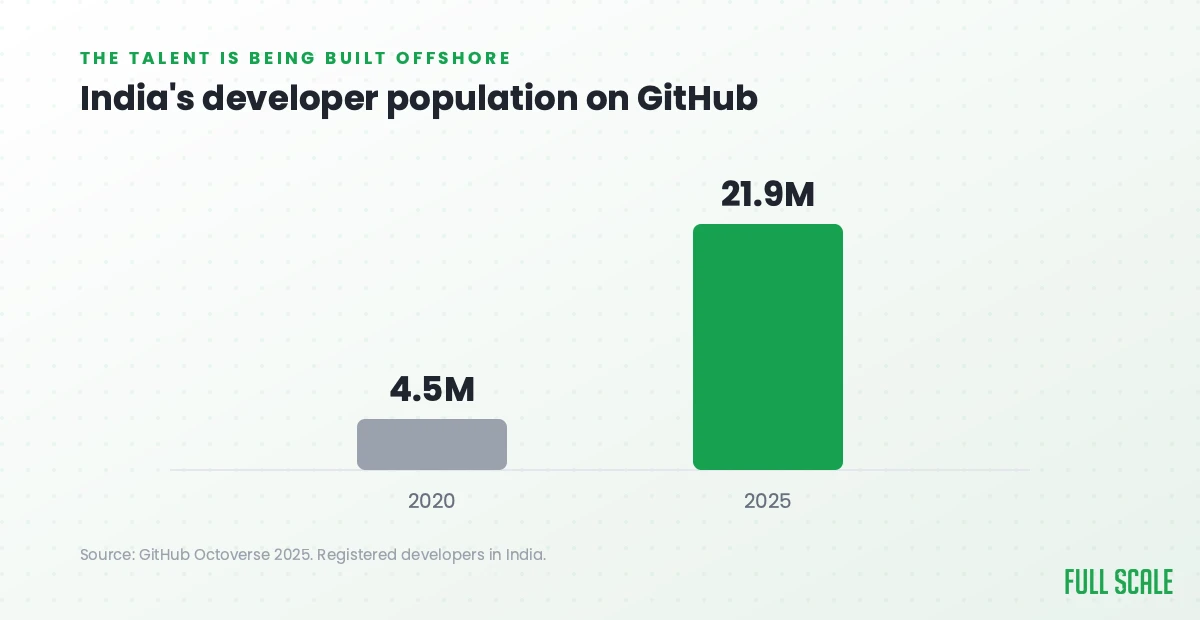
The Philippine IT and business process sector hit about $40 billion in revenue with 1.9 million workers in 2025, on the way to a $59 billion, 2.5 million target by 2028 (IBPAP IT-BPM Roadmap 2028 for the target; the 2025 actuals via IBPAP’s year-end reporting). One caveat that most write-ups skip: the large majority of that is call centers and back-office work. Software and IT is only about 16% to 18% of it. So the headline “1.9 million” is not 1.9 million developers, and anyone implying that is stretching. The software slice is real and growing, but it is a slice. India tells a similar story at larger scale, and its developer population on GitHub grew from 4.5 million in 2020 to 21.9 million in 2025 (GitHub Octoverse 2025). A 2018 Korn Ferry study projected a global shortage of 85 million skilled workers by 2030; it predates the AI shift, so treat it as old context rather than a current forecast.
I have hired developers on three continents, and the country was never the thing that decided it. A team in Manila and a team in Austin both live or die on the same question: do the people take ownership, or do they sit and wait to be told what to do next. Once the operating model is right, the location on the map stops carrying much weight. There is a real debate to be had about the ethics of offshoring, and I have made the case elsewhere for why doing it well is fair; I will not relitigate it here.
What holds up when everything else changes
Strip out the tools and the trend lines and the same three things decide whether a team is worth paying for. I built my book, Product Driven, around them: communication, curiosity, and courage. An engineer earns their keep now by pulling a real requirement out of a half-formed ask, not by typing fast. By staying suspicious of whatever the AI just handed them and probing where it falls apart. And by being the one person willing to say, out loud, that a feature is a bad idea before it ships.
None of that changed with AI. Eight years, 200-plus companies, and 5 million-plus development hours in, the durable stuff is still the human stuff. AI just made it more obvious who has it.
What I would do if I ran engineering in 2026
Here is the part I actually believe, and it is the opposite of the doom you have been reading.
Software development has never been more affordable than it is right now. Between AI making engineers faster and offshore talent giving you more for your dollar, you can build more with the same budget than at any point in my career. The pessimists read that as a reason to cut. If you run a product, it is a reason to build more, because the same money now buys more of what you want.
You might be thinking the opposite. If AI lets companies do the same work with fewer people, and my own clients are covering resigned seats with it, why hire anyone at all? Here is the honest answer. If your goal is to hold this year’s output flat, AI alone may get you there with a smaller team. But almost nobody’s roadmap is “ship exactly what we shipped last year.” There is always more you would build if you could afford it. For years the limit on that list was budget. Cheaper software moves the limit to ambition, because the features and products that were never worth the old price are worth building now. That is where a senior team, offshore or not, earns its keep. You are not choosing between engineers and AI. You are using both to finally reach the work that was always sitting just past the budget line.
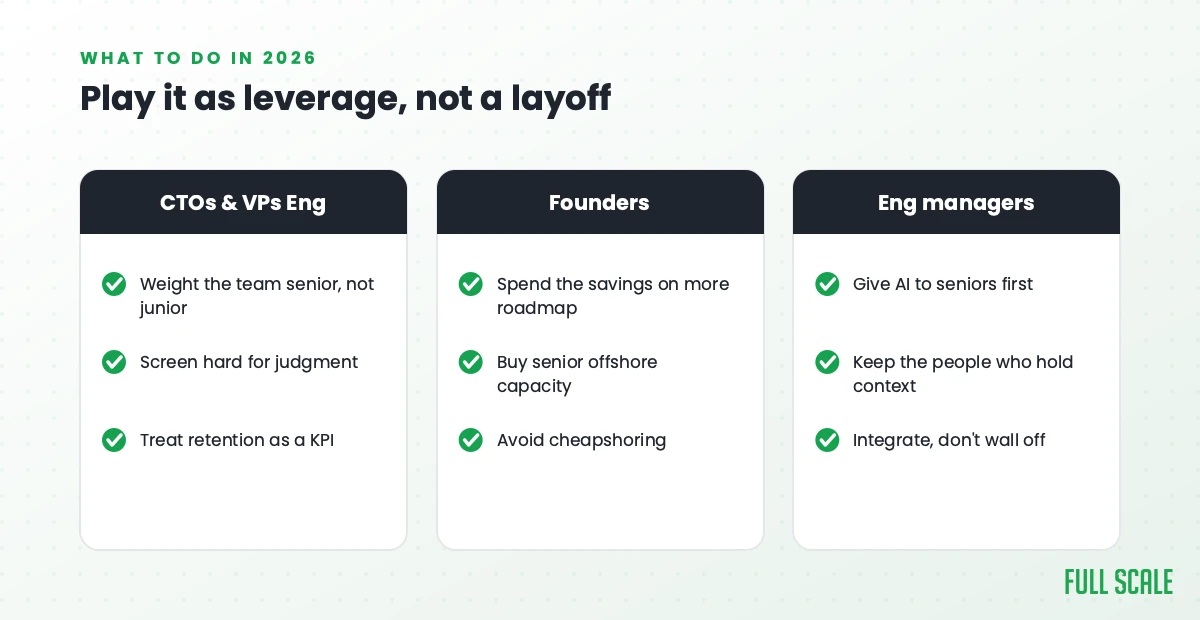
My advice is simple. Do not cut your ambitions to match a scary headline. Invest more in innovation, because your dollars go further than they used to. Build a senior-weighted team that can direct AI instead of a big junior team that competes with it. Screen hard for judgment, because the funnel is full of noise. And when you find people who are good, keep them, because retention is now a competitive advantage and not an HR metric. Offshore talent is one of the most direct ways to get more engineering for your money, and in 2026 that math is the best it has ever been. Managing agentic coding workflows well is now part of that screen, not a footnote.
Full Scale compiled this report as a staffing firm working in this market. If it helps to talk through what the data means for your own team, you can reach us here.
Methodology
This report combines three kinds of data. First, public company disclosures: quarterly earnings and press releases from the firms that do work like ours, including EPAM, Globant, Endava, Grid Dynamics, Cognizant, DXC, TCS, Infosys, Wipro, HCLTech, Persistent, Kforce, Robert Half, ASGN, and ManpowerGroup’s Experis, from their Q1 2026 and fiscal 2025 reporting. Attrition figures are each company’s own reported voluntary attrition; Full Scale’s 93%+ is our internal annual retention rate, so the comparison is retention against attrition and we have flagged it as such rather than implying an identical methodology. Second, third-party research: BLS, Challenger, the World Economic Forum, SIA, ASA, Bullhorn, NASSCOM, IBPAP, Stack Overflow, JetBrains, GitHub, HackerRank, Dice, Mercer, Deloitte, SignalFire, the Stanford Digital Economy Lab, Indeed Hiring Lab, Gartner, and METR, each cited inline with its report and period. Where a source is a company platform or survey, that scope is noted. Third, Full Scale’s own operating data across 700-plus placements and 300-plus current engineers. The WEF workforce figures are theirs; the interpretation that AI is decoupling headcount from output is ours.
Frequently asked questions
What are the biggest IT staffing trends in 2026?
Hiring skewed toward senior and AI-capable engineers while entry-level roles collapsed, AI started separating revenue growth from headcount growth, and retention and vetting became the deciding factors because losing an experienced person now costs more.
Is the IT staffing industry recovering in 2026?
Yes, slowly. U.S. staffing revenue is forecast to grow 1% to $180.2 billion in 2026 after three down years, and IT staffing specifically is forecast to grow 1% to $37.7 billion after milder declines, with near-real-time staffing employment up year over year.
Is the software field actually shrinking?
No. The BLS still projects 15% job growth for software developers through 2034 and tech unemployment is below the national rate. What is shrinking is entry-level hiring, down roughly 65% at major tech companies versus 2019.
What are the key IT staffing statistics for 2026?
U.S. staffing revenue is forecast to grow 1% to $180.2 billion and IT staffing 1% to $37.7 billion; 74% of employers cannot fill tech roles; developer AI adoption sits between 85% and 97%; and voluntary turnover is 13%, with 47% of tech professionals actively job hunting.
How is AI changing IT staffing?
AI made typing faster and judgment scarcer, so demand shifted to senior engineers who can direct it, entry-level hiring fell, and some firms are growing revenue without adding proportional headcount.
Does offshore staffing still make sense in 2026?
Yes, and the cost math is the best it has been. A senior offshore engineer can cost 50% to 70% less than a comparable U.S. hire, and that gap is cost-of-living arbitrage, not lower skill, as long as you avoid picking a partner on price alone.
Is fractional IT leadership a growing trend in 2026?
Yes, for the same reason entry-level hiring is not: AI shifted the bottleneck from headcount to judgment. A company that does not need a full-time VP of Engineering every week still needs someone senior directing the work, reviewing architecture decisions, and making calls a junior team cannot. A fractional CTO or VP of Engineering fills that gap without the fixed cost of a full-time executive hire, which fits the broader 2026 pattern of demand for senior judgment climbing while permanent headcount growth stays flat.