
An Outsourced Development Team Only Works One Way

In this article
- What an outsourced development team actually is
- The version everyone tries first is the one that fails
- The one way it works is a team you manage like your own people
- An outsourced development team needs an engineering leader on your side
- Cost is a good reason to do this, but cheapest is a trap
- What about IP, security, and control?
- What to demand so you get a team, not a queue
- The honest version
- Frequently asked questions
- Build a team you actually run
Quick Answer: An outsourced development team is a group of software engineers, employed by an outside partner, who build your software while you direct the work. It succeeds when someone on your side owns it and the engineers answer to you, the way dedicated Filipino engineers do inside a Full Scale client’s standups and chat. It fails when a vendor’s project manager stands between you and the developers. A senior engineer in the Philippines typically bills $30 to $40 an hour, well under half the loaded cost of a US hire.
I’ve outsourced plenty of software in my career, and a lot of it went fine. I outsourced projects for WordPress, Elasticsearch, and other things I didn’t know much about. Those were quick, well-scoped jobs. I handed them over, I got back what I asked for, and I never had to think about them again.
For years, though, I wouldn’t go near an outsourced development team. Every founder I knew who had tried one came back with the same horror story: the work fell apart, the developers vanished, and the money was gone. So I stayed away.
When I finally did build offshore teams myself, they worked, every time. At Stackify I hired developers in Russia who did excellent work, plus a DevOps engineer in Mexico who was one of the best I’ve ever worked with. Later, the team we built in the Philippines became the foundation of Full Scale. None of them went sideways, and the reason had nothing to do with the country or the talent. It came down to how each team was set up.
After 20 years and four companies, here’s what I’ve landed on.
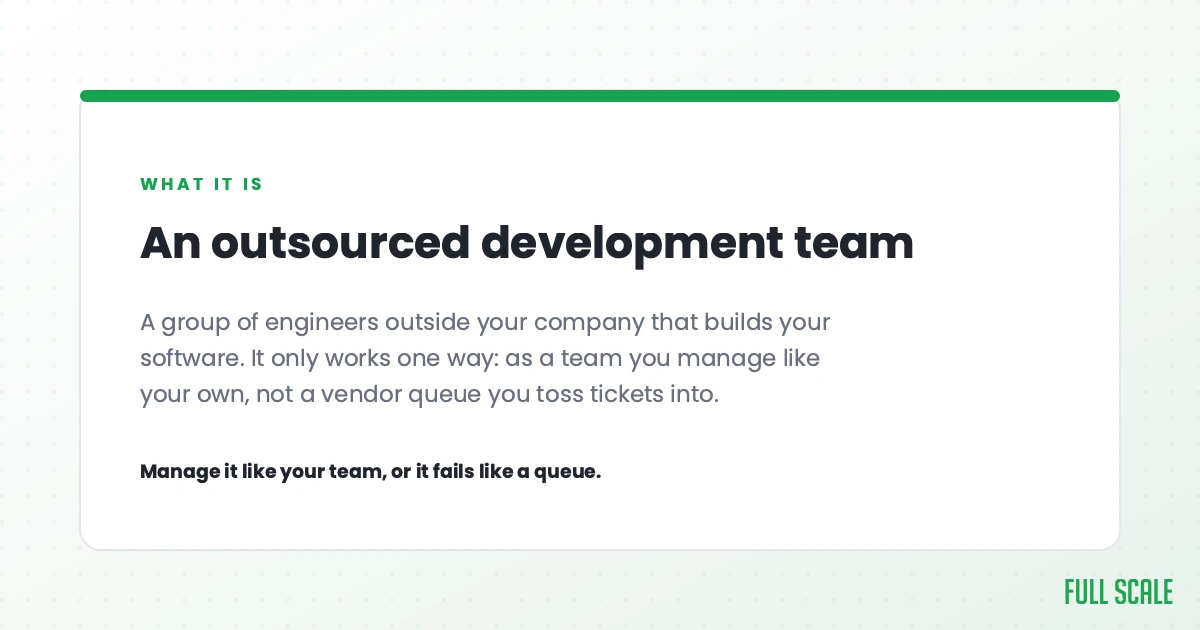
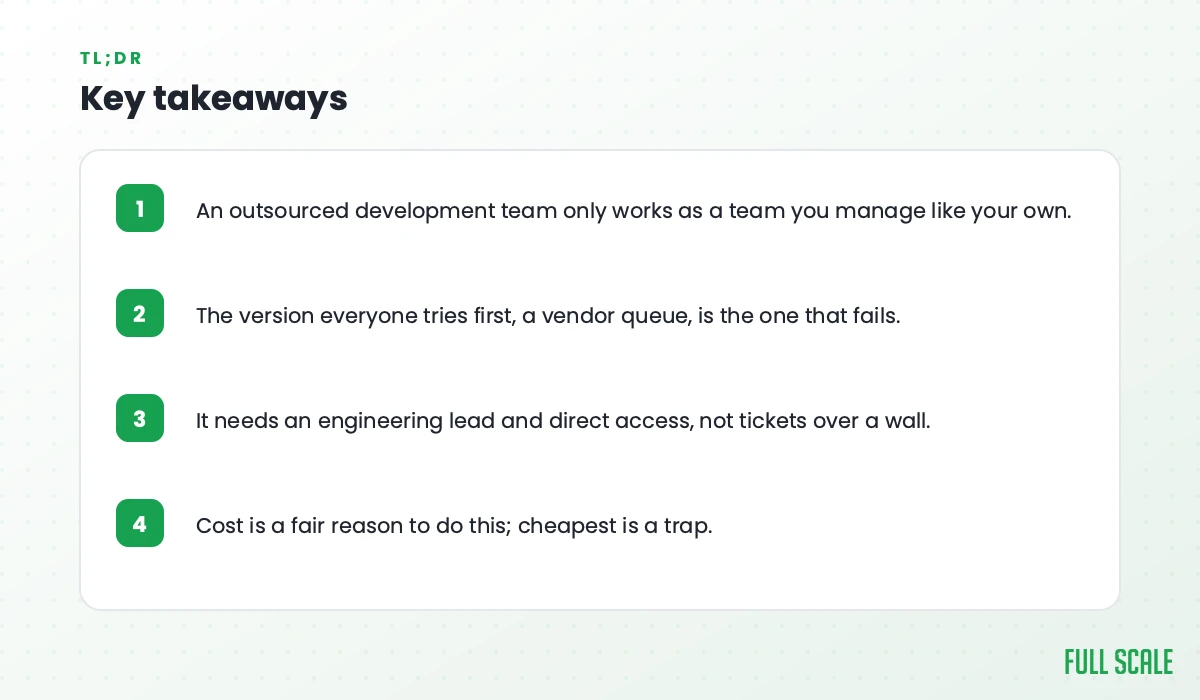
An outsourced development team only works one way: when someone on your side owns it and runs it like their own.
It works when the people directing the team answer to you, the same way they would if you’d hired them into your own office. It fails when you hand it off to a vendor and hope. The teams behind all those horror stories fell apart for one reason: the company bought a project when what it needed was a team it actually ran, one of the outsourcing mistakes that explains why outsourcing fails more than any other single decision.
What an outsourced development team actually is
An outsourced development team is a group of software engineers, employed by an outside partner, who build and maintain software for your company. The engineers aren’t on your payroll. The partner recruits them, pays them, and handles the HR side. But the work is yours, and the product is yours.
That’s different from a few things people lump together:
- A freelancer is one person on a transactional gig, good for a small job but not something you build a product on.
- A project shop takes a written spec, builds to it, and hands it back. You manage the contract, never the people.
- A single augmented developer is one engineer plugged into your existing team.
An outsourced development team is the whole unit: several engineers, often with a lead and QA, working together on your product over time.
People mean two completely different things by “outsourced development team,” and only one of them holds up for ongoing product work.
| The project version | The team version | |
|---|---|---|
| What you outsource | The team and the responsibility | The hiring and employment only |
| Who manages the work | The vendor | You |
| You talk to | A project manager | The engineers |
| Best for | A scoped, hand-it-off project | Your actual product, long term |
The project version is fine for a finished, well-defined job, the kind of thing I outsourced with those WordPress and Elasticsearch builds. The team version is what you want when you’re building something that has to keep evolving. Most people reach for the wrong one. For the full map of outsourcing models and what each costs, see the software outsourcing guide.
The version everyone tries first is the one that fails
When a founder decides to outsource a development team, the instinct is almost always the same. Find the cheapest option, write up what you want, hand it over, and let the vendor run it. I call going offshore for price alone cheapshoring, and it’s the fastest way to waste a pile of money.
For years I wouldn’t touch offshore at all, because everyone I knew who tried it had the same horror story. I figured out later that the stories weren’t really about bad developers. They were about a broken setup.
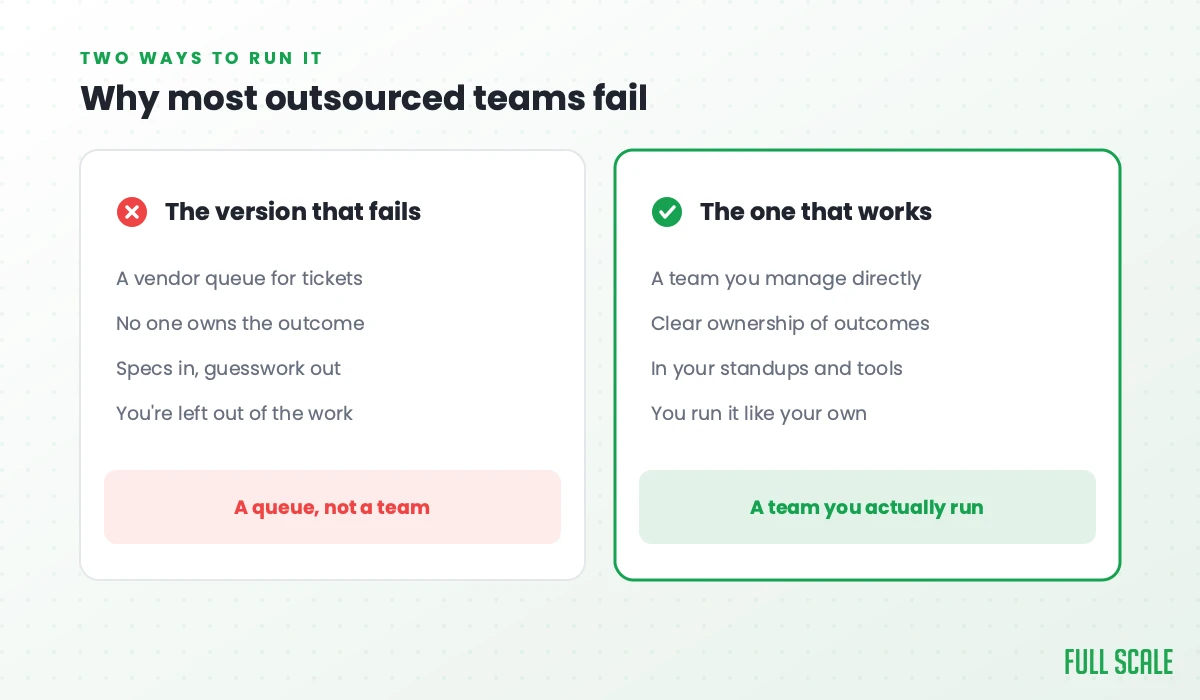
The setup looks like this. You only ever talk to one person at the vendor, usually a technical project manager, even though five or more developers are actually building your product behind them. Sometimes it’s a language gap, sometimes it’s a cultural rule about who’s allowed to talk to the client. Either way, almost nothing flows back and forth, and you end up with a team you can’t communicate with and a middleman in the way of every decision.
That’s the real problem, because software development is about communication more than anything else. When there’s a layer between you and the people writing your code, you can’t communicate, and nobody on a project-shop team truly owns your product. They’re billing hours against a spec. The moment the spec is wrong, and the spec is always wrong eventually, everything stalls. It’s less a team than a queue you feed requirements into.
AI has only raised the stakes on that. A coding assistant can write a feature in an afternoon now, so the bottleneck has moved to deciding what to build and catching it when it’s wrong, and that work runs on communication and judgment.
If you’re still deciding whether you’re buying a project or building a team, I wrote a full decision framework on how to outsource software development that walks through the questions to ask yourself first.
The one way it works is a team you manage like your own people
Now flip it. The engineers work on your Slack and show up to your standups, and they answer to your product manager rather than to an account manager who relays decisions back and forth. No vendor rep stands between you and the people building your product.
They’re dedicated to you and stay on your product for the long haul instead of rotating between five clients. You keep your own in-house leadership, not a vendor’s PM, and let the team plug into it, and you hand them goals to own instead of a stack of tickets to close.
When it’s set up that way, the developers care about your product the same way your in-house engineers do. The fact that some of them live in another country stops mattering.
Run this way, the benefits people chase from outsourcing actually show up. You can ramp a team in weeks instead of the months a local hire takes, scale it up or down as the roadmap shifts, reach specialists who are scarce or expensive at home, and free your own engineers to focus on the core product instead of the backlog. You get all of that only when it’s a team you run, and it disappears the moment you hand the work to a project shop.
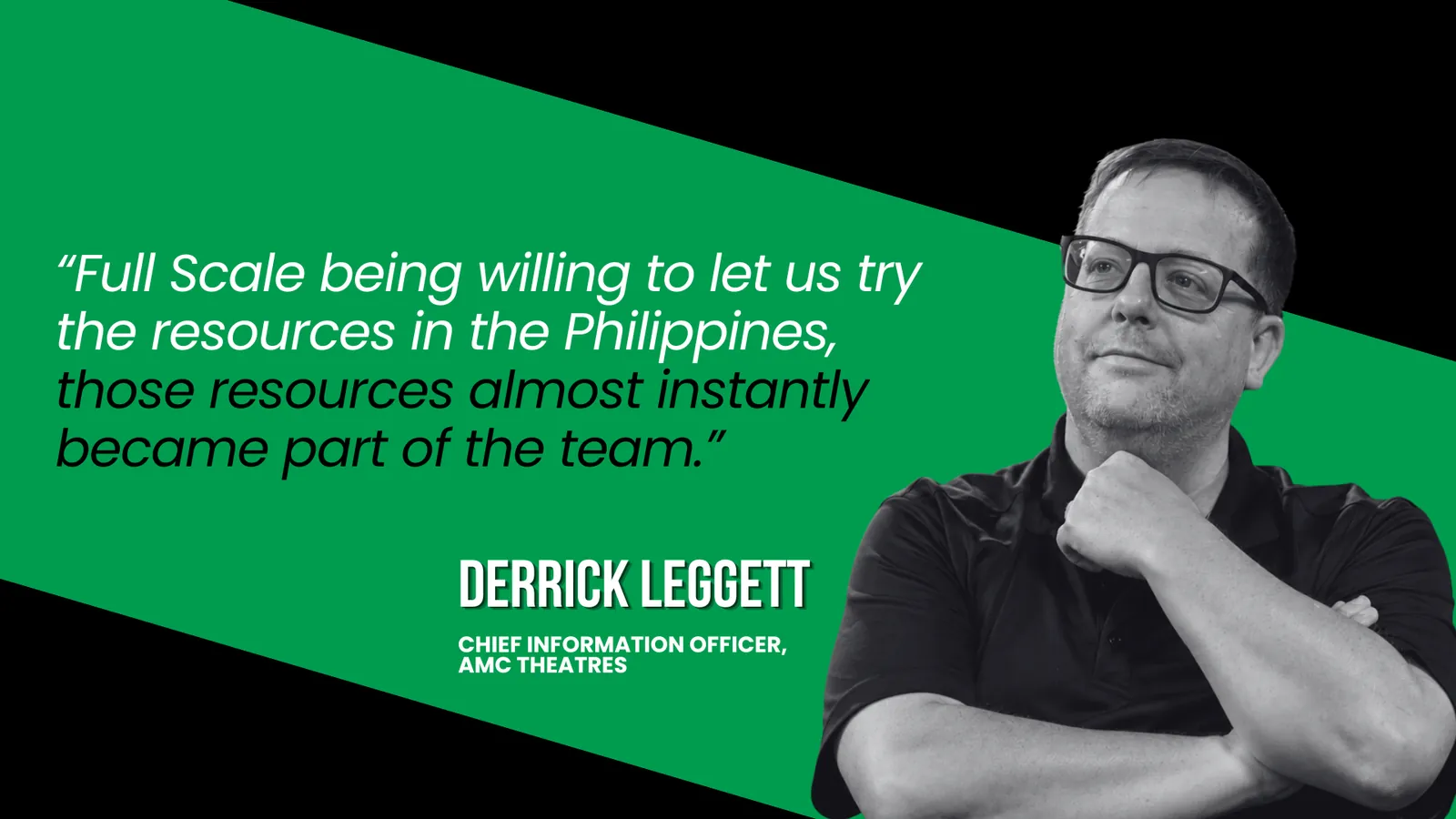
The best example I can point to is AMC Theatres. The engineers Full Scale placed in the Philippines are treated as full AMC engineers, with the same code review, the same Slack, and the same standards as the Kansas City team. Here’s how their CIO, Derrick Leggett, describes it:
“It’s a fully integrated team. It’s just some of the people happen to be living in the Philippines.”
The geography is an afterthought in how he describes it, which is the entire point. This model has a name, or really a few names. People call it staff augmentation, or a dedicated team, which are the same idea with different amounts of structure.
If you want the full comparison, I’ve broken down the staff augmentation vs. outsourcing debate and written a complete dedicated development team guide on how to hire and onboard one. The label matters less than the structure.
The version of an outsourced development team that works is the one you stop treating as outsourced.
An outsourced development team needs an engineering leader on your side
Every company that builds software has an engineering leader running the team. Outsourcing doesn’t change that, it just raises the question of which side that leader is on, which is the same fork covered in offshore dedicated team vs. in-house team. An outsourced development team works far better when the person managing the team and holding the vendor accountable works for you rather than for the vendor, because a vendor grading its own homework will always tell you the homework is going great.
A lot of founders outsource precisely because they don’t have that leader in-house, and that’s the version where the most money gets lost. If that’s you, hire one, even part-time. In my experience a fractional CTO runs about $5,000 to $10,000 a month, far less than a full-time hire, and that monthly cost is often the thing that makes the whole engagement work.
Think about building a house. You’re still the homeowner, you walk the site and make the calls that matter, but you hire a general contractor to run the trades day to day, and you want one you chose and trust rather than a subcontractor who volunteered to supervise their own work. Your engineering leader is that general contractor, the vendor’s developers are the trades, and the whole thing rides on having someone running it who answers to you. I dug into where the model breaks without that leadership in offshore staff augmentation.
Cost is a good reason to do this, but cheapest is a trap
The savings are real, and they’re usually what gets people in the door.
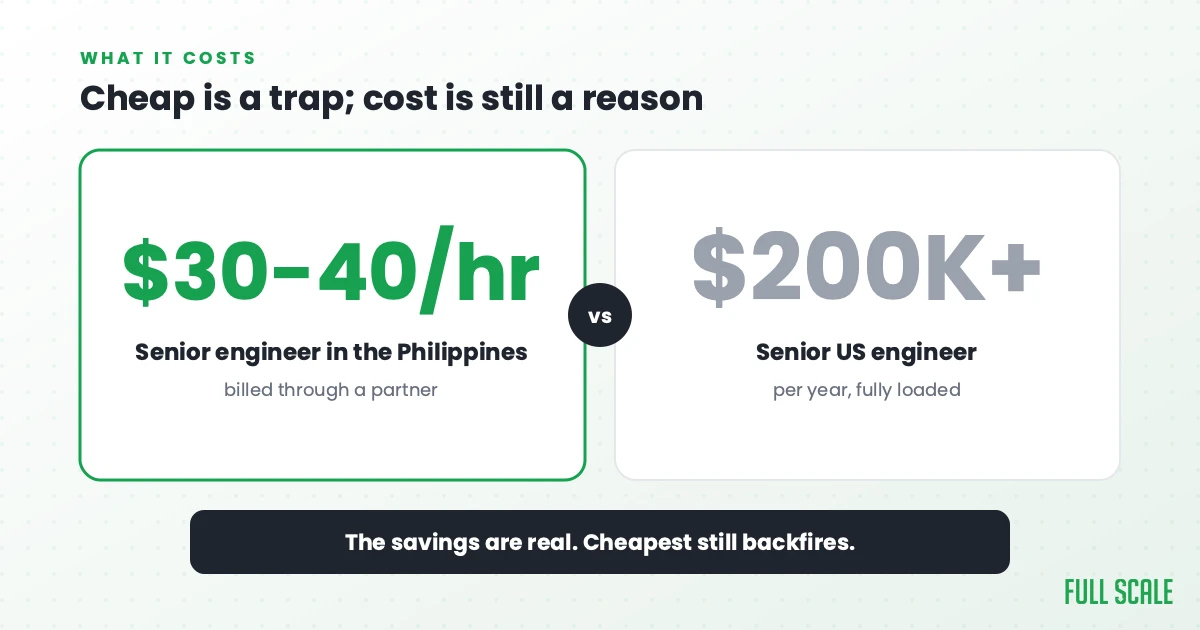
The BLS puts the median US software developer at about $133,000 in base salary, and a senior engineer sits well above that, in the $150,000 to $185,000 range. Once you add benefits, payroll taxes, equipment, recruiting, and overhead, the all-in cost lands at roughly 1.25 to 1.4 times that base, so call it $200,000 or more for one senior engineer.
At Full Scale, a senior engineer in the Philippines typically bills $30 to $40 an hour, which works out to roughly $60,000 to $85,000 a year. That’s well under half the loaded cost of the US hire, for the same caliber of work. If you’re bootstrapping the company, that gap is often what makes a real engineering team possible at all.
| Senior US developer | Senior offshore engineer (Philippines) | |
|---|---|---|
| Cost | ~$200,000+/yr, all in | ~$30–$40/hr, about $60,000–$85,000/yr |
| Relative cost | Baseline | Roughly a third to a half |
So yes, the savings are real. But there’s a trap. If cost is the only reason you’re doing this, you’ll buy the cheapest thing on the market, which is a freelancer or a project shop, and then you’ll get burned and swear off offshore for good. Cost is a legitimate reason to hire globally. It just can’t be the only one.
The right order is communication first, cost of living second, and country last. Most companies do it backwards and pick the cheapest country first. Figure out who can actually communicate with your team, then look at the economics.
There are smart developers all over the world. About 80% of software developers don’t even live in the US, so talent scarcity isn’t the reason anyone goes global. Cost of living is.
For me, the country that wins on communication is the Philippines, and it isn’t close. There’s no real language barrier. The Philippines is the third-largest English-speaking country in the world, and Filipino engineers grow up on American culture, so the references and the working style just land. The low rates are a cost-of-living difference, and they have nothing to do with skill.
Some people will tell you a $5-an-hour rate is exploitation. My sister-in-law in the Philippines works as a virtual assistant for $5 an hour, four times what my brother-in-law makes at Jollibee. He would take that VA job tomorrow. The wage that looks low from here is life-changing there.
What about IP, security, and control?
This is the question every CTO asks, and the honest answer is that your protection comes from how the engagement is built rather than from a promise in a contract. A team you run like your own is far safer here than a faceless project shop, because the developers work inside your environment. They use your repositories, your cloud accounts, your access controls, and your security policies, the same way an in-house engineer would. You grant and revoke access on your terms, and your code lives where it already lives instead of on some vendor’s server you can’t see.
Two things are non-negotiable. The developers should be real, full-time employees of your partner, under proper contracts with clear intellectual property (IP) assignment and confidentiality terms, rather than anonymous freelancers off a marketplace. And the country matters: the Philippines is a stable, US-friendly place to do business, which is part of why I trust it where I wouldn’t trust some cheaper options that are notorious for IP headaches. Get the access model and the contracts right and an offshore engineer is no riskier than any other remote hire.
I laid out the long version in the offshore IP protection framework, but the short version is the same as everything else here: structure decides the outcome.
What to demand so you get a team, not a queue
These are the things that separate a real outsourced development team from a project shop wearing the same label:
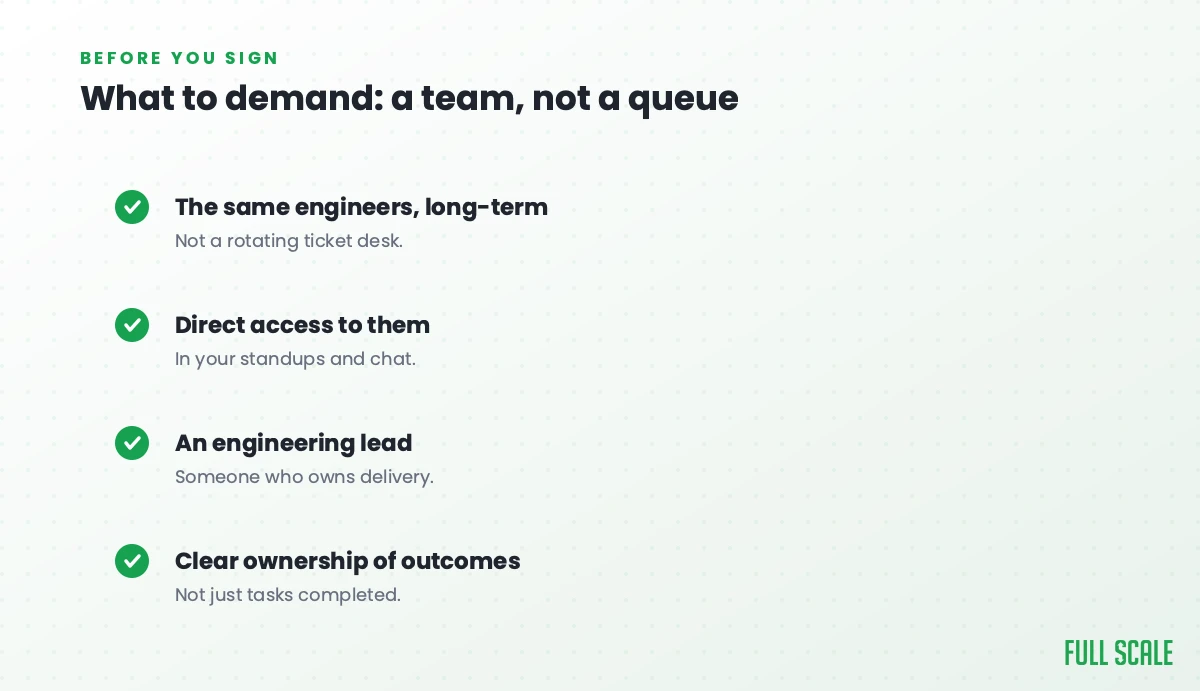
- Direct access to the developers. You talk to the people writing your code, with no mandatory project-manager middleman.
- Real retention numbers. Ask the provider what theirs is. A team that turns over every nine months isn’t a team. Ours sits at 93%, and we’re Great Place to Work certified in the Philippines two years running.
- Engineers you interview and keep. You pick them, and they stay dedicated to your product instead of being shared across five other clients.
- Month-to-month terms. You’re hiring a team, so you shouldn’t be locked into a fixed-bid project contract.
- Technical leadership stays on your side. The team plugs into your direction, and if you don’t have that leadership in-house, hire it (even a fractional CTO) rather than letting the vendor supply the person who manages the vendor.
- A real overlap window. A few hours of shared working time each day is usually plenty. Full days are available when a role needs them.
- References you actually call. Ask to talk to clients who came on six to twelve months ago, and call them. A partner worth hiring will have them ready.
The fear underneath all of this is simpler: what if the developers just aren’t good? You handle it the way you’d handle any hire. You interview them, you turn down the ones who don’t clear your bar, and you hold the ones you keep to the same standard as everyone else on the team. A good partner’s whole job is to recruit and retain people who pass that test, which is why retention is the number to watch: the team that’s good this quarter is still your team next year.
One more thing we do that’s worth copying: every engagement gets a Customer Success Manager whose job is to keep both the client and the engineers happy. They have the hard conversations a client can’t always have directly with an offshore engineer, and the other way around. It’s a big part of why that 93% number holds. For a fuller rubric on judging a provider, I’d compare notes with my take on team augmentation and the four real options in outsourcing developers or hiring in-house.
This is also the heart of what I argue in Product Driven: the teams that win are the ones that own the product, wherever they happen to sit.
The honest version
The teams I built worked for one reason, and it had nothing to do with the country or the talent. Someone on our side owned every one of them. The horror stories were the opposite: a vendor handed a project, with no one on the buyer’s side holding it together. The day you put real ownership on your side of the table is the day offshore starts working. That became the foundation of Full Scale, which today runs a team of 350+ in the Philippines and has been named to the Inc. 5000 five years running.
If you do it right, the outsourcing part ends up being the least interesting thing about the team.
Frequently asked questions
What is an outsourced development team?
An outsourced development team is a group of software engineers, employed by an outside partner, who build and maintain software for your company. The developers aren’t on your payroll, but the work and the product are yours. The version that works treats them like your own team: you direct the work, they stay dedicated to your product long term, and there’s no middleman between you and the people writing your code.
Is outsourcing a development team the same as staff augmentation?
In practice, the version that works is staff augmentation, or a dedicated team, which is the same model with more or less structure. You employ a partner’s engineers as if they were your own and manage them directly. The alternative is project outsourcing, where you hand a vendor a spec and wait for deliverables, and that’s the version that usually fails for ongoing product work.
How much does it cost to outsource a software development team?
A senior US developer costs about $150,000 to $185,000 in base salary and roughly $200,000 or more all in once you add benefits, taxes, equipment, and overhead. At Full Scale, a senior engineer in the Philippines typically bills $30 to $40 an hour, which lands well under half the loaded cost of a US hire. Cost is a legitimate reason to go offshore, but buying the cheapest option is how engagements get burned.
Why do outsourced development teams fail?
They almost always fail on communication and accountability, almost never on talent. The usual setup has you talking to a single project manager while the actual developers stay hidden, so you never build a relationship with the people writing your code and no one on your side is holding the vendor accountable. The fix is structural: bring the team onto your own and keep someone on your side, full-time or fractional, who owns the outcome.
What if I don’t have a technical leader to manage an outsourced development team?
Get one on your side before you start, even part-time. A fractional CTO or engineering leader you hire and pay can judge the vendor’s work, push back when it’s wrong, and hold them accountable in a way you can’t if you’re not technical yourself. The one rule that matters is that this person answers to you rather than to the vendor. If the vendor supplies the manager, no one is really holding the vendor accountable.
Build a team you actually run
If you want an outsourced development team that works the way I’ve described, that’s exactly what Full Scale builds: dedicated Filipino engineers you manage like your own. Schedule a call and we’ll talk through what your team should look like.