
7 Reasons Companies Hire Contractors Instead of Employees

In this article
- Why do companies hire contractors instead of employees? 7 reasons
- The cost of an employee versus a contractor goes way past the hourly rate
- The disadvantages of hiring contractors nobody puts in the pitch
- "Contractor" means two different things
- Should you hire an employee or a contractor?
- Frequently asked questions
- Add capacity without adding headcount
Quick Answer: Companies, and engineering teams especially, hire contractors instead of employees to add capacity they can scale back down, skip benefits that run about 30% of compensation, start in weeks instead of months, get specialized skills, and avoid layoffs. The reason few say out loud is that budget gets approved more easily than headcount. A staff augmentation partner like Full Scale gives you contractor billing with a full-time engineer behind it.
A lot of companies hire contractors because finance approved the money and never approved the seat.
That's one of seven real reasons, and the rest are legit too. I see this one from the other side of the invoice. Full Scale is the contractor line in the budgets of 80+ companies right now, which makes me the guy finance pays instead of hiring someone.
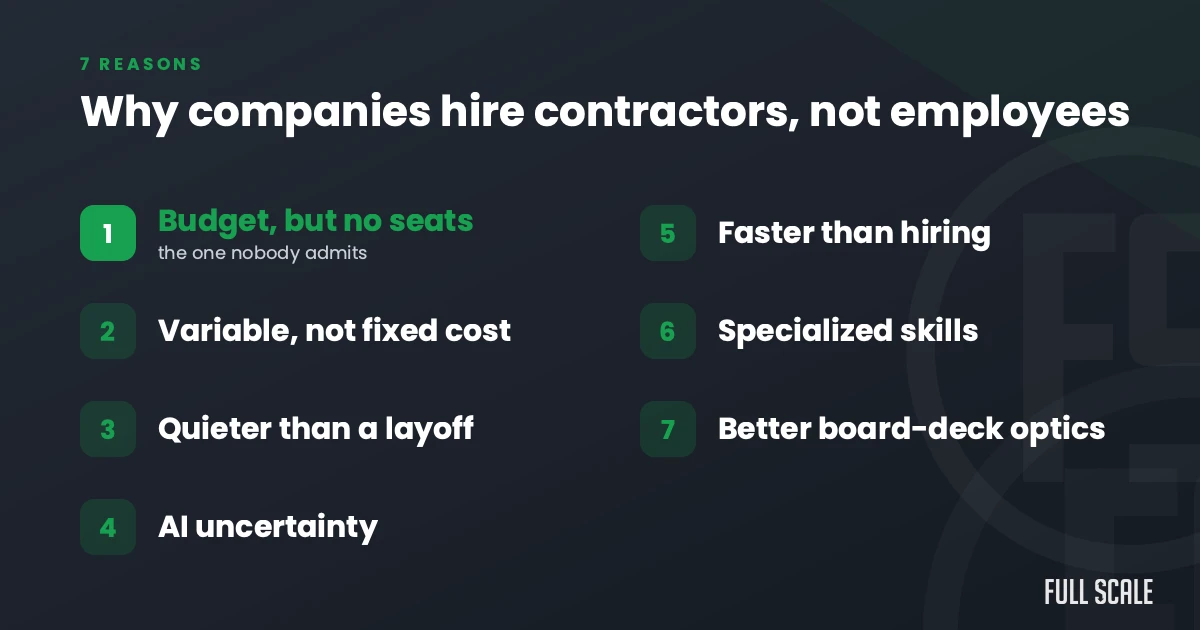
Why do companies hire contractors instead of employees? 7 reasons
Companies hire contractors instead of employees because a contract is easier to get approved and much easier to end than a hire. Only a couple of the seven reasons below are really about cost.
1. They have the budget but not the headcount
This is the one nobody admits: at most companies, finance approves two things separately, a dollar budget and a number of seats. Seats are the hard one, because every seat is a permanent cost and the board asks about each one. Dollars for "outside services" get a lot less scrutiny.
An engineering leader with money and no approved seats does the obvious thing and buys the capacity from a vendor. The work still gets done and shows up as an invoice instead of a person on the org chart.
Sometimes the cap comes from the bank account instead of the board. Stackify hit that wall in 2018. We needed roughly ten more engineers so the product could support more languages, and we didn't have the cash for ten Kansas City salaries. So we hired in the Philippines. That team topped 20 people and carried a lot of the load that got Stackify to its 2021 sale. That side project turned into Full Scale. It's still my favorite staff augmentation example if you want the whole story.
2. A contractor is a variable cost, and an employee is a fixed one
An employee costs the same in a slow quarter as in a busy one, while a contractor can be scaled back the minute the roadmap shrinks.
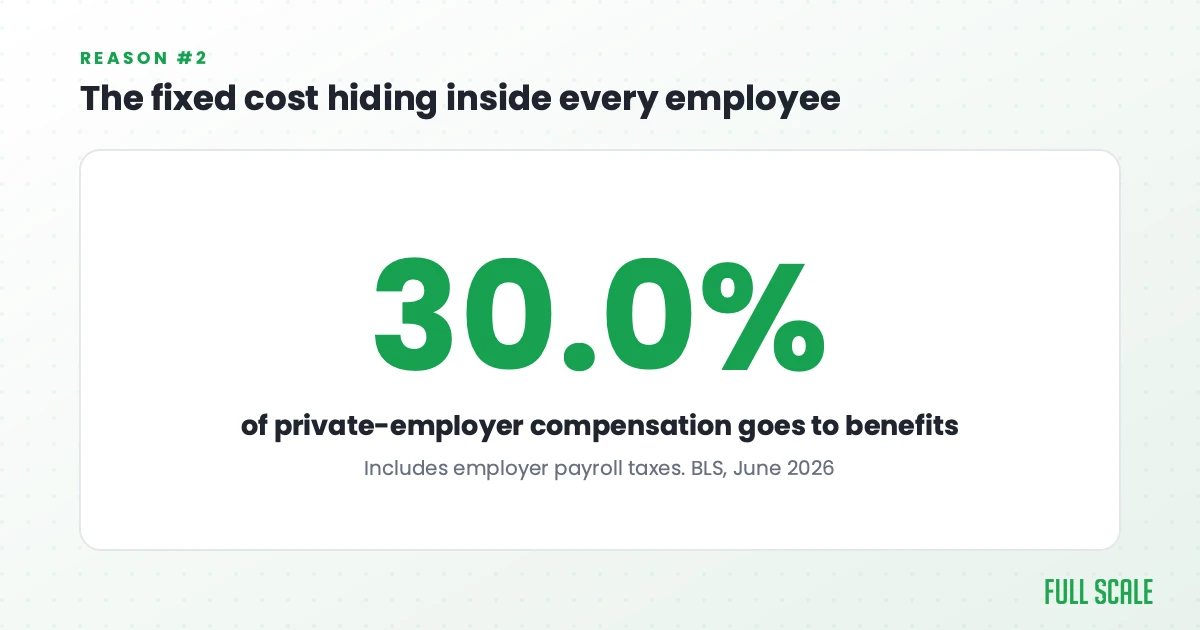
The fixed part is bigger than most founders think. Benefits, including the employer's share of payroll taxes, made up 30.0% of what private employers spent on compensation in June 2026, according to the Bureau of Labor Statistics. And that's before you pay a recruiter or buy anyone a laptop.
CFOs like any cost they can turn down later, and a contractor is a cost with a dial on it.
3. Ending a contract is quieter than a layoff
Ending a contract doesn't count as a layoff, and that matters a lot to companies that have already been through a round of cuts. Tech companies announced 165,925 job cuts through September 2026, up 54% from the same stretch of 2025 and more than any other industry, according to Challenger, Gray & Christmas.
Every one of those cuts was a person, and laying people off is the worst part of running a company. It means severance, legal review, a hit to the morale of everyone who stays, and sometimes a news story.
Ending a contract means giving the notice both sides agreed to on day one, and it doesn't show up in anyone's layoff count. Many companies that went through cuts now keep a smaller core team on payroll and flex the rest.
4. No one knows what an engineering team looks like after AI
Engineering leaders don't want to lock in permanent roles that might look completely different in 18 months. AI was the top reason companies gave for layoffs in 2026, cited in 120,136 announced cuts through September, about 21% of all of them, according to the Challenger, Gray & Christmas September 2026 report.
Whether that's real or just a good excuse, the effect on hiring is the same. AI hasn't replaced engineers, but it's changing what the job looks like, and we tracked that shift in our IT staffing trends report. Nobody wants to be the one who just hired a team built for 2023.
5. Contractors start faster than new hires
Filling a US engineering seat usually takes a few months once you add up finding candidates, the interview loop, the offer back-and-forth, and the notice they owe their current boss. I broke down the time to hire a software engineer separately, and the answer is never "next week."
A contractor or a staff augmentation partner can usually start much faster. At Full Scale, a developer can start in as little as 7 days when the right person is on our bench, and onboarding into your codebase takes about two weeks after that. When a launch date is already on the calendar, that gap usually decides it.
6. They need specialized skills for a defined stretch of work
Some work needs an expert for six months and then never again. A payments integration is the classic example: you want someone who has done a few before, and you won't need them once it ships.
Hiring a full-time specialist for a six-month problem means you either invent work for them in month seven or you let them go. Neither is great. Bringing in specialized skills on a contract matches the cost to the length of the job.
7. Revenue per employee looks better in a board deck
Investors and boards watch revenue per employee, and contractors don't count in the denominator.
The spend doesn't change at all, only the line it leaves the building on. But a lean employee count makes a better slide, and a better slide makes for a shorter board meeting. Nobody has ever complained about a shorter board meeting.
The cost of an employee versus a contractor goes way past the hourly rate
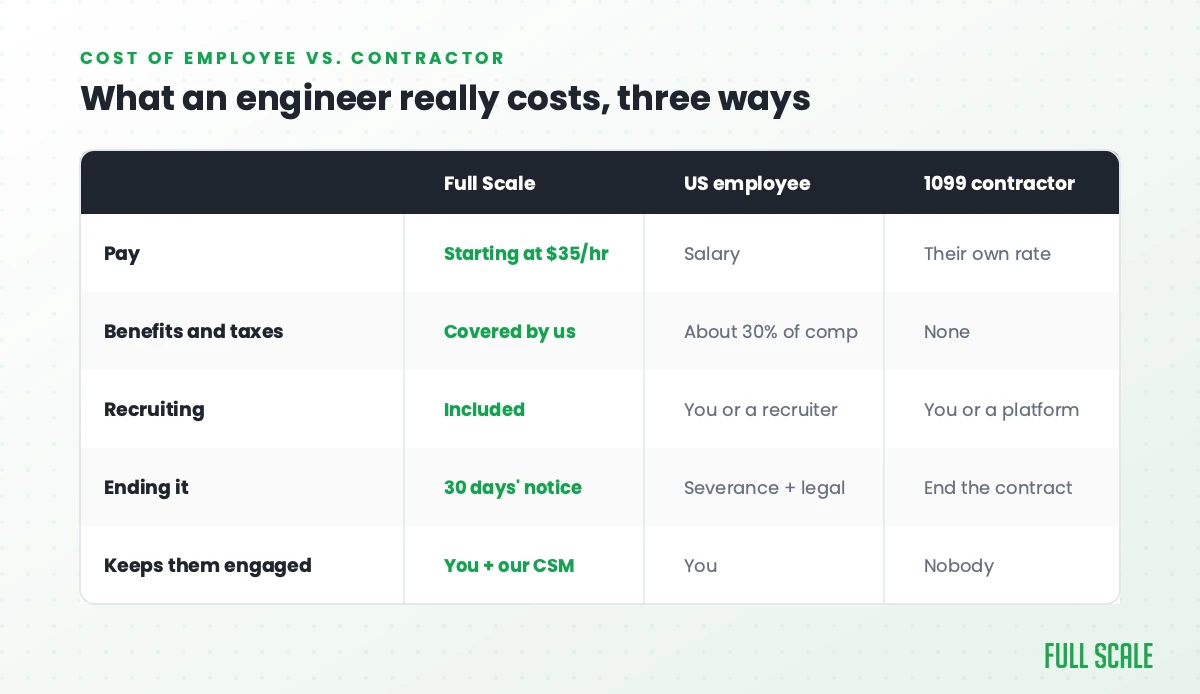
This table splits out the full cost for a US employee, an independent contractor, and a staff augmentation partner like Full Scale.
| Cost line | US employee | Independent contractor (1099) | Staff augmentation partner (Full Scale) |
|---|---|---|---|
| Pay | Salary | The contractor's own rate, which prices in their benefits and downtime | Starting at $35/hr, fully loaded |
| Benefits and employer payroll taxes | You pay them, about 30% of total compensation on average | None, the contractor covers their own | None for you, Full Scale pays its engineers' benefits |
| Recruiting | Your team, or a recruiter fee | Your team, or a marketplace fee | Included |
| Payroll, HR, and equipment | You | The contractor | Full Scale |
| Ending it | Severance, legal exposure, a hard conversation | End the contract | Two-week money-back window, then 30 days' notice |
| Who keeps them engaged | You | Nobody | You manage the work, and a Full Scale customer success manager keeps the engineer supported |
Against a comparable US hire, Full Scale clients save 50% to 70%. That's a real number, but if it's the only reason you're hiring, that's what I call cheapshoring, and it usually costs more.
The disadvantages of hiring contractors nobody puts in the pitch
The disadvantages of hiring contractors almost all trace back to one thing: the person on the other end has no long-term stake in your product, and the law may not even agree they're a contractor.
Everything they learned leaves with the contract
A contractor spends three months learning your codebase, your customers, and why that one service is held together with tape. Then the contract ends and all of that leaves with them. The next person starts from zero.
They do the ticket and nothing else
If the spec says add a button, you get a button, even when everyone on the call knows the button is a bad idea. Nobody's paying them to care whether the feature makes sense, so most of them don't ask.
They have other clients
When a better-paying gig shows up, they take it, sometimes in the middle of your sprint. Odds are you weren't their favorite client anyway.
The code might not be yours
An independent contractor can own what they write unless your agreement assigns it to you in writing, and that step is easy to skip when you're in a hurry. Even with a signed assignment, enforcing it against one person in another country is mostly theoretical. With Full Scale, you sign the IP-assignment and confidentiality agreements with us, a US company, and we've never had a single IP or confidentiality issue in the history of the company.
Misclassification is a real legal risk
If someone works for you every day, on your schedule, doing the same work as your employees, they may legally be an employee. The paperwork doesn't settle it. David Siegel, a partner at the startup law firm Grellas Shah, said on the Startup Hustle podcast that a signed contractor agreement "is nice, but it is not determinative."
The federal test also keeps moving. The Department of Labor proposed replacing its 2024 contractor rule in February 2026, and it may have changed by the time you read this. That same test is why a staff augmentation partner is set up differently. The developer is employed, paid, and covered by the partner company, and you sign one services agreement with that company, so the employment relationship sits with the partner instead of you. This isn't legal advice. Talk to an employment lawyer before you call a full-time person a 1099.
Hiring overseas has its own version of this, which I covered in the legal requirements for Philippine hires. If you're hiring freelancers off a marketplace, the risks get worse, and I wrote about that in staff augmentation vs. independent contractors.
"Contractor" means two different things
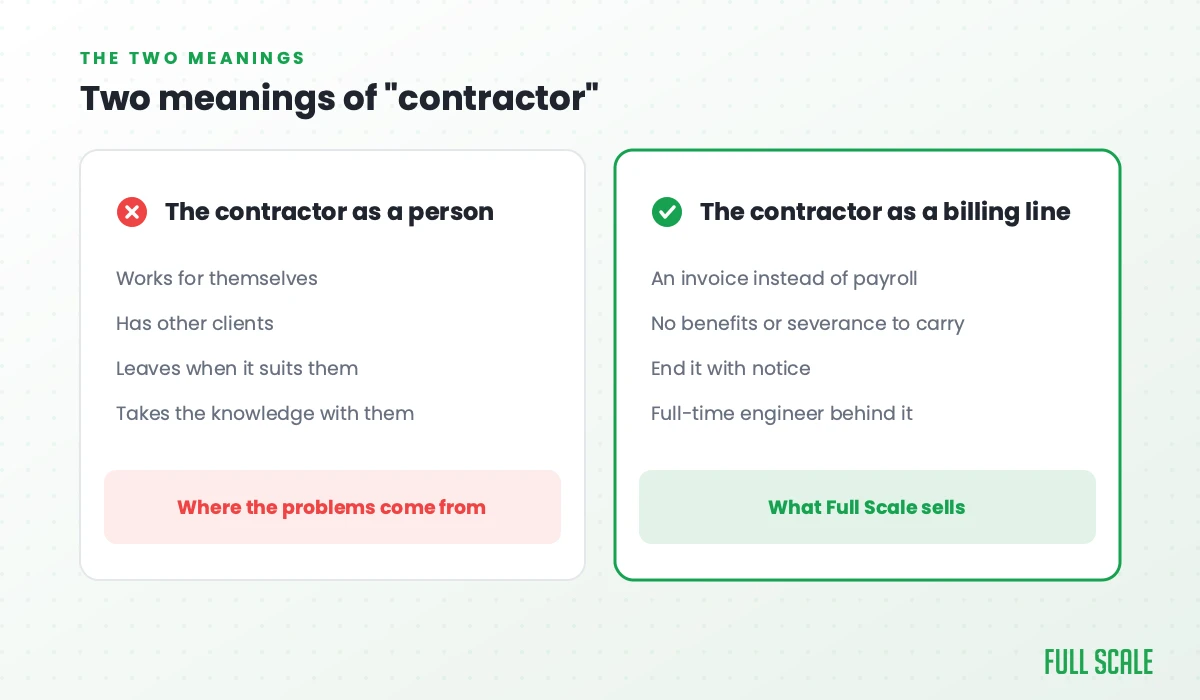
Most of the confusion about contractors comes from mixing up two meanings of the word.
The first is a billing relationship: you pay an invoice instead of running payroll, and you can end it with notice and no severance.
The second is the person's employment status: that contractor works for themselves and usually has other clients, so your product is one gig among several.
Companies want the first kind of contractor, and almost every disadvantage of hiring contractors comes from the second.
You can have one without the other. Full Scale is a contractor on your books and a full-time job for the engineer. Our developers work full-time for Full Scale, nearly all of them as regular employees, and we're the ones paying for their health coverage and time off. If a client wraps up, that engineer usually stays on our payroll until another team needs them. Their rent doesn't depend on your roadmap. Our developer retention runs at 93%+.
It also changes who answers for it. When a freelancer disappears, you're just out a contractor, but when a developer on a Full Scale team goes quiet, they have to explain it to us.
That setup is the staff augmentation model. You keep a core team on your payroll, including the people who own architecture and product decisions. That's the part you keep in-house, and it's rule one of managing distributed teams. Then you add developers who live in your Slack and show up to your standups, with no middleman between you and them.
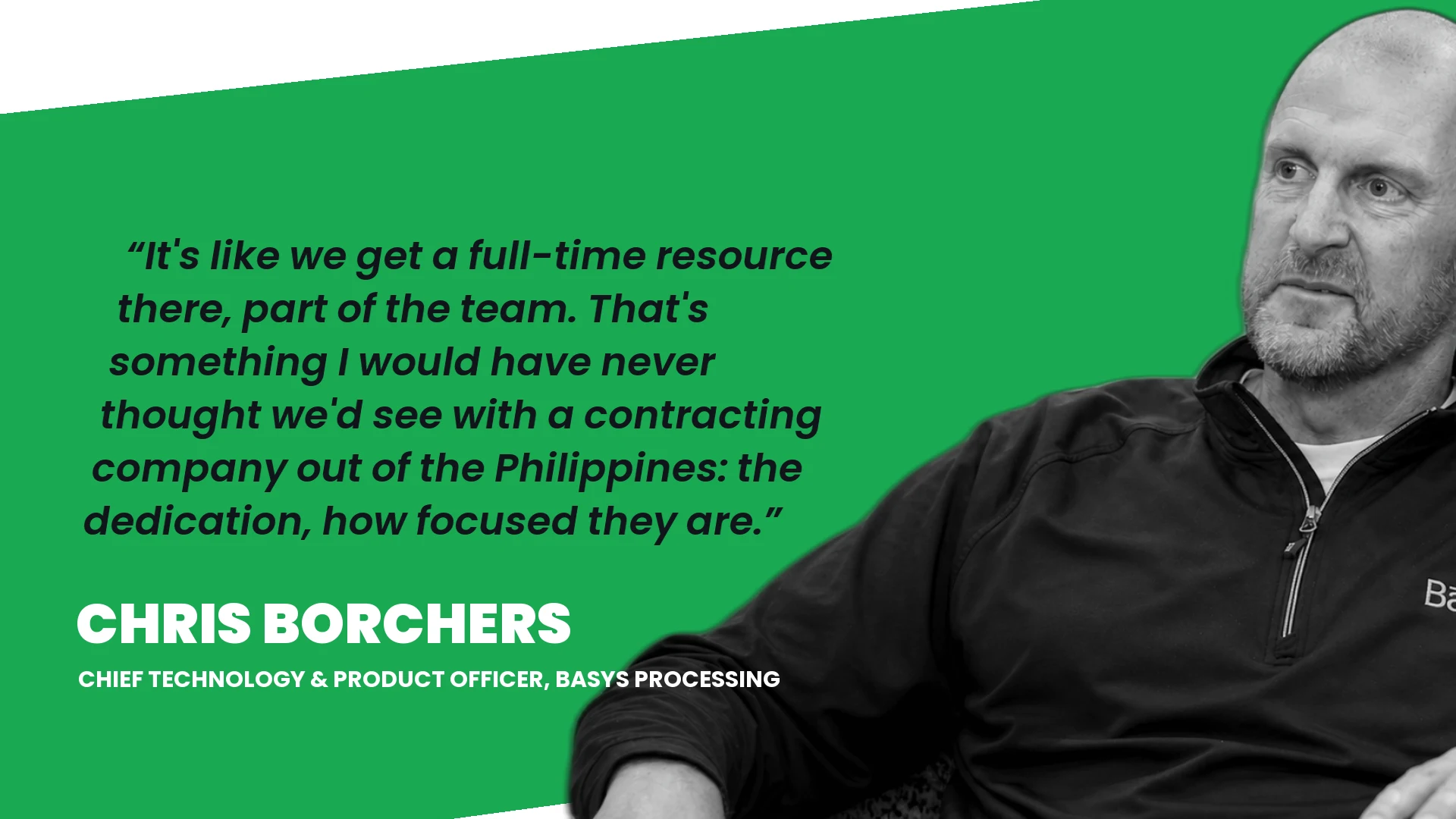
Chris Borchers, Chief Technology & Product Officer at Basys, put it this way: "It's like we get a full-time resource there, part of the team. That's something I would have never thought we'd see with a contracting company." A lot of these engagements start with one or two developers and grow into a whole team over a few years.
We call it a win-win-win: a win for our employees, a win for our clients, and that makes it a win for us.
Should you hire an employee or a contractor?
Hire employees for the people who own architecture and product decisions, and use contractors or a partner for capacity you might need to turn down later. Anyone who gives you one answer for everything is selling something (including me). This is how Full Scale would call the most common situations.
| Your situation | The better call |
|---|---|
| You need someone to own architecture, product direction, or security | Hire an employee. This is the core team. |
| You need ongoing product work and can't get headcount approved | A staff augmentation partner |
| You need help in two weeks for a three-month, clearly scoped project | An independent contractor or a specialist firm |
| You need a one-time specialist, like a penetration test or a compliance audit | An independent contractor or a specialist firm |
| You want to try out a working relationship before committing | Not a 1099 "trial." Use a partner with a money-back window instead. |
| Cost is the only thing you care about | Slow down. Hiring the cheapest developer is cheapshoring, and it usually costs more. |
| You need to grow from two developers to ten this year | A staff augmentation partner, so you're not running five searches at once |
If you're in one of the partner rows, our terms are public: a two-week money-back guarantee, then 30 days' notice to cancel, and no long-term contract.
Frequently asked questions
Is it better to hire a contractor or an employee?
Whether to hire a contractor or an employee depends on how long you need the work and who has to own it. Hire employees for the people who set direction, like architecture, product, and security leadership. Use contractors or a staff augmentation partner for capacity you might need to scale down, specialized skills for a defined project, or work you need started in weeks instead of months.
What are the disadvantages of hiring a contractor?
The biggest disadvantages of hiring a contractor are lost knowledge when the contract ends, a ticket-taker mindset, the risk they leave mid-project for a better-paying client, and misclassification exposure if they work like an employee. A staff augmentation partner avoids most of these because the developer works full-time for the partner, even though you pay for them like a contractor.
What are red flags when hiring a contractor?
Red flags when hiring a software contractor include someone who can't name past clients you can call, refuses a video interview, won't commit to overlapping work hours, has several other active clients, or pushes for large payments up front. In engineering, also watch for anyone who wants to work in their own repository instead of yours. Your code should live in your accounts from day one.
Can you hire a contractor as a trial before making them an employee?
Hiring a contractor as a trial before making them an employee is possible, but it's riskier than most founders think. On the Startup Hustle podcast, startup lawyer David Siegel of Grellas Shah agreed that bringing someone in as a contractor for a month or two to see how it goes is "pretty typically an employee," and a signed contractor agreement doesn't change that. Check with an employment lawyer before you set one up. A safer way to test a working relationship is a staff augmentation partner with a money-back window, like Full Scale's two-week guarantee.
Is an offshore developer from a staff augmentation company a contractor or an employee?
An offshore developer from a staff augmentation company is both, depending on whose books you're looking at. To your company, a staff augmentation firm like Full Scale is a contractor: you pay an invoice, with no payroll, benefits, or severance. To the developer, it's a full-time job. Full Scale's engineers in the Philippines work full-time for Full Scale with benefits, which is why they behave like team members instead of freelancers.
Why are tech companies leaning on contractors right now?
Tech led every industry in announced job cuts through September 2026, and AI was the top reason companies gave, so leaders are wary of adding permanent headcount they might have to cut again. They also don't know yet which roles AI will change. Contractors let them add capacity without that commitment.
Add capacity without adding headcount
If you've got the budget and not the seats, that's the exact problem Full Scale solves. You get full-time developers who join your team, on terms you can actually get through finance. Book a call and tell us what you need.