
Web Application Development Cost in 2026: What You Pay For and Where the Rate Matters

In this article
Web Application Development Cost in 2026: What You Pay For and Where the Rate Matters
Quick Answer: Web application development cost in 2026 runs from roughly $15,000 for a simple app to $350,000 or more for a complex one, according to two 2026 agency cost guides. Clutch's verified-client data shows an average web development project near $66,500 and a typical timeline of nine months. The team rate is the biggest lever you control, and Full Scale engineers start at $35 an hour fully loaded, which runs 50 to 70% below a comparable US hire.
It's impossible to give an accurate web application development cost without a project scope, so all credible cost figures include a range and a disclaimer. In this article, we'll cover the ranges we were able to find, note where they conflict, and do some math on the only variable that you can control, your hourly rate. I won't make up any price lists. Any figures sourced from a third party will include the author's name and publication date. Where a figure is Full Scale's own, I'll clearly indicate this.
What the sourced data says a web application costs
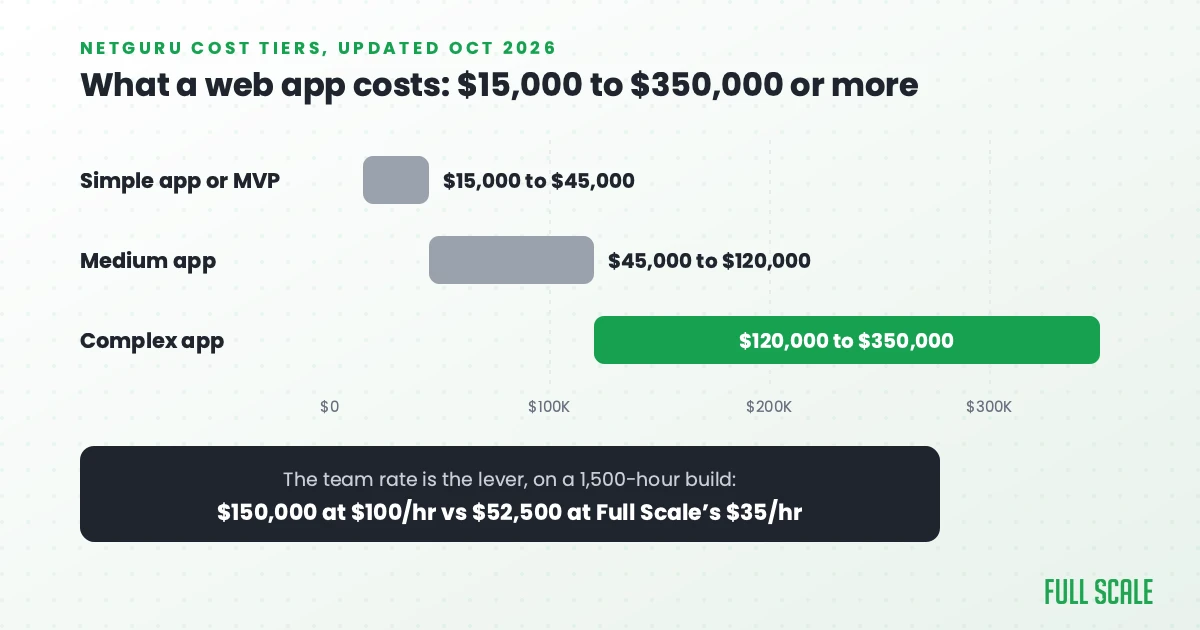
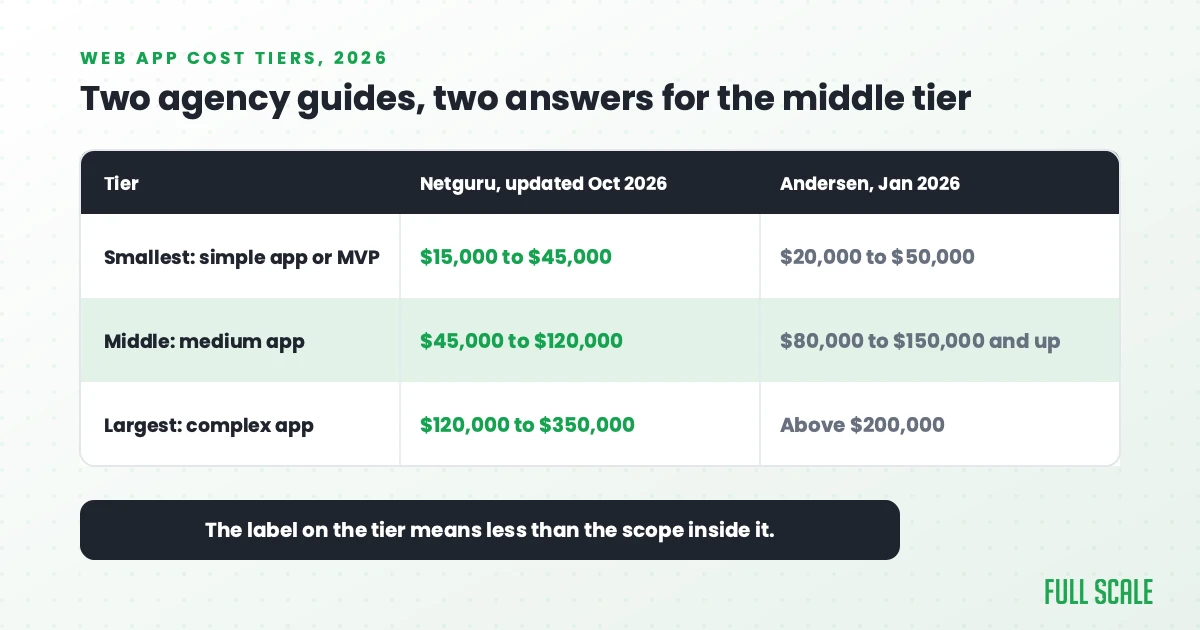
A web application's third-party costs break down into three levels, though the two leading sources give different boundaries for the middle level. Full Scale verified this data in October 2026.
There are two agency cost guides that offer tiered ranges. Because these guides come from agencies whose business is providing web app services, they should be viewed as indicative rather than definitive.
| Tier | Netguru guide (updated Oct 2026) | Andersen guide (Jan 2026) |
|---|---|---|
| Smallest (simple app or MVP) | $15,000 to $45,000 | $20,000 to $50,000, up to about $80,000 with heavier security, integrations, or UX |
| Middle (medium or mid-scale app) | $45,000 to $120,000 | $80,000 to $150,000 and up |
| Largest (complex or enterprise app) | $120,000 to $350,000, with enterprise at $350,000 to $1,000,000 and up | Above $200,000, often $300,000 to $400,000 and up |
The difference between the two sources comes down to the mid-level range. While one places the maximum price point at $120,000, the other sets the minimum at $150,000. As such, the name of the tier matters less than the actual features being developed.
For an outside perspective, Clutch provides pricing information based on the experience of verified web development clients. As of its September 2026 update, Clutch reports an average project cost of about $66,500, an average monthly cost near $7,100, and a typical timeline of nine months. Clutch also states that the majority of web development projects on their site fall below $10,000, without citing the total sample size.
I think my take is that the average is high, but that's because a handful of large projects drag it up, and that sub $10,000 group includes a lot of smaller sites. A proper web app is what you'd find in those agencies' tiers, not near the bottom of the Clutch list.
Budget by app type
What the application does matters more than how it's built. The Andersen guide provides a breakdown of January 2026 cost ranges based on type of application. It labels these figures as "indicative," not binding.
| Type of web application | Indicative build cost (Andersen guide, Jan 2026) |
|---|---|
| Internal business app | $30,000 to $80,000, rising to $100,000 to $120,000 and up |
| Customer portal | $60,000 to $120,000, up to $150,000 to $200,000 and up |
| Progressive web app (PWA) | $60,000 to $120,000, above $150,000 for advanced offline needs |
| Marketplace | $80,000 to $150,000, above $200,000 to $300,000 and up |
| SaaS product | $100,000 to $200,000 at first, $250,000 to $300,000 and up for advanced products |
For MVP versus platform development cost differences, check out our MVP development cost guide. For SaaS-specific costs, see our SaaS development cost guide.
The rate is the lever, and hours are the other half
The price of a web application is hours x rate, plus the non-developer roles. Hours are almost always driven by your scope. Rate is set by whom you hire, and rate is the variable with the largest variance.
How large is that variance? Look at Clutch's verified-client reviews: Full Scale charges $35 an hour fully loaded, which is within the band Clutch assigns to the Philippines.
| Where the company is based | Hourly rate (Clutch, Sept 2026) |
|---|---|
| United States, Canada, Australia | $100 to $149 |
| Poland | $50 to $99 |
| Philippines, Ukraine, Spain, Mexico | $25 to $49 |
| India | Under $25 |
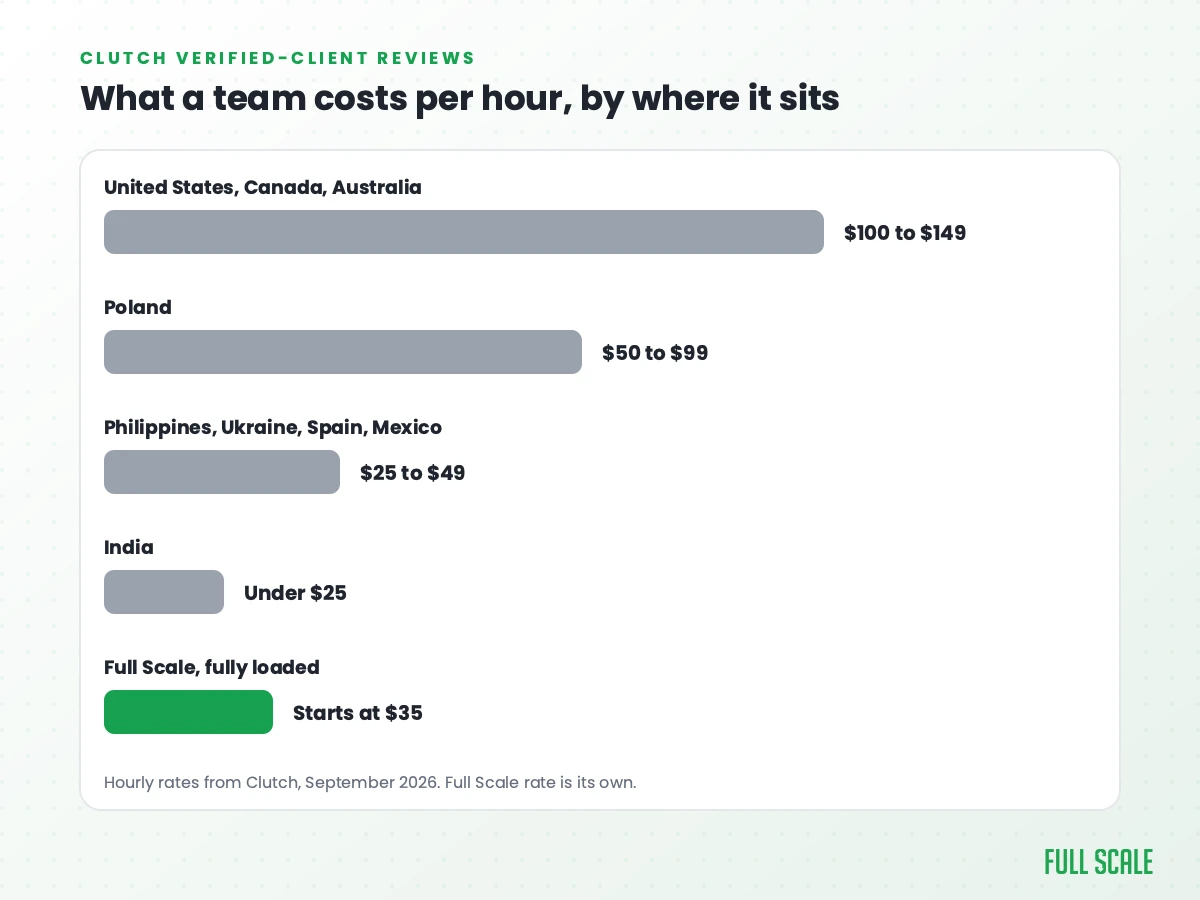
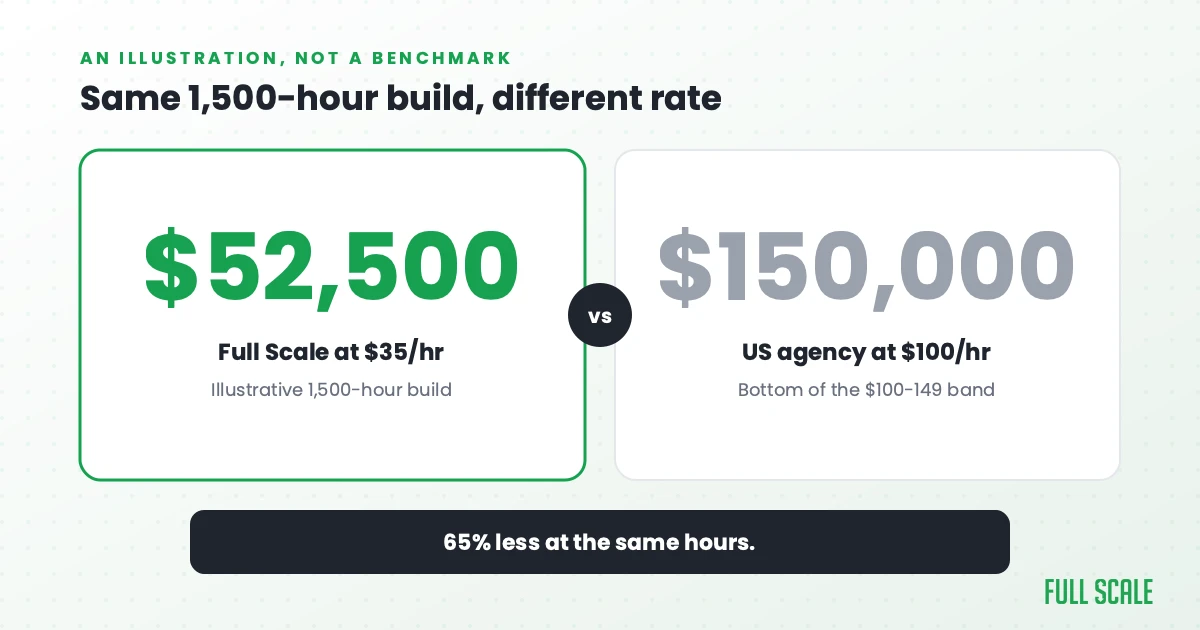
Let's run some numbers, assuming a build size that's arbitrary but illustrative. If I'm building a web application that takes 1,500 hours to develop (which is my assumption, not a benchmark), the lowest end of the US band costs $150,000 ($100/hour * 1,500 hours). Full Scale would charge $52,500 ($35/hour * 1,500 hours), or 65% less. This falls within the 50 to 70% savings that Full Scale sees against a comparable US hire, and is consistent with the cost-of-living differential I describe in the Offshore Development Cost Analysis.
The catch here is the word same. A lower hourly rate only saves money if you don't spend more time building something. If you hire the cheapest possible group, give them a spec, and then give them no technical guidance, they will spend extra time fixing their mistakes. I refer to this as cheapshoring, and it's the most expensive way to outsource work.
If you want to see a rate by rate breakdown of what it really costs to have a US-based team working on your project, you can calculate it in our software development cost calculator.
Where web app budgets leak
The Web app budget leaks in three places: the data model, the scope creep with no cost, and staff turnover.
None of it shows up on the hourly rate line item.
The data model and permissions
The front end is easy to adjust; you can update a UI within hours. The back end is not. If you don't get the database design right, you never get anything right with an app.
Your user roles and access levels are determined by your database design, too. Altering these things post-launch requires changes to all the functionality you build on top of them.
That's why I suggest spending more time with your data model upfront. It's the cheapest decision to get right on day one and the most expensive to change in month eight.
Scope that moves with no price on it
Scope will shift. Who pays for that? A fixed-bid contract bills your guess upfront, and then charges you for every change. That's why fixed-cost software development works for a build you can describe completely and fails for a product you'll iterate on.
A team that resets every nine months
Turnover is the bill no one quotes. According to the Society for Human Resource Management, replacing an employee costs 50% to 200% of that employee's salary. With a vendor team that churns, you pay the same amount of money in re-training hours.
Because Full Scale's developer retention rate is over 93%, the developers who learned your codebase last year are still there next year. Offshore works much better when you hire talent to work directly for you on a long-term basis, and retention is the reason.
What a web application costs after launch
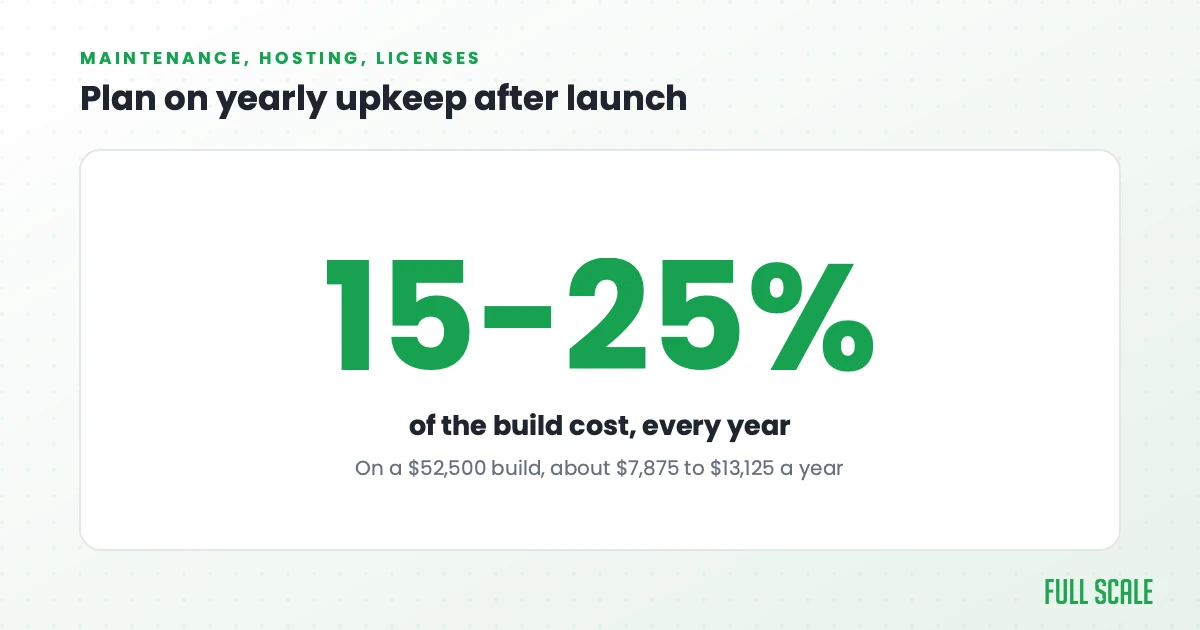
As a rule of thumb, you should expect to spend 15 to 25% of the total build cost annually for maintenance, hosting, and licenses. That's the figure found in both agency calculators, and I use it as a budget number, not a price tag.
If you take my 1,500-hour example, that looks something like this:
| Build rate | Build cost | Yearly upkeep at 15% | Yearly upkeep at 25% |
|---|---|---|---|
| $100 an hour (US agency, low end) | $150,000 | $22,500 | $37,500 |
| $35 an hour (Full Scale) | $52,500 | $7,875 | $13,125 |
Hosting is a separate category. It used to be buying hardware and renting rack space; now it is a credit card and a drop-down menu. That's why most companies don't realize they're overspending. According to Flexera's 2026 State of the Cloud report, wasted cloud costs sit at roughly 29%, which is the highest they've been in five years, so you'll want to carefully review your monthly invoices. You can learn more about how to reduce those expenses in our cloud cost guide.
Artificial Intelligence will alter how many hours this process takes, primarily by handling simple tasks and basic frontend code. However, I'd use AI with greater caution when tackling the backend, since it must account for features not yet in development.
How to get a quote you can compare
Get the same 5 things from each company, in writing, so you can compare apples to apples:
- Hours per role, with a rate for each role, to understand how much of the quote is design vs engineering vs QA vs PM.
- The assumptions, such as how many user types, integrations, and screens are included in the quote.
- The exclusions, like hosting, 3rd party licenses, and security testing.
- The change request rate, because scope creep happens.
- The maintenance terms for the first year after launch.
Also make sure they're a viable vendor to begin with. How to choose a web development company explains what you should own, like code, hosting, and domains, and our custom web application company guide explains why your engagement model matters more than your price. To learn more about the phases of development itself, read our web application development process article. We have a pricing page showing what Full Scale charges, and offshore web development post explains how to get started. If you're estimating a larger custom build, our custom software development cost post follows the same process outside the web.
Frequently asked questions
How much does it cost to build a web application?
Building a web application costs roughly $15,000 to $50,000 for a simple app, $45,000 to $150,000 for a medium one, and $120,000 to $400,000 or more for a complex one, based on two 2026 agency cost guides. Clutch's verified-client reviews put the average web development project near $66,500. Full Scale's rate starts at $35 an hour fully loaded, so the same scope costs 50 to 70% less than with a comparable US team.
How much does a web application cost to maintain each year?
Web application maintenance, hosting, and licenses typically run 15 to 25% of the original build cost per year, according to two 2026 agency guides. On a $52,500 build, that is about $7,900 to $13,100 a year. Larger, faster-growing apps sit at the high end.
Why do web application development quotes vary so much?
Quotes vary because the scope, the team's rate, and the exclusions all differ. Clutch's client reviews put hourly rates anywhere from under $25 to $149 depending on where the company is based, and agency guides disagree on where a medium app starts. Get hours by role and a written list of assumptions from each company so the quotes compare.
Is it cheaper to build a web application offshore?
Building a web application with a Philippines-based team is cheaper per hour. Full Scale engineers start at $35 an hour fully loaded, against $100 to $149 an hour for US, Canadian, and Australian companies in Clutch's data. The savings hold only when the offshore engineers are senior, directly managed by you, and kept on the product over time.
How long does it take to build a web application?
Clutch reports a typical timeline of nine months across web development projects on its platform. A simple internal tool can ship much sooner, and a complex product takes longer. Scope, not headcount, sets most of the timeline.
A web app is priced by the team you keep
A web app is something that you will be paying for over several years, which makes the hourly rate irrelevant compared to the team you stick with.
For a true estimate with hours by role, schedule a call with Full Scale at https://fullscale.io/schedule-call/.
I have more details on why teams that stay out-build teams that reset in Product Driven at https://fullscale.io/product-driven/.