
How to Choose a Web Development Company by What You're Actually Building

In this article
- A brochure site and a web app need two different companies
- Ask who owns the keys on launch day
- Write speed and security into the contract as numbers
- Read the proposal for what it leaves out
- Meet the people who will write the code
- Where Full Scale fits, and where it doesn't
- Frequently asked questions
- Pick the company that hands you the keys
How to Choose a Web Development Company by What You're Actually Building
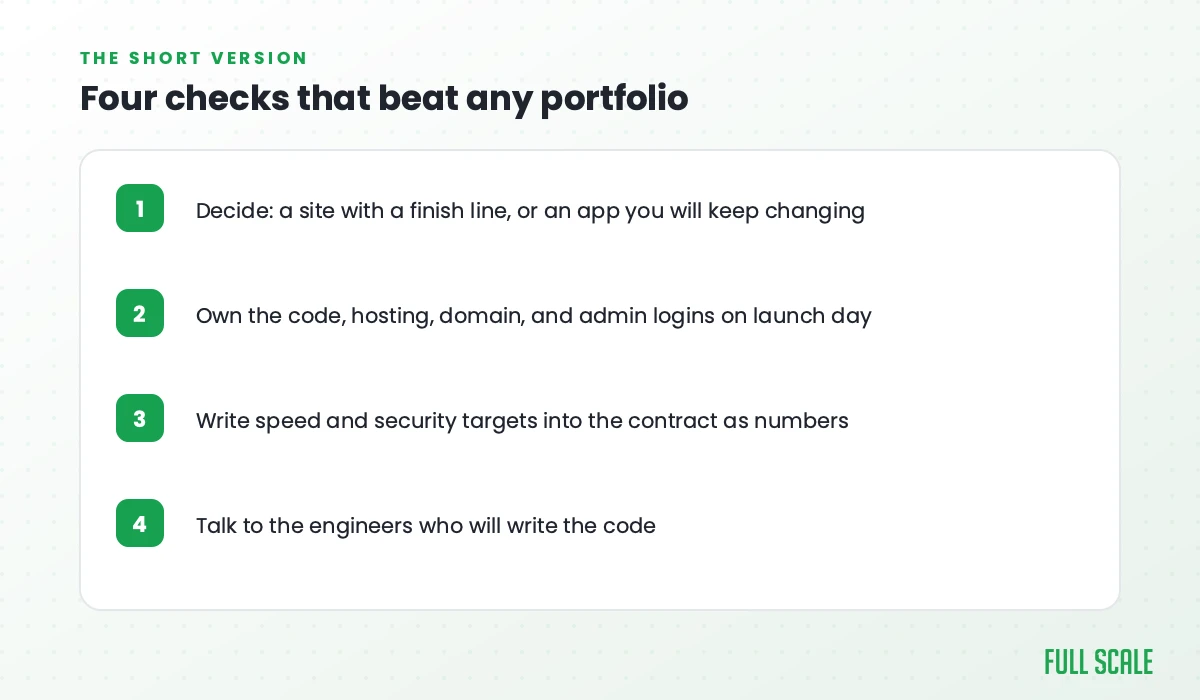
Quick Answer: To choose a web development company, first decide whether you are buying a website with a finish line or a web application you will keep changing for years, because those jobs need different kinds of companies. Then check what you will own on launch day (code, hosting, domain, admin access), write speed and security targets into the contract as numbers, and talk to the engineers who will write the code. Those four checks tell you more than any portfolio.
A lot of advice about how to choose a web development company starts with portfolios, testimonials, and a list of interview questions for the sales meeting. I'd go back one step before that with a question most proposals never consider: What are you building?
A marketing website and a web application are both "web development," and they are not remotely the same thing. You hire the wrong type of web development company for either, and you end up with either a stunning site no one knows how to update, or a fixed price web application that will never get better after it goes live.
A brochure site and a web app need two different companies
A web development company is the right fit when its engagement style aligns with the cadence of future changes. A website with a finish line is suited for a fixed-price project. A product you'll iterate on monthly is suited for a long-term team.
I own Full Scale, where we deploy engineers for ongoing product development, and don't sell fixed-price projects, so take this with a grain of salt. That said, here's how I'd categorize them:
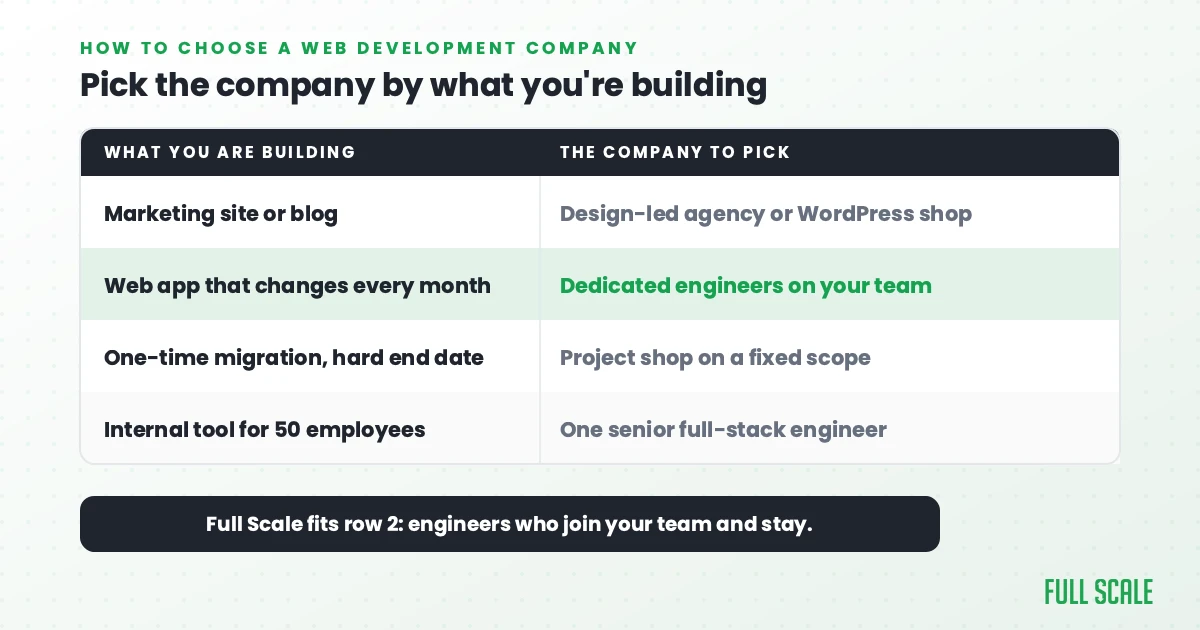
| Your situation | The kind of company to pick | Why |
|---|---|---|
| Marketing site or blog, managed by non-technical staff, going live soon | A design-focused agency or a high-quality WordPress dev shop | The project has a clear endpoint, and most of the work is in the creative |
| Web application handling user accounts, billing, or PII that will be modified every month for the foreseeable future | Engineers integrated into your organization, or a product development partner on a continuous basis | Needs will continue to evolve, requiring someone who will still be able to maintain the code in three years |
| One-off site rebuild or replatform with a specific deadline and a well-defined specification | A traditional software services provider on a fixed-price basis | The requirements are clear enough that they can provide a quote |
| Internal web application for 50 employees | One senior developer or a very small team | You need the security features of a large-scale app, but don't need the polish |
The way to decide between the 2nd and 3rd rows is to think about whether you could write "done" on one page. If you can't, then you're purchasing ongoing product work, regardless of what the sales deck calls it.
I came up as a backend dev and never cared for CSS. I still have emotional scars from Internet Explorer 6, making me the least qualified person to say that the front end of a website is easy. But it's still the more forgiving half of the job. A screen you get wrong gets corrected in an afternoon, whereas a poor data model imposes a tax on every feature you add going forward. This is why asking "who's going to own the backend in year 2?" is a lot more important than "who built the most beautiful homepage?"
Ask who owns the keys on launch day
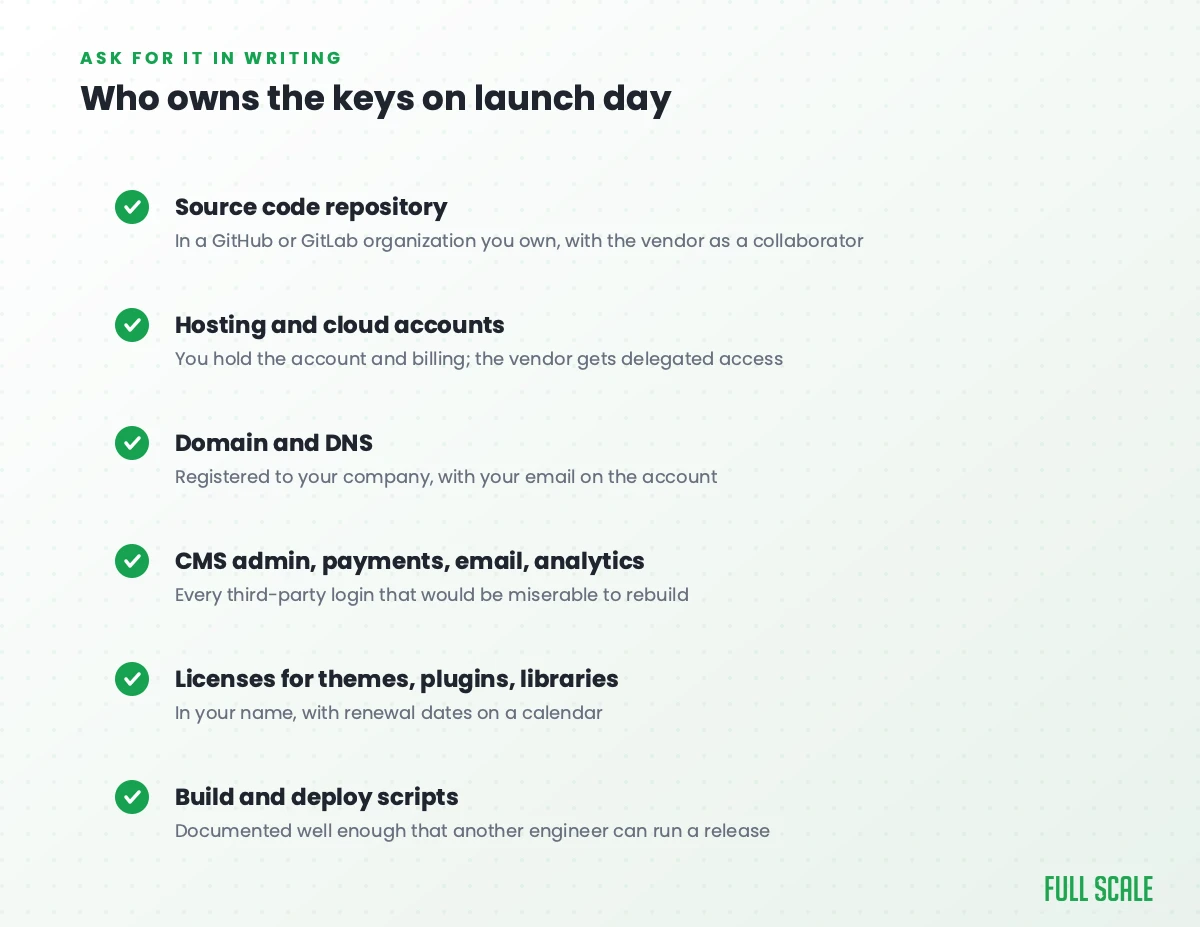
Before you hire a web development company, make sure all of the accounts your site relies on are in your name. It's the specific test most generic selection guides miss, but it's the one that determines how much a split hurts. Ask the company to write down where each of these is held:
- The source code repository: On a GitHub or GitLab organization you own, and they're a collaborator, not vice versa.
- Hosting and cloud accounts: Account and billing in your hands, and the vendor has delegated access.
- Your domain and DNS: In your name and email.
- The CMS admin, payment processor, email service, and analytics. All the logins you don't want to recreate.
- Licenses for themes, plugins, and paid libraries. In your name, with renewal dates on someone's calendar.
- The build and deploy scripts. Documented so another engineer can run a release without calling them.
Next comes the contract test. At Full Scale, we promise in our contracts that everything we build for you belongs to you, and we never reuse a framework or module created for one customer for another customer. Not all companies will tell you this, and that's helpful to know.
My favorite test is this: What happens if I fire you on a Friday afternoon? The correct response is dull. You already have the repo, the cloud account, the domain, and a README that anyone can follow. An incorrect response begins with "well, we would need to transfer..."
Write speed and security into the contract as numbers
A proposal that promises a "fast, secure site" is promising nothing. Request measurable acceptance criteria for a staging site before you pay the last invoice.
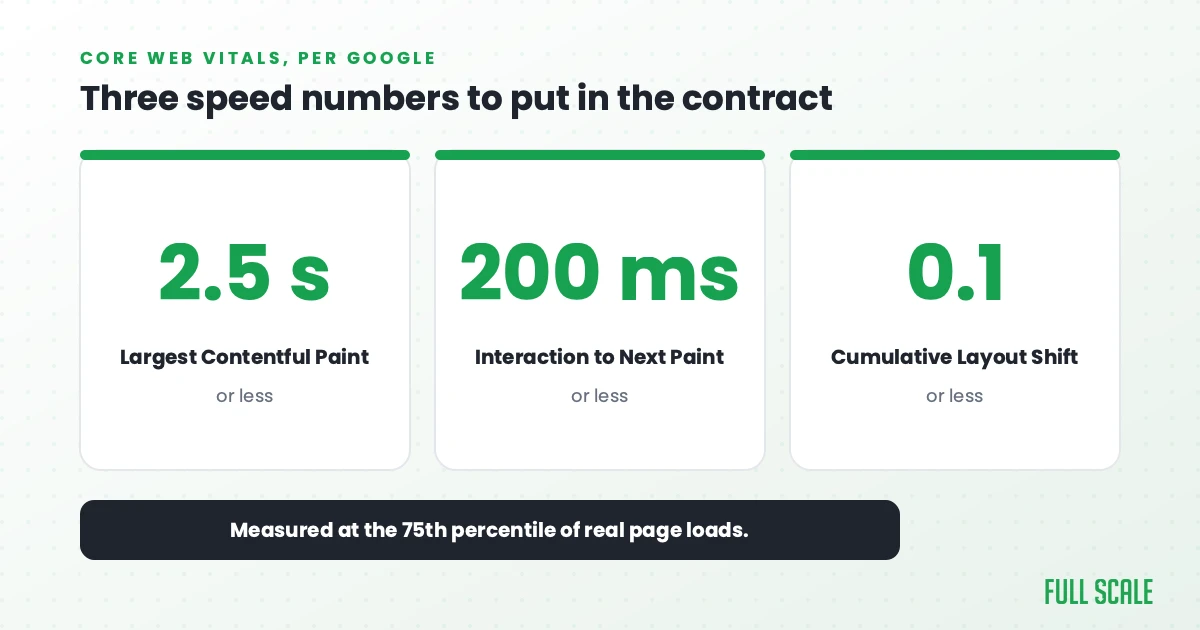
For speed, Google publishes these thresholds. The three Core Web Vitals demand Largest Contentful Paint of 2.5 seconds or less, Interaction to Next Paint of 200 milliseconds or less, and Cumulative Layout Shift of 0.1 or less, all at the 75th percentile of real page loads. Include those metrics in your agreement, and note what pages they cover.
For security, request which checklist the company measures itself against. The OWASP Top 10 is the industry-standard risk report, and in the 2025 version, Broken Access Control is number one. If the vendor doesn't know how it checks who should be able to view what content, it's overlooked a key security problem that's caused employees to get fired.
For accessibility, name a standard. WCAG 2.2 is the latest W3C recommendation, and "AA" is the level most purchasers request. If the vendor hasn't heard of it, you already have your answer.
This requires no lengthy legal document. It requires three lines and someone to verify those three lines.
Read the proposal for what it leaves out
The most expensive words in a web development proposal are the ones you don't see. Cross-check your proposal against this checklist and highlight any blanks:
- Staging. Your only version of the site is the production one? That means every change is a live experiment.
- Automated tests. What tests run prior to each release, and who reviews them?
- Hosting and monthly costs. Who pays, who chooses the package, and who's on call at 2 a.m.?
- Change request pricing. The scope will shift. Learn the price before you do.
- A post-launch support window. What's included after go-live, for how long, and with what SLA?
- Documentation for handoff. System architecture, environment setup, and restore-from-backup procedures.
Launch day marks the beginning of the bill, not the conclusion. Maintaining and updating a web application incurs its own annual expense; I explain that in detail here: what a web application costs to build and run.
Meet the people who will write the code
The team that you get from the company you hire, is the team that you can communicate with, so make sure that you get to speak to real engineers. Software development is a lot more about communication than most people realize, and you can't assess communication skills over a phone call with the account manager.
When you have your conversation, ask an engineer to walk you through a technical tradeoff that would be relevant to your project, why they would use one database over another, why one kind of cloud service vs another, etc. Listen for simple explanations in plain English, as well as thoughtful questions that demonstrate a genuine interest in the product you're building. If you're only allowed to speak with a single point of contact, one person acting as a middleman between you and the team, then you've stumbled upon the middleman pattern, which I explain as a reason longer builds fail in the custom web application company guide.
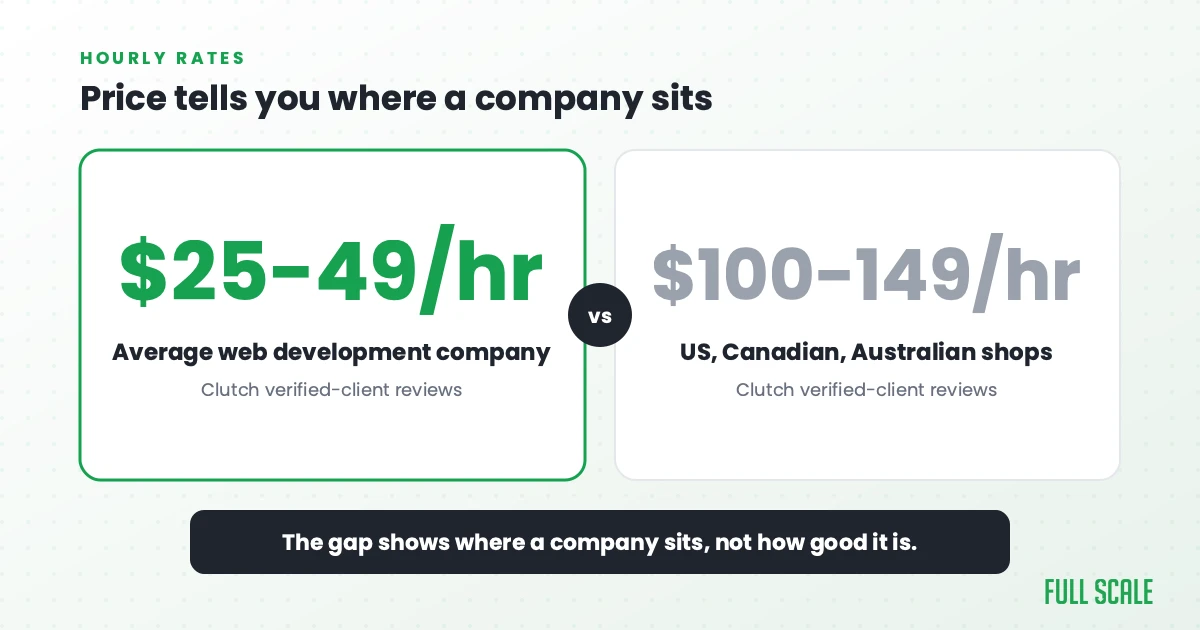
Pricing doesn't tell you nearly as much as you'd like it to. According to Clutch's pricing data, which is derived from reviews written by real customers, puts the average web development company at $25 to $49 an hour, while US, Canadian, and Australian firms charge on average $100 to $149. But that price range reflects geography, not quality. Price-based evaluation has its own name in my book, cheapshoring, and it usually ends with a rebuild.
You want to work with a company that cares about your product, not just your project. If you want a framework for evaluating reviews, awards, and references, I wrote about how to vet software development companies, and there's also a guide to the offshore due diligence checklist for reviewing the contract and legal structure. For evaluating vendors outside of the web layer, look at how to choose a custom software development company.
Where Full Scale fits, and where it doesn't
If you're building a web application you'll be updating frequently and want senior-level developers on your team, Full Scale is a great choice. Our 350+ engineers work from across the Philippines, and clients pay from $35/hour fully loaded, which runs 50 to 70% below a comparable US hire.
You get a two-week money-back guarantee, then 30 days' notice to drop anyone, with no long-term contracts. Our web development services and web app development services pages provide more details about how this works.
If you're launching a small 5-page website in 30 days, Full Scale isn't the right choice. Work with a web design agency and forget about it until you're ready to build a product.
Frequently asked questions
How do you choose a web development company?
To choose a web development company, match the company type to the project, then verify four things: that you will own the code, hosting, and domain; that speed and security targets are written as numbers; that the proposal includes staging, testing, and post-launch support; and that you can speak directly to the engineers. A scoped agency suits a site with a finish line, and a team that stays suits an app you will keep changing.
What questions should I ask a web development company before hiring?
Ask who will own the source code, hosting account, and domain at launch; what Core Web Vitals and security checklist the work will be tested against; whether the price includes a staging environment and automated tests; what change requests cost; and whether you can speak with the engineers instead of one project manager. Also ask what happens if you end the contract on a Friday.
Should I hire a web development agency or a freelancer?
A freelancer fits a small, well-scoped site with a clear end. A web development agency fits larger scopes that need design, engineering, and QA together. For a web application you will run for years, dedicated engineers who join your team beat both, because the people who learn your product stay with it.
How much does a web development company charge?
Clutch's review data puts the average web development company at $25 to $49 an hour, with US, Canadian, and Australian companies at $100 to $149. Full Scale engineers start at $35 an hour fully loaded. Total project price depends on scope, and the web application development cost guide walks through it.
How do I check a web development company's reviews?
Read the middle reviews, not just the five-star ones, and look for the review where something went wrong and the company fixed it. Then confirm with a live reference call. The full method for Clutch, G2, and GoodFirms is in how to vet software development companies.
Pick the company that hands you the keys
It's actually very easy to leave a good web development company, and that's probably why you'll want to stick around. If you're building a web application and want to chat with a team that operates within your own, schedule a call with Full Scale. Polish is less important than product thinking, which I explain in detail in my book, Product Driven.