
SaaS Development Cost in 2026: The Build Is Only the First Bill

In this article
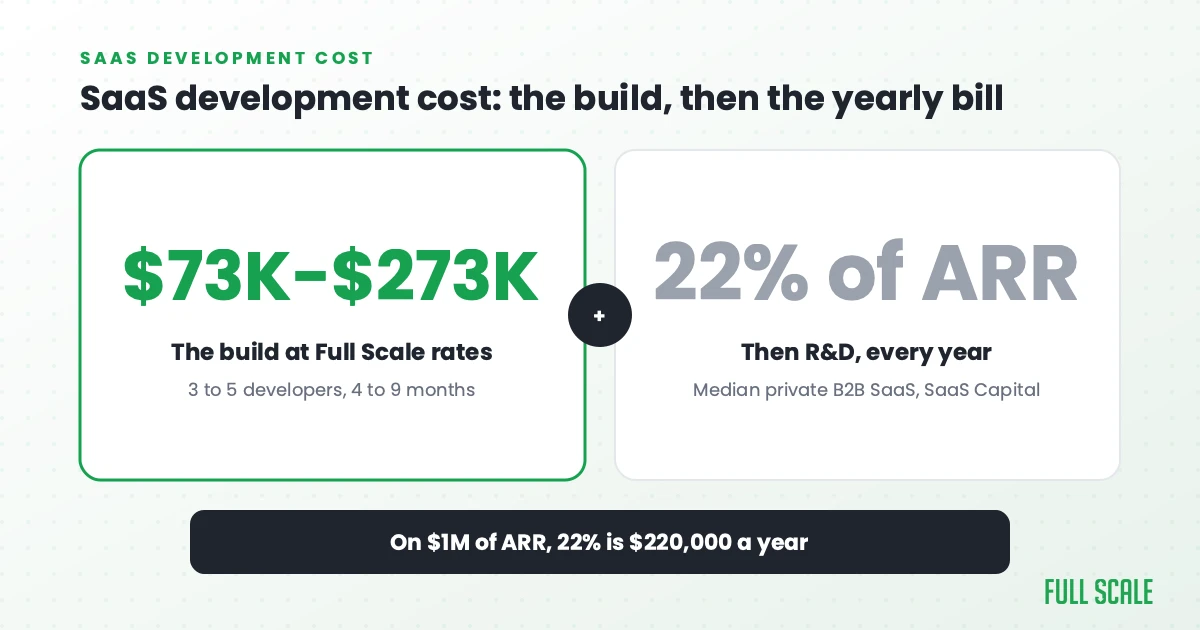
Quick Answer: SaaS development cost in 2026 is a build bill in team-months plus a yearly bill to run the product. A first version built by three to five developers over four to nine months costs about $73,000 to $273,000 at Full Scale's $35-an-hour starting rate, and about 2.7 times that with US employees. After launch, the median private B2B SaaS company spends 22% of revenue on R&D and 5% on hosting, per SaaS Capital.
SaaS stands for software as a service, and the service part is the part that keeps invoicing you. Many SaaS cost guides cover only the building process. Our guide calculates the cost of building a SaaS app using developer-months, then calculates the cost of running that same software after you start receiving payments from users.
SaaS development cost: the build, in team-months
So a SaaS build costs (number of developers) x (number of months) x (monthly rate). One Full Scale developer works out to ~$6,070/month on our $35-an-hour starting rate. A US employee at the BLS median software developer salary of $135,980 is more like ~$16,200 per month, fully loaded, since wages are just 70% of what private employers spend.
We priced four team shapes at both rates, over at Full Scale. Use the shapes as scale markers when you're scoping yours. The last column is my illustrative take on what each can buy.
| Team shape (developers times months) | Developer-months | Full Scale dedicated team at $35/hr | US employees, fully loaded at the BLS median | What it could buy (my illustrative take) |
|---|---|---|---|---|
| 3 developers for 4 months | 12 | About $72,800 | About $194,300 | A v1 workable for a few pilot customers |
| 4 developers for 6 months | 24 | About $145,600 | About $388,500 | A v1 with accounts, billing, and admin area |
| 5 developers for 9 months | 45 | About $273,000 | About $728,500 | A more complete product with integrations and a couple of customer roles |
| 6 developers for 12 months | 72 | About $436,800 | About $1,165,500 | A multi-feature platform with a roadmap |
That table is showing prices to the developer. A designer, a product owner on your end, hosting, and compliance costs are separate, on both sides. At $35 an hour, the rate is where Full Scale pricing begins, not what each developer costs. Most of our clients typically realize between 50% and 70% in savings when compared to hiring US-based equivalents.
According to our software development cost calculator, building a feature-rich SaaS application will cost between $250,000 and $1,000,000, based on data collected from more than 200 companies Full Scale has worked with. The two middle rows in the chart above fall within that range. For the lowest-end estimate, our MVP development cost guide breaks down the cost to build an MVP in phases.
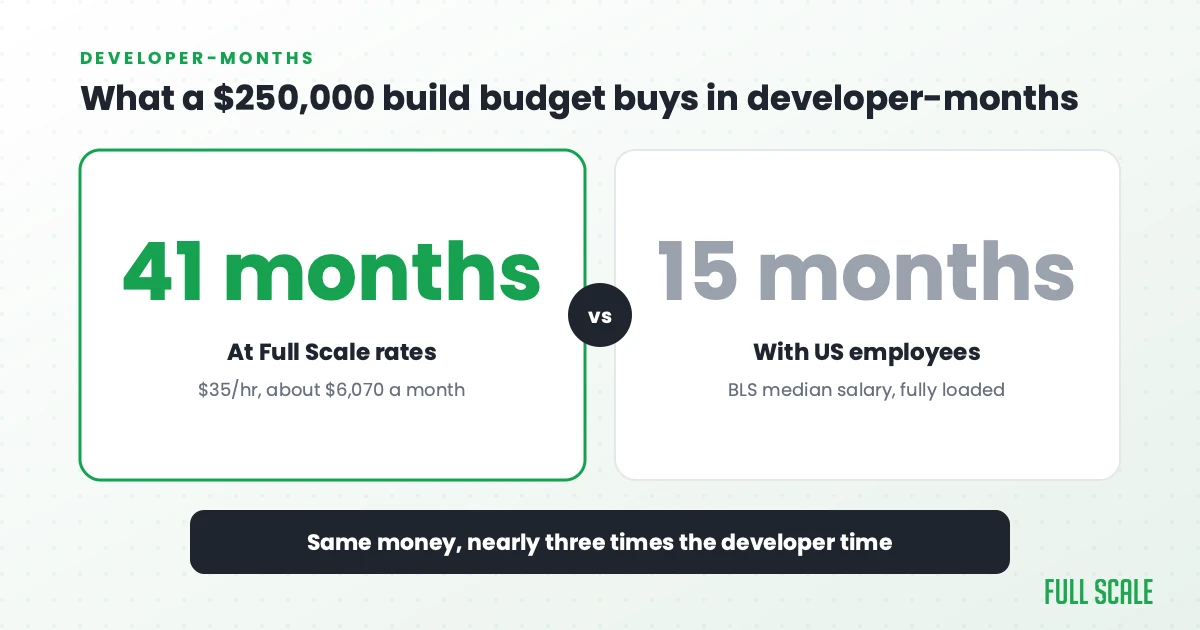
At Full Scale's rates, $250,000 equates to roughly 41 developer-months. Onshore, you'd get around 15 months for the same price.
What a SaaS costs to run, per dollar of revenue
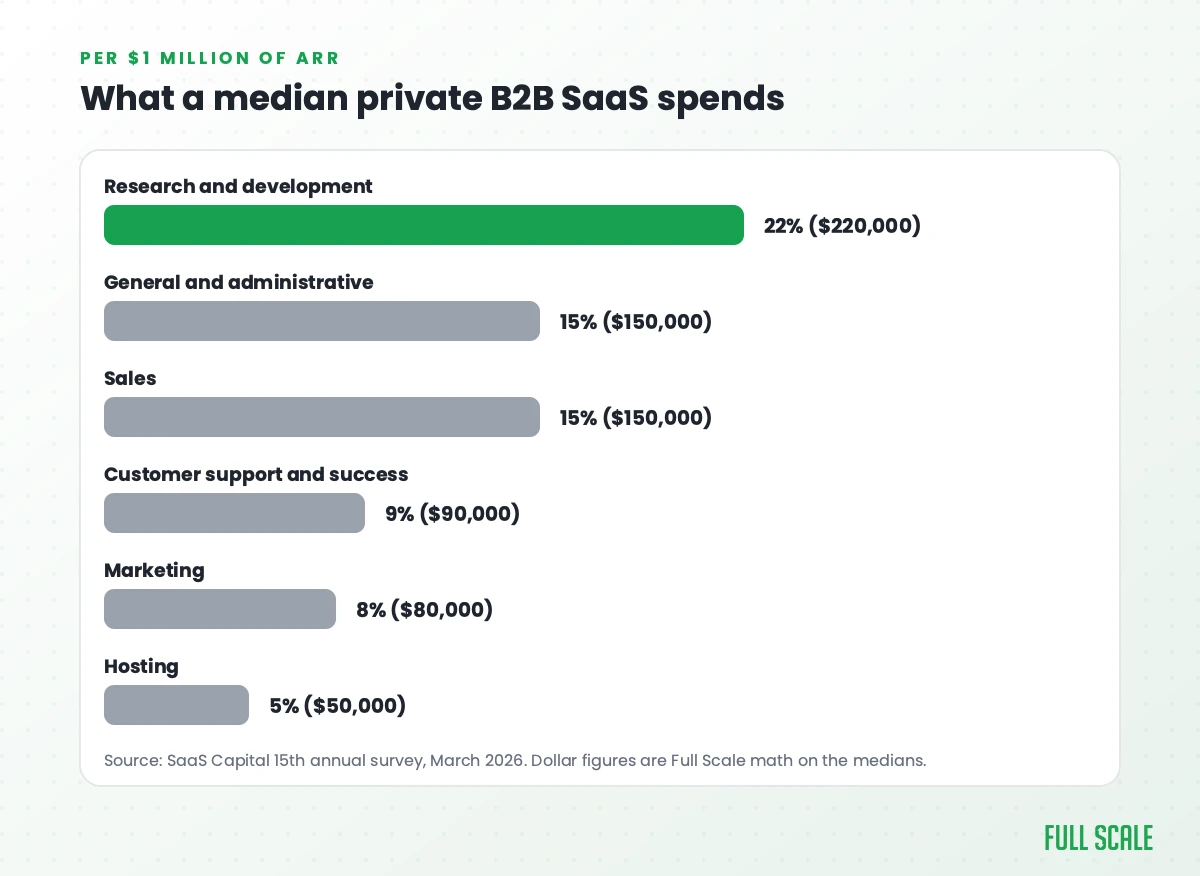
Even after it's generating revenue, a SaaS company spends a significant fraction of its revenue on engineering, hosting, and support. According to the 15th annual SaaS Capital survey of over 1,000 private B2B SaaS companies, which was completed in March 2026, reports median spending as a percentage of annual recurring revenue (ARR).
Full Scale converted these percentages into actual dollar amounts for a company with $1 million of ARR. This column is just a simple calculation based on SaaS Capital's median percentages.
| Spending line (median private B2B SaaS) | Share of ARR, per SaaS Capital | Per $1 million of ARR |
|---|---|---|
| Research and development | 22% | $220,000 |
| Hosting | 5% | $50,000 |
| Customer support and success | 9% | $90,000 |
| General and administrative | 15% | $150,000 |
| Sales | 15% | $150,000 |
| Marketing | 8% | $80,000 |
These figures are the overall median spend for SaaS companies that have already started bringing in revenue. R&D in this context includes product and design staff in addition to developers. Think of the R&D figure as what your development budget looks like once you have launched your product.
Here is what that R&D line means in developers. On $1 million of ARR, R&D costs 22%, or $220,000 per year. At Full Scale's starting rate, this covers roughly 3 dedicated developers for an entire year. At US median salaries, according to the Bureau of Labor Statistics, it only covers 1.
This cost doesn't decrease as your company scales up. In SaaS Capital's survey, the median R&D spend for companies between $3 million and $5 million of ARR was 24%. The key takeaway here is that you're going to have to pay engineers every year your SaaS is running, so the monthly cost is much more important than the initial build quote.
What to buy instead of building
There's a price tag on payments, authentication, and compliance, and it's easy to look up. Compare that price tag with the number of months of development time required to write it yourself. I discussed the "if you can buy it, buy it" heuristic in my post how to start a SaaS company, and the post build versus buy talks about the tradeoffs in general. Here are two examples of the buy side:
- Payments and billing. Stripe charges 2.9% plus 30 cents per successful domestic card transaction, and Stripe Billing adds an extra 0.7% of billing volume on the pay-as-you-go tier. For a $100/month SaaS product, that comes out to roughly $3.90, or 3.9%. Many SaaS founders like to think they can save money by rolling their own billing, until the first edge case involving a failed credit card pops up.
- Security audits. When a potential enterprise customer asks for a SOC 2, Vanta, which makes compliance software, estimates the audit cost itself to be anywhere from $10,000 to $50,000, and the total cost for a first-time SOC 2 is between $10,000 and $80,000 or more. Talk to a few auditors to get a sense of pricing for your particular situation, but make sure you have that cost factored into your planning for when your first major prospect asks for it, not from day 1.
This isn't included in a typical development budget. It's part of the true cost of doing SaaS.
The work that makes software SaaS
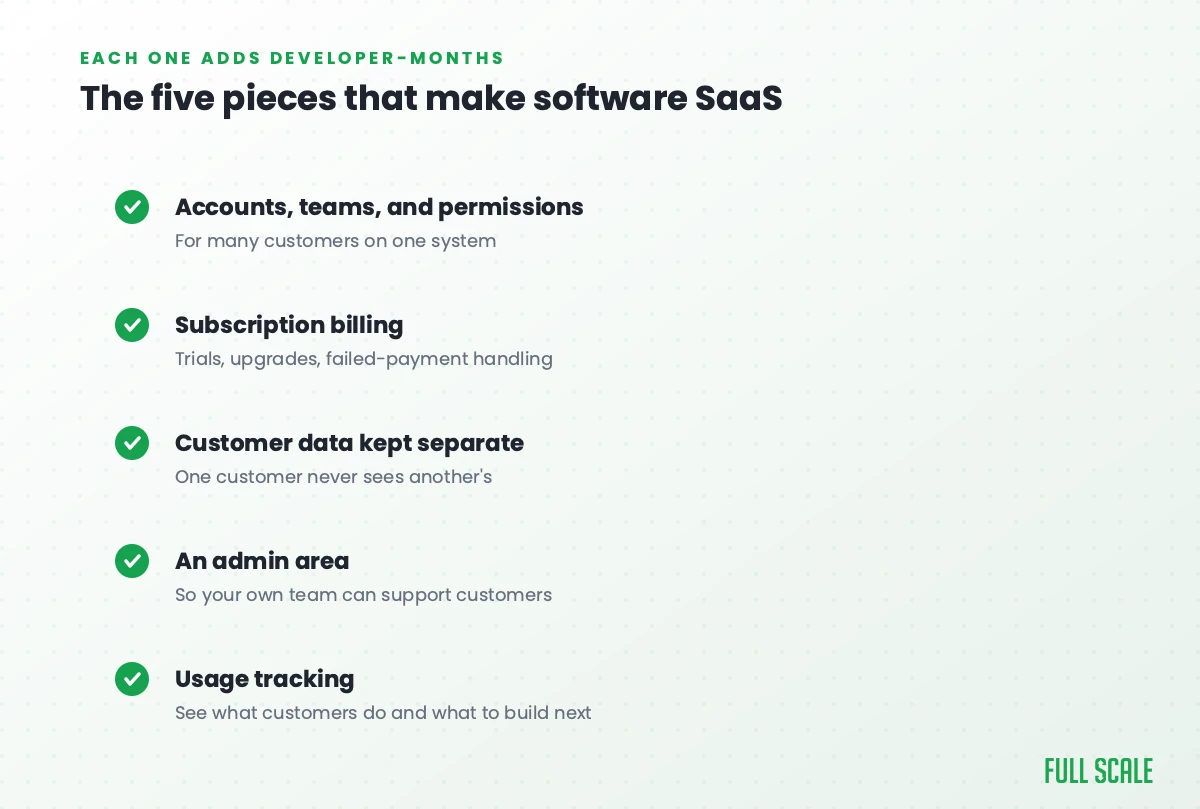
A SaaS product will have 5 components that a single-company internal app won't. Every component adds cost and every cost component depends on your scope.
- Accounts, teams, and permissions for a number of different customers using one product
- Billing functionality for subscriptions, trial periods, upgrades, and failed credit card charges
- Customer-specific data that is distinct from another customer's data
- Admin area for your team to manage and help customers
- Analytics on user activity so you know what they're doing and what to build next
Our SaaS development services page explains how Full Scale handles the staffing for projects like these. Ask any vendor if they include each of the five items in the initial quote or if they'll add them later.
Pick the SaaS budget by your situation
The right SaaS budget depends on whether anyone is paying yet. Here is the call I'd make at Full Scale for each situation, using the numbers above.
| Your situation | What the money should buy | Why |
|---|---|---|
| No customers yet and an untested idea | A prototype, then a thin build (see MVP development cost) | The cheapest stage should be allowed to say stop |
| About $250,000 raised, building the first real version | About 41 developer-months at Full Scale rates, against about 15 with US employees | The rate decides how many months of runway the build gets |
| Paying customers and about $1 million of ARR | About three dedicated developers all year at Full Scale rates, from a 22% R&D line | Engineering is a yearly cost now, and the median spends about this much |
| A software company adding a SaaS product | A dedicated team sized to the product, extended as it grows | You already have customers and an engineering culture to plug into |
If you're a startup weighing a first build, why startups offshore their first software project covers the case in more detail.
Where Full Scale fits in a SaaS budget
With Full Scale, we send dedicated developers from across the Philippines to join your SaaS team via staff augmentation, starting at $35 an hour fully loaded. The exact price varies based on their seniority, expertise, and team size. Each developer works for one client and you can begin in as little as 7 days. If it isn't working out in the first two weeks, you get your money back. After that, you can drop a developer on 30 days' notice with no long-term contract (more info in our article, when it isn't working out).
If I were building a SaaS, I'd hire my team to build the product because those same people would run it. And I'd choose based on fit, not the cheapest option (which is what I call cheapshoring). Full Scale developers are trained on concepts from my book, Product Driven, which means they'll ask you why you want to build the feature before they build it.
Frequently asked questions
How much does it cost to build a SaaS product?
A first SaaS version built by three to five developers over four to nine months costs about $73,000 to $273,000 at Full Scale's $35-an-hour starting rate. The same teams as US employees at the BLS median salary, fully loaded, cost about $194,000 to $728,000. Design, a product owner on your side, hosting, and compliance work are extra, and the build is followed by a yearly cost to run and improve the product.
How much does it cost to run a SaaS company's software after launch?
SaaS Capital's 2026 survey of more than 1,000 private B2B SaaS companies found median spending of 22% of annual recurring revenue on research and development, 5% on hosting, and 9% on customer support and success. On $1 million of recurring revenue, that is about $220,000 for R&D, $50,000 for hosting, and $90,000 for support. These are company-wide medians, not a build estimate, and they apply to companies that already have revenue.
How much does a SaaS MVP cost?
A SaaS MVP built by two to four developers working two to four months costs about $24,000 to $97,000 at Full Scale's $35-an-hour starting rate, and roughly 2.7 times that with US employees at the BLS median salary. A clickable prototype before the build is nearly free in cash and can show whether the build is worth paying for. Full Scale's MVP development cost guide breaks the stages down.
What does it cost to take payments in a SaaS product?
Stripe charges 2.9% plus 30 cents per successful domestic card transaction, and Stripe Billing adds 0.7% of billing volume on its pay-as-you-go plan. On a $100 monthly subscription that works out to about $3.90 in fees, or 3.9%. Buying payments and billing this way is usually cheaper than building them, because the developer-months and the compliance burden stay off your bill.
Is it cheaper to build SaaS with an offshore team?
Building SaaS with a dedicated offshore team is cheaper per developer-month, by about 62% at Full Scale's $35-an-hour starting rate against a US employee at the BLS median salary, and Full Scale clients typically save 50 to 70% against a comparable US hire. The savings matter most for SaaS because the team keeps working after launch, so the monthly difference compounds every year the product runs.
Price the build and the years after it
Add the developer-months for the build to the yearly engineering line for the product and you have the real number. If a dedicated team fits your SaaS, tell us what you're building and we'll run both numbers on your scope.