
MVP Development Cost in 2026: Pay for Learning, Not Just the Build

In this article
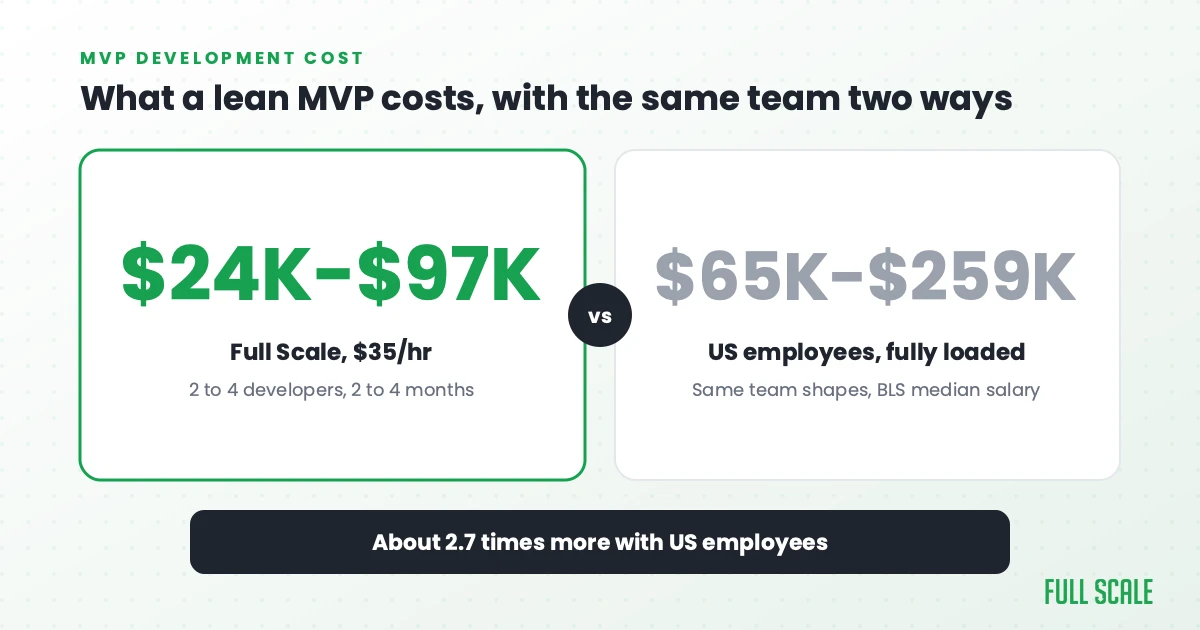
Quick Answer: MVP development cost is team-months times a monthly rate. A lean MVP team of two to four developers working two to four months costs about $24,000 to $97,000 at Full Scale's $35-an-hour starting rate. The same team as US employees costs about 2.7 times more. Stage the spend as a prototype, a thin build, and a decision, so a wrong guess costs you the first stage and not the whole budget.
A 2-person, 2-month, MVP can be done for as little as $24,000 at Full Scale's starting rate of $35/hr, or as much as $97,000 for a 4-person, 4-month MVP. If those same people were US employees, they would cost about 2.7x that.
Stage your spend, being Prototype, Build, Decide. That way you don't lose a lot if you turn out to be wrong about the first stage, and only lose that stage.
Lean MVPs cost far less than most founders expect, provided you spend the first dollars on learning, not on building. A $97,000 MVP built in an effort to verify a hunch is a very expensive way to learn that your friends were merely being polite.
This post breaks down the MVP price by stage, with the first stage costing roughly the same as a SaaS subscription.
How much does MVP development cost?
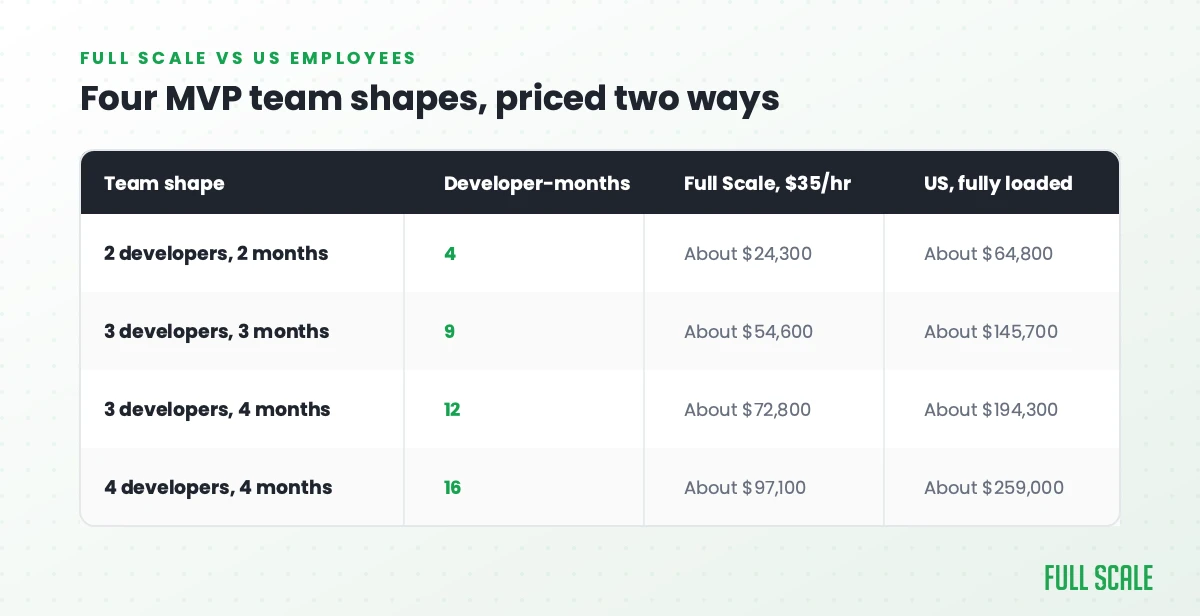
You can hire a two-to-four person MVP team for two-to-four months from Full Scale for about $24,000-$97,000, at their starting rate of $35/hour. Those same shapes would cost around $65,000-$259,000 as US employees at the median salary from the Bureau of Labor Statistics (BLS), fully loaded.
At Full Scale, one dedicated developer costs about $6,070/month at the starting rate. That's $35/hour across approximately 173 working hours. One US employee at the median BLS salary for a software developer $135,980 costs about $16,200/month, since wages are only 70% of what private employers spend after factoring in payroll taxes and benefits. Full Scale priced out four MVP-size team shapes both ways.
| MVP team shape (developers times months) | Developer-months | Full Scale dedicated team at $35/hr | US employees, fully loaded at the BLS median |
|---|---|---|---|
| 2 developers for 2 months | 4 | About $24,300 | About $64,800 |
| 3 developers for 3 months | 9 | About $54,600 | About $145,700 |
| 3 developers for 4 months | 12 | About $72,800 | About $194,300 |
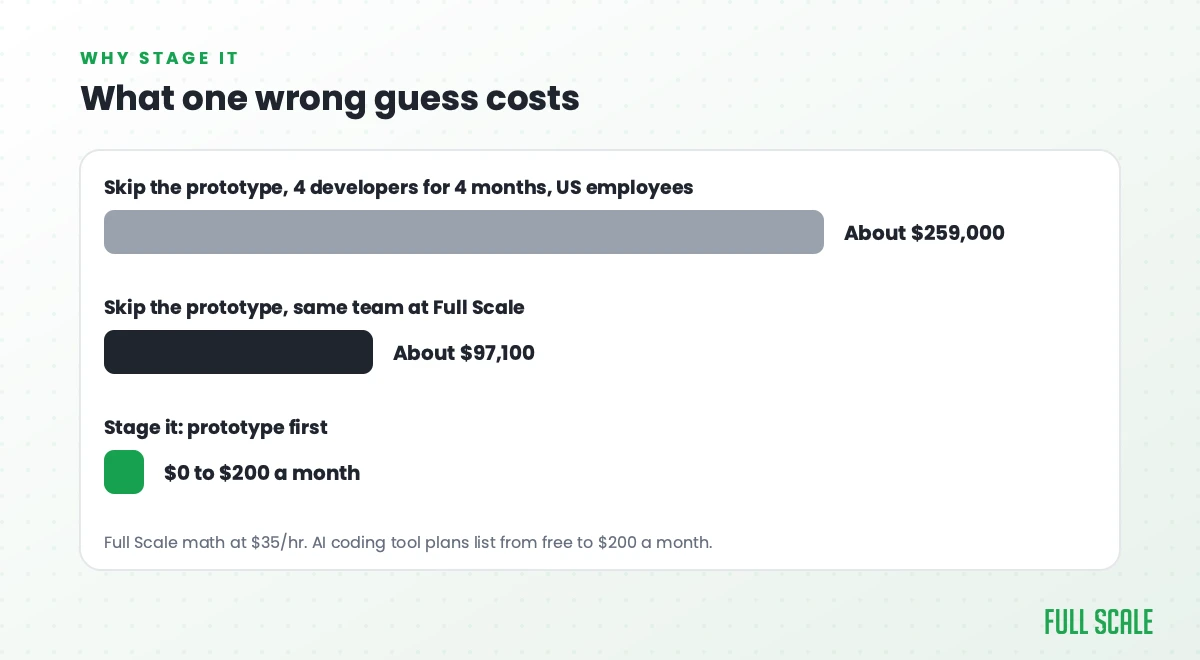
| 4 developers for 4 months | 16 | About $97,100 | About $259,000 |
The shapes act as good scale markers when you're scoping out your own project. In the above table, only the cost of the developer is calculated. On either side, there will also be a designer, a product owner from your side, and the cost of hosting. Plus, at $35/hour, that's where Full Scale's pricing starts, not what all developers cost. Your seniority mix will move the needle, but it usually ends up being in the 50%-70% range Full Scale clients are saving over a comparable US hire.
If you're curious about the role-by-role rates behind a team like this and how to reduce scope, our MVP development strategy covers these points. To calculate the cost with your own team size, try our software development cost calculator.
Why MVP quotes run from five figures to $200,000
When you search for MVP pricing and agency pages, you'll see that some charge anywhere from the low five figures to $200,000. Most of them are being honest, they're just charging for different things with one word: just a build by two devs, a build + discovery and design, or a build + a year of support.
Choosing the cheapest one based solely on price is what I call cheapshoring. A single number doesn't tell you everything. Ask every vendor for how many people, how many months, and what's not included, then compare developer-months. This same technique can be applied to any app quote, and our guide to mobile app development cost applies it to app quotes.
Budget the MVP in three stages
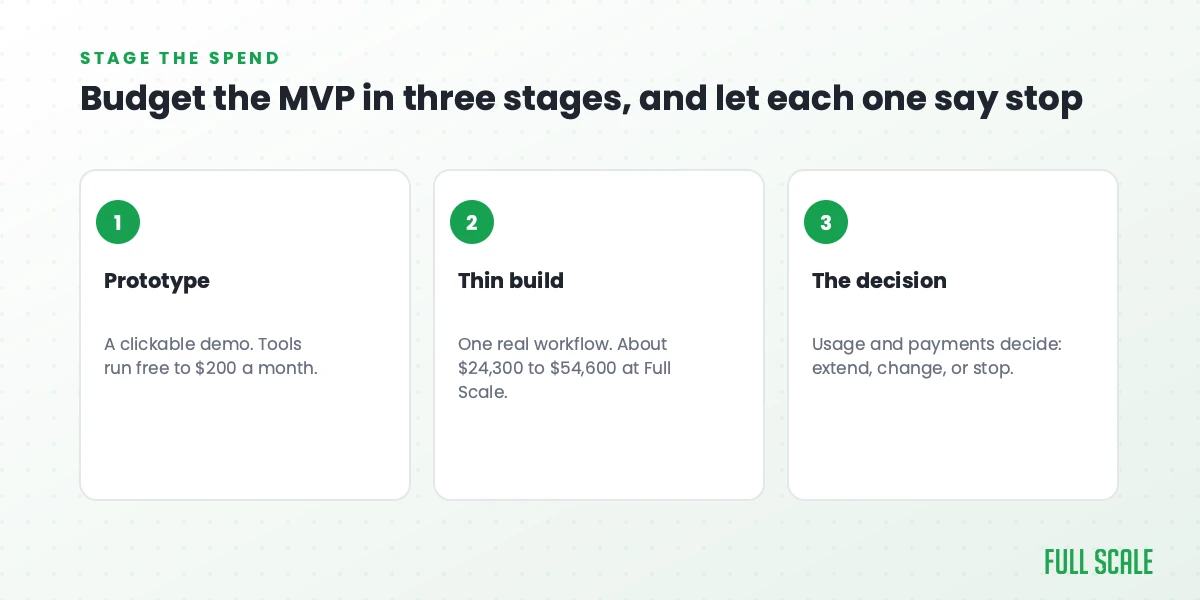
I recommend an MVP budget broken up into three spends: a prototype, a thin build, and a decision. You spend more on each step than the last, and at each step you have the option to say stop. At Full Scale, we price the second phase in developer-months, and the first costs almost nothing. Here's how much each step costs and what you learn.
| Stage | What you buy | What it costs | What it settles |
|---|---|---|---|
| 1. Prototype | A clickable prototype that real people can respond to | AI coding tools offer plans ranging from free to $200 per month, per Cursor's pricing page as of October 2026, plus your time | Whether people respond the way you expect |
| 2. Thin build | One real workflow, built for use, by two or three engineers | Around $24,300 to $54,600 at Full Scale's starting rate for 4 to 9 developer-months | Whether real people use it and pay for it |
| 3. The decision | Usage, payments, and commitments from early adopters | Mostly your time, and the cost of the time you wait | Whether to add to the team, pivot, or shut down |
The prototype stage is cheap because of AI. It's not free, though, and a prototype is not an MVP, as I've explained in my minimum viable product guide. A prototype shows you if the idea is intriguing. A thin build shows you if people will use it.
A cheap stage one is the point: it's the stage which gets to say 'stop'.
What the thin build should and shouldn't include
The second stage pays for one workflow that is solid enough to show to strangers. It doesn't include the admin panel, the second user persona, or any of the integrations that you may "need." Any additional functionality will cost you developer months and developer months are expensive.
According to Pendo's 2019 feature adoption report, 80% of the features in an average software application are used infrequently or not at all. It's a dated study, but it's the classic one. Trimming down the feature list before development begins is the best way to save money.
What it costs to be wrong
If you staged the spend, a wrong guess only costs one stage. If you didn't, it's the entire budget. Of 431 venture-backed startups that have died since 2023, poor product-market fit ranked second among failure reasons, cited by 43%, and running out of money was first, at 70%. CB Insights notes that running out of money is usually the last thing to go wrong, after something else already did.
The cost of the same wrong guess: $97,100 at Full Scale's starting rate (about $259,000 with US employees) if you skip the prototype and go straight to a four-developer, four-month build, versus a software subscription and a few weekends if you stage it.
It's tempting to skip stage one because building something feels like progress while making a prototype feels like homework. It still takes weeks and months to go from idea to paying product even with AI and a good team, and this is something Full Scale Ventures knows well now that we're building our own software products.
What an MVP quote usually leaves out
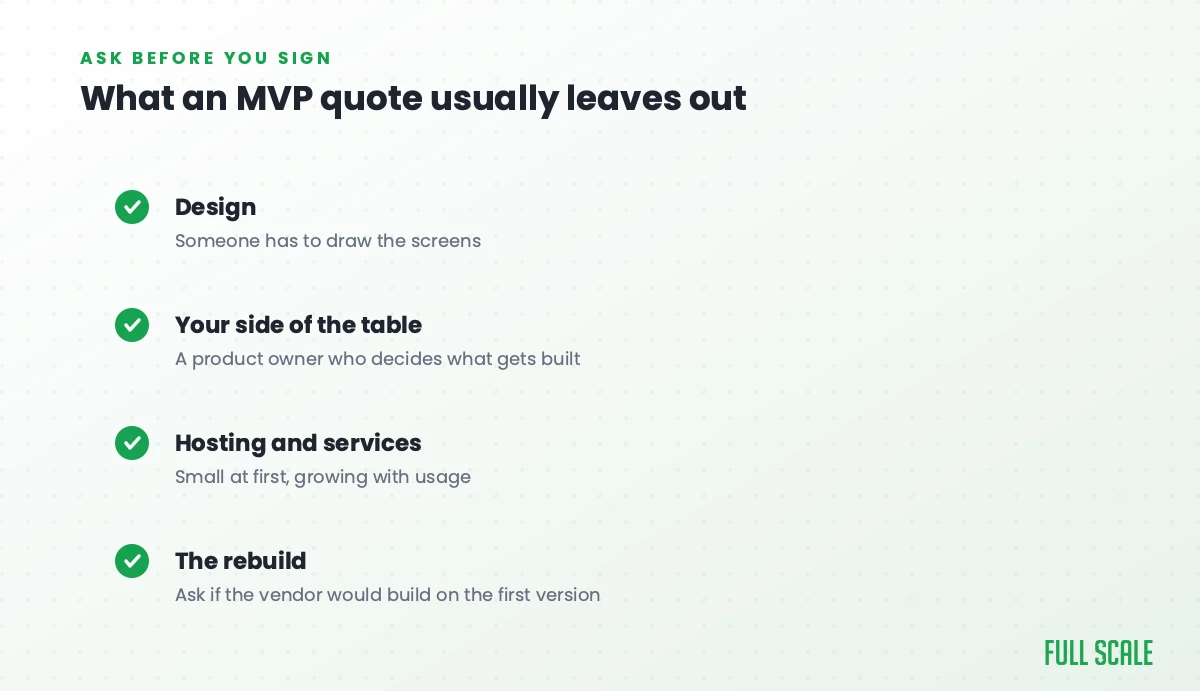
An MVP quote typically includes developers, but usually not much more. There are four things you should ask about before signing off.
- Design. A developer guessing at design will cost you in rework.
- Your product owner. The product owner on your team makes decisions about what gets built each sprint. They take time or money, and the project stops if they're not available.
- Hosting and services. Services like cloud hosting, email, and payment processing are cheap to start but scale with usage.
- Rebuilding. An MVP designed to be discarded is cheaper initially but more expensive down the road. You will want to continue developing the app if it's successful, so ask the vendor if they would develop on top of it.
Non-engineering founders face the most difficult version of this problem. You can find guidance for evaluating an MVP that you don't understand in our guide for non-technical founders.
Pick the MVP budget by your situation
The right MVP budget follows what you've already learned. Here's the call I'd make at Full Scale for each of these scenarios, with the developer-month calculations we used above.
| Your situation | What to spend first | Why |
|---|---|---|
| You have an idea no customer has seen yet | Just Stage One: build a prototype and talk to customers | The lowest-cost stage is the stage most likely to tell you to stop |
| Customers have tried a prototype, and a handful of them are willing to use the product | A skinny version of the product: three developers for three months ($54,600 at Full Scale's rate) | It's one feature set, built solidly, for a few people who want it |
| You have about $100,000 in the bank and no revenue | About 16 developer-months at Full Scale rates, or about six if you're hiring US-based developers | Rate determines how many months of runway your project will buy |
| You're a software company launching another product line | A team built for that product line, scaled up if demand shows up | You have a market; skip the market research phase and just pay for development |
The spending question is the staffing question. Our post on how to start a SaaS company without burning your runway works through that for software products, and SaaS development cost prices what comes after the MVP.
Where Full Scale fits in an MVP budget
With Full Scale, you're building MVPs with skilled, dedicated engineers located across the Philippines via staff augmentation, starting at $35 per hour fully loaded. Depending on seniority, skill level, and team size, the final cost is different.
You can begin in as little as 7 days, and the first two weeks come with a money-back guarantee. After that, you can drop a developer on 30 days' notice, with no long-term contract. Read more about that process at when it isn't working out.
As your MVP becomes a product, the team scales up or down, which is why you're paying for a month or more, rather than just for a project. We explain how we staff this on our MVP development page. And just like in my book, Product Driven, our engineers ask why a feature matters before you build it.
Frequently asked questions
How much does it cost to build an MVP?
A lean MVP team of two to four developers working two to four months costs about $24,000 to $97,000 at Full Scale's $35-an-hour starting rate. The same team as US employees at the BLS median salary, fully loaded, costs about $65,000 to $259,000. Design, a product owner on your side, and hosting are extra on both sides, so add them before you set the budget.
How much does an MVP cost for a startup?
A startup should price an MVP in developer-months, not in a lump sum. A three-developer team working three months is nine developer-months, which comes to about $54,600 at Full Scale's $35-an-hour starting rate and about $145,700 for US employees at the BLS median salary. With $100,000 in the bank, that is about 16 developer-months at Full Scale rates and about 6 at US rates.
Is it cheaper to build an MVP with AI?
AI makes the prototype stage nearly free in cash, since AI coding tools list plans from free to $200 a month, but it does not make the production MVP free. A prototype can show whether anyone wants the product, and a real MVP still needs developers who can judge, secure, and maintain what the AI wrote. The savings show up as fewer developer-months, not as zero developer-months.
Why do MVP cost estimates vary so much?
MVP cost estimates vary because they price different things under the same word. One quote covers a thin build by a small team for a few months, and another bundles discovery, design, testing, and post-launch support. Ask every vendor for the number of people, the number of months, and what the price excludes, then compare developer-months instead of totals.
How much does an MVP app cost?
An MVP app costs about what any mobile app costs per developer-month, with a smaller scope. Clutch's mobile app data puts most reviewed projects between $10,000 and $49,999, and the average at about $90,780 over roughly 11 months. At Full Scale's $35-an-hour starting rate, one dedicated developer costs about $6,070 a month, so a two-developer, four-month MVP app runs about $48,500.
Price the learning first
Add up the developer-months your first real test needs, then stage them so the cheapest stage can say stop. If that's a thin build with a dedicated team, tell us what you're testing and we'll crunch the numbers on your scope.