
Why Fixed Cost Software Development Doesn’t Work (and What Does)

In this article
- What fixed cost software development actually means
- You can fix the price or you can fix the scope. You can’t fix both.
- Why most reputable vendors won’t sign one
- New work always takes longer than you think
- Does AI change any of this?
- When fixed cost actually works (and when it doesn’t)
- The alternative: hire a team, not a project
- FAQ
- Stop trying to buy software like a project. Hire a team.
Every founder who comes to me asking for a fixed price on a software project is asking the wrong question.
I get the instinct. You’ve been burned before, or you’ve heard the stories from people who have. A vendor quoted six months, and twelve months in you’re still writing checks. So when you go looking for the next partner you want a number locked in writing. Fixed cost software development sounds like the grown-up, responsible way to buy. Predictable budget, defined scope, clear deliverables, no surprises.
It’s also why the project will end badly.
Quick Answer: Fixed cost software development locks in a price and a scope before any code is written, and it fails on real product work because you can hold the price fixed or the scope fixed, never both. Quality is what gives when reality pushes back. It only works for small, well-understood, one-time jobs like a marketing site or a data migration. For ongoing product work, Full Scale staffs a dedicated team instead of quoting a fixed price, so priorities can shift without a change-order fight every time the roadmap moves.
What fixed cost software development actually means
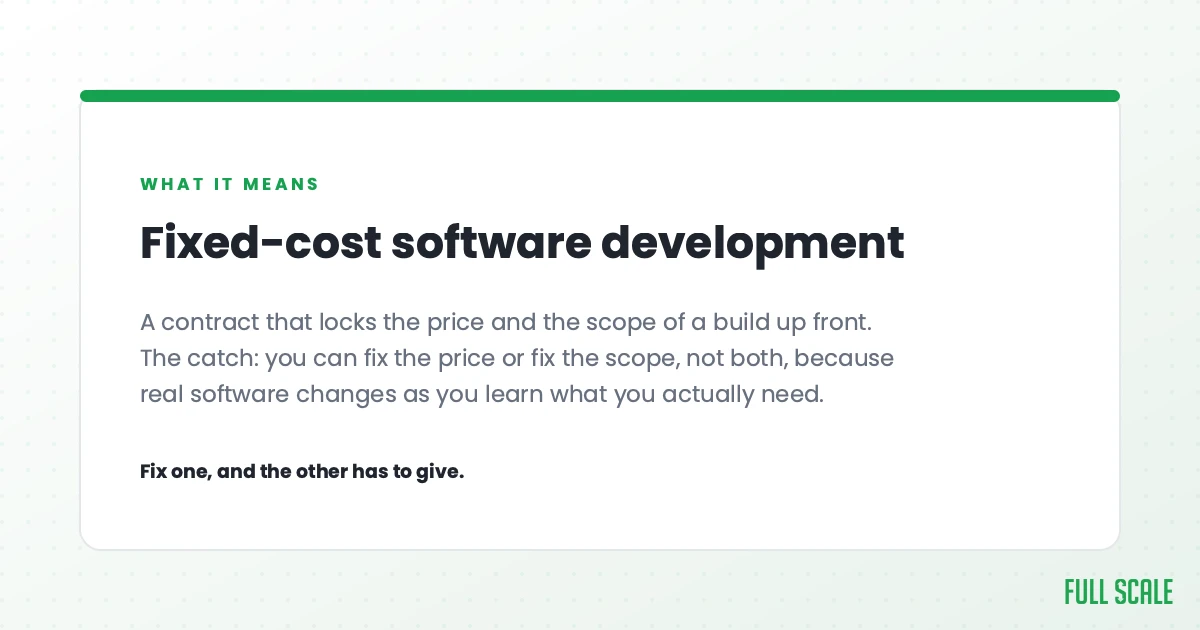
Fixed cost software development is a contract model where the buyer and vendor agree on the total project price, scope, and timeline before any code is written. The price doesn’t change unless the contract is formally revised.
That’s the setup most buyers want. You scope the work, the vendor quotes a number, you sign, work happens, you pay the agreed price. Simple and predictable, and that’s the appeal. It looks like buying a kitchen renovation or a piece of furniture, where you know what you’re getting and what you’ll pay before anything happens.
But software is not a kitchen renovation. Every feature you’ve ever asked a team to build was being built for the first time by that team in that context. There is no fixed reality to fix a price against. The contract is engineering a kind of safety that doesn’t exist in the actual work.
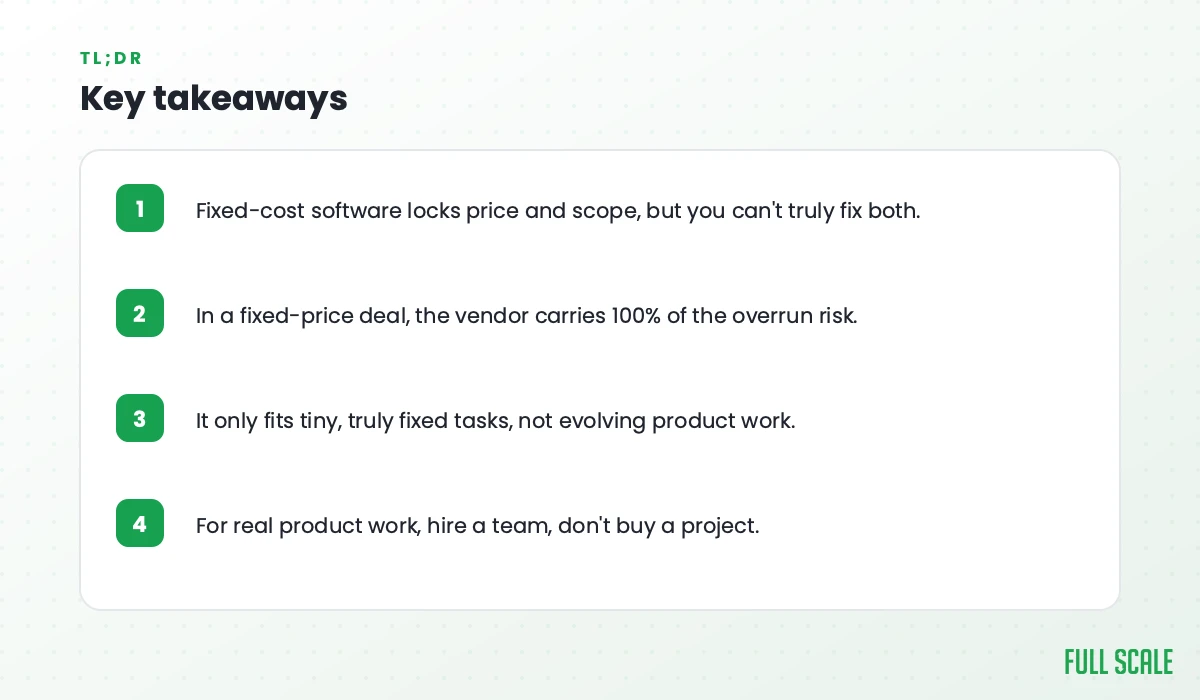
You can fix the price or you can fix the scope. You can’t fix both.
Every software project has three variables: scope, cost, and quality. You get to pin down two of them. The third has to be allowed to move, because something always has to give when reality pushes back against the plan. That’s just how the work behaves. It is the same constraint at the heart of the Agile vs Waterfall choice: Waterfall tries to pin down all three, Agile plans for one of them to move. If your real goal is to lower your software development costs, the model you staff with matters more than the contract type.
In a fixed cost contract you’ve tried to pin down two: the scope and the price. The third variable, quality, is what gives. Either the code gets worse as the deadline approaches, or the scope quietly contracts as the vendor finds reasons not to build the parts that turned out to be harder than expected.
The other version of this is the contract that fixed price and pretends to fix scope. Every time the product changes (and the product will change, because the customer changes their mind, because you learn something, because the market moves), the vendor opens a change order. Now you’re not building, you’re negotiating. The relationship goes adversarial inside a month and stays there.
I wrote about this on LinkedIn last year. The post went something like this:
No one ever misses a deadline. They just change the deadline. When scope creeps but dates stay fixed, time becomes the only free variable.
That’s the same trilemma, said in the language teams actually use. The deadline didn’t slip. We just stopped calling it a deadline.
Why most reputable vendors won’t sign one
Most reputable vendors won’t sign a fixed price contract because they know the estimate is wrong before they even quote it, and they’re the ones who’d carry the loss. The shops that will sign one are not the shops you want building your product.
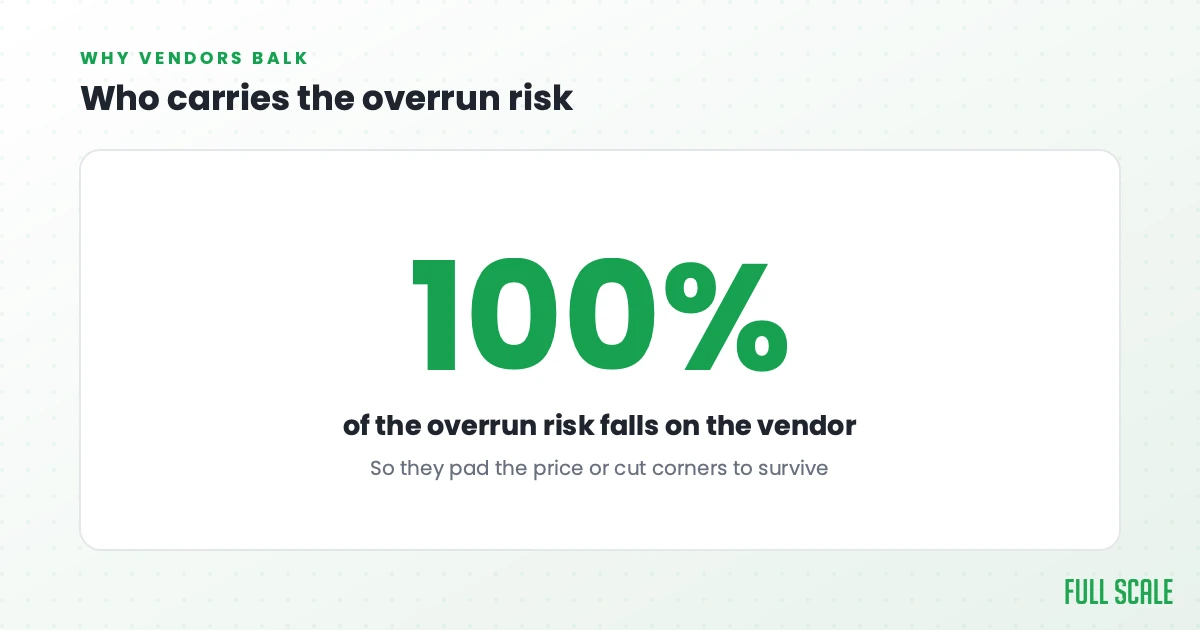
Start with the risk. In a fixed price contract, the vendor takes 100% of the overrun risk. If the work takes twice as long, they eat the cost. The buyer’s downside is capped at the agreed price. That sounds fine until you remember the vendor knows the estimate is wrong before they sign. No reputable shop signs a contract where they commit to a number they know they’ll have to fight to defend, and they carry all the downside, and the customer carries none.
So one of two things has to be true about the shop that’s offering you a fixed price. Either they’ve padded the number by 30 to 50 percent to absorb the risk in advance, which means you’re overpaying for a buffer you don’t see, or they’re planning to cut corners when the work turns out harder than expected. Sometimes both. Either way, the buyer pays.
The estimate itself is also wrong. There’s a well-known concept in software engineering called the Cone of Uncertainty, originally documented by Steve McConnell at Construx. At project start, software estimates are off by a factor of four in either direction. Even at the requirements stage, after you’ve done real planning, estimates are still plus or minus 50 percent. That’s not a developer-skill problem. That’s the math of estimating work you haven’t done before.
I wrote on LinkedIn a few years ago:
Asking a developer to estimate a new feature is like asking a vegetarian chef how long it would take to make homemade German sausage. They might understand the general concept. They might have read about the process. They might even have seen it done before. But without having done it themselves? It’s just a guess.
That’s the dirty secret of every fixed-bid software contract. The price tag is built on a guess that the vendor and the buyer have agreed to treat as a promise. The good vendors won’t take that contract. The bad ones will. Which is most of what you need to know about who you should hire.
(There’s a #NoEstimates crowd that argues we should stop estimating entirely. I don’t go that far. Estimates are useful as conversation starters and as ranges. They’re broken as commitments.)
New work always takes longer than you think
Construction can be fixed-bid because the construction industry has built the same house ten thousand times. The framers know how long the framing takes. The electricians know how long the rough-in takes. The numbers exist because the work has been repeated enough times to be measured.
Software has built this feature exactly once: the time you’re about to build it. Every other feature was a different feature, in a different codebase, with a different team, against a different set of requirements.
New work will always take longer than you think. Because coding isn’t like cooking pasta where you’ve done it 100 times before.
That’s the structural problem. It comes from the nature of doing work that hasn’t been done before, not from laziness or optimism or a bad engineering culture.
What makes the fixed price contract worse is the pressure it puts on the estimator. The developer who says “twelve weeks” is going to get pushed to say “ten weeks” because the buyer wants a smaller number. The developer who says “ten” gets pushed to say “eight.” Eventually somebody signs.
Most technical leaders give in to pressure. We know it’ll take three weeks, but we say two weeks to avoid conflict. All we’re doing is postponing the inevitable disappointment.
That same LinkedIn post had the line I come back to most:
The most damaging estimate isn’t the long one. It’s the unrealistic one that destroys trust.
Fixed price contracts are factories for unrealistic estimates. They take the most pressured guess on day one and treat it as the floor for the next six months.
Does AI change any of this?
A little, on one side of the line. Not at all on the other.
For small, well-understood, scoped work, AI is changing the economics in a real way. Marketing sites get built in a week instead of three. Simple integrations and one-off scripts get done in days. The kind of fixed-bid work that always made sense is now cheaper to commit to, and the vendors who deliver it can quote tighter numbers with less risk. That’s a genuine shift.
For real product work, AI doesn’t change the math. The estimate is still a guess. Roadmaps still shift weekly. The customer still calls Tuesday morning and changes the priority. If anything, AI makes the moving target move faster, because teams can ship and learn in days instead of weeks, which compresses how fast new scope shows up. A contract written in January that assumed the June feature set will still hold in June was always wishful thinking. AI just makes the wish more obviously broken.
The “AI lets us fix-bid everything now” pitch I’ve started seeing in 2026 is mostly coming from the same shops that always wanted to sign fixed-price contracts. The technology changed. The shop’s interest in transferring risk to the buyer did not.
When fixed cost actually works (and when it doesn’t)
I run a staff augmentation company and I outsource work on fixed bids regularly. It’s not hypocrisy. It’s where fixed cost actually fits.
I’ve used fixed-price arrangements for WordPress builds, for an Elasticsearch project, and for a handful of similar narrowly-scoped jobs. Three things were true of all of them. The scope was fully understood before I asked for a price. The technology had been done a thousand times before by the people I was hiring. And I had no interest in keeping a full-time WordPress or Elasticsearch person on staff once the work was done. That’s the sweet spot.
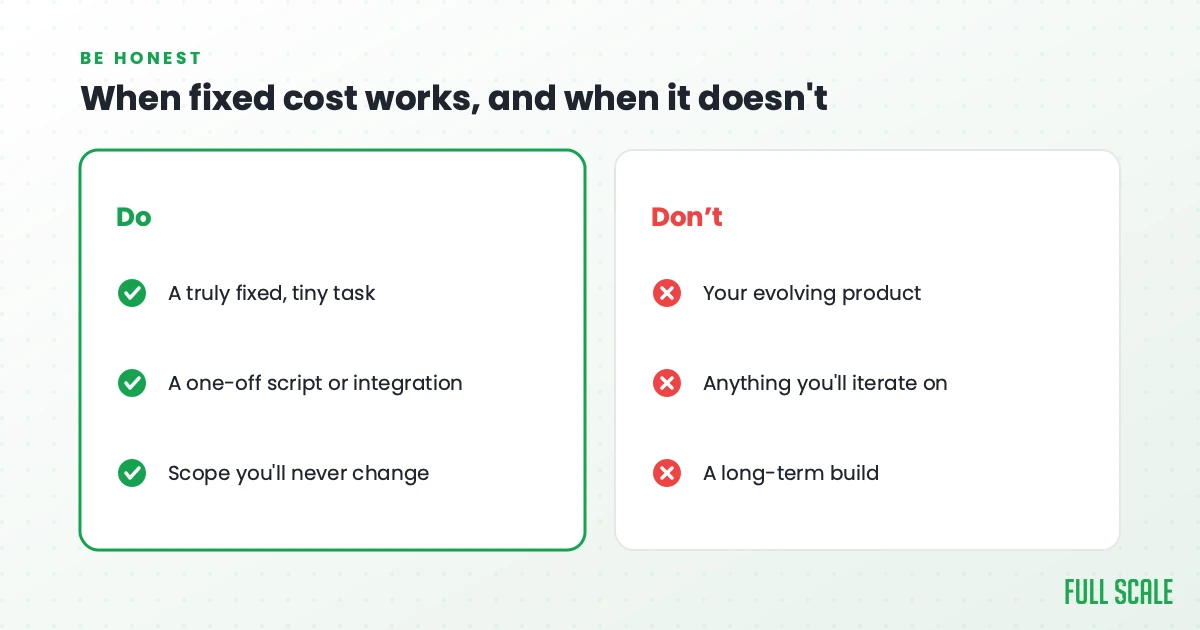
Here’s where fixed cost works:
- Marketing sites and well-defined branded builds
- One-time data migrations with clear inputs and outputs
- Narrow specialty work where the team already has reference projects
- Compliance integrations against a stable spec
- Anything scoped, well-trodden, and not part of your core product
Here’s where it doesn’t:
- Anything you’re going to keep developing for years
- Anything where the product strategy might change
- Anything where the team needs to build deep knowledge of the codebase
- New product development, where the whole point is learning what to build
For everything in the second list, the wrong question is “how do I lock in a price.” The right question is “how do I get a team that can build this with me for the long haul.”
The three engagement models stacked side by side:
| Dimension | Fixed cost | Time and materials | Staff augmentation |
|---|---|---|---|
| What you pay for | A delivered scope | Hourly or daily work | A team’s ongoing time |
| Who carries scope risk | Vendor (in theory), you (in practice) | You | You |
| Best for | Scoped, well-understood work | Mid-size projects with some flexibility | Long-term product development |
| Speed to start | 4-8 weeks of negotiation | 1-2 weeks | 2-3 weeks |
| What you have at the end | A delivered project, no team | A delivered project, no team | A team that knows your codebase |
Look at what you get with staff augmentation: a team that knows your codebase, not just a delivered project. That’s the part most fixed-cost buyers don’t realize they’re giving up.
The alternative: hire a team, not a project
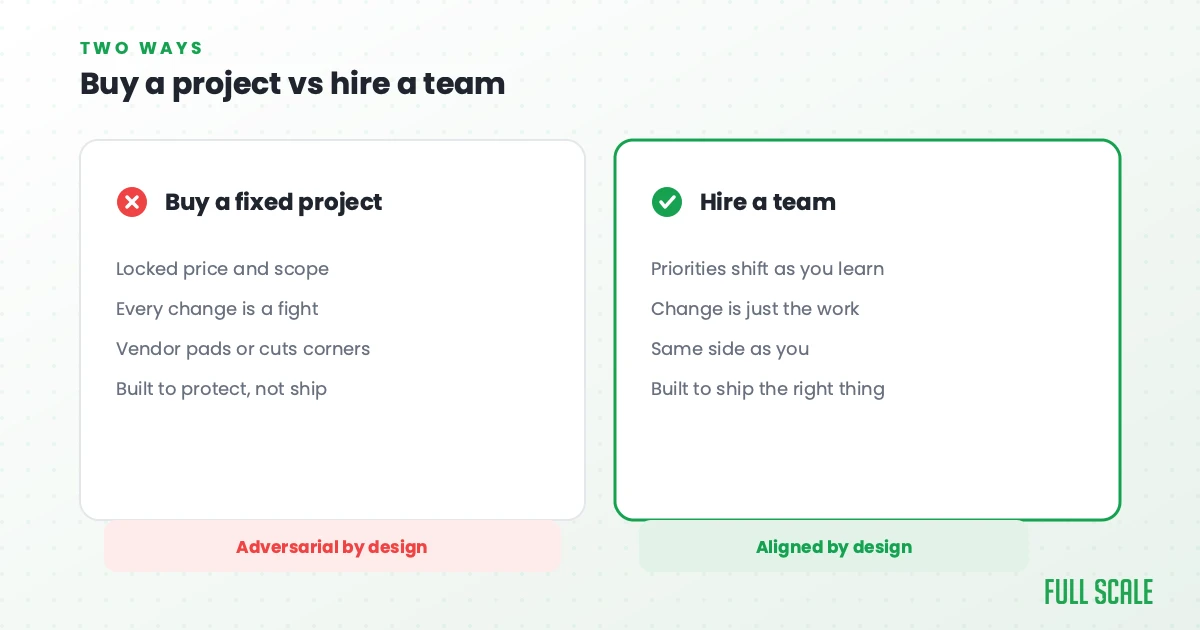
Stop trying to buy a delivered scope. Start funding a team.
Hire talent to work directly for you on a long-term basis. Don’t hire them just for a project.
You pay for the team’s time. The team builds whatever the product needs this month. When the priorities change, you don’t open a change order, you have a conversation. Nothing has to be renegotiated because nothing was contracted in the first place except the team showing up.
The deeper reason this matters has nothing to do with pricing. It’s that fixed-price contracts are project-shaped, and product engineering is not a project. It’s the same team building the same product for years. Every fixed-price engagement starts the meter back at zero, dumps institutional knowledge at the contract end, and asks the next vendor to relearn everything the last one already figured out. The same logic applies to why a SOW rarely delivers on its promise for product work: the document formalizes a snapshot of requirements that the product will outgrow the moment it ships. For web applications specifically, our web app development teams are built for the long-term model by design.
At Full Scale we hired 100 developers in our first year because the demand for this model is real and not getting smaller. One of those long-term engagements is with LendingStandard, a Kansas City company that processes roughly 30 percent of the affordable multifamily property loans in the country. Their CEO Andy Kallenbach put the thing better than I can:
“Waking up each morning to collaborate with the Full Scale team has become the highlight of my day. Their work ethic, pride in craftsmanship, and the sheer quality of their output have not only met but exceeded our expectations. The most significant impact has been the seamless integration of their team with ours, making every challenge surmountable and every success sweeter.”
You can’t say that about a fixed-price vendor. You can’t have that relationship with someone who’s calculating the change-order fee while you’re talking. That’s what a team sounds like.
At Full Scale, our clients are not hiring us for a short-term engagement. They are trusting us with their long-term teams.
The one thing this model does not replace is your in-house technical leadership. Staff augmentation extends your team. It does not replace your CTO. If you don’t have someone in-house who can direct the work, lead the architecture, and set the priorities, you don’t have a staff aug problem. You have a different problem with a different solution.
FAQ
What’s the difference between fixed cost and time and materials in software development?
Fixed cost locks the total project price up front. Time and materials bills by the hour or by the developer-month with no preset total. Fixed cost moves the risk to the vendor on paper. Time and materials puts it on the buyer. Most real product work ends up in the second model whether the contract started in the first or not, because scope changes force the conversation back to honest hourly billing one change order at a time.
Why do most software vendors refuse to sign fixed cost contracts?
Because they know the estimate is wrong before they sign, and they’re being asked to carry all of the overrun risk. Software estimates are guesses, especially for any work the team hasn’t done before. A vendor who signs a fixed price contract is either padding the number to absorb the risk in advance, or planning to cut corners when scope shifts. Reputable shops would rather work hourly and stay honest.
Does AI make fixed cost software development more accurate?
For small, well-understood scopes, yes. Marketing sites and simple integrations can be quoted and built more cheaply now, which makes fixed pricing more practical at the low end. For real product work, AI doesn’t fix the moving-target problem. Roadmaps still shift weekly, customers still change their minds, and the estimate is still a guess. AI builds the moving target faster, it doesn’t make it stand still.
When does fixed cost software development actually work?
When the scope is fully understood, the technology is well-trodden, and the work won’t generate institutional knowledge you need to keep. Branded websites, well-defined integrations, narrow specialty projects. Anywhere the team needs to learn the codebase deeply and stay with it for years, fixed cost is the wrong shape.
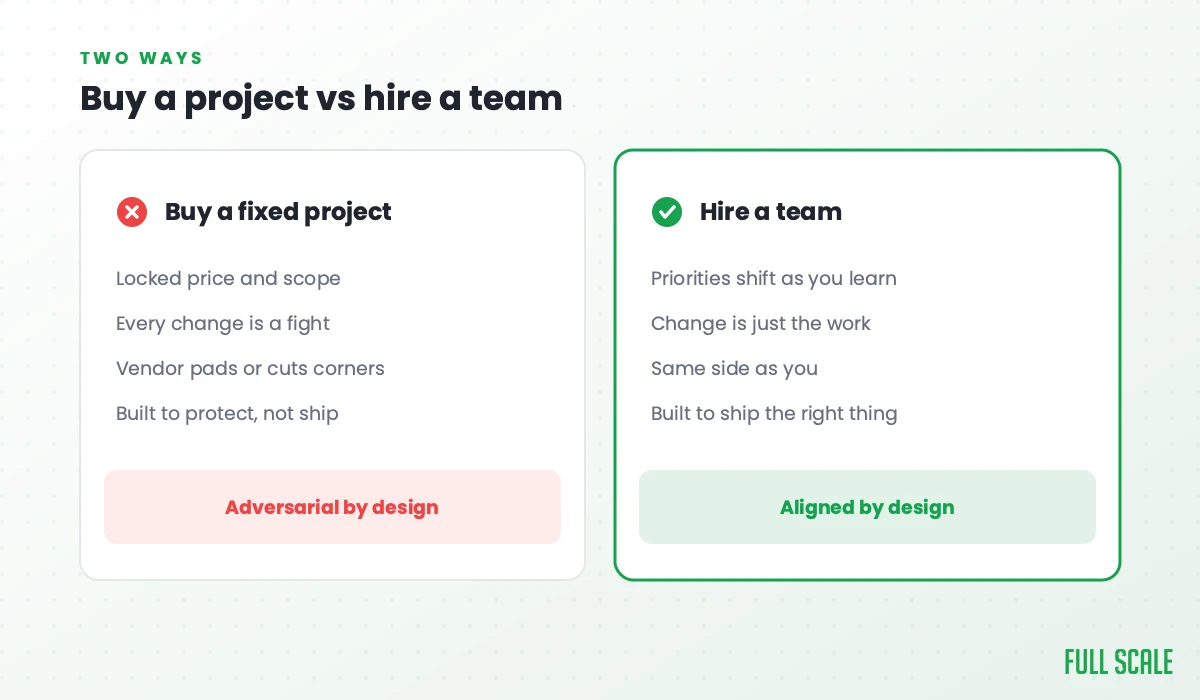
Stop trying to buy software like a project. Hire a team.
That’s the whole argument. If the fixed-price quote on your desk is starting to feel like it’s hiding something, it probably is.
Schedule a call and we’ll talk through what a long-term team would look like for your product.