
Staff Augmentation Pricing Model: The 4 Ways Vendors Charge You

In this article
In 2012, my buddy who owned a dev agency told me he had Java engineers available. I needed them, I trusted him, and I skipped the interview. I found out on the first phone call that they were in St. Petersburg, Russia. (This was 2012, well before the war. I would not hire in Russia today.) The work was good. The friendship was real. I was also paying Kansas City rates for two developers halfway around the world, and I had no idea, because nobody ever showed me what was inside the number I was signing.
The rate is just what a pricing model produces. Different models can hand you the same-looking invoice while hiding completely different things underneath it.
Most posts about this topic show a table of hourly rates by country and call it done. I’ll do that too, later, because the numbers are useful. The bigger decision is which pricing model you sign, because that’s what determines what you can see, what you control, and what your markup actually buys. I’ve been the client getting quietly overcharged. I now run the company doing the charging. Both jobs taught me the same lesson: buyers obsess over the hourly number and skip the structure sitting underneath it.
For the model definition itself, start with what is staff augmentation. This post is about how that model gets priced.
The 4 Staff Augmentation Pricing Models
Every vendor I’ve dealt with, including the one running this website, prices staff augmentation one of four ways.
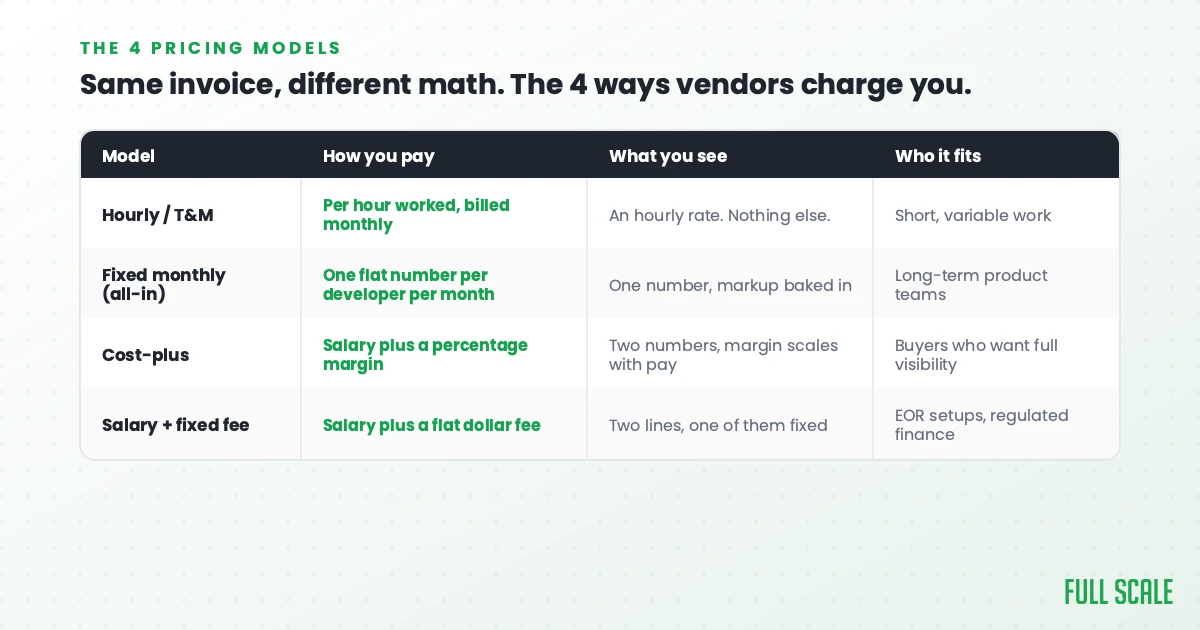
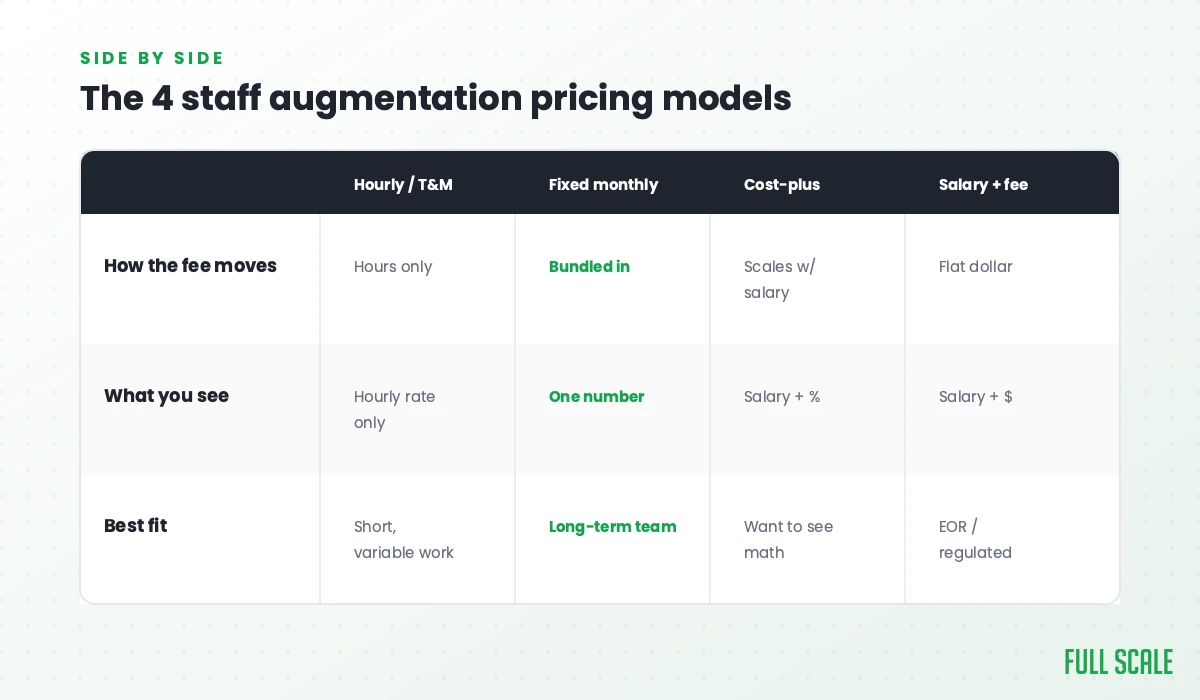
| Model | How you pay | What you see | Who it fits |
|---|---|---|---|
| Hourly / T&M | Per hour worked, billed monthly | An hourly rate. Nothing else. | Short, variable work |
| Fixed monthly (all-in) | One flat number per developer per month | One number. Salary and markup are baked in together. | Long-term product teams |
| Cost-plus | Developer salary, plus a percentage margin (say, salary plus 30 percent) | Two numbers: salary, then a margin that scales with it | Buyers who want full visibility and a hand in hiring |
| Salary + fixed fee | Salary stated separately, fee is a flat dollar amount that doesn’t move with salary (say, $500 a month) | Two lines on the invoice, one of them fixed | EOR (employer-of-record) setups, regulated finance teams |
Worth saying up front: only the first row is a genuinely different economic unit, paying for consumed hours instead of a fixed block of capacity. The other three are the same underlying math, developer pay plus a markup, shown to you in more or less detail. That overlap is the real decision. It comes down to two questions: do you pay by the hour or for capacity, and if it’s capacity, how much of the math does the vendor show you. Here’s each one, what it’s for, and where it breaks.
Hourly / T&M, you pay for hours, and the rate hides everything
The vendor quotes an hourly number. You pay for hours worked, billed monthly. Salary, benefits, infrastructure, and vendor margin are all baked into that single number, and you never see the seams. Toptal, Upwork, and Turing default to this. So does most consulting work that isn’t product work.
It’s a fine model for a two-week migration or a six-week prototype. It breaks down on a long-term team, because you end up paying timesheet overhead on developers who should just be embedded, and your engineers burn hours every week filling out tracking software so you can pay them to fill it out. You will never learn what your developer actually takes home, which means you’ll never know whether the vendor is paying them enough to keep them around.
Fixed monthly all-inclusive, one number, and the trade-off is disclosure
The vendor charges one flat rate per developer per month. That number covers salary, benefits, infrastructure, recruiting, management, and vendor margin, and you write one check. This is how we price at Full Scale. A senior developer through us typically runs $5,000 to $7,000 a month, depending on stack, seniority, and specialty. Structurally, this is still cost-plus math. We pay the developer, add our markup, and hand you one number instead of two. Where the developer half of that number comes from is location, because the cost of hiring a software developer is set by where they live, not how good they are.
It works for a team you’re keeping for years, because finance can budget it a quarter out and nobody has to track hours. The trade-off is presentation, the markup is bundled rather than itemized. If you want the number for the roles you need, the Full Scale pricing page has it. Plenty of vendors sell this exact same fixed-monthly structure as software development as a service, a subscription wrapper on the same math, not a different pricing category.
We aren’t in this for some three-month gig. If your engagement has an end date on the calendar already, skip ahead to picking a model, this isn’t it.
Cost-plus, the fee is a percentage, so it scales with what the developer earns
The vendor tells you what the developer is paid and adds a stated markup on top, usually 30 to 50 percent for IT and software roles (staffing industry markup data, narrower than the 30 to 75 percent range general staffing sees). Say the developer’s salary is $3,000 a month. A 30 percent margin means the fee is $900 that month. Give that developer a raise to $3,500 and the fee grows with them, to $1,050. The vendor’s fee is pegged to the developer’s pay, always a cut of it rather than a flat amount.
Why sign up for a fee that grows every time the developer gets a raise? Because a percentage keeps the vendor’s incentive pointed the right way. They earn more only when the developer earns more, so they aren’t fighting you on comp. It’s also just the market default for this model. It fits a buyer who wants full visibility and a hand in hiring, and who doesn’t mind the extra involvement that comes with it. You’ll interview more candidates, approve more hires, and watch every cost change the moment it happens: a salary bump, a benefits increase, whatever it is. Nobody smooths that math out for you. That’s the whole point of the model, and also the cost of it.
Salary + fixed fee, the fee is a flat number regardless of what the developer earns
Same two-line invoice as cost-plus, salary on one line, fee on the other, but the fee itself works differently. Instead of a percentage, it’s a flat dollar amount that doesn’t move when salary does. A vendor running this model might charge $500 a month per developer no matter whether that developer earns $2,000 a month or $6,000 a month. That flat structure is the real difference from cost-plus: cost-plus scales with pay, this one doesn’t.
This is the model most EOR (employer-of-record) providers run, since their fee is really covering a fixed bundle of payroll, tax, and compliance work that costs about the same to administer per employee regardless of salary level. It shows up in regulated industries too, for the same reason: finance wants a fee they can budget as a flat line item, not one that moves every time someone gets a raise.
Pick the model that fits how you want to run the engagement, not the one with the smallest sticker.
Fixed-Bid and Hybrid Pricing Belong to Project Work
Two more pricing structures show up when you search this topic, and they belong to a different category entirely: fixed-price/project bids and hybrid engagements (hourly for discovery, fixed for the build, a retainer after launch). Both are project outsourcing pricing, not staff augmentation pricing. A staff augmentation vendor sells you a person embedded on your team indefinitely. A project shop sells you a deliverable with a defined end. If a vendor quotes you a fixed bid for an ongoing team, you’re buying the wrong category for the job. See fixed cost software development for when that model actually fits.
How This Differs From a Freelancer, a BPO Seat, or a Project Shop
A lot of pricing confusion is really leftover intuition from a completely different category of vendor.
| Model | What you get | How it’s priced | When it fits |
|---|---|---|---|
| Call center / BPO seat | An outsourced support agent, often pooled | Per seat, per month | High-volume support work |
| Virtual assistant | Generalist remote admin help | Hourly, via a marketplace | Inbox, scheduling, light admin |
| Freelance platform | A self-managed independent contractor | Hourly, marketplace-set | Short, scoped tasks |
| Project outsourcing | A vendor owns a defined deliverable | Fixed bid or milestone | Scoped work with an end date |
| Staff augmentation | A developer embedded in your team | Fixed monthly, all-in | A team you’re keeping |
A call center seat is priced like a seat because the agent is interchangeable. A software developer, doing real product work, generally isn’t. The person who wrote the code needs to still be around when it breaks at 2 a.m.
Marketplace hourly pricing works for point work. It stops working once the engagement turns into a team with shared context: now you’re paying an hourly rate to have someone relearn your codebase every Monday standup while they juggle two other clients. By month three you’re paying the “cheap” rate to onboard the same person, over and over.
The hidden cost at the bottom of the market is turnover, and nobody puts that in the sales deck. The cheaper the rate, the more likely that developer is underpaid against their own local market, and the shorter they’ll stick around. Chasing the lowest number is what I call cheapshoring, and it rarely saves what it looks like it saves once you account for re-onboarding the next person every few months.
What a Real Markup Pays For
Back to those two St. Petersburg engineers from the intro. I didn’t find out where they were sitting until the first call. The work was solid, my friend’s agency was solid, and the markup was completely invisible to me. I didn’t know what those developers earned or what was baked into what I paid. My friend owned the spread. I didn’t get to see inside it.
That story sits behind every staff augmentation pricing conversation. The minute you can’t see inside a rate, you’re trusting the vendor with two things at once: whether the developer is any good, and whether the math is fair. You check the first one by interviewing. You only check the second one by asking what the markup pays for.
Here’s what a real markup should be buying:
- Recruiting and vetting. Sourcing senior developers in a competitive offshore market is a full-time pipeline, not a job board search.
- Statutory benefits. In the Philippines, employers owe SSS, PhilHealth, Pag-IBIG, and 13th-month pay by law, together adding roughly a fifth on top of base wage (Philippine statutory-benefit rates; the 13th-month portion alone is about 8.3 percent by law). Skip these and the vendor keeps the difference, and the developer pays for it twice: once in the paycheck, once when they quit.
- Infrastructure. Office space, equipment, secure networking, SSO, backups, dev environments. Real, recurring, per-developer cost.
- Training. A developer in year three of their tenure is worth more to you than the same person in year one. Somebody has to fund that growth.
- Retention. Full Scale keeps over 93 percent of its developers year over year. Most offshore vendors bury their churn numbers, because the math doesn’t hold up when you look at it directly.
- HR, legal, IP, and backfill support. When something breaks, the vendor’s team handles it. When someone leaves, the vendor’s pipeline is what finds and onboards the next person fast. When the contract needs IP language your legal team can sign, someone already wrote it.
- Account management. One person who knows your team and your project well enough to make something move fast when it needs to.
If a vendor’s rate looks great and you can’t tell them apart from that list, treat it as a bill you haven’t received yet.
Our own model is bundled too, so it’s fair to ask why that opacity is any different from the hourly kind above. We don’t itemize the developer’s take-home either. What we do put out in the open is everything the markup buys: 93 percent retention is a number we publish, full statutory benefits are a stated commitment, and onboarding runs about two weeks, which a client watches happen. Opacity is only a problem when there’s nothing behind it to check.
What This Costs, By Region
Once you’ve settled on a model, region moves the number more than the vendor does. About 90 percent of the world’s software developers don’t live in the United States (GitHub’s Octoverse 2024, SlashData’s developer population report), and a senior engineer in Manila or Bucharest is paid against a different cost of living than one in San Francisco, for the same work. That gap is where the 50 to 70 percent savings figure everyone quotes comes from. It comes straight out of geography. The pricing model just decides how much of that savings you keep versus how much the vendor holds onto.
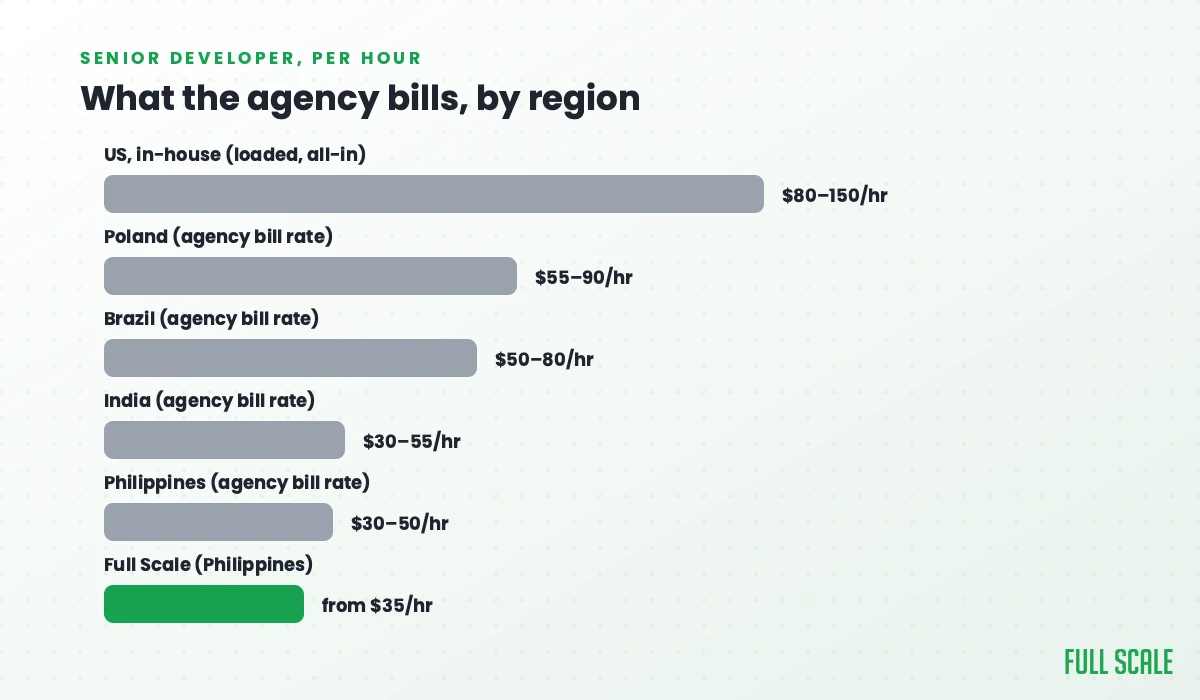
Here’s what senior developers bill by region, agency rate compared to what they take home locally. These are market ranges, not a single vendor’s quote, built from developer salary data plus the sourced 30 to 50 percent IT staffing markup, not a single billing-rate source (nobody has clean visibility into every agency’s invoice, so treat any table claiming otherwise with suspicion).
| Region | Developer takes home (hourly) | Agency bills the client (hourly) |
|---|---|---|
| Philippines | $20-30 | $30-50 (Full Scale: $35) |
| Vietnam | $18-30 | $30-50 |
| India | $20-35 | $30-55 |
| Romania | $30-45 | $40-60 |
| Ukraine | $30-50 | $40-65 |
| Mexico | $30-50 | $45-75 |
| Brazil | $25-45 | $50-80 |
| Poland | $35-55 | $55-90 |
| United States (loaded, in-house) | n/a | $80-150 |
The US row is a loaded cost for hiring in-house, not an agency bill rate, included so the offshore numbers have something to compare against. The Philippines sits at the low end on cost while still delivering strong English fluency and real-time overlap with US hours, which is worth more than it looks on a spreadsheet, especially against Vietnam, whose outsourcing to vietnam industry grew up serving Japanese and Korean clients more than American ones. For the fuller country-by-country breakdown, see our offshore rates by country guide; for the nearshore trade-off specifically, see nearshore vs offshore.
One more thing rate tables skip: a $4,000 monthly quote from one vendor isn’t the same $4,000 from another if one of them is skipping mandatory benefits and the other isn’t. If a vendor won’t say what’s inside the number, the number is the smallest problem in the room.
Picking the Right Model For Your Situation
Stop shopping for the lowest hourly rate. Shop for the model that matches how you want to run the engagement.
- A long-term product team you’ll keep extending for years. Fixed monthly all-in, through staff augmentation services built for exactly that. Predictable, embedded, nobody’s tracking hours.
- Short, scoped work with a defined end, a marketing site, a one-time integration, an Elasticsearch tuning project. Hourly, or straight project outsourcing. I’ve used both for exactly this kind of work and the hourly model was the right call both times, because the work had a stop date and I didn’t need a permanent WordPress person on staff.
- You want to interview and manage every hire yourself. Cost-plus, with full salary disclosure. You’re trading convenience for visibility.
- You’re in a regulated industry and finance needs cost lines split. Salary plus fixed fee. Cleanest fit when the books need salary on one line and fee on another.
- You need a few hours this week. A freelance platform. That’s not staff augmentation, and it shouldn’t be priced like it.
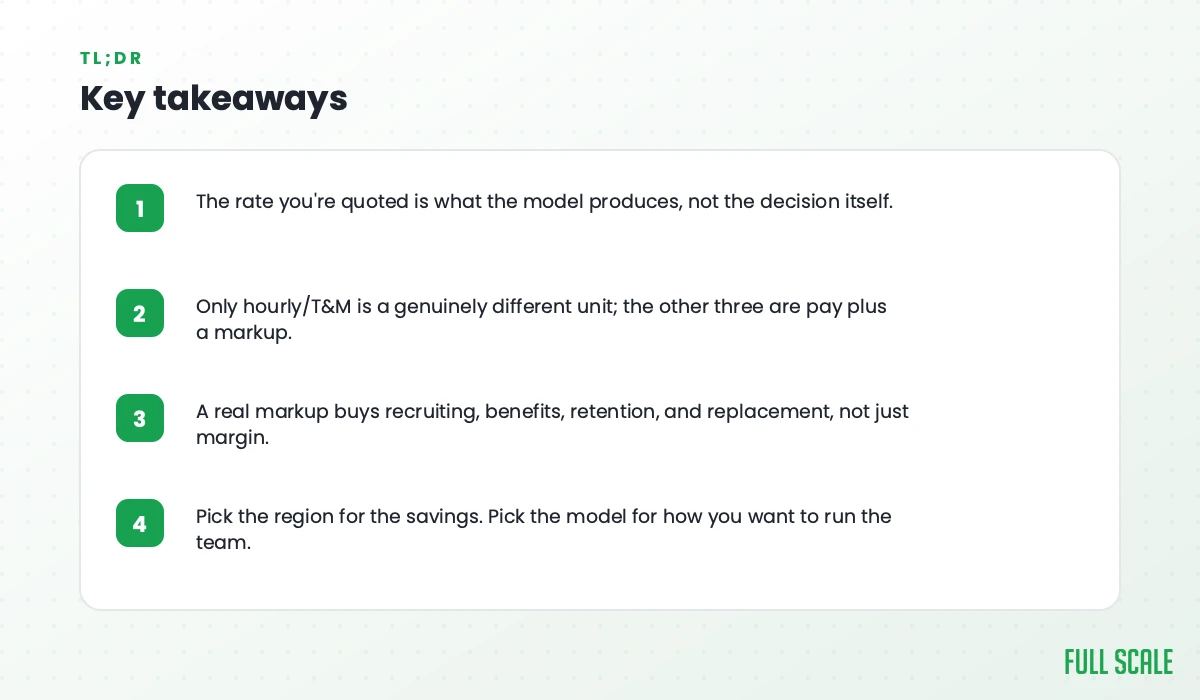
Pick the region for the savings. Pick the model for how you want to run the team. Most buyers argue about the hourly number instead, which is the part of this that matters least.
FAQ
What’s the difference between hourly (T&M) and cost-plus pricing?
Hourly, or time-and-materials, bundles salary, benefits, overhead, and margin into a single rate. You pay for hours, and you don’t see what’s inside them. Cost-plus discloses the developer’s salary and adds a percentage margin on top, so the fee scales with what the developer earns. A close cousin, salary plus fixed fee, discloses the salary the same way but charges a flat dollar fee instead, one that stays the same whether the developer earns $2,000 a month or $6,000.
What’s the best staff augmentation pricing model for a long-term team?
Fixed monthly all-inclusive, priced per developer. One predictable number, budgetable across quarters, no hour-tracking overhead. Hourly and cost-plus both add operational work that stops paying off once the engagement is measured in years instead of weeks.
What’s the typical markup on staff augmentation?
For IT and software roles specifically, usually 30 to 50 percent over the developer’s pay. General staffing (non-technical roles included) runs a wider 30 to 75 percent. If a vendor won’t tell you the markup, that’s often because the developer’s actual pay is lower than you’d want to know, and it shows up later as turnover.
How much does staff augmentation cost per hour?
Depending on region and seniority, senior developer billing rates run from around $30 to $90 an hour. A senior developer in the Philippines lands around $30 to $50 an hour, with Full Scale at $35. The same role hired in-house in the US runs $80 to $150 an hour on a fully loaded basis. Ask what the developer actually takes home before comparing two quotes as if they’re the same product. At the top of that $30-to-$90 band sit some nearshore staffing platforms, BairesDev among them, whose senior and specialist rates creep close enough to US in-house costs that the pricing model stops making sense, which is what our bairesdev pricing breakdown digs into.
Is staff augmentation cheaper than hiring in-house?
For comparable senior roles, offshore staff augmentation typically runs 50 to 70 percent cheaper than an all-in US hire, and the gap gets better every year the developer stays. The savings come from where the developer lives. How the vendor structured the invoice only decides how much of it reaches your budget. For the deeper finance-side math, see our in-house vs. outsourcing cost analysis. That’s the pricing side of the model; IT staff augmentation services covers the rest in plain English.
The Bottom Line
Global talent saves real money, and the region you pick decides how much there is to save in the first place. The pricing model you sign decides how much of that savings you get to keep. None of that math means anything if the proposal itself is vague about who’s actually doing the work.
If you want one number per developer, a team that’s still there in year three, and a markup you can ask about without getting a shrug back, that’s what we build at Full Scale. Schedule a call about the roles you need. Senior developers run $5,000 to $7,000 a month, hiring takes about two weeks, and nobody’s going to make you guess what St. Petersburg has to do with any of it.