
Why Bootstrapping Founders Need Offshore Development

In this article
- What bootstrapping actually means
- Why I’m a fan
- The hard parts nobody puts on the pitch deck
- For a software startup, engineering is the whole budget
- Why bootstrapping founders need offshore development
- How to keep the rest of your burn low
- Bootstrapped companies that made it big
- Is bootstrapping right for you?
- Frequently asked questions
- Build a team you can actually afford
Quick Answer: Bootstrapping means building a company on your own money instead of raising it from investors. For software founders, the hardest part is affording engineers: a senior U.S. developer can cost $180,000 to $250,000 a year, enough to eat a bootstrapped budget whole. Offshore developers do the same work for a fraction of that, which is why so many bootstrapped software companies are built with offshore teams. Staying bootstrapped also gives you more room in your exit strategy, since no investor clock is forcing a sale.
I’m a big fan of bootstrapping, and not in theory. I co-founded VinSolutions as a 22-year-old college dropout building software for car dealerships, and we bootstrapped it to $35 million in annual recurring revenue without raising a dime. That experience shaped how I think about building software as a startup on a tight budget. It also shaped how I would approach a tech startup business plan on a tight budget today.
So when I tell you bootstrapping works, I’ve lived it.
But if you’re building software, one number decides whether you make it: what it costs to build the product. Engineers are the most expensive thing a software startup buys, and they’re the reason most bootstrapped tech companies run out of road.
I got around that with offshore developers, and it’s the single biggest reason I still tell software founders to bootstrap.
That’s the thread running through this whole guide. But first, the basics.
What bootstrapping actually means
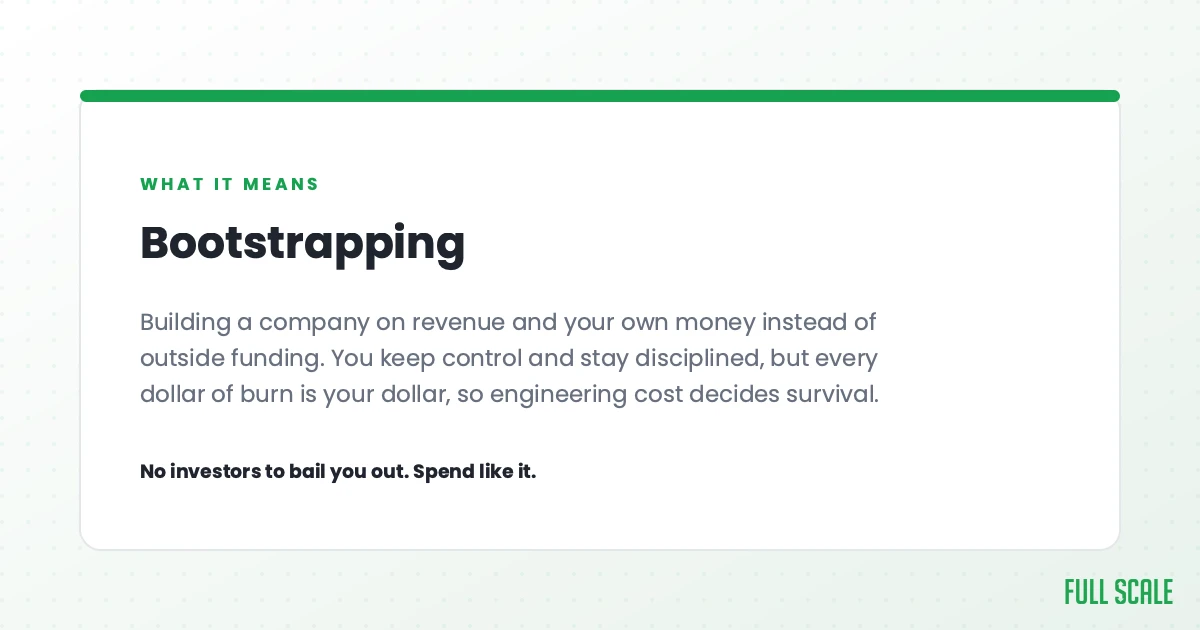
Bootstrapping means starting and growing a business without outside funding. That means no venture capital, no angel investors, and no bank loan hanging over you. You use your own savings, the revenue the business throws off, and a lot of resourcefulness to keep the lights on.
The word comes from the old phrase “pull yourself up by your bootstraps,” which described doing something hard with nothing but your own effort. That’s the spirit. You’re the only investor, so every decision is yours and every dollar comes out of your pocket.
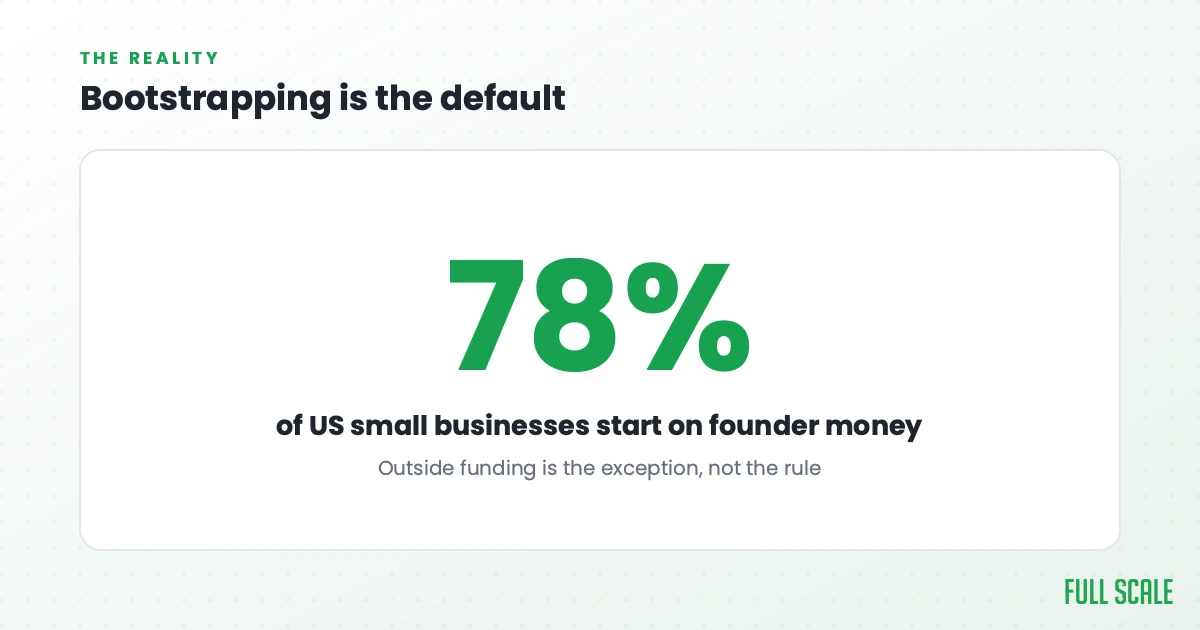
This is far more common than the funding headlines suggest. About 78% of small businesses in the United States start with the founder’s own money rather than outside capital, according to the U.S. Chamber of Commerce. Raising a round is the exception, not the rule. It just gets all the press.
Here’s the quick contrast between the two paths.
| Bootstrapping | Raising capital | |
|---|---|---|
| Money source | Savings and revenue | Investors |
| Who owns it | You | You and your investors |
| Growth speed | Slower, steady | Faster, fueled by cash |
| Pressure | Pay the bills | Hit investor return targets |
| Best for | Lean, revenue-friendly businesses | Capital-heavy or land-grab markets |
Why I’m a fan
The first reason is control. When you bootstrap, you own the whole thing and answer to no one. You can change your product, your pricing, or your entire business model on a Tuesday afternoon without asking a board for permission. Nobody is pushing you to grow faster than is healthy just to juice their return.
Bootstrapping also forces a discipline that funded companies almost never develop.
I learned this the hard way at Stackify, my second company. We spent $10,000 sponsoring a developer conference for a big product launch and walked away with zero new customers. The product didn’t resonate, and we found that out only after we’d written the check. When the money is yours, you ask the cheap question first: does anyone actually want this? Bootstrappers validate before they spend, because they have no choice. It’s the same idea I ended up writing a book about, Product Driven.
That constraint is a feature.
A bootstrapped company tends to find product-market fit faster, because survival depends on real customers paying real money, not on the next round of funding. You feel the market’s answer immediately. And when you don’t give away equity early, whether to an investor or by paying a developer in equity to build the product, the company you build stays yours to sell, run, or hand down.
The hard parts nobody puts on the pitch deck
I’m a fan, but I won’t pretend bootstrapping is easy. It’s brutal in ways funded founders never feel.
Growth is slow when you can only spend what you earn. A competitor who just raised $10 million can outspend you on marketing, hiring, and product for years while you claw forward one customer at a time. You also wear every hat. Sales, support, accounting, hiring, and the actual work all land on you, and the financial risk is yours alone.
Bootstrapping is the right call for most businesses, but not for all of them.
Some companies genuinely need a pile of money on day one. If you’re building biotech, hardware, or anything capital-intensive, or you’re in a winner-take-all market where the first company to scale wins everything, going it alone can sink you. In those cases, raising money or joining a startup accelerator is the smarter starting point. Be honest about which kind of business you’re building. Getting that wrong is one of the bigger risks a startup faces.
But for most software companies, it comes down to one number.
For a software startup, engineering is the whole budget
Here’s the part that matters most if you’re building a tech or software company. For almost every startup I’ve seen, the single largest expense is engineering. Developers are expensive, and a bootstrapped budget feels that more than anyone.
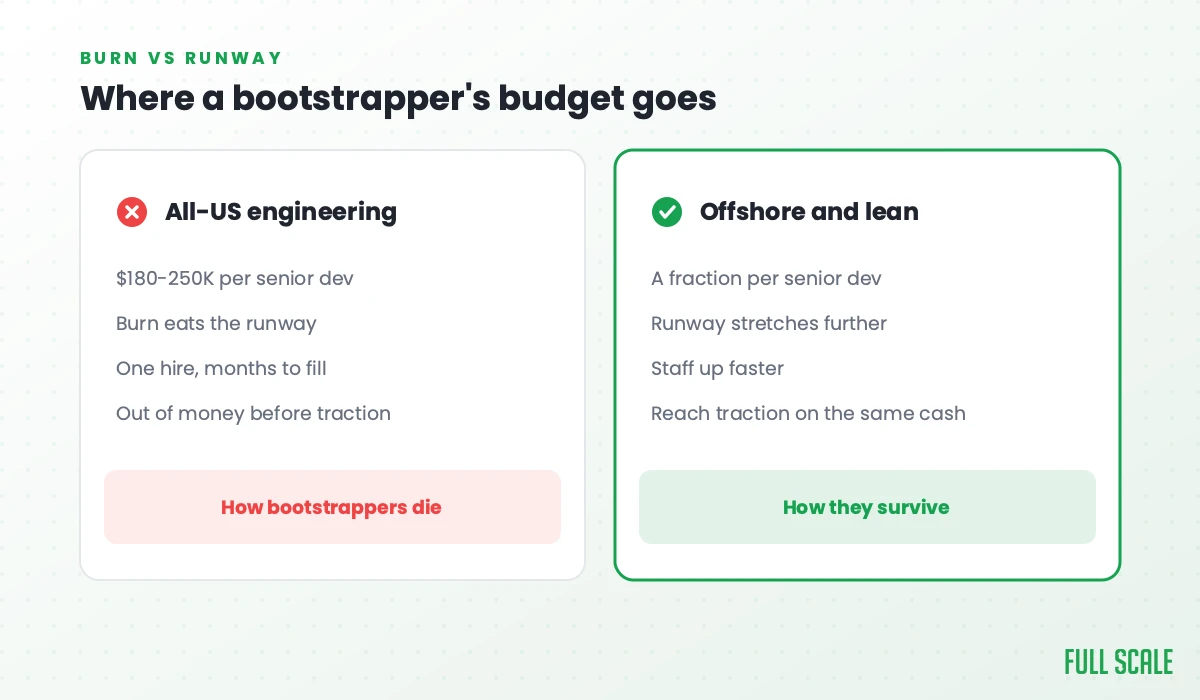
A senior software developer in the United States runs $180,000 to $250,000 a year once you add benefits, payroll taxes, and equipment. For a bootstrapper, that one hire can be the whole budget. And a real product usually needs more than one engineer.
That’s the wall most bootstrapped software companies hit. The idea is usually fine and the market is real. They just can’t afford to build fast enough on their own savings, so they stall out while a funded competitor ships. It is the single biggest reason startups outsource their software development instead of waiting until they can afford local hires.
This is the problem offshore development solves.
Why bootstrapping founders need offshore development
This is the lever I care about most, because it’s the one I’ve used myself.
At Stackify I built a team of more than 20 developers in the Philippines, and that team kept our costs low enough to keep building. It was a real part of why we exited in 2021. Offshore developers cost a fraction of their U.S. counterparts, often less than half, for the same skill and the same hours. The work got done, the burn stayed manageable, and I didn’t have to give away a slice of the company to pay for it.
That experience is the entire reason Full Scale exists. Founders kept asking me how I’d built a strong, affordable team overseas, so we turned it into a company that does it for them.
The reason this works isn’t that the talent is cheaper. It’s that the cost of living is lower. A developer in Manila earns a great living on a rate that would barely cover rent in San Francisco. Some people will call cross-border hiring exploitation, but a stable, full-time job at a strong wage is life-changing for the engineer taking it, and you can pay well and still spend far less than a U.S. salary.
For a bootstrapped founder, that math is the difference between making it and stalling out. The same savings that buy you one U.S. developer can buy a small team in the Philippines, which means you ship a real product instead of a half-built one.
Do it as a dedicated team, not a handoff to an outsourcing firm
There’s a right way and a wrong way to go offshore. Most offshore work fails when a founder hands a pile of requirements to an outsourcing shop and waits for magic. The fix is to hire developers who work directly for you, full-time, the way your local employees would.
That’s the model I’d point any bootstrapper to. You can hire offshore developers in the Philippines who join your team and your standups, or build a dedicated offshore team that reports to you instead of disappearing behind a project manager. Done this way, offshore development is the closest thing a bootstrapped software founder has to a cheat code.
How to keep the rest of your burn low
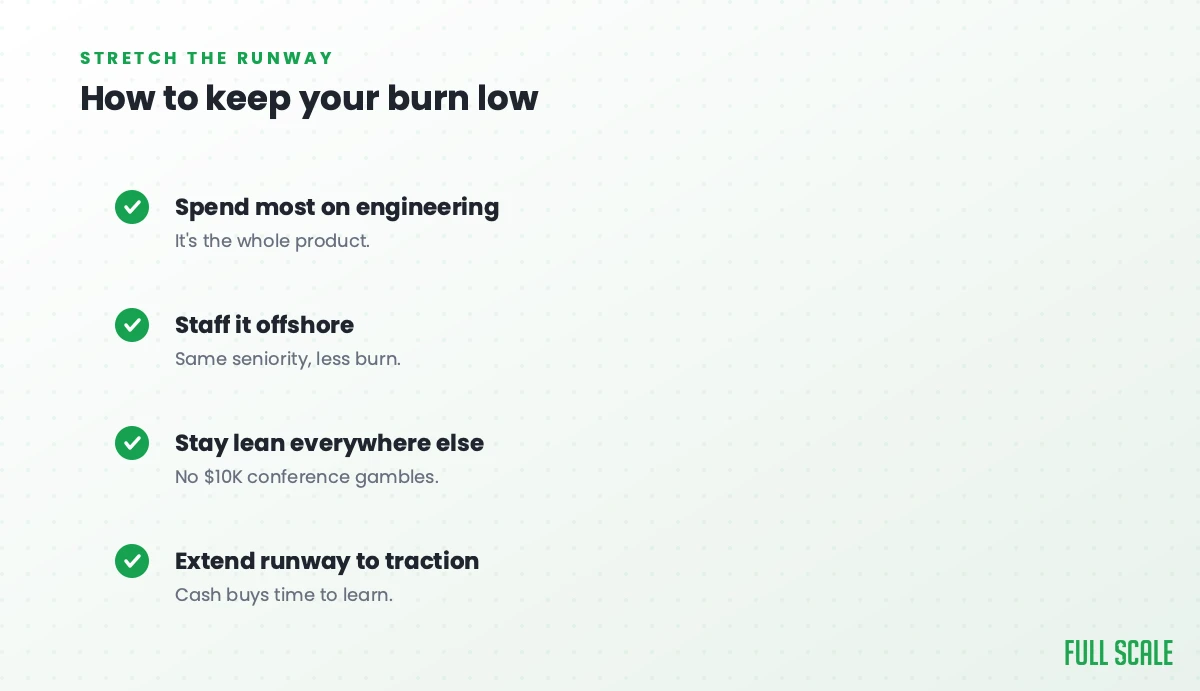
Offshore is the biggest lever, but the lean mindset has to run through everything else too.
Start with a lean plan instead of a 40-page business document. A one-pager that names your customer, your product, and your basic numbers is enough, and it’s easy to change when you learn something new. You will change it.
Keep your fixed costs near zero for as long as you can. Skip the office and work from home. Use the laptop you already own. Question every recurring charge, because subscriptions are where lean budgets quietly bleed out. There are plenty of other ways to lower your startup costs before you spend a dime you don’t have to.
Keep your day job longer than feels comfortable. A paycheck is the cheapest funding you’ll ever get, and it buys you runway while the business finds its feet.
Spend only on what’s been validated. That’s the Stackify lesson again. Money goes toward what customers have already asked for. Everything else waits.
Bootstrapped companies that made it big
Plenty of household names never took a dime of venture money, at least not early.
Mailchimp is the cleanest example. The founders bootstrapped it for two decades and sold to Intuit for around $12 billion in 2021 without ever raising outside capital. Every dollar of that exit stayed with the people who built it.
Basecamp stayed small and profitable on purpose, funding itself on revenue and turning into a quiet cash machine instead of chasing scale. Spanx founder Sara Blakely started with $5,000 of her own savings and kept full ownership all the way to a billion-dollar valuation. Even Atlassian ran on a credit card in its early days before it became one of the biggest software companies in the world.
The thread connecting them is patience. They grew at the speed their revenue allowed, kept control, and let the business compound.
Is bootstrapping right for you?
Run through a few honest questions before you decide.
- Can your business start small and earn revenue early, or does it need a big spend just to launch?
- Do you want full control more than you want speed?
- Can you stomach being the only person on the hook financially?
- Is your market a slow build, or a race where the first to scale wins?
If you can start lean and you’d rather own the whole thing than grow on someone else’s timeline, bootstrapping is probably your path. If your idea needs serious capital just to exist, raising money is the honest answer.
And if you’re bootstrapping software, deciding to bootstrap is the easy part. Affording the engineering is the real test, and that’s the one offshore development is built to pass.
Frequently asked questions
What is bootstrapping in simple terms?
Bootstrapping is starting a business with your own money instead of money from investors. You fund it with savings and the revenue the business earns, and you grow only as fast as that cash allows.
What does it mean when a company is bootstrapped?
A bootstrapped company was built without outside funding. The founders kept full ownership and financed growth themselves, so there are no investors holding equity or pushing for a return.
How can a bootstrapped startup afford software developers?
The most effective move is hiring offshore developers, who cost a fraction of U.S. engineers for the same work because the cost of living where they live is lower. A bootstrapper’s savings stretch two or three times further with a dedicated offshore team than with a single local hire.
Is bootstrapping better than raising venture capital?
It depends on the business. Bootstrapping wins when you value control and your company can earn revenue early. Raising capital wins when you’re in a capital-heavy industry or a winner-take-all market where speed decides who survives.
What is bootstrap financing?
Bootstrap financing is funding a business from internal sources rather than external ones. That means personal savings, revenue, customer prepayments, and keeping costs low, instead of loans or investor money.
What are some examples of bootstrapped companies?
Mailchimp, Basecamp, Spanx, and Atlassian all grew without early venture funding. Mailchimp is the standout, selling to Intuit for around $12 billion in 2021 without ever raising a round.
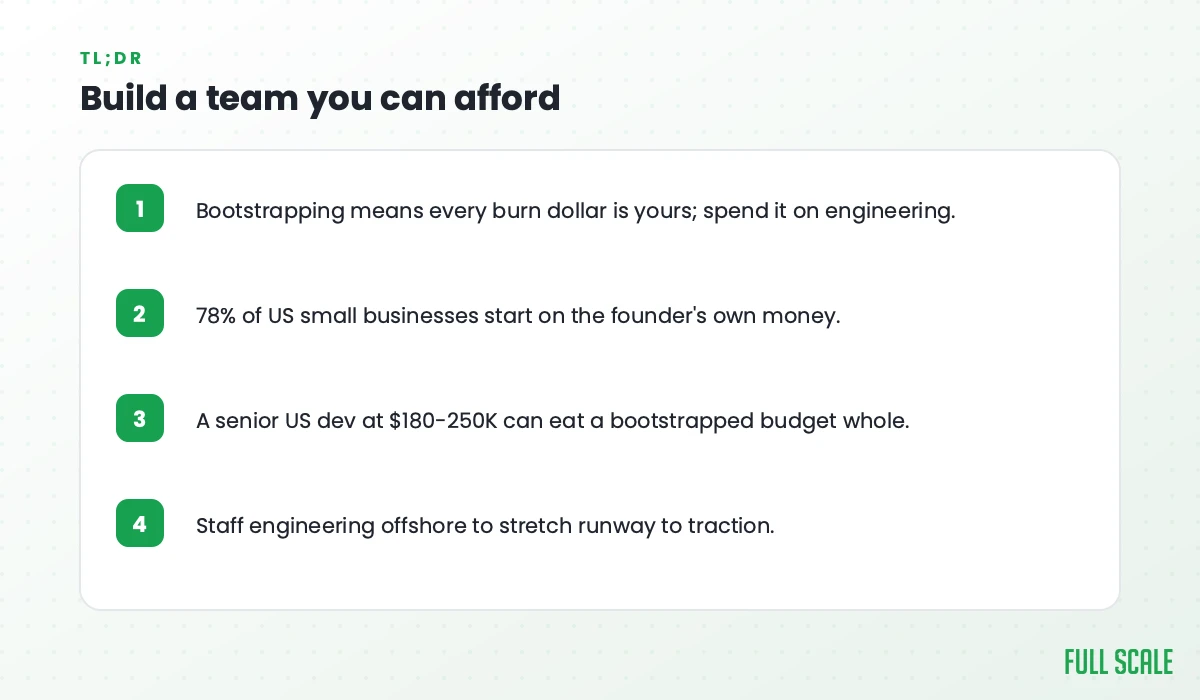
Build a team you can actually afford
If you’re bootstrapping a software company, your developers will be your biggest cost and your biggest constraint. Full Scale helps founders build affordable, dedicated engineering teams in the Philippines so you can keep growing without burning through your savings. Book a call and we’ll help you figure out the right team for your budget.