
How to Outsource Software Development Successfully

In this article
- First, decide what you are outsourcing
- How to outsource a scoped project
- How to outsource your product (the part people get wrong)
- Offshore, nearshore, or onshore: where matters less than how
- How to successfully outsource software development: the keys that make it work
- The bottom line
- Frequently asked questions
I get a version of the same phone call every few weeks. A founder, frustrated and a little panicked, tells me he paid an agency to build his product, the thing his whole company runs on. The demo looked great. Then, about eight months in, the team that built it had quietly rotated onto other clients, nobody left at the shop actually understood his codebase, and every small change took weeks and a new invoice.
He asks me how to find a better outsourcing company. It helps to see which companies actually outsource software to the Philippines before you decide.
I tell him the company wasn’t really his problem. The model was. Once you sort that out, how to choose a software development outsourcing company gets a lot simpler. If you are weighing where to do it, IT outsourcing in the Philippines is the option I keep coming back to.
That call is the whole reason this article exists. Almost everyone asks how to outsource software development as if it were one decision: find a vendor, write a spec, hand it off, wait for software to come back. That framing is exactly why so much outsourcing ends in a rebuild. It is the same hand-off mistake behind most of the India outsourcing failure stories founders trade. Learning how to successfully outsource software development starts one step earlier than picking a partner, with a question most founders skip entirely. Answer it well and you start to see why IT outsourcing is worth it in the first place. It also helps to see how other companies pulled it off, like these companies that outsourced the right way.
I have been hiring engineers outside the US for almost twenty years. At Stackify I built teams in Russia, Uruguay, Colombia, and the Philippines, and I outsourced scoped projects too, WordPress builds and an Elasticsearch integration I didn’t want to staff for. Some of those bets worked and some of them taught me expensive lessons. Since 2018 I have run Full Scale, where we run dedicated engineering teams in the Philippines in a staff augmentation model. So I sell this for a living, and I am going to be honest about it anyway: the difference between outsourcing that works and outsourcing you have to throw away has very little to do with the country, the rate, or even the vendor. It comes down to one thing the founder on the phone got backwards.
What were you actually outsourcing? There are two completely different jobs hiding under the same word, and the model that wins at one is the model that wrecks the other. If you want the longer version, here is how to choose a software outsourcing model start to finish.
Quick answer: Outsource a scoped project (finite, well-defined work you can put in a statement of work) with a fixed-price shop. Outsource your ongoing product with staff augmentation or a dedicated team you manage like your own. That choice is the whole point of choosing the right offshore development model. Pick the wrong model for the work and no vendor on earth will save the engagement. When the stack is .NET, the team route means you hire remote ASP.NET developers rather than hand the whole project to a vendor.
First, decide what you are outsourcing
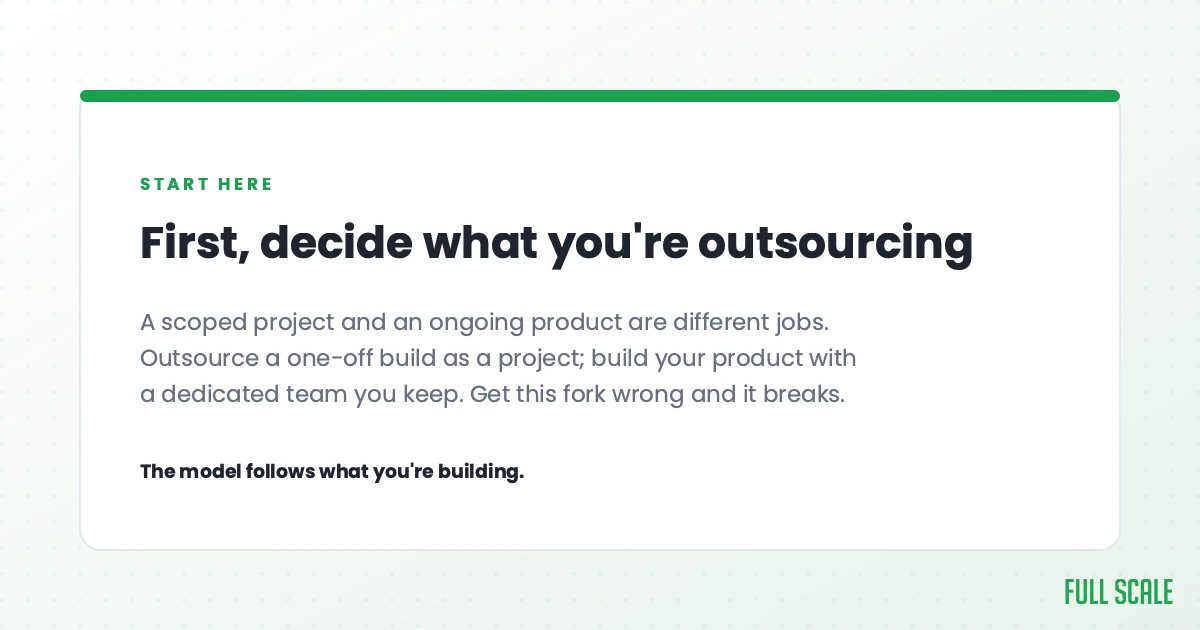
Before you compare vendors or rates, answer one question: are you outsourcing a scoped project or your ongoing product?
A scoped project, the kind you can capture in a statement of work (SOW), is finite. You know exactly what it is, you will be done when it ships, and you do not need to keep the knowledge afterward. Think a marketing site on WordPress, an Elasticsearch integration, or a one-off data migration. I have outsourced plenty of these over the years on a per-project basis, and it was exactly the right call.
Ongoing product work is the opposite. It is the software your business runs on, the thing you will iterate on for years, the codebase where this quarter’s decisions become next year’s foundation. The work never really finishes, and the knowledge your team builds up is most of the value. That founder’s mistake was simple: he treated his product like a scoped project, bought a deliverable, and was shocked when the knowledge walked out the door with the team.
Three questions sort almost any task into one bucket or the other:
- How long will you need the work? Weeks means project. Years means product.
- Is it core to your business? If it is the thing customers pay you for, it is product.
- Do you need to keep the knowledge? If the people doing it walking away would hurt, it is product.
Get this diagnosis right and the rest of the decision makes itself. Get it wrong, and you will apply the cheap, hands-off project model to your actual product and spend the next year paying for it.
Whether to outsource at all is its own decision. This one comes right after it: given that you are going to outsource, what kind does the work actually call for?
How to outsource a scoped project
If the work really is a scoped project, this is the easy case, and I am not going to overcomplicate it for you.
Project-based outsourcing is fine here. A fixed-scope, fixed-price arrangement with a freelancer or an agency does the job. You can even, carefully, hand it over the wall, because the wall is short and the work on the other side of it is well-defined. You are buying a deliverable here, and the relationship ends the day it ships. For that kind of quick, scoped task a freelance marketplace is the right tool, and the best Toptal alternative depends on the job in front of you.
A few things still matter:
- Write the scope down in detail. Fixed price only protects you if the scope is genuinely fixed. Vague requirements turn into change orders and arguments, and I have watched loose scopes balloon well past the original quote more times than I can count.
- Define what “done” looks like before anyone starts, including acceptance criteria you can actually test against.
- Use standard, open technology. Even on a one-off, do not let a shop build it on a proprietary framework only they understand. The day you need to change it, you want any developer to be able to read it.
- Get the basics in writing, an NDA and clear ownership of the code, so the thing you paid for is unambiguously yours.
That is most of it. The trouble starts when people take this same playbook (pick a vendor, write a spec, hand it off) and point it at their actual product.
How to outsource your product (the part people get wrong)
Here is where the over-the-wall model breaks, and it breaks the same way almost every time. It is the story I opened with.
You hire a project shop. You work through a project manager. The developers writing your code are walled off behind that one person, so they can never ask you why, only what. In a lot of offshore shops this is by design: you only ever talk to the technical project manager, and every other developer hides behind that person, sometimes because of an English gap, sometimes because of a cultural rule about who is allowed to talk to the client. Either way, you have a team you cannot actually communicate with and a middleman in the way of every decision. They build the literal request instead of the right thing, small misunderstandings compound, and the people who learned your product roll off to the next client the moment the contract ends, taking everything they learned with them.
The two failure modes I see over and over are no direct line to the developers and no engineering leadership on your side making sure the work is actually right.
The model that fixes both at once is staff augmentation: a dedicated team that works full-time on your product and is managed like your own employees, even though they sit in another country. The vendor handles payroll, benefits, HR, and equipment, so you get the cost advantage of offshore without running an entity overseas. But the relationship looks nothing like a project shop. The developers join your standups, live in your Slack, and learn your customers. It looks like your team because it is your team. That is the real difference between staff augmentation and traditional outsourcing: you keep the team and the knowledge it built, where a project shop hands you a deliverable and moves on. It’s the same model behind our web app development company practice, where engineers work in your standups and your tools from day one.
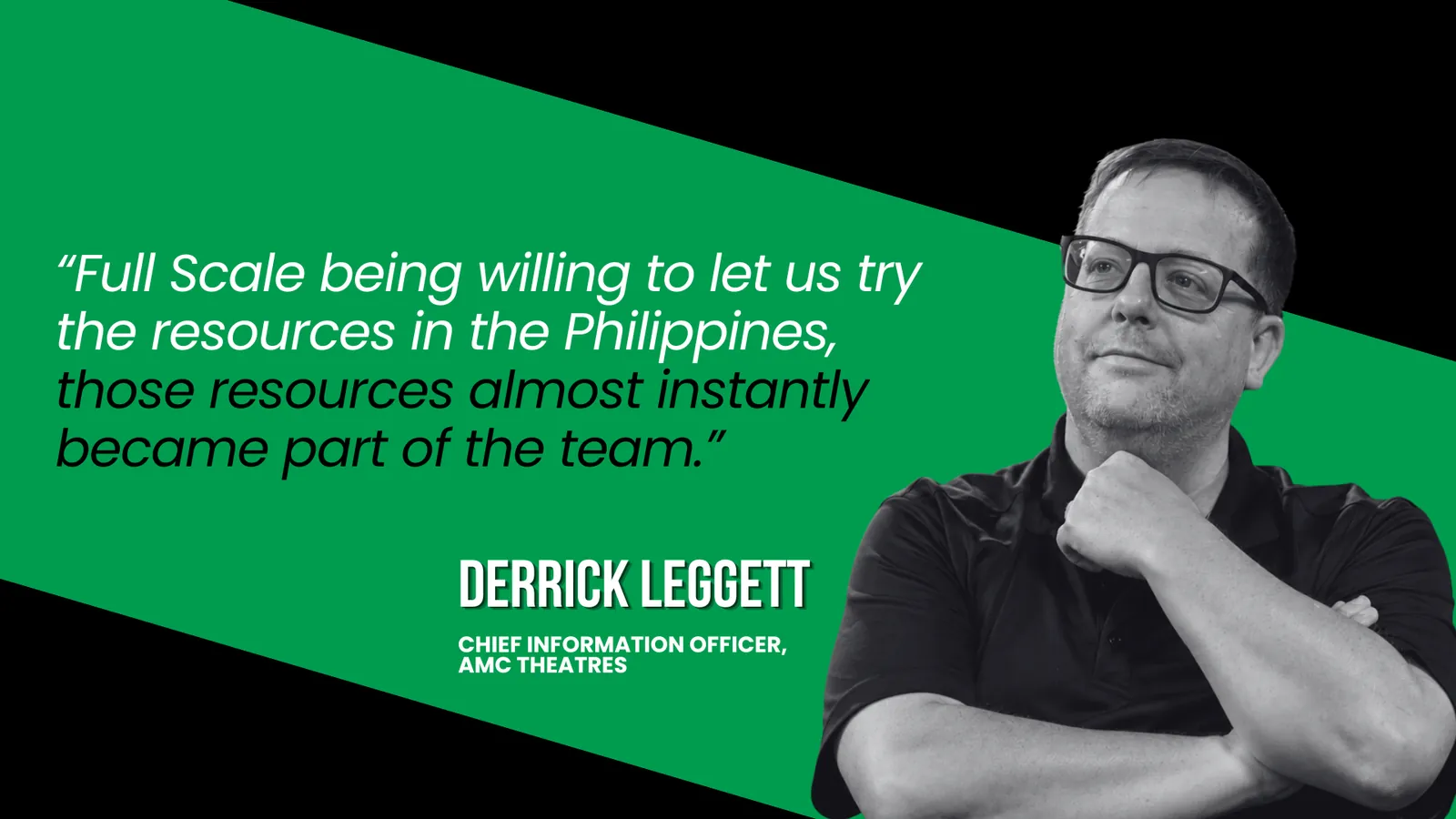
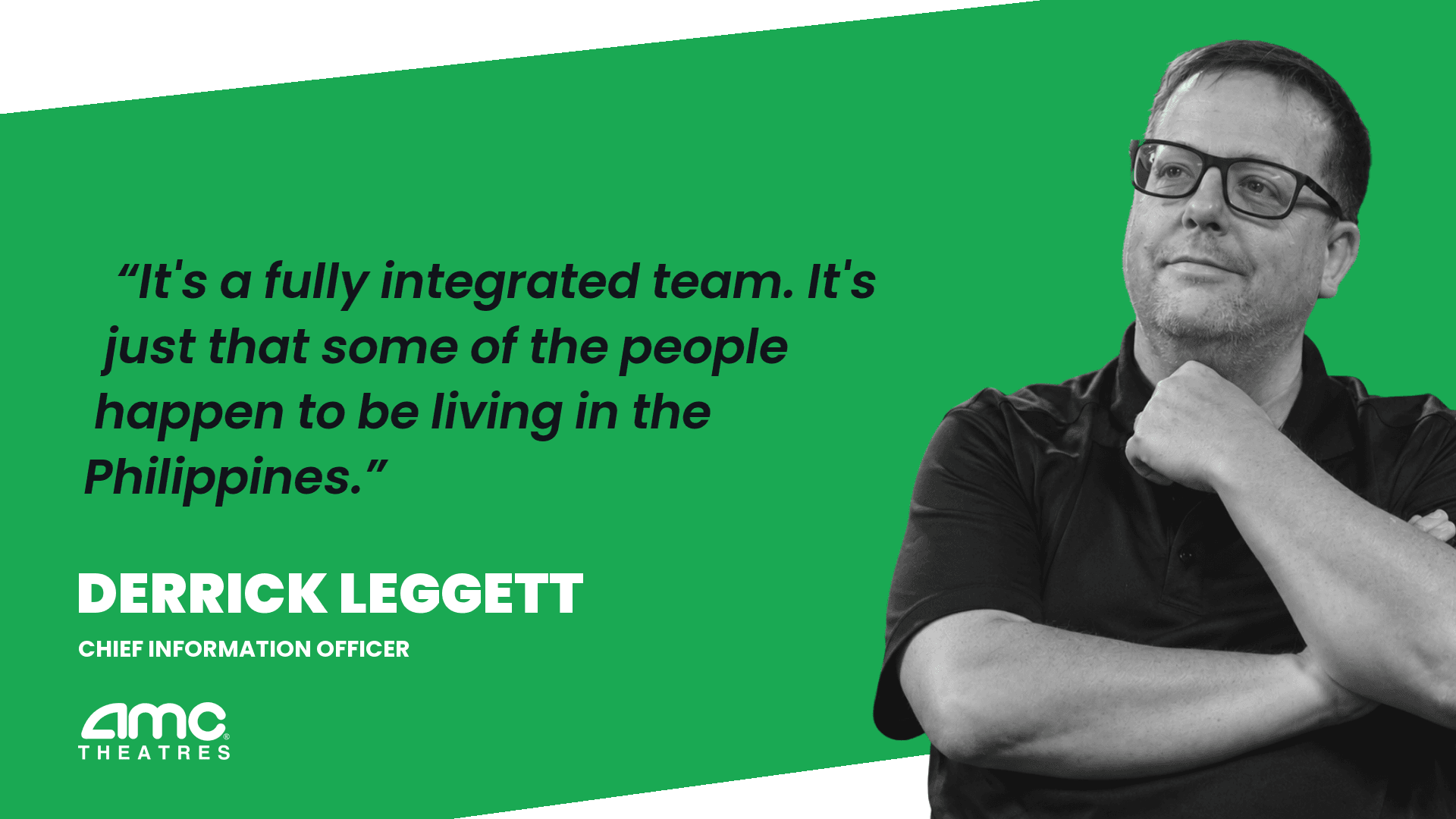
My client AMC Theatres runs their Full Scale engineers as one integrated team alongside their US staff. Their CIO, Derrick Leggett, describes it best: “It’s a fully integrated team. It’s just some of the people happen to be living in the Philippines.” There is no us and them, which is exactly why the engagement has lasted years instead of ending in a rebuild.
The version of offshore that works is the one that feels the least like offshore.
| Scoped project (SOW) | Ongoing product | |
|---|---|---|
| Best model | Project-based / fixed price | Staff augmentation / dedicated team |
| Pricing | One project fee | Fixed monthly per engineer |
| Communication | Through a PM is fine | Direct to every engineer |
| What you’re buying | A deliverable | A team that stays |
| Over-the-wall handoff? | Acceptable | Fatal |
The point here is narrower: match the model to the work, and you have already avoided the most expensive mistake in outsourcing. If .NET is the stack in question, our guide to outsourcing .NET development
Offshore, nearshore, or onshore: where matters less than how
The other question everyone asks about how to outsource software development is where. Onshore is hiring in your own country. Nearshore puts the team a few time zones away at most, somewhere like Latin America if you are based in the US, while offshore means somewhere far, the Philippines or Eastern Europe. I have hired across most of these. At Stackify I had developers in Uruguay and Colombia, which is nearshore, and in Russia and the Philippines, which is offshore.
Here is what location actually decides: your hourly rate and how many hours you overlap each day. Nearshore costs more and hands you close to a full day of overlap. Offshore in the Philippines runs 50 to 70 percent below US rates and, set up right, still gives you a solid half day together. What location does not decide is whether the engagement works. I have watched nearshore teams fall apart and offshore teams thrive, and the difference was always the model and the communication, never the map.
So pick the place that gives you enough overlap at a rate you can sustain, then spend your real energy on how you run the team. If you want the deeper version of that tradeoff, we broke down offshore versus nearshore on its own.
How to successfully outsource software development: the keys that make it work
Once you have picked the dedicated-team model for product work, a handful of things separate an engagement that lasts from one you will regret. None of them are complicated. Most founders just skip them.
I broke these down in a video on the dos and don’ts of offshore development, based on twenty years of building these teams. It is worth ten minutes if you are about to do this:
Watch “The Do’s and Don’ts of Offshore Software Development” on YouTube
Here is the short version of what makes it work.
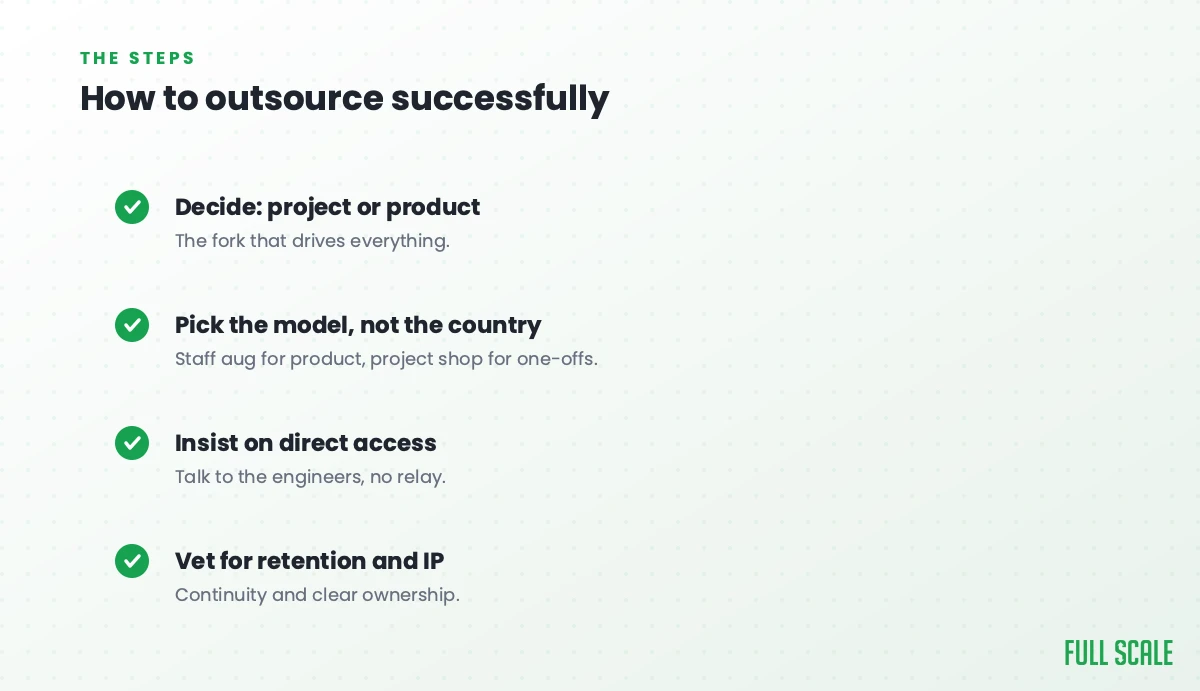
Insist on direct access to the actual developers. An account manager who relays messages does not count. If a vendor will not let you talk to the people writing your code, walk away. Every clarification that has to pass through a middleman turns into a two-day game of telephone, and context dies in transit. Software development is about communication more than anything else, and you cannot communicate with someone you are never allowed to talk to.
Get real overlap in working hours. You need at least three to four hours of overlap with your team every day, and a good vendor shifts their team’s schedule to your hours rather than asking your US engineers to take 9 p.m. calls. Half a day of overlap is enough for standups, breakout calls, and the 1-on-1s that actually build the relationship. Without it, every question costs you a full day and momentum dies. This is one reason I keep coming back to the Philippines: it is the third-largest English-speaking country in the world, so the overlap you get is real working time instead of a translation layer in between.
Give them goals, not tickets. This matters more in 2026 than it ever has. The order-taker engineer whose whole job was implementing a pre-chewed ticket is the one AI is replacing first. What survives is the engineer who can take an ambiguous goal and own the outcome. As I argue in my book, Product Driven, engineers who think like owners outperform the ones who wait for tickets. So hand your team the problem and let them propose the solution. If they just nod and build whatever you say, you do not have engineers, you have typists.
Communicate deliberately. When you are managing a distributed team, there is no office where the vision spreads by osmosis. You have to put it in front of every engineer, on purpose, constantly. Keep your language clean, get to the point, and lean on video and short Loom recordings over walls of text. Most of what derails a remote engagement is not a skill gap, it is a vision gap nobody noticed until the wrong thing shipped.
Check whether the vendor can keep its own people. Turnover is the silent killer, because every engineer who leaves takes context with them, exactly what happened to the founder I opened with. This matters even more offshore: contact-center and outsourcing attrition in the Philippines has run as high as 30 to 40 percent a year industry-wide, so retention is one of the numbers I watch most closely. Full Scale is Great Place to Work Certified, with 95% of our team calling it a great place to work versus 65% at a typical company, and our developer retention runs above 93%. That is not a vanity stat. It is why the same developers are still on your project two years in.
Keep your own engineering leadership. Staff augmentation works because you still own the vision, the priorities, and the architectural calls. A dedicated team extends your leadership rather than replacing it. If nobody on your side is making sure quality and process actually happen, even a great team will firefight forever.
The bottom line
If there is one thing to take from this, it is that the secret to how to successfully outsource software development is being honest about what you are outsourcing. If it is a scoped project, finite, well-defined, a clean statement of work, hire a project shop, scope it tightly, and move on. If it is your product, the thing you will live with for years, do not throw it over a wall. Build a dedicated team you manage like your own, give them direct access and real overlap, hand them goals instead of tickets, and pick a partner who keeps their people.
The cheapest option that produces software you have to rebuild is the most expensive choice you can make.
The founder I described at the top learned that the hard way. He is rebuilding now, this time with a team he actually talks to.
If you want help figuring out which model fits what you are building, and, if it is product work, what a dedicated team for your stack would look like, that is exactly what we do. Full Scale builds and manages dedicated development teams in the Philippines that integrate with your engineers and stay for the long haul. Tell us what you are building and we’ll show you engineers who could start this week, and we’ll skip the sales deck.
Book a discovery call with Full Scale
Frequently asked questions
What is the best way to outsource software development?
How to outsource software development depends entirely on what you are outsourcing. For a scoped project (a statement of work), a fixed-price arrangement with a freelancer or agency works well. For ongoing product development, the most reliable model is a dedicated offshore team that works full-time on your product and is managed like your own staff. You talk to the developers directly, they learn your customers, and the vendor handles payroll and HR, combining the cost advantage of offshore with the close collaboration of an in-house team. Ruby on Rails is a good example: outsource Ruby on Rails development as a project contract and you risk inheriting convention-violating code that fights the framework; staff aug the same engineers and they make the conventions work for you.
How do I successfully outsource software development without getting burned?
Most failures come from treating outsourced developers like a vending machine: write requirements, throw them over the wall, wait for software. The fixes are direct communication with the actual engineers, a few hours of daily time-zone overlap, giving the team goals instead of pre-broken-down tickets, and choosing a partner with low turnover so knowledge does not walk out the door.
Should I outsource a scoped project or hire a dedicated team?
Outsource as a scoped project when the work is well-defined, short-term, and not core to your business. Use staff augmentation or a dedicated team when the work is your actual product, will continue for years, and you need to retain the knowledge. Picking the project model for ongoing product work is the single most common and most expensive outsourcing mistake. That same rule governs outsourcing Python development: Python work that will keep evolving belongs in a staff augmentation model, not a project contract. Laravel is a good example of where that rule is especially strict: outsourcing Laravel work as a project contract exposes you to PHP’s largest cheap-end talent pool, which is also the spaghetti-code risk pool. Angular is the clearest example of where that rule matters most: outsourcing Angular work as a project contract exposes you to DI misuse and RxJS subscription leaks that compile cleanly and compound silently until the service layer needs to be rewritten.
How much does it cost to outsource software development?
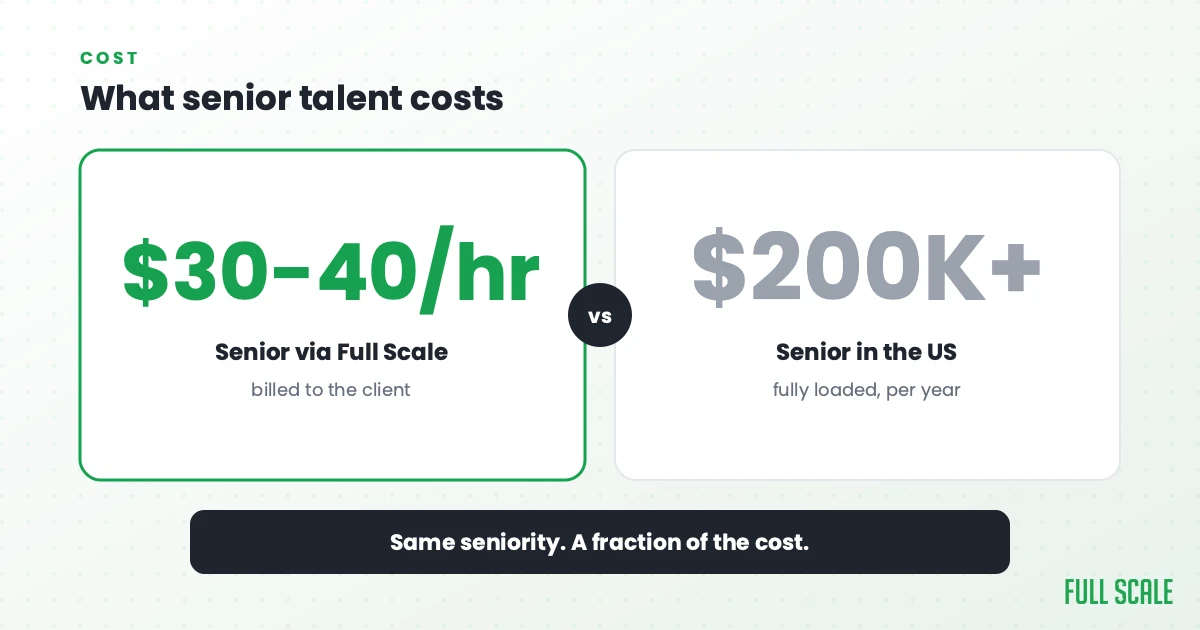
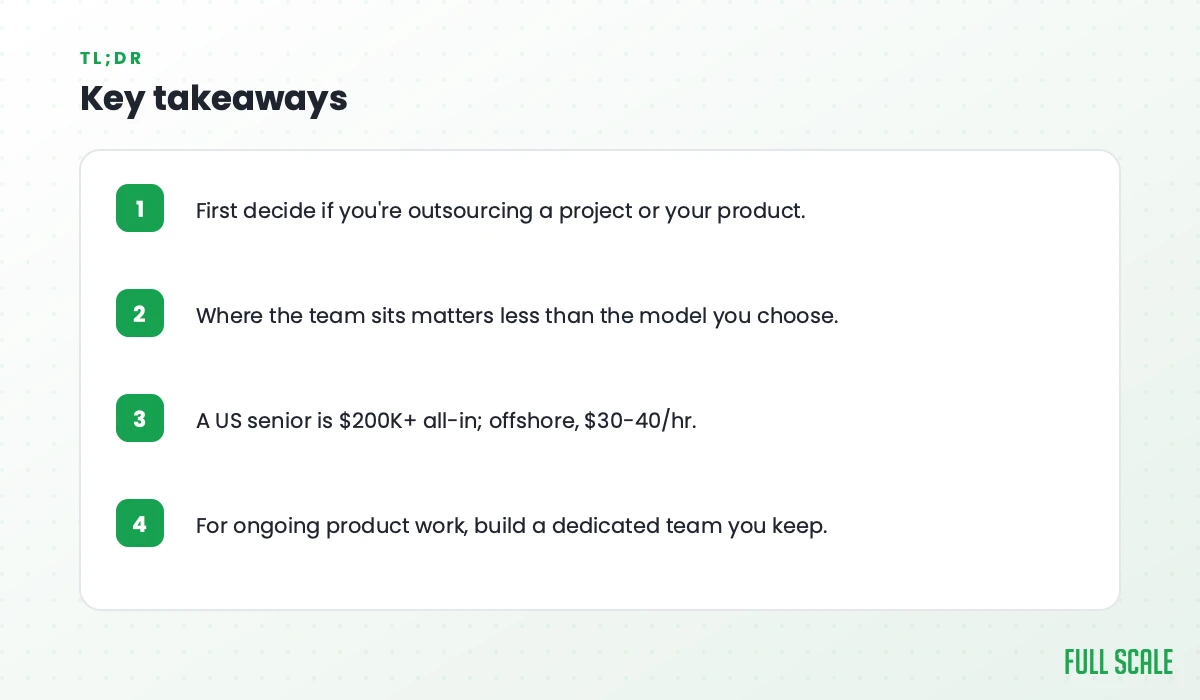
Start with what you are comparing against. A senior US software developer earns a base salary of roughly $150,000 to $185,000, and once you add benefits, payroll taxes, equipment, and overhead, the fully loaded cost is about 1.25 to 1.4 times that, which lands a senior hire north of $200,000 a year. A senior engineer on a dedicated offshore team in the Philippines typically bills in the range of $30 to $40 an hour, which is how offshore teams come in 50 to 70 percent below US rates. But the hourly number is not the real cost. Add your management time, the ramp-up while the team learns your product, and any rework from miscommunication. A fair rate with a team that stays beats a cheap rate with high churn every time.
What is staff augmentation in software development?
Staff augmentation means adding dedicated developers to your existing team rather than handing a whole project to a vendor. The engineers work only on your product, full-time, and you manage them like your own employees while the partner handles employment, payroll, and HR. It is the model that fixes the control and continuity problems that wreck traditional project outsourcing. If your stack includes .NET, the same model breakdown applies to offshore .NET development: a project shop that hands back a deliverable and a staff-augmentation team that integrates with your engineers are fundamentally different engagements.