Offshore React Development – Hire Trusted, Affordable Talent from the Philippines

In this article
- The One Structural Choice That Determines Offshore React Success
- The 7 Reasons Offshore React Projects Fail
- The Full Scale Direct Integration Model for React
- The 5-Stage Vetting Process: Finding Senior React Engineers
- The 7-Day Integration Framework for React Teams
- The Real Cost of Offshore React Development
- The React Codebases That Offshore Best
- When Offshore React Development Makes Sense
- When It Doesn’t Make Sense
- Common Objections
- Why Full Scale for Offshore React Development
- Frequently asked questions
I have been shipping software for twenty-plus years, and I have watched the frontend go through four or five framework generations. jQuery. Backbone. Angular 1. Ember. The churn was constant.
React won because it took component thinking seriously. The modern React toolkit (hooks, Suspense, Server Components, Next.js, TanStack Query, TypeScript) is what most serious product teams build their interfaces on today. I know this not just from placing React developers offshore but from building with it myself. The website you’re reading right now was built by Full Scale on React and Next.js. Replacing WordPress with a Next.js site was one of my favorite things I’ve ever done. It also shapes how we think about what a React developer actually does now.
So when companies ask whether offshore React development works, I have a specific answer, not a generic “yes, with the right partner” answer. I know what a senior React developer actually looks like, what breaks in React production systems, and what the wrong engagement model does to a React codebase. Many of those React codebases are really Next.js apps, so teams hire dedicated Next.js developers who know the App Router, not just React. Before you bring one on, know how to interview front-end developers in the AI era.
Here’s what most companies get wrong.
What you’ll learn in this guide:
- The structural mistake that causes most offshore React projects to fail
- The React-specific failure modes (component architecture drift, TypeScript gaps, state management mismatches) that don’t show up until it’s expensive to fix
- Our 5-stage vetting process for React engineers, including what we test that most agencies don’t
- Real cost breakdown with sources
- Which React projects offshore well and which don’t
- The AMC Theatres case study, consumer-scale React in production
The One Structural Choice That Determines Offshore React Success
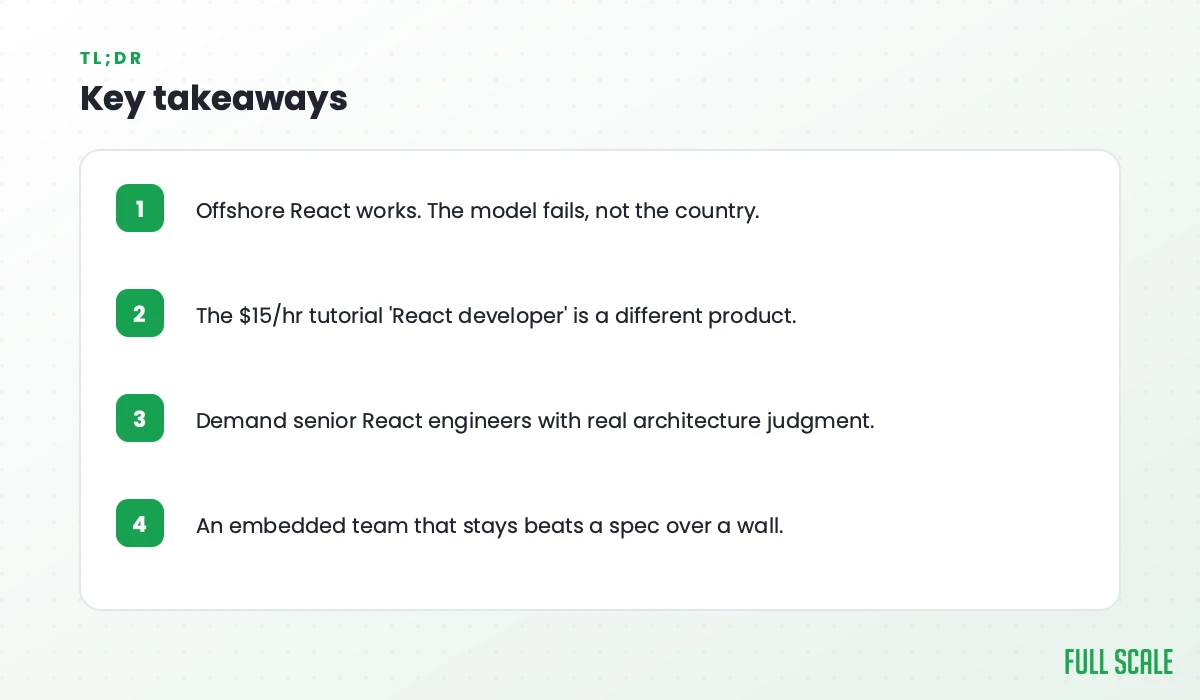
The most common mistake is choosing the wrong engagement model, not hiring a bad developer.
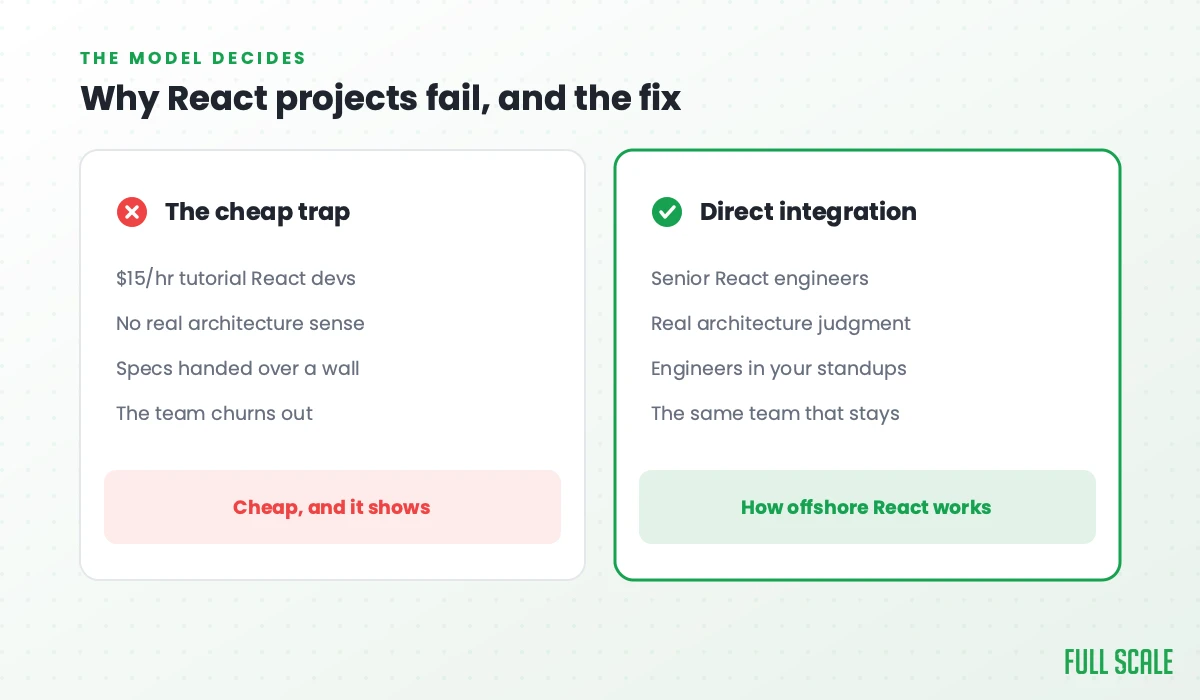
Project outsourcing puts layers between you and the developers building your React codebase. You explain requirements to an account manager, who explains to a project manager, who explains to developers. By the time your design intent, your TypeScript patterns, and your component philosophy reach the people writing code, most of the important context has been stripped out.
With React, this is especially damaging. React’s flexibility means a project shop will make its own decisions about component structure, state management patterns, TypeScript strictness, and styling conventions. You’ll receive code that runs and conflicts with everything your existing frontend does. The architecture mismatch shows up slowly, then all at once.
Staff augmentation / direct integration puts your offshore React developers on your team. They’re in your Slack, reviewing PRs, attending frontend planning sessions, working in your design system, extending your component library. Full Scale handles payroll, HR, and workspace. You handle technical direction. Onboarding to a real design system matters more than ever now that AI and UX design have made the baseline interface a commodity.
The difference in outcomes:
| Factor | Project Outsourcing | Direct Integration (Full Scale) |
|---|---|---|
| Component architecture | Shop’s conventions | Your conventions |
| TypeScript patterns | However they work | Your strictness settings |
| Design system fit | Post-delivery retrofitting | Built to spec from day one |
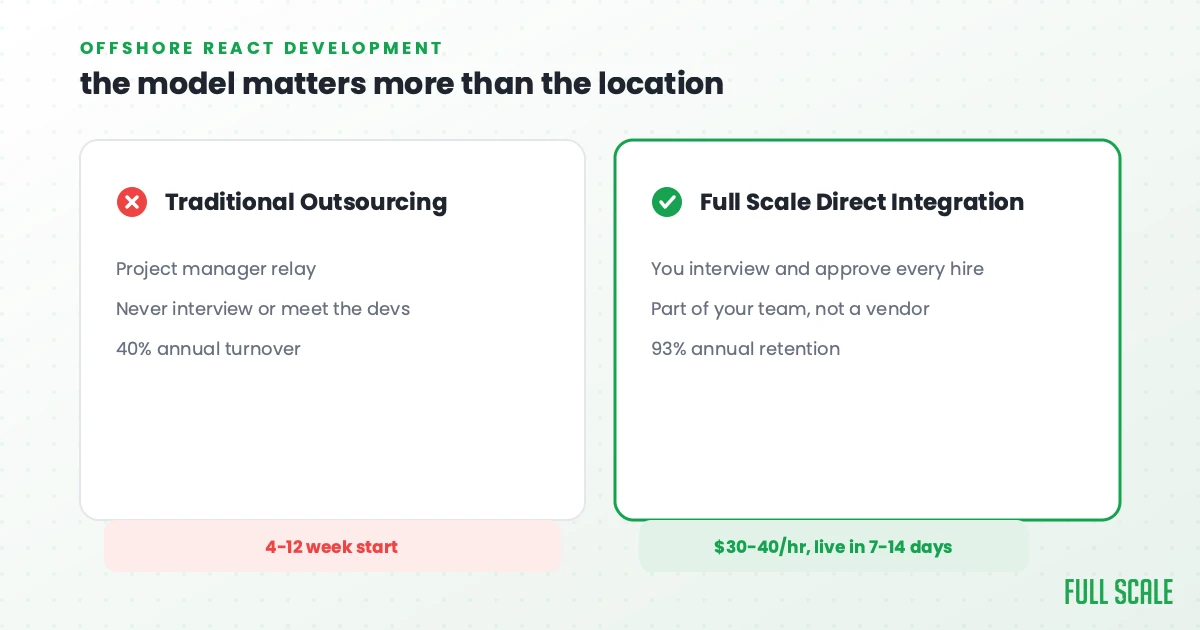
| Annual turnover | ~40% | ~7% (93% retention) |
| Time to start | 4-12 weeks | 7-14 days |
When CTOs tell me their offshore React project “looked good in demo but didn’t match our codebase,” it was the model. Every time. The staff augmentation vs. outsourcing distinction is the actual decision being made, whether or not the company framed it that way going in.
The 7 Reasons Offshore React Projects Fail
Reason 1: Cheapshoring the React stack
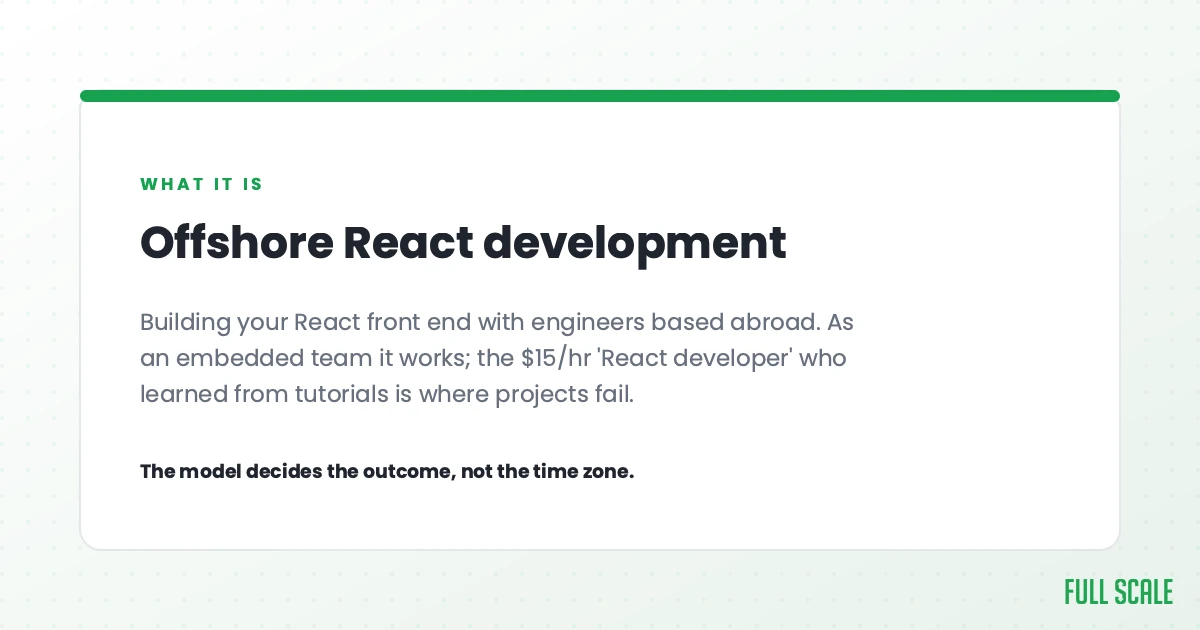
React is used by roughly 40% of professional developers. That enormous supply means there’s a massive pool of $15/hour React developers: people who learned React from a tutorial, can build a to-do app, and have never worked with TypeScript generics, React Server Components, or a real-world design system.
I call this cheapshoring: offshoring for cost alone. For React it’s particularly damaging because the gap between a tutorial-level React developer and a production-level React developer is enormous, and the damage from a tutorial-level developer in your codebase isn’t always visible immediately.
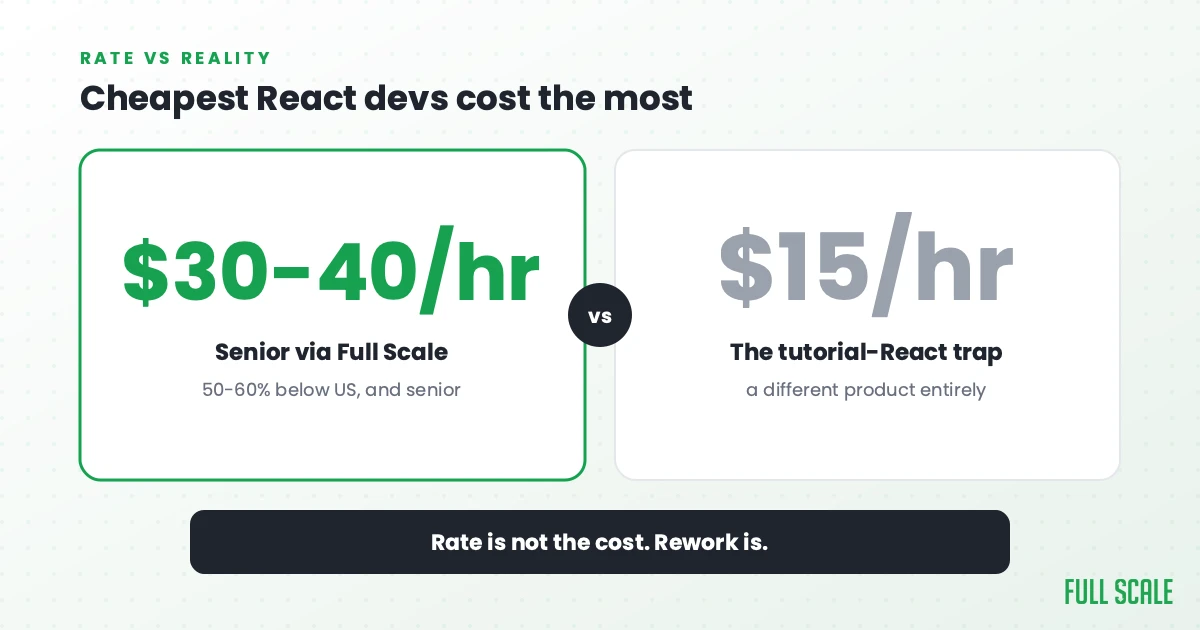
Senior offshore React developers at Full Scale cost $30-$40/hour, 50-60% below the all-in US cost. The $15/hour tier doesn’t buy a discounted version of that. It buys a different category of developer. Our offshore development best practices guide covers this pattern in depth across every stack.
Reason 2: Wrong engagement model for ongoing product development
React frontends are living codebases, not finite projects. New features, design system evolution, performance work, accessibility improvements, framework updates (App Router, React 19): these require developers who understand the codebase deeply over time.
Project outsourcing produces code that’s complete and wrong. Staff augmentation produces developers who build your product alongside you.
Reason 3: Inadequate React-specific vetting
Most React vetting asks: can they write a component? Can they use hooks? Can they describe useState vs. useReducer?
These questions don’t surface production React developers. What I look for in our vetting: can they explain the re-render implications of their component structure? How do they approach TypeScript generics in a shared component library? Have they worked with React Server Components in production? What’s their approach to async state and loading states in a Next.js App Router app?
Developers who can answer those questions have built real React products. The ones who can’t have watched tutorials.
Reason 4: TypeScript treated as optional
In 2026, TypeScript is not optional for serious React development. TypeScript-strict React codebases produce fewer runtime errors, better component API contracts, and dramatically better developer experience when working across a large frontend.
Offshore React developers who claim TypeScript experience but write JavaScript-with-type-annotations are not the same as developers who work fluently with generics, conditional types, and utility types in a strict TypeScript config. Our vetting distinguishes between the two explicitly.
Reason 5: Poor onboarding to your design system
React codebases vary more than most other stacks. Your design system, your component library choices (Radix, shadcn/ui, custom), your styling approach (Tailwind, CSS modules, styled-components), your state management pattern: these aren’t universal. Offshore React developers who are technically strong but dropped into your codebase without structured onboarding will write components that work and don’t fit.
Our 7-day integration framework is specifically designed to transfer this context in the first week.
Reason 6: No React architecture discussion in the interview
Developers who only receive tickets never develop component architecture opinions. Offshore React developers who aren’t included in frontend planning sessions, design reviews, and technical discussions become execution arms rather than engineers. That’s when code quality degrades.
Reason 7: Short-term thinking on a long-term codebase
The offshore React developers who make the biggest difference are the ones who’ve been on your product for 18+ months, who know why the component tree looks the way it does, which parts are intentionally complex and which are technical debt, and what the migration path looks like when a dependency updates. High turnover in an offshore React team destroys that accumulated knowledge. Deloitte’s 2024 Global Outsourcing Survey found cost is no longer the primary driver of outsourcing success. Retention and outcomes are.
The Full Scale Direct Integration Model for React
Your offshore React developers join your GitHub organization. They review and get reviews on the same PR queue as your local team. They use your ESLint config, your TypeScript strictness settings, your design system tokens.
Full Scale handles the Philippines side: payroll, benefits, HR, workspace, equipment, legal compliance. You handle everything technical.
What this means for a React frontend specifically
No separate component library they maintain independently. No “their coding standards” vs. “your coding standards.” No post-delivery reconciliation of their component tree with your design system.
One codebase. One set of conventions. Engineers who happen to live in the Philippines.
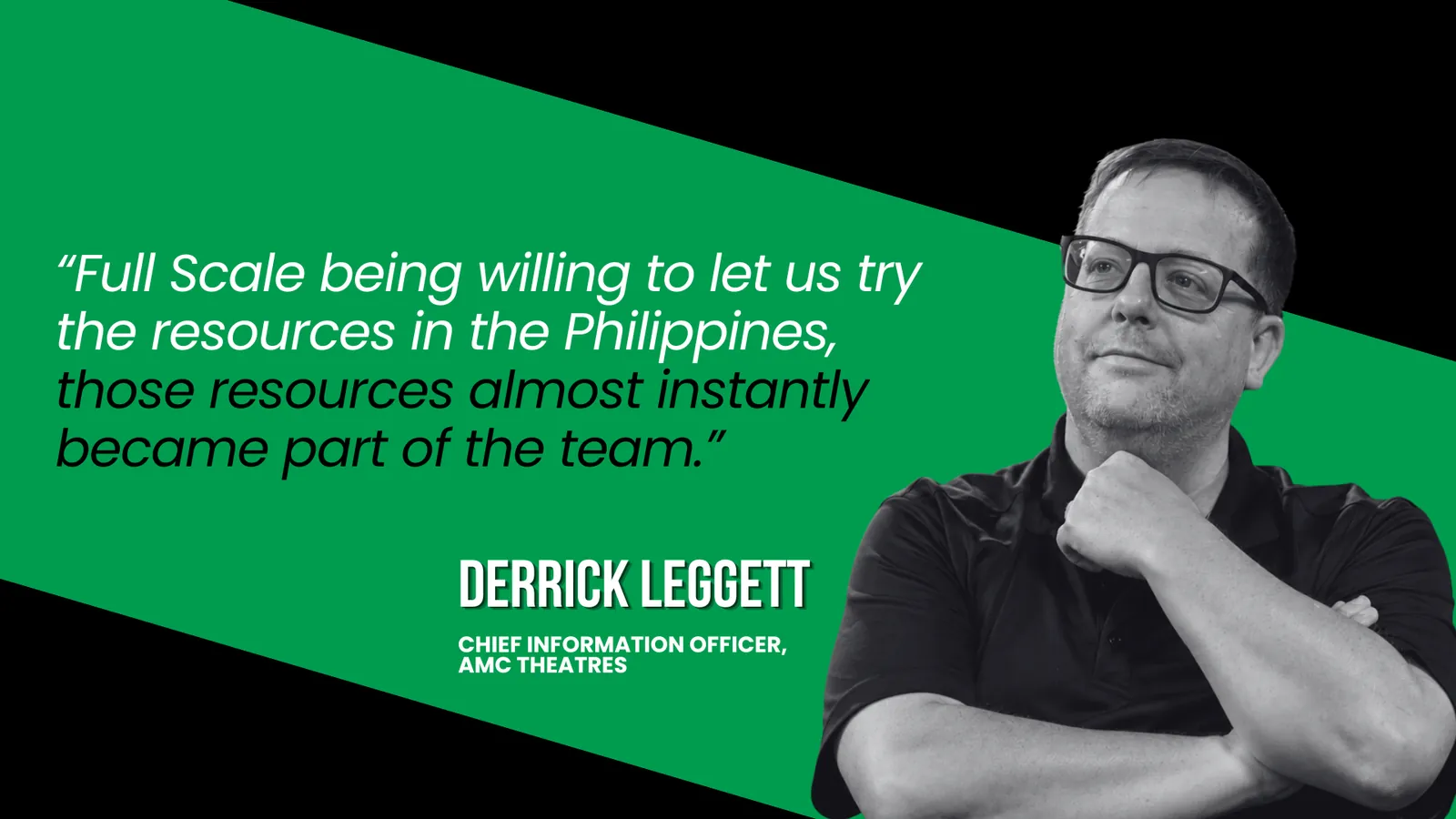
That’s what Derrick Leggett, CIO of AMC Theatres, describes about his engineering team: “It’s a fully integrated team. It’s just some of the people happen to be living in the Philippines.” The AMC Theatres case study is the best demonstration of this model at consumer scale: Full Scale developers working on a React-driven platform that serves millions of moviegoers. Read what offshore development really means if you want the full framing before going deeper on React specifically.
Why 93% annual retention in React teams specifically matters
React knowledge is codebase-specific. A React developer who’s been in your system for two years knows why you chose your state management approach, what the legacy components look like versus the refactored ones, and what the pattern is for adding a new feature to the design system. That institutional knowledge is extremely valuable and irreplaceable by a new hire.
Full Scale’s 93% annual developer retention versus the ~40% industry average compounds directly into React frontend quality over multi-year engagements.
The 5-Stage Vetting Process: Finding Senior React Engineers
Fewer than 3% of React applicants pass our full process.
Stage 1: Resume and portfolio screening (55% rejected)
What we look for: 4+ years React experience with production TypeScript, evidence of Next.js App Router work, GitHub with real component code (not tutorial repos), design system or component library contributions, English proficiency.
Red flags: “React/Vue/Angular” listed interchangeably (no genuine expertise), no TypeScript in recent work, portfolio with only to-do apps or clone projects.
Pass rate: 45%
Stage 2: Technical assessment (40% of Stage 1 rejected)
90 minutes. React rendering model and performance, TypeScript depth, Next.js data fetching patterns, state management design, accessibility fundamentals, testing approach.
Sample questions: – “Walk me through what happens when a parent component re-renders in React 18, what does or doesn’t re-render, and why?” – “Design a TypeScript generic for a reusable form component that can work with different data shapes.” – “How does React Server Components change the data-fetching pattern in a Next.js App Router app?” – “What’s your approach to testing a component that makes API calls?”
These questions came directly from Full Scale’s skills assessment framework, designed to surface developers who understand React’s rendering model, not just its API surface.
Cumulative pass rate: 27%
Stage 3: Live coding exercise (30% of Stage 2 rejected)
Build a real React component with TypeScript under real conditions. We observe: does their component structure reflect clear thinking? Do they write tests? How do they handle edge cases (loading, error, empty states)? How do they communicate while building?
No whiteboard algorithms. No syntax gotchas. Real work.
Cumulative pass rate: 19%
Stage 4: Code review and architecture discussion (20% of Stage 3 rejected)
Review their real GitHub code. “Why did you structure this component this way?” “How would you refactor this to be more reusable?” “What’s the performance implication of this pattern?”
This separates developers who make decisions and can explain them from developers who write code and can’t articulate why.
Cumulative pass rate: 15%
Stage 5: Cultural fit and English proficiency (about 20% of Stage 4 rejected)
The Philippines is the third-largest English-speaking country in the world. We still test communication fluency directly in every interview. Technical communication in React, whether describing a component architecture in a planning session or articulating a performance concern in a PR comment, requires both English fluency and React depth.
Final pass rate: under 3%
The 7-Day Integration Framework for React Teams
Day 1: Access and design system orientation
GitHub org access, Storybook access (if applicable), design system documentation, component library overview, local dev environment setup. Goal: developer can run the app and browse the component library by end of Day 1.
Days 2-3: Codebase architecture walkthrough
Walk through the component tree of a key feature end-to-end. How data flows from the API layer to the component. How state is managed. Where the design system boundaries are. Pair on a small bug fix or style adjustment.
Days 4-5: First real feature
A small, well-scoped component addition or UI feature. Active code review with explicit feedback on component structure, TypeScript types, and design system compliance.
Days 6-7: Process integration
Participate in frontend planning or design review. Feedback session on what’s working. Set clear expectations for the first 30 days.
Weeks 2-4: Ramp to full productivity
React developers who get this onboarding are contributing meaningfully to real features in week two. The alternative, “here’s the GitHub repo, figure it out,” adds two to three weeks to the ramp.
The Real Cost of Offshore React Development
Transparent pricing
Senior offshore React developer at Full Scale: $30-$40/hour fully loaded. Annually: $62K-$83K. See Full Scale’s pricing for the current rate card.
US equivalent: senior React engineers earn $130K-$155K in base salary. With the 1.25-1.4× loaded-cost multiplier for benefits, payroll taxes, and overhead: $160K-$215K+ annually. Recruiting fees add another 20-25% of first-year salary, or $32K-$40K per placement.
| Cost Factor | US Senior React Dev (3 years) | Full Scale Offshore (3 years) | Savings |
|---|---|---|---|
| Compensation | $480K-$615K | $186K-$249K | $294K-$366K |
| Recruiting | $32K-$40K | $0 | $32K-$40K |
| Onboarding | $12K | $6K | $6K |
| Turnover | $80K-$120K | $0 | $80K-$120K |
| Total | $604K-$775K | $192K-$255K | $412K-$520K (55-65%) |
The companies who say offshore “isn’t cheaper” are calculating hourly rate. When you model retention, keeping React developers who know your component architecture for three years versus replacing them in 18 months, the math is decisive.
The React Codebases That Offshore Best
Next.js App Router SaaS frontends
The strongest offshore fit in React. Next.js enforces enough structure (App Router conventions, data fetching patterns, Server/Client component boundaries) that a new developer can understand the codebase architecture quickly. TypeScript + Next.js + a design system is the combination where offshore React developers ramp fastest and produce the most consistent code.
Component library and design system work
Building and maintaining a shared component library (with Storybook, Radix primitives, shadcn/ui patterns, or a custom system) is highly structured work. Clear contracts, documented behavior, testable in isolation. Excellent offshore fit for senior React developers with component library experience.
Frontend modernization
Class components to hooks. JavaScript to TypeScript. CSR to Next.js SSR. These migrations require React depth, TypeScript fluency, and the patience to work inside legacy code without breaking existing behavior. Same model as PHP and Node.js legacy work: senior developers embedded with your local team, not a project shop handed a rewrite spec.
What doesn’t offshore as cleanly
Highly exploratory UI/UX work where the visual direction changes weekly. Greenfield design system work where the component API is still being invented. These need tight design/engineering co-location until the patterns stabilize. Once you have a working design system and established patterns, the offshore model works.
When Offshore React Development Makes Sense
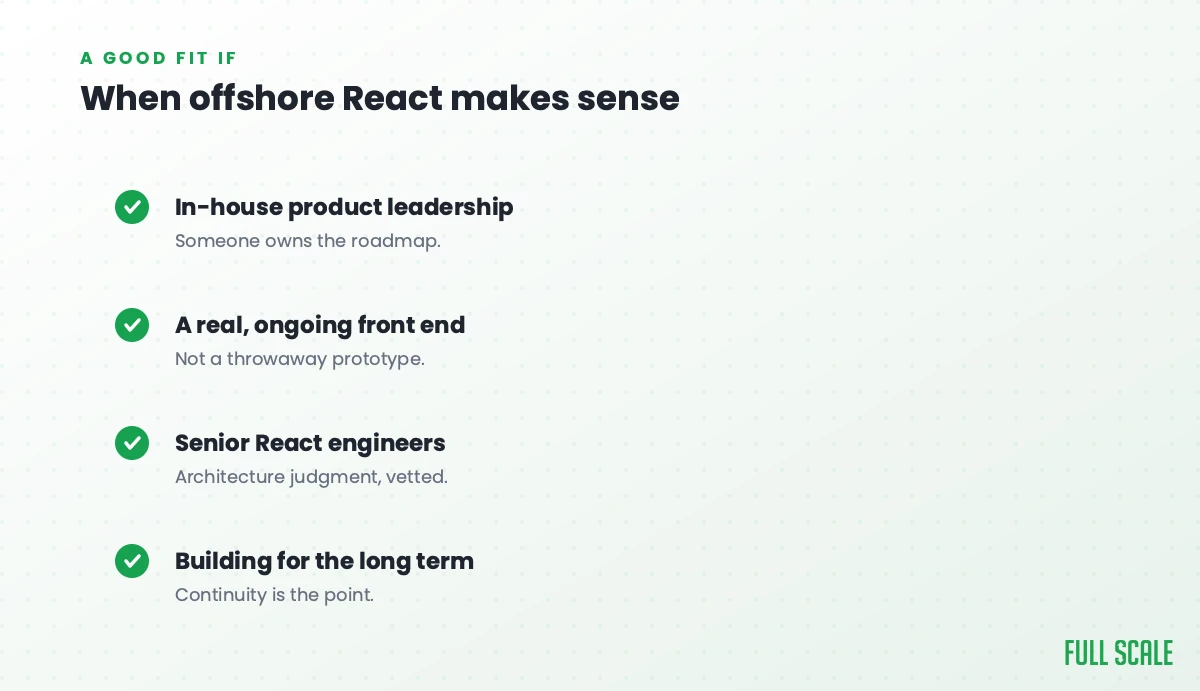
You have an established React codebase. Your stack is defined. TypeScript is in place. Components follow a pattern. Offshore React developers can extend what you have rather than inventing new conventions.
You’re scaling an ongoing product. Feature backlog, component work, performance improvements, accessibility. The staff augmentation model was built for this.
You want engineers, not contractors. The offshore React developers who compound value are the ones who care about the product: included in planning, given architectural responsibility, treated as part of the team.
You need speed. Senior React hiring in the US takes 60-90 days. Our timeline is 7-14 days.
When It Doesn’t Make Sense
Your React architecture is undefined. Work out the component system and state management approach with your core team before adding offshore capacity.
You want project outsourcing for ongoing work. The project outsourcing model for React consistently produces component mismatches and TypeScript debt. If you want developers who treat your codebase like their own, you need staff augmentation.
You’re in emergency mode. Panic React hiring produces the same bad outcomes as any panic hiring. See the common offshore software development challenges guide for the patterns to avoid.
Common Objections
“How do I know the React developers match our TypeScript standards?”
TypeScript depth is tested explicitly in stage 2 (generics, utility types, strict mode design) and stage 3 (live TypeScript coding). We reject React developers who treat TypeScript as optional. If the first placement isn’t working out in the first two weeks, you get your money back, and after that there are no long-term contracts.
“What about design system fit?”
Design system onboarding is day one, not an afterthought. The integration framework is specifically designed to transfer your component conventions before the developer writes a single line of feature code.
“Time zones?”
The Philippines overlaps 8+ hours with US morning hours. Your offshore React developers are in your standups, in your design reviews, reviewing PRs in real time during your workday.
“What about IP?”
Full Scale is a US company. US contracts, enforceable IP assignment, NDAs. Zero IP incidents across 700+ placements since 2018. See our offshore development due diligence checklist for the full vendor evaluation framework.
Why Full Scale for Offshore React Development
I rebuilt our company website on React and Next.js. I’ve watched the frontend framework wars for twenty years. I know what a senior React developer looks like and what a junior React developer with an inflated resume looks like. That background, along with the Product Driven framework I wrote about, shapes every stage of our vetting and onboarding process. For full-stack teams that need JavaScript on both sides, we also place from the same bench on the hire JavaScript developers side.
Full Scale has placed senior React engineers in the Philippines since we started. 93% annual retention. AMC Theatres case study, Fortune 500 consumer React in production. Inc. 5000 for five consecutive years. Great Place to Work Certified in the Philippines, where 95% of our team says Full Scale is a great place to work.
Month-to-month contracts. Direct developer access. No PM relay.
If you’re ready to add senior React engineers who work like extensions of your team, schedule a consultation.
Want to figure out whether to outsource a React project or build a long-term team first? Read How to Outsource React Development Without Getting Burned.
Frequently asked questions
What is offshore React development?
Offshore React development is hiring React engineers in another country to work on your frontend. The model matters more than the location: staff augmentation (developers integrated directly into your team, using your design system, TypeScript config, and processes) produces 93% annual retention at Full Scale, versus 40% annual turnover typical of traditional project outsourcing.
How much does offshore React development cost?
Senior offshore React developers at Full Scale cost $30-$40/hour fully loaded, or $62K-$83K annually. A US senior React engineer costs $130K-$155K in base salary and $160K-$215K+ fully loaded. That’s 55-65% in savings annually, before factoring in near-zero recruiting costs and 93% retention versus 40% US turnover.
How do you vet offshore React developers for TypeScript and Next.js?
Our 5-stage process specifically tests TypeScript depth (generics, utility types, strict mode) and Next.js fluency (App Router, Server Components, data fetching patterns) in stage 2. Stage 3 is a live TypeScript coding exercise. We reject developers who treat TypeScript as optional or who’ve never built with Next.js App Router in production.
How long does it take to hire offshore React developers?
7-14 days from consultation to a developer working in your codebase. US React hiring at the senior level typically takes 60-90 days. Full Scale maintains a pre-vetted bench of React engineers in the Philippines ready to start.
Can offshore React developers work with our existing design system?
Yes. Design system onboarding is day one of the integration framework. Before a developer writes feature code, they’ve worked through your component library, your TypeScript patterns, and your styling conventions. The goal is that their first PR looks like it could have been written by your local team.
What React frameworks do your developers specialize in?
Next.js (App Router and Pages Router), React 18/19 with hooks and Suspense, TypeScript (strict mode), TanStack Query, and React Native for mobile. Our developers stay current with changes across the React stack. Server Components, Server Actions, and the App Router are production experience for our senior bench, not theoretical knowledge.