
Offshore Node.js Development – Hire Trusted, Affordable Talent from the Philippines

In this article
- What Most Companies Get Wrong About Offshore Node.js Development
- The 7 Reasons Offshore Node.js Projects Fail
- The Full Scale Direct Integration Model for Node.js
- The 5-Stage Vetting Process: How We Find Senior Node.js Engineers
- The 7-Day Integration Framework
- The Real Cost of Offshore Node.js Development
- The Node.js Codebases That Offshore Best
- When Offshore Node.js Development Makes Sense
- When It Doesn’t Make Sense
- Common Objections
- Why Full Scale for Offshore Node.js Development
- Frequently asked questions
Quick Answer: Offshore Node.js development works when the engineers join your team directly, and it fails when a project shop puts a manager between you and the people writing code. Full Scale places senior Node.js engineers in the Philippines through staff augmentation at $30-$40 an hour fully loaded, against $160K-$220K+ a year for a fully loaded US senior, with 93% annual retention. Fewer than 3% of applicants pass our vetting, and most engineers can start in as little as 7 days.
My first language was .NET, but at Stackify, we built a Node.js agent that hooked into the event loop and tracked every HTTP request, database query, and external call across thousands of customer applications. On the language decision itself, see Node.js vs Python.
That experience changed how I think about Node.js development. I spent years watching real production Node.js systems fail in real time. The usual suspects were memory leaks from event emitter misuse, synchronous file reads that blocked the event loop, and database connection pools exhausted by improperly chained promises. I saw these patterns in thousands of codebases before I ever started placing Node.js developers offshore. It also pays to be clear on what a Node.js developer actually does now.
When companies ask me whether offshore Node.js development works, I’m not guessing. I know what breaks in Node.js at scale, I know what a senior Node.js developer actually looks like (and how many “senior” developers can’t explain the event loop), and I’ve run a staffing company that’s placed Node.js engineers across the Philippines since 2018.
Here’s what most companies get wrong, and what actually works.
What you’ll learn in this guide:
- The one structural choice that determines whether offshore Node.js development succeeds or fails
- What I’ve seen break in Node.js production systems, and how it shapes how Full Scale vets Node.js developers
- Our 5-stage vetting process for Node.js engineers, with the specific technical questions that separate senior from junior
- Real cost comparisons including the numbers most offshore vendors don’t show you
- Which Node.js codebases offshore well, and which don’t
- When offshore Node.js doesn’t make sense
What Most Companies Get Wrong About Offshore Node.js Development
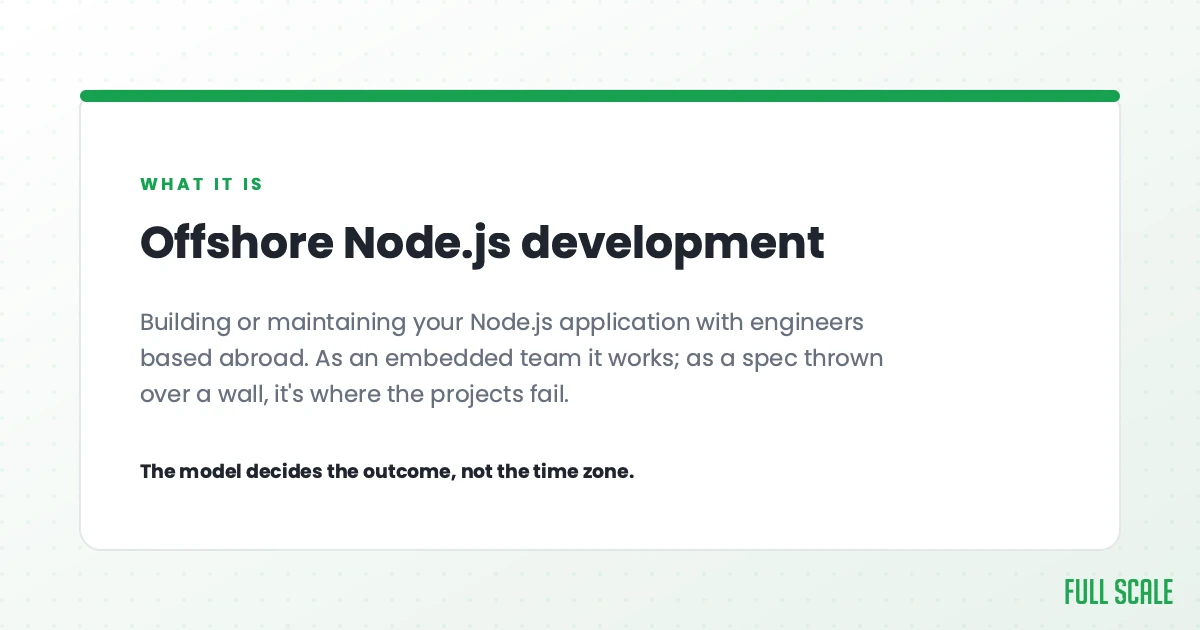
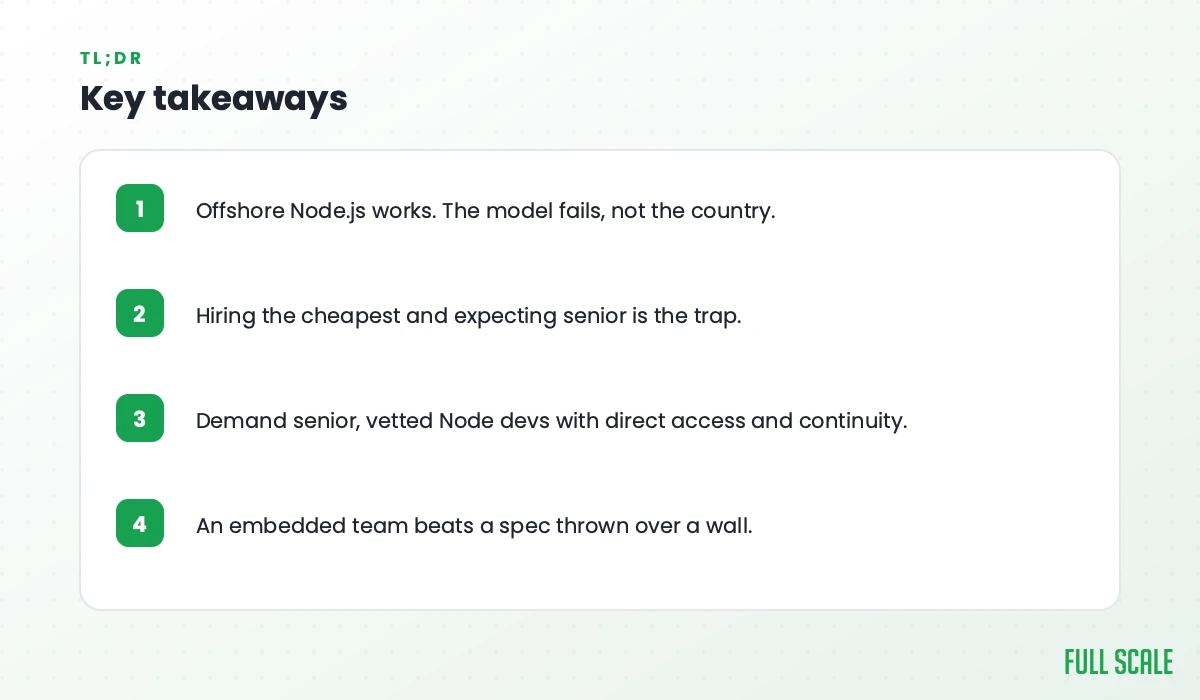
The most common mistake isn’t choosing the wrong country or the wrong timezone. It’s choosing the wrong engagement model.
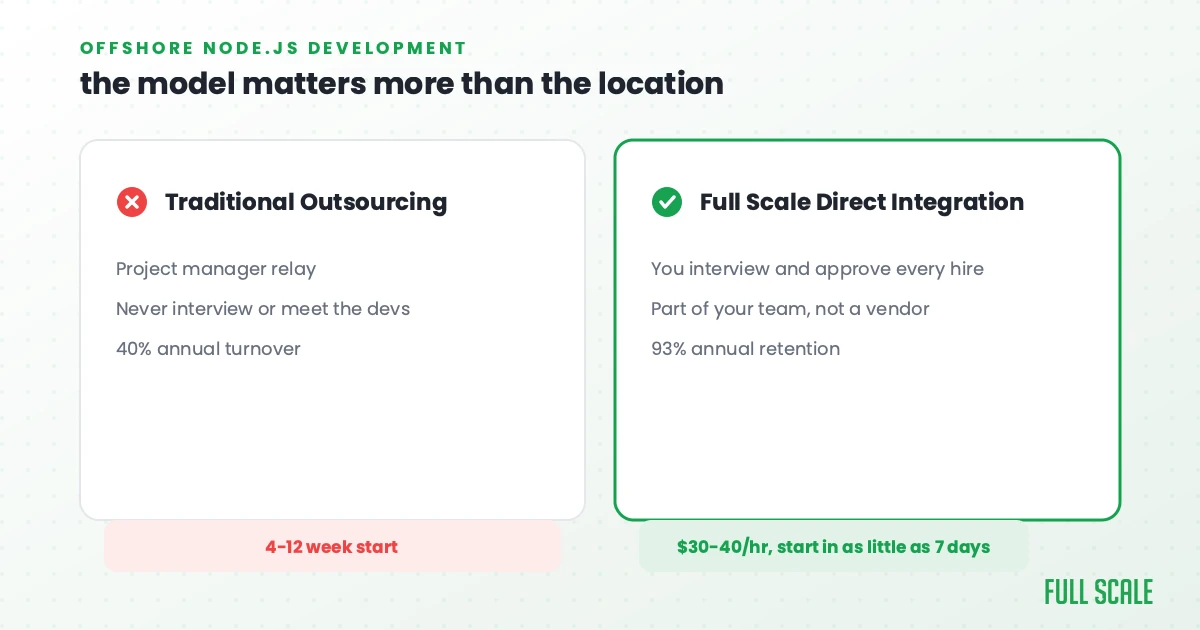
There are two ways to use offshore Node.js developers. Most companies use the wrong one.
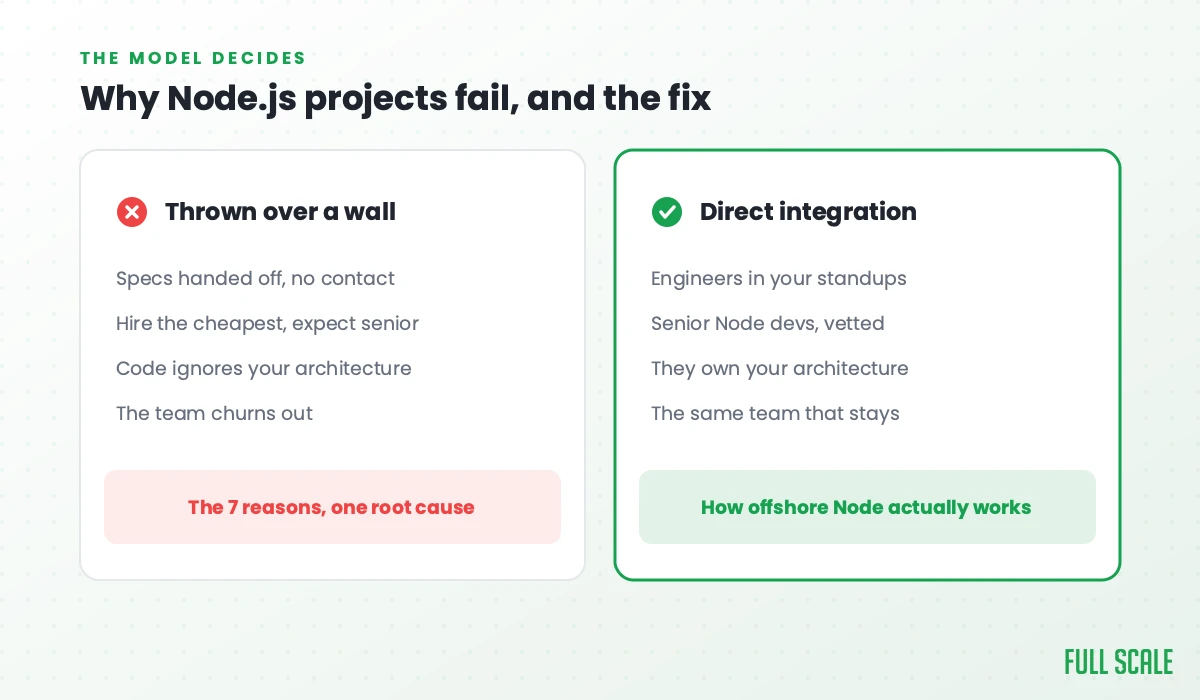
Model 1: Project outsourcing (why it fails). You hire an agency. They assign a project manager. That PM manages developers. You explain your requirements to the PM, the PM explains to developers, and by the time your intent reaches the person writing code, critical context has been stripped out.
With Node.js specifically, this is catastrophic. Node.js architecture decisions compound quickly. The choice between Express and NestJS, the event loop management strategy, the async/await patterns your codebase follows, these are decisions where misunderstandings early on produce technical debt that’s expensive to unwind. A telephone game between you and developers makes every one of those decisions worse.
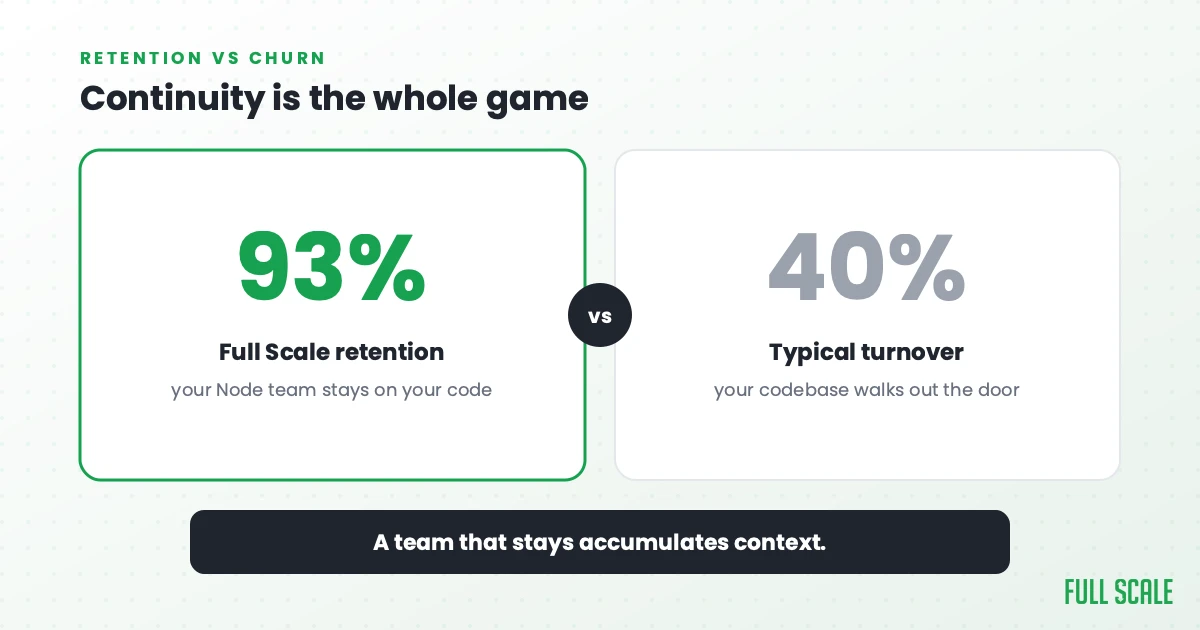
The outcome: 40% annual developer turnover, code that doesn’t reflect your architecture decisions, and a codebase that the developers who built it can’t maintain because they never understood the system they were building.
Model 2: Direct integration / staff augmentation (what works). Your offshore Node.js developers are in your Slack. They attend your standups. They commit to your GitHub repos. They work on your Jira tickets. Full Scale handles payroll, HR, and workspace. You handle everything else, technical direction, code review, architecture decisions.
The outcome: 93% annual developer retention. Node.js developers who understand your event loop, your async patterns, your data models, and your deployment targets, because they’ve been part of every discussion from day one.
| Factor | Project Outsourcing | Direct Integration (Full Scale) |
|---|---|---|
| Communication | You → PM → Developers | You ←→ Developers directly |
| Architecture decisions | Filtered through PM layer | Made with the team in real time |
| Annual turnover | ~40% | ~7% (93% retention) |
| Time to start | 4-12 weeks | As little as 7 days |
| Node.js code quality | Interpreters building toward a spec | Engineers building toward your system |
I’ve had clearer architecture discussions with our Philippines Node.js team than with contractors in the same city. The problem lives in the layers between you and the people writing code. The staff augmentation vs. outsourcing distinction is where the decision actually lives.
The 7 Reasons Offshore Node.js Projects Fail
Offshore Node.js projects fail for seven reasons: cheap rates, the wrong engagement model, weak vetting, poor onboarding, no documented standards, ticket-queue management, and high turnover. I saw these patterns in customer Node.js applications through the Stackify APM, and I’ve seen them repeated in offshore engagements for years.
Reason 1: Hiring at $15/hour and expecting senior Node.js work
Node.js has an enormous supply of developers globally. It’s used by roughly 40% of professional developers, which means the quality range is enormous too. The $15/hour end of the offshore Node.js market is not filled with hidden gems. It’s filled with developers who can write Express routes but have never debugged a memory leak, never designed a microservices boundary, and never built anything with proper TypeScript generics.
At Full Scale, senior Node.js developers cost $30-$40/hour to the client, still 50-60% below the all-in cost of a US equivalent. That rate funds developers who understand async patterns, TypeScript depth, and system design. The $15/hour rate funds developers who learned Node.js from a YouTube tutorial and will write callback hell in 2026.
I call the $15/hour trap cheapshoring. It’s the most expensive way to hire offshore development, because the cost of fixing cheapshored code always exceeds what you saved on the rate. I’ve covered the full pattern, offshore development best practices and the common offshore software development challenges, elsewhere. The short version: rate optimization is not cost optimization.
Reason 2: Using project outsourcing for ongoing product development
Node.js APIs and real-time systems are not fixed-scope projects. They evolve with your product. Event-driven architectures require continuous architectural thinking. Schema changes cascade through TypeScript types. A project shop handed a spec and told to deliver in six weeks will deliver the spec, not a system that can grow with your product.
I expanded on the distinction between outsourcing and staff augmentation in our outsourcing guide for Node.js. The short version: if you’re building an ongoing product, you need team extension.
Reason 3: Inadequate technical vetting
Most Node.js vetting processes test for syntax when they should test for systems. Can they explain promises? Can they write a middleware function? These questions don’t surface the problems I saw in production through Stackify’s APM.
What I look for: can they explain what blocks the Node.js event loop (the official guide on not blocking it is the baseline) and give a production example of when that matters? Can they describe the difference between process.nextTick, setImmediate, and Promise microtasks, as laid out in the Node.js event loop documentation? Can they walk through how they’d diagnose a gradual memory leak in a long-running Express server?
Developers who can answer those questions confidently have actually built things in Node.js. The ones who can’t have memorized answers to common interview questions.
Fewer than 3% of developers who apply to Full Scale pass our full vetting process. Skills assessment for software developers covers the theory; our Node.js process is the applied version.
Reason 4: Poor onboarding for Node.js codebases
Node.js codebases vary wildly. The conventions of a well-structured NestJS monorepo are nothing like a sprawling Express application that grew organically over five years. Offshore Node.js developers who are technically strong but dumped into your codebase without an architecture walkthrough will spend weeks learning what they could have learned in two days of intentional onboarding.
Our 7-day integration framework (detailed below) covers this specifically.
Reason 5: No documented Node.js standards
Async/await vs. callbacks vs. raw Promises. Error handling patterns. TypeScript strictness settings. ORM choice. Test framework preferences. These vary more in Node.js than they do in mature stacks like .NET. If you haven’t documented your team’s conventions, your offshore Node.js developers will make reasonable choices that conflict with yours.
Reason 6: Treating offshore Node.js developers as a ticket queue
The offshore developers who produce the best Node.js work are the ones who understand the product well enough to push back on a ticket when the implementation doesn’t serve the goal. That only happens when they’ve been included in planning, have context on the users, and feel like engineers rather than ticket-executors.
Reason 7: No long-term commitment
Node.js developers who understand your event loop, your connection pooling strategy, and your TypeScript patterns are more valuable in month 18 than month 1. High turnover in an offshore Node.js team is financially and operationally expensive. Deloitte’s 2024 Global Outsourcing Survey found that companies are increasingly measuring outsourcing success on outcomes and retention rather than cost, because the companies burning through developers have figured out that turnover eliminates every cost advantage.
The Full Scale Direct Integration Model for Node.js
The structure: you talk directly to Node.js developers. They attend your standups. They work in your tools. Full Scale handles payroll, benefits, HR, compliance, and workspace in the Philippines. You handle technical direction, code review, and architecture.
What this means in practice for Node.js teams
Your offshore Node.js developers join your Slack. They’re in the same GitHub organization. They get the same PR review process as your local engineers. They attend sprint planning and know the roadmap. When you decide to migrate from Express to NestJS, or to add Prisma as your ORM, they’re in the conversation from the beginning, not handed a spec after the decision has been made.
This matters especially for Node.js because the language is opinionated in few ways. The community offers ten approaches to every problem. A team that’s aligned on conventions ships faster and produces more maintainable code. Offshore developers who are integrated from day one develop that alignment naturally. Offshore developers who are handed a spec develop their own conventions.
What Full Scale handles so you don’t have to
Payroll and benefits in the Philippines. HR issues and performance management. Physical workspace and equipment. Background checks more thorough than the US standard, including an in-person address check where an investigator confirms the candidate lives where they say they do. Legal compliance. If a developer isn’t working out, a two-week money-back guarantee applies, then 30-day notice and no long-term contracts.
Why this produces 93% annual retention
Developers stay when they feel like engineers on your team. When they understand the product, have ownership over their work, and have a career path beyond “write the tickets.” Full Scale is Great Place to Work Certified in the Philippines. 95% of our team says Full Scale is a great place to work versus 65% at a typical Philippines company. That’s how we attract Node.js developers worth placing.
A FinTech CTO who’s worked with us for two years: “Our Node.js team knows our event loop better than some local engineers we’ve hired and lost. The retention is the real ROI — not the hourly rate.” The developer retention strategies that drive this aren’t complicated, but they require treating offshore engineers like team members, not contractors.
The 5-Stage Vetting Process: How We Find Senior Node.js Engineers
Fewer than 3% of applicants make it through. Here’s why.
Stage 1: Resume and portfolio screening (55% rejected)
What we look for: 4+ years Node.js experience with evidence of production systems (not tutorials), TypeScript in recent work, specific framework depth (NestJS, Express, or Fastify, not “I know all frameworks”), public GitHub with actual architecture, English proficiency indicators.
Red flags: generic “full-stack developer” claims with no backend depth, GitHub with only tutorial repos, “I’m proficient in Node.js, React, Python, Go, Rust, and Kubernetes.”
Our Node.js developer hiring process follows this standard.
Pass rate: 45%
Stage 2: Technical assessment (40% of Stage 1 rejected)
90 minutes. Node.js runtime fundamentals, TypeScript depth, async patterns, database design, API architecture, security practices.
Sample questions:
- “Explain what can block the Node.js event loop and give an example from a production system.”
- “Design a database schema for a multi-tenant SaaS with row-level permissions.”
- “What’s the difference between
process.nextTickandsetImmediate, and when does it matter?” - “How would you handle graceful shutdown of a Node.js server with active Socket.io connections?”
The last two questions come directly from patterns I saw fail in customer applications through Stackify’s APM. Developers who’ve built real systems can answer them. Developers who’ve memorized interview prep can’t.
Cumulative pass rate: 27%
Stage 3: Live coding exercise (30% of Stage 2 rejected)
60-90 minutes. Build a small API with a real-world constraint: TypeScript, proper error handling, async/await, at least one database interaction. We observe how they handle edge cases, whether they write tests, how they structure the code, and how they communicate while building.
We don’t do whiteboard algorithms. We replicate the actual work.
Cumulative pass rate: 19%
Stage 4: Code review and architecture discussion (20% of Stage 3 rejected)
We review real code from their GitHub or portfolio. “Walk me through the architecture of this project.” “What would you change if starting over?” “How did you handle this specific async problem?” “Explain your TypeScript type strategy here.”
What this reveals: do they have opinions? Can they defend them? Do they understand the trade-offs they made?
Cumulative pass rate: 15%
Stage 5: Cultural fit and English proficiency (about 20% of Stage 4 rejected)
Conversational interview. Communication clarity under pressure, work ethic, remote-work readiness, long-term fit.
The Philippines is the third-largest English-speaking country in the world. Our Node.js developers communicate at the level you’d expect from a senior engineer anywhere, but we test for it, every time.
Final pass rate: under 3%
The 7-Day Integration Framework
Day 1: Access and setup
Welcome call. Access to GitHub, Slack, Jira, AWS or cloud platform, development environment, VPN. Goal: developer can commit code by end of Day 1.
Days 2-3: Codebase orientation
Architecture overview. Walk through the event flow for a key system (how a request enters, what happens, how it exits). Pair programming on a small bug or cleanup task. First PR submitted and reviewed.
For Node.js specifically: document your async patterns, your error handling conventions, your TypeScript configuration. Don’t make the developer reverse-engineer them from the codebase.
Days 4-5: First real feature
A small, well-defined task from the actual backlog. Daily standups with the full team. Active code review with feedback.
Days 6-7: Process integration
Sprint planning or retrospective participation. Feedback session on what’s working. 30-day roadmap discussion.
Weeks 2-4: Ramp to full productivity
- Week 2: 60-70% velocity
- Week 3: 80-90% velocity
- Week 4: full productivity
Node.js developers who’ve been through proper onboarding reach this timeline consistently. Developers dumped into a codebase without orientation take twice as long.
The Real Cost of Offshore Node.js Development
What you actually pay
Senior offshore Node.js developer at Full Scale: $30-$40/hour fully loaded (payroll, benefits, HR, workspace included). At full-time hours, that’s $62K-$83K annually. See Full Scale’s pricing page for the current rate card.
US equivalent: a senior backend Node.js developer earns $130K-$160K in base salary. With the standard loaded-cost multiplier of 1.25-1.4, total annual cost is $160K-$220K+. Add recruiting fees of 20-25% of first-year salary, roughly $32K-$40K per placement.
| Cost Factor | US Senior Node Dev (3 years) | Full Scale Offshore (3 years) | Savings |
|---|---|---|---|
| Compensation | $480K-$660K | $186K-$249K | $294K-$411K |
| Recruiting | $32K-$40K | $0 | $32K-$40K |
| Onboarding | $15K | $7K | $8K |
| Turnover | $80K-$120K | $0 | $80K-$120K |
| Total | $607K-$835K | $193K-$256K | $414K-$579K (about 68%) |
The companies that say offshore “isn’t actually cheaper” are the ones calculating the hourly rate without modeling retention. When you keep Node.js developers for three years instead of replacing them in 18 months, the savings compound substantially.
See what that looks like in practice
Full Scale’s client case studies show how this model works for real product teams.
The Node.js Codebases That Offshore Best
API-first SaaS, real-time systems, serverless functions, and legacy modernization all offshore well when the vetting and onboarding are right. Undefined greenfield architecture and experimental research do not.
API-first SaaS (NestJS, Express, Fastify + TypeScript)
The strongest offshore fit in the Node.js world. Well-structured NestJS codebases especially, the framework enforces module boundaries, dependency injection, and consistent patterns that dramatically reduce the context-building time for a new offshore developer.
If you’re running a TypeScript + NestJS API, a new senior engineer from our bench can be contributing meaningfully within a week. If you’re running a sprawling un-typed Express codebase with inconsistent error handling, that timeline extends, but the fix is documentation and standards, not geography.
Real-time systems (Socket.io, WebSockets)
Works well offshore when the offshore developers have real-time experience. The vetting matters more here. Make sure you’re testing event loop understanding specifically. I’ve seen real-time Node.js systems brought down by offshore developers who understood the Socket.io API but didn’t understand what their event handlers were doing to the event loop.
An engineer who can explain backpressure and socket.io rooms under load is the right hire for real-time work. That’s what stage 2 and 3 of our vetting are for.
Serverless (AWS Lambda, Vercel Functions, Cloudflare Workers)
Clean offshore fit for the right developers. Bounded functions, clear contracts, testable in isolation. The vetting question: cold-start optimization, proper connection pooling in Lambda (one of the most common production Node.js mistakes), and async error handling. Developers who’ve built serverless in production know these. Developers who haven’t will learn at your expense.
Legacy Node.js modernization (callbacks → async/await → TypeScript)
High demand. Large category. Requires both deep Node.js history (understanding what the code was trying to do) and modern Node.js fluency (knowing how to get it there). This is work for a senior embedded team. The offshore developers who succeed at legacy Node.js modernization are the ones working alongside your local engineers, not receiving a rewrite spec.
What doesn’t offshore well
Undefined greenfield architecture (“we’re not sure what we’re building yet”) and highly experimental research engineering where requirements change daily. These need continuous co-located collaboration until the patterns stabilize. Once you have established patterns and conventions, the offshore model works.
When Offshore Node.js Development Makes Sense
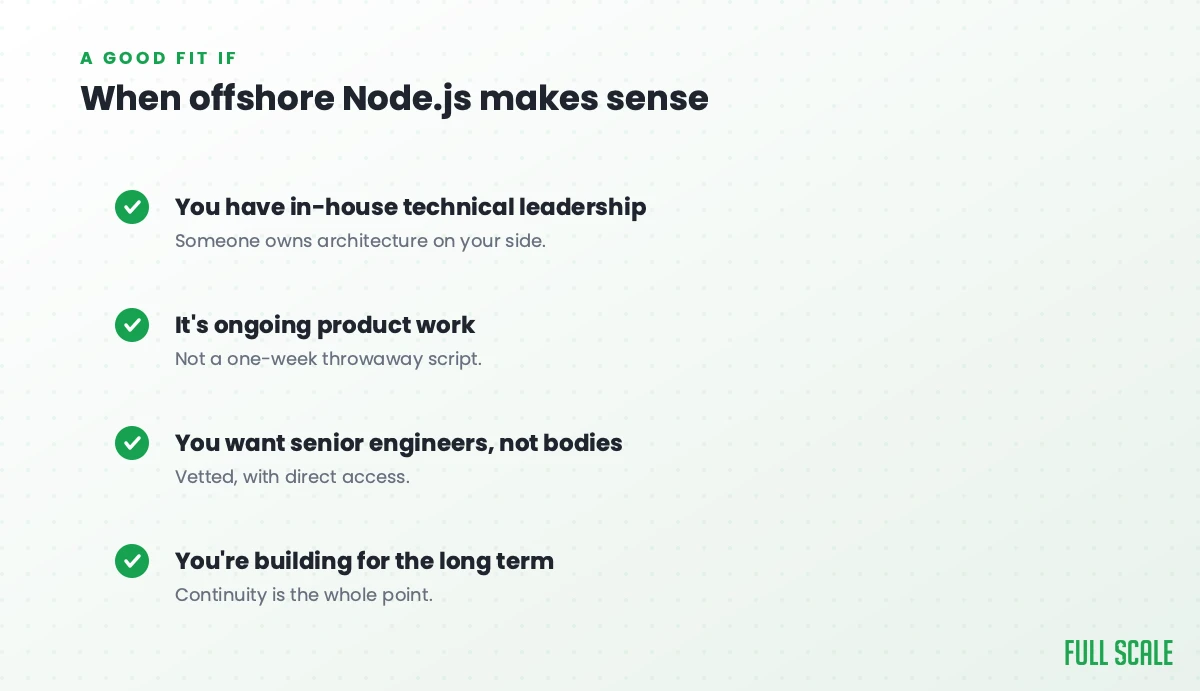
You’re scaling an existing product. API backlog, feature queue, microservices expansion. You have TypeScript and a consistent codebase. Offshore developers can be productive within a week.
You value long-term team building. Node.js developers who know your async patterns, your data models, and your deployment targets are worth more in year two than year one. The staff augmentation model is built for this.
You’re comfortable with distributed teams. You already use Slack, GitHub, Jira. Standups on video are normal. You’ve managed remote engineers before, or you’re ready to.
You need speed. Local Node.js hiring at the senior level takes 60-90 days. We can start in as little as 7 days. When you have a product roadmap and real deadlines, that gap matters.
When It Doesn’t Make Sense
You’re still defining the architecture. If you’re not sure whether you’re building microservices or a monolith, work that out with your core team first. Offshore integration works best with established patterns.
You want project outsourcing, not team building. If you want to hand a spec to a vendor and receive a deliverable, we’re not the right partner for that. Our model requires you to manage the developers like your own team.
You’re in crisis mode. “We need someone tomorrow” doesn’t work for any hiring model. Fix the planning process first.
Common Objections
“How do I know the Node.js developers are actually senior?”
Fewer than 3% of applicants make it through our vetting. The process includes live coding, architecture discussion, and portfolio code review, not just a technical quiz. If a developer we place isn’t performing in the first two weeks, you get your money back, and after that there are no long-term contracts.
The retention rate is the proof: clients don’t keep developers for two-plus years if the work is bad.
“What about the event loop and async complexity, can offshore developers handle that?”
The developers who pass our vetting can. That’s specifically what our stage 2 technical assessment tests, event loop understanding, async pattern depth, TypeScript type design. We designed the assessment around the production failure modes I saw through Stackify’s APM.
“Time zones?”
The Philippines has an 8-hour daily overlap with US mornings. Real-time collaboration during your workday, not messages waiting when you wake up. Our developers also work full US hours when the engagement requires it.
“What about IP and security?”
Full Scale is a US company. US-based contracts, enforceable NDAs, IP assignment. Background checks more thorough than US standards. Zero IP incidents across 700+ developer placements since 2018. Our offshore development due diligence checklist covers the full vendor evaluation framework if you want to compare us against alternatives.
Why Full Scale for Offshore Node.js Development
I built a Node.js APM agent at Stackify that ran in production for thousands of teams. That experience, seeing what breaks in real Node.js systems at scale, is the foundation of how we vet and place Node.js developers. It also informed the product thinking framework I wrote about in Product Driven, building systems people actually need, not just systems that pass tests.
The vetting process turns away more than 97% of applicants, specifically on the criteria that matter for real production Node.js work. Full Scale has placed Node.js engineers across the Philippines since 2018. 93% annual retention. Inc. 5000 for five consecutive years. See how that works in practice in our client case studies, including the AMC Theatres case study, a Fortune 500 engineering team where the Philippines developers work as full AMC engineers, not contractors.
Month-to-month contracts. No lock-in. We earn your business every month or you leave.
If you’re ready to build a distributed Node.js team that works like an extension of your existing engineering organization, schedule a consultation. Thirty minutes, honest assessment of fit, no sales pressure.
Not sure whether to outsource or staff-augment? Read Outsource Node.js Development: The Decision Framework Most Teams Skip first. Or explore what offshore development really means before making the call.
Frequently asked questions
What is offshore Node.js development?
Offshore Node.js development is hiring Node.js engineers in another country to work on your software projects. The model determines success more than the location: staff augmentation (developers integrated directly into your team) achieves 93% annual retention at Full Scale, versus 40% annual turnover typical of traditional project outsourcing.
How much does offshore Node.js development cost?
Senior offshore Node.js developers at Full Scale cost $30-$40/hour fully loaded, including payroll, benefits, HR, and workspace. Annually that’s $62K-$83K, compared to $160K-$220K+ for a fully loaded US senior Node.js engineer. The savings compound significantly when you factor in Full Scale’s near-zero recruiting costs and 93% retention.
How do you vet offshore Node.js developers?
Our 5-stage process: resume and portfolio screening, 90-minute technical assessment (event loop, async patterns, TypeScript, API architecture), live coding exercise, code review and architecture discussion, and cultural fit and English proficiency interview. More than 97% of applicants don’t make it through. The technical assessment specifically tests event loop understanding and production async patterns, the failure modes I saw most in real Node.js applications through Stackify’s APM.
How long does it take to hire an offshore Node.js developer?
As little as 7 days from initial consultation to a developer working on your codebase, depending on bench availability. US Node.js recruiting at the senior level typically takes 60-90 days. Full Scale maintains a pre-vetted bench of Node.js engineers in the Philippines.
Which Node.js frameworks do your developers specialize in?
NestJS (enterprise TypeScript, our most-requested), Express.js (most widespread), Fastify (performance-critical APIs), and Socket.io for real-time systems. TypeScript is the baseline expectation across all engagements, not an optional skill.
What’s the difference between offshore Node.js development and outsourcing?
Offshore Node.js staff augmentation: your developers join your team, use your tools, follow your processes, and you manage their work directly. Full Scale handles the employment. Offshore project outsourcing: you hand a spec to a vendor team you never interact with directly. Staff augmentation produces 93% retention and better code quality; project outsourcing produces 40% turnover and spec-compliant code that doesn’t always serve the actual system. Read our outsource Node.js guide for when each model applies.