
Outsource React Development: How to Pick the Right Model

In this article
- The React-Specific Outsourcing Problem
- When Project Outsourcing Works for React
- The Component Architecture Mismatch (Why Most React Outsourcing Burns Teams)
- The React Cheapshoring Trap
- How to Vet a React Outsourcing Partner
- Red Flags Specific to React Outsourcing
- Structuring for Success Either Way
- Outsource vs. Staff Augment: The React Decision
- Ready to Get This Right?
- Frequently asked questions
Quick Answer: Outsourcing React development usually means one of two models: project outsourcing, where a vendor delivers a scoped component or feature, or staff augmentation, where React engineers join your team directly. For ongoing product work, staff augmentation wins because the real risk isn’t missing features, it’s component architecture that doesn’t match your codebase. Full Scale places senior React engineers in the Philippines under this model, the same approach used for AMC Theatres’ consumer-scale React work.
React outsourcing fails in a specific way that other languages don’t.
With most stacks, the failure is generic: developers who don’t understand your requirements, code that misses the spec, a project manager who mistranslated everything. Those failures are visible quickly.
React outsourcing has a slower failure mode. The components look right. The app runs. The Storybook pages render fine. And then your local team opens a PR from the outsourced work and spends two weeks reconciling the component structure with your design system, fixing the TypeScript they wrote around rather than through, untangling the state management pattern that made sense in isolation but conflicts with how the rest of your app manages state. A vague brief is usually the root cause, which is why writing a sharp React developer job description comes first.
I’ve seen this play out repeatedly at Full Scale, where we’ve placed React engineers and worked with companies recovering from exactly this kind of failed outsourcing engagement. The staff augmentation vs. outsourcing distinction is the actual decision being made here, and most companies don’t realize they’ve made it until they see the delivered code. The damage isn’t always obvious at delivery. It’s obvious six months later when you’re trying to extend the outsourced code and every addition requires fighting the decisions a project shop made without understanding your codebase. That risk is higher on a Next.js app, where you want to hire Next.js developers who understand server components and the rendering tiers.
This guide is about avoiding that failure: whether you decide to outsource a React project or extend your team with offshore React developers.
The React-Specific Outsourcing Problem
Every frontend framework creates this risk, but React creates it more than most.
React is intentionally un-opinionated. It gives you primitives (components, hooks, context) and lets teams make the decisions about how to use them. That flexibility is what makes React powerful for teams who have established their own patterns. It’s what makes React outsourcing to a project shop dangerous.
A project shop that receives a React spec will make dozens of architectural decisions before they write the first component:
- Component hierarchy and composition patterns
- State management (local state, Context, Redux, Zustand, Jotai, TanStack Query)
- TypeScript strictness and type patterns
- Styling approach (Tailwind, CSS modules, styled-components, CSS-in-JS)
- Data fetching patterns (useEffect, React Query, SWR, Next.js data fetching)
- Design system integration (if one exists) or new component patterns (if it doesn’t)
Every one of those decisions is made based on the project shop’s preferences and past experience, not yours. When the deliverable arrives, you get code that runs and doesn’t belong in your codebase.
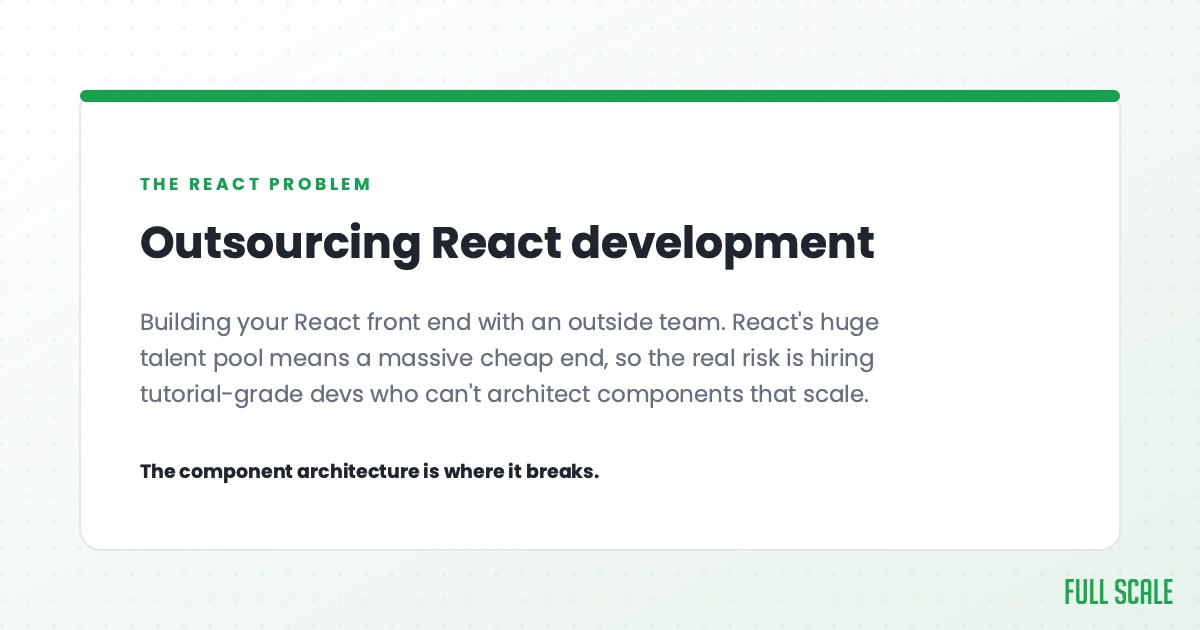
Staff augmentation avoids this entirely. Your offshore React developers work in your codebase from day one. They adopt your TypeScript config, extend your component library, follow your state management pattern. The decisions were made before they arrived, and they’re building on them, not around them.
When Project Outsourcing Works for React
Not all React work needs a long-term team. Some is genuinely appropriate for project outsourcing.
A standalone micro-frontend with a documented interface. A marketing landing page, an embeddable widget, a prototype that’s intentionally disposable. If the React component(s) live at a clear boundary with a documented contract and you don’t need them to integrate deeply with your design system, project outsourcing can deliver them.
A charting layer with a fixed API. If you’re adding a charts section, a dashboard, or a reporting view that connects to a stable data API and doesn’t need to share state with the rest of the app, the interface is clear enough for project outsourcing.
A well-specified component with an existing design system to match. If you have a Storybook with defined tokens and component patterns, and you’re asking a project shop to build one specific component to match the existing system, the spec is concrete enough to work.
What makes React project outsourcing work in these cases: the component boundary is clean, the contract is explicit, and you’re not asking the outsourced team to make architectural decisions. They’re implementing a specification where the hard decisions are already made.
What doesn’t work: ongoing feature development, any work that requires understanding your state management patterns, design system additions where the “fit” question is open-ended, and anything that will need to be extended by your local team later.
The Component Architecture Mismatch (Why Most React Outsourcing Burns Teams)
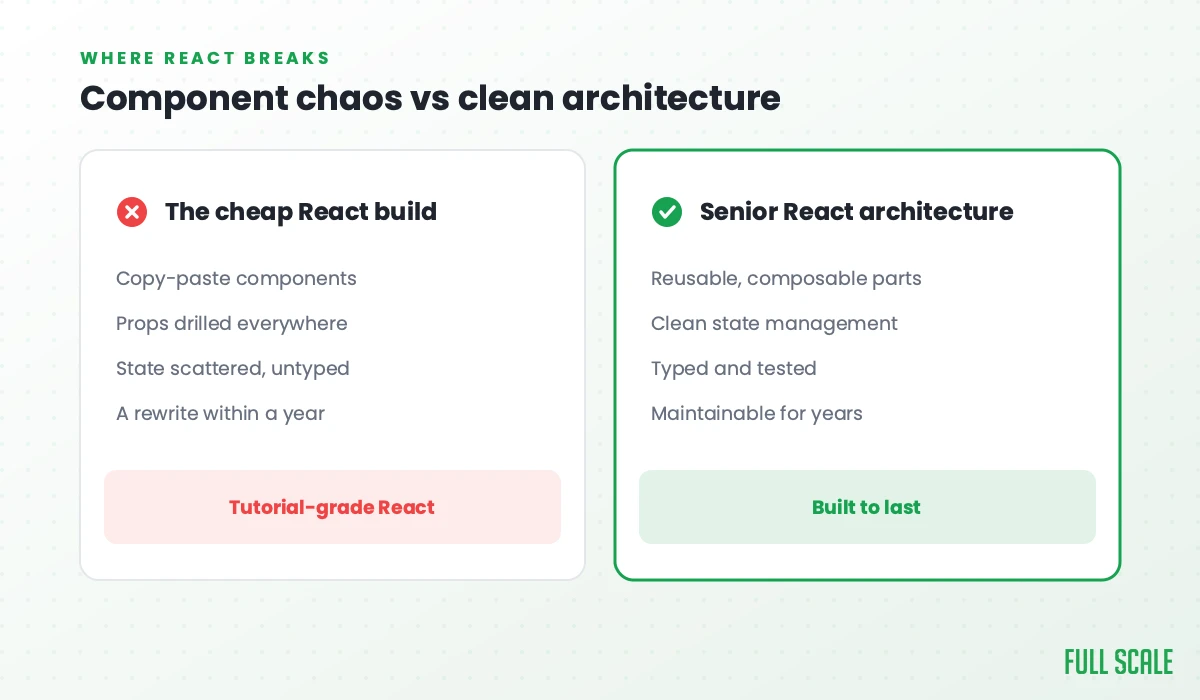
The most expensive React outsourcing failure isn’t missing features. It’s component architecture that looks right and costs weeks to extend.
Here’s the pattern:
- You outsource a feature: a settings page, an onboarding flow, a dashboard module.
- The project shop delivers. It runs. Tests pass. Demo looks good.
- Your team opens the PR to merge it.
- The component structure uses a different state management approach than your existing app.
- The TypeScript is written around your strict config rather than to it:
anytypes, assertions, workarounds. - The styling uses inline styles or a different CSS approach than your design system.
- The component hierarchy doesn’t match your existing patterns: it’s structured how their developers think about components, not how yours do.
None of this prevents the feature from shipping. All of it makes the feature expensive to maintain.
The fix is not “find a better project shop.” The fix is the right engagement model. Developers who work in your codebase from day one, who learn your TypeScript config and your component patterns before they write production code, don’t make these decisions because the decisions have already been made for them.
The React Cheapshoring Trap
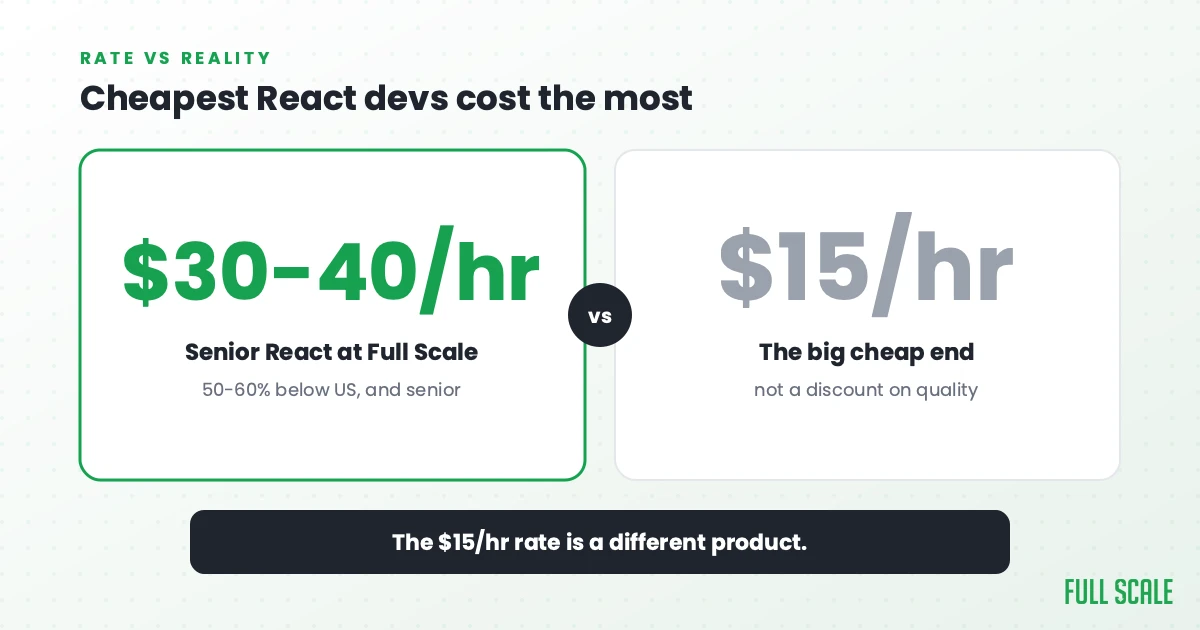
React is used by roughly 40% of professional developers globally. That enormous supply means the offshore React market has a very large, very visible cheap end: agencies offering React development at $15-$25/hour for “senior” developers.
I call this cheapshoring: offshoring for cost alone. For React, it produces a specific failure mode: developers who learned React from a tutorial, can build a component from a screenshot, and have never worked with TypeScript generics, React Server Components, or a real-world design system.
The gap between a tutorial-level React developer and a production-level React developer is enormous, and it’s invisible until you’re in the code. The cheapshoring trap is that this gap doesn’t show up in demos. It shows up when your team tries to extend the delivered work. The same trap waits on the server side, which is why teams that outsource Node.js development need the same production-level bar.
Senior offshore React developers who’ve built real products in TypeScript and Next.js cost $30-$40/hour at Full Scale, still 50-60% below the fully-loaded US equivalent. The $15/hour rate isn’t a discount on the same product. It’s a different product.
Deloitte’s 2024 Global Outsourcing Survey found that cost reduction fell from 70% to 34% as the primary outsourcing driver between 2020 and 2024. The companies that have been outsourcing long enough have figured this out already.
How to Vet a React Outsourcing Partner
Whether you’re outsourcing a scoped project or building a long-term React team through staff augmentation, the vetting criteria overlap. The emphasis shifts.
For project outsourcing
Ask to see their TypeScript, not just their React. Request code samples from their React work specifically. Look for: strict TypeScript (not any types and assertions), component composition patterns that match modern React, evidence of Next.js App Router experience if that’s your stack.
Ask how they handle design system integration. “We’ll match your design” is not an answer. Ask: “If we give you a Storybook with component tokens, what’s your process for ensuring new components use those tokens rather than creating new patterns?” A real answer describes a specific review and validation process. A non-answer defers to “our developers are experienced.”
Define TypeScript strictness requirements upfront. Put your tsconfig.json in the requirements spec. Explicitly state that any types, type assertions, and @ts-ignore comments are not acceptable. Make this a contractual requirement, not a preference.
Ask how they handle component architecture decisions. If the spec is ambiguous on component hierarchy, who decides? A good project shop will tell you they’ll flag the ambiguity and ask for direction. A bad one will tell you their senior developer will handle it.
Require a design review checkpoint before final delivery. Not just a function review, a design system review where your team evaluates whether the component structure, TypeScript types, and styling match your existing patterns.
For staff augmentation
Ask about React-specific technical depth in the vetting process. Not “can they build a React app” but: how do they test for rendering behavior and TypeScript generics? Do they evaluate Next.js App Router and Server Component experience? What’s their rejection rate?
At Full Scale, fewer than 3% of applicants make it through our 5-stage vetting process. Our skills assessment for software developers covers the framework behind how we evaluate React depth specifically. The stage 2 technical assessment explicitly tests TypeScript depth, React rendering model understanding, and Next.js data-fetching patterns. Developers who pass that have built real React products.
Ask about the onboarding process for your design system. Direct integration teams should have a structured approach to transferring your component conventions before a developer writes production code.
Ask about retention. High React developer turnover means constantly onboarding new developers who don’t know your component system. Full Scale’s 93% annual retention compounds directly into React frontend quality.
Verify Philippines English fluency with a real conversation. Not a sales call, a technical conversation with the actual developers. Component architecture discussion, PR review simulation, planning session.

Red Flags Specific to React Outsourcing
JavaScript without TypeScript in their recent work. TypeScript is the quality baseline for React in 2026. Shops that show you JavaScript component examples for recent work are either behind the market or showing you old portfolios.
“We use React/Vue/Angular based on client needs.” This means they have no genuine React depth. Senior React engineers have opinions about React. They don’t treat it as interchangeable with other frameworks.
Vague answers about state management. “We use whatever approach is best for the project” is not an answer. A senior React developer should have a considered position on local state vs. context vs. external state management libraries, and when each is appropriate.
No mention of testing. React component tests (Jest, Vitest, React Testing Library) are standard for production React work. If the vendor’s proposal doesn’t mention testing strategy, ask explicitly.
“We’ll match your design system” without asking what your design system is. Design system integration requires understanding your design system. A vendor who commits to matching it without asking questions about it hasn’t thought about what that commitment means.
Structuring for Success Either Way
If you’re outsourcing a scoped React project
Share your tsconfig.json in the requirements. Put TypeScript strictness requirements in the contract. Include a design system review milestone before final delivery. Negotiate direct developer access. Define “done” in terms of your codebase integration, not just feature function.
If you’re building an ongoing React team through staff augmentation
Document your conventions before they start: TypeScript config, ESLint rules, state management pattern, component structure, design system tokens. Run a structured design system onboarding in the first week. Pair the offshore developer with a local senior engineer for the first two weeks. Include them in frontend planning sessions from day one.
The React developers who become your most valuable long-term engineers are the ones who feel like engineers: included in architecture discussions, given meaningful work, recognized for quality. The Product Driven principles behind this (ownership, clarity, courage) apply to distributed teams just as much as co-located ones. That requires treating the engagement as team building from the start.
Outsource vs. Staff Augment: The React Decision
Outsource a scoped React project when: – The component boundary is clean and contractually defined – The integration with your design system is specified, not open-ended – TypeScript strictness requirements are in the contract – You can define “done” before the first component is built
Use React staff augmentation when: – You have ongoing React product development – Your component system needs to evolve with the product – Design system consistency across a growing codebase matters – You’re planning to work with these developers for 12+ months
When in doubt: ongoing React product development almost always needs staff augmentation. Project shops deliver React that looks done. Integrated teams deliver React that belongs in your codebase.
Ready to Get This Right?
If you have a scoped React project with clean component boundaries and explicit TypeScript requirements, schedule a consultation and we’ll tell you honestly whether it’s a fit for project outsourcing or staff augmentation.
If you need ongoing offshore React engineers who work as extensions of your team: extending your design system, working in your TypeScript codebase, attending your frontend planning, read Offshore React Development Done Right for the full guide on how the staff augmentation model works for React teams. Or explore our client case studies including the AMC Theatres case study to see consumer-scale React in practice.
Frequently asked questions
What’s the most common way React outsourcing fails?
Component architecture mismatch. Project shops make their own decisions about component structure, TypeScript patterns, state management, and styling: decisions that conflict with your existing codebase. The code ships, runs, and costs weeks to maintain or extend because it doesn’t follow your conventions. The fix is staff augmentation, the model Full Scale uses: developers who work in your codebase from day one and adopt your patterns rather than creating their own.
How do I ensure outsourced React developers match our TypeScript setup?
Put your tsconfig.json in the requirements spec. Explicitly prohibit any types, type assertions, and @ts-ignore comments as a contractual requirement. Include a TypeScript review checkpoint before final delivery. Better yet, include this in your evaluation criteria when selecting a vendor: ask to see recent TypeScript work and evaluate it against your strictness settings.
How much does outsourcing React development cost?
Cost is downstream of the model you choose. For ongoing React work, staff augmentation with a quality vendor runs mid-range for senior engineers, not bottom-tier. Be skeptical of anything below $25/hour for “senior” React developers, because the TypeScript and Next.js depth won’t be there at that price. For a one-off project the rate matters less than a tightly written spec. The full US-versus-offshore cost breakdown is in our offshore React development guide.
Should I outsource React or hire an offshore team?
Outsource (project model) when you have a self-contained component scope, explicit design system requirements in the contract, and a clear done state. Use staff augmentation (offshore team model) when you have ongoing React product development and need developers who know your codebase over time. Most teams searching for “outsource React development” actually need staff augmentation: they’re describing a product roadmap, not a one-time project.
How do offshore React developers integrate with our design system?
In a staff augmentation model: design system onboarding is day one of the integration framework. Before the developer writes feature code, they work through your component library, TypeScript patterns, and design token conventions. In a project outsourcing model: put the design system requirements in the spec explicitly, share the Storybook, and build a design system review into the delivery checkpoint. Assuming a project shop will figure it out on their own produces the component mismatch pattern.
What React skills should I require from an offshore React team?
TypeScript strict mode fluency (not just type annotations, generics and utility types), Next.js App Router experience for SSR/SSG work, React 18/19 hooks and rendering model understanding, testing with React Testing Library or Vitest, and direct experience with your state management library. “React developer” is too broad a requirement for production work in 2026. Be specific about the stack you’re running and vet for it explicitly.