
Node.js Developer Hourly Rate in the Philippines for 2026

In this article
- A senior Node.js developer hourly rate in the Philippines is $35 at Full Scale
- A Node.js developer's level depends on how much of the system they can own
- Node.js rate cards run from $12 to $95 an hour because they price different things
- Node.js developer salary in the Philippines runs $15 to $30 an hour across stacks, and the bill covers more than pay
- Five senior Node.js developers cost about $30,300 a month
- The Philippines prices near India and below Mexico and Brazil
- Staff augmentation, direct hire, a project shop or a freelancer: each changes what you pay
- How the numbers in this guide were built
- What Full Scale Node.js engineers work on
- Node.js is JavaScript on the server, so the rate follows the level and not the job title
- Frequently asked questions
- Get a price for your own Node.js team
Quick Answer: At Full Scale, a senior Node.js developer in the Philippines costs $35 an hour fully loaded, which is roughly $6,100 a month. Mid-level is $30, junior is $25, and a team lead or senior architect is $40 or more. What a Node.js developer takes home is lower, broadly $15 to $30 an hour locally across stacks, and the rest of the rate goes to benefits, equipment, employer costs and Full Scale's margin.
Four prices answer the question: $25, $30, $35 and $40+ an hour, by level. Node.js adds a wrinkle, because it is JavaScript on the server and the same engineer may be hired as a backend developer, a full-stack developer or an API architect. The last section before the FAQs shows how the rate treats those titles. Where I did the arithmetic, I label it so you can check it.
A senior Node.js developer hourly rate in the Philippines is $35 at Full Scale
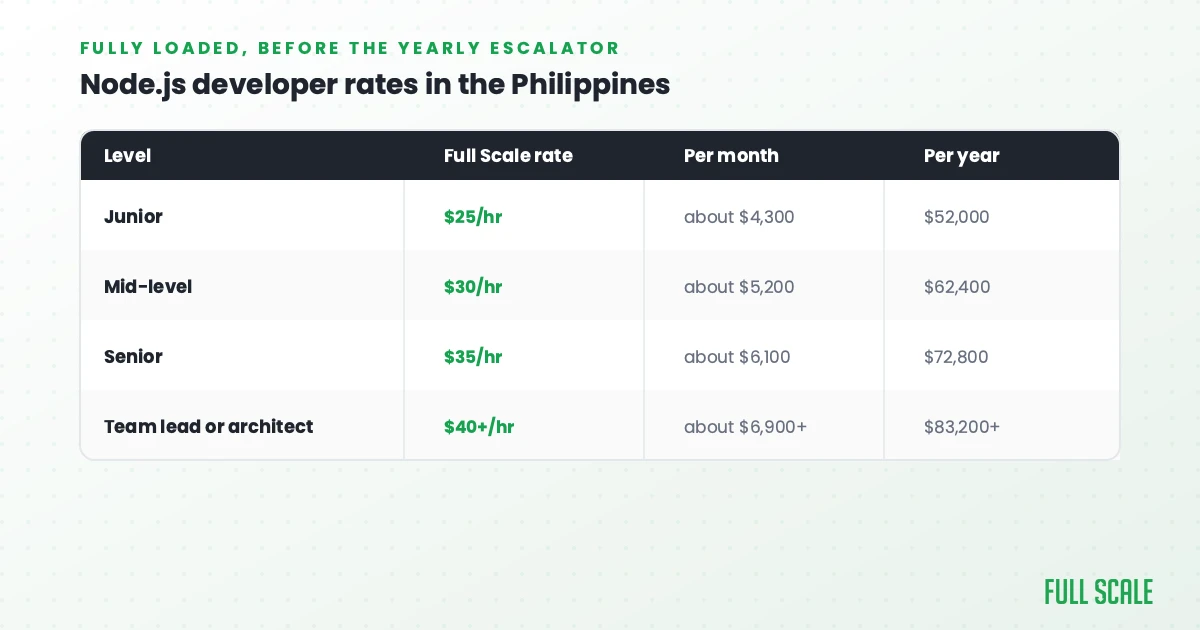
Full Scale bills Node.js developers in the Philippines by seniority, and the senior rate is the one we quote first and the one to budget with. Each rate is the hourly price of one dedicated engineer, fully loaded, with payroll, benefits, equipment and HR inside it. The monthly and annual columns are my arithmetic at 40 hours a week.
| Level | Full Scale rate | Per month (about 173 hours) | Per year (2,080 hours) |
|---|---|---|---|
| Junior Node.js developer | $25/hr | about $4,300 | $52,000 |
| Mid-level Node.js developer | $30/hr | about $5,200 | $62,400 |
| Senior Node.js developer | $35/hr | about $6,100 | $72,800 |
| Team lead or senior architect | $40+/hr | about $6,900+ | $83,200+ |
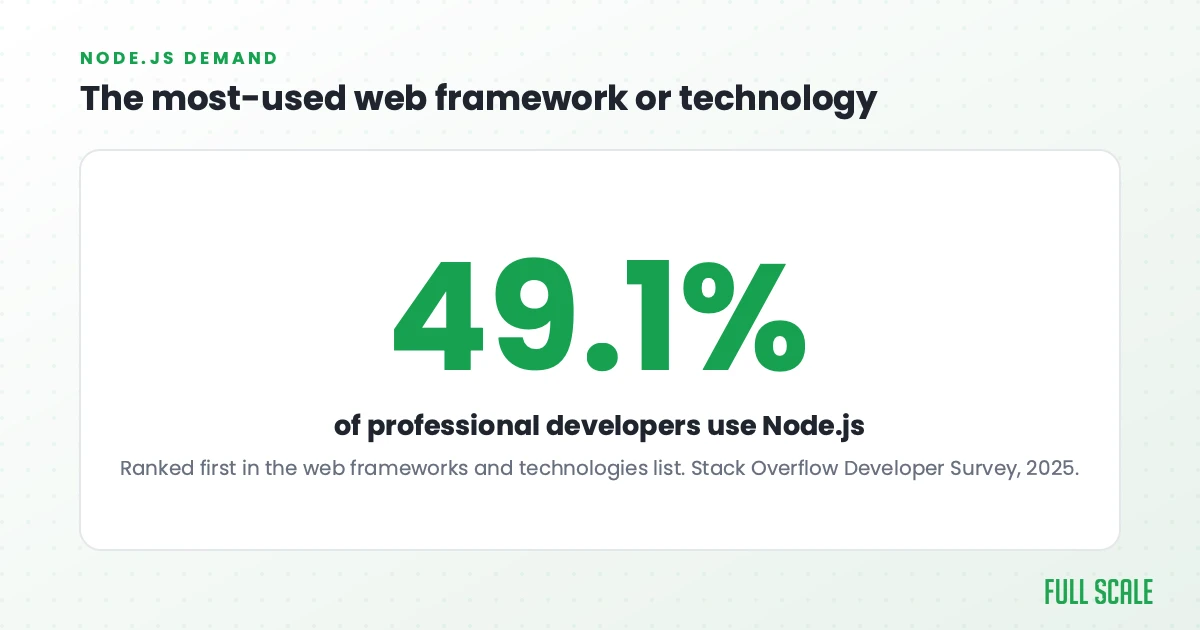
Node.js sits on the same tiers as our other mainstream stacks, while a harder-to-find stack like Rails can run slightly above them. The pool of people who know it is huge, since Node.js is used by 49.1% of professional developers in the 2025 Stack Overflow Developer Survey, which makes it the most-used web framework or technology on the list.
How quickly we can start someone depends on bench availability for the level you need, and as little as 7 days is possible. The same tiers apply to .NET developers in the Philippines.
A Node.js developer's level depends on how much of the system they can own
At Full Scale, a level comes from how much of the problem a developer can own without hand-holding, and years on a résumé don't set it. A junior owns a well-defined task and has the work reviewed before it ships. A mid-level developer owns a feature, edge cases included. A senior owns the system, and the team lead or architect above that is where the $40+ rate starts. Our career ladder has the full version, and the post on the difference between junior, mid-level and senior developers covers what each level looks like day to day.
Node.js rate cards run from $12 to $95 an hour because they price different things
Published Node.js rates for the Philippines disagree because the number on the page can be what a developer earns, what a freelancer charges or what a firm bills. Here is what three public sources said when I read them in November 2026.
| Source | What it says about Node.js | What it covers |
|---|---|---|
| VA Masters cost guide | $12 to $16 an hour for Node.js (Express, Fastify, NestJS), $13 to $17 for the MERN stack | The Philippines, and it doesn't say whether that's pay or price |
| Second Talent rate card, updated September 2026 | $15 to $25 for a junior, $25 to $42 mid-level, $42 to $65 senior, $65 to $95 for an architect | Philippine developers billed to international clients, with no method shown |
| Lemon.io | $24 to $86 for a senior with a $45 median, and $38 to $85 for a strong senior with a $60 median | Its own marketplace contracts in more than 70 countries |
Lemon.io's Philippines page covers all stacks. It shows 489 contracts in Q3 2026 with a $35 senior median and a middle half between $31 and $45.
That's $12 to $95 for one runtime. Pricing "a Node.js developer" without naming the job is like pricing "a kitchen" without saying whether you mean a food truck or a hotel. VA Masters doesn't say whether its number is pay or price, and Second Talent doesn't show how it got its rates, so treat all of these as a map of the spread rather than as quotes.
| The number | What it measures | When it's the right one |
|---|---|---|
| Local pay | What the developer earns in the Philippines, broadly $15 to $30 an hour across stacks | Context for what the market pays |
| Freelance or marketplace rate | What an independent developer charges with no employer behind them, so taxes, benefits, equipment and gaps between jobs are the freelancer's problem | A one-off API, a webhook or a prototype |
| Staff augmentation rate | What a firm bills a client for a dedicated engineer, which at Full Scale is $35 an hour for a senior Node.js developer, fully loaded | A Node.js team you plan to keep |
At Full Scale, the number we publish is the third one, because it's the one on your invoice.
Node.js developer salary in the Philippines runs $15 to $30 an hour across stacks, and the bill covers more than pay
Developers in the Philippines earn roughly $15 to $30 an hour across stacks, and Node.js sits inside that range. Our senior engineers are toward the top of it. The $35 senior rate is higher because it pays for more than salary, and part of the gap is Full Scale's margin, which is how a company that buys laptops and health insurance stays in business.
Most of our engineers are employees, and some choose to work as independent contractors. For the employees, the rest of the gap pays for what an employer owes. The salary guide has the peso detail behind the local pay.
| Part of the rate | What it covers |
|---|---|
| Benefits | Health insurance from day one with dependents covered free, group life insurance and paid time off |
| Equipment | A company laptop and a work-from-home allowance |
| Employer costs | Payroll taxes, HR and the cost of running the company |
| Margin | What's left, which keeps Full Scale in business |
A Node.js developer at $12 an hour is often the expensive one. I call that cheapshoring, staffing offshore on price alone and paying for it later in rework, turnover and a senior engineer who ends up reviewing everything. Node.js is a good example, because one synchronous call in the wrong place can block the event loop, and the event loop does not care what the engineer cost. Picking the right level matters more than the $10 an hour you save by dropping from senior to junior.
Five senior Node.js developers cost about $30,300 a month
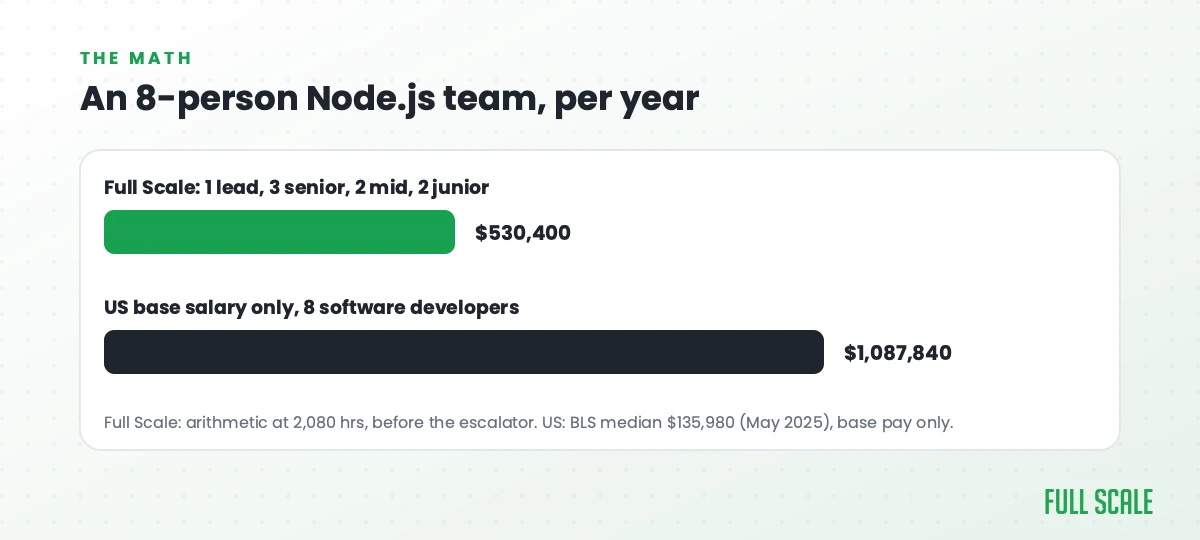
This table shows what Node.js teams cost at Full Scale's rates, next to the US base salary alone for the same headcount. Every Full Scale figure is my arithmetic.
| Team | Full Scale per month | Full Scale per year, before the escalator | US base salary only, per year |
|---|---|---|---|
| 2 senior developers | about $12,100 | $145,600 | $271,960 |
| 5 senior developers | about $30,300 | $364,000 | $679,900 |
| 8-person mixed team (1 lead at $40, 3 seniors, 2 mid, 2 junior) | about $44,200 | $530,400 | $1,087,840 |
Full Scale's contract includes a built-in rate escalator of 6% a year, applied as two 3% increases and disclosed from day one, so the annual columns are before the escalator.
The US column uses the BLS median pay for software developers, which was $135,980 in May 2025. That's base salary alone, with no benefits, payroll taxes or recruiting added, and it covers all software developers rather than Node.js in particular. The real US cost is higher. Five seniors come to about $316,000 a year less than five developers at that median, before anyone adds the cost to hire a software developer.
The Philippines prices near India and below Mexico and Brazil
Market ranges for a senior developer on any stack run about $30 to $50 an hour in the Philippines, $30 to $55 in India, $45 to $75 in Mexico and $50 to $80 in Brazil. Full Scale's $35 sits inside the Philippines range. Those are market billing ranges, built from salary data plus the usual agency markup, so they aren't quotes from any one vendor. For a country-by-country comparison that covers more than price, see the best countries guide.
What you give up in the Philippines is overlap, and most of it comes back with a shifted schedule. A US team gets three to four shared hours with most of our engineers, and some work full US business hours.
Staff augmentation, direct hire, a project shop or a freelancer: each changes what you pay
Who employs the engineer and who handles the paperwork changes your total. Here is how the options compare for Node.js work.
| Your situation | What fits | What changes the bill |
|---|---|---|
| You want 3 to 15 Node.js engineers who work like your own team | Staff augmentation through a firm like Full Scale | One fully loaded hourly rate, with payroll, benefits, HR and equipment handled for you. At Full Scale that comes with a two-week money-back guarantee, then 30 days' notice and no long-term contract |
| You have a Philippine entity and can run it yourself | Direct hire | Payroll, benefits, HR, recruiting and replacement are all yours |
| You want someone else to run payroll but not recruiting | An employer of record (EOR) | The developer's pay plus the EOR's fee. The EOR takes payroll, statutory benefits and compliance, while recruiting, day-to-day management and replacement stay with you |
| A scoped API or integration with a fixed spec | A project shop | A price for the deliverable instead of an hourly rate, and scope changes cost extra |
| A one-off webhook, script or prototype | A freelancer | The lowest sticker price and no continuity |
Vendors don't all bill the same way. The post on the four staff augmentation pricing models explains what to ask before you compare quotes, and the guide to outsourcing Node.js development covers when a project shop beats a dedicated engineer.
How the numbers in this guide were built
The $25 to $40+ rates are what Full Scale charges. Everything per month or per year is arithmetic on those rates, at 40 hours a week and 2,080 hours a year. The US base salary is the Bureau of Labor Statistics median, checked in November 2026. The Node.js share is from the 2025 Stack Overflow Developer Survey. I read the VA Masters, Second Talent and Lemon.io numbers on their own pages in November 2026, and I use them only to show how far published rates spread. The country ranges are market billing ranges for a senior developer on any stack.
What Full Scale Node.js engineers work on
Our Node.js engineers work on APIs in NestJS, Express and Fastify, usually in TypeScript, plus REST and GraphQL integrations, real-time systems on WebSockets and Socket.IO, queue workers, serverless functions on AWS Lambda and Vercel, and performance and memory debugging. At Full Scale the rate is set by the level of engineer you staff, so the useful question is which level the project needs. Greenfield architecture and API design is senior work, because someone has to decide the shape of the system before anyone builds it. Feature work in an existing NestJS service suits a mid-level developer. Tests, small endpoints and bug fixes fit a junior with review. If your code still runs on Node 20, which nodejs.org now lists as end of life, the upgrade is senior work too. The hire Node.js developers page covers each project type, and the guide to offshore Node.js development covers how to vet the engineer.
Node.js is JavaScript on the server, so the rate follows the level and not the job title
On Startup Hustle I once said that Node.js is just JavaScript, and that it's popular because everyone already has to know JavaScript for the browser. I'm an old .NET developer, so I'm a visitor in Node.js country, but the logic holds up. It has a practical side for your budget, because the same person can write your API and your React front end, and one language means one engineer can get paged for both. Stackify's monitoring product supported Node.js alongside Java, PHP and Python.
At Full Scale the price doesn't change with the title on the job post. Here is how the common Node.js roles map to the rates.
| The role you're hiring | What the engineer does | Rate at Full Scale |
|---|---|---|
| Backend Node.js developer | APIs, services, queues and database work | $25, $30 or $35 by level |
| Full-stack Node.js and React developer | Server code and the browser code that calls it | The same tiers by level, with the JavaScript developers page covering the front end |
| NestJS or API architect | Service boundaries, contracts and the decisions that are expensive to reverse | $40 or more |
| Real-time, serverless or performance specialist | WebSockets, Lambda functions, memory leaks and event loop problems | Follows the engineer's level |
The Node.js developer job description post covers what to put on the posting, and the comparison of Node.js and Python covers the language choice itself. Both are worth reading before you fix a title, because a narrow title can send you looking for a specialist when a mid-level full-stack engineer would do.
With AI writing so much of the first draft, typing a route handler is the cheapest part of the job now. What the $35 buys is a senior who reads what a model wrote and knows whether it blocks the event loop, and who catches the plausible-looking mistake before it ships. The part about caring how the product turns out is what my book, Product Driven, is about.
Frequently asked questions
What is the hourly rate for a senior Node.js developer in the Philippines?
At Full Scale, a senior Node.js developer in the Philippines is $35 an hour, fully loaded. That works out to roughly $6,100 a month or $72,800 a year at 40 hours a week. Other sources quote anywhere from about $12 to $95 an hour because they measure different things, such as local pay, freelance rates, agency prices or architect-level roles.
How much does a Node.js developer earn in the Philippines?
Developers in the Philippines earn roughly $15 to $30 an hour across stacks, and Node.js sits inside that range. Full Scale's $35 senior rate is higher because it also covers benefits, equipment, employer costs and the company's margin.
What does a team of 10 Node.js developers cost per month?
Ten senior Node.js developers at Full Scale cost about $60,700 a month, or $728,000 a year, at the $35 rate for 40 hours a week, before the escalator. Mid-level engineers at $30 an hour lower the total and a team lead at $40 or more raises it. Full Scale's contract includes a 6% annual escalator, applied as two 3% increases, so the cost rises over time.
Does Node.js cost more than other stacks at Full Scale?
No. Node.js sits on the same seniority rates as our other mainstream stacks, and only a harder-to-find stack like Rails can run slightly above them. The level of the engineer sets the price, and the framework or runtime does not.
Is a full-stack Node.js and React developer priced differently from a backend one?
Full Scale's tiers are set by seniority, so a full-stack developer is priced by level like a backend developer. A mid-level full-stack engineer is $30 an hour and a senior is $35. An architect who designs your services and contracts is a different job and starts at $40. If you need a specialist in an area like real-time streaming, we quote that on a call.
Why do some sites list Node.js developers in the Philippines at $12 to $16 an hour?
Those figures are usually freelance or marketplace rates, or what a developer earns, and they leave out the employer costs a firm covers. A fully loaded staff augmentation rate also includes benefits, equipment and the firm's margin, so the two numbers aren't measuring the same thing.
Is staff augmentation or an employer of record cheaper for Node.js developers?
It depends on how much of the work you want to own. An employer of record handles payroll, statutory benefits and compliance for a fee, and you still handle recruiting, daily management and replacement. Staff augmentation puts all of that into one hourly rate.
Get a price for your own Node.js team
Want a price for your own Node.js team? Schedule a call and we'll quote it by seniority.