How Much Does It Cost to Hire a Software Developer?

In this article
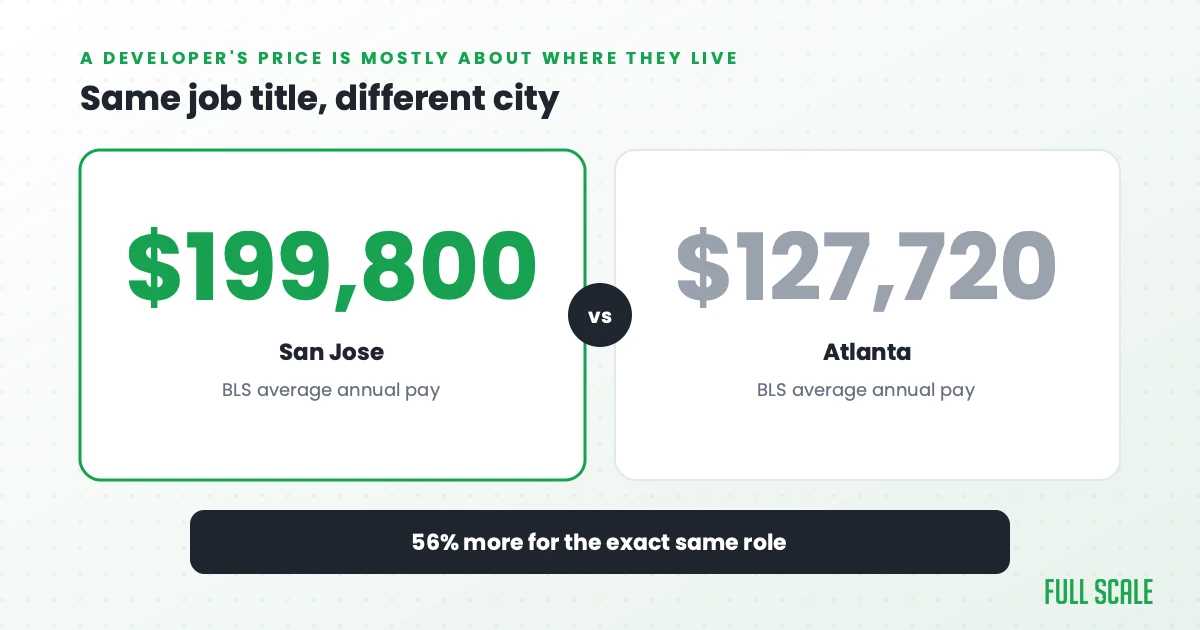
Quick Answer: The cost to hire a software developer depends far more on location than on skill. A senior engineer in San Jose reports about $199,800 a year on average per BLS data, versus $127,720 in Atlanta, 56% more for the exact same role. Offshore markets like the Philippines widen that gap further, at 50-70% less than a comparable US hire. The way to add developers without increasing burn rate is to hire the same skill bar in a lower cost-of-living market, not to lower your standards.
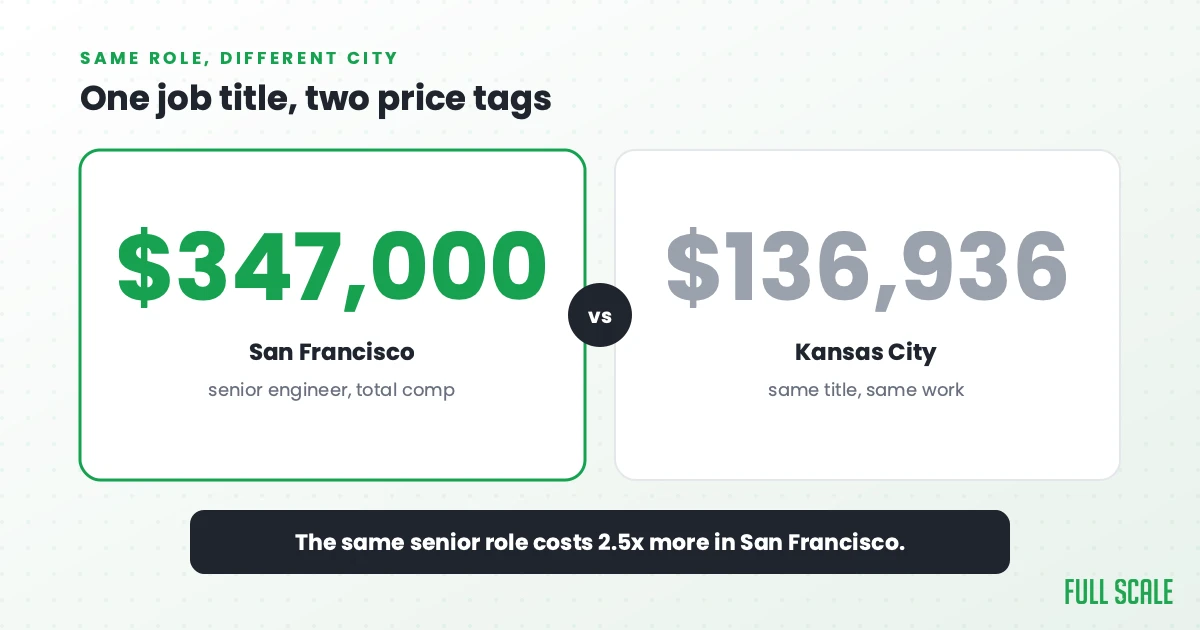
A senior software engineer in San Francisco reports about $347,000 in total pay. The same senior role in Kansas City reports about $137,000. Both numbers come from the same place, Levels.fyi, and both describe a senior engineer doing the same work with the same title.
That is a 2.5x gap for a job description that does not change.
The engineer in San Francisco is not 2.5 times better. There is no version of this where one person writes 2.5 times the code or makes 2.5 times fewer mistakes. The thing that moved is the cost of living around them, not the talent inside them. The clearest version of that is a Ruby on Rails developer job description built for the AI era.
The cost of hiring a software developer is mostly a cost-of-living bill, not a skill bill. Once you see that, the whole hiring map looks different. You stop asking “how much does it cost to hire a software developer” and start asking “what does a developer cost where I’m willing to hire one.” Those are different questions, and the second one is what actually controls your budget.
This post is about that second question. We will start inside the United States, where the spread is already huge, then follow the same pattern out to Canada, Mexico, and the rest of the world. The point is not to rank countries by price. We have a separate guide on offshore software development rates by country for that. The point here is simpler and more useful: location sets the price, and skill mostly does not ride along with it.
A quick note on the numbers
Salary data is messy, so here is how I am using it. The U.S. figures lean on the Bureau of Labor Statistics, which reports actual wages paid to employees. That is the cleanest source there is. The city and country comparisons lean on Levels.fyi, which is self-reported total compensation, base plus stock plus bonus, and skews toward engineers at larger, well-paying tech companies. So treat Levels.fyi as the upper end of each local market, not the middle. I have filtered it to senior wherever possible so we are comparing the same level everywhere.
One honest caveat on that San Francisco figure: a chunk of $347,000 is big-tech stock, which inflates the top of the range. That is exactly why the section below leans on BLS base wages, which strip the equity out. The pattern holds either way, and the BLS numbers are the conservative version of it. Where a figure is net of tax instead of gross, or comes from a local survey instead of BLS, I say so.
The average cost to hire a software developer across U.S. cities
You do not need to leave the country to watch the price of the same engineer double.
The BLS tracks average pay for software developers by metro area. These are base wages, not total comp, so the absolute numbers run lower than the Levels.fyi figures above. The pattern is what matters:
| U.S. metro | Average annual pay (BLS, base) |
|---|---|
| San Jose | $199,800 |
| San Francisco | $181,220 |
| Seattle | $164,130 |
| New York | $152,100 |
| Boston | $148,100 |
| Dallas | $128,100 |
| Chicago | $127,960 |
| Atlanta | $127,720 |
Source: BLS Occupational Employment and Wage Statistics.
San Jose pays about 56% more than Atlanta for the same job title. Nationally, BLS puts the median software developer wage at $133,080, with the bottom 10% under $79,850 and the top 10% over $211,450. That is a 2.6x spread inside one country, and geography drives a big share of it before seniority even enters the picture.
The same engineer is worth a different amount depending on which city’s rent they are trying to cover.
This is why remote hiring quietly became a budget lever. When a developer can live in Kansas City and work for anyone, the company gets to pick which market it pays into. Hire from the Bay Area and you pay Bay Area money. Hire the same skill from a lower-cost metro and you don’t, even though the work coming back is the same.
The salary is not the whole cost
Before we leave the U.S., one correction that catches a lot of founders off guard. The salary is not what the hire costs you.
A full-time employee costs roughly 1.25 to 1.4 times their base salary once you add benefits, payroll taxes, equipment, and overhead. MIT’s widely cited employee-cost work is the standard reference for that multiplier. Run it on a senior engineer in a top U.S. market and you clear $200,000 all in before anyone writes a line of code.
Then there is the cost of finding them. A recruiter or staffing agency placement fee typically runs 15% to 25% of first-year salary, per Eddy’s HR breakdown, climbing toward 30% for senior and hard-to-fill roles. On a $180,000 salary that is another $27,000 to $54,000 for the introduction alone.
So the headline salary is the floor, and the floor itself is set by location. Everything stacked on top scales with it.
The same pattern, everywhere else
Now widen the lens. The U.S. spread is real, but it is small compared to what happens when you cross a border.
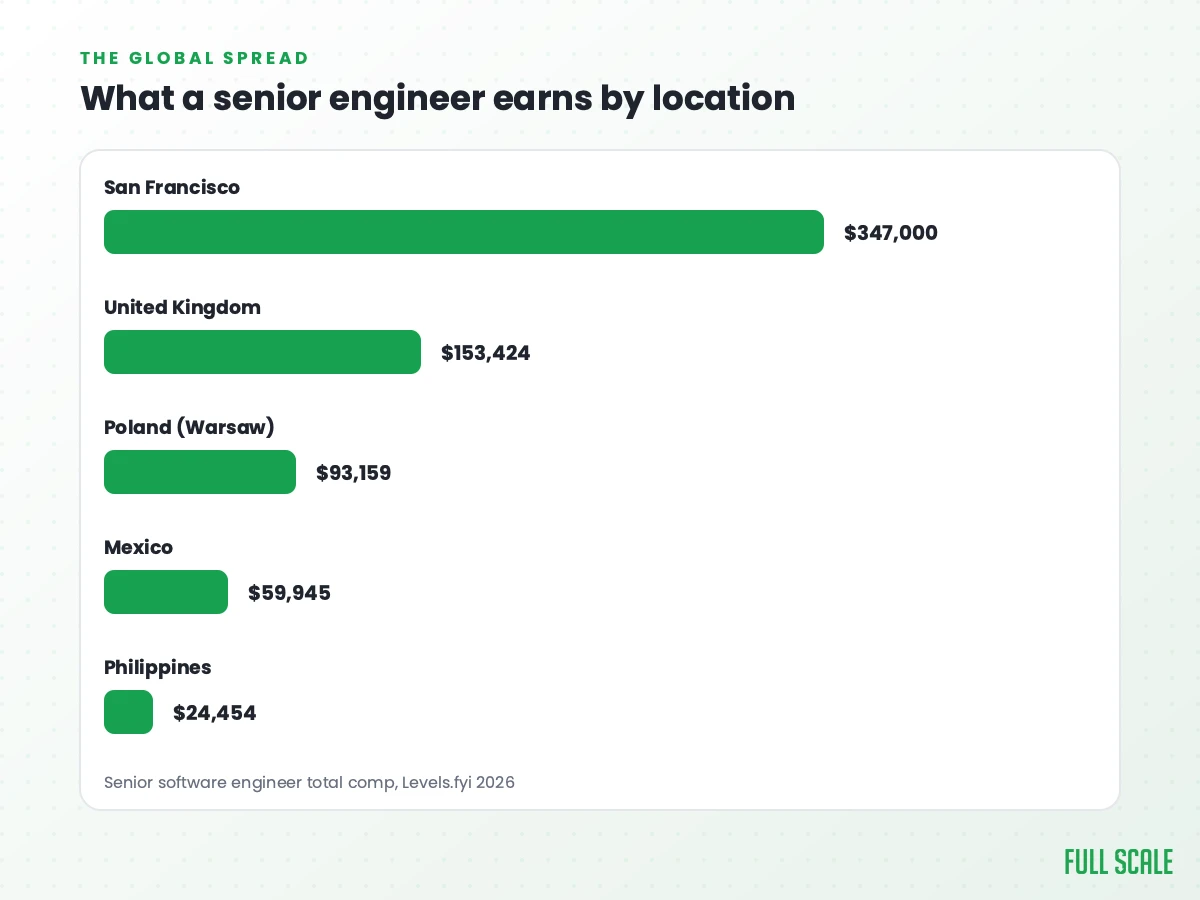
Here is senior total comp from Levels.fyi for a few markets, in U.S. dollars:
| Location | Senior total comp (USD) |
|---|---|
| San Francisco | $347,000 |
| United Kingdom | $153,424 |
| Kansas City | $136,936 |
| Poland (Warsaw) | $93,159 |
| Poland (Kraków) | $86,178 |
| Mexico | $59,945 |
| India (Hyderabad) | $55,817 |
| India (Mumbai) | $35,935 |
| Philippines | $24,454 |
Source: Levels.fyi location pages, senior level.
Notice what happens inside Poland and inside India. Warsaw pays about 8% more than Kraków. Hyderabad pays more than half again what Mumbai does. Same country, same talent pool, same language, just a different city and a different number. The within-country gap you saw between San Francisco and Kansas City is not an American quirk. It shows up everywhere, for the same reason every time.
Canada sits where you would expect a nearshore market to sit. Levels.fyi puts the all-levels median around $99,000, below U.S. pay but well above most offshore markets, which is why it gets used for time-zone-friendly hiring at a discount.
A second source backs the international cliff. The 2025 Stack Overflow Developer Survey reports median pay by country for the same titles. A U.S. engineering manager reports $200,000. The same title reports $118,335 in Germany, $92,812 in France, and $52,308 in India. A U.S. back-end developer reports around $175,000 against $22,086 in India. Different survey, different method, same shape: the title holds steady and the pay falls off a cliff as you move to a lower-cost country.
To be clear about the lane here, this section is an illustration of the pattern, not a hiring menu. If you want the full country-by-country rate detail for building an offshore team, that lives in our offshore rates guide and our offshore development cost analysis.
Why location sets the price: it is a cost-of-living bill
Here is the part the typical “cost to hire” guide skips. It will show you a table of rates by region and stop there, as if the rates fell out of the sky. They did not. Pay tracks the local cost of living, because that is what a salary is for.
Numbeo’s 2025 cost-of-living index puts the United States at 64.9 against a New York City baseline of 100. Most of the offshore markets above sit between 25 and 40. Rent is even more lopsided. The U.S. rent index is 40.9, against 6.9 in the Philippines, 7.2 in Brazil, and 7.8 in Ukraine. A developer in Manila is not trying to cover San Francisco rent on a San Francisco salary. They are covering Manila rent on a Manila salary, and that math works out fine for them.
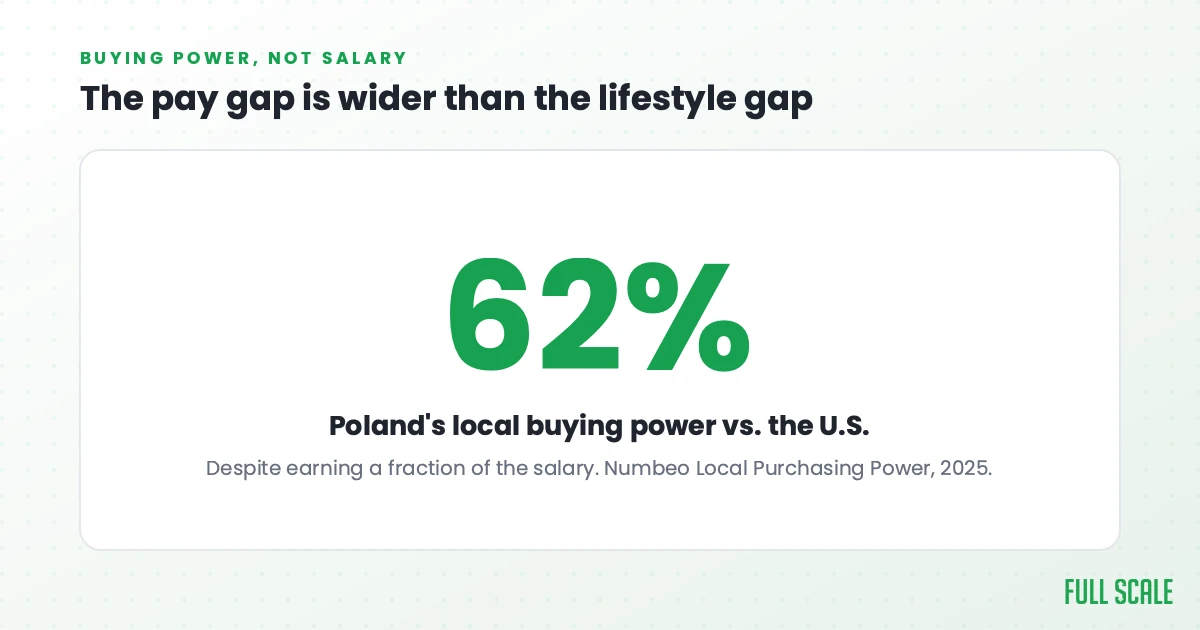
The number that really tells the story is purchasing power. Numbeo’s Local Purchasing Power Index measures what local pay actually buys against local prices. The U.S. sits at 146.2. Poland is at 91.4, which is about 62% of the U.S. level, far above the 27% you would guess from comparing raw salaries. A Polish developer earning a fraction of an American salary is not living a fraction of an American life. The pay gap is much wider than the lifestyle gap.
This is not a quirk of one crowdsourced website. It is one of the most stable findings in economics, sometimes called the Penn effect: price levels are systematically lower in lower-income countries, and the OECD’s purchasing-power data shows the same persistent gaps year after year. As a country gets richer, its wages and its prices rise together. The salary follows the cost of living, in San Jose and in Manila alike.
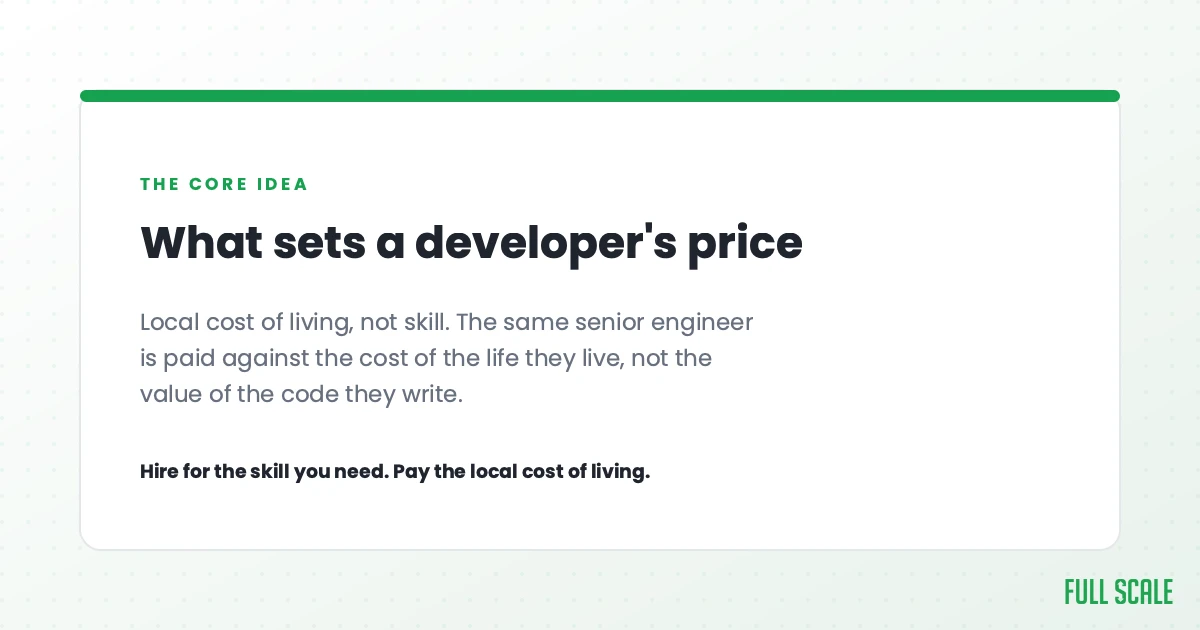
A developer’s pay is priced against the cost of the life they live, not the value of the code they write.
So skill is mispriced by geography
Put the two halves together and the conclusion is uncomfortable but useful.
If the price of a developer is set by where they live, then paying San Francisco rates does not buy you better engineers. It buys you engineers who live in San Francisco. The skill you actually need is available at a wide range of prices, and the price is mostly about real estate.
There is a fair objection to this. Expensive hubs like San Francisco and Seattle really do concentrate engineers who have worked at large scale, on hard problems, alongside strong peers. That part is true. But it is a selection effect, not something the zip code did to them. Talented people moved to where the money and the hard problems were, so the city collected more of them in one place. The skill itself exists in every market. The same screening bar, applied in Kraków or Cebu or Kansas City, turns up the same caliber of engineer. What changes between those places is the housing cost the salary has to cover, and housing markets have nothing to do with code quality.
That cuts against how most people shop for talent. There is a real instinct that the more expensive developer must be the better one, the way you would assume about a car or a watch. With engineers, that instinct is mostly noise. A great senior developer in a lower-cost city is still a great senior developer, and the label on the price tag is a cost-of-living label.
It works in the other direction too, which is where people get burned. Chasing the lowest possible number is its own mistake. I call it cheapshoring: hiring on price alone, ignoring skill, communication, and retention, and ending up with rework that costs more than you saved. The goal is the best skill per dollar, which is a very different target from the cheapest zip code.
And remember that a rate is not a salary. When you hire through an agency, a large slice of what you pay is markup that never reaches the developer. Contract and staffing markups commonly run 30% to 75% over the worker’s actual pay rate, per industry staffing data. So “what a developer costs” and “what you get charged for a developer” are two different numbers, and the gap between them is somebody’s overhead. Our staff augmentation cost breakdown walks through how that pricing actually works.
How to decide where to hire
So how do you use any of this when you actually have a role to fill?
Start with the skill bar. Decide what the role genuinely requires, whether that is senior judgment, a specific stack, or real ownership, and refuse to lower it to chase a cheaper market. That bar does not change with geography. The Product Driven approach we write about is built on hiring engineers who own outcomes, and that standard is the same in every city on the list above.
Then ask who can actually communicate with your team, because that is what decides whether a remote hire works, not the rate or the time zone. Communication is the variable that makes or breaks offshore, and only after it should cost and country fall out. Once skill and communication are settled, choose the market that clears the bar for the least money. A nearshore market like Mexico or Canada buys you closer working hours; an established offshore market clears the same skill bar for a fraction of U.S. pay, and good teams there shift their hours to overlap your day anyway. The cost difference is geography. It is not a quality penalty, as long as you hire for skill instead of price.
This is the model we run at Full Scale. We staff U.S. companies with vetted engineers in the Philippines through staff augmentation, and we pay them at the top of their local market, which is how you attract the best people in any city. The client rate is a flat, fully loaded $35 an hour, which works out to roughly $73,000 a year. Set that beside the $200,000-plus all in for the same seniority in a major U.S. metro. And note what kind of number each one is: the $35 an hour is already a price that includes our vetting, management, and overhead, while the $200,000 is your raw internal cost before a recruiter fee. Even comparing price to cost, the gap is almost entirely the cost of living of two different places, not two different skill levels.
If your instinct is to keep some of the team local and add capacity elsewhere, that is a sound instinct. Our guide to reducing software development costs covers the in-house-plus-offshore model in detail.
The takeaway is the one we started with: hire for the skill you need, then pay the cost of living of wherever that skill happens to live. If you want help finding senior engineers without paying a U.S.-city premium for them, talk to our team about the roles you are trying to fill.
Frequently asked questions
How much does it cost to hire a software developer?
In the United States, the median software developer earns about $133,080 a year per BLS, but the range runs from under $80,000 to over $211,000 depending mostly on city. Once you add benefits, taxes, and overhead at roughly 1.25 to 1.4 times salary, plus a recruiter fee of 15% to 25%, a senior U.S. hire clears $200,000 all in. The same seniority costs far less in lower-cost U.S. cities and dramatically less abroad, because pay tracks the local cost of living.
Why does the same role cost so much more in some cities?
Because salaries are priced against local living costs, not against the value of the work. San Francisco rent and prices are several times higher than in Kansas City or Manila, so San Francisco salaries are higher to match. The job is the same; what changes is the cost of the life around it.
Does a cheaper location mean lower-skilled developers?
No. Skill does not track price across geographies. A senior engineer in a lower-cost city or country is paid less because their cost of living is lower, and it has nothing to do with how capable they are. The mistake to avoid is the opposite one: hiring on price alone, which is cheapshoring, and which usually costs more in the end through rework and turnover.
Where should I hire to get the best value?
Set the skill bar for the role first, confirm the person can communicate well with your team, then pick the lowest-cost market that clears both. Nearshore markets like Mexico and Canada offer senior talent with closer working hours; established offshore markets like the Philippines clear the same bar for less. The right answer is the best skill per dollar, which is a different and better target than the cheapest possible rate. The same pattern repeats inside a country: in the Philippines, the same senior role costs meaningfully less outside the capital, which is the whole point of our Cebu vs. Manila vs. Davao breakdown.
How do I add developers without increasing my burn rate?
Hire the same skill bar in a lower cost-of-living market instead of hiring fewer people or lowering your standards. A senior developer through offshore staff augmentation runs 50 to 70 percent less than a comparable US hire, fully loaded, which means you can add real capacity without moving the needle on burn the way a US hire would. The mistake that does increase burn is chasing the cheapest rate available, since a developer who cannot do the job ends up costing more in rework than a properly vetted one would have from the start.