
.NET Developer Salary and Hourly Rates in the Philippines for 2026

In this article
- A senior .NET developer hourly rate in the Philippines is $35 at Full Scale
- Our levels follow how much a developer can own
- Rate cards disagree because they price three different things
- .NET developer salary in the Philippines runs $15 to $30 an hour across stacks, and the bill covers more than pay
- A .NET team costs about $6,100 a month per senior engineer
- The Philippines prices close to India and below Mexico and Brazil
- Staff augmentation, direct hire, a project shop or a freelancer: each changes what you pay
- How the numbers in this guide were built
- Full Scale engineers already work on .NET software for medical companies
- Senior engineers are what the $35 buys
- Frequently asked questions
- Get a price for your own .NET team
Quick Answer: At Full Scale, a senior .NET developer in the Philippines costs $35 an hour fully loaded, which is roughly $6,100 a month. Mid-level is $30, junior is $25, and a team lead or senior architect is $40 or more. The developer's own pay is lower, broadly $15 to $30 an hour locally across stacks, and the difference pays for benefits, equipment, employer costs and Full Scale's margin.
Those four prices are the whole answer. Online rate cards for the same job disagree with each other, and the third section shows why. Where I did the arithmetic, I label it so you can check it.
A senior .NET developer hourly rate in the Philippines is $35 at Full Scale
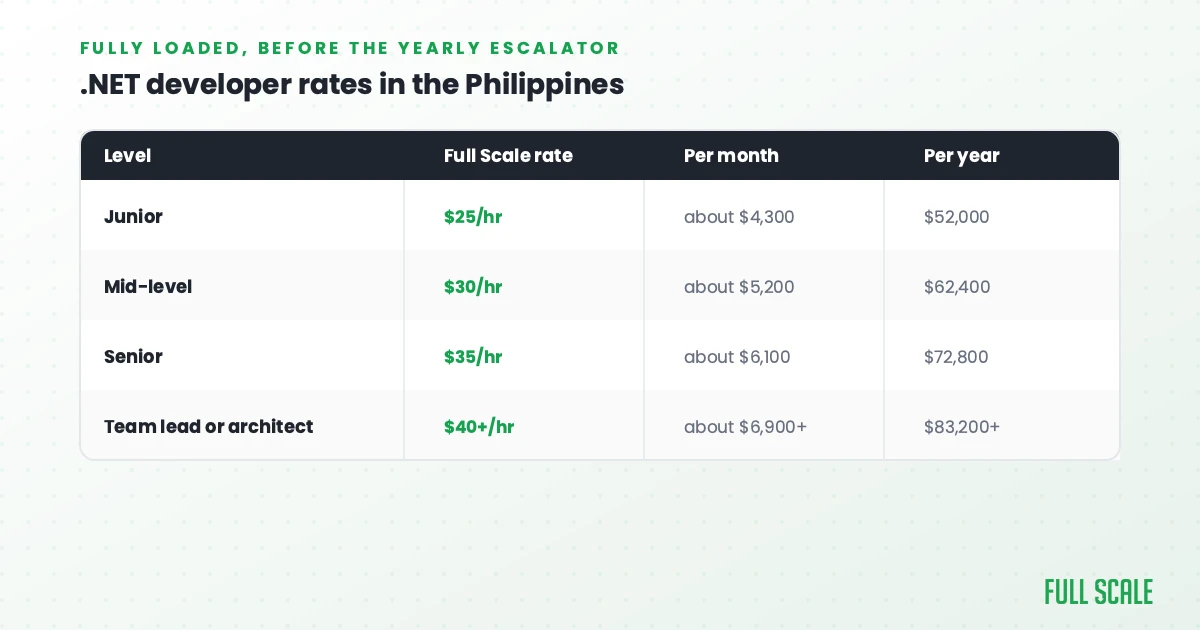
Full Scale bills .NET developers in the Philippines by seniority, and the senior rate is the one we quote first and the one to budget with. Every rate below is the hourly price for one dedicated engineer, and it's fully loaded, so payroll, benefits, equipment and HR sit inside it. The monthly and annual columns are my arithmetic at 40 hours a week.
| Level | Full Scale rate | Per month (about 173 hours) | Per year (2,080 hours) |
|---|---|---|---|
| Junior .NET developer | $25/hr | about $4,300 | $52,000 |
| Mid-level .NET developer | $30/hr | about $5,200 | $62,400 |
| Senior .NET developer | $35/hr | about $6,100 | $72,800 |
| Team lead or senior architect | $40+/hr | about $6,900+ | $83,200+ |
.NET sits on the same tiers as the other stacks we staff. A stack that's hard to find can cost a little more for a while, and that changes from time to time. .NET isn't one of those. C# is used by 29.9% of professional developers in the 2025 Stack Overflow Developer Survey, which makes the global pool deep. In our experience .NET is among the easier stacks to fill.
That's why a start in as little as 7 days is realistic, depending on bench availability. Rails and Java take a little longer because we get fewer requests for them.
Our levels follow how much a developer can own
At Full Scale, a developer's level comes from how much of the problem they can own without hand-holding. Years on a résumé don't set it. These are the first three levels, condensed from our career ladder.
| Level | What they own | How they work |
|---|---|---|
| Junior | A well-defined task | Work is reviewed before it ships |
| Mid-level | A feature, including the edge cases nobody spec'd | Reviewed on architecture, not every line, and accountable for the feature working in production |
| Senior | A system, or a client relationship end to end | Trusted to carry our judgment to a client directly, and the one who fixes it at 2am |
A team lead or senior architect works above that, and it's where the $40+ rate starts. If you want the day-to-day version of each level, the post on the difference between junior, mid-level and senior developers walks through it.
Rate cards disagree because they price three different things
Online rate cards for .NET developers in the Philippines disagree because three different numbers get mixed together under the word "rate." As of November 2026, a Philippines cost guide from VA Masters puts a senior developer at $15 to $18 an hour. A rate card from Second Talent puts a senior .NET developer at $35 to $50 an hour for international clients. Its freelance column takes a lead up to $85. Lemon.io's Q3 2026 data comes from 489 active Philippines contracts. It puts the senior contract rate at a $35 median, with the middle half between $31 and $45.
That's a $15 to $50 spread for a senior, and neither VA Masters nor Second Talent shows how it got its rates.
| The number | What it measures | What you do with it |
|---|---|---|
| Local pay | What the developer earns in the Philippines, broadly $15 to $30 an hour across stacks | Context for what the market pays |
| Freelance rate | What an independent developer charges with no employer behind them, so taxes, benefits, equipment and gaps between jobs are the freelancer's problem | A one-off task |
| Staff augmentation rate | What a firm bills a client for a dedicated engineer, which at Full Scale is $35 an hour for a senior .NET developer, fully loaded | A team you plan to keep |
At Full Scale, the number we publish is the third one, because it's the one on your invoice. A page that quotes one number and never says which of the three it means is a horoscope.
.NET developer salary in the Philippines runs $15 to $30 an hour across stacks, and the bill covers more than pay
Developers in the Philippines earn roughly $15 to $30 an hour across stacks, and .NET sits inside that range. Full Scale's senior engineers are toward the top of it. The $35 senior rate is higher than that, and some of the gap is Full Scale's margin, which is how a company that pays for health insurance and laptops stays in business.
Our engineers are employees by default, and some choose independent contractor status. For employees, the rest of the gap pays for the things an employer covers. The salary guide has the peso detail behind the local pay.
| Part of the rate | What it covers |
|---|---|
| Benefits | Health insurance from day one with dependents covered free, group life insurance, and paid time off |
| Equipment | A company laptop and a work-from-home allowance |
| Employer costs | Payroll taxes, HR, and the cost of running the company |
| Margin | What's left, which keeps Full Scale in business |
The cheapest .NET engineer in Manila is usually the expensive one. I call that cheapshoring, staffing offshore on price alone and paying for it later in rework, turnover and a senior engineer who ends up reviewing everything. The tier you pick matters more than the $10 an hour you save by dropping from senior to junior.
A .NET team costs about $6,100 a month per senior engineer
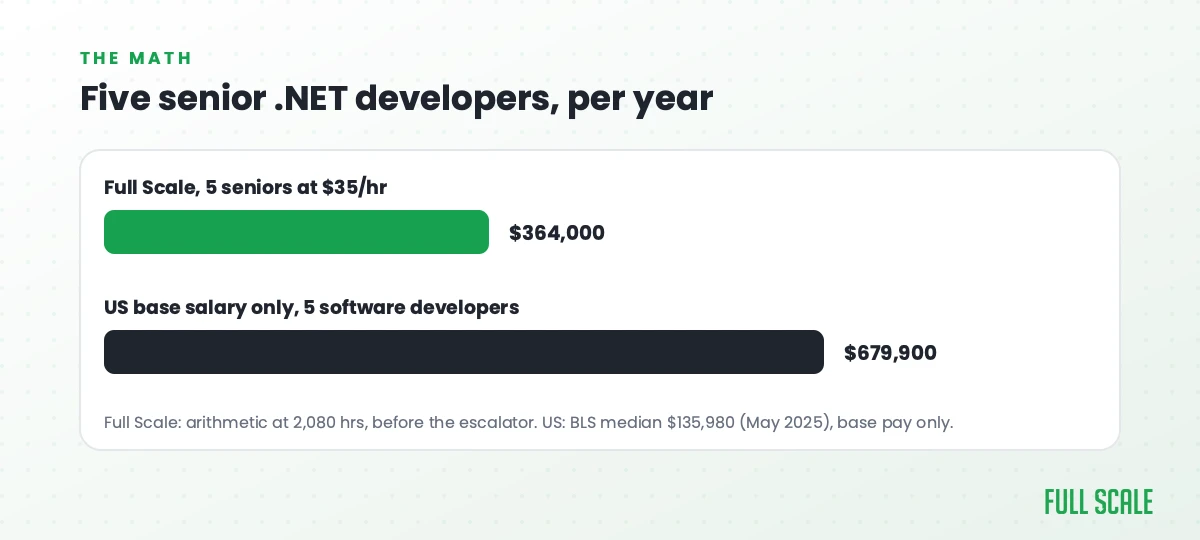
This table shows what a team of .NET developers costs at Full Scale's rates, next to the US base salary alone for the same headcount. Every Full Scale figure is my arithmetic.
| Team | Full Scale per month | Full Scale per year, before the escalator | US base salary only, per year |
|---|---|---|---|
| 5 senior developers | about $30,300 | $364,000 | $679,900 |
| 10 senior developers | about $60,700 | $728,000 | $1,359,800 |
| 5-person mixed team (1 lead at $40, 2 seniors, 1 mid, 1 junior) | about $28,600 | $343,200 | $679,900 |
Full Scale's contract includes a built-in rate escalator of 6% a year, applied as two 3% increases and disclosed from day one, so the annual columns are before the escalator.
The US column uses the BLS median pay for software developers, which was $135,980 in May 2025. It covers base salary only, so it leaves out benefits, payroll taxes and recruiting, and it covers all software developers rather than .NET specifically. Treat it as a floor for the US side. A ten-person US team costs about $632,000 a year more in base salary alone, which is before anyone adds the cost to hire a software developer.
The Philippines prices close to India and below Mexico and Brazil
A senior developer in the Philippines is billed at roughly $30 to $50 an hour, close to India and below Mexico and Brazil. These are typical billed ranges in US dollars per hour.
| Country | Senior developer, typical billed range |
|---|---|
| Philippines | $30 to $50 per hour (Full Scale charges $35) |
| India | $30 to $55 per hour |
| Mexico | $45 to $75 per hour |
| Brazil | $50 to $80 per hour |
These are market ranges for senior developers on any stack, built from salary data plus the usual agency markup, so they aren't quotes from any one vendor. The full table and the method are in our guide to the best countries for offshore software development.
Overlap is a scheduling choice, and it closes much of the nearshore gap. Most of our engineers shift their day so it overlaps a US afternoon, which leaves a US team three to four working hours with them. Some work full US business hours. English is easy for US teams to work with, too.
Staff augmentation, direct hire, a project shop or a freelancer: each changes what you pay
The same engineer costs a different total depending on who employs them and who does the paperwork. This is how the options differ on cost for a .NET team.
| Your situation | What fits | What changes the bill |
|---|---|---|
| You want 5 to 15 .NET engineers who work like your own team | Staff augmentation through a firm like Full Scale | One fully loaded hourly rate, with payroll, benefits, HR and equipment handled for you. At Full Scale that comes with a two-week money-back guarantee, then 30 days' notice and no long-term contract |
| You have a Philippine entity and want to run it yourself | Direct hire | You carry payroll, benefits, HR, recruiting and replacement yourself |
| You want someone else to run payroll but not recruiting | An employer of record (EOR) | You pay the developer's pay plus the EOR's fee. The EOR handles payroll, statutory benefits and compliance, and you still own recruiting, daily management and replacement |
| One scoped project with a fixed spec | A project shop | A price for the deliverable instead of an hourly rate, and scope changes cost extra |
| A one-off task or a short experiment | A freelancer | The lowest sticker price and no continuity |
The four ways vendors charge for staff augmentation differ more than most buyers expect, and it's worth reading before you compare quotes.
How the numbers in this guide were built
The Full Scale rates are what we charge. The monthly and annual figures are arithmetic from those rates at 40 hours a week, or 2,080 hours a year. The US base salary comes from the Bureau of Labor Statistics, checked in November 2026. The C# share comes from the 2025 Stack Overflow Developer Survey. I read the VA Masters, Second Talent and Lemon.io figures from their own pages in November 2026, and I quote them only to show how far published rates spread. The country ranges are the market ranges in our best-countries guide.
Full Scale engineers already work on .NET software for medical companies
Yes, and SOTA Cloud is one example. SOTA Cloud is a cloud dental imaging company with FDA-cleared software in more than 1,000 dental locations, built on C#, .NET, Angular and Azure, and Full Scale engineers work on its team.
My own first big .NET project was a laboratory information system. The lab had been sending Cerner roughly $1M a year to keep an old AS/400 system running, and we built the replacement ourselves. I was doing medical .NET work long before Full Scale existed.
Bring your compliance and legal team into the first call to scope the FDA and HIPAA requirements for your product.
Senior engineers are what the $35 buys
A senior engineer earns the $35 by knowing what order to do things in. I've been building on .NET since 2002, which means I've lived through every rename Microsoft ever came up with: .NET Framework, .NET Core, and now plain .NET. At Stackify we moved a large .NET Framework app off WCF and onto .NET Core Web API services. The APIs were taking in billions of data points a day on Azure. We moved the services over one at a time, old and new side by side, and the new ones ran on Linux in Kubernetes. The migration write-up has the details.
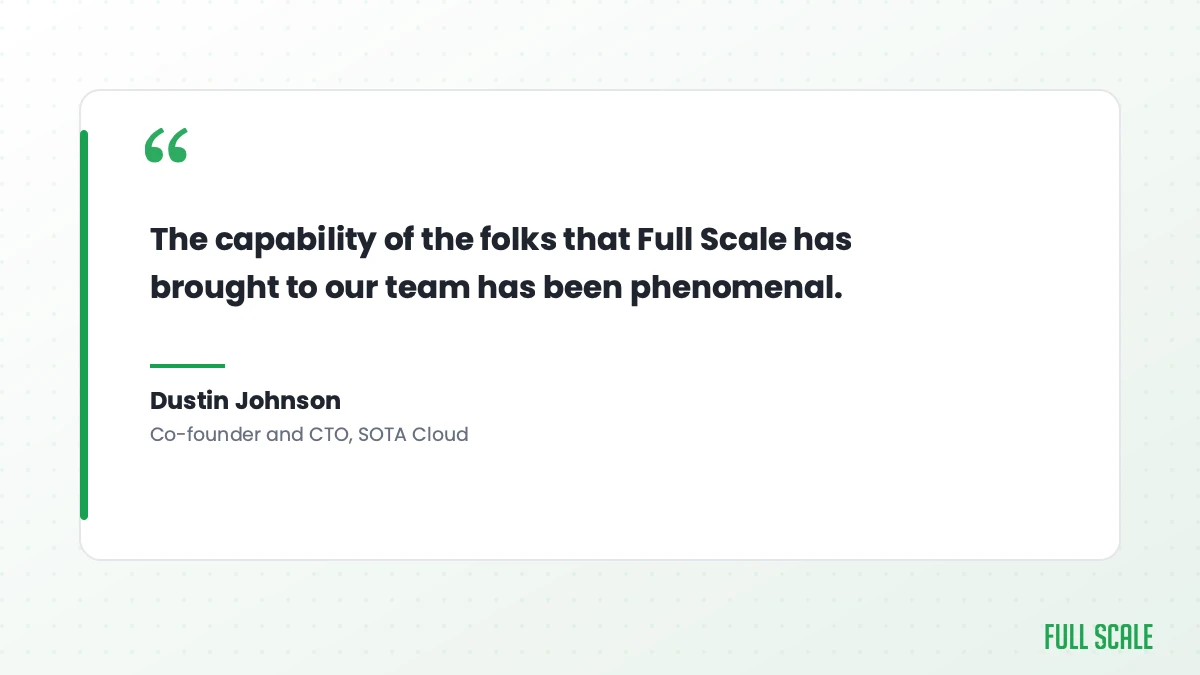
SOTA Cloud's co-founder and CTO, Dustin Johnson, put it this way about the engineers Full Scale staffed:
"The capability of the folks that Full Scale has brought to our team has been phenomenal. The Full Scale team has staffed us with top performers in our company, even relative to some of the folks that we have here in the US."
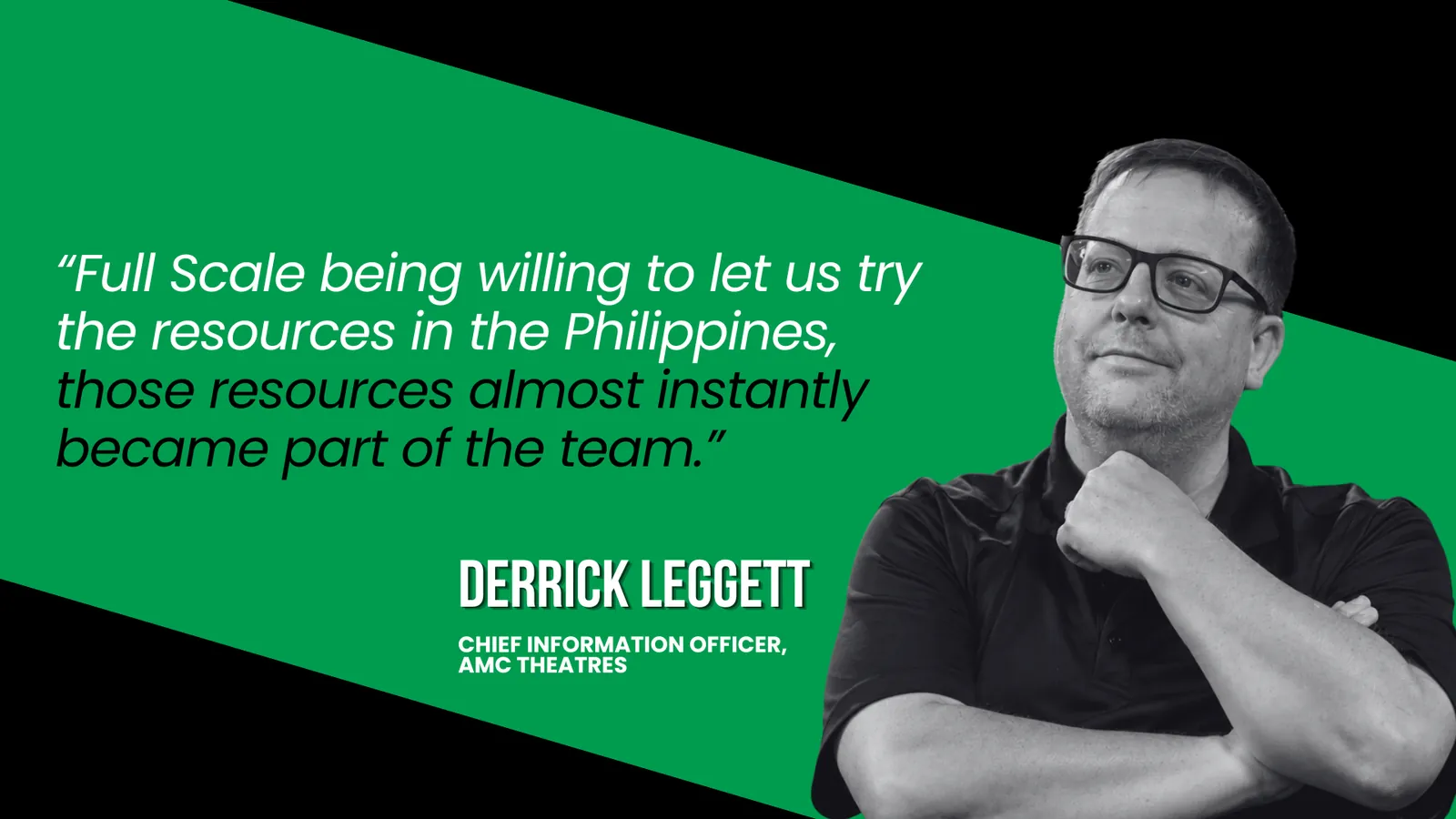
AMC Theatres, which runs the world's largest movie-theatre ticketing platform, is a Full Scale .NET client. The engineers we placed there are full AMC engineers, in the same standups, tools and roadmap as everyone else. The caring-about-the-outcome part is what my book, Product Driven, is about.
Frequently asked questions
What is the hourly rate for a senior .NET developer in the Philippines?
At Full Scale, a senior .NET developer in the Philippines is $35 an hour, fully loaded. That works out to roughly $6,100 a month or $72,800 a year at 40 hours a week. Other sources quote anywhere from about $15 to $50 an hour for a senior because they measure different things, such as local pay, freelance rates or agency prices.
How much does a .NET developer earn in the Philippines?
Developers in the Philippines earn roughly $15 to $30 an hour across stacks, and .NET sits inside that range. Full Scale's $35 senior rate is higher because it also covers benefits, equipment, employer costs and the company's margin.
What does a team of 10 .NET developers cost per month?
Ten senior .NET developers at Full Scale cost about $60,700 a month, or $728,000 a year, at the $35 rate for 40 hours a week, before the escalator. Mid-level engineers at $30 an hour lower the total and a team lead at $40 or more raises it. Full Scale's contract includes a 6% annual escalator, applied as two 3% increases, so the cost rises over time.
Does .NET cost more than other stacks at Full Scale?
No. .NET sits on the same seniority rates as our other stacks. A stack that's harder to find can cost a little more for a while, but .NET is among the easier ones for us to fill.
Is staff augmentation or an employer of record cheaper for .NET developers?
It depends on how much of the work you want to own. An employer of record handles payroll, statutory benefits and compliance for a fee, and you still handle recruiting, daily management and replacement. Staff augmentation puts all of that into one hourly rate.
Can I hire .NET developers for healthcare projects?
Yes. Full Scale engineers already work on .NET software for medical companies, including SOTA Cloud's FDA-cleared dental imaging platform. Bring your compliance and legal team into the first call to scope the FDA and HIPAA requirements for your product.
How fast can I start a .NET developer?
.NET is among the easier stacks for Full Scale to fill, so a start in as little as 7 days is realistic, depending on bench availability. Full onboarding into your codebase runs about 14 days. Stacks we get fewer requests for, like Rails and Java, can take longer.
Get a price for your own .NET team
Want a price for your own .NET team? Schedule a call and we'll quote it by seniority.