
Outsource Node.js Development: How to Pick the Right Model

In this article
- Two Things You’re Choosing Between
- Why Node.js Makes This Distinction Especially Important
- The Node.js Cheapshoring Trap
- When Project Outsourcing Works for Node.js
- Vetting a Node.js Partner for Either Model
- Red Flags Specific to Node.js Outsourcing
- Structuring the Engagement for Success
- The Outsource vs. Staff Augmentation Checklist
- Ready to Figure Out Which Model You Need?
- Frequently asked questions
Quick Answer: Outsourcing Node.js development usually means one of two models: project outsourcing, where a vendor delivers a fixed scope, or staff augmentation, where Node.js engineers join your team directly. For most ongoing Node.js product work, staff augmentation wins because Node’s lack of enforced structure means the architecture keeps evolving as your team learns what actually breaks in production. Full Scale places senior Node.js engineers in the Philippines under this model, vetted for real async and event-loop depth, not just route-handler syntax.
Most companies searching for “outsource Node.js development” are looking for something that doesn’t quite match what they’re describing.
They want a Node.js team to help build their product. They’ve heard you can hire one offshore. They search, they find agencies, they compare rates. What they haven’t done is ask the first question: do I actually want to outsource a project, or do I want to extend my team?
Those are different things, and the distinction determines whether what you’re doing will work. The full breakdown lives in our staff augmentation vs. outsourcing guide, but the Node.js version has some specific wrinkles worth understanding.
I’ve seen this from both sides. At Stackify, we built a Node.js APM agent that ran in production for thousands of customer applications. I spent years watching what breaks in real Node.js systems at scale. Then I co-founded Full Scale and placed Node.js engineers with product companies. Most of the companies that came to us with “we need to outsource Node.js development” actually needed something different, and the ones who figured that out before signing a contract did dramatically better than the ones who didn’t.
This guide is the decision framework most teams skip before they start talking to vendors.
Two Things You’re Choosing Between
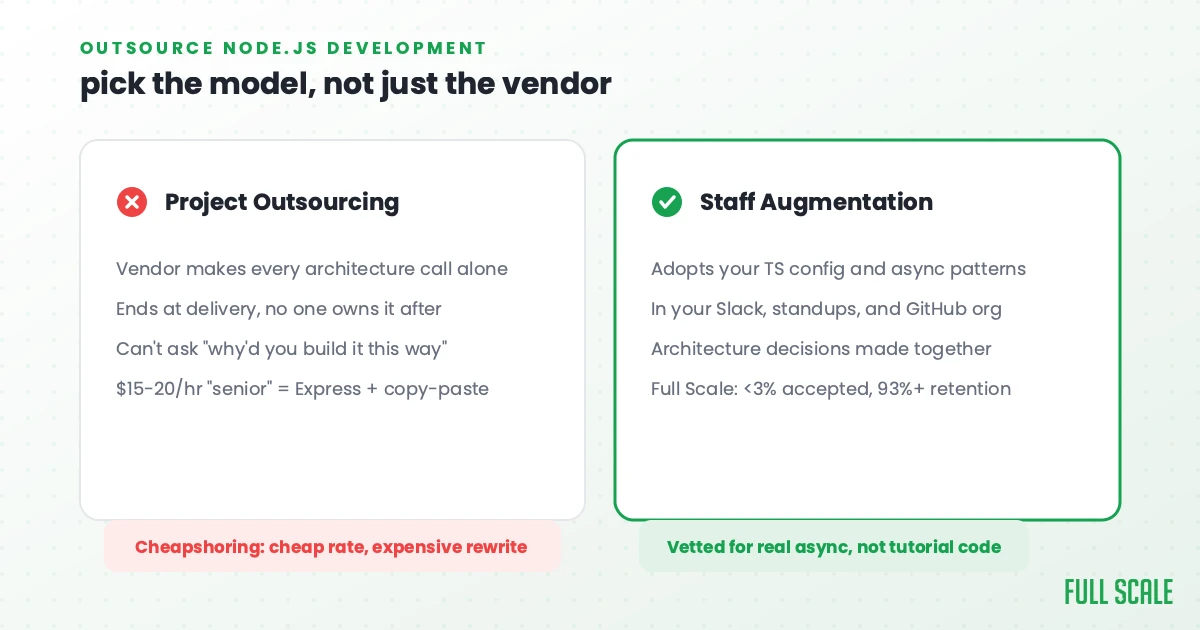
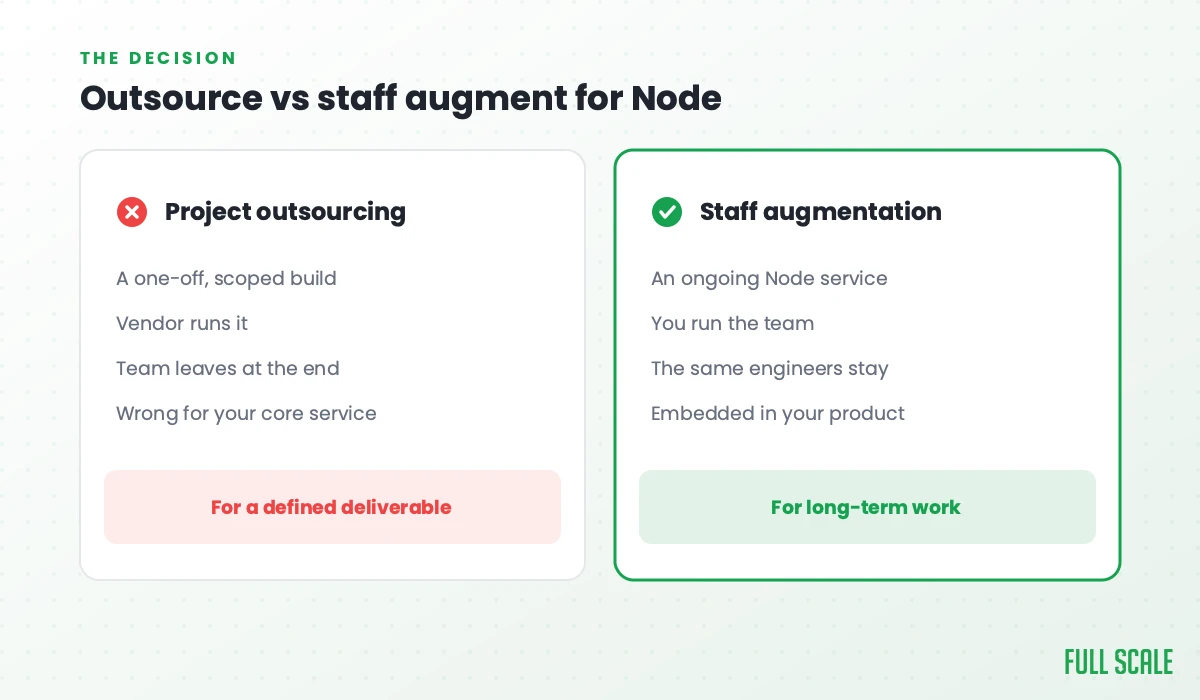
Project outsourcing means handing a defined scope of Node.js work to an external team and receiving a deliverable. You define what to build, and you pay for what they deliver after you review it.
This works when the work is genuinely scoped: a specific API integration with a clear spec, a one-time migration, a well-defined authentication service you’re extracting from a monolith. Something with an agreed-on done state that doesn’t require the developers to understand your entire product.
Staff augmentation means adding Node.js engineers to your team. They’re in your Slack, on your standups, working in your GitHub organization, following your TypeScript conventions and your PR process. You manage their work. Full Scale handles payroll and HR. They build what you’re building, continuously.
This works for ongoing Node.js product development: a SaaS API you’re actively expanding, a microservices migration, a real-time system you’re scaling. Anything where requirements evolve with what users actually do.
Most companies searching for “outsource Node.js development” are describing a product roadmap, not a scoped project. They want Node.js engineers for weeks or months, building features as the product grows. What they’re describing is staff augmentation. They reach for the word “outsource” because it’s familiar, even though the engagement they actually need works differently.
The distinction matters because the vendors are different, the pricing models are different, and the failure modes are different.
Why Node.js Makes This Distinction Especially Important
Node.js has no enforced structure. The same application could be built with Express, NestJS, Fastify, raw HTTP, or any combination. The async model (callbacks, Promises, async/await) can be implemented ten different ways, some of which work and some of which subtly destroy performance. TypeScript strictness settings vary. ORM choices vary.
When a project shop receives a Node.js spec and builds in isolation, they make every one of these architectural choices themselves. Some of those choices will conflict with your existing patterns, your team’s conventions, or your production requirements, and you won’t know until the deliverable arrives.
When a staff augmentation team integrates with yours, they adopt your patterns, from your TypeScript config to your error handling approach to your async conventions. The architecture decisions are made together, in real time, with the people who have to live with them.
I saw the consequences of the project outsourcing model repeatedly through Stackify’s APM data. Production Node.js applications with inconsistent async patterns (some callbacks, some Promises, some async/await, all in the same service), connection pools misconfigured, event loop blocking in unexpected places. These are the codebases that arrive from project shops that built to spec without ever understanding the system they were building into.
The Node.js Cheapshoring Trap
Hire Node.js developers on rate alone and you are buying a rewrite you haven’t scheduled yet.
Node.js is used by roughly 40% of professional developers globally. That means the offshore Node.js talent pool is enormous, and so is the quality range.
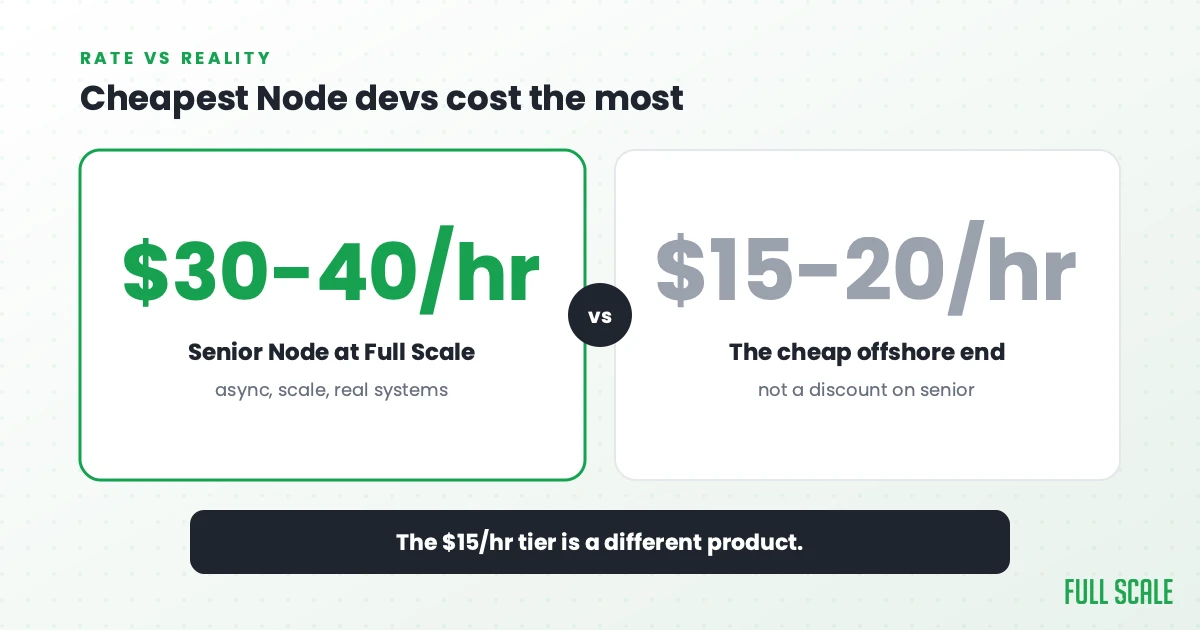
The $15-$20/hour end of the offshore Node.js market is large, visible, and heavily advertised. Agencies will quote you a Node.js team at those rates and describe the developers as “senior.” What “senior” usually means at those rates is 3+ years of experience writing Express routes and copying Stack Overflow answers.
I call this cheapshoring: offshoring done for cost alone, with no real quality bar. For Node.js it’s particularly dangerous because the language is forgiving enough that code that looks like it works can fail unpredictably in production, especially under load, especially with real async complexity, especially at the event loop edge cases that a developer who’s only built tutorial projects has never encountered.
The math on cheapshoring always loses in the end, because the refactoring cost exceeds the rate savings. The bill just never calls ahead.
Deloitte’s 2024 Global Outsourcing Survey says skilled talent and agility now join cost reduction as key drivers for outsourcing. The companies that have been at outsourcing long enough have learned: you hire offshore for the best outcome at a sustainable rate, not for the cheapest rate available.
When Project Outsourcing Works for Node.js
Not everything needs a team. Some Node.js work is genuinely scoped and appropriate for project outsourcing.
Well-specified one-time integrations. A Stripe webhook handler with documented behavior. A Twilio SMS integration for a specific use case. A data pipeline that transforms one input schema to one output schema. These have a real done state and clear acceptance criteria. A project shop can deliver them.
Defined microservice extraction. “Take this specific service from our monolith, give it its own repository with this interface, add tests.” Clear scope, clear contract, can be delivered and accepted.
Migration with a known target. “Move this database from one schema to another and write the migration scripts.” Bounded, testable.
A mobile app backend with a frozen API contract. If the app’s screens and endpoints are settled, a mobile app backend can be scoped and handed off like any other service. If the app is still changing, the backend changes with it, and that is a team job.
What makes these work: you can write down the done state before the first line of code is written. You can write an acceptance test. The developers don’t need to understand your broader system to complete the work.
What doesn’t work as a project: any ongoing product development, any architecture-dependent work where the requirements will evolve, any work where you’ll need to ask “why did you do it this way?” after delivery.
Vetting a Node.js Partner for Either Model
Whether you’re outsourcing a scoped project or building an ongoing staff augmentation engagement, the vetting criteria overlap, but the emphasis differs.
For project outsourcing
Insist on direct developer access. The main failure mode of Node.js project outsourcing is the telephone game between you and the developers. If the agency won’t commit to direct communication with the engineers building your code, you’re buying the telephone game and its outcomes.
Test their Node.js specifically. Not “do you do Node.js?” but: “How do you handle graceful shutdown in a Node.js server? What does your TypeScript strictness configuration look like? How do you prevent event loop blocking in an Express middleware?” Agencies that can’t answer these questions in the sales call will not answer them better in execution.
Get scope boundaries in writing. Every Node.js project outsourcing engagement goes wrong the same way: the spec changes, the agency calls it scope creep, and you spend the last 40% of the timeline renegotiating. Define what’s in and out before signing.
Ask for the test coverage on past delivered work. Node.js code without tests is a liability. Any project shop unwilling to show you test coverage on prior deliverables is telling you something.
Check their Node.js version standards. In 2026, any Node.js shop still defaulting to CommonJS without offering ESM, or building without TypeScript, is behind. These are signals of whether the team works with modern Node.js or builds like it’s 2019.
For staff augmentation
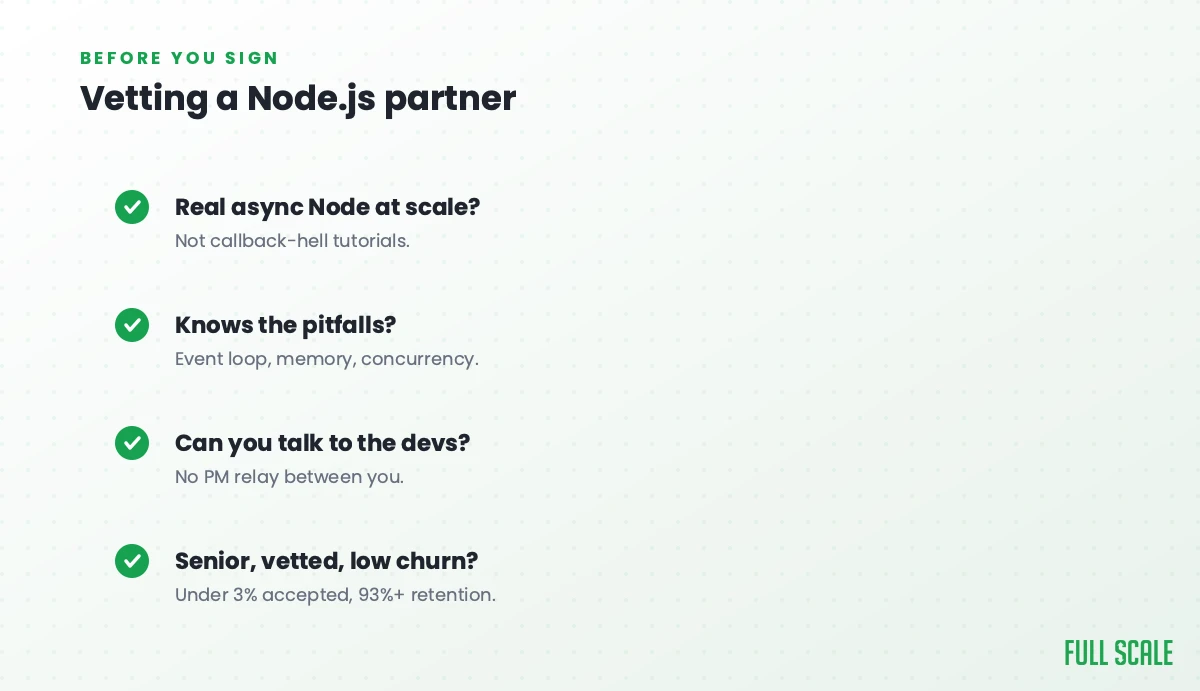
Understand their vetting process in detail. Ask for the stages, what each tests, and the rejection rate. “We only hire the best” isn’t a vetting process. At Full Scale, fewer than 3% of applicants make it through our 5-stage process. A partner who can’t describe a real rejection rate is probably not rejecting enough.
Ask specifically about Node.js technical depth. The questions that matter are event loop understanding, async pattern discipline, TypeScript fluency, and architecture decision experience, not “can they write a route handler.” The developers who’ve built real production Node.js systems can explain what happens when you block the event loop, and the ones who haven’t usually change the subject. Node’s own guide to not blocking the event loop is a fair yardstick for the answer.
Ask about retention rates. High turnover in a staff augmentation engagement means you’re constantly onboarding new developers who don’t know your system. Full Scale’s annual Node.js developer retention is 93%. That compounding system knowledge is part of the value. Our skills assessment for software developers explains how rigorous vetting drives retention. Accurately-placed developers don’t leave.
Check direct access explicitly. Direct communication with the developers, not a project manager relay. This should be non-negotiable. If the vendor’s team is in the Philippines, also verify English fluency in a real conversation. The Philippines is the third-largest English-speaking country in the world, but communication quality still varies widely between vendors.
Red Flags Specific to Node.js Outsourcing
“We use Node.js for everything.” Node.js is the right choice for APIs, real-time, and event-driven systems. It’s not the right choice for CPU-intensive computation or certain kinds of background processing. A vendor who claims it’s universally optimal doesn’t have strong Node.js opinions. They have strong “whatever you want to hear” opinions.
No TypeScript in their work samples. TypeScript is the quality baseline for serious Node.js development in 2026. A vendor whose code samples are in JavaScript without TypeScript is either behind the market or showing you old work. Either is a signal.
Callback-heavy code in their examples. Callbacks in 2026 Node.js code (outside of specific performance contexts) is a legacy pattern. Developers still writing callbacks where async/await would work have not kept current with the language.
Vague architecture answers. “We’ll discuss the architecture once the project starts” from a project shop means your architectural decisions will be made by developers you’ve never met, based on their preferences, not yours.
No mention of testing. Node.js APIs without tests will break in ways that are expensive to debug. If the vendor’s proposal doesn’t mention testing strategy, ask directly. “We follow best practices” is not a testing strategy.
Structuring the Engagement for Success
If you’re outsourcing a scoped Node.js project
Define done before you start. Write acceptance criteria, not just feature descriptions. Specify what the API contract looks like, what the error handling behavior should be, what test coverage you expect. The cleaner the input, the better the output.
Negotiate direct developer access into the contract. Even on a fixed-scope engagement, you should be able to talk to the engineer writing your code.
Build in a mid-project architecture review. Don’t wait until delivery to find out the approach conflicts with your existing systems.
Plan the handoff. Who maintains this code? If it’s your team, you need a knowledge transfer phase, not just a final deliverable.
If you’re building a staff augmentation Node.js team
Document your conventions before they start. TypeScript config, async patterns, error handling, test framework, ORM, naming conventions. Don’t make the developer reverse-engineer your standards from the codebase. A sharp Node.js developer job description helps here, because it forces you to write those standards down before the first interview.
Treat the first 30 days as an investment. Pair the offshore developer with someone on your local team. Give them architecture context, not just a Jira ticket. Developers who understand the system from week one build better things in month six. The Product Driven framework I wrote about (ownership, clarity, vision) applies just as much to distributed teams as co-located ones.
Build in the relationship. The Node.js developers who become your most valuable long-term engineers are the ones you treated as engineers from the beginning: included in planning, recognized publicly, given meaningful work.
The Outsource vs. Staff Augmentation Checklist
Match your situation to a row below. Each row describes a real Node.js situation and gives one answer.
| Your Node.js situation | Model that fits | Why |
|---|---|---|
| You can write down the done state completely before starting | Project outsourcing | A spec with an acceptance test can be handed off and checked |
| The work is one-time with a clear acceptance test | Project outsourcing | Nothing needs to be learned after delivery |
| The developers don’t need to understand your broader product | Project outsourcing | The scope carries all the context |
| You’re comfortable maintaining the deliverable after handoff | Project outsourcing | Your team owns the code from day one |
| You have ongoing Node.js product development with an evolving roadmap | Staff augmentation | The work never reaches a done state |
| Requirements change based on user behavior and product decisions | Staff augmentation | Decisions get made with the engineers, in real time |
| You need developers who understand your architecture deeply over time | Staff augmentation | System knowledge compounds with every month on the team |
| You’re planning to work with this team for 12+ months | Staff augmentation | Retention matters more than the day-one rate |
When in doubt: if you’re talking about a roadmap, you need staff augmentation, and that is the work Full Scale does. If you’re describing a spec, you might be able to outsource it.
Ready to Figure Out Which Model You Need?
If you’re not sure whether your Node.js situation is a project or an ongoing team, schedule a consultation. See the Full Scale case studies for examples of how this looks in real product teams. We’ll tell you honestly which model fits, even if it’s a project engagement that Full Scale isn’t the right partner for.
If you’ve already decided you need an ongoing offshore Node.js team, read Offshore Node.js Development Done Right, the full guide on how the staff augmentation model works for Node.js, including the 5-stage vetting process and the 7-day integration framework. You can also explore what offshore development actually means before committing to either model.
If you need dedicated Node.js engineers on your team, hire from the Full Scale bench. Senior Node.js developers in the Philippines, 93% annual retention, starting in as little as 7 days.
Frequently asked questions
What does it mean to outsource Node.js development?
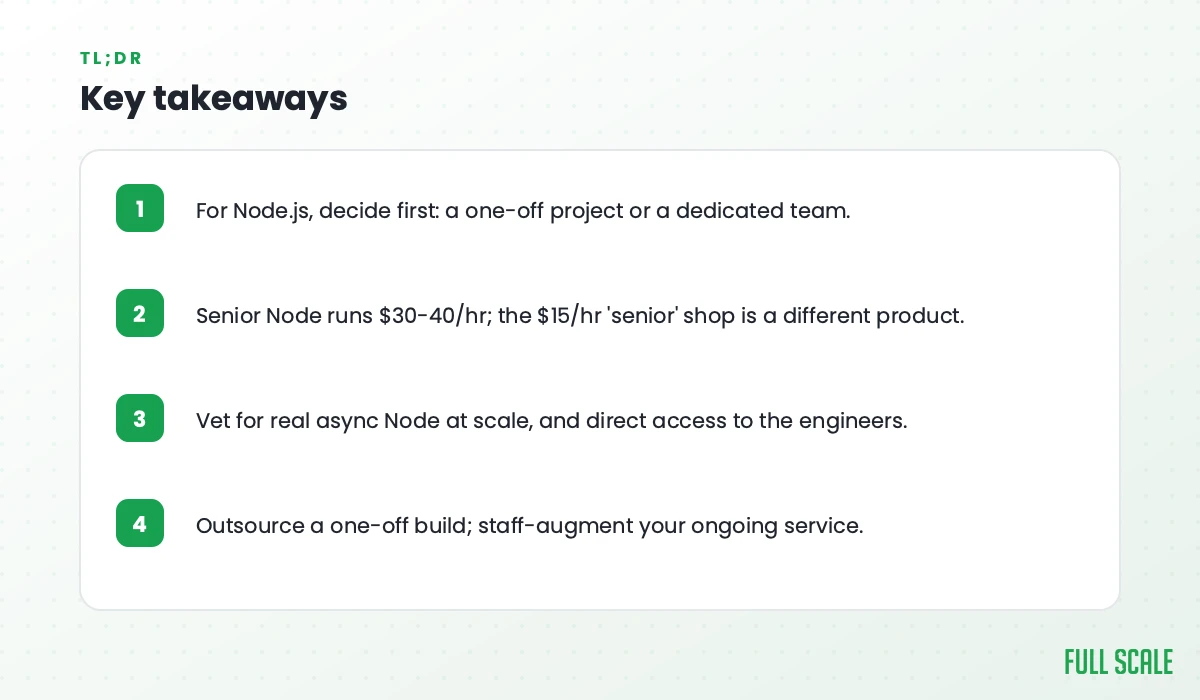
Outsourcing Node.js development means hiring an external team to handle Node.js work. There are two models: project outsourcing (a scoped deliverable with a fixed spec) and staff augmentation (offshore Node.js engineers who join your team directly and work on your ongoing product). Most companies searching for “outsource Node.js development” describe ongoing product development, which means they actually need staff augmentation, not a project shop. At Full Scale, we’ve found staff augmentation produces better outcomes than project outsourcing for most ongoing Node.js work.
How do I know if I need project outsourcing or staff augmentation for Node.js?
Project outsourcing works when you have a fixed spec, a clear done state, and work the developers don’t need to understand your broader system to complete. Staff augmentation works for ongoing product development, evolving requirements, and situations where deep system knowledge compounds over time. If you’re describing a product roadmap, it’s staff augmentation. If you’re describing a spec with a hard deliverable, it might be a project.
Who should I outsource Node.js development to?
Outsource a scoped Node.js project to a team that gives you direct access to the engineers and shows test coverage on past work. Outsource ongoing product work to a staff augmentation partner whose engineers join your team, follow your TypeScript and async conventions, and stay long enough to learn your system. Full Scale places senior Node.js engineers in the Philippines on that model, and fewer than 3% of applicants make it through our vetting. Whoever you pick, ask for the rejection rate, the retention rate, and a real Node.js technical question answered on the sales call.
What should I look for when vetting a Node.js outsourcing partner?
Ask about their Node.js vetting process specifically: rejection rate, what the technical assessment tests, whether they evaluate TypeScript depth and async pattern understanding. Insist on direct developer access (no PM relay). Check their code samples for TypeScript and async/await usage. Ask about retention rates for ongoing engagements. Get IP assignment and NDA terms in writing before discussing timeline.
What guarantees should I ask for before signing a Node.js outsourcing contract?
Ask how you can leave, and how fast. At Full Scale, if the engagement isn’t working out in the first two weeks, you get your money back, and after that you can drop a developer with 30 days’ notice and no long-term contract. Also get IP assignment and NDA terms in writing before you discuss timeline. A clean exit and clear ownership of the code protect you more than a promise to swap developers in.
Why do most Node.js outsourcing projects fail?
The most common causes: choosing a project outsourcing model for work that requires ongoing team integration; hiring cheapshored developers at $15/hour who lack the async and event loop depth that production Node.js requires; and working with vendors who put a PM between you and the developers. Node.js architecture decisions compound, and misalignment early on creates expensive technical debt later.
What’s the typical cost range for outsourced Node.js development?
Cost is the wrong place to start: the model you pick moves the number far more than the rate does. A cheap project shop that ships an architecture your team can’t extend is more expensive than a higher hourly rate that produces a system you own. For senior Node.js work, treat rates below $20/hour as a quality signal, not a savings opportunity. The async and event-loop depth production Node.js needs isn’t there at that price. Senior Node.js engineers at Full Scale run $30-40 an hour. Once you’ve settled the model, the full US-versus-offshore cost math is in our offshore Node.js development guide.
How do I avoid getting burned by a Node.js project shop?
Define the spec completely before starting. Include acceptance criteria, not just feature descriptions. Negotiate direct developer access into the contract. Build in a mid-project architecture review. Ask about their TypeScript standards and test coverage expectations upfront. And if the engagement is ongoing product development rather than a one-time project, consider staff augmentation instead. The project shop model is structurally misaligned with ongoing development.