Node.js vs Python in 2026: Which Backend to Build On (and Hire For)

In this article
Most Node.js versus Python comparisons treat it like a cage match, with a winner at the bottom. The honest 2026 answer is less satisfying and more useful: for a growing number of companies, it’s both. Python owns the AI, machine-learning, and data core. Node owns the real-time, full-stack, and edge layer. The interesting question isn’t which one wins, it’s which one belongs at the center of your product, and which one you can actually hire for.
I run Full Scale, and we staff both Node and Python teams for US companies through our custom web development services. I also built monitoring tools at Stackify that ran across both runtimes in production, so I’ve watched where each one shines and where each one bites. Here’s the comparison from a buyer’s seat: what to build on, and what you can staff.
The 30-second answer
- Python is the default if AI, machine learning, data, or scientific computing is anywhere near your core. The entire AI stack is Python-first, and that’s not close.
- Node.js is the default for real-time apps, APIs, and full-stack JavaScript teams who want one language and shared types across the front and back end.
- Both is increasingly the real answer: Node at the real-time and API gateway, Python behind it for the AI and data work. Many AI-first companies run exactly this split.
- Hiring is a near-tie. Both are among the largest talent pools in software, and salaries sit around the same developer median. Pick on product shape and team skills, not availability.
What each one is in 2026
Node.js is JavaScript on the server. The current production line is Node 24, the active long-term-support release, with Node 22 in maintenance; Node is also moving toward an annual major-release cadence. Modern Node is far more batteries-included than its reputation: built-in fetch, a built-in test runner, a watch mode, and as of late 2025 it can even run TypeScript directly by stripping types. The frameworks are Express 5 (the ubiquitous default, finally a major release after years), NestJS (opinionated and TypeScript-first for enterprise teams), and Fastify (the high-throughput choice).
Python is the general-purpose language that happens to own data and AI. Python 3.13 and 3.14 are current, and the big structural news is the long-running global interpreter lock finally becoming optional: free-threaded Python became officially supported in 3.14, though it’s still opt-in and not the production default yet. That’s worth watching, because the GIL was Python’s classic concurrency ceiling. The frameworks are FastAPI (the async-first rising star and the default for new Python APIs, especially anything touching LLMs), Django (full batteries-included), and Flask (the minimalist).
The real dividing line: what’s at your core
This is the decision, and it’s cleaner than the benchmark articles make it.
If artificial intelligence, machine learning, data pipelines, or scientific computing is anywhere near the center of your product, choose Python and stop deliberating. The entire stack assumes it: PyTorch, TensorFlow, scikit-learn, pandas, NumPy, Hugging Face, LangChain, and the official OpenAI and Anthropic SDKs are all Python-first. GitHub’s 2025 Octoverse data shows Python contributors growing nearly 49% year over year, explicitly driven by AI and data science work. There is no equivalent stack in Node, and trying to rebuild it is a losing fight.
If you’re building real-time features, chat, collaboration, live dashboards, streaming, or an API gateway in front of other services, Node is the more natural home. Its event-loop model holds enormous numbers of concurrent I/O connections cheaply, and if your front end is React, you get one language and shared TypeScript types across the whole stack. Node is the single most-used web technology in the 2025 Stack Overflow survey at nearly 49%.
And here’s the part most comparisons miss: a lot of modern teams run both. Node sits at the public API, auth, and real-time gateway; Python sits behind it doing the AI and data work. That’s not indecision, it’s the architecture a lot of AI-first companies actually ship. If your guide-writer makes you pick exactly one, they’re answering a simpler question than the one you have.
Performance and concurrency, honestly
Neither tops the benchmark charts; the compiled languages do. Between the two, Node is meaningfully faster on high-concurrency I/O work, the websockets-and-APIs territory it was built for. Python is competitive or faster on CPU-bound numeric work, because that work runs through optimized C extensions like NumPy rather than pure Python.
The two concurrency models explain the split. Node is a single-threaded event loop, brilliant for thousands of simultaneous I/O operations, but a long synchronous computation blocks everything, so CPU-heavy work needs worker threads. Python’s global interpreter lock historically allowed only one thread of Python bytecode at a time, though it always releases during I/O, and the new optional free-threading build is starting to lift that ceiling.
The caveat to keep in front of you: benchmarks aren’t apps. An application doing 8,000 requests a second runs fine on Node or Python; at 80,000 it doesn’t, and that’s where runtime choice starts to matter. Most backends never reach the load where the runtime is the bottleneck. Your configuration and architecture move performance more than the language does.
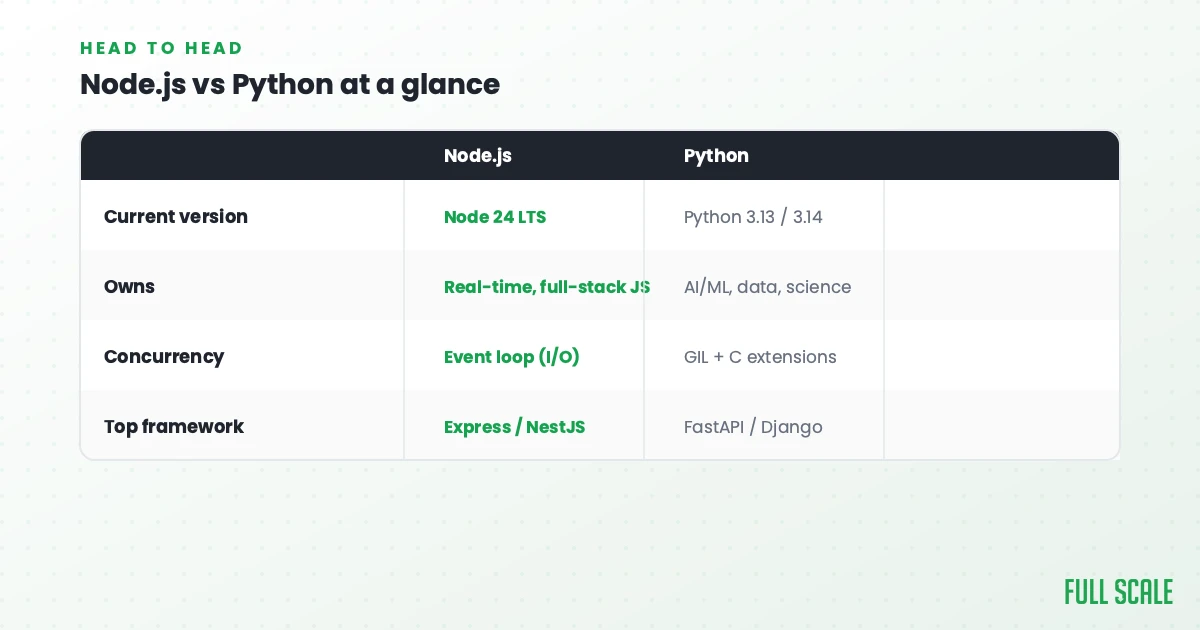
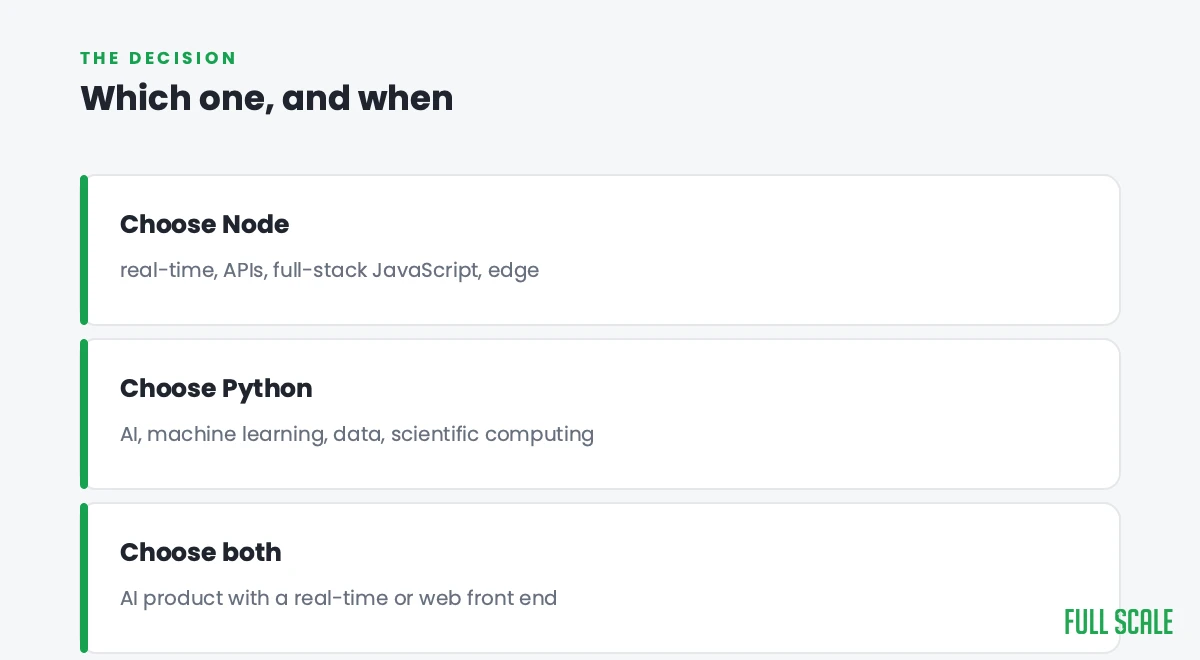
| Node.js | Python | |
|---|---|---|
| Current production version | Node 24 LTS | Python 3.13 / 3.14 |
| Owns | Real-time, APIs, full-stack JS, edge | AI/ML, data, scientific computing |
| Concurrency | Event loop, great for I/O | GIL (now optionally off), async + C extensions |
| Top frameworks | Express, NestJS, Fastify | FastAPI, Django, Flask |
| Hiring pool | Huge (JavaScript) | Huge, fastest-growing (AI-driven) |
| Cold start (serverless) | Slightly faster | Close; import-heavy apps slower |
Cost and serverless
For ordinary hosting the two are close, with one nuance. On serverless, Node and Python have similar cold starts, both far faster than Java or C#, with Node usually edging Python because Python’s cold start is dragged down by importing heavy libraries like pandas unless you’re careful. That detail got more pointed in 2025, when AWS Lambda began billing the cold-start initialization phase, turning slow imports into a real line-item cost. For an I/O-bound, high-concurrency workload, Node also tends to need fewer instances, which lowers the always-on bill. For CPU and data work, Python’s native extensions win. As always, it tracks the workload, not the language.
Hiring: a near-tie with a momentum note
Both pools are enormous and they overlap, because plenty of full-stack developers write both. JavaScript has the largest installed base of any language. Python has the momentum and the larger learner pipeline, with more than 70% of people learning to code using it, again driven by AI.
On salary, the per-language difference is noise. The US median for software developers is about $133,000 according to the Bureau of Labor Statistics, and aggregator gaps between Node and Python developers are smaller than the spread within either role. Both staff well offshore, with India the deepest pool for either, Python carrying a slight edge in data and ML specialties and Node in pure web and API work. For a buyer, neither is supply-constrained, so let product shape and your team’s existing skills decide, not availability.
When to choose each
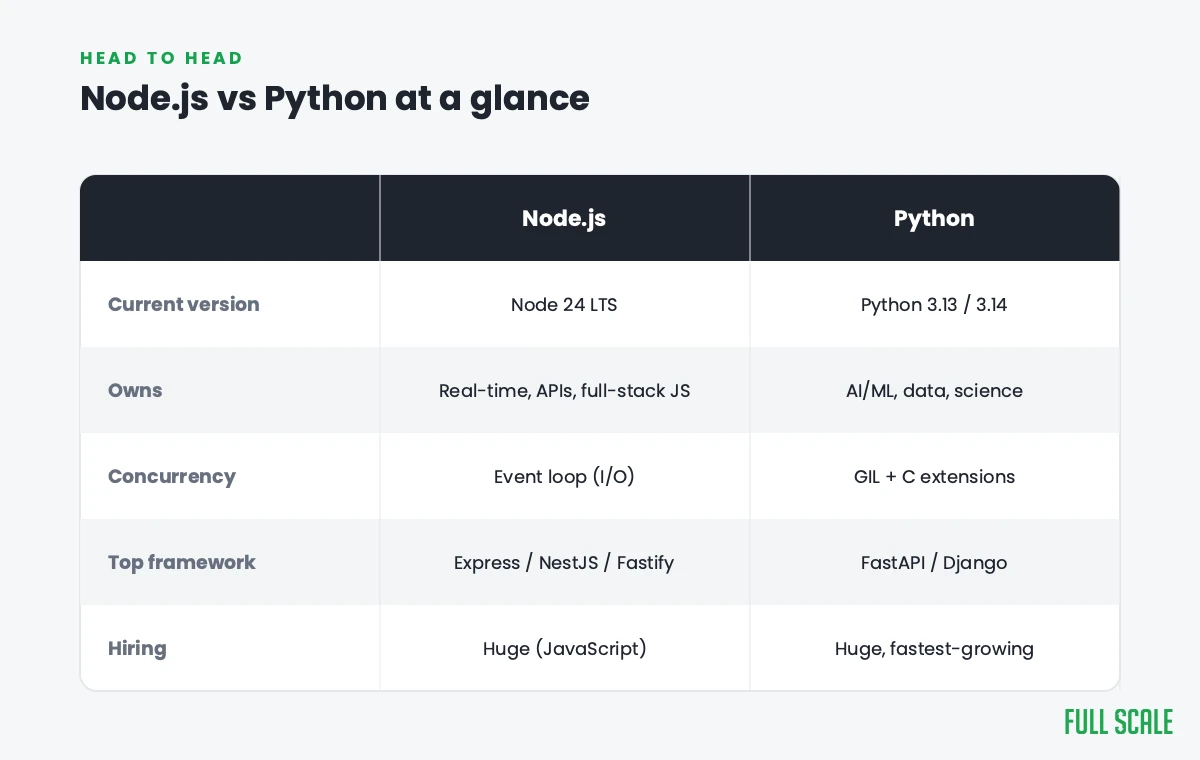
Choose Node.js if you’re building real-time or high-concurrency I/O features, you want one language and shared types across a React front end and the back end, you’re serverless or edge-first and care about cold-start cost, or your product is an API and orchestration layer.
Choose Python if AI, machine learning, data, or scientific computing is near your core, you want mature batteries-included frameworks or modern async APIs, your heavy lifting is CPU-bound numeric work, or your team’s depth is in data and research.
Choose both if you’re building an AI-first product with a real-time or web front end. Node at the gateway, Python for the intelligence, is a proven, boring-in-a-good-way architecture in 2026.
Who builds on each
Be careful with the adopter lists floating around, because most are a decade stale. The big one to correct: Uber moved off Node to Go years ago, so anyone listing it as a current Node shop is wrong. Honestly dated, Node runs Netflix’s web and UI tier (the core is Java), Walmart’s mobile traffic, and Trello’s real-time board, a textbook websockets case. Python ages better because it usually sits at the application core: Instagram runs the world’s largest Django deployment, confirmed present-tense by Meta’s own engineers; Reddit, Dropbox, and Spotify’s data and ML work are all Python; and OpenAI and Anthropic ship Python-first. PyTorch leads model training. When the language is the core rather than one tier, the adoption tends to stick, which is part of Python’s story.
Frequently asked questions
Is Node.js or Python better for backend development?
Neither is universally better. Python is the clear choice if AI, machine learning, or data is near your core, because the entire stack is Python-first. Node is the clear choice for real-time apps, APIs, and full-stack JavaScript teams. Many modern products use both, with Node at the gateway and Python for the AI and data work.
Which is faster, Node.js or Python?
Node is meaningfully faster for high-concurrency I/O work like APIs and websockets, which is what its event loop was built for. Python is competitive or faster on CPU-bound numeric work through C extensions like NumPy. For most applications, neither is the bottleneck, configuration and architecture matter more.
Which is easier to hire for?
It’s close to a tie. Both are among the largest talent pools in software, salaries sit around the same developer median, and both staff well offshore. Python has slightly more momentum and a larger learner pipeline thanks to AI; Node has the deep full-stack JavaScript pool. Pick on product fit, not availability.
Should I use Python for AI and Node for the web?
Often, yes. A common 2026 architecture runs Node at the real-time and API gateway and Python behind it for the AI, machine learning, and data work. It lets each language do what it’s best at, and many AI-first companies ship exactly this split.
Is Python’s GIL still a problem?
Less than it was. The global interpreter lock historically allowed only one thread of Python bytecode at a time, though it always released during I/O. As of Python 3.14, a free-threaded build that removes the GIL is officially supported, but it’s still opt-in and not the production default, so treat it as promising rather than done.
Which should a startup choose?
Match it to your product. If you’re AI-first or data-heavy, start with Python. If you’re building real-time features or want one JavaScript stack across front and back end, start with Node. If you’re an AI product with a web front end, plan for both. Your team’s existing skills should break any tie.
Pick the one your product points to
Node and Python are both excellent, both deeply supported, and both easy enough to hire for that availability shouldn’t decide it. The benchmark gaps won’t make or break your product, and for most teams neither runtime is the bottleneck.
What should decide it is where your product’s center of gravity sits. If it’s AI and data, that’s Python. If it’s real-time and full-stack JavaScript, that’s Node. If it’s an AI product with a real-time face, build both and let each do its job. Then hire for the choice, which on either side is very doable.
If you’d rather not sort the hiring out alone, that’s what we do, and we staff both. Talk to us about building your backend team, and we’ll put pre-vetted Node or Python developers in front of you who already work the way the AI era demands.