MVP Development Strategy: Why Cutting Scope Beats Process

In this article
- What an MVP actually is, and what it isn’t
- The real reason MVPs fail
- The MVP development process, stage by stage
- The hardest part is cutting scope
- MVP development challenges teams actually hit
- What an MVP costs, and how to think about budget
- Architecture: build for the experiment, not the empire
- How you know it worked, and what comes after
- Building the team to do it
- FAQs: MVP development strategy
- Start your MVP the right way
Quick Answer: The real MVP development strategy is cutting scope to the one riskiest assumption, not adding process. Build only what tests that assumption, ship to real users in 6 to 12 weeks, and decide based on what they actually do. Most MVPs fail from scope creep and unclear requirements, not from picking the wrong framework or tech stack, and those same two failure modes are what sink an outsourced MVP build if the team isn’t treated as part of yours.
I’ve co-founded four companies and sold two of them. I built VinSolutions into a business that sold for around $150 million, then started Stackify, and today I run Full Scale, where my team has helped build the first version of a product for hundreds of startups. If you want the bigger picture first, here is what a minimum viable product actually is and why the code was never the hard part. It also taught me how investors evaluate a startup from both sides of the table.
So I’ve shipped a lot of minimum viable products, and I’ve watched even more founders ship theirs.
Here is the thing almost no MVP guide will tell you. The MVP rarely fails because the team skipped a step in some seven-phase framework. It fails because nobody had the nerve to cut scope. That nerve is the real difference in how startups should build software. It is the same trap behind most failed launches, which is why how to start a SaaS company without burning your runway begins with validation.
Your MVP is not a smaller version of your product. It’s the smallest thing you can build that answers the one question you’re most afraid to ask. Usually that question is “does anyone actually want this?” And most founders would rather spend six months building than spend two weeks finding out the answer is no. Once the idea is validated, design becomes the differentiator, which is the heart of how AI has changed user experience strategy. Answering that question is the whole game, and finding product-market fit is just proving the answer is yes.
That’s the real MVP development strategy. Everything else is just pulling it off without lying to yourself.
What an MVP actually is, and what it isn’t
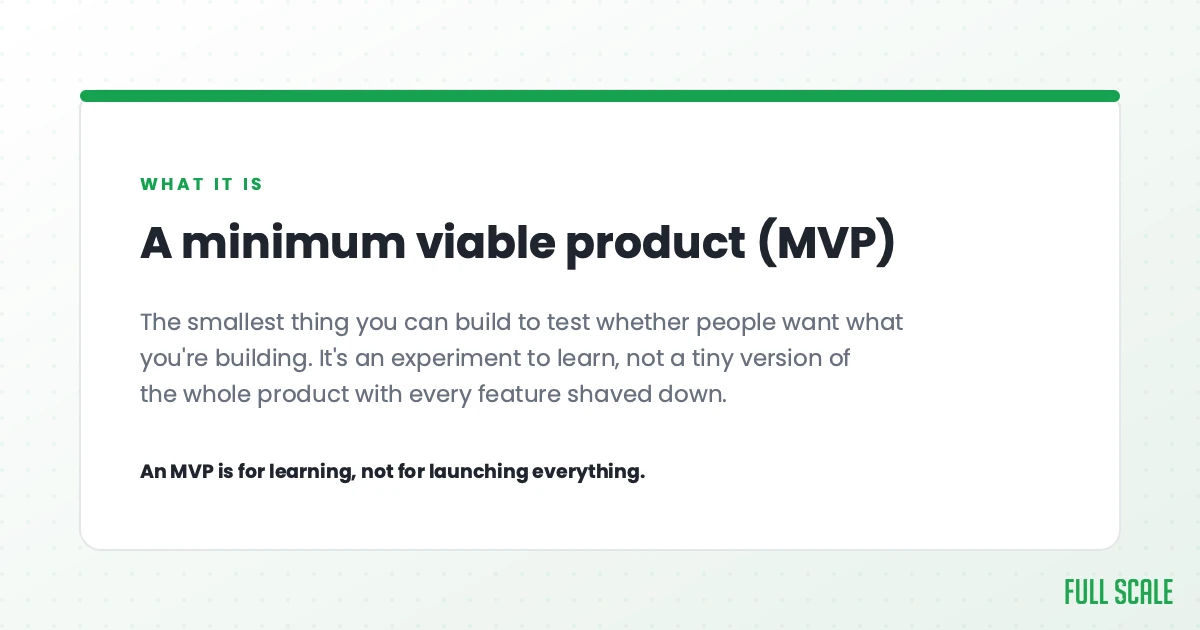
The term comes from Eric Ries and the lean startup movement, and it has been watered down ever since. A minimum viable product is the simplest build that lets you learn something true about the market. Not the prettiest version, and not the one you’d demo to your mom, but the version that puts a real choice in front of a real user so you can watch what they do. It is the same instinct behind the modern startup business plan: show something real instead of describing it.
People confuse three things here, so let’s be clear about the differences.
| What it proves | Best for | Typical build | |
|---|---|---|---|
| Prototype | What it could look like | Aligning stakeholders, early design feedback | Days, no working backend |
| Proof of concept | That it can be built | Testing a hard technical assumption | Days to weeks, throwaway code |
| MVP | That people want it | Validating real market demand | Weeks, shippable to users |
A prototype is great for getting everyone to agree on what you’re building. It cannot tell you whether the market cares, because nobody is paying or relying on it. A proof of concept answers a narrower question, usually “can our team actually pull off this integration.” The MVP is the only one of the three that gets put in front of customers with something at stake.
If you remember one distinction, make it this: a prototype tests the idea with your team, an MVP tests the idea with the market.
The real reason MVPs fail
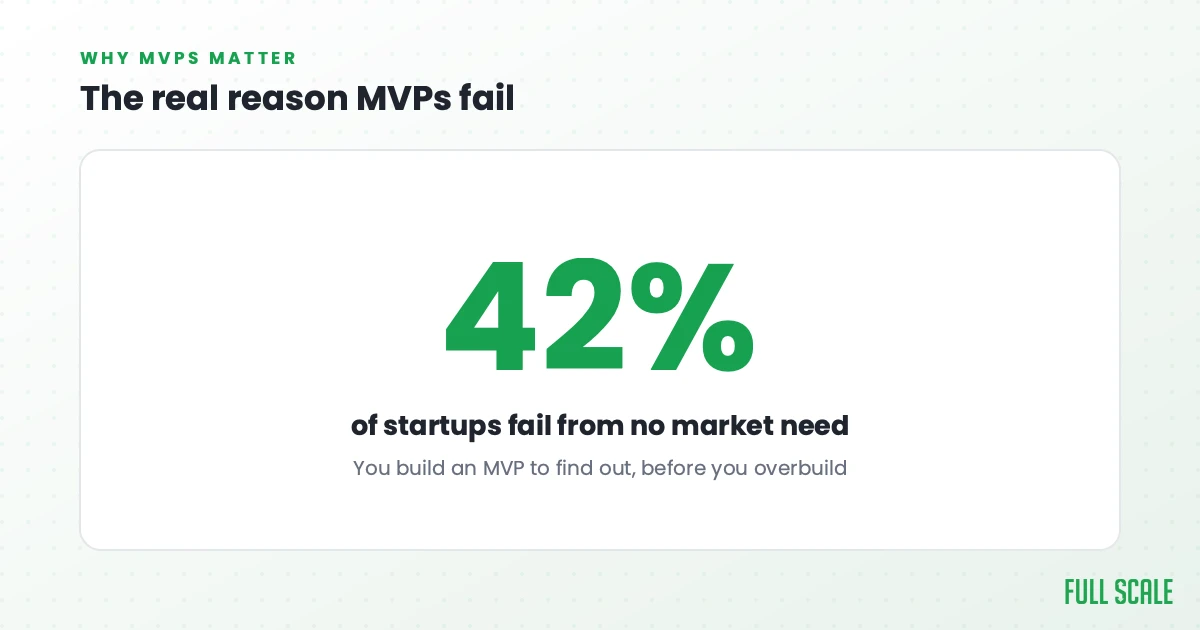
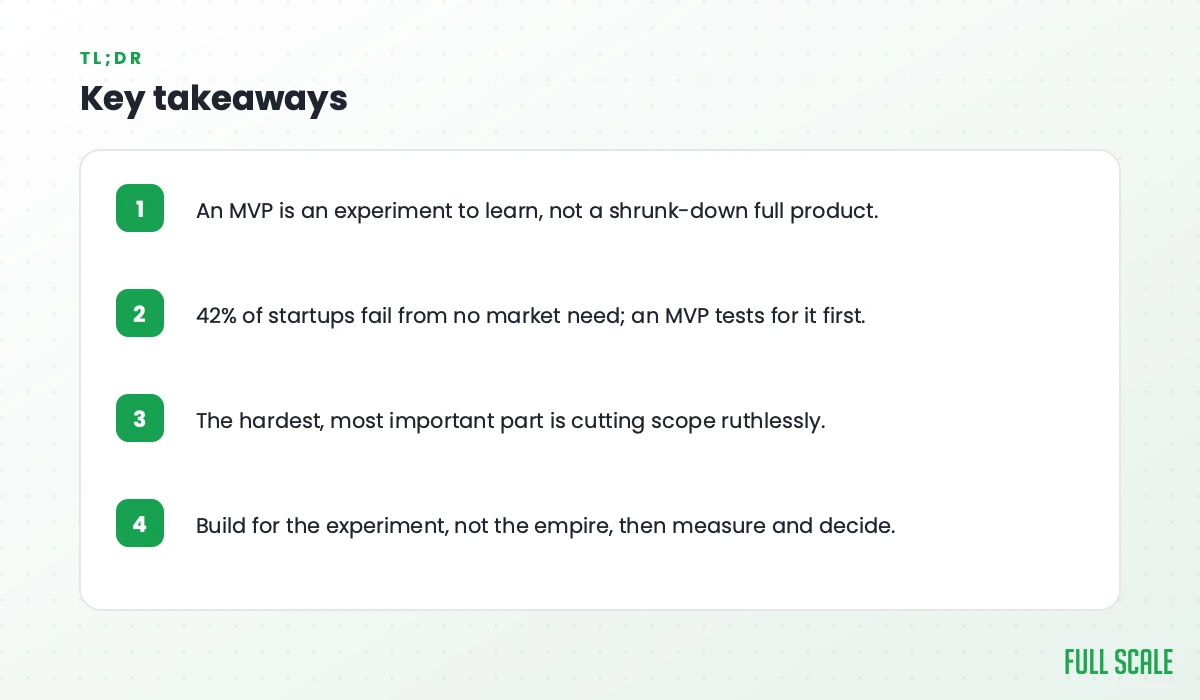
CB Insights looked at why startups die and found that 42% of them fail because there was no market need for what they built. Not because the code was bad. Because they built something nobody wanted, and they found out too late.
Read that again, because it reframes the whole job. The point of an MVP development strategy is not to build faster. It’s to be wrong sooner, while being wrong is still cheap.
That’s where the framework-worship genre gets it backwards. You’ll find dozens of “7 steps to a successful MVP” posts, and the old version of this very page was one of them. Steps feel safe. They let you feel productive while you avoid the scary part. But a tidy process around the wrong product just gets you to failure on schedule.
The founders I’ve watched succeed weren’t the ones with the cleanest Gantt chart. They were the ones willing to ship something embarrassing and learn from it. Steve Blank calls this “getting out of the building”, and he’s right. The whole game is subtraction. Accelerators force that same discipline on every batch, and I broke down how startup accelerators actually work for founders weighing one.
The MVP development process, stage by stage
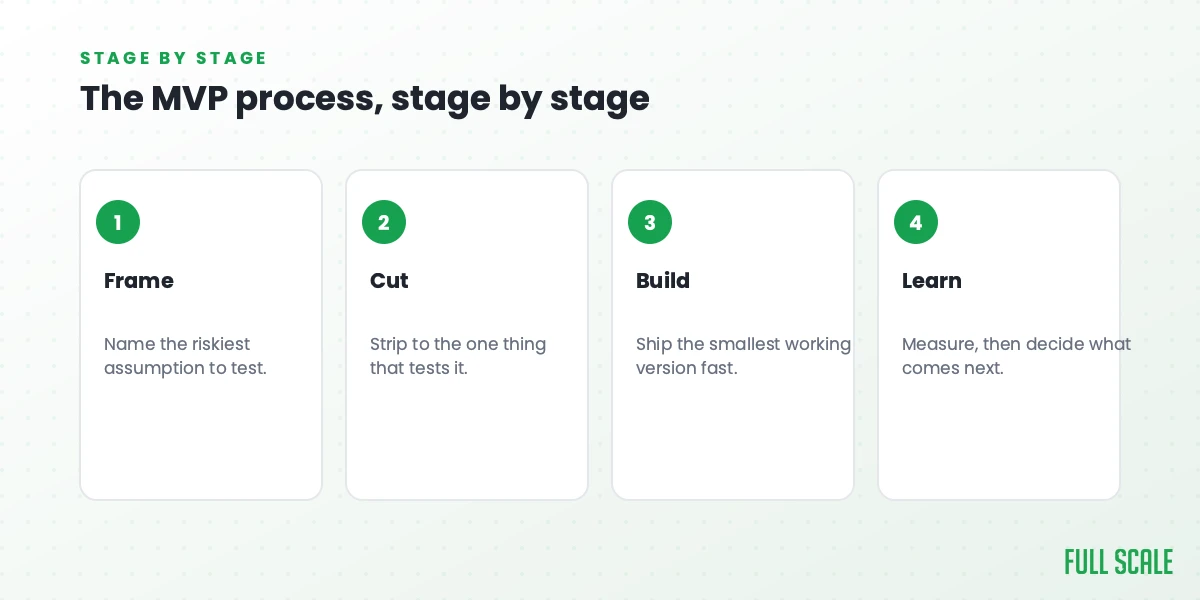
You still need a process. You just need to understand that the process exists to protect the learning, not to manufacture features. Here are the four stages I’d actually defend, and roughly how long each takes for a typical software product.
1. Find the one question (1 to 2 weeks)
Before anyone writes code, write down the single riskiest assumption your business depends on. For most products it’s demand: will people use this and pay for it. For some it’s feasibility, or distribution, or unit economics. Whatever it is, that assumption is what your MVP has to test. Everything that doesn’t test it is scope you can cut. It is also why, this early, the real question is how much testing is enough rather than how to hit full coverage.
2. Cut to the core (1 to 2 weeks)
This is the stage everyone rushes and shouldn’t. List every feature you think you need, then cross out anything that doesn’t directly serve the one question from stage one. A hard prioritization pass here is worth more than any amount of later optimization. If cutting a feature makes you nervous, that’s usually a sign it belongs in version two, not version one.
3. Build the experiment (4 to 12 weeks)
Now you build, fast, with the smallest team that can do the job well. Wire up analytics on day one, because an MVP that ships without instrumentation is just an opinion with a login screen. Keep the agile loop tight: weekly demos, real users in front of it as early as you can stomach. The choice of how rigid to make the plan comes down to how Agile and Waterfall compare on iteration cost and requirement stability.
4. Learn and decide (ongoing)
Ship to a small group of real users and watch what they do, not what they say in a survey. Then make an honest call: double down, change direction, or kill it. The teams that win treat this as the start of the work, not the finish line.
If you want to sanity-check the budget behind those stages, our software development cost calculator lets you plug in team size and timeline. And when the budget isn’t there at all, some founders cover the early build by building their product for equity instead of cash, though it’s a bigger commitment than it looks. How much of an MVP you can build is shaped directly by your tech startup funding and how you spend it.
The hardest part is cutting scope
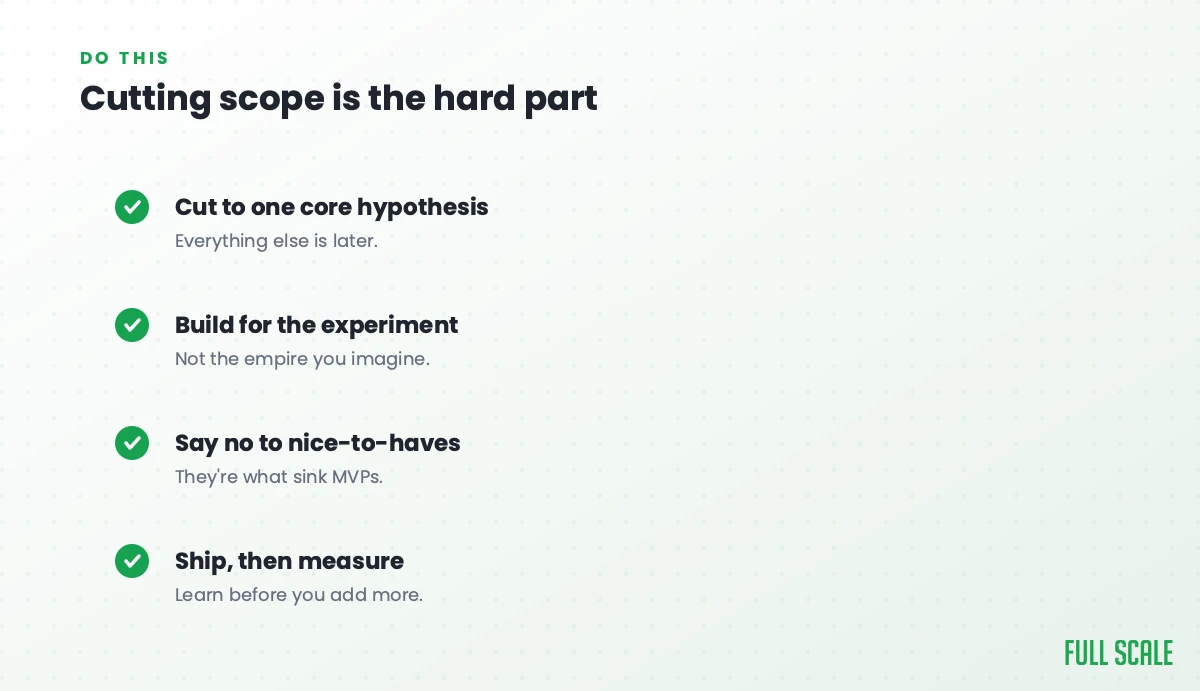
Everything above sounds reasonable on paper. In the room, it’s brutal. You’re emotionally attached to the product in your head, and the MVP feels like a betrayal of it.
I’ve lived this. When we were building early products, the temptation was always to add “just one more thing” before showing anyone. That instinct is exactly the one that kills MVPs. The discipline of saying no to your own good ideas is the rarest skill in product development, and it’s the whole reason I wrote about it in Product Driven.
Here’s the worked example I use with founders. Say you’re building a marketplace. You “need” buyer accounts, seller accounts, payments, reviews, search, messaging, and a recommendation engine. The riskiest question is whether buyers and sellers will transact at all. So the MVP is one category, manual matching, and payments you might literally run through email and a payment link at first. It’s ugly and a little embarrassing, and it answers the only question that matters in three weeks instead of nine months. If the transactions happen, now you’ve earned the right to build the rest.
MVP development challenges teams actually hit
The challenges that sink an MVP are rarely the ones in the planning doc. These are the four I see over and over.
Scope creep wearing a disguise. It almost never shows up as “let’s add a huge feature.” It shows up as a string of reasonable-sounding small additions, each one defensible, that together push your launch from eight weeks to eight months. And the moment it does launch, the job shifts to application support and maintenance, which is a discipline of its own. It is worth understanding the real cost of saying yes to each one before you do.
Building for the enterprise you hope to become. Teams over-engineer the architecture for millions of users they don’t have yet, and the technical debt they avoid is theoretical while the time they burn is real.
Confusing motion with progress. A team can run perfect sprints, hit every deadline, and still be building the wrong thing. Velocity feels like progress, which is why it’s dangerous. That’s the trap no process saves you from, and it’s why choosing the right development methodology matters far less than staying honest about whether the work matters.
Polishing instead of shipping. The instinct to make it perfect before anyone sees it is the enemy. Perfect is how you avoid the verdict.
Naming these out loud with your team early is half the battle. Most of them are failures of nerve, not failures of skill.
What an MVP costs, and how to think about budget
I’ll be straight about my bias here: Full Scale builds MVPs for clients, so I have a commercial interest in you choosing to build one. I’ll give you the honest version anyway.
MVP cost is driven by three things: how many people you put on it, how long they work, and where they sit. That last one moves the number more than founders expect. Here’s a rough sense of hourly rates by role and location.
| Role | US in-house | Offshore (Philippines) |
|---|---|---|
| Product manager | $120-180/hr | $40-60/hr |
| Technical lead | $150-200/hr | $50-80/hr |
| Designer | $100-150/hr | $30-50/hr |
| Developer | $100-160/hr | $25-50/hr |
| QA engineer | $80-120/hr | $20-35/hr |
Those offshore numbers are why a lot of early-stage teams build with a distributed team instead of hiring locally. The cost difference on a three-to-six-month build is the difference between one runway and two.
But cost isn’t the trap. The trap is spending any amount of money on the wrong scope. A cheap MVP of a product nobody wants is still a waste. Get the scope right first, then optimize the rate. A non-technical founder has an even harder version of this problem: no way to judge whether the scope someone handed back is honest.
Architecture: build for the experiment, not the empire
The biggest technical mistake in MVP development is building for scale you haven’t earned. You don’t need to plan for ten million users when you’re trying to find your first ten.
| Architecture | Strength | Weakness | Use it when |
|---|---|---|---|
| Monolith | Fast to build, simple to run | Harder to scale later | You’re validating, full stop |
| Microservices | Scales independently | Heavy operational overhead | You already have scale and teams |
| Serverless | Cheap at low traffic, auto-scales | Vendor lock-in | Spiky or unpredictable load |
For almost every MVP, the answer is a monolith. It’s faster to build and easier to reason about, and “we’ll have to refactor this when we’re huge” is a great problem to have. You can always re-architect once you have real users and real revenue. You can’t un-waste the six months you spent building microservices for an idea that fizzled.
On the tech stack itself, pick what your team already knows. A boring, well-understood stack ships faster than a trendy one your developers are learning on the job. React or Vue on the front end, Node or Python or Rails on the back end, Postgres for data. The stack rarely decides whether you find product-market fit. Your scope discipline does. If your team knows Vue.js, leaning into it means you can hire Vue.js developers offshore and onboard them faster than switching to a framework no one on the team has shipped in production. If your team has shipped React, the low-risk MVP choice is Next.js, and you can hire Next.js developers who move fast in it.
How you know it worked, and what comes after
An MVP succeeds when it gives you a clear answer, even if the answer is “no.” That’s the mindset shift. But if you’re trying to measure whether you’re onto something real, a few signals matter more than the rest.
Retention is the first one. If people use it once and never come back, you don’t have a product, you have a demo. Marc Andreessen’s old essay on product-market fit still describes the feeling best: when you have it, you can feel the market pulling the product out of your hands. When you don’t, no amount of feature-building fakes it.
For an actual measure, the most useful one I know is the test Sean Ellis popularized: ask your users how they’d feel if they could no longer use the product. If more than 40% say “very disappointed,” you’re likely closing in on product-market fit. Below that, keep iterating before you pour money into growth.
Here’s a simple read on whether you’re ready to scale past the MVP.
| Signal | Not ready | Ready to scale |
|---|---|---|
| Retention | Users leave after first use | They keep coming back |
| Product-market fit | Under 40% “very disappointed” | Over 40% “very disappointed” |
| Unit economics | Costs more to acquire than they’re worth | Customer value well above acquisition cost |
| Stability | Frequent outages | Holds up under real use |
What comes after the MVP is a different job than building it. Scaling rewards reliability, hiring, and process, where the MVP rewarded speed and ruthlessness. The founders who struggle most are the ones who keep running the company like it’s still week one long after the product proved itself.
Building the team to do it
You can build an MVP with a tiny team: a strong technical lead, one or two developers, a designer who can also think about product, and someone owning QA. What matters more than headcount is that the people are senior enough to make good cuts without being told.
This is where a lot of founders use offshore developers to stretch the budget. I’m biased, but I also know the model works, because I lived it before Full Scale existed. At Stackify I built a team in the Philippines that grew to more than twenty developers and helped carry us to an exit. That experience is the entire reason Full Scale exists. If you go that route, treat the team integration as seriously as the hiring, because a distributed team that isn’t truly part of your standups is just expensive outsourcing.
FAQs: MVP development strategy
What are the biggest pitfalls of outsourcing MVP development?
The two failure modes that sink outsourced MVPs are the same ones that sink in-house MVPs, just faster: unclear requirements and no one with the authority to cut scope. An outsourced team that only takes a spec and disappears for twelve weeks will build exactly what was written, wrong assumptions included, because nobody was in the room asking “does this actually need to be a feature?” The fix isn’t a better contract, it’s treating the outsourced developers as part of your team, in your standups, with someone senior enough on your side to make the cuts. See our offshore development best practices and the fuller risks of outsourcing breakdown for how to avoid the rest.
What does MVP stand for in development?
MVP stands for minimum viable product. It’s the simplest version of a product you can build that still delivers real value and lets you test whether the market wants it, before you invest in the full thing.
What is the best MVP development strategy?
The best MVP development strategy is to identify the single riskiest assumption your business depends on, then build only what’s needed to test it. Cut every feature that doesn’t serve that one question, ship to real users fast, and decide based on what they do.
How long does MVP development take?
A focused MVP usually takes about six to twelve weeks to build once the scope is locked. More complex products run three to six months. The biggest variable isn’t team size, it’s how disciplined you are about cutting scope before the build starts.
What are the 3 elements of an MVP?
Minimum, viable, and product. Minimum means the smallest feature set that tests your assumption. Viable means it actually works well enough to deliver value. Product means a real user can use it for a real purpose, not just look at a mockup.
What comes after the MVP?
After the MVP you make a decision: keep going, change direction, or stop. If the signals are good, you shift from validating to scaling, which means investing in reliability, the team, and the features you deliberately cut from version one.
How do I build an MVP for my startup?
Start by writing down the one assumption that would kill your business if it’s wrong. Build the smallest thing that tests it, put it in front of 20 to 30 real users, and watch their behavior. Iterate based on what they do, then expand only after the core idea proves out.
Start your MVP the right way
The teams that win don’t have the fanciest process. They have the discipline to build less and learn faster. If you want experienced developers who understand how to ship a lean first version and scale it once it proves out, Full Scale’s MVP development services can put a senior team on your product in a couple of weeks.