
Software Testing Strategies Are a Leadership Decision, Not a QA Checklist

In this article
- The question that actually sets your strategy
- Most teams test too much, not too little
- The hill I will die on: early-stage software needs the least testing
- The testing types still matter, they just don’t lead
- Automate by risk, not by trend
- “Outsourcing QA” isn’t really a thing
- How to write a testing strategy that’s worth reading
- Frequently asked questions
- The bottom line
Quick Answer: A software testing strategy is a risk decision, not a list of test types. The question that should drive it is simple: what is the worst thing that happens if this code is wrong? Code that can charge a customer the wrong amount or fire off thousands of bad emails earns deep testing. A feature nobody uses yet does not. Most teams get this backwards and test everything to the same depth, which wastes time on low-stakes code and still misses the stuff that can take the business down. It starts with hiring right, which is why the QA engineer job description has to change too.
Search “software testing strategies” and you get the same article ten times. A list of testing types: unit, integration, system, acceptance, black box, white box. Then a template for a test strategy document and a section on who signs it.
That is not a strategy. That is a glossary.
A real testing strategy answers a harder question than “which tests exist.” It answers where to spend your limited time and money, and where not to. The thing that decides that is risk.
The question that actually sets your strategy
When I ran engineering at Stackify, we built software that profiled the performance of other companies’ applications. It ran on their servers, inside their production environment. If we shipped a bug, we could crash a customer’s servers and take their business offline.
So our testing strategy wasn’t a debate about coverage percentages. It was existential. We tested that code like the company depended on it, because it did.
The level of testing a piece of code needs is set by what happens when it breaks.
That is the whole game. Before you pick tools or write a single test case, ask one question about the thing you’re building:
What is the worst thing that happens if this code is wrong?
If the answer is “we charge thousands of customers the wrong amount,” you test it hard. Billing logic, payment flows, anything that touches money gets the deepest coverage you can give it, because a mistake there is the kind that ends up in a lawyer’s email. Same with anything that fires automatically at scale. If a job can send a hundred thousand wrong text messages or emails before a human notices, that is a five-alarm risk and it gets tested like one.
If the answer is “a button in an internal admin tool looks a little off,” you can live with that. Test it lightly, ship it, fix it if someone complains.
This isn’t hypothetical. In July 2024, one bad update from CrowdStrike crashed about 8.5 million Windows machines and grounded airlines, banks, and hospitals for a day. That is a blast radius. Code with that kind of reach earns the deepest testing you can give it, every time. This ties into a broader shift around testing AI-generated code, which is changing where teams should spend their QA effort.
Risk is the input. Coverage is the output. Every other decision in your strategy, manual or automated, how many environments, what your release gate looks like, falls out of answering that question honestly for each part of the system.
Most teams test too much, not too little
The cost of bad software is real. Poor software quality cost the US an estimated $2.41 trillion in 2022, according to the Consortium for Information and Software Quality (CISQ). But look at where that cost comes from and most of it sits in a small number of catastrophic failures and piled-up technical debt, not in the thousand tiny bugs that never mattered. That is an argument for testing by blast radius. It is not an argument for testing everything to the same depth, which is exactly what a number that big tempts teams to do.
That instinct is where teams go wrong.
Most teams over-test.
This isn’t true of every team, and it isn’t true of the dangerous code. But in the teams I’ve run and the ones we staff, the more common waste is too many tests on code that never needed them, not too few on the code that did. Teams treat coverage as a virtue in itself, so they chase high numbers everywhere and feel good about the dashboard. Coverage spread evenly across a codebase isn’t diligence. It’s a failure to decide. You spent the same effort hardening a settings page that you spent on the payment system, and the settings page was never going to hurt anyone.
Over-testing has a real cost, and it isn’t just the hours. Every test you write is a test you have to maintain. A giant suite of brittle tests on low-risk code slows every future change and breaks constantly for reasons nobody cares about. Even Google found that about 16% of its tests show some flakiness, failing without any real code change. That is how a test suite quietly stops protecting you. When half the failures are noise, people stop reading them, and the one failure that mattered scrolls right past.
A good strategy is mostly a list of things you decided not to test deeply. That feels uncomfortable to write down. Write it down anyway.
The hill I will die on: early-stage software needs the least testing
If you’re building something brand new and nobody is using it yet, you should do the minimum amount of testing you can get away with.
I know that sounds reckless. It isn’t. It is the single best call about quality an early-stage team can make.
The reason is that most early products are wrong. Not buggy, wrong. The feature you’re polishing is one you may rip out in a month because customers didn’t want it. Perfectly testing a product nobody has validated is the most expensive way to learn that lesson. You spend weeks making something bulletproof, then you delete it. Get it in front of real users first, find out if the thing should exist, and harden it once you know it’s staying.
There’s one caveat, because this trips people up. Blast radius still sets the floor. If your early product can charge a real customer real money, that part is past the minimum rule no matter how unproven the rest of the product is. Test the dangerous surface, and keep everything around it light until the product earns more.
There is one hard exception, and it overrides everything above.
If your software can hurt someone when it fails, none of this applies. Medical devices, anything in a car or a plane, software that controls physical equipment. If a crash means a person gets injured or worse, you test it to the maximum from day one, validated market or not. The blast radius there isn’t a refund. It’s a life. The risk question answers itself.
That exception is exactly the point, though. It’s the same rule running in the other direction. You set your testing depth by the cost of failure, and for most SaaS features early on, the cost of failure is low and recoverable. So spend accordingly.
The testing types still matter, they just don’t lead
None of this means the testing types are useless. You still need to know the difference between manual and automated testing, and when each one earns its keep. You still need to understand unit, integration, and end-to-end coverage. I wrote a whole breakdown of the software testing methodologies if you want the catalog, and it’s worth reading.
Here’s the short version, with each type framed by the risk that makes it worth running:
- Unit tests are cheap and fast, so put them on any logic complex enough to break quietly. Spend them on the code that does real calculation, not on glue.
- Integration tests earn their keep where two parts hand off to each other and a wrong assumption between them is expensive. The seams are where data and money leak.
- End-to-end tests are slow and brittle, so reserve them for the few flows a user must never see fail: sign-up, checkout, the core job your product exists to do.
- Regression tests are the ones that gate a release. Automate them on your high-risk paths so a new change can’t quietly break the thing that pays the bills.
- Acceptance testing confirms the software does what the business actually asked for, which matters most right before something ships to a customer.
- Performance and load tests are worth it only when slowness or a traffic spike is a real risk. Skip them on an internal tool nobody hammers.
- Security tests are non-negotiable on anything touching auth, payments, or personal data, and mostly skippable on a throwaway prototype.
- Manual and exploratory testing still finds the weird, human stuff automation misses, which is most valuable on new features where you don’t yet know what can go wrong.
The point is the order. Methodologies are the toolbox. The risk decision is what tells you which tools to reach for and how hard to swing. Decide what’s worth testing and how deep based on the cost of failure, then pick the specific type of test that fits. A team that picks the types first and the risk second ends up with a beautiful test pyramid protecting code that never needed it. It’s the same call you make on every change once you learn to read the risks in software development.
Automate by risk, not by trend
Automation deserves the same risk lens. The advice you’ll read everywhere is “automate as much as possible” and “shift left.” Fine as slogans, useless as a strategy, because they don’t tell you what to automate first.
Automate the tests that protect your highest-risk paths and run constantly. Your payment flow, your auth, your core data integrity, the handful of things that would be a disaster if they broke after a deploy. Those get automated regression tests that gate every release. Low-risk, rarely-changing screens can stay manual or barely tested. You will get more safety per hour of effort by putting your automation where the blast radius is biggest.
Testing depth is only half of managing blast radius. The other half is how you ship. Staged rollouts, feature flags, and fast rollback mean a bad change reaches a few users instead of all of them at once. The CrowdStrike update went out to everyone at the same moment, which is what turned one bad file into a global outage. How hard you test something and how carefully you ship it are really the same decision.
AI has changed the math here, but not the principle. Tools that write tests from real traffic make it cheaper than ever to generate coverage. That sounds great until you remember the trap: more tests on the wrong code is still the wrong move, now with a bigger engine behind it. AI makes it easy to flood your suite with low-value tests. The teams that win still point that firepower at the risky paths and skip the rest. Cheap test generation actually makes the risk decision more important, because the cost of testing the wrong things just dropped to near zero, and so did the friction that used to hold teams back from doing it.
“Outsourcing QA” isn’t really a thing
At some point the strategy runs into a staffing question. Do you build a QA function in-house or bring in outside help? Most people frame it as in-house quality versus outsourced quality, like you’re shipping the work to a vendor and hoping.
That framing is wrong, at least for how good teams do it now.
With staff augmentation, there is no such thing as outsourcing QA. The testers and QA engineers are part of your team. They sit in your standups, they work in your codebase, they own quality alongside your developers. You’re not handing quality to a black box and getting a report back. You’re adding people who happen to be employed somewhere else.
That distinction matters because quality is not a phase you can ship out. It’s a habit the whole team carries. The “throw it over the wall to QA at the end” model fails for the same reason a separate testing strategy doc nobody reads fails. Quality has to live inside the team that builds the thing. Plenty of teams do this with offshore QA engineers, and it works well when those engineers are embedded in the team instead of siloed off in a separate shop. The one mistake to avoid is hiring on price alone and bolting on the cheapest testers you can find. I call that cheapshoring, and it’s how you end up with a QA team that checks boxes instead of catching the bug that takes you offline.
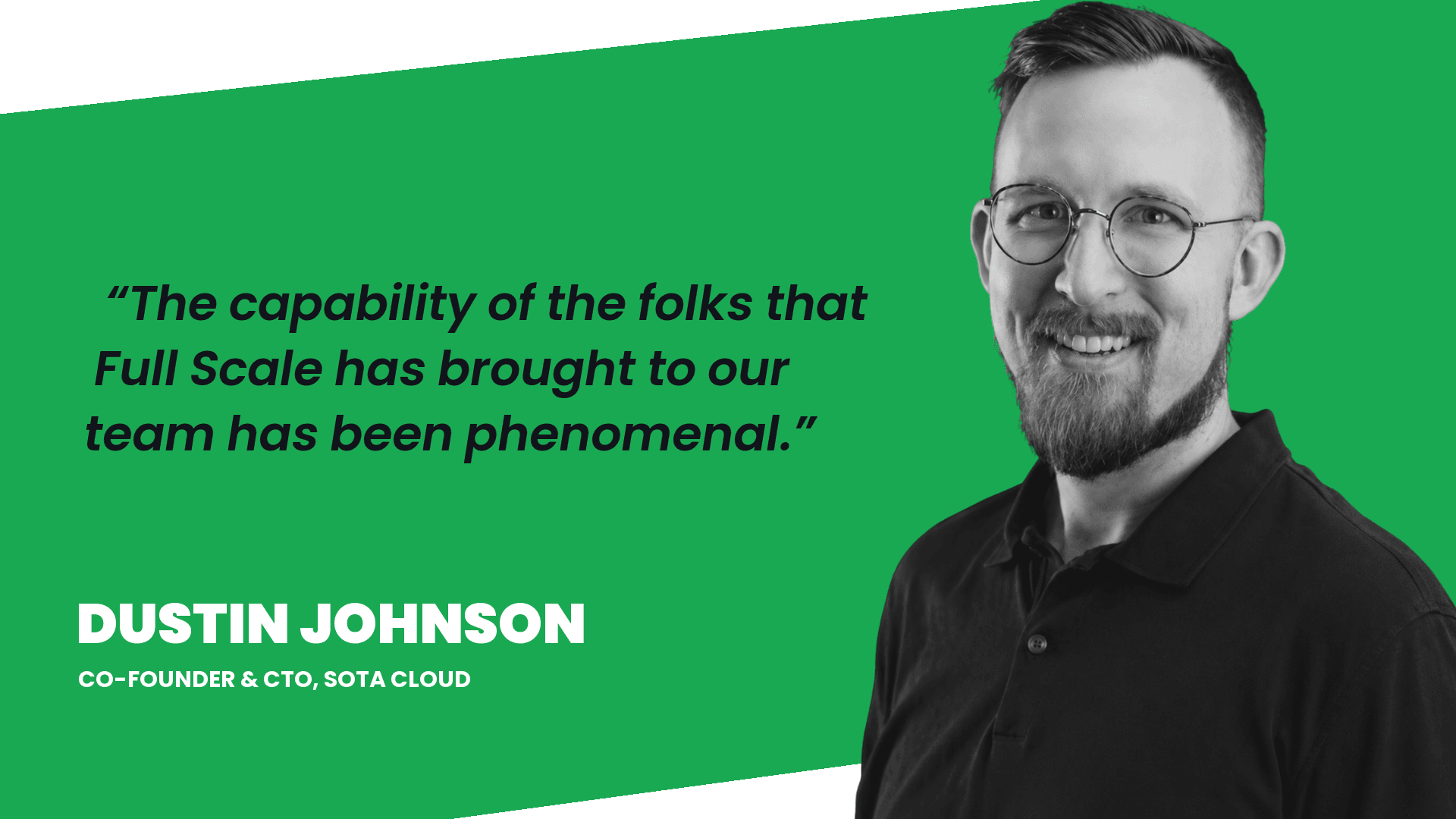
When we staff QA engineers for a client, they’re embedded the same way our developers are. Dustin Johnson, the co-founder and CTO of SOTA Cloud, put it this way: “The capability of the folks that Full Scale has brought to our team has been phenomenal. The Full Scale team has staffed us with top performers in our company, even relative to some of the folks that we have here in the US.” That’s the bar. These are engineers who treat your risk as their risk, sitting on your team instead of waiting at the other end of a contract. If you want to go deeper on the model, we wrote up how QA outsourcing and software testing services actually work when they’re done as augmentation instead of handoff.
This is also just the Product Driven idea applied to testing. The engineers closest to the product should own its quality, because they’re the ones who understand what failure actually costs.
How to write a testing strategy that’s worth reading
If you want a document at the end of this, whether you call it a test strategy or a QA strategy, keep it short and make it about decisions, not definitions. A useful testing strategy fits on a page and answers:
- Which parts of the system are high-risk, and what “high-risk” means here. Name the blast radius. Money, data loss, things that run at scale, anything that can hurt a person.
- What level of testing each risk tier gets. Deep automated coverage for the dangerous stuff, light or manual for the rest, and the things you’ve explicitly decided not to test.
- What gets automated and gates a release, versus what a human checks by hand.
- Who owns quality. The answer should be “the team,” not “a QA department at the end.”
That’s it. No eight-step template, no roles matrix. The strategy is the set of risk calls. Everything else is execution, and execution belongs in a test plan, which is a different and more detailed document for a specific release.
The teams that ship reliable software fast aren’t the ones with the biggest test suites. They’re the ones who decided early what was worth protecting and put their effort there.
Frequently asked questions
What is a software testing strategy?
A software testing strategy is the set of decisions about what to test, how deeply, and what to leave lightly tested or untested, based on the risk of each part of the system failing. It’s a high-level plan driven by the cost of failure, not a list of testing types or a template document.
What is the difference between a test strategy and a test plan?
A test strategy is the high-level approach: which risks matter most and how much testing each one earns across the product. A test plan is the detailed, release-specific document that spells out scope, schedule, environments, and exactly which tests run for a given version. The strategy stays stable; the plan changes with each release.
How much testing is enough?
Enough testing is the amount that matches the cost of failure for that piece of code. High-risk paths like billing, authentication, and anything that runs automatically at scale should get deep, automated coverage. Low-risk and unvalidated features should get the minimum, since over-testing them wastes effort and creates brittle suites that slow you down.
What are the main types of software testing strategies?
The common types include unit, integration, system, and acceptance testing, plus manual versus automated approaches and specialized testing like performance and security. These are the methods you choose from once you’ve decided what’s worth testing. The full breakdown lives in our guide to software testing methodologies.
Should you outsource software testing?
With a staff augmentation model, “outsourcing” QA really means adding embedded QA engineers who work as part of your team rather than handing testing to a separate vendor. Done that way it works well, because quality stays inside the team building the product. The thing to avoid is hiring testers on price alone, which usually buys box-checking instead of real risk coverage.
The bottom line
Your testing strategy is one of the most important decisions you’ll make as an engineering leader, and it isn’t about buying more tools or chasing a coverage number. It’s about being honest with yourself about what could actually take you down, and spending your effort there. If you want help building a team that thinks about quality that way, that’s what we do.