
Scope Creep and the Cost of Saying Yes

In this article
At one of my startups, an engineer came to me with a quick feature. Harmless. The kind of thing you say yes to without thinking, because saying no feels like getting in the way of someone who cares.
It took a month. And that month was supposed to go to the work that actually mattered.
That engineer wasn’t slacking off or padding hours. He was taking ownership. I wrote a whole book, Product Driven, about why ownership is what you’re building toward when you grow and scale a team, so I’m not about to complain that someone showed too much of it. He saw something he thought would make the product better and he ran at it. The exact instinct I want in every person on my team is the same instinct that quietly blew up the plan.
That is what scope creep really is. It’s what ownership looks like before judgment catches up to it.
And the cost of saying yes was that month, and the priority that sat untouched while we built something nobody had asked for.
Quick Answer: Scope creep is the gradual, uncontrolled expansion of a project beyond what was originally agreed, added one reasonable-sounding change at a time until the timeline and budget no longer match the work. It's often mistaken for a process failure, but on engineering teams it's usually the shadow side of the ownership you actually want: an engineer using their own judgment to take on extra work without weighing what it costs the priority. The durable fix is clearer priorities and better judgment, not a heavier approval process, since process catches mistakes but judgment prevents them. Full Scale coaches engineers on exactly that judgment as part of how it staffs and manages teams.
What scope creep actually is
Scope creep is when the work on a project keeps expanding past what you agreed to build, one reasonable-sounding addition at a time. No single change looks dangerous. The damage is in the pile.
It helps to separate it from a normal scope change. A scope change is a decision: you look at new information, weigh it, and choose to adjust the plan with your eyes open. Scope creep is the absence of that decision. The work grows because nobody stopped to ask whether it should, not because anyone chose to grow it.
| Scope change | Scope creep | |
|---|---|---|
| The decision | Made on purpose, tradeoffs in view | Never made; work expands by default |
| What triggers it | New information you choose to act on | “Just one more thing,” one at a time |
| Who notices | Everyone knows the plan moved | Nobody, until the timeline slips |
| The cost | Budgeted for | Hidden, and paid later |
Most articles about scope creep are written for project managers, and they treat it as a governance failure. Tighten the requirements, add a change-control process, make people fill out a form before anything moves. That advice isn’t wrong, exactly. It’s just aimed at the wrong cause when the team in question is a group of engineers you actually trust.
Scope creep usually starts inside the team, not with the customer
On an engineering team, scope creep most often starts with an engineer trying to help. When people picture scope creep, they picture a pushy client adding requests. That happens. But the version that hurts most comes from inside the building.
We tell engineers to leave things better than they found them. It’s one of the first instincts you learn to admire in a good developer.
It’s also the exact place scope creep starts.
You see it in the “while I was in there” refactor that turns a one-line fix into a three-day rewrite. Then comes gold-plating, polishing a feature past anything a user will notice. Or an engineer chasing the interesting problem instead of the assigned one. Every one of those is somebody using their judgment, and doing exactly what we taught them to do. That’s the uncomfortable truth: the same judgment that makes a great engineer worth hiring is the judgment that takes the team somewhere it shouldn’t go.
Some of that work is just off-priority. Some of it is genuinely risky, the kind of change that looks small and quietly threatens something load-bearing. Knowing the difference is a skill, and it’s the one I care most about teaching. I wrote a whole separate piece on how to size up the real risk of a change before you make it, because “it’s just a small change” is how most production fires start.
Why more process is usually the wrong fix
More process is usually the wrong fix because it blocks the good additions along with the bad ones. The instinct, once scope creep burns you a few times, is to build a wall: a change-control board, mandatory tickets for anything not on the roadmap, approval before an engineer is allowed to follow a hunch.
I understand the instinct. I think it’s mostly a mistake on an engineering team.
There’s a real exception worth naming. If you’re in a regulated business, shipping medical software or moving money around, or you’re running a team too big or too junior to coach every call, then change control is the floor you stand on, and I’m not arguing against it there. It’s there to catch the mistakes you can’t afford. But on most engineering teams, reaching for process first gets the order backwards. It becomes the goal instead of the floor.
When you bolt a process gate onto every decision, you don’t just stop the bad additions. You stop the good ones too, and worse, you teach your best people that initiative is a problem to be managed. You spent years trying to build a team that owns its work. A thick approval process is how you turn owners back into order-takers. The same trap shows up in testing, which is why I argue that your testing strategy is a leadership call, not a checklist. Process is good at catching mistakes. It’s terrible at building judgment, and judgment is the actual thing you’re short on.
The real job is teaching judgment
The fix is a harder job than installing a form: give people room to own their work, and teach them how to use that room well.
In practice that means making the priority impossible to misread, so an engineer can tell the difference between the work that matters and the work that’s merely interesting. It means making it safe to stop and ask “should I even be doing this?” without sounding like they can’t make a decision. And it means being honest about your own role in the mess. A lot of scope creep traces straight back to a leader who gave vague direction, rewarded heroics, and said “just make it work” one too many times. The team is often just doing what you trained them to do.
People mostly learn judgment by getting it wrong. You can coach, you can warn, you can tell the story about the quick feature that ate a month, and someone on your team will still have to burn their own month before it sticks. That’s just how judgment gets built. Your job is to make the lessons survivable, not to prevent every one of them.
I learned my own version the expensive way. At Stackify, the company I founded before this one, we kept saying yes to feature requests, sure that more would make the product easier to sell. We built a feature factory. Customers didn’t want to buy our feature factory. All those yeses didn’t even win us the customers we said yes for. Saying yes feels like progress and generosity. Often it’s neither.
This is really a question of courage, the willingness to say no to good ideas so you can finish the ones that matter. I wrote more about that in The Courage to Ask Why, and it runs through the whole book.
The cost of saying yes is everything you didn’t build
The reason scope creep is so easy to wave off is that each yes looks cheap: one feature, one refactor, a few days.
But every yes spends a resource you can’t get back, which is your team’s attention. The month of work was the smallest part of the cost. A roadmap item slipped, a customer problem stayed unsolved, and we’d taken on a risky change we never thought through. You won’t find any of that on an invoice. It shows up later, as the thing you meant to ship and didn’t.
That’s why I think about saying yes as a budget, not a courtesy. Every yes is a no to something else. You just don’t see the no, because it’s the work that never happened.
The model you choose changes the math
How you staff the work also shapes how scope creep shows up. A fixed-bid vendor on a statement of work has every reason to either gold-plate to look generous or fight you on a change order over every small thing, because their margin depends on the line you drew. That’s a different failure mode than an embedded team, and it’s worth understanding before you sign anything: here’s how I think about staff augmentation versus outsourcing, and why the cheapest option usually costs the most.
At Full Scale we build teams that own the work alongside our clients, and developing the judgment this whole post is about is a big part of what makes that model work. An engineer who’s accountable to your priorities and has learned where the risk lives doesn’t need a change-control board. They self-regulate, because they understand the cost of saying yes.
Frequently asked questions
What is scope creep?
Scope creep is the gradual, uncontrolled expansion of a project beyond what was originally agreed, added one small change at a time. It rarely arrives as a single big request. It accumulates through reasonable-sounding additions until the timeline and the budget no longer match the work.
What causes scope creep?
Unclear priorities, vague direction from leadership, and a low cost of adding “just one more thing.” On engineering teams a lot of it comes from inside the team, where developers use their own judgment to take on extra work, off-priority improvements, or risky changes that weren’t part of the plan.
What is the difference between scope creep and a scope change?
A scope change is a deliberate decision to adjust the plan based on new information, made with the tradeoffs in view. Scope creep is what happens when that decision never gets made and the work expands by default. The difference is whether someone consciously chose the change.
How do you prevent scope creep?
On a team you trust, the durable fix is clearer priorities and better judgment, not a heavier approval process. Make the priority unmistakable, make it safe to ask whether a piece of work is worth doing, and coach people on which changes carry real risk. Process catches mistakes; judgment prevents them.
Is scope creep always bad?
No. Sometimes the new work is the right work, and the discovery is worth more than the original plan. That’s a scope change worth making. It only becomes scope creep when the team slides into the new work without anyone weighing it against what they gave up to do it.
What are examples of scope creep in software development?
The common ones come from inside the team: a “while I was in there” refactor that turns a one-line fix into a three-day rewrite, gold-plating a feature past anything a user will notice, or an engineer chasing the interesting problem instead of the assigned one. At one of my startups, a quick, harmless feature took a month and pushed aside the priority that mattered.
What is the difference between scope creep and feature creep?
Feature creep is scope creep that shows up in the product, where more and more features get added to what you are building. Scope creep is the wider pattern, and it also covers refactors, polish, and side projects that nobody weighed against the priority. Both come from saying yes without asking what it costs.
The best weapon I’ve found against scope creep is a question, and it costs nothing to ask.
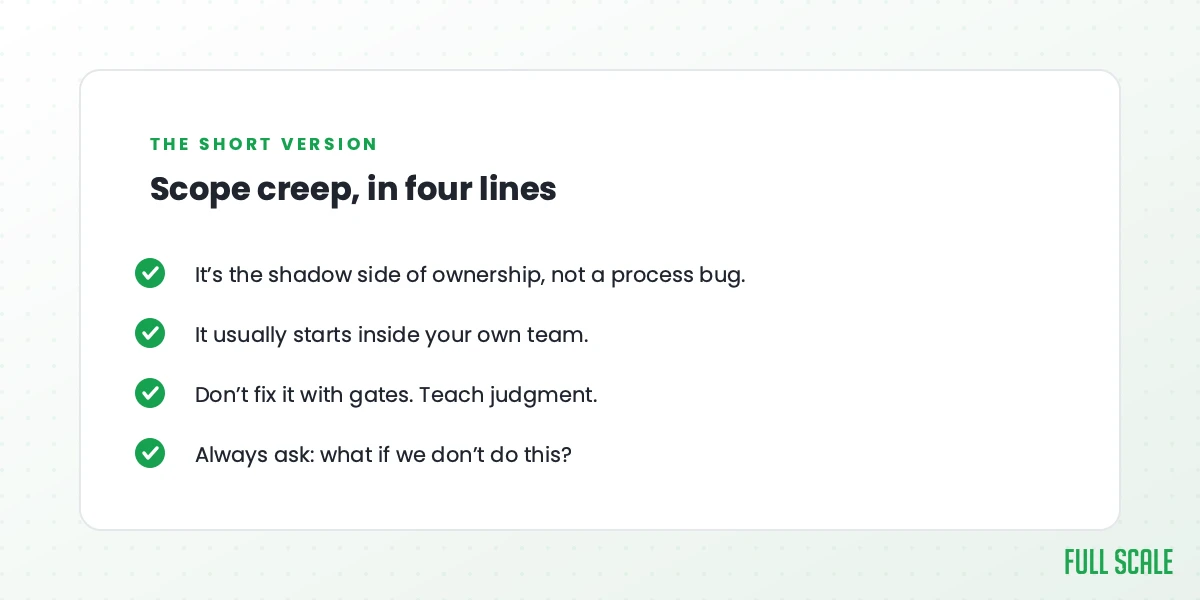
What if we don’t do this?
Ask it of every quick feature and every “while I’m in there” refactor. Most of the time the honest answer is that nothing much happens, and you just got your priority back. The question drags the cost of saying yes into the open before you spend a month finding it out the hard way. Teach your team to ask it, and you’ve handed them the judgment no change-control board ever will.
If you want a team that owns its work and knows when to say no, let’s talk about building one.