Agile vs Waterfall: When Each One Actually Wins (From 20 Years of Running Both)

In this article
- What Waterfall actually is (and the one thing it still does well)
- Where Agile came from (and where it quietly fails)
- Agile vs Waterfall: the differences that actually change your decision
- When Waterfall wins
- When Agile wins
- The hybrid most teams actually run
- What AI changes about the choice
- Frequently asked questions
- Run the methodology. Own the product.
People treat the Agile vs Waterfall debate like a religion. The Agile believers call Waterfall a relic from a slower era. The Waterfall defenders insist you cannot ship a serious system without planning it first. Both camps are half right, and both miss the more interesting question. Before you pick a side, it helps to be clear on which benefits agile actually delivers in the first place. Both are really just different ways to sequence the phases of the software development life cycle.
I have been building and running software teams for more than 20 years. I co-founded VinSolutions, the number-one CRM in automotive, and sold it for $147 million. I built Stackify. Now I am CEO of Full Scale, where our engineers work across dozens of product teams. I have shipped software under Waterfall, Agile, Scrum, Kanban, and everything in between. The full software development methodologies list covers all of them, but the Agile vs Waterfall question is the one that comes up most in practice. I have watched teams succeed and fail under both.
Here is my honest take.
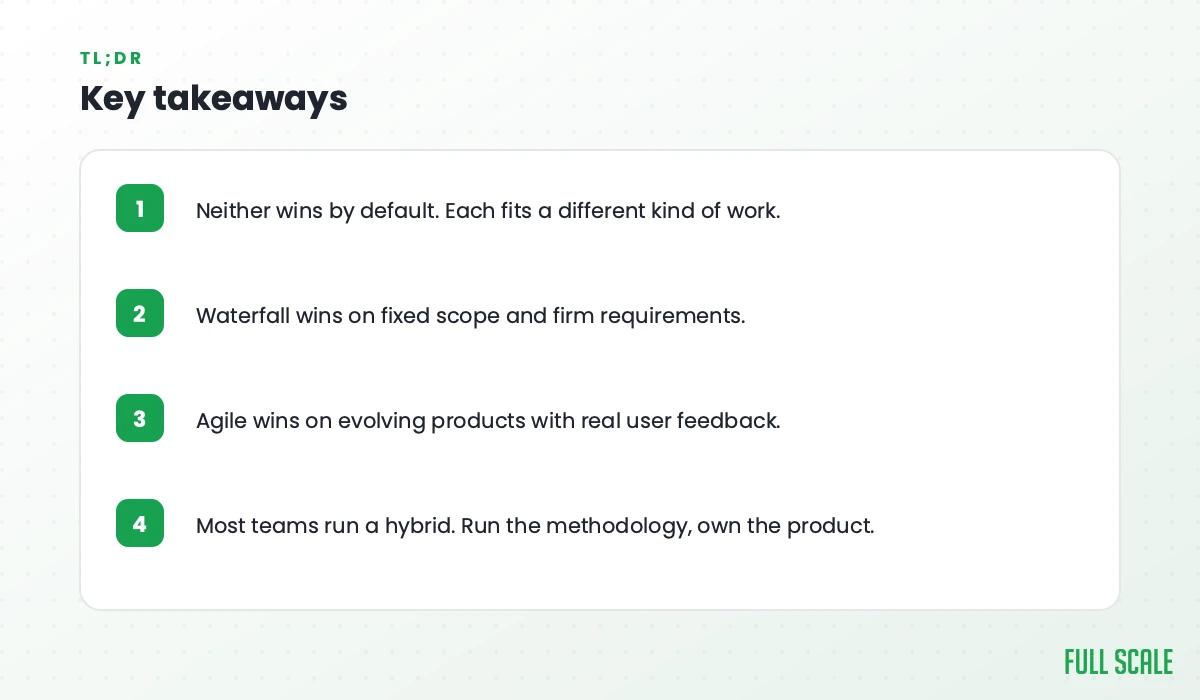
The real answer is not Agile or Waterfall. It is both, at different levels of scope. Most product teams should run Agile across the project, but developers naturally work in a waterfall loop day to day: do this thing, figure it out, move to the next. Understanding why that is true is more useful than picking a side.
This post covers what each method is actually good for, when each one wins, and why the hybrid most teams run is the closest thing to a right answer we have.
What Waterfall actually is (and the one thing it still does well)
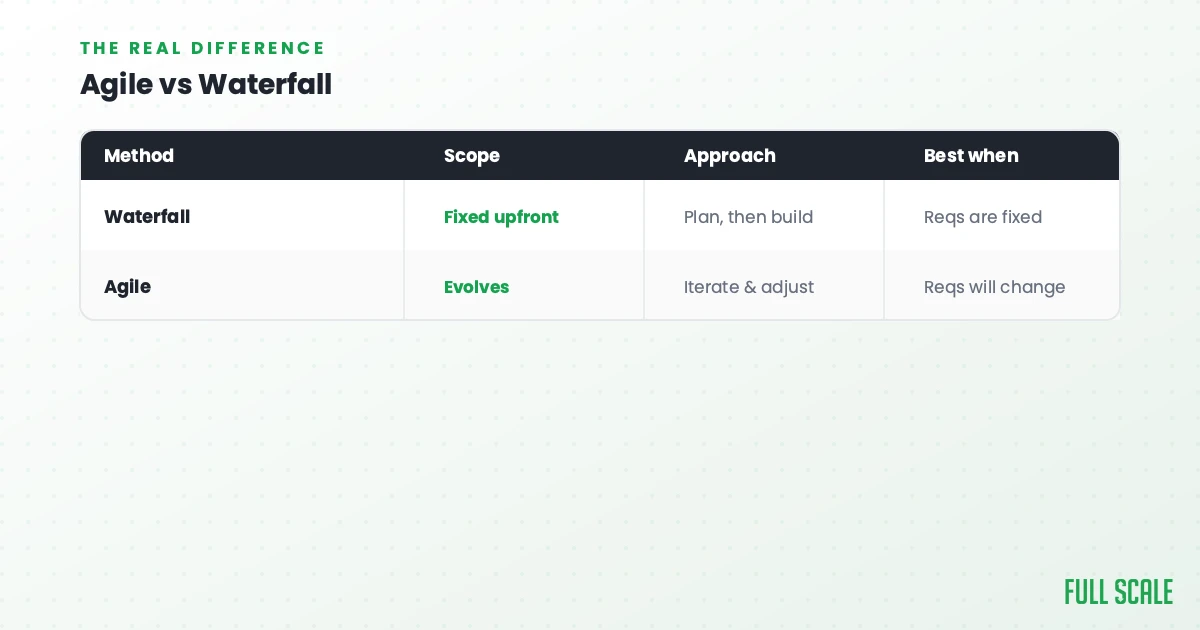
Waterfall is a linear, plan-first approach. You define requirements, design the system, build it, test it, and ship it, in that order. You finish one phase before the next begins. The work is documented at every stage and the plan is locked.
That sounds slow because it usually is. On most software projects, requirements change the moment a customer sees the first working version. Waterfall was built for a world where change was expensive, and for that world it made sense.
Waterfall still makes sense when the cost of a mistake is genuinely high. Think medical device software with FDA sign-off requirements, a government system with hard compliance gates, or an ERP rollout where rolling back a bad deploy takes weeks. In those cases, upfront rigor is the safety net, not bureaucracy.
Outside of those scenarios, you mostly see Waterfall-style work where someone is using it by default, not by choice.
Where Agile came from (and where it quietly fails)
Agile is not a single tool. It is a set of ideas from the Agile Manifesto: work in small increments, deliver something useful often, and keep the customer close enough to give you real feedback before you have gone too far in the wrong direction.
Those ideas were right when the Manifesto was written in 2001, and they are more right now.
The good part of Agile is that it forces you to stay connected to the problem you are solving. I built VinSolutions in what I would now call extreme Agile: founder mode, early days, where I could talk to a dealer in the morning and ship a solution by that afternoon. No tickets, no PM, no approvals. Direct feedback loop. That is the best possible version of the Agile mindset.
But here is where Agile went sideways.
At some point, Agile got turned into an assembly line. Teams added a Scrum Master, then product owners, then product managers, then QA gates, and along the way developers got stripped down to people who execute tickets, not people who own outcomes. That assembly-line version is described very well in the post on how software developers became software engineers: a role that used to mean owning the whole job got narrowed to one station in a longer chain.
Agile the mindset still works. What breaks teams is Agile the bureaucracy.
You can’t fix engineering with Agile, OKRs, or roadmaps. The ceremonies are not the point.
Agile vs Waterfall: the differences that actually change your decision
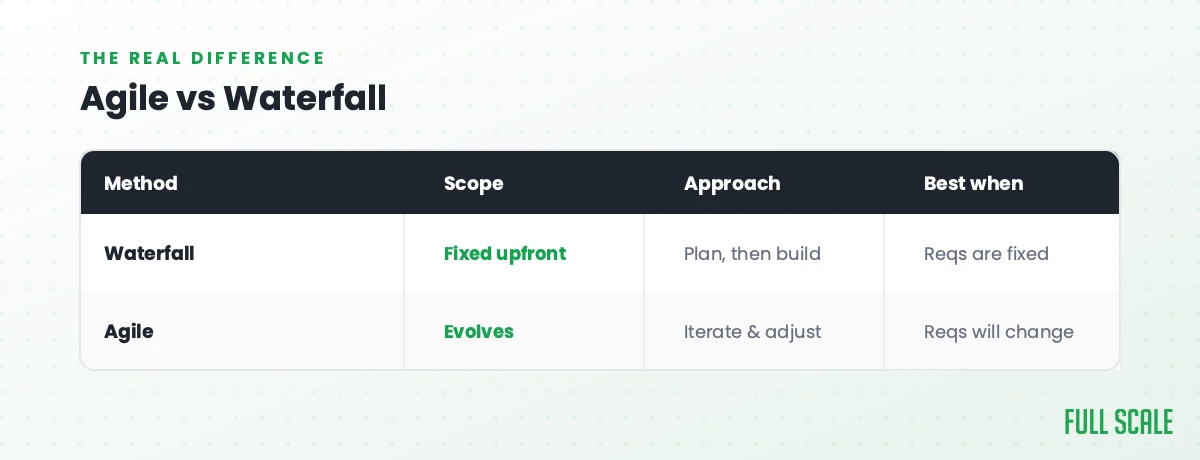
Most comparisons give you a table of 12 differences and stop there. The differences that actually matter when you are deciding which to run are much fewer.
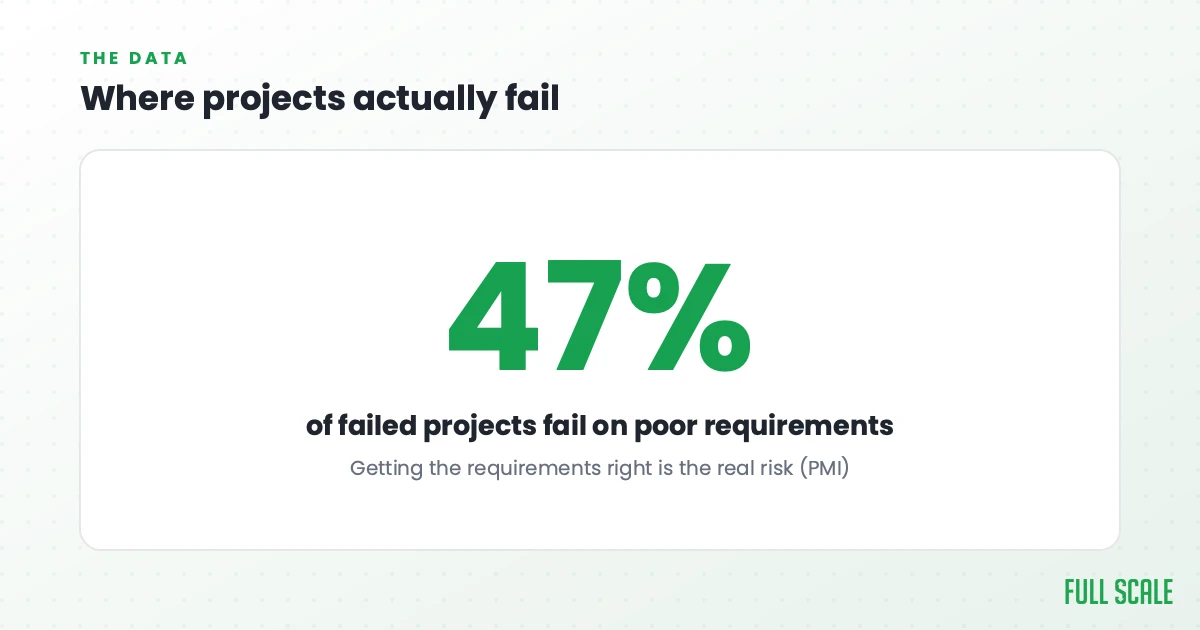
How stable are the requirements? Waterfall asks you to commit to the requirements before you build. Agile assumes the requirements will change. If you genuinely know what you need to build and it will not move, Waterfall reduces friction. If you are building a product and you do not really know what customers want yet, Agile is the only sane choice. According to the Project Management Institute, 47% of projects that miss their goals do so because of poor requirements management. That number is mostly about teams who committed to the wrong requirements before they knew what the customer actually needed.
What is the cost of a mistake? If shipping the wrong version means you lost a week and can correct in the next sprint, that is an Agile project. If shipping the wrong version means you need to restart six months of certified work, that is a Waterfall project.
How much customer access do you have? Agile only pays off if you can close the feedback loop. If you cannot get real input from real users between iterations, the “build, learn, adjust” loop breaks. In that case, more upfront planning is the honest answer.
Who is going to run it? A senior team that self-organizes and pulls the next important thing gets more out of Agile. A team that needs explicit task assignment and deadline pressure gets more out of Scrum’s planning cadence. That is less about the methodology than about the people, a point we cover in more depth when looking at Scrum vs Kanban. A Scrum Master can run every ceremony on the calendar and still not fix a team that does not understand what they are building or why.
When Waterfall wins
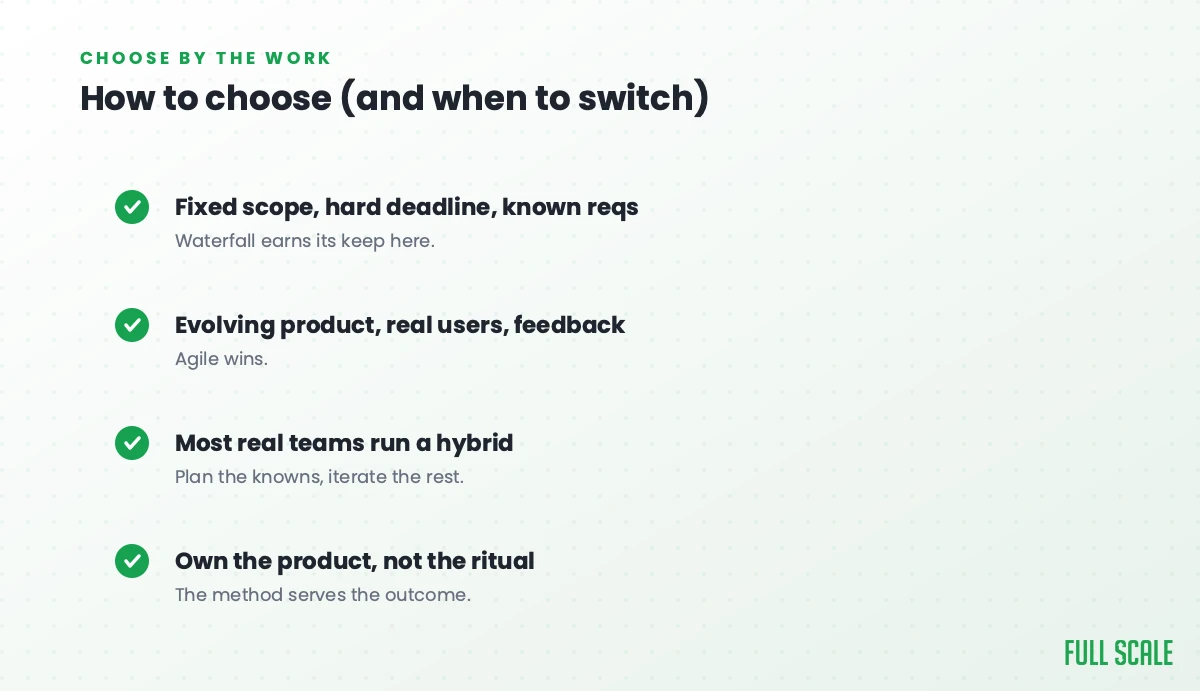
Waterfall earns its place in fixed-scope, regulated work where a mistake is genuinely expensive to undo.
If you are building software for a medical device, a bank, or a government contract with audit trails and sign-off requirements, the process documentation in Waterfall is part of what you are delivering. The rigor is required, not just nice to have.
Waterfall also works well when you are on a clear, well-defined problem with a fixed budget and a fixed timeline, and everyone agrees the requirements are stable before the first line of code. ERP implementations often look like this. So do large infrastructure migrations where the system you are replacing is well understood.
Outside of those contexts, most “we use Waterfall” teams are really running a slow Agile with a lot of documentation. The discipline to actually freeze requirements and move through phases without revisiting them is harder than it sounds.
When Agile wins
Agile wins on most software products, particularly when customers can give you feedback and when you do not fully know what you need to build until you start building it.
The MVP approach is pure Agile logic: ship the smallest thing that tests your assumption, learn from real users, and build the next thing from what you learned. That loop is faster than planning it all up front, and it produces something customers actually want more often than a full plan followed by a big release.
Agile also wins when requirements are genuinely uncertain and the cost of learning late is higher than the cost of iteration. Which, again, is most software. It is also why offshore teams that run Agile well outperform ones that hand over a spec and wait: the feedback loop is the whole value.
The failure mode is Agile without real product thinking. Running sprints and holding standups does not mean you are building the right product. I saw this at Stackify. We had a clean process, a solid sprint cadence, constant releases, and we were still building things customers did not ask for and did not use. The process looked right. The product was not landing. The issue was not the framework.
The hybrid most teams actually run
Here is the thing nobody says plainly enough.
Most high-performing teams run a hybrid, and it is not the watered-down kind where you take bits of each methodology and call it a process. It is a structural observation about how software development actually works at different levels of scope.
Run Agile across the arc of the project. Run a waterfall loop day to day.
What I mean is this. Developers naturally work waterfall-style at the task level. You pick up a piece of work, do it, learn from what you found, and move to the next one. It is genuinely hard to write out the complete requirements for six weeks of work and then build every piece of it to spec without learning anything that changes the plan. The day-to-day reality is sequential and iterative: scoped step, figure it out, next step.
That instinct is not wrong. It is just waterfall at a smaller scope. The Agile structure sits around it: sprints, reviews, customer feedback, course corrections every two weeks. But inside each sprint, developers are largely doing waterfall things: design this piece, build it, check it works, move on.
In the AI era this loop is even more obvious. Prototyping with AI is exactly the same pattern. You do something, experiment with the output, adjust the prompt or the spec, then do the next thing. Sequential and scoped, with learning baked in. That is the waterfall instinct applied at the smallest unit of work, which is where it belongs.
The teams that waste the most time are the ones treating Agile as a religious principle and Waterfall as a failure. The right frame is: Agile for the project, waterfall for the day. Use each where it fits.
What AI changes about the choice
A lot, and also less than people think.
On the “a lot” side: AI makes iterating faster. When you can go from an idea to a working prototype in an afternoon instead of a week, the cost of getting something wrong drops. That pushes even more work toward Agile. If you can build as fast as you can plan, why lock in a six-month plan?
The catch is that cheap iteration with no upfront thinking just produces the wrong thing faster. The 2025 DORA report found that AI amplifies whatever is already there. Strong teams get faster and better. Weak teams ship their problems quicker. A team with no product clarity does not get product clarity from a faster feedback loop. They just build more wrong things per sprint.
In April 2026, Google’s CEO said 75% of the company’s new code is now AI-generated, with every line still reviewed and approved by an engineer. When AI writes most of the code, the ceremony around the code matters less. What matters more is deciding what to build and judging whether the output is any good. That is the Agile loop: talk to customers, get feedback, iterate fast.
For the modern software development process, the methodology is scaffolding. What decides success is whether your team has enough context to build the right thing, and enough product thinking to push back when the plan is wrong.
People ask whether Agile is even still relevant in this environment, and it is a fair question worth taking seriously in the broader is Agile dead debate. The short answer: the mindset is more important than ever, even as the ceremony matters less.
Frequently asked questions
What is the difference between Agile and Waterfall?
Waterfall is a linear, plan-first approach where you define requirements completely before building. Agile works in short cycles, delivering small pieces of working software and adjusting based on feedback. Waterfall fits projects where requirements are stable and mistakes are expensive. Agile fits most product development, where requirements change as you learn what customers actually need.
Which is better, Agile or Waterfall?
Neither is better in the abstract. Waterfall wins when scope is fixed, requirements are stable, and the cost of deviating from the plan is high, like a regulated compliance build. Agile wins on most software products, where you do not fully know what you need to build until you start. For the majority of product teams today, Agile is the right default.
Can you combine Agile and Waterfall?
Yes, and most teams do whether they call it that or not. A common pattern is Agile at the project level with Waterfall-style thinking at the task level: sprint planning and retrospectives around the arc of the project, but sequential step-by-step execution inside each piece of work. Some teams also use Waterfall for a defined discovery or design phase before switching to Agile for the build.
Is Waterfall dead?
No. Waterfall is the right approach for a real set of projects: regulated builds, fixed-scope contracts, safety-critical systems with audit requirements. The argument is not that Waterfall is dead. It is that most software teams reach for Waterfall when Agile is the better fit, because planning everything up front feels safe. That is where the problem lives.
What is an Agile Waterfall hybrid?
An Agile Waterfall hybrid is a delivery model that uses elements of both. A common version is running a Waterfall-style requirements and design phase for the overall system, then breaking the build into Agile sprints with regular reviews. Another common version is what most teams do without naming it: Agile cadence at the macro level, sequential task execution at the micro level.
Run the methodology. Own the product.
For the offshore teams at Full Scale, we have run every methodology variation you can imagine across dozens of client products. The teams that do well are not the ones with the purest Agile process. They are the ones where engineers understand the product and the customer well enough to catch a bad decision before it ships.
That is the part no framework gives you. Read Product Driven if you want the longer argument on it.
If you need a team of senior engineers who think that way, and who can slot into your process, Scrum, Kanban, Agile, or your own board, let’s talk about building yours.