
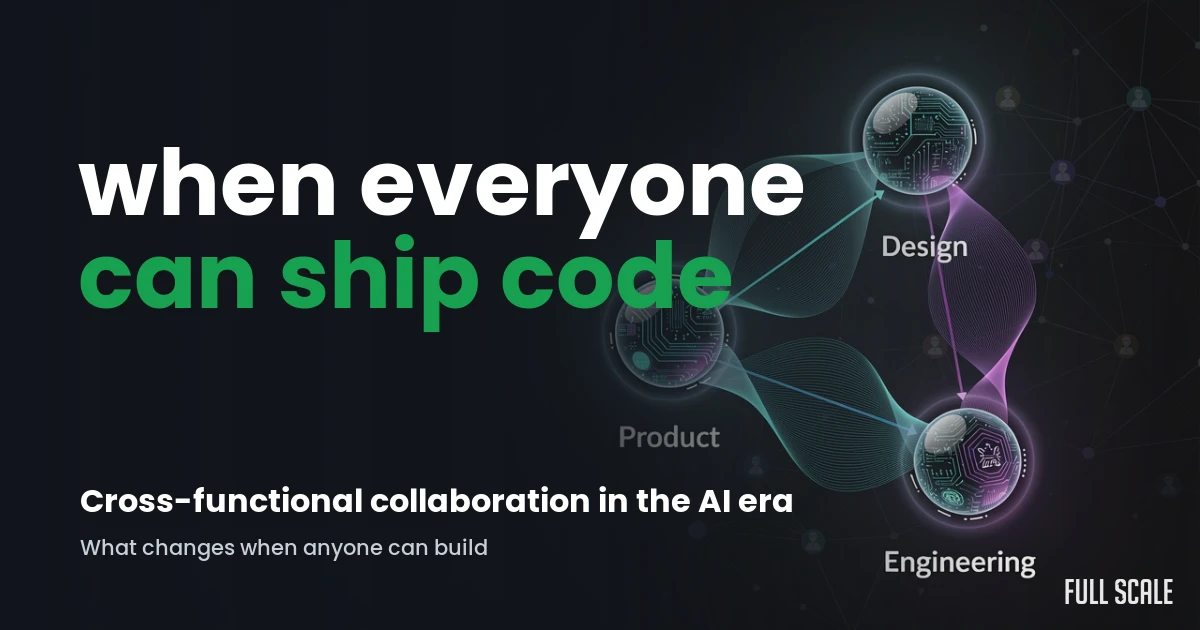
Cross-Functional Collaboration in the AI Era: When Everyone Can Ship Code

In this article
- What cross-functional collaboration actually means now
- AI didn’t erase the roles, it smeared them
- The new bottleneck is review, not writing
- Why cross-functional collaboration matters more now, not less
- The collaboration barriers AI made worse (and the ones it eased)
- How to run a cross-functional team when everyone can ship code
- What it looks like when it actually works
- Building a team that can collaborate this way
- Frequently asked questions
- Ready to build a team that collaborates like one
Last month I watched a CEO push code to production. He doesn’t write code. He hasn’t really written code in years. He told Cursor what he wanted, it wrote the thing, and he merged it himself before lunch. When anyone can ship code that fast, you need a kill switch for risky releases to keep the speed from hurting you.
That same week, his product manager stopped writing tickets and started handing engineers working prototypes built with AI. The designer shipped real Figma components straight into the front end. And the senior engineers spent most of their days doing one thing: reviewing pull requests, trying to keep all of it from breaking the product. That shift hits design especially hard, which is why AI has changed user experience strategy more than it has changed who does the work.
This is what cross-functional collaboration looks like in 2026.
Everyone was shipping more than they ever had. The team was also more confused than it had ever been. The walls between development, product, and design are coming down, but not in the clean, friendly way the conference talks promised. They’re coming down because AI handed everyone the same tools, and now nobody is quite sure who owns what. Part of the new clarity is knowing the difference between AI and machine learning.
AI didn’t reduce the need for cross-functional collaboration. It raised the stakes. The same holds inside engineering, where collaboration on a software team lives or dies on communication.
When anyone on the team can produce code, a design, or a feature spec in an afternoon, the hard part stops being the production. The hard part becomes agreeing on what to build, checking that it’s any good, and keeping the whole thing pointed in one direction. That work is collaboration. And it just got a lot harder. Once anyone can ship code, an MVP is about validation, not the code, and agreeing on what to build becomes the whole game.
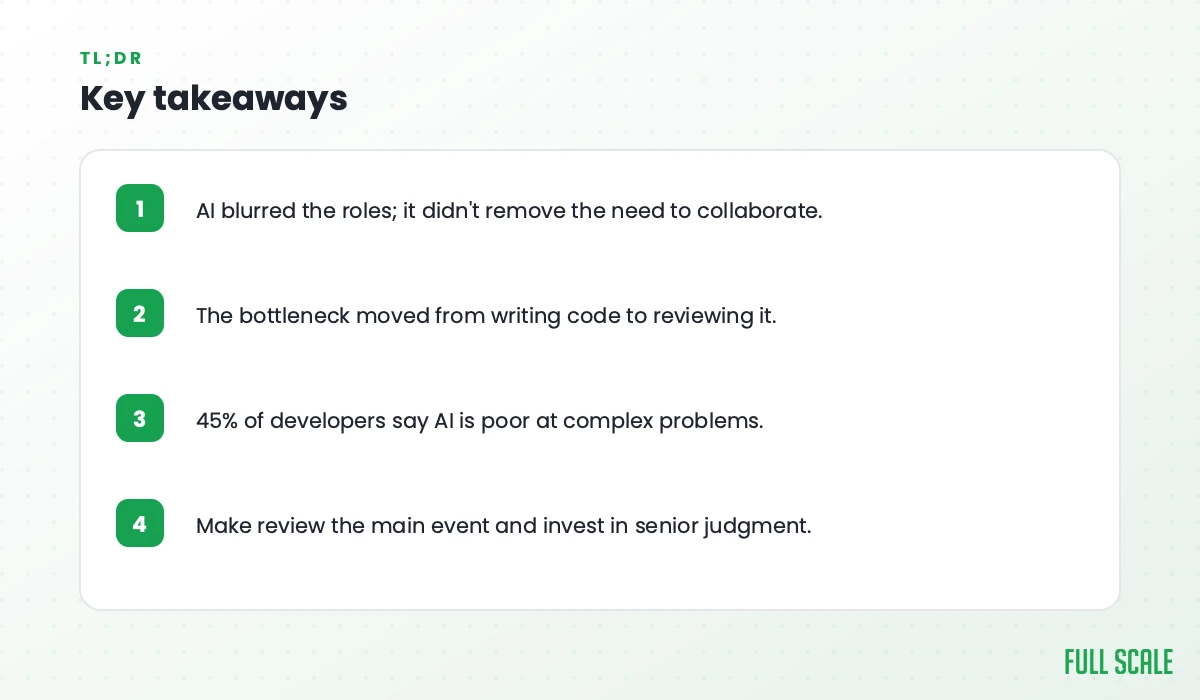
Quick Answer: Cross-functional collaboration is when people from different disciplines, developers, designers, product managers, and QA, work together on the same product as one team instead of passing work down a line through handoffs. AI blurred the old role boundaries: product managers ship working prototypes, designers ship production code, and even non-technical leaders merge their own AI-generated code, which shifts the real bottleneck from writing code to reviewing it and agreeing on what to build. The skills that matter most now are communication, curiosity, and courage, not who owns which ticket. Full Scale builds distributed teams as fully integrated members of one team, not a walled-off vendor, so that review and alignment work the same way whether the engineer sits down the hall or overseas.
What cross-functional collaboration actually means now
Cross-functional collaboration is when people from different disciplines (developers, designers, product managers, QA, and the business) work on the same product as one team instead of passing work down a line.
The textbook version of this used to be about handoffs. Product wrote the spec. Design made the mockups. Engineering built it. QA tested it. Each group did its part and threw the work over the wall to the next group.
That model is already breaking, and AI is finishing the job.
The old definition assumed each role could only do its own slice of the work. A designer couldn’t ship code. A product manager couldn’t build a prototype. A CEO definitely couldn’t merge a pull request. Those assumptions held the roles in place, and the handoffs were how the team stayed coordinated.
Now those assumptions are gone. So if your idea of cross-functional collaboration is still “smooth handoffs between specialists,” you’re solving a problem that barely exists anymore. The new problem is the opposite: everyone can reach into everyone else’s job, and that creates a different kind of mess.
AI didn’t erase the roles, it smeared them
Here’s what actually changed on the ground.
The product manager can describe a feature to an AI and get a working prototype back, so they stop writing detailed specs and start shipping half-built features for engineering to “just finish.” The designer can generate production-ready components, so the clean handoff to a front-end developer turns into a pile of code nobody on the engineering team wrote. The founder or CEO, the one who used to draw on whiteboards, can now open Claude or GitHub Copilot and put real code in front of the team.
According to the 2024 Stack Overflow Developer Survey, 62% of professional developers were already using AI tools in their work, and 82% of them used those tools to write code. That number is only going one direction. The tools aren’t just for developers anymore, either. They’re for everyone who touches the product.
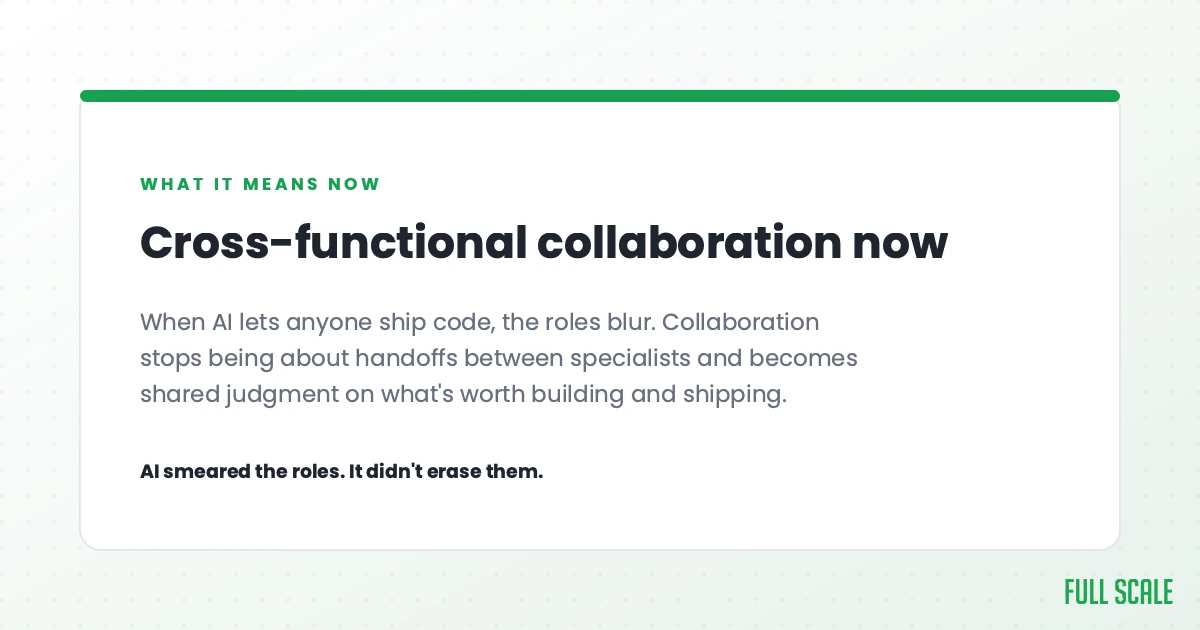
This is the part most “how to collaborate better” advice misses completely. The roles haven’t disappeared. They’ve smeared into each other.
A designer who ships code is doing engineering work without an engineer’s training. A CEO who merges a pull request is making technical decisions without a technical review. None of that is bad on its own. Some of the best products I’ve seen got built because a founder could move fast and prove an idea in real code. But it only works if someone is watching the whole picture, and that someone is almost always a senior engineer who didn’t ask for the job.
As I’ve said before about the trend everyone calls vibe coding: it only works if you’ve been coding long enough to know when the AI is wrong. That’s the catch. The people generating the most code are often the least equipped to tell when it’s bad.
The new bottleneck is review, not writing
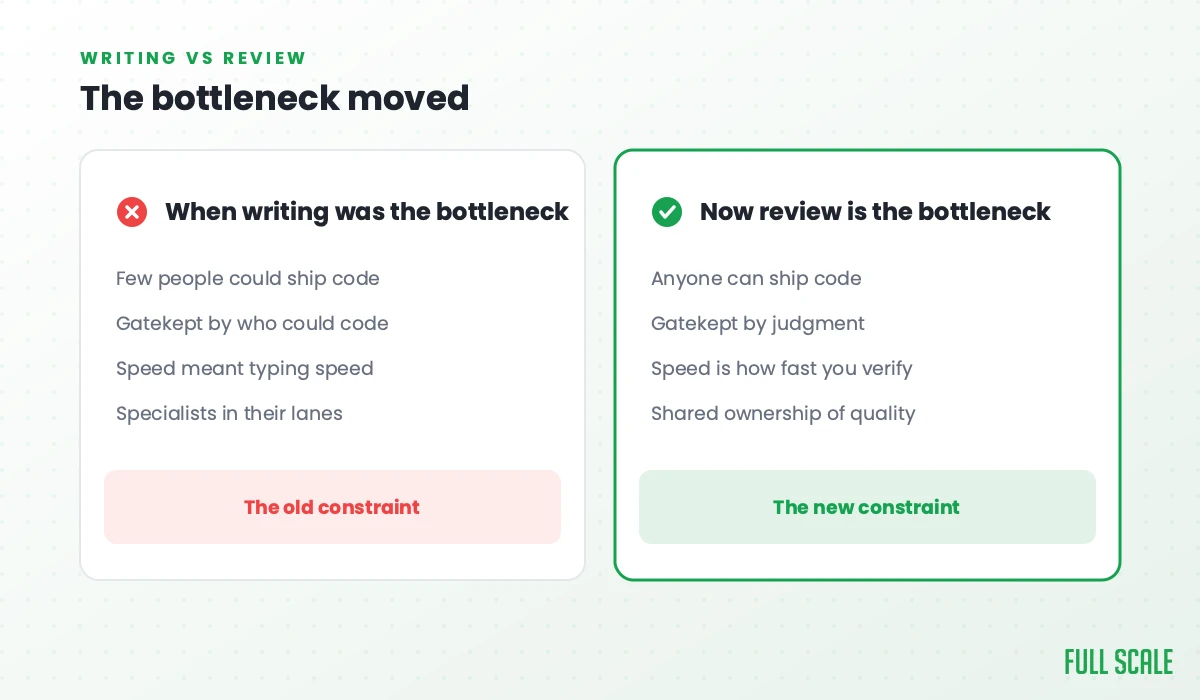
For years, the constraint on a software team was how fast it could write good code. That’s why we hired more developers, and why “just add more devs” became the default answer to every deadline.
AI broke that constraint. Writing code is no longer the slow part.
The slow part is now review.
When the CEO ships a feature, someone has to read it. When the PM hands over an AI-built prototype, someone has to figure out which parts are real and which parts are held together with tape. When the designer’s generated components land in the repo, someone has to make sure they don’t quietly break three other screens. All of that lands on the same small group of experienced engineers, and they are drowning.
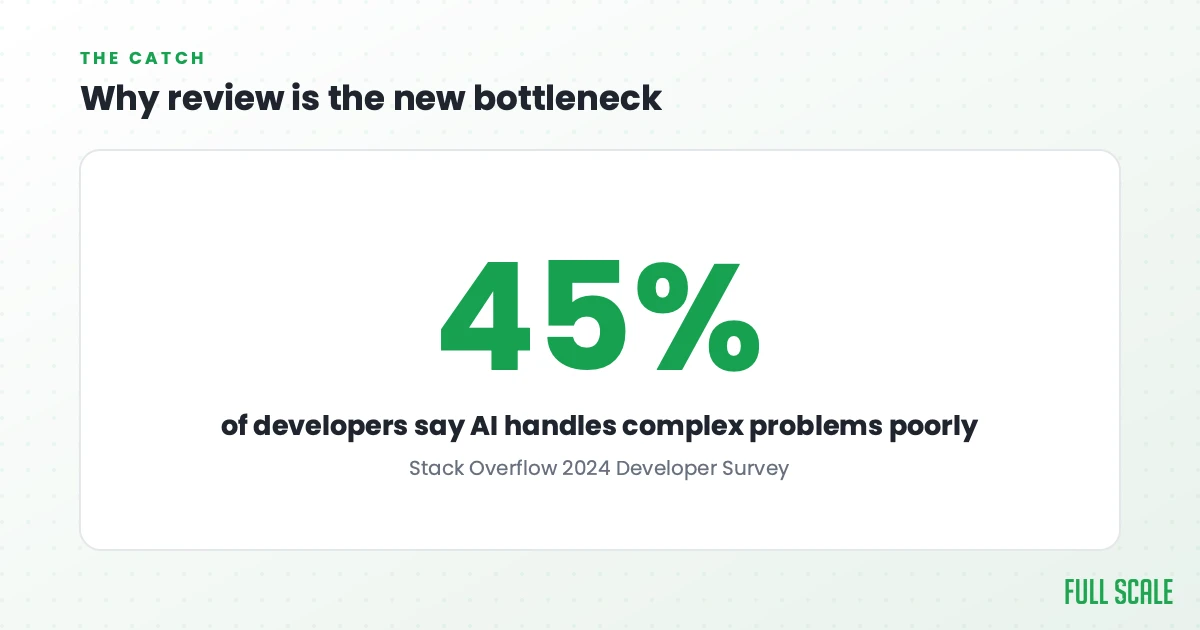
The Stack Overflow data backs this up. Even as developers adopted AI tools fast, 45% of them said the tools were bad or very bad at handling complex problems. So the output went up, the trust did not, and the work of checking everything fell to the humans who can actually tell the difference.
This is the quiet tax nobody put on the roadmap. Your most valuable engineers are spending their days reviewing other people’s AI output instead of solving the hard problems only they can solve.
The hard part of software development was never typing. It’s understanding the problem you’re trying to solve. AI is great at the typing and useless at the understanding, so when you let it generate code that nobody really understands, you’re creating tomorrow’s technical debt today. Cross-functional collaboration is how you catch that before it ships, because the person who understands the problem and the person who wrote the code are often no longer the same person.
Why cross-functional collaboration matters more now, not less
Put all of this together and you get a strange result. The thing that makes a team move fast, AI, is also the thing that makes collaboration non-negotiable.
When everyone could only do their own job, the role boundaries did your coordinating for you. The handoff was the checkpoint. Now the checkpoints are gone, and the only thing standing between “we ship fast” and “we ship a fast-moving mess” is how well the team talks to each other.
When anyone can produce, alignment becomes the scarce resource.
That’s the whole game now. It’s not about who can build the feature. Plenty of people and tools can build the feature. It’s about whether the team agrees the feature is worth building, whether it fits the product, and whether it’s actually any good. None of that happens in the code. It happens in conversation.
I wrote a whole book, Product Driven, around a version of this idea: you don’t need rockstar developers, you need rockstar requirements. AI made that even more true. A team that can generate anything but can’t agree on what matters will just generate the wrong things faster.
The skills that decide whether this works aren’t new, but they’re suddenly the whole ballgame. I think about them as three C’s: communication, curiosity, and courage. Communication, because the job is now mostly about understanding problems and working with people, not producing code. Curiosity, because the tools change every few months and the people who stay curious about them adapt while everyone else falls behind. And courage, because someone has to be willing to say “I don’t understand what this AI-generated code does, and we shouldn’t ship it” in a room full of people who want to move fast.
A team with those three things will thrive no matter how good the tools get. A team without them will collaborate itself straight into a pile of code it can’t maintain.
The collaboration barriers AI made worse (and the ones it eased)
Not every old barrier got worse. A couple actually got better. Here’s how the classic friction points shifted once AI entered the room.
| Old collaboration barrier | What AI did to it |
|---|---|
| Technical and non-technical people speaking different languages | Eased. AI is a decent translator. A PM can ask it to explain a technical tradeoff, and an engineer can ask it to rewrite a spec in plain terms. |
| Slow handoffs between design and development | Eased, then complicated. Handoffs are faster, but now design ships code nobody on the dev team reviewed. |
| Misaligned goals between teams | Much worse. When everyone can ship independently, everyone can chase their own version of “done” without anyone noticing until it’s merged. |
| Review and quality control | Much worse. Output exploded, the number of experienced reviewers did not, and the gap is where bugs and tech debt now live. |
| Shadow work that skips the process | New problem. People ship AI-built features around the normal review path because they can, and the team finds out later. |
The pattern is clear. AI helped with the friction that came from people not being able to do each other’s jobs. It made everything worse where the friction came from people not agreeing on what to do or not checking each other’s work.
That’s the shift in one sentence. The bottleneck moved from “can we build it” to “should we build it, and is it any good,” and only collaboration answers those two questions.
How to run a cross-functional team when everyone can ship code
So what actually works? Here’s what I’d tell any engineering leader trying to keep a cross-functional team sane in 2026.
Measure outcomes, not output. When code is cheap to produce, counting commits or features shipped is worse than useless. It rewards exactly the volume that’s burying your reviewers. Tie the whole team, developers, designers, PMs, to the same outcome: did the customer get value? A shared agile process helps here, but the metric matters more than the ceremony.
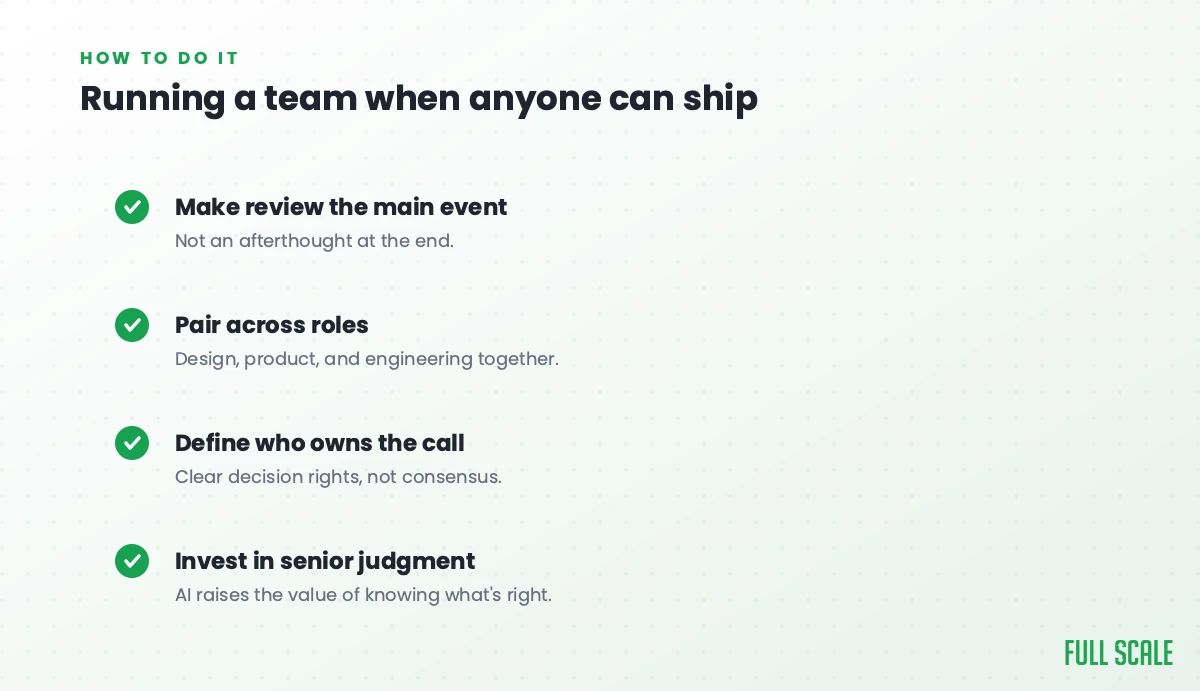
Make review a first-class job instead of a chore squeezed in at 5pm. If your senior engineers are reviewing all day, that’s not a distraction from their real work. In an AI-heavy team, it is the real work. Staff it, schedule it, and respect it. Pair junior and senior engineers on reviews so the knowledge spreads instead of bottlenecking on two people.
Keep one human who owns the problem end to end. AI can write the code and draft the spec, but someone has to own whether the thing actually solves the customer’s problem. That person needs to talk to customers, understand the product, and have the authority to say no. Usually it’s a strong product manager, but it can be a tech lead. What matters is that it’s a person, not a prompt.
Bring back the demo. The single best cross-functional habit I know is a weekly live demo where the whole team shows what they built to each other and to the business. It surfaces misalignment in minutes that would otherwise hide in the codebase for weeks. When everyone can ship in isolation, the demo is how you pull them back into one room.
Put guardrails on AI-generated code. No code reaches production without a human who understands it signing off, no matter who generated it or how senior they are. That’s not bureaucracy. It’s the one rule that keeps the review bottleneck from becoming an outage. Good knowledge transfer habits matter more than ever, because the person who generated the code may not be around to explain it later.
None of these are about tools. You can buy every collaboration platform on the market and still ship chaos. They’re about the team agreeing on how it works together, which is the only thing that’s ever made cross-functional collaboration work.
What it looks like when it actually works
The best example I have isn’t a theory, it’s a client.
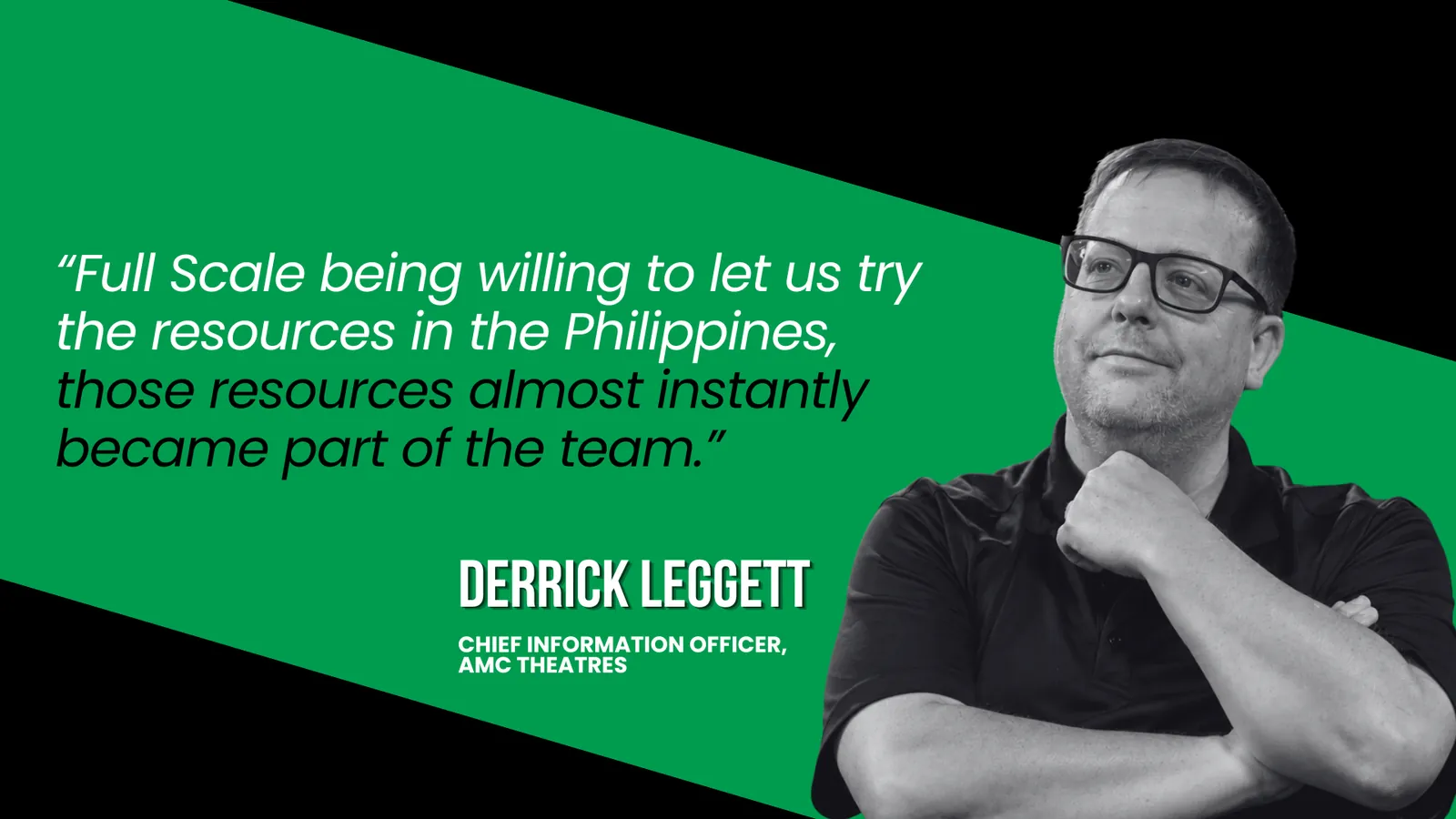
AMC Theatres runs the largest movie-theatre ticketing platform in the world, and its CIO, Derrick Leggett, built a global engineering organization where developers in the Philippines, the US, India, and South America all work as one team, not a vendor on the other side of a wall.
The way Derrick puts it: “It’s a fully integrated team. It’s just some of the people happen to be living in the Philippines.”
That integration is exactly what makes the AI era survivable. When the team shares standups, tools, and a roadmap, there’s no handoff cliff for AI-generated work to fall off of. Everyone sees everyone’s work, so review is built into how the team operates instead of being an afterthought.
Derrick is also blunt about why adopting these tools isn’t optional: “People who don’t adopt AI and learn how to use it are going to be working at 30%, 50%, 80% of what the person sitting next to them is.” He’s right. But the teams that win won’t be the ones that adopt AI fastest. They’ll be the ones that adopt it fastest and keep collaborating while they do it.
Building a team that can collaborate this way
You can’t bolt cross-functional collaboration on at the end. It comes from how you hire and how you run the team from day one. For a front-end role specifically, here are the front-end developer skills worth hiring for.
At Full Scale, we hire for communication as hard as we hire for technical skill, because software development is about communication more than anything else. We’ve learned that a brilliant engineer who won’t speak up when a spec is wrong is worth less than a good one who will. That’s truer now than ever, when half the job is catching the moments where AI quietly went off the rails.
Our model is built around long-term, dedicated teams that integrate directly with your in-house engineers, not a project shop you hand requirements to and hope for the best. When you hire developers who work as part of your team, join your standups, and care about the product, the cross-functional muscle builds naturally. The same goes for the QA engineers and UX designers who round out a real product team. You can read more about how we run offshore development as integrated teams rather than walled-off vendors.
Pure coders will be replaced by AI. Problem solvers, the people who can communicate, stay curious, and own outcomes, will run technology organizations. Building a team of those people is the whole job now.
Frequently asked questions
What is cross-functional collaboration in software development?
Cross-functional collaboration is when people from different disciplines, including developers, designers, product managers, and QA, work together on the same product as one team instead of passing work down a line through handoffs. The goal is shared ownership of the outcome, where the team is measured on whether the customer got value rather than on whether each group finished its own isolated piece.
How has AI changed cross-functional collaboration?
AI blurred the boundaries between roles. Product managers can build working prototypes, designers can ship production code, and even non-technical leaders can generate and merge code with tools like Cursor and GitHub Copilot. This makes collaboration more important, not less, because the bottleneck shifts from writing code to reviewing it and agreeing on what to build. Alignment and code review become the scarce resources instead of raw production capacity.
Why is code review the new bottleneck in AI-assisted teams?
When AI lets many people generate code quickly, all of that output still has to be checked by humans who understand the system. The number of experienced engineers who can do that review well does not grow as fast as the output does. The 2024 Stack Overflow survey found that 45% of developers think AI tools handle complex problems poorly, so trust in the output stays low even as volume climbs, which leaves senior engineers buried in reviews.
What skills matter most for cross-functional collaboration now?
Communication, curiosity, and courage. Communication matters because the job is now about understanding problems and working with people, not just producing code. Curiosity matters because the tools change constantly and the people who keep learning them adapt. Courage matters because someone has to be willing to push back and say a piece of work isn’t ready, even when the team wants to move fast.
Do remote and offshore teams collaborate well in the AI era?
Yes, when they’re set up as integrated teams rather than walled-off vendors. A remote team that shares your standups, tools, and roadmap collaborates the same way a co-located one does, and AI translation tools have actually reduced some of the old language and documentation friction. The key is treating offshore developers as full members of one team, the way AMC Theatres runs its global engineering organization, rather than handing requirements to a project shop.
How do you keep AI-generated code from creating technical debt?
Require that a human who understands the code signs off before it reaches production, no matter who generated it. Tie the team to outcomes instead of output so nobody is rewarded for shipping volume. Invest in strong knowledge transfer so the person who generated a piece of code isn’t the only one who can explain it. The hard part of software is understanding the problem, and that understanding has to live with a person, not just in a prompt.
Ready to build a team that collaborates like one
If your roadmap is moving fast but your team is shipping confusion, the fix usually isn’t more tools or more developers. It’s a team built to work together from the start. Book a discovery call and we’ll talk through how to build a cross-functional team that can actually keep up with the AI era.