Developer Burnout: 7 Warning Signs Your Best Engineers Are About to Quit

In this article
Your top performer just put in their two weeks. Again. The third senior engineer in six months, and the exit interview said “burnout.”
If you are an engineering leader, you already know how this conversation goes. You already know which of your other engineers are next. And you already know that the standard advice (more PTO, more swag, more pizza Fridays) is not going to fix any of it.
Developer burnout is also expensive. Gallup’s research on turnover puts the cost of replacing a technical employee at around 80% of their annual salary, which means losing a senior software engineer typically runs into six figures once recruiting fees, the half-finished project, the institutional knowledge gap, and the months of lost velocity all get added up. It also leaves you carrying a team that watched its best engineer leave and is now wondering why they are still there. That math is the same one behind the cost of developer turnover industry-wide.
This is what burnout actually looks like on an engineering team, what causes it, and what to do about it before your next senior engineer hands in their notice. Remote and offshore teams feel this first, which is why being deliberate about how you keep your offshore developers motivated and engaged matters even more at a distance. It often starts upstream, with scaling the team too fast after a raise and then leaning on the people who stayed to cover the chaos.
What Developer Burnout Actually Is
Burnout is not the same as being tired or stressed.
The World Health Organization classifies burnout as an occupational phenomenon, a sustained state of physical, emotional, and mental exhaustion caused by chronic workplace stress that has not been managed. Sleep does not fix it, and neither does a long weekend. By the time you can see it on a team, the engineer has been carrying it for months. A lot of that overload traces straight back to planning your team’s capacity at 100% with no slack for the unexpected.
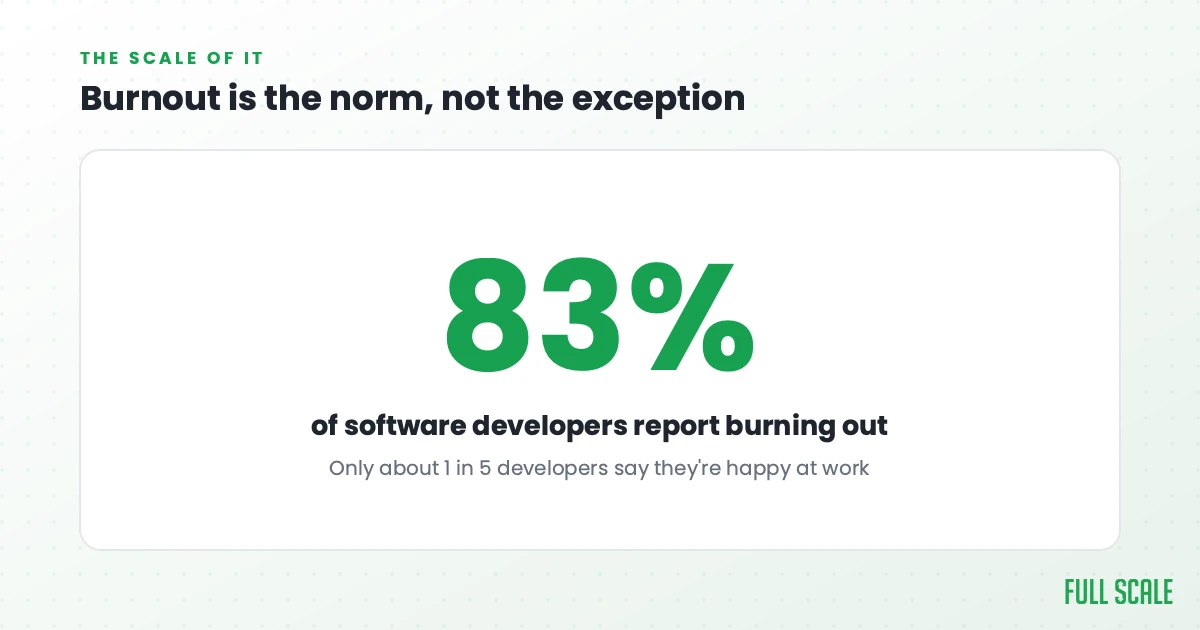
Burnout is everywhere in this profession, and the numbers are not subtle. In Jellyfish’s 2024 State of Engineering Management report, 65% of engineering professionals said they had burned out in the past year, and a 2021 Haystack Analytics study put the figure for software developers at 83%. The Stack Overflow 2024 Developer Survey fills in why: only about one in five developers say they are happy at work, and the single biggest source of frustration is technical debt, which weighs on 62% of them. For most teams, the conditions that produce burnout are already in the room.
The reason most engineering leaders miss burnout is that it does not look like what they expect. It rarely looks like crying at a standup or storming out of an office. It looks like steady, almost invisible decay. The senior engineer who used to push back in design reviews stops pushing back. The architecture channel in Slack goes quiet for the first time in two years. Tickets get closed on time, but nobody on the team seems happy about anything.
By the time you notice, they are already drafting the resignation email.
The 7 Warning Signs of Developer Burnout
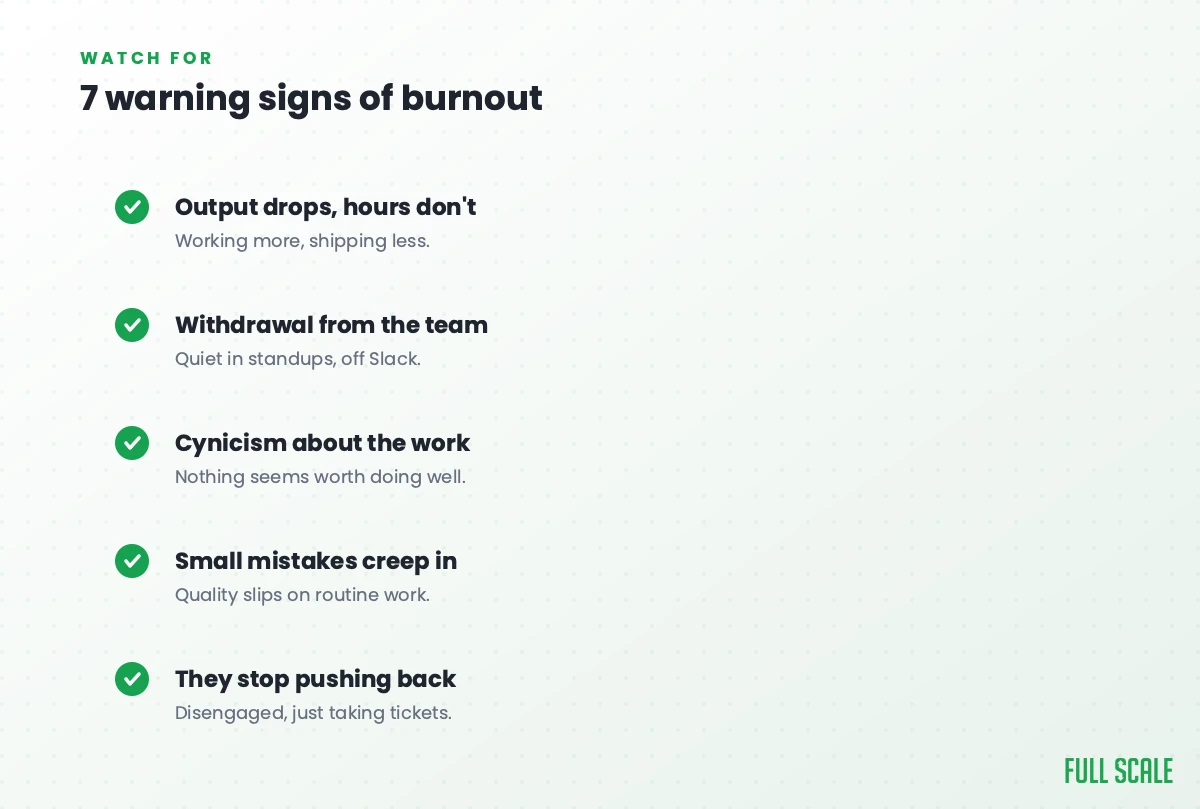
You can spot burnout before resignations start if you know what you are looking for. These are the signs that show up first.
1. Code Quality Slips First
The earliest measurable signal of burnout is in the work itself.
Bug reports start climbing, and familiar tasks take longer than they used to. PR reviews come back with “LGTM” instead of substantive notes, and the refactor work just stops happening. Test coverage drops because writing tests has started to feel like one more thing on a pile that is already too tall.
Most managers explain this away as project complexity or shifting requirements. Sometimes that is true. Usually it is the first dot on a curve.
2. Withdrawal From the Team
Burned-out engineers stop participating before they stop working.
You see it first in the small interactions. Standups get terser, Slack responses get slower, the engineer who used to lead pair programming sessions stops volunteering for them. Cameras go off in meetings. They stop signing up for stretch projects, and when you ask them about something, they say “sure, whatever works” instead of having an opinion.
If your most opinionated engineer suddenly does not have opinions, something is wrong.
3. Time Off Patterns Change
This one is sneaky because it can look like a healthy boundary, but the pattern matters.
Engineers heading toward burnout start taking more sick days than they used to, showing up late, or leaving early without much explanation. In remote teams they go dark for hours at a time, miss core collaboration windows, and skip the optional team stuff entirely. They are not recovering on those days. They are avoiding work because work has become the thing draining them.
4. Physical and Emotional Symptoms
Burnout shows up in the body before it shows up on the spreadsheet.
Engineers report constant fatigue, headaches, trouble sleeping, getting sick more than they used to. The emotional side is worse. They get cynical about the roadmap and dismissive about company direction. Conversations they used to enjoy turn irritable. They start telling you they feel underappreciated, or they stop telling you anything at all.
When a calm engineer starts losing it over small things, that is stress talking, and it is worth taking seriously.
5. The Curiosity Goes Out
This is the saddest one, and one of the most reliable.
Software engineers got into this work because they liked solving hard problems. Burned-out engineers stop. The interesting links stop showing up in the team channel. The docs they used to be three versions ahead on, they are now a year behind. They skip internal tech talks. They reach for the obvious solution instead of the right one, and architecture discussions feel like more work instead of more interesting.
When a senior engineer loses the technical curiosity that made them senior in the first place, they are not coming back to the role they used to play. They are either leaving the company or quitting in place.
6. The Overwork Paradox
Some engineers respond to burnout by doing the opposite of what you would expect.
Instead of pulling back, they double down. The hours go up, the to-do list grows, and they start obsessing over details that do not matter. They refuse to delegate because they do not trust anyone else to do it right, and they start handling production incidents personally because they cannot tolerate the risk of someone else making it worse.
This is the burnout pattern that is hardest to catch, because on paper it looks like dedication. It is the same trap as mistaking busyness for real productivity. In practice it is a fear response, and it ends with the engineer collapsing or quitting.
7. Creativity Drains Out
The last warning sign is the hardest to measure but the most damaging.
You see them copy-pasting from Stack Overflow for problems they used to enjoy solving. Architectural decisions that require sitting with ambiguity get pushed off the agenda, the quick fix wins over the refactor every time, and contributions to planning sessions get smaller. When they do contribute, the suggestion is usually to cut scope rather than to dig in and find a better solution.
Engineering organizations live and die on creative problem-solving. When yours dries up, your roadmap dries up with it.
What Actually Causes Developer Burnout
Most engineering leaders treat burnout like a personal failing or a wellness issue. It is neither. It is almost always structural, and after twenty years of running engineering teams I keep seeing the same four causes.
Every one of these traces back to how a team is led, not who is on it. I wrote about most of them at length in Product Driven, because the cure for burnout and the cure for an underperforming engineering org are mostly the same thing.
1. They Do Not Know Why the Work Matters
This is the cause I see most often, and the one engineering leaders most consistently underestimate.
A developer who ships ticket after ticket without ever hearing from a customer, without ever seeing the impact of the feature they built, without understanding why the three-month project they finished actually mattered to the business, will burn out. It does not matter how interesting the technical problem is. The work has to connect to something larger or it stops mattering.
Engineers do not know what to build or why it matters. That is the underlying problem behind a huge chunk of what looks like burnout. You do not solve it with swag or perks. You solve it by putting them in front of the customer so they can see the work land.
2. They Have No Voice in Shaping the Work
Senior engineers especially burn out when they are treated as ticket-clearing labor.
If your developers cannot push back on bad specs, cannot ask hard questions about why a feature is being built, cannot bring their own ideas to the roadmap, they will start checking out. The best engineers got into this work because they wanted to solve hard problems, and they want a real voice in deciding which problems are worth solving. Take that away and you are paying senior engineers to do junior work, which they will not tolerate for long.
This is the opposite of how a product-driven team operates. Engineers who think like owners outperform those who wait for tickets, but ownership only exists when leadership actually shares it.
3. Shipping Pressure With No Time to Do the Work Right
Some engineers burn out because they cannot do the job at the level of quality they want to.
You see it on teams stuck in the ship-ship-ship cycle. The deadlines never let up, the test coverage keeps slipping, the technical debt keeps growing, and the engineers who care about the craft start to feel like they are not really doing engineering anymore, just firefighting with a deadline attached.
This is one of the quieter causes of burnout because on the surface the team looks like it is performing. They are shipping, and velocity is up. But morale is being borrowed against the work, and that bill always comes due. We have written more about what technical debt actually costs and the real price of never paying it down.
4. They Do Not Know If They Are Winning or Losing
This one shows up in two places at once: at the individual level and at the company level.
At the individual level, engineers want to know how they are doing. Are they meeting expectations? Are they on track for the promotion? Did the project actually go well? Without honest feedback from their manager, they fill in the silence with anxiety. The engineer who never gets told they are doing a good job is the engineer who starts wondering if they should leave.
At the company level, engineers want to know whether the company is winning or losing. Are we landing customers? Is the market healthy? Is my job safe? In the absence of information they assume the worst. A team that watches layoffs at competitors and gets no communication from leadership about how the business is doing is a team that is half-checked-out by Tuesday.
The fix for both is the same: more communication, more often, and more honestly than feels comfortable.
How to Actually Stop Developer Burnout
The good news is that all four causes are fixable, and most of the fix is free. None of it is exotic; it is the ordinary work of keeping good engineers happy done deliberately.
Show Them the Customer
The cheapest, highest-impact thing you can do is connect your developers to the people who use what they built.
Bring customer feedback into your team meetings. Pull customer support tickets into a Slack channel the engineers can see. When a customer renews the contract or names a feature your team built as the reason they bought, tell your engineers. Done is not when the code ships. It is when the customer sees value. Engineers who hear that directly from the customer come back to work with energy.
Give Engineers Real Ownership
Ownership is not handed out in an all-hands. It is built day by day by actually listening.
That means inviting senior engineers into roadmap conversations early, before the spec is locked. It means letting them push back on requirements and treating the pushback as useful, not as friction. It means giving them the authority to make decisions about how the work gets done, not just the deadline by which it needs to ship. Ownership grows out of trust and safety. Accountability pressure just teaches engineers to cover themselves. Engineers who feel they own the outcome of their work do not burn out the way engineers who feel like labor do.
Build Slack Into the System
If your team only ships and never invests, you will lose your best engineers to the team next door that does both.
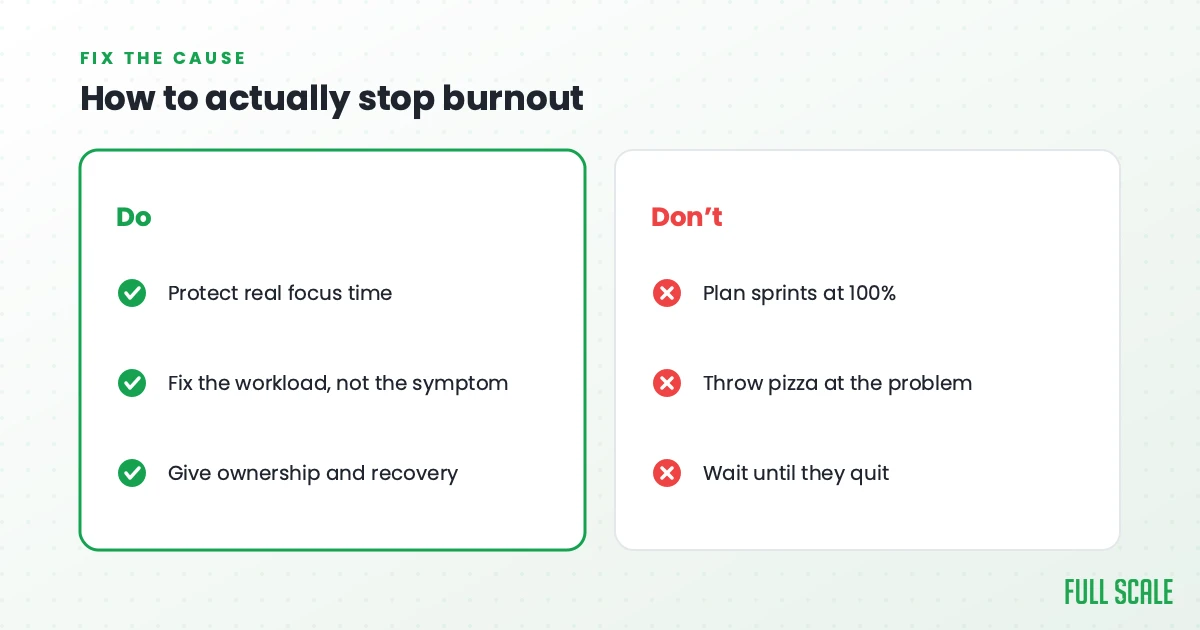
Reserve real time for the work that does not show up in the sprint goal: refactoring, testing, paying down technical debt, building internal tools, automating the painful parts of the deployment pipeline. The number you pick (15%, 20%, a Friday a week) matters less than the fact that you protect it. If you cannot sell that to your stakeholders, you have a different problem you need to solve first.
Tell People How They Are Doing
The simplest burnout-prevention move is also the one most leaders skip.
Run real one-on-ones. Sit down with each engineer every week or two and tell them specifically how they are doing, what they are doing well, where they could grow, and whether they are on track for the next step. Skip the “how’s it going” small talk and get into the actual feedback. Recognition is free, and most engineering leaders give it out at maybe a tenth of the rate their teams actually need. Those one-on-ones are also where mentoring your engineers actually happens, not in some formal program with a name.
At the company level, communicate constantly. Tell the team how the business is doing, who you closed, where you are losing, what the next quarter looks like. Engineers will fill silence with worst-case scenarios; the only way to prevent that is to crowd out the silence with real information.
Celebrate the Wins
Teams work hard. They invest months of nights and weekends into projects, and then they ship, and then the next sprint starts the next morning. After enough of that, even good teams start to feel like nothing they do gets noticed.
Stop and mark the win. Have a team lunch, take everybody out for a beer, or do a demo to the whole company where the engineers present what they built. Whatever fits your team will work. The point is that the team experiences the win as a win, not as another row in the burndown chart that has already been overwritten by the next thing.
I wrote more about this in Product Driven. The chapter on celebrating outcomes covers why this matters more than any of the bigger structural moves leaders usually reach for first.
How We Run This at Full Scale
We hold ourselves to a 93% year-over-year developer retention rate. The industry average for tech is closer to 75% to 80%, and we treat that 93% as the single best measure of whether our company culture is actually working. On a distributed team, that number is the clearest read you get on whether your remote team’s culture is real.
A few of the specifics. Our year-end party is a 400-person event where every employee brings their significant other. The summer party is even bigger, because employees bring their spouses and their kids. We sponsor a basketball team and a marathon. The point of all of it is to give our people a real community that exists outside of work, because the people who have one stay.
We also run community service projects in the Philippines every year. I have personally been to the islands to clean up trash on beaches, plant mangrove trees, and bring food and toys to school-aged kids on a remote island that does not get many visitors. Our engineers come with us. It is one of the parts of the job I am proudest of.
None of this is incidental to retention. Our clients trust us with their long-term engineering teams, which means they are counting on us to keep the engineer they hired in the chair for years, not months. Investing in our people in real and specific ways is the work behind that promise. If you want a closer look at how we structure the engagement, hire developers in the Philippines covers the model.
What to Do When an Engineer Is Already Burned Out
If you are reading this and recognizing one of your engineers, it is not too late, but it does require an actual response.
The first move is to take work off their plate. Reshuffling the sprint or optimizing their calendar does not count; the load has to actually come down. Pull them off the urgent stuff, even if it hurts. Other people can carry the urgent stuff. The engineer you are trying to keep cannot.
The second move is honesty in the one-on-one. Do not ask “are you okay.” Ask what specifically is making the work feel impossible right now, and listen without immediately offering solutions. Most burned-out engineers know exactly what is wrong. They have been telling you in smaller ways for months.
The third move is structural change. If you fix the immediate workload but do not fix the system that caused the burnout in the first place, the same engineer (or the next one) will be back in this place in six months. Real developer retention starts with making the environment one they want to stay in.
The Cost of Doing Nothing
You already know the answer here, but it is worth being specific.
When a senior engineer leaves, the bill comes in pieces, and most of them never show up on a budget line:
- Six to twelve months of lost velocity before a replacement is fully productive
- Institutional knowledge that was never written down, walking out the door
- Tens of thousands in recruiting fees, plus months of management time on the hiring process
- A morale hit on the engineers left behind, who are already wondering how long until it is their turn
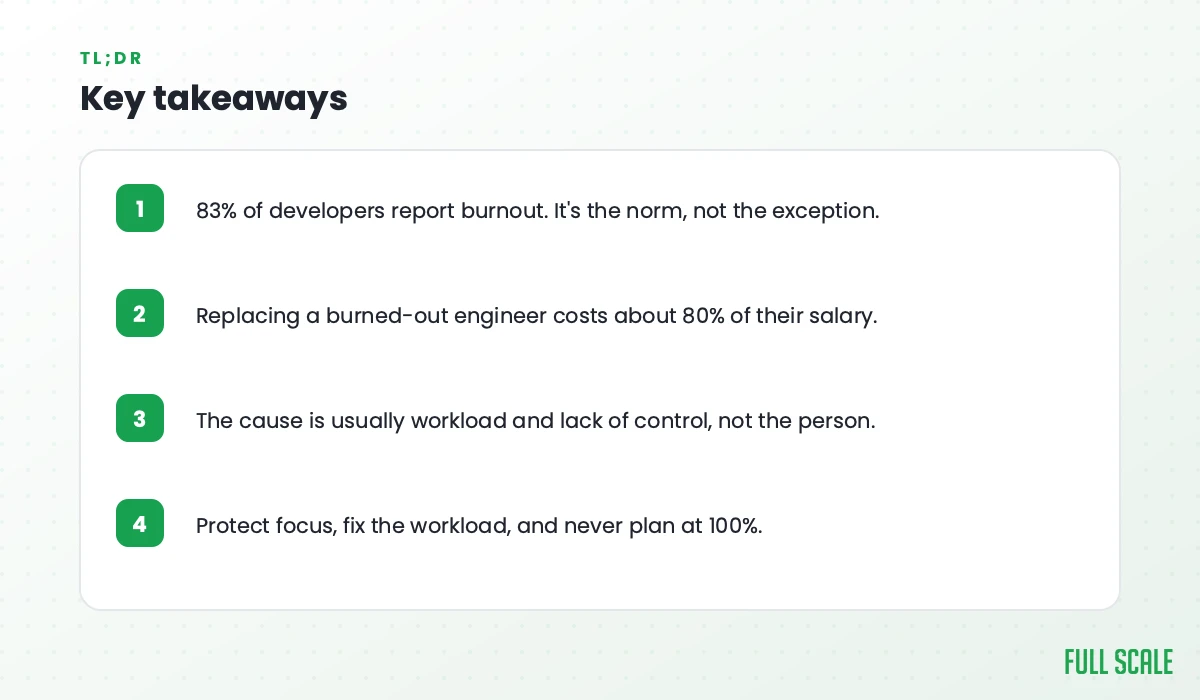
Gallup puts the cost of replacing a technical employee at around 80% of their annual salary, which is the visible portion. The bigger cost is the next two engineers who quietly start looking for the door after they watched their colleague leave.
Burnout prevention is one of the highest-impact things an engineering leader can spend time on. It pays for itself the first time it keeps a senior engineer in the chair.
FAQ
How long does it take an engineer to recover from burnout?
Recovery takes three to six months with real intervention. Lighter cases resolve in six to eight weeks once the workload comes down. Severe burnout (the kind that came with physical symptoms and months of mounting cynicism) needs four to six months and sometimes time off. The variable is whether the underlying conditions actually change. If the engineer comes back to the same workload and the same calendar, they do not recover. They relapse.
Is remote work making developer burnout worse?
Remote work can cut both ways. It removes commutes and gives engineers control over their environment, which helps. It also blurs the line between work and home, makes social isolation worse, and turns every interaction into a video call. Whether remote work prevents or accelerates burnout depends almost entirely on how the team is run. The remote-versus-office question is mostly a distraction from the actual problem.
What is the difference between developer burnout and just being stressed?
Stress is situational and recovers when the situation changes. Burnout is chronic and does not recover with rest alone. Stress can sometimes improve performance in short bursts. Burnout consistently degrades performance, creativity, and the engineer’s relationship with the work. If a long weekend used to fix it and now does not, you are looking at burnout.
Should I hire more engineers or use offshore developers to take the load off?
Both can work. Local hiring takes 60 to 90 days and costs $15,000 to $75,000 per hire, and the new engineer takes another six months to be fully productive. Outsourced software development services get you a productive engineer in two weeks at lower cost, and you keep your senior team focused on the work that actually requires deep context. The right answer depends on whether the pressure on your team is short-term project work or a long-term capacity problem.
How do you bring up burnout with a senior engineer without making it worse?
Do not make it about them. Make it about the work and the system. “I have noticed reviews have been quieter lately. What is getting in the way?” lands better than “are you burned out?” Most senior engineers will tell you exactly what is wrong if you ask the right question. The worst thing you can do is treat the conversation like a performance issue. The engineer is rarely the problem; the conditions they are working under almost always are.
Matt Watson is the CEO of Full Scale and a four-time tech founder. He co-founded VinSolutions (acquired) and Stackify, and has spent twenty years building, scaling, and sometimes burning out engineering teams. He writes about engineering leadership at productdriven.com.