Developer Turnover: Why Engineers Quit (and How to Stop It)

In this article
Quick Answer: Developer turnover is the rate at which software engineers leave a team, and US tech quits alone run 13 to 15% a year, according to the Bureau of Labor Statistics. Engineers mostly quit over career growth and management, and replacing one costs 50 to 200% of their salary plus the knowledge that walks out with them. Full Scale keeps about 93% of its engineers year over year by hiring them as full-time staff and giving each one room to grow.
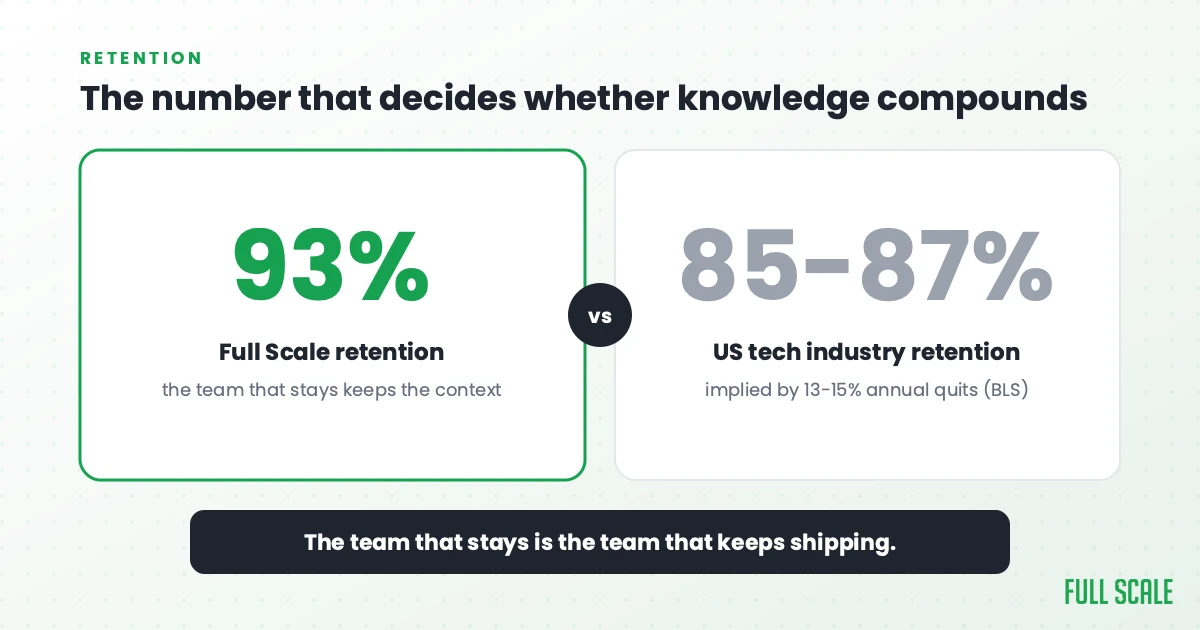
Software engineering runs some of the highest voluntary turnover of any white-collar job. US tech quits alone run 13 to 15% a year, according to the Bureau of Labor Statistics, and that number only counts the people who left on their own. At that rate, a team loses something like a quarter of itself every two years, one resignation letter at a time.
Most engineering leaders already know developer turnover is expensive. What most of them haven’t figured out yet is that AI just made it worse.
Why software engineers actually quit
Career growth is the single biggest reason software engineers quit, and it isn’t close. Work Institute’s research has found career development holds the number one spot in exit interviews for more than ten years running, and their 2025 Retention Report puts 75% of last year’s departures as preventable with better management. Engineers want to keep learning. Park someone on the same maintenance ticket for a year and they will start returning recruiter emails out of boredom alone.
Pay matters too, obviously, and bad management shows up in exit interviews far more often than any executive wants to admit. So does plain burnout: an engineer running at a sprint pace for two years straight quits the job before anyone notices they were drowning. Toxic culture and a lack of recognition round out the list, and none of it is exotic.
Most of the reasons people quit are the same five or six reasons they have always quit. Even when you fix every one of them, the labor market does not cooperate, especially for anyone actually good.
You can fire the worst developer you have, and like three days later, they just got a new job making more money.
I said a version of that line on the Developer on Fire podcast back in 2017, and it still holds up for strong engineers. Good developers, and honestly some mediocre ones, do not sit on the market long. You can build the best culture in the industry and still lose a senior engineer to a recruiter with a bigger number. Demand for real judgment never really goes away, even in a year when demand for junior typing speed has cooled.
What developer turnover actually costs
Replacing one software engineer costs 50 to 200% of their salary, and the invoice is the smaller part of the bill. Nobody budgets for a resignation, which is why it hurts more than the line items they do track.
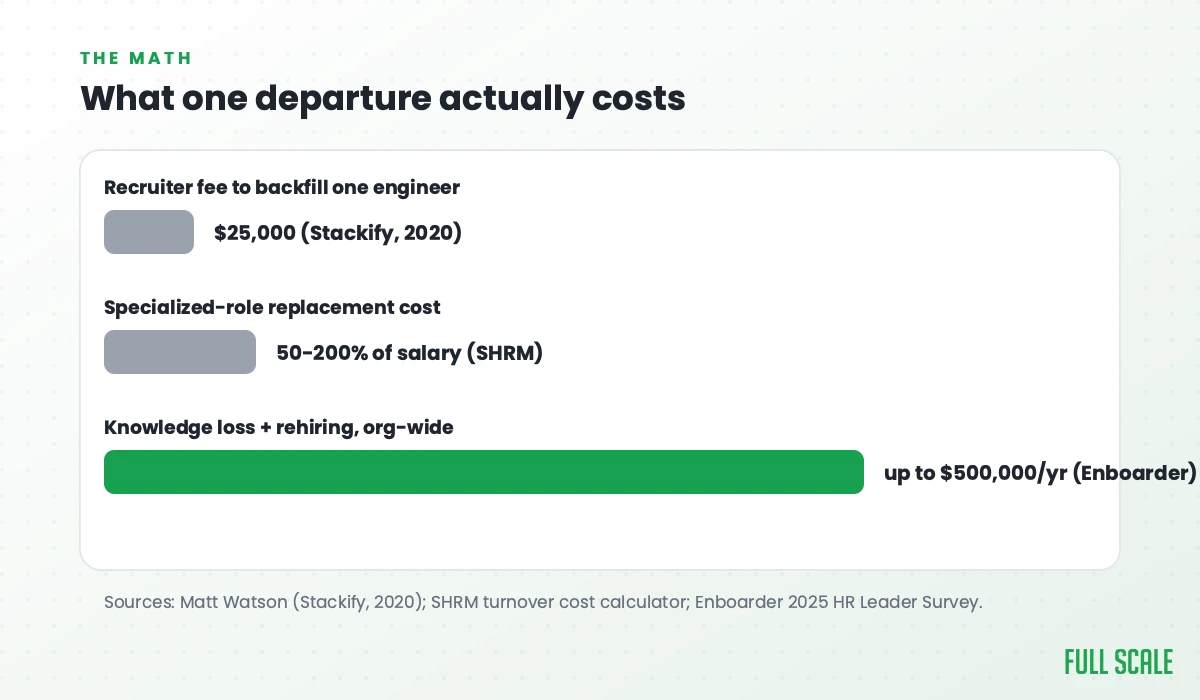
When I was running engineering at Stackify in 2020, one employee leaving cost us about $25,000. That accounted for the recruiter’s fee and the nearly three months the position sat vacant. That money was gone before the replacement even logged into the codebase. SHRM’s own research says it can cost 50 to 200% of a specialized technical employee’s salary to replace them. That’s lost recruiting time, ramp-up time, and lost productivity, spread over the following six to nine months. It’s the normal price of doing this poorly, not some rare worst case.
But costs associated with recruiter fees are the least of your worries.
The most painful cost is also the one that never appears on an invoice. It’s the lost knowledge that was in that engineer’s head. That knowledge is pretty invaluable. Whether it was knowledge of a vendor integration held together with duct tape, or a shortcut that only works until the end of the quarter, it’s all gone. The new employee starts from zero and will spend months closing a gap the last employee had already closed.
This is a problem that spans all industries, not just engineering. Enboarder’s 2025 HR leader survey found that 76.6% of respondents were concerned about institutional knowledge loss as the largest challenge companies face when employees leave.
Roughly 4 in 10 respondents quantified the impact: inconsistent offboarding, knowledge loss, security risk, and rehiring expense together can total up to $500,000 annually for their organization.
No one, however, accounts for that on the P&L, and it is often the most significant cost in the entire equation.
AI made developer turnover more expensive
AI makes developer turnover more expensive, because code is now cheap and the judgment a departing engineer carries is not. The obvious assumption is the opposite: that AI shrinks this whole problem. Give the replacement hire an AI assistant and, on paper, they should be closing tickets almost immediately.
The part that actually slows a team down was never how fast someone could type out a function.
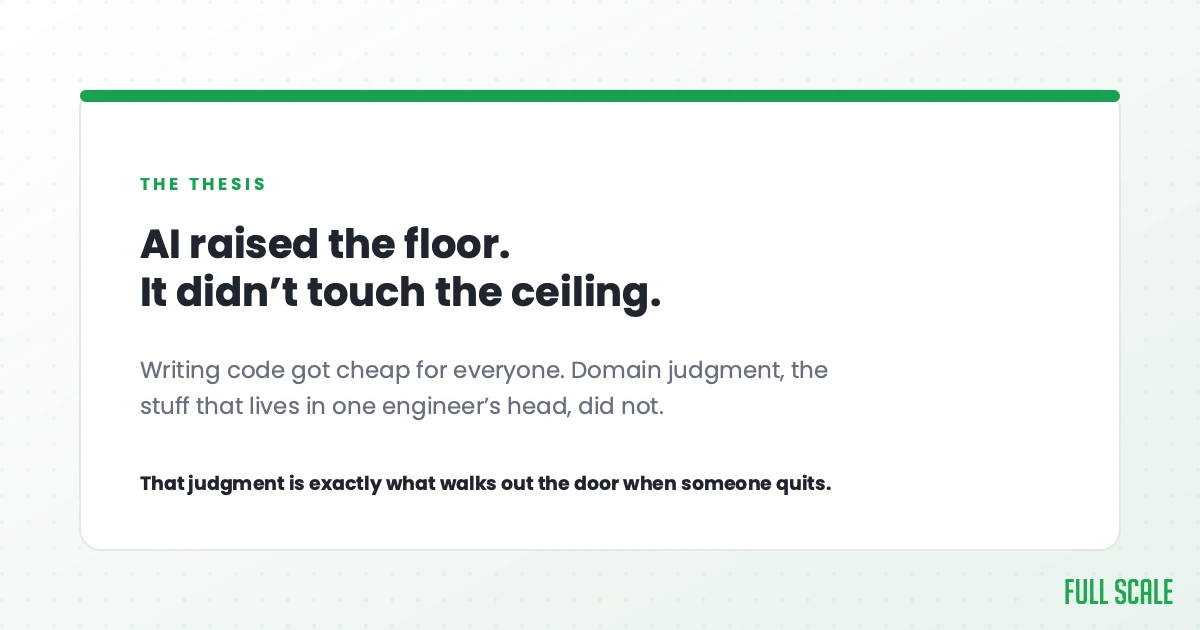
AI raised the floor. It didn’t touch the ceiling. Writing code got cheap and fast for everyone. The baseline skill engineers used to be measured on stopped being the differentiator. What decides whether the code is any good now is judgment. Judgment is built from a hundred small, unwritten calls: a client contract clause nobody wants to trigger, a release date the whole team quietly avoids, a module only one person is allowed to touch. That is domain knowledge, and it almost never lives anywhere but in someone’s head.
AI cannot write that down for you, because AI never learned it in the first place. Generated code shows up with no memory of the decisions, arguments, and compromises that got the real system to where it is, so there is nothing for a departing engineer to transfer that the AI already had. Load a brand-new hire up with every AI tool that exists. They can still walk straight past the reason a customer is about to leave, because nothing in that toolset ever taught them why the customer mattered. The tools just help them ship the wrong answer faster.
Verification is the scarce, human part of shipping now. The more code AI generates, the heavier that judgment layer gets, and judgment is exactly what a departing engineer takes with them.
What actually survives a resignation
Some will say the fix is obvious: point an AI agent at the codebase and the Slack history, and the knowledge is preserved automatically. That only works if the knowledge was written down somewhere for the agent to index. Most tribal knowledge never was. Nobody filed a ticket explaining the weird exception. It just lived in one engineer’s head, and an AI reading your Slack history cannot summarize a conversation that never happened.
One thing actually helps here, and it’s boring on purpose: get architecture decisions, the reasoning behind the weird workarounds, and the why-not-just-the-what out of people’s heads and into text somewhere a human or a model can find it later. Do that consistently and a resignation stops being a full reset. Whoever inherits the account gets a running start instead of a blank page, and so does whatever AI tool they’re pointed at. You still lose the judgment that walked out the door. You just don’t lose the paper trail that made that judgment possible to reconstruct.
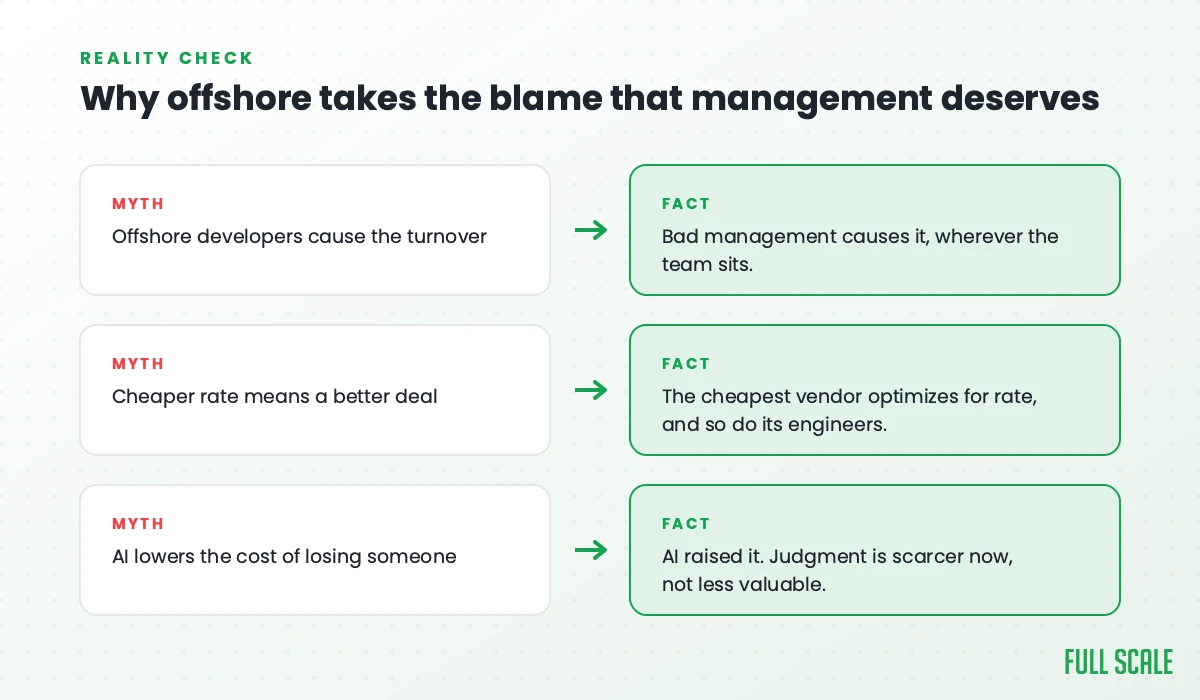
Why offshore takes the blame that management deserves
A lot of engineering leaders land on the wrong culprit and blame offshore itself. I’ve personally hired in Uruguay, Colombia, Russia, and the Philippines, and in every one of those engagements, the developers who left weren’t chasing a bigger paycheck somewhere else. They were reacting to how badly, or how well, they’d been folded into the actual team.
There’s a name for what breaks these engagements, and I coined it because I kept seeing the same mistake: cheapshoring. A vendor mirrors whatever its client optimizes for. Optimize for the lowest possible rate and you get a vendor optimized to hit that rate, which means the engineers on the account get run like inventory instead of people worth keeping around.
Distance makes ordinary turnover worse for a real reason. The Philippine BPO industry runs annual attrition around 30%, because people with no real stake in the client’s product leave for an extra dollar an hour the moment someone offers it.
Even with good management, you still lose something real: the hallway conversation where an engineer half-explains a weird decision never happens on a distributed team. Writing things down matters even more when nobody is around to overhear it.
It’s a management problem wearing a passport.
How to actually reduce developer turnover
Reducing developer turnover comes down to three habits, and the full playbook lives in its own post:
- Make it a real job, not a gig, so people have a reason to care about next quarter.
- Ask how the work is actually going on a schedule, not just after something breaks.
- Rotate people onto new problems on purpose before they get restless on the old one.
Do that consistently and it works. Full Scale’s own developer retention runs about 93%, meaning 93 of every 100 people we employ are still on staff a year later. Which client account someone sits on can shift as a client’s own needs change, but as long as a client wants to keep a developer and that developer hasn’t resigned, they stay put. The number that matters here is whether the person leaves the company at all, and that’s exactly what 93% measures. Look at our work with AMC Theatres and you can see it play out: the same engineers have been on that account long enough that AMC just calls them their team.
None of that knowledge has to leave if the person doesn’t leave. I wrote up the full playbook, the five specific things that get retention to 93% and where the model breaks down, in how we keep developer retention at 93%. If you’re past the diagnosis and ready for the fix, that’s where to go next.
Frequently asked questions
Why do software engineers quit?
The highest cited reason is career stagnation, which has been the number one reason for more than a decade. Compensation, poor management, burnout, and toxic work culture are also significant, and most of it can be resolved with adequate management.
What is the average developer turnover rate?
The average developer turnover rate in US tech is 13 to 15% a year, according to the Bureau of Labor Statistics, and that counts only people who left on their own. Work Institute’s retention research puts 75% of departures as preventable with better management. At Full Scale, about 93% of the engineers we employ are still on staff a year later.
How do you calculate the cost of developer turnover?
Include the recruiter or agency fee. Add the salary lost while the role sits vacant for weeks or months, plus the lost productivity of the new hire while they’re still ramping up. Technical roles, on average, can cost 50 to 200% of the departing employee’s salary for these reasons, and that doesn’t even account for the institutional knowledge the employee takes with them.
Does AI make developer turnover better or worse?
It gets worse, because AI makes code cheap for every task and so raises the value of the judgment only experienced engineers hold. That judgment walks out the door with them, and AI cannot replace it, since it was never written down for the AI to learn.
How can companies reduce developer turnover?
Give engineers long-term value: competitive pay, real room to grow, and a way to resolve dissatisfaction before it turns into a resignation. Managing turnover is a business discipline, not an employee perk, and it works the same whether the team sits down the hall or across the globe.
If you are tired of re-explaining your product to a new hire every few months, let’s talk about what a team that actually stays would look like.