
Startup Mistakes to Avoid After Getting Funded: Why Hiring Fast Is the One That Kills You

In this article
You closed the round. The wire hit. Everybody on Slack is posting the rocket emoji.
Here is the part nobody warns you about: the startup mistakes to avoid after getting funded are more dangerous than the ones you made before the money showed up. When you were broke, your constraints made your decisions for you. Now you have a bank account that says yes to almost anything, and the discipline that kept you alive has to come from you instead.
I have raised money and I have bootstrapped. I co-founded VinSolutions and grew it to $35 million in annual recurring revenue with no outside funding before it sold, then I started Stackify with venture money behind it. I have watched what happens when a founder treats a funding round like a finish line. It is almost always the same story.
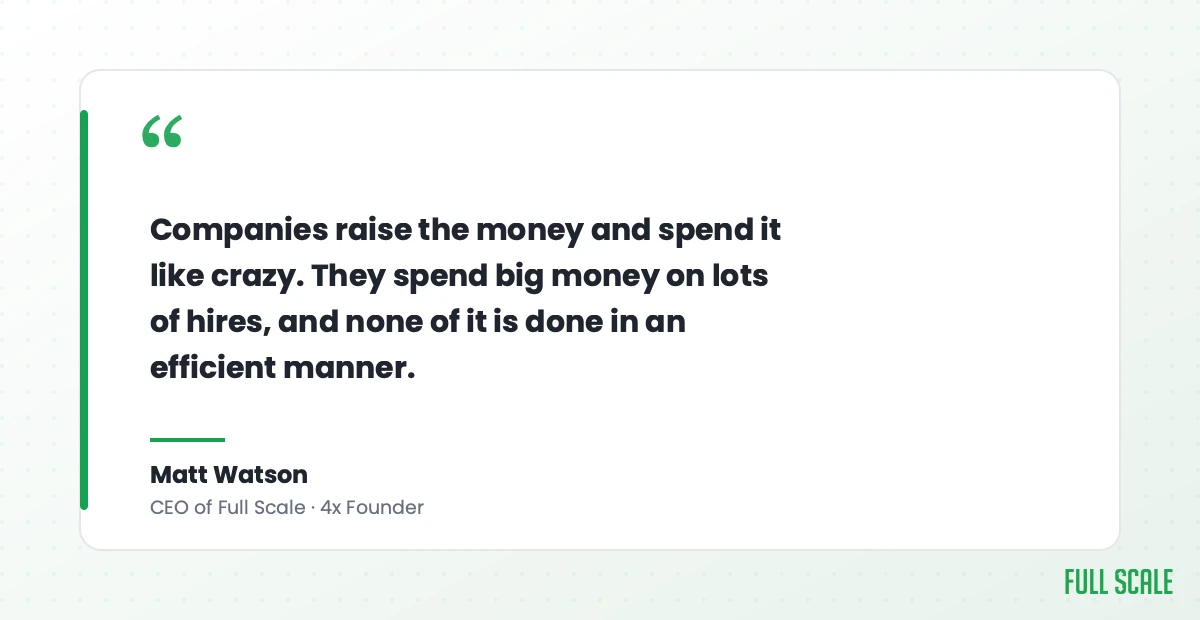
“Companies raise the money and spend it like crazy. They spend big money on lots of hires, and none of it is done in an efficient manner. You end up with whole teams that don’t even know what they’re doing.”
I learned this funding one of my own companies. When the money was mine, it was easier to keep writing checks than to face the hard problems and make the hard calls. The cash let me put off decisions that being broke would have forced on me that same week. Scarcity creates urgency, and the money quietly takes that edge away.
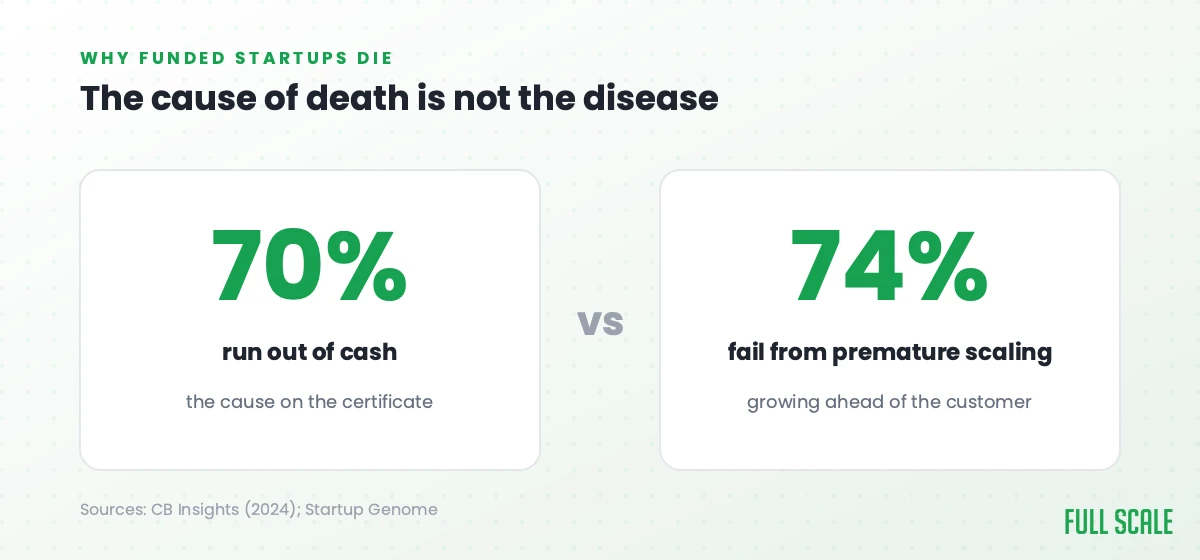
Running out of cash is how startups die. The often-cited CB Insights analysis of failed startups puts “ran out of money” at the top of the list at around 70%. But that is the cause of death on the certificate, not the disease. The disease is spending ahead of what you have actually proven. And the fastest way to do that is to hire too many people, too soon.
Quick Answer: The most expensive mistake after getting funded is hiring too fast, filling an org chart you imagined at scale instead of the work actually in front of you. The fix is to hire for validated demand, not a forecast, and use staff augmentation to add senior engineering capacity you can flex up or down instead of committing the round to permanent local headcount. The other common mistakes (spending before you've proven demand, losing track of burn, vanity spending, and going quiet on customers) all trace back to the same root cause: spending like the money removes the need for discipline instead of raising the bar for it.
The mistake that drives all the others: hiring too fast
Every other money mistake on this list is smaller than this one, so I am putting it first.
The day after a raise, the pressure to hire is enormous. Your investors want to see you “deploy capital.” Your roadmap suddenly looks achievable if you just had more engineers. So you post ten roles, hire recruiters, and start filling seats. Six months later you have a team of thirty people and no one is sure who owns what.
The expensive part is not that some of those hires are bad. It is that the whole structure is inefficient before anyone writes a line of code.
I have a friend who scaled an offshore team to sixteen developers in Pakistan, convinced that more bodies would fix his delivery problems. It did not. The gap was never headcount. The gap was leadership and process, and you cannot hire your way out of that. You just make the chaos more expensive.
The graveyard is full of well-funded companies that learned this the hard way:
- Fast, the one-click checkout startup, raised about $124.5 million over three years. Its 2021 revenue was still in the low six figures while it burned through cash on a big team and, according to former employees, spending some described as frivolous. It shut down in April 2022, roughly a year after its biggest round.
- Bolt, another checkout company, raised a $355 million round in early 2022 at an $11 billion valuation. After a hiring boom and repeated layoffs, it runs on roughly 100 people today and has shed about 97% of its value. The CEO later blamed a sense of “entitlement” that festered while the company was flush, with people who “felt entitled but weren’t actually working hard.”
- Convoy, the freight startup backed by Jeff Bezos, raised more than $1 billion and was valued at $3.8 billion just 18 months before it closed. It had grown to about 1,500 employees, cut back to 500, and still ran out of road. Its assets sold for $16 million.
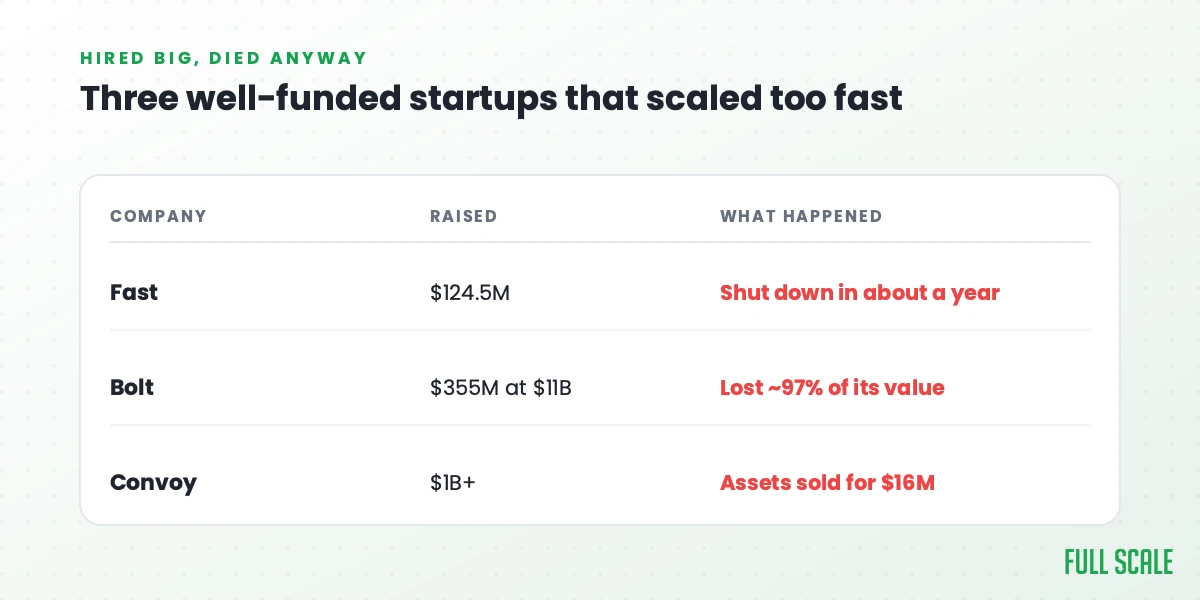
None of these companies failed because they could not raise money. They failed because raising money let them scale a team faster than they scaled a real, validated business. The headcount was not a side effect of the trouble. It was the trouble.
Hiring is also the most expensive mistake to unwind. You can kill a marketing campaign tomorrow. A wrong senior engineer costs you their salary, their benefits, three to six months of ramp, the severance when it ends, and the weeks of confusion while everyone figures out who actually owns what now. Multiply that by a team you hired in a hurry and you have burned a real chunk of the round before you have shipped anything people want.
There is a fair counter-argument here. In a true land-grab market, moving fast and hiring ahead of the curve can be the right call. I am not telling you to crawl. But the line that matters is not fast versus slow. It is validated versus unvalidated. Scaling fast to meet demand you have already proven is aggressive and smart. Doing the same thing on demand you are only hoping for is just expensive guesswork.
The often-cited Startup Genome research, drawn from thousands of high-growth startups, found that 74% of them fail from premature scaling, growing the team or the spend ahead of the customer. So before you open ten roles, ask the boring question: what have we actually proven that these hires are for? If the honest answer is a forecast instead of real demand, you are not scaling. You are gambling with a bigger stack.
Spending before you have proven anyone wants this
This next one is a cousin of the first: pouring the money into building and promoting something the market has not asked for yet.
At Stackify we once spent $10,000 sponsoring a developer conference for a big product launch. We got zero new customers from it. The product idea simply did not resonate, and no amount of marketing budget was going to change that. The money did not fix the problem because we never had a money problem in the first place.
Demand, not code, is the difference between a product that works and one that quietly dies.
I see this every day at Full Scale Ventures, our studio. We have built products with the same team and the same tools where one got polite “sounds good” feedback and nobody used it, and another had people calling back asking when it would ship. Funding makes it dangerously easy to skip the step where you find out which one you have. You feel productive because you are spending, and spending feels like progress when it is really just motion.
Mark Roberge, HubSpot’s first chief revenue officer and the author of The Science of Scaling, made this point when he came on my podcast: the classic founder error is overestimating demand and scaling before you have nailed product-market fit. The money just lets you make that error at a larger scale.
The rest of the post-funding mistakes
Hiring too fast and spending ahead of demand are the big ones. These four show up right behind them, and the new capital makes each one easier to commit.
Losing your grip on burn and runway. When you were bootstrapping, you knew your runway to the dollar. After a raise, founders stop watching the number until it is suddenly small again. At Stackify our Azure bill once ran past a million dollars a year, and the only reason that number never sank us is that we watched it like a hawk. Know your monthly burn, know how many months it buys, and treat a shrinking runway as the emergency it is, not a problem for next quarter.
No clear goals for the money. Capital with no plan attached gets spent on whatever feels urgent that week. Before you spend, write down what this money is supposed to buy: which milestones, which metrics, what “working” looks like. If you cannot say what a hire or a campaign is supposed to move, you are not ready to fund it.
Vanity spending. The fancy office, the rebrand, the celebrity endorsement. Fast chased celebrity endorsements while its revenue stayed in the six figures. None of that buys you a business. It buys you the appearance of one, which is worse, because it fools you too.
Going quiet on customers. Funded founders get busy scaling and stop talking to the people who actually pay them. Those conversations were your edge when you were small. Do not trade them for a bigger pipeline you have not validated.
The fix: spend the money smarter
Here is the part that sounds boring and is actually the whole game. Slow and steady, even with money in the bank.
When I ran VinSolutions, we grew to $35 million in ARR and a nine-figure exit without ever taking outside money. That forced a kind of discipline: every hire and every dollar had to earn its place because there was no cushion. You do not lose that discipline when you raise. You choose to keep it. The founders who win after a round are the ones who still spend like they are about to run out.
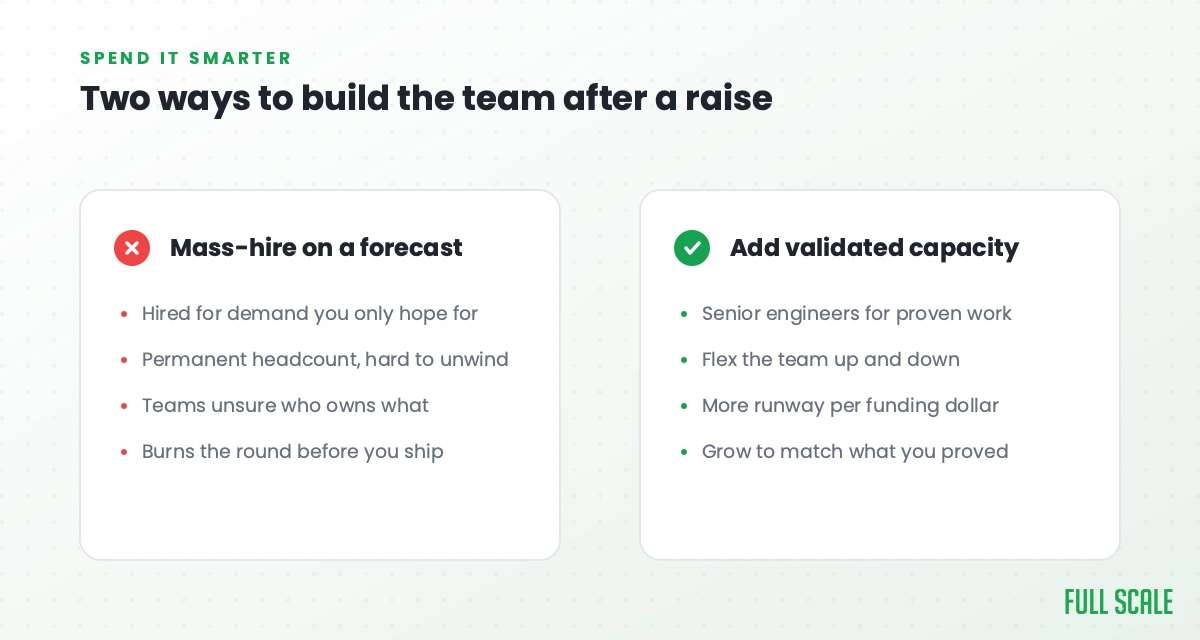
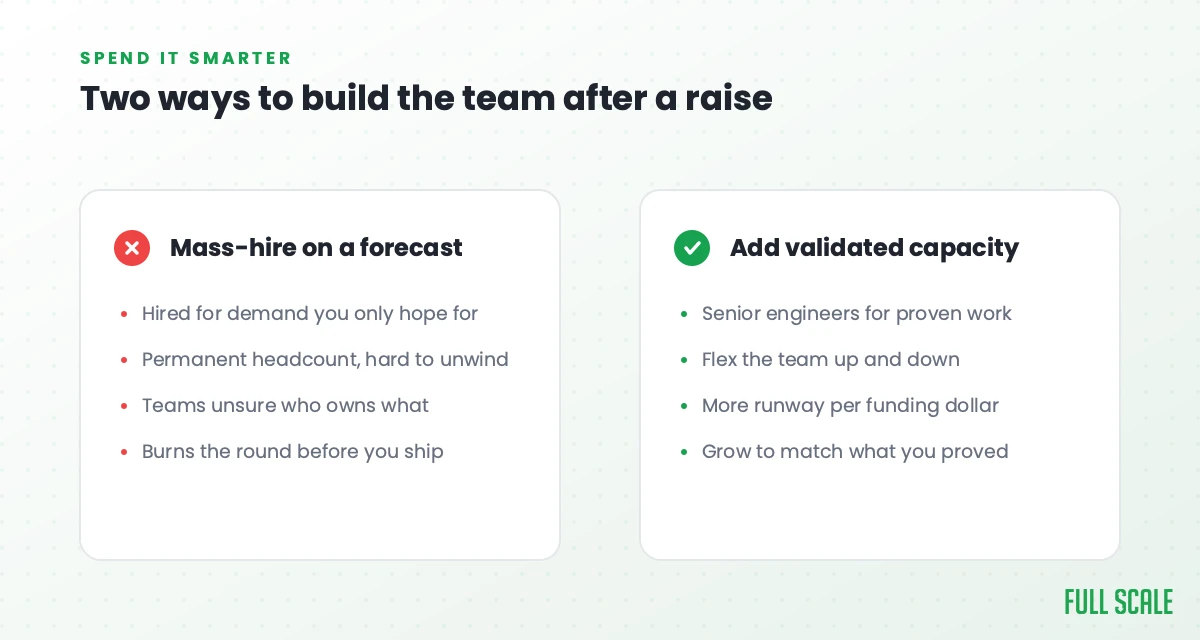
A lot of that discipline comes down to how you build the team. Most founders think they have two options after a raise: hire full-time senior engineers locally, which is slow and very expensive, or hire the cheapest developers they can find, which usually ends badly. The cheap route is its own trap. I call it cheapshoring, hiring on price alone, and it costs more than it saves every time.
There is a third option, and it is built for exactly this moment.
Staff augmentation lets you add the specific engineering capacity you have validated a need for, without committing to a permanent headcount you might not need in a year.
The point is capital efficiency, not cheaper bodies. It gives you option one’s senior quality without option one’s permanent commitment. You bring on senior developers for the work that is actually in front of you, you flex the team up when demand is proven and down when it is not, and the same funding dollars buy you more runway than a wall of full-time local salaries would. At Full Scale we have done this for more than 200 companies since 2018, placing senior engineers from the Philippines at a fully loaded rate around $35 an hour with retention above 93%. The point is not the rate. The point is that you grow the team to match the business you have proven, not the org chart you are imagining at scale.
That is the difference between deploying capital and burning it.
If you want the longer version of how to think about engineering spend before and after a raise, I wrote about building a SaaS company without burning your runway and about funding resources for tech startups. And the philosophy underneath all of it, building product-driven instead of just shipping faster, is in my book Product Driven.
Frequently asked questions
How fast should a startup hire after getting funded?
As fast as your validated demand justifies, and no faster. The mistake is treating the round as a mandate to fill an org chart you imagined at scale. Hire for the work that is actually in front of you, prove it is working, then add the next role. Speed that chases demand you have proven is fine. Speed that chases demand you are hoping for is how you burn the round.
How much of a seed round should go to engineering salaries?
There is no clean percentage, because it depends on what you have proven. The better question is whether each engineering dollar maps to a validated need or a forecast. A wrong full-time senior hire is one of the most expensive and hardest things to unwind in an early company, so the safer move is to add capacity you can flex up and down rather than committing the round to permanent headcount before product-market fit is real.
What is premature scaling?
Premature scaling is growing your team or your spend ahead of your customers, before you have proven people actually want what you are building. The often-cited Startup Genome research found it is behind roughly 74% of high-growth startup failures. The simplest self-check: if your hiring plan is justified by a forecast instead of real demand, you are probably scaling prematurely.
Is staff augmentation a good fit for a funded startup?
It often is, because it solves the exact problem a fresh round creates. Staff augmentation lets you add senior engineering capacity for validated work without locking in permanent local headcount, so the same funding buys more runway and you can flex the team up or down as demand becomes clear. The point is capital efficiency, not hiring the cheapest developers you can find, which is its own trap.
Funded is the start line, not the finish
The raise is not the achievement. It is the fuel, and the clock on proving your business just started ticking faster. The startup mistakes to avoid after getting funded almost all trace back to one habit: spending ahead of what you have proven, with hiring too fast leading the way.
The companies that survive are not the ones that raised the most. They are the ones that spent the round like they had to earn it twice.
If your next move is scaling the engineering team and you would rather do it efficiently than burn the round on it, let’s talk about what that looks like.