Dedicated Development Team: The 2026 Hiring, Cost, and Onboarding Guide

In this article
- What a dedicated development team actually is
- Is a dedicated team different from staff augmentation?
- When a dedicated team is the right call, and when it isn’t
- How a dedicated team compares to other engagement models
- Who’s on a dedicated development team
- What a dedicated development team actually costs
- How to hire a dedicated development team
- How AI tooling changed the dedicated team calculation in 2026
- Making the partnership work for the long haul
- Red flags when evaluating a dedicated team provider
- A real example: what this looks like for a Full Scale client
- FAQ
- The takeaway
Most teams that come to Full Scale for a dedicated development team already tried hiring locally first. They posted the role and waited 90 days for two candidates to surface, lost the better one to a competing offer, and discovered the other was a stretch hire who didn’t quite get there. Meanwhile the roadmap kept moving, the board kept asking when the new feature was going to ship, and the math of waiting another quarter for the next two hires stopped working. So they started looking at offshore dedicated teams, and they ran into the same SERP everyone else does: a stack of guides that all say roughly the same things, which is why I wrote how the offshore development models compare in roughly the same words, and none of them actually answer the question the buyer is asking.
Picking a dedicated team is one piece of a larger set of offshore development best practices that also covers vendor vetting, IP assignment, and the background-check infrastructure you’ll need.
This is the version I wish I had when I was hiring my first dedicated team at Stackify in 2018, and the version I’d hand a new Full Scale client today. Building software requires building a long-term team. The dedicated team model is one of the most useful staffing decisions you can make if you understand where it fits and where it doesn’t, and there is more nuance than the standard SEO guides will admit.
What a dedicated development team actually is
A dedicated development team is a small group of engineers, hired through a vendor, who work full-time and long-term on your product under your direction. The vendor handles the employment relationship, payroll, benefits, and HR. You handle the work. The team sits in your standups, ships in your sprints, and stays with your product the way employees would. The extended team approach is the same vendor relationship with a different team structure, where one to three engineers are added to your existing team instead of forming a self-contained unit. An offshore development center is the bigger version of the same relationship, where the partner also carries facilities and infrastructure.
That’s it. Strip away the marketing language across the SERP and that is the whole model.
A few things a dedicated team is not. It isn’t a freelance pool that bills hourly for whatever work you toss at it. It also isn’t a project shop selling you a fixed-bid deliverable, or a staffing agency placing one resume at a time and walking away. And it isn’t a managed-service contract where the vendor owns the outcome and hands you deliverables. The vendor in a dedicated team relationship handles the people. You handle the product. That model applies across every stack in your engineering org: whether you’re building in React, Node.js, or hiring Vue.js developers for your frontend, the dedicated team structure is what creates continuity.
The reason this matters is that the failure modes for each of those other models are different from the failure modes for dedicated teams. If you treat the people on your dedicated team like a freelance pool, the relationship will fail. If you treat them like a vendor who owes you a deliverable, the relationship will also fail. The model only works when you treat the people on the team like the rest of your engineers, because functionally, that is what they are.
Is a dedicated team different from staff augmentation?
Short answer: no.
I get this question on almost every sales call. There is a whole cottage industry of blog posts trying to draw a careful distinction between “staff augmentation” and “dedicated development teams,” and most of it is marketing. The model underneath the labels is the same. It is the same. Just more than one person.
Where the terms diverge is in framing, not function. “Staff augmentation” tends to mean an individual contributor filling a specific role on an existing team. “Dedicated team” tends to mean a wrapped unit that comes with its own tech lead, sometimes a project manager, sometimes a QA lead. Vendors who sell to engineering leaders who already have a CTO and a tech lead usually use the staff augmentation language. Vendors who sell to non-technical founders and product leaders who want a unit that runs its own ceremonies usually use the dedicated team language. Most vendors, including Full Scale, do both. We call it whichever name the client uses.
The naming question matters less than the question underneath it: are you trying to ship one bounded deliverable, or are you building something you’re going to keep building for years? If it’s the second one, you want a long-term team, and whether that team gets labeled staff augmentation, dedicated team, outstaffing, or team augmentation is a vocabulary choice. Pick the vendor based on what they actually do, not the noun they put on their service page. The structural call that actually changes the engagement is extended team vs dedicated team, which comes down to whether you need a small set of engineers added to your existing team or a self-contained unit standing up alongside it.
When a dedicated team is the right call, and when it isn’t
Most of the guides ranking for this keyword skip the second half of that sentence. Here are both halves.
A dedicated team is the right call when:
- You’re building a product, not a deliverable. The code is going to keep getting changed for years. Institutional knowledge has to live with the team that builds it.
- Your roadmap shifts quarter to quarter, sometimes month to month. Fixed-bid contracts can’t accommodate that. A dedicated team can.
- Local hiring can’t keep up with growth. This is the most common trigger I see. A buyer tried to hire two engineers locally, got nowhere in 90 days, and finally accepted that the local market wasn’t going to deliver the headcount fast enough.
- You have engineering leadership in-house but not enough engineering capacity. A CTO, a VP Eng, or a founder with technical chops. Someone on your side directing the work. The dedicated team supplies the hands.
- You want the option to keep the team indefinitely. No handoff, no scope close-out, no contract renewal stress.
A dedicated team is the wrong call when:
- The work is truly bounded and short-term. A marketing site rebuild. A one-off Salesforce integration. A WordPress launch. When the Salesforce work is the opposite, a multi-year org running sales, service, and marketing, companies hire dedicated Salesforce engineers instead, because the accumulated org context pays back faster than another project-shop engagement. I have outsourced both WordPress builds and an Elasticsearch project personally, because in those cases it didn’t make sense to staff up. Use a project shop, not a dedicated team.
- The build is regulated and requires every engineer to be on-site with clearances. Some defense work, some healthcare work, some financial work. The model doesn’t fit.
- You have no engineering leadership and no plan to hire any. Without somebody on your side directing the work, the team ends up going in whatever direction looks most reasonable from the outside, and that’s almost never the direction you wanted.
- You don’t actually care about long-term ownership. If you’re going to lose interest in six months, the team will lose context, and the relationship will fray. Project shops handle that case better.
- Your real problem is product clarity, not capacity. Throwing more developers at unclear requirements burns the budget the same as throwing employees at it. You don’t need rockstar developers. You need rockstar requirements.
Most healthy engineering orgs end up running a mix. Some senior employees in-house for architecture, stakeholder management, and the most strategic product work. A dedicated team supplying ongoing build capacity at a fraction of the in-house cost. The occasional project shop for bounded specialty needs. The “pick one model and live with it forever” framing in most SERP articles is fiction.
How a dedicated team compares to other engagement models
Here is the comparison table the rest of the SERP refuses to put on the page.
| In-house hiring | Dedicated team | Staff augmentation | Project outsourcing (fixed bid) | Time & materials | Freelancer marketplace | |
|---|---|---|---|---|---|---|
| Who controls the work | You | You | You | The vendor | Mostly you | You, loosely |
| What you’re buying | Employees | A team | Individual roles | A deliverable | Hours | A profile |
| Cost model | Salary + benefits | Monthly per developer | Monthly per developer | Fixed bid | Hourly | Hourly |
| Best for | Strategic roles | Long-term product | Filling specific gaps | Bounded scope | Scope-fluid project work | One-off tasks |
| Knowledge retention | High | High | High | Low | Medium | Low |
| Onboarding time | 45 to 90 days | 2 to 3 weeks | 2 to 3 weeks | Vendor-side | Days | Days |
| Replaceability | Hard | Easy | Easy | N/A | Easy | Easy |
| Typical contract | At-will employment | Month to month | Month to month | Project SOW | Open hourly | Per task |
A dedicated team versus a fixed-bid project are solving different problems. Project outsourcing buys you a finished deliverable, while a dedicated team rents you a team that keeps building your deliverables over time. The software development SOW that governs project outsourcing is built around a fixed end state, which is why it works for a marketing site but tends to break for an evolving product. If you have a finite list of features and a real deadline and you don’t intend to develop the product after launch, a fixed bid might be the right tool. If you have a roadmap that keeps growing, a fixed bid will burn you on scope churn, and you’ll end up either rebuilding it or hiring a long-term team to take it over. I have seen the second outcome more times than the first.
A dedicated team versus a freelancer marketplace like Toptal, Turing, or Andela: those are marketplaces; we’re operators. A marketplace sends you a profile from a global pool of independent contractors. A vendor like Full Scale employs the developers, vets them in-house, and provides a team that already works together. Different model, different vetting, different management overhead. Marketplaces work fine for short engagements with a single contributor. The dedicated team model exists because most product work doesn’t fit that shape.
The pre-offshore horror stories I heard early in my career, the language barriers, the late-night meetings, the rewriting all the code anyway, were almost all stories about project outsourcing, not stories about dedicated teams done right. The model matters more than people give it credit for.
Who’s on a dedicated development team
The honest answer is: it depends on the work. Here are two staffing recipes I see most often.
The 5-person MVP team. When you’re building a new product or vertical from scratch and you have a product owner on your side directing the work:
- 1 tech lead
- 3 mid to senior full-stack developers
- 1 QA engineer
This team can ship a working MVP in 8 to 12 weeks for most web product categories, and it scales smoothly into a longer build if you keep the team in place.
The 8-person scaling team. When you have an existing product and you’re adding capacity to ship faster:
- 1 tech lead
- 2 senior backend developers
- 2 senior frontend developers
- 1 mobile developer (if you have native apps)
- 1 QA engineer
- 1 DevOps engineer
That team can run two parallel feature workstreams plus carry the deploy pipeline and incident response.
On project managers: if you have a competent product owner on your side, you don’t need a second PM on the dedicated team. Pay for one or the other, not both. Where I see overhead creep in is when the buyer wants the vendor to handle product direction too, which is when the dedicated team model starts shading into project outsourcing and the failure modes change. Keep product direction on your side. That’s the point.
On architecture: most dedicated teams should not include a software architect as a separate role. The tech lead does architecture work alongside the build, the same way they would in a healthy in-house team. If you actually need a dedicated architect on top of a tech lead, your scope is probably too big for a 5 to 8 person team, and you should be staffing two teams instead.
What a dedicated development team actually costs
Most guides on this topic say “depends” and link to a regional rate chart. That is not useful when you’re trying to write a budget. Here are the real numbers from operating Full Scale across hundreds of engagements.
Monthly all-in rates per developer:
| Role | Philippines | US (base salary only) | US (true cost including benefits and overhead) |
|---|---|---|---|
| Junior developer | $2,500 to $3,500 | $7,000 to $9,000 | $9,500 to $12,500 |
| Mid-level developer | $3,500 to $5,000 | $9,500 to $13,000 | $13,000 to $18,000 |
| Senior developer (7+ years) | $4,000 to $6,000 | $12,000 to $18,000 | $16,500 to $25,000 |
| Tech lead | $5,500 to $7,500 | $15,000 to $22,000 | $20,500 to $30,500 |
| QA engineer | $2,500 to $4,000 | $7,500 to $11,000 | $10,500 to $15,500 |
| DevOps engineer | $4,500 to $6,500 | $13,000 to $18,000 | $17,500 to $25,000 |
Monthly burn for a complete team:
A 5-person Philippines team (1 tech lead, 3 mid-to-senior developers, 1 QA): roughly $25,000 to $35,000 per month. The same team hired in-house in the US, on a true-cost basis including benefits, recruiting, equipment, and HR overhead: $80,000 to $110,000 per month.
That’s the 50 to 80 percent cost reduction you’ve seen quoted. It isn’t a quality dynamic, it’s a labor market dynamic. The cost of living in Cebu is not the cost of living in San Francisco, and that shows up in salaries. The developers themselves are senior engineers with 7+ years of experience on average. Our developer retention is over 93 percent, which means the team you hire is the team you keep, and the institutional knowledge stays.
A few things that move the price up or down. A specialty stack (think embedded systems, ML infrastructure, certain enterprise platforms) costs more because the talent pool is smaller. A seniority-heavy team costs more than a balanced one. Time zone coverage requirements affect it: if you need genuine 24-hour on-call, you pay for it. Month-to-month contracts come at a small premium over annual commitments, and that flexibility is usually worth what it costs.
What it doesn’t include and shouldn’t surprise you on: software licenses, cloud infrastructure, third-party services, and anything specific to your product. The dedicated team is the people. The product budget is yours.
How to hire a dedicated development team
There’s a standard sales pitch for this section that goes “we have a 3-phase process and our QuickStart program gets you live in 14 days.” I want to give you something more useful.
Phase 1: Define the team before you contact a vendor. Most engagements that go sideways were under-specified upfront. Before you take a single sales call, write down the tech stack, the seniority mix you want, the time zone coverage you need, and the success metrics you’ll use in the first 90 days. Be specific. “We need a senior Ruby on Rails developer who can also work in React, ideally with Postgres scaling experience, working US morning hours, and we’ll judge success by their PRs merged and their participation in design conversations.” That sentence will protect you from three different categories of vendor surprise. The same playbook applies whether you are staffing a React pod, a Python data team, or going to hire a dedicated Ruby on Rails team for a SaaS build.
Phase 2: Vet the vendor, then vet the developers. The most common buyer mistake I see is reversing this order. Asking developer interview questions before you understand the vendor is putting effort in the wrong place. Vet the vendor first: ask their retention rate, ask to talk to two existing clients without vendor staff on the call, ask what their replacement policy is when a developer isn’t working out, and ask for a sample MSA so you can read the IP assignment language. If any of those answers are evasive, stop. Once you’ve cleared the vendor, interview the actual developers the same way you’d interview any senior hire.
Phase 3: Onboard the team in 30 days. Here’s the playbook the SERP doesn’t give you. That sprint is the front end of a longer developer onboarding process that really runs about ninety days.
| Time | Milestone |
|---|---|
| Day 1 | Accounts created (GitHub, Slack, Linear or Jira, Figma, prod monitoring). Intros on a real call with your team. Repo access. First standup attended. |
| Day 3 | First codebase walkthrough complete. First small PR opened against an internal style guide or test fix. |
| Week 1 | First merged PR shipped to production behind a feature flag. Team is in standups, in retros, in code review rotations. |
| Week 2 | Full sprint participation. Each developer owns at least one ticket on the active sprint. Tech lead is participating in roadmap discussions. |
| Week 4 | First fully-owned feature in production. The team has run a retro on their own onboarding and surfaced friction. Your engineering leader and the tech lead have a recurring 1:1. |
If you’re past week 4 and the team hasn’t shipped something they own end-to-end, the onboarding failed. Diagnose it before the burn rate makes the conversation harder.
Local hiring for a senior engineering role averages over 40 days from job posting to start date according to LinkedIn talent solutions data. A working dedicated team relationship gets you to the same place in 2 to 3 weeks. That speed advantage is most of why people make the call.
How AI tooling changed the dedicated team calculation in 2026
The competitor articles ranking for this keyword don’t mention AI once. In May 2026, that’s malpractice. I dig into those shifts in this piece on the latest offshore software development trends.
Cursor, Claude Code, and the rest of the AI-augmented developer toolkit have raised throughput per developer in ways the SERP has not caught up with yet. A 4-person team in 2026 can carry roughly the workload a 6-person team carried in 2023, give or take, depending on the work. The implication for dedicated teams is direct: the same monthly burn buys more output, and the same output costs less.
There’s a flip side worth being honest about. Pure coders will be replaced by AI. Problem solvers will run technology organizations. The dedicated team you want to hire in 2026 is composed of engineers who can use AI tooling to ship faster without producing code they can’t explain. The horror story I see coming is junior developers who lean on Cursor to produce code that none of them, including the AI, fully understand, and then someone hands me the codebase 18 months later and asks why everything breaks when they try to add a feature. AI is a powerful tool that can boost productivity, but relying on it to generate unexplainable code creates tomorrow’s technical debt today. The hard part of software development isn’t writing code. It’s understanding the problem you’re trying to solve.
When you’re evaluating a vendor in 2026, ask specifically: what AI tools do your developers use day-to-day, what’s your training program for those tools, what are your code review standards for AI-generated code, and what’s your IP and licensing posture on it. A vendor who handwaves the question is a vendor who hasn’t thought about it. The cost arbitrage between offshore and onshore is also getting more attractive, not less, because AI tooling raises the floor on what mid-level developers can deliver. A Philippines mid-level dev using Cursor and Claude Code well is more than competitive with a US mid-level dev who isn’t.
Making the partnership work for the long haul
The dedicated team model fails for reasons that are almost never about the developers and almost always about how the buyer set up the relationship.
The first one is communication. People worry about time zones up front and then forget about them once the contract is signed. Four hours of overlap is plenty for most teams. Our Philippines developers commonly work an evening shift to overlap with US business hours, and the 14-hour Kansas City to Manila difference becomes on-call coverage rather than a problem. Set the overlap expectations in writing on Day 1 and you’ll save yourself months of friction.
The second one is contracts. The MSA is with Full Scale, not with individual developers. IP assignment happens at the vendor level and flows through to the work product. NDA chains, data residency, HIPAA compliance, SOC 2 considerations: all of that lives in the contract before anyone writes a line of code. Don’t sign anything until your lawyer has read the IP assignment language. Don’t accept “we’ll handle that” as an answer when you ask about specific compliance frameworks. The good vendors have answers.
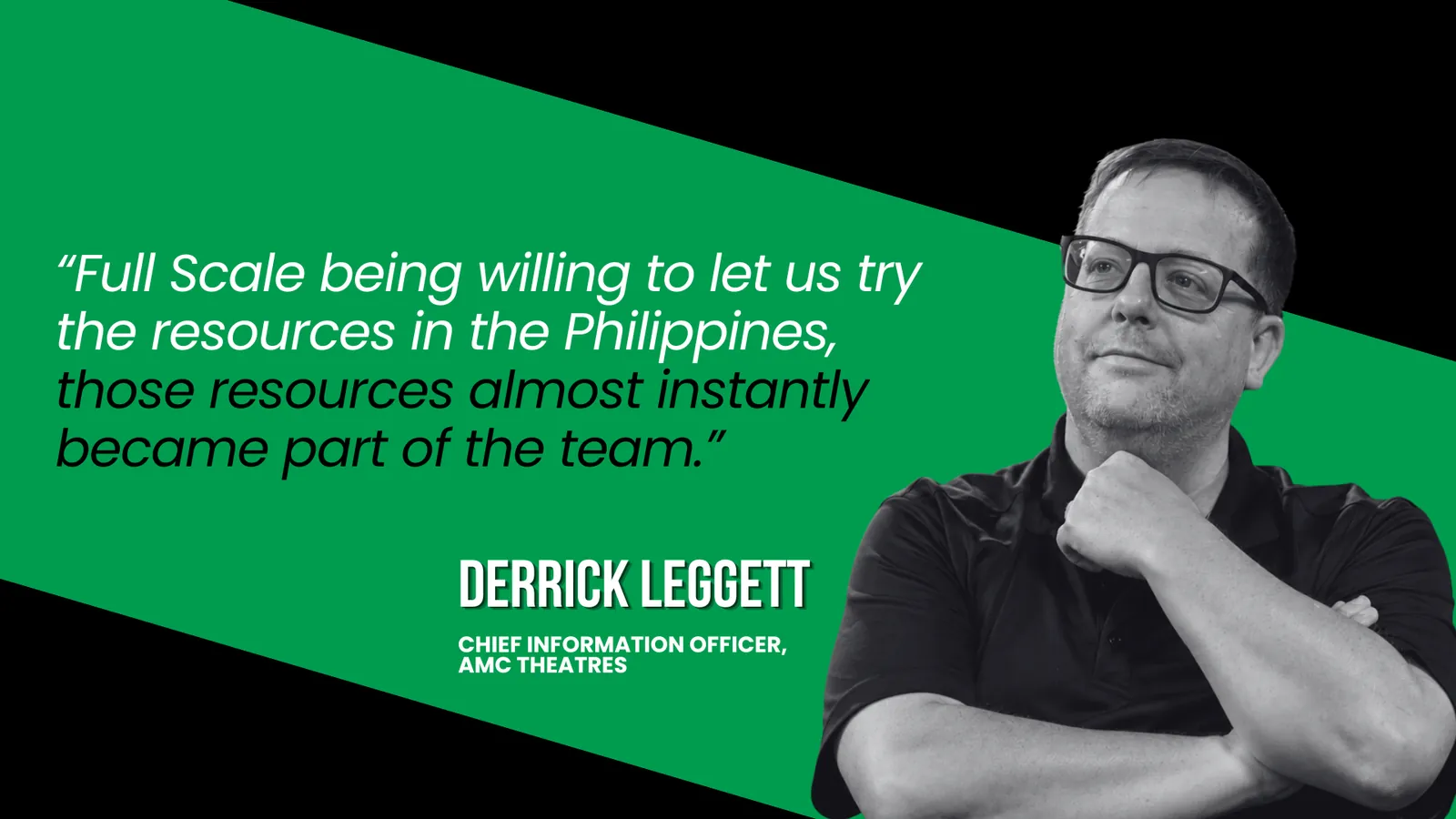
The third one is the part most buyers miss: you have to treat the team like employees, because that’s what they are. They sit in the same standups your in-house engineers do, run code reviews against the same standards, and live in the same Slack channels rather than getting siloed in a vendor-only thread. AMC Theatres has been a Full Scale client for years, and one of the things their CIO Derrick Leggett has built is a global engineering organization where the developers in the Philippines are AMC engineers, full stop. They review code with the New York team, ship to the same release branches, and share in the wins when something lands well. That’s what the dedicated team model looks like when it’s done well. We aren’t in this for some 3-month project, and the client isn’t either.
The fourth one is the part nobody likes talking about: when someone isn’t working out, replace them. Month-to-month contracts mean you can. Reasonable vendors will handle the replacement without drama, and you can have a new developer in standup within a week. Letting a mismatched developer ride the engagement for six months out of conflict avoidance is more expensive than a clean swap on Day 30.
Red flags when evaluating a dedicated team provider
A short list of warning signs from years of watching engagements succeed and fail.
On the vendor:
- No published retention rate, or a number that sounds invented (anything north of 95 percent in this industry deserves follow-up questions).
- They refuse to let you talk to existing clients without vendor staff on the call.
- They push fixed-bid pricing on work that is obviously long-term product development.
- No replacement policy in the MSA.
- A bench that skews heavily junior.
- Time zone overlap requires the developers to work overnight rather than the vendor adjusting shift patterns.
- No clear answer when you ask what AI tools their developers use.
On the engagement itself:
- The vendor wants to own product direction. That’s a project shop dressed in dedicated team clothes. Either model can be fine for the right buyer, but you should know which one you’re signing for.
- Hourly billing with vague scope is time-and-materials in disguise. Real dedicated team contracts are per-developer-per-month.
- “Hybrid” rates that turn out to be high-bill-rate consulting marked up over headcount cost.
If a vendor checks one of these boxes, you can probably still make it work. If they check three of them, walk.
A real example: what this looks like for a Full Scale client
I started Full Scale by accident. The Stackify Philippines team I built in 2018 worked so well that friends started asking me for access to the same setup, and we spun it out as its own company. We hired 100 developers in the first year. Now we serve over 200 tech companies, employ 350-plus people in the Philippines, and have made the Inc. 5000 list three years running. The Stackify dedicated team grew to 20-plus developers by 2021 and was a big key to the success of Stackify and our eventual exit that year. The dedicated team model isn’t theoretical for me. It’s the thing I built a company around after watching it work in my own engineering org.
The clearest current example I’d point you at is LendingStandard. They’re a Kansas City-based commercial real estate platform that processes roughly 30 percent of affordable multifamily property loans nationwide. They tried local hiring first, including vocational programs and college recruiting, and local just couldn’t keep up with their growth. Andy Kallenbach, their CEO, came to us for a dedicated team. From their case study:
“Waking up each morning to collaborate with the Full Scale team has become the highlight of my day. Their work ethic, pride in craftsmanship, and the sheer quality of their output have not only met but exceeded our expectations. The most significant impact has been the seamless integration of their team with ours, making every challenge surmountable and every success sweeter.”
The seamless integration line is the thing. When the dedicated team model is set up right, the team isn’t separate from your team. It is your team.
FAQ
What is a dedicated development team?
A dedicated development team is a small group of engineers, hired through a vendor, working full-time and long-term on your product under your direction. The vendor handles employment, payroll, and HR. You handle the product.
How is a dedicated development team different from staff augmentation?
Functionally, the same model under different vendor branding. Staff augmentation usually refers to individual contributors filling specific roles, while a dedicated team usually refers to a pre-composed unit including a tech lead or QA. Most vendors offer both under whichever name the client uses. The real distinction worth caring about is project versus long-term team, not the naming.
How much does a dedicated development team cost?
A 5-person dedicated team in the Philippines typically runs $25,000 to $35,000 per month all-in. The equivalent team hired in-house in the US costs $80,000 to $110,000 per month after benefits, recruiting, and overhead. The 50 to 80 percent cost reduction is driven by labor market dynamics, not a skill gap.
How long does it take to hire a dedicated development team?
With a working vendor relationship, 2 to 3 weeks from signed agreement to developers in your standups. Local hiring for the same roles averages over 40 days per LinkedIn talent solutions data.
What roles are on a dedicated development team?
For an MVP build, a typical team is one tech lead, three full-stack developers, and one QA. For scaling an existing product, add specialists (backend, frontend, mobile, DevOps) depending on the workload. If the app side is the bottleneck, you can hire dedicated mobile developers who plug into the same team rather than running as a separate vendor.
How is my IP protected when working with a dedicated team?
A US-based MSA with the vendor includes IP assignment for all work product. The same protections that apply to a local employee apply here, just through the vendor relationship rather than directly. Verify the IP language in the MSA before signing.
Can I hire the developers full-time later?
Vendor-specific, but most reasonable vendors allow conversion after a defined period with a placement fee. Ask about it on the sales call. Pretending the option doesn’t exist is a red flag.
How do dedicated teams compare to Toptal, Turing, or Andela?
Marketplaces connect you with individual freelancers from a global pool. Dedicated team vendors employ the developers and provide a pre-composed unit that already works together. Different model, different vetting, different management overhead.
Does the dedicated team model still work in 2026 with AI tooling?
It works better. AI tools raise per-developer throughput, which means a smaller team carries more workload, and the cost arbitrage between offshore and onshore gets more attractive. Ask the vendor what AI tools their developers use and how they handle IP on AI-generated code.
What if it doesn’t work out?
Standard dedicated team contracts are month-to-month. There’s no severance, no legal exposure, no scope dispute. Replace anyone within a week. End the engagement with 30 days notice if you need to.
The takeaway
Building software requires building a long-term team. A dedicated development team is what that team looks like when the company hiring it can’t or shouldn’t build the whole thing in-house.
If you want to talk through what a dedicated team would look like for your product, set up a call with the Full Scale team.