
What Is Outstaffing? A Practitioner’s Definition

In this article
Quick Answer: Outstaffing is a staffing model where a third-party vendor formally employs developers who work full-time and long-term on your team, handling payroll, benefits, HR, and compliance, while you direct the work day to day. It is functionally identical to what most US companies call staff augmentation, the vocabulary just splits by region. Full Scale runs this model with senior developers in the Philippines, with retention running 93%+, because the team that stays is what makes the arrangement actually work.
A CTO I was talking to last month told me his investor had asked him about “the outstaffing thing” in a board meeting, and he didn’t have a clean answer for what it was or whether it was a problem. For the employment-model angle, see PEO vs EOR vs staff augmentation.
He’s not the only one. Outstaffing is a word you start hearing once you’ve taken a meeting with a dev shop. It shows up in proposals. It shows up in due diligence questions. It shows up in articles that contradict each other.
Most of those articles get the basics half-right. Here’s the version I’d give a CTO over coffee.
What Outstaffing Is, in a Sentence
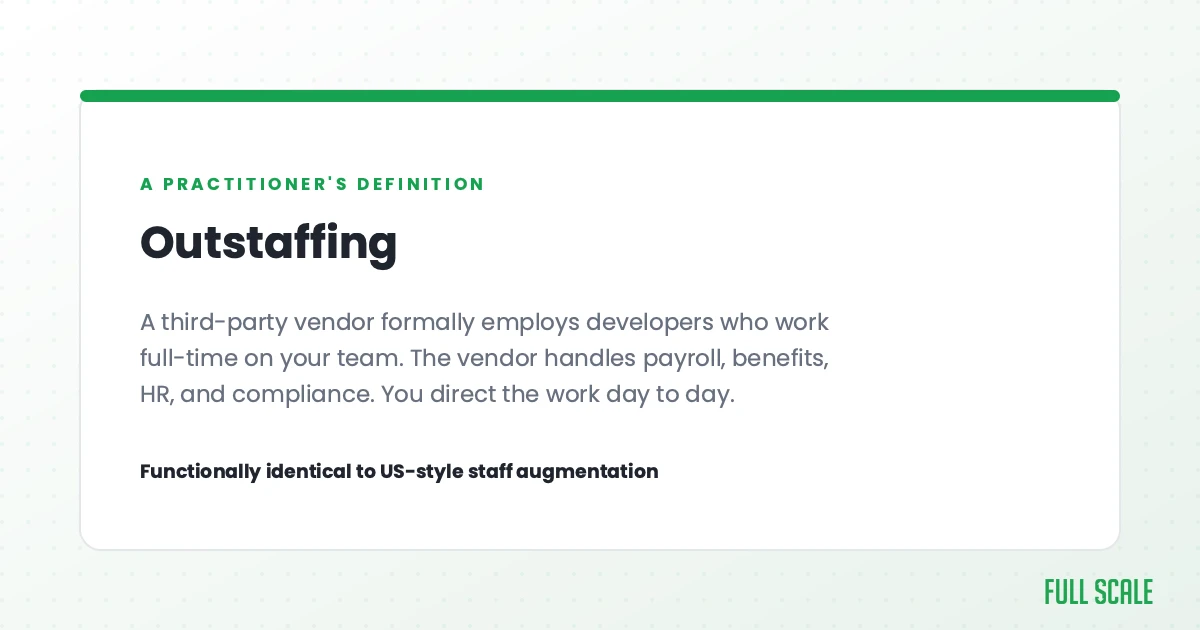
Outstaffing is a staffing model where a third-party vendor formally employs developers who work full-time and long-term on your team. The vendor handles payroll, benefits, HR, and compliance. You direct the work day to day. It’s functionally identical to what most US companies call staff augmentation, and the full side-by-side comparison of team extension and staff augmentation covers why the vocabulary keeps splitting by region. Whatever you call it, the same discipline applies when selecting an outstaffing company.
That’s the snippet definition. Plain version: outstaffing is hiring long-term, full-time contractors to join your team through a partner who handles the employment side. The simplest way I’ve said it on LinkedIn: outstaffing, not project outsourcing, is the right way to work with external contractors or offshore developers.
That’s a different thing from the three models people confuse it with. Project outsourcing hands a defined deliverable to a vendor who manages the work and gives you back a finished thing. Consulting gives you an opinion and leaves. A freelance marketplace hands you the contract and the quality problem all at once.
The model is straightforward. The interesting parts of this conversation (where outstaffing works, where it doesn’t, and what investors actually scrutinize) live further down.
How Outstaffing Actually Works
The mechanics are boring on purpose. Boring is what you want.
- You define the role. Skills, seniority, stack, sometimes a project context. Same conversation you’d have with an internal recruiter.
- The partner sources and vets. Resumes, technical interviews, an English screen, a culture-fit conversation. At Full Scale, we have a 14-day hiring timeline because we’ve been doing this since 2018 and the pipeline is already there.
- You interview the finalists. This is the part most companies skip and shouldn’t. Treat it like hiring an employee, because functionally that’s what’s happening. You’re going to work with this person for years.
- Integration. The developer gets your Slack, your GitHub, your standup invite, your code review process. They join your team’s existing channels, not a separate “vendor channel” where they wait for assignments.
- Day-to-day work. Your leads assign work, your code review process applies, your standards win. When it’s working, you forget the developers aren’t on your payroll.
The partner handles the operational lift you don’t see. Payroll. Benefits. Equipment. HR. Replacement if a developer leaves. Local labor law compliance in the developer’s country. Our team at Full Scale are all our employees. We don’t want to find random contractors and just hand them off to our clients.
That last point matters more than most articles will tell you. A real outstaffing partner is the legal employer of the developer. Not a marketplace, not a directory, not a referral. There’s an actual employment relationship on the partner’s side, which means there’s an actual contract on yours.
Outstaffing vs. Outsourcing vs. Dedicated Team vs. Traditional Hire
The comparison most buyers actually want is this one. Here it is in one table.
| Dimension | Outstaffing | Project outsourcing | Dedicated team | Traditional hire |
|---|---|---|---|---|
| Who employs the developer | Vendor | Vendor | Vendor | You |
| Who manages the work | You | Vendor | You (often with a vendor PM) | You |
| Pricing model | Time and materials, monthly per developer | Fixed bid or milestone | Time and materials, team-level | Salary |
| Best for | Long-term product work | Scoped deliverables | Long-term work with a structured team unit | Permanent core team |
| Speed to start | 2 to 3 weeks | 4 to 8 weeks | 4 to 6 weeks | 2 to 4 months |
| Commitment | Month-to-month per developer | Project duration | 6 to 12 month minimums common | Permanent |
| Where the IP sits | Yours, per contract | Yours, per contract | Yours, per contract | Yours |
If the work outlives the contract, you want outstaffing or a dedicated team. If the work ends with the deliverable, you want outsourcing. An extended team approach is the smallest version of outstaffing, where you add one to three engineers to the team you already have under your existing engineering manager rather than standing up a full self-contained group.
I should say something most articles on this topic won’t: outsourcing is sometimes the right call. I’ve personally outsourced WordPress builds. I’ve outsourced an Elasticsearch project at Stackify. Both worked. Neither of them needed a long-term Filipino senior engineer sitting on my standup for two years. They were scoped deliverables that someone else could own end-to-end and ship. Hire talent to work directly for you on a long-term basis. Don’t hire them just for a project.
That’s the test. Long-term team, outstaffing. One-time deliverable, outsource it.
What Smart Investors Actually Want
This is the section that doesn’t exist in any of the other articles ranking for this query, and it’s the section the CTO from the board meeting wishes someone had written.
There’s a piece of conventional wisdom going around that investors don’t like outstaffing arrangements. The argument is that VCs get nervous when the engineers building your product are on someone else’s payroll, because they see it as a risk to IP, retention, or transferability in an acquisition.
Smart investors want companies to have low cost and efficient ways to build software. That’s the actual truth. An engineering operation that runs at sub-US cost without sacrificing seniority is a feature, not a bug. The thing investors actually scrutinize is whether the structure works, not whether the developers happen to live somewhere else.
I’ll show you what I mean with my own story.
When I started building the Stackify team in the Philippines in 2018, a friend (Matt DeCoursey) already had developers there through his own company. He offered to share access. We opened a small office. By the time we sold Stackify in 2021, that team had grown to about 20 developers and they were one of the biggest reasons the company was worth selling. I credit building the team there with being a big part of Stackify’s success and our eventual exit.
Here’s the part that matters for this section. When we set up that team with my friend, we set it up as its own company. The Filipino developers were employees of that company, not contractors of mine. Stackify was the client. The two entities had a clean staffing contract between them.
When Stackify sold to Netreo in 2021, that Philippines team transferred to the new owner without renegotiation. The structure was clean enough that the deal closed and the team kept working. Netreo later got acquired by BMC. Same outcome. The team stayed.
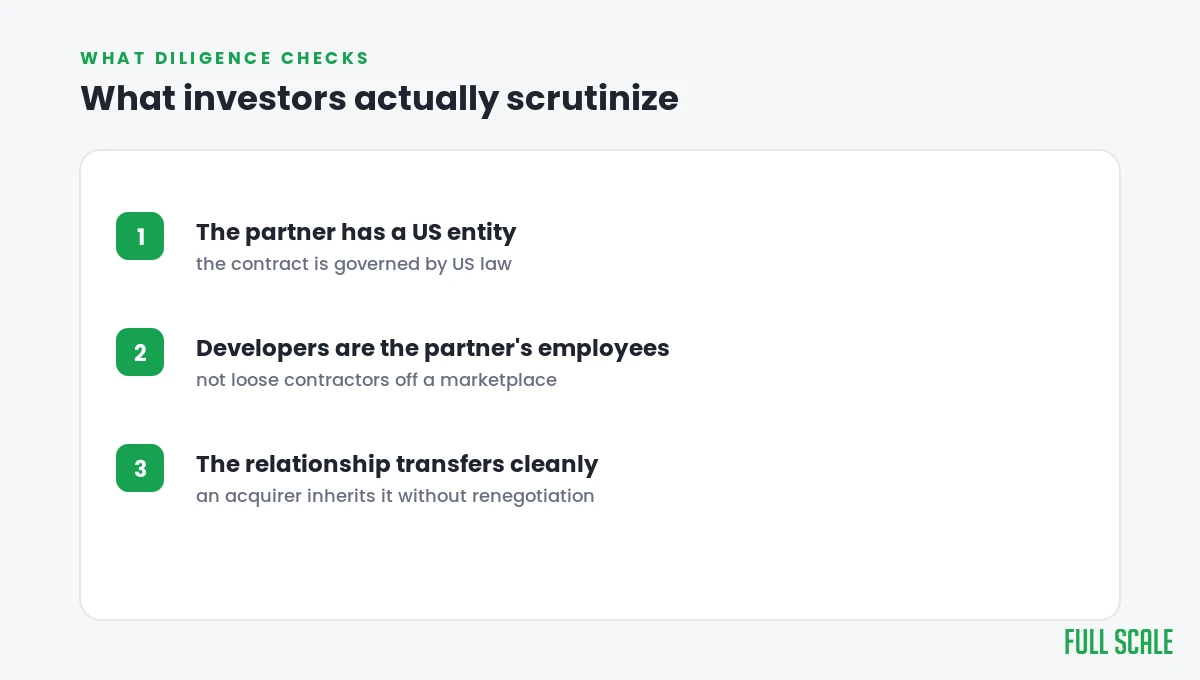
That’s what investors and acquirers actually look at. Three things, and none of them have to do with the word “outstaffing.”
First, the staffing partner has a US entity. The contract is governed by US law and the acquirer doesn’t have to chase down a foreign vendor through an international legal process.
Second, the developers are employees of the partner, not loose contractors stitched together off a marketplace. Cleaner classification story, lower misclassification risk, fewer awkward questions in the diligence Q&A.
Third, the relationship is transferable. A successor entity inherits the staffing agreement and doesn’t have to renegotiate from scratch.
What actually decides the diligence question is whether your partner is structured so the relationship transfers, not whether investors balk at the word outstaffing. At Full Scale, our clients are not hiring us for a short-term engagement. They are trusting us with their long-term teams.
When Outstaffing Makes Sense, and When It Doesn’t
Outstaffing isn’t the right answer for every company. Here’s the honest version.
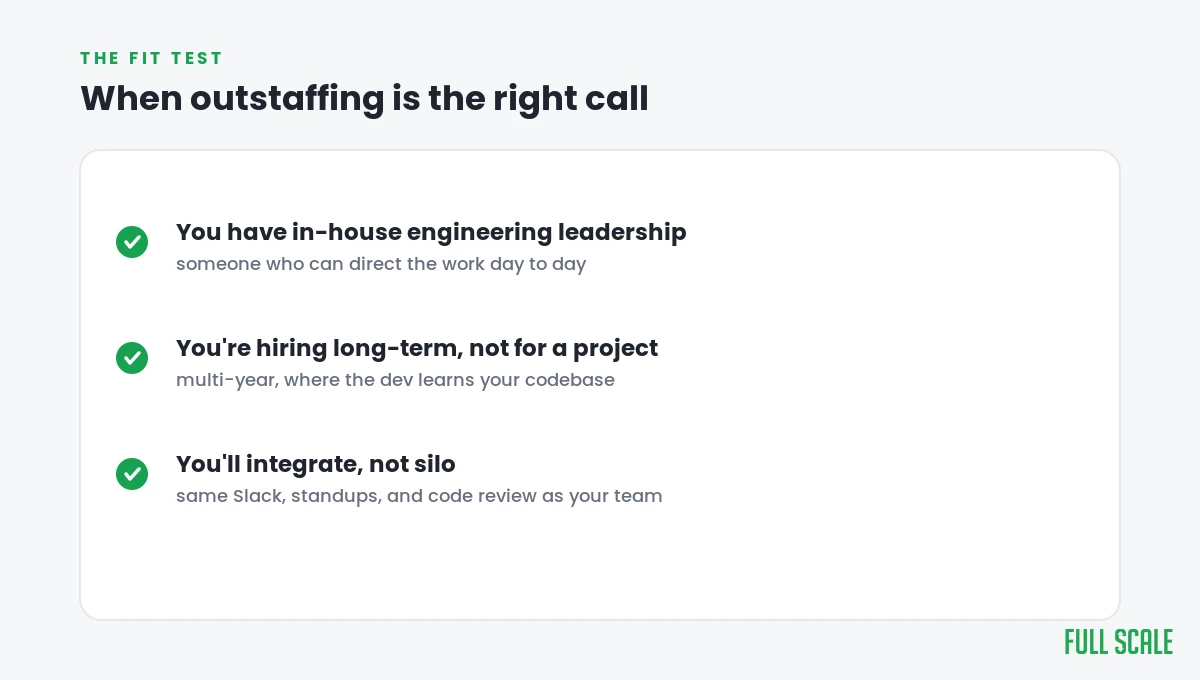
It works when three things are true.
- You have in-house engineering leadership. A CTO, a head of engineering, a tech lead. Someone who can direct the work. Outstaffing fails when the client has no one to point the developers at a problem, because then you’re paying for capacity you can’t deploy.
- You’re hiring for the long term, not a project. Six-month engagements rarely work. Multi-year ones do, because that’s the timeframe where the developer actually learns your codebase and your business. We aren’t in this for some 3-month project.
- You’re willing to integrate, not silo. Treat the outstaffed developers like the rest of your engineering team. Same Slack channels, same standups, same code review process. Don’t put them in a separate vendor lane and then complain that they don’t have ownership.
Offshore works much better when you hire talent to work directly for you on a long-term basis. Most offshore collaboration fails because people simply hand a bunch of requirements over to an outsourcing firm and expect to get back a successful project. That’s not what outstaffing is. That setup, a developer who works only for you over the long haul, is where the real benefits of outstaffing come from.
It’s the wrong call in two situations.
First, when the work is a one-time scoped deliverable that doesn’t need anyone on your team after launch. A WordPress build. A specialty integration. A migration project. Outsource those, pay for the outcome, move on.
Second, when there’s no engineering leadership in-house. You always need technical leadership in-house. If there isn’t a CTO or technical lead to direct the developers day to day, you don’t want outstaffing. You want a vendor who owns the outcome, manages their own people, and ships you a product. That’s project outsourcing, and it’s a legitimate model in that scenario.
Why Some Firms Call It Outstaffing Instead of Staff Augmentation
This is the question I get asked most often, and the answer is shorter than people expect.
The model is the same. The word changes depending on which vendor wrote the proposal. Some firms use “outstaffing” because they want to distinguish themselves from “outsourcing,” a word that carries baggage in a lot of buyers’ heads. Some firms use it because it’s the term that’s used in their local market. The substance underneath (third-party employer of record, full-time long-term developers integrated into the client team, time-and-materials pricing) doesn’t change.
There are seemingly thousands of companies that do outsourcing of software development, whether it is outstaffing, outsourcing, offshoring, or nearshoring. Consulting is a different category entirely, and if you are actually trying to decide between hiring a team and hiring staff augmentation consulting help, the two solve different problems.
For what it’s worth, Wikipedia has a thorough entry for staff augmentation and no entry at all for outstaffing. That tells you something about which name is more established in the US market. If you’re searching for the same model under either word, you’ll end up in the same place. For a US-market deep dive, see our piece on what staff augmentation is.
Spend less energy on the word. More on whether the partner is structured to give you what you actually need.
FAQ
What is the difference between outstaffing and outsourcing?
Outstaffing puts external developers on your team under your management. Outsourcing hands a defined project to a vendor who manages the work and delivers an outcome. Outstaffing is for long-term product work where you retain control. Outsourcing is for scoped deliverables where you want a fixed outcome. The comparison table above shows the differences side-by-side, and we go deeper in outsourcing vs. outstaffing.
Is outstaffing the same as staff augmentation?
Functionally, yes. Outstaffing and staff augmentation describe the same staffing arrangement: a third-party vendor employs developers who work full-time on your team under your management. The vendor handles payroll, benefits, and compliance. You direct the work. The terms come from different markets. Some firms use one, some use the other. Wikipedia has an entry for “Staff augmentation” but not for “Outstaffing,” which is a fair indicator of which name is more established in the US market.
How does outstaffing work in practice?
You define the role and skills you need. The partner sources and vets candidates. You interview the finalists. Selected developers integrate into your team’s Slack, GitHub, standups, and code review process. Your leads direct their work day to day. The partner handles payroll, benefits, equipment, retention, and compliance. The typical timeline from kickoff to a developer joining your standup is 2 to 3 weeks.
Do investors and acquirers have a problem with outstaffing relationships?
Smart investors look for low-cost, efficient engineering operations. Outstaffing fits that description when it’s structured well. What investors actually scrutinize is whether the staffing partner has a US entity, whether the developers are the partner’s employees rather than loose contractors, and whether the relationship transfers cleanly to a successor entity. When my company Stackify sold to Netreo in 2021, our Philippines team transferred to the new owner without renegotiation. Done right, an outstaffing arrangement strengthens the diligence story rather than complicating it.
When should I NOT use outstaffing?
Two situations. First, scoped deliverables you won’t need to maintain (a WordPress build, a one-time integration, a specialist project where you don’t need an ongoing person on that technology). Outsource those instead. Second, companies without any in-house engineering leadership. If you don’t have a CTO or technical lead to direct the developers day to day, you need a vendor that owns the outcome, not a staffing model that hands you a developer.
The Short Version
Outstaffing is a way to hire long-term engineering talent through a partner who handles the employment side. Done well, it’s the kind of structure smart investors actively look for. The word on the proposal doesn’t matter. The structure underneath does.
If you’re building a long-term engineering team and you want senior developers integrated into your team in two weeks, that’s what Full Scale does. Book a discovery call to see how we’d staff your team.