
Backend Developer Skills: What to Hire For in the AI Era

In this article
- What a backend developer actually does (and why the job changed)
- The technical backend developer skills, and what each one really tells you
- The skills AI turned into résumé noise
- The skills that actually predict a good backend hire
- How to actually screen for these skills
- The real cost of getting this wrong, and the cheapshoring trap
- Where to find backend developers who have these skills
- Frequently asked questions
- The bottom line
The list of backend developer skills you should hire for in 2026 is shorter than it used to be, and the few that remain are harder to screen for. The same gap shows up when you hire Django engineers, where the framework is easy to claim on paper and hard to fake under a real system-design question. Many of those same skills are what cloud-native application development actually demands, judgment about when to add complexity most of all. The same screening logic applies to .NET developer skills, where C# fluency is the floor and judgment is the real test. That logic carries straight into Node.js developer skills, where the runtime is the floor and judgment is the test. The same move applies to a senior Python developer job description.
That’s because AI has erased the gap between knowing a framework and shipping with it. The boilerplate, the CRUD endpoints, the first draft of an API, all of that is cheap now. So a résumé full of languages and frameworks tells you less than it ever has, and the skills that actually predict a good backend hire have moved up the stack into judgment. The same move shows up in Java developer skills, where core Java is the floor and judgment is the real test.
I’ve been hiring backend engineers for 20 years, through Full Scale, Stackify, and VinSolutions. Here’s what I’d screen for now, what I’d ignore, and why the AI era changed the answer. If you’re hiring on the other side of the stack too, we wrote the matching guide on front-end developer skills.
Quick Answer: The backend developer skills worth hiring for now are data modeling, system design, API design, security instinct, and the judgment to catch when AI-generated code is wrong, not fluency in a specific framework or language. AI has made framework knowledge and memorized syntax cheap to fake, so a résumé heavy on those signals less than it used to. Full Scale screens candidates on a real design problem and how they use and correct AI, not a trivia quiz, because that's what actually predicts a good backend hire.
What a backend developer actually does (and why the job changed)
A backend developer builds the part of the product users never see: the logic, the data, the APIs, the security, and the systems that keep it all running under load. If the front end is the storefront, the backend is the warehouse, the cash register, and the locked room where the money is.
That job didn’t disappear when AI started writing code. It got more important. AI is good at producing the code; it’s bad at deciding what the code should do, how the data should be shaped, and what breaks when ten thousand people hit it at once. Those decisions are the backend, and they’re now the bulk of the value a backend developer adds.
So the skills worth hiring for are the ones AI can’t do for you. Like making the right monolith vs microservices call.
The technical backend developer skills, and what each one really tells you
Here’s the technical checklist, and what each item actually signals about a candidate.
| Skill | What it really tells you |
|---|---|
| A backend language (Node.js, Python, Java, Go, C#, PHP) | The floor, not the ceiling. Which one matters less than how deeply they understand it |
| Databases and data modeling | The single most predictive backend skill. A good data model survives a decade; a bad one taxes every feature after it |
| API design (REST, GraphQL) | Whether they can build something other teams can actually use without a meeting |
| System design and architecture | Whether they’ll build for the load you have or over-build for one you’ll never reach |
| Security fundamentals | Whether they think about how it breaks, not just whether it works |
| Cloud and basic DevOps | Whether they can ship and run it, not just write it |
| Testing | Whether the next person can change the code without fear |
Notice that only the first row is about a language. The rest are about judgment, and that’s the point. That judgment is the core of what a senior backend engineer actually does.
The skills AI turned into résumé noise
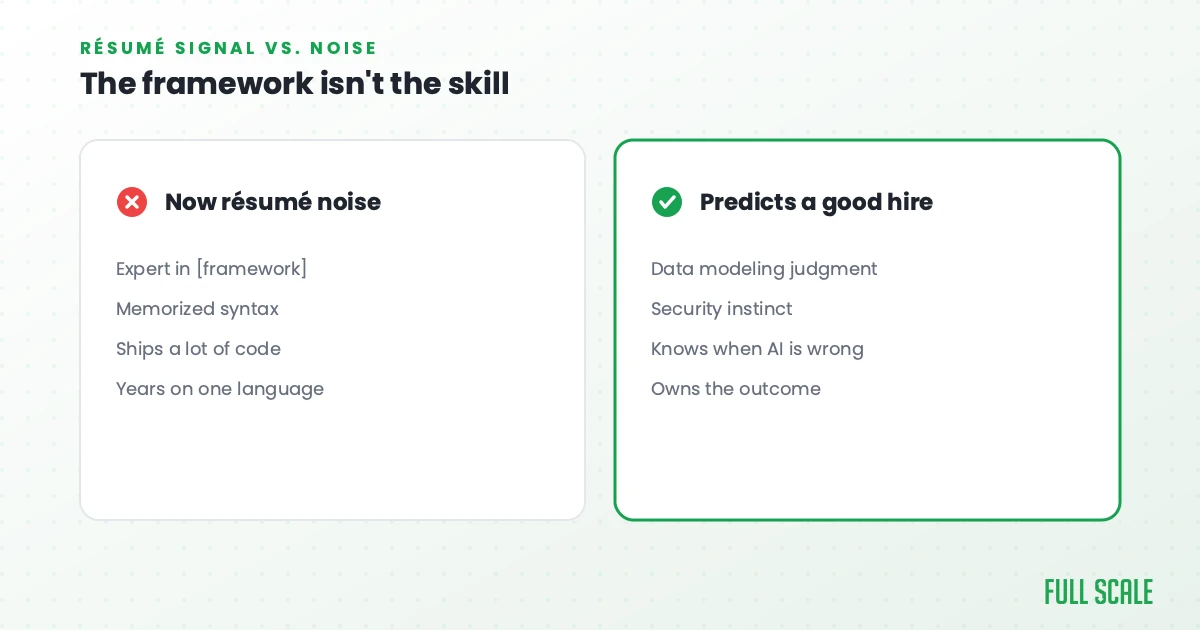
A few things that used to impress on a backend résumé now tell you almost nothing.
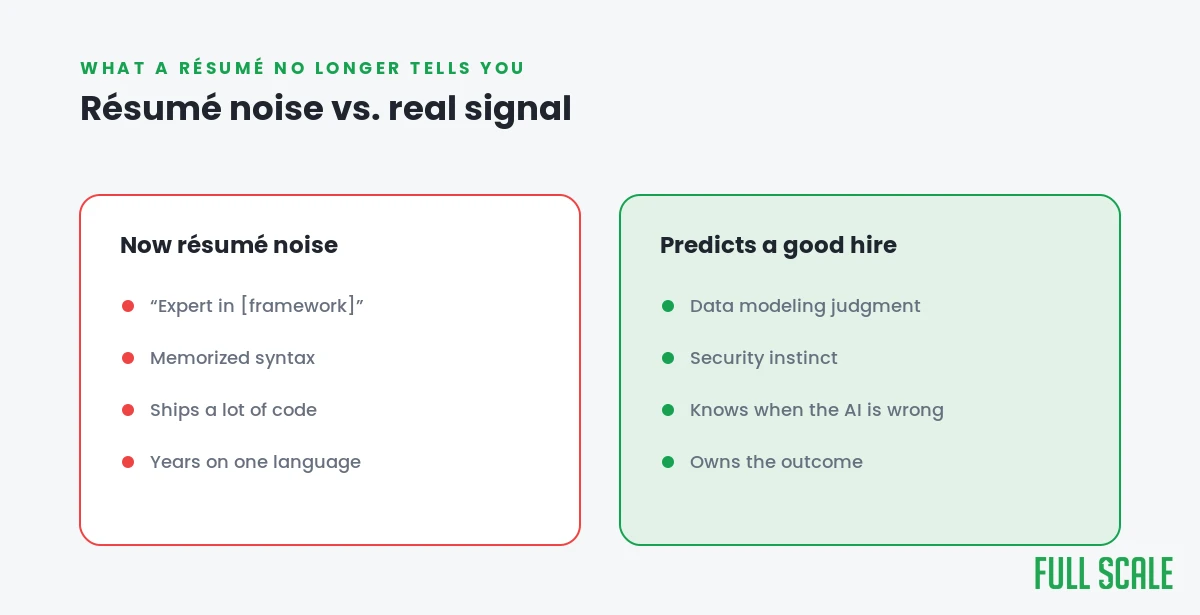
Knowing a specific framework is one. AI can scaffold a working API in any popular framework in minutes, so “expert in Express” or “five years of Django” is a weaker signal than it sounds. The framework is learnable in a weekend; the judgment to use it well is not. Adjacent specialties raise their own bar, like a MarTech developer who lives between marketing and engineering.
Memorized syntax is another. The ability to write a query or a sort algorithm from memory mattered when you couldn’t look it up instantly. Now it’s the cheapest skill on the list. As Google’s CEO said, about 75 percent of the company’s new code is AI-generated, and the engineers still review every line. The typing is not the job.
Raw output is the third. “Ships a lot of code” used to be a compliment. Now anyone can generate a lot of code, and more of it is a liability, not an asset. GitClear found duplicate code blocks jumped about eightfold in 2024 as AI use spread. Volume is not value.
The skills that actually predict a good backend hire
These are the ones I’d weight most heavily, and they’re all variations on judgment.
Data modeling. Ask a candidate to design the data model for a real feature and you learn more in 20 minutes than a résumé tells you in a year. Data modeling is also the crux of the SQL vs NoSQL choice. A good backend engineer shapes data so the next ten features are easy. A weak one ships a schema that fights every change.
I’ve believed this my whole career: if you don’t get the database design right, you never get anything else right in the app, because everything downstream inherits that decision. It’s why I’d weight a candidate’s data-modeling judgment above almost anything else on their resume.
Security instinct. The engineers worth hiring assume their code will be attacked. This matters more in the AI era, not less: a 2025 Veracode study found 45 percent of AI-generated code carried a known security flaw, and the bigger models were no safer. Someone has to catch that, and it’s the backend developer.
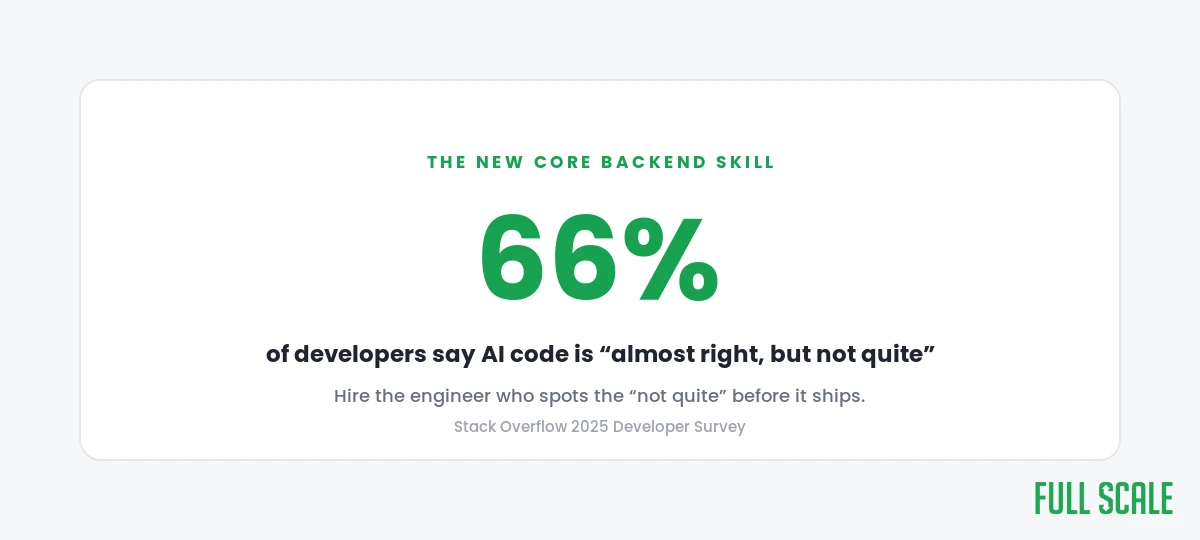
Knowing when the AI is wrong. This is the new core skill. Stack Overflow’s 2025 survey found 66 percent of developers say their biggest AI frustration is code that’s almost right but not quite. The valuable engineer is the one who spots the “not quite” before it ships. I joke with clients that we’re all paying developers to babysit AI now, to review what it generates and steer it toward something useful. It’s an exaggeration, but it’s where the value moved.
Ownership. The best backend engineer I ever worked with, at Stackify, owned our monitoring support across Java, Node.js, PHP, and Python. He decided which languages to support and what “done” meant. His title was senior developer, but he operated like a product manager. That ownership, the instinct to own the outcome and not just the ticket, is the trait that separates a good hire from a great one. It’s a theme I keep returning to in my book, Product Driven.
How to actually screen for these skills
You can’t find these traits on a résumé, so stop trying. Screen for them directly.
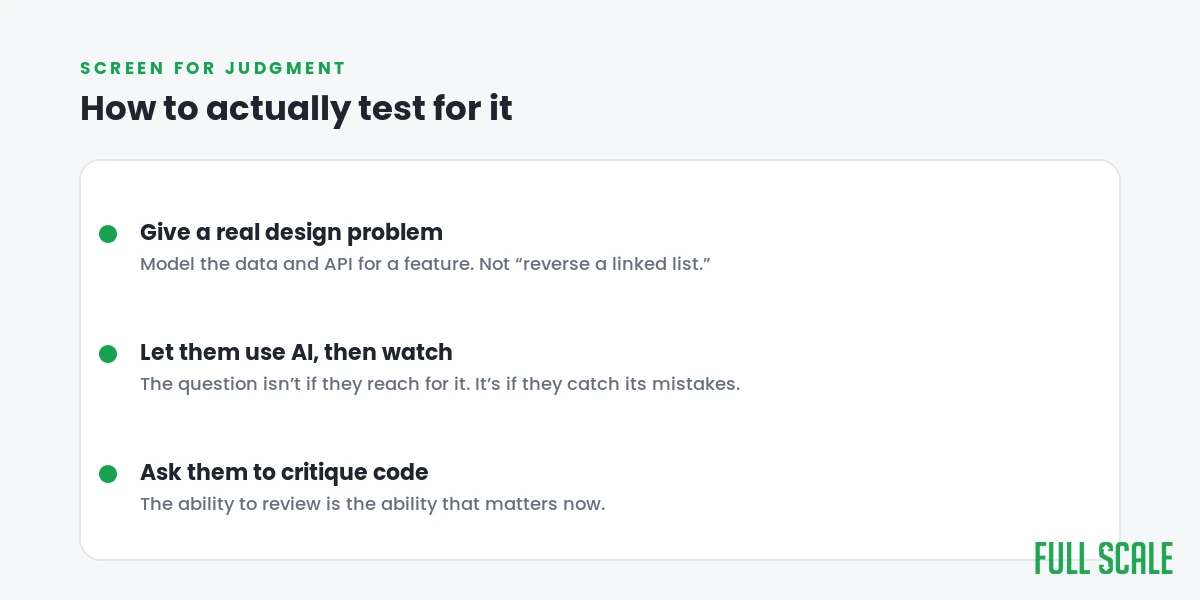
Give a real design problem, not a trivia quiz. “Design the data model and API for this feature” surfaces judgment; “reverse this linked list” surfaces memorization that AI made worthless.
Let them use AI in the interview, then judge how they use it. The question isn’t whether they reach for AI. It’s whether they catch what it gets wrong. One of our engineers on the SOTA Cloud team used Claude to reverse-engineer a proprietary dental imaging file format, which is exactly the kind of AI-directed problem solving you want to see. The tool did the grinding; the engineer supplied the judgment.
Ask them to critique code, not just write it. Hand them a flawed schema or a risky endpoint and see whether they spot the problem. The ability to review is the ability that matters now.
The real cost of getting this wrong, and the cheapshoring trap
Hiring the wrong backend developer is more expensive than hiring the wrong front-end developer, because backend mistakes are invisible until they’re costly. A bad data model or a security hole doesn’t show up in a demo. It shows up a year later as a migration you can’t afford or a breach you have to disclose.
This is why I tell people the cheapest backend developer is usually the most expensive one. Hiring for rate alone is what I call cheapshoring, and the backend is where it does the most damage. A $40-an-hour engineer with good judgment is cheaper over two years than a $150-an-hour one who picks the wrong architecture, the same point I made in the backend development cost breakdown. The rate is the easiest number to compare and the least predictive of what you’ll spend.
Where to find backend developers who have these skills
The engineers with these skills are mostly not on job boards. The best backend developers already have jobs and aren’t applying anywhere.
That’s the core of what we do at Full Scale. We run in-house recruiters who go after passive candidates, and we accept under 3 percent of applicants. The ones who make it through join an internal AI training program, because we refuse to staff engineers who can’t work the way the job now demands. The result is senior backend engineers who own their work, which is why a client like SOTA Cloud’s CTO said our team includes top performers even relative to the people they have in the US.
You can build that screening capability in-house, or you can borrow ours. Either way, screen for judgment, not for a list of frameworks.
If you want senior backend engineers who already clear that bar, schedule a call with us.
Frequently asked questions
What skills does a backend developer need in 2026?
A backend language is the floor, but the skills that matter most are data modeling, system design, API design, security fundamentals, and basic cloud and DevOps. Above all, the ability to use AI well and catch what it gets wrong. Framework-specific knowledge matters far less than it used to, because AI can scaffold working code in any popular framework, so judgment about how to structure data and systems is what separates good hires from weak ones. That mix is also what upskilling software engineers for AI should build toward, not faster typing.
What’s the most important backend developer skill to hire for?
Data modeling, closely followed by security judgment. A good data model makes every future feature easier and survives for years, while a bad one taxes every change after it. Because these decisions are invisible in a demo and expensive to undo, they’re the skills worth screening for directly with a real design problem rather than a coding trivia quiz.
Do backend developers still need to code if AI writes it?
Yes, but the job shifted from writing code to directing and reviewing it. AI generates a large share of new code now, but it produces a meaningful amount of flawed and insecure code, so the human has to know enough to catch the mistakes. A backend developer who can’t read and judge code can’t tell when the AI is wrong, which is now the core of the job.
How do I screen for backend developer skills?
Give candidates a real design problem like modeling the data and API for a feature, let them use AI and judge how well they catch its mistakes, and ask them to critique flawed code rather than only write new code. These surface judgment, which is what predicts a good backend hire. Memorization-style quizzes test the one skill AI has made cheap.
Is it cheaper to hire backend developers offshore?
On rate, almost always, because of cost-of-living differences rather than lower skill. But the rate is the smallest part of the real cost. A cheaper engineer who makes a poor architecture or security decision costs far more over the life of the system, so hire offshore for judgment and vetting, not for the lowest possible hour.
The bottom line
The backend developer skills worth hiring for in the AI era are the ones AI can’t supply: data modeling, system design, security instinct, and the judgment to know when the generated code is wrong. The frameworks and the syntax are table stakes now. Screen for judgment directly, don’t cheapshore the role where bad decisions compound, and you’ll hire backend developers who are still paying off years from now.