
Front-End Developer Skills: What to Hire For in the AI Era

In this article
- What a front-end developer actually does (and why the job changed)
- The technical front-end developer skills, and what each one really tells you
- The skills AI turned into résumé noise
- The skills that actually predict a good front-end hire
- How to actually screen for these skills
- The real cost of getting this wrong (and the cheapshoring trap)
- Where to find front-end developers who have these skills
- Frequently asked questions
- The bottom line
Most front-end developer skills lists are the same generic checklist of technologies to learn, written for someone who wants to become a front-end developer.
This is the other article, the one for the person doing the hiring.
I’ve hired front-end developers, and a lot of other kinds, across four companies and four countries. I bootstrapped VinSolutions to $35 million in annual recurring revenue and sold it, founded and sold Stackify, and I now run Full Scale, where we hired 100 developers in our first year and run more than 350 engineers today. I have screened more résumés and sat through more bad interviews than I’d like to count.
Here’s what I’ve learned, and it’s the part the skills lists miss.
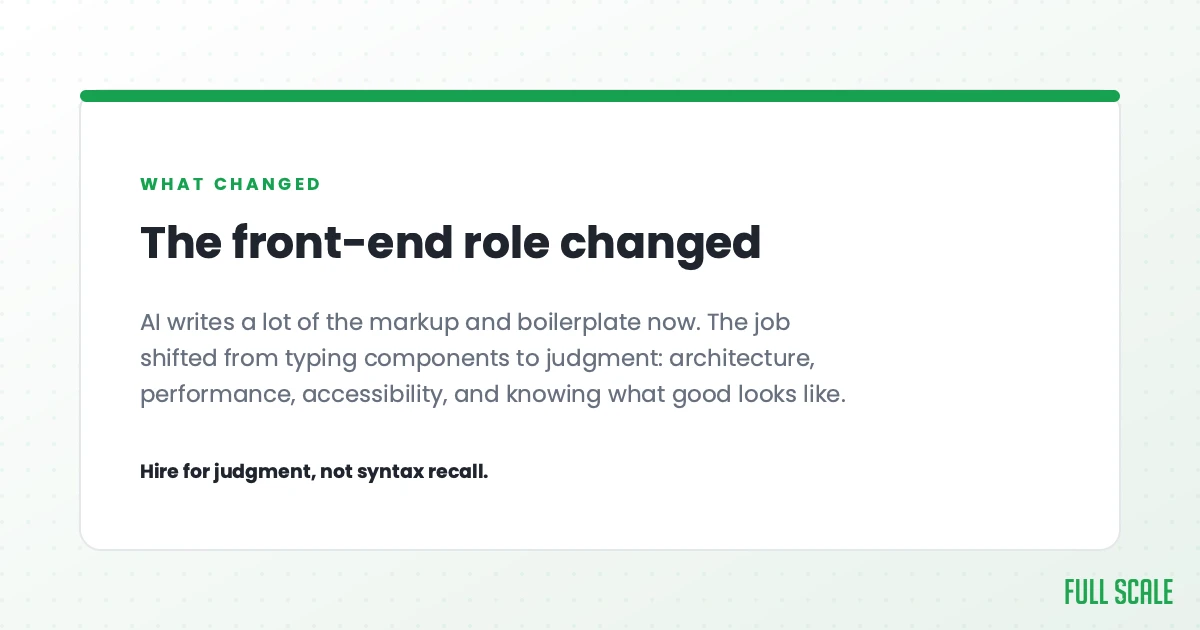
The checklist that mattered in 2015 is mostly noise now, because AI writes the code those skills used to cover. What’s left is harder to put on a résumé and far more important to hire for.
Quick Answer: A front-end developer job description should lead with communication, curiosity, and judgment, not a checklist of frameworks. AI now writes a large share of routine front-end code, so knowing HTML, CSS, JavaScript, and a framework like React is the floor, not the pitch. What still separates candidates is whether they can explain their decisions, teach themselves new tools, catch when AI-generated code is wrong (Veracode found about 45% of it carries a known security flaw), and push back on a bad requirement before it ships. Full Scale screens every front-end hire on that judgment before they ever join a client team.
What a front-end developer actually does (and why the job changed)
A front-end developer builds the part of an app or website that people actually see and touch: the buttons, the layouts, the forms, the way a page reacts when you click something. The classic toolkit is HTML for structure, CSS for styling, and JavaScript for behavior, usually on top of a framework like React. A lot of that toolkit now starts prebuilt too: plenty of teams reach for something like Shadcn UI templates instead of styling every dashboard and form from a blank file. All of that is a different world from the server side, and how frontend and backend work differs is the first thing worth understanding before you hire for either role.
That much hasn’t changed. What changed is who writes it.
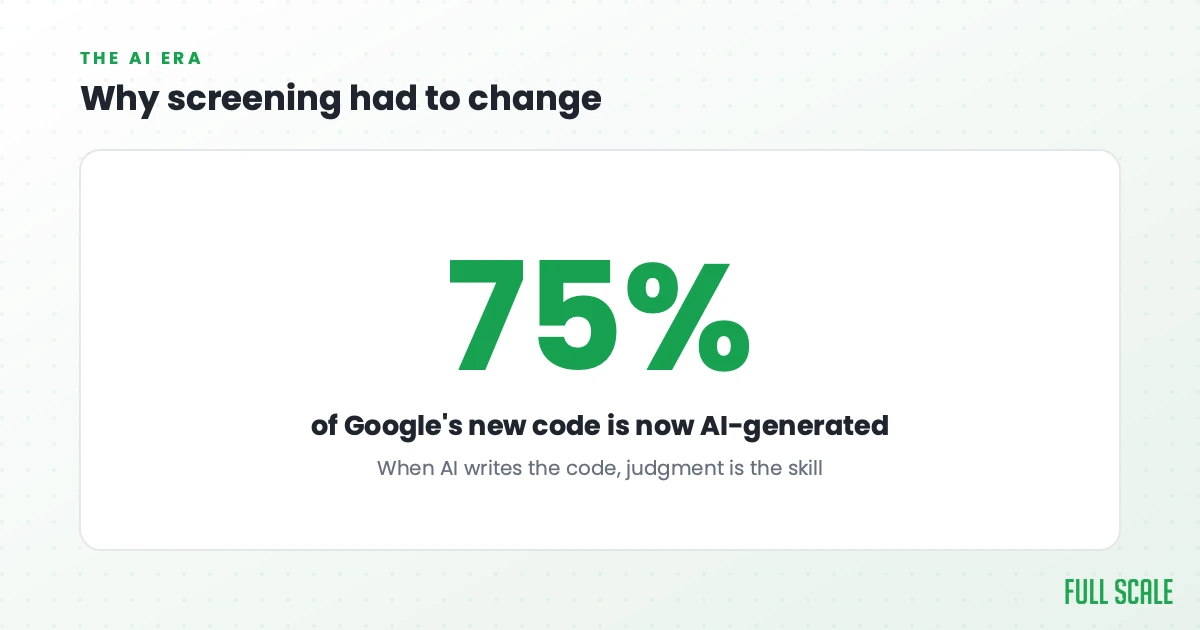
Microsoft says as much as 30% of its new code is now written by AI, and Google’s CEO said in April 2026 that about 75% of the company’s new code is now AI-generated, with every line still reviewed and approved by an engineer. In the 2025 Stack Overflow Developer Survey, 84% of developers said they use or plan to use AI tools in their work. The mechanical part of front-end development, turning a design into working markup, is the part AI does best. A junior developer with Cursor open can scaffold a responsive component in minutes, and that change is exactly why the old way of evaluating a developer no longer works. This is one of the bigger shifts I’ve written about in how AI is changing software development.
So if you’re hiring and your screen is still “can this person hand-write a flexbox layout,” you’re testing for the cheap part. The skills that decide whether a hire succeeds are the ones AI can’t fake. Let’s start with the technical skills anyway, because you still need to evaluate them. You just need to know what they’re actually telling you.
The technical front-end developer skills, and what each one really tells you
Every frontend developer skills list online gives you these as things a candidate should have. I’m going to give them to you as signals to read. When you see a skill on a résumé or in a portfolio, the question isn’t “do they know it.” It’s “what does knowing it (or not) tell me about how they’ll work on my team.”
| Skill | What it is | What it tells you in a hire |
|---|---|---|
| HTML and CSS | The structure and styling of a page | Table stakes. Everyone claims it, so judge it by whether their actual work is clean and accessible. Listing it on a résumé tells you nothing. |
| JavaScript and TypeScript | The language that makes pages interactive | Still the core. JavaScript leads the 2025 Stack Overflow survey at 66% usage. A candidate reaching for TypeScript signals they care about catching bugs before users do. |
| A framework (React, Vue, Angular) | Tools that structure larger apps | React is the most-used front-end framework (44.7% in the same survey). Match the framework to your stack, but don’t over-index on it. A strong developer picks up a new framework quickly. |
| Responsive and mobile design | Making a site work on any screen | This one is expected, so test it on a real device instead of taking the claim at face value. |
| Version control (Git) | Tracking and merging code changes | If they can’t talk about branching, code review, and resolving a merge conflict, they haven’t worked on a real team. |
| Testing and debugging | Finding and fixing problems | The single most underrated skill, and the one that matters more in the AI era, not less. |
| Web performance | How fast and smooth the page feels | A developer who profiles load times and Core Web Vitals without being told is thinking about the experience the user actually has, which is the judgment you want. |
| Web accessibility | Building for people with disabilities | The strongest judgment tell on this list. WebAIM found accessibility failures on about 95% of home pages. A candidate who builds accessible interfaces unprompted cares about the user behind the screen. |
Notice the pattern. The skills near the top of the table are easy to verify and easy to fake on a résumé. The skills near the bottom, testing and accessibility, are the ones that separate a developer who ships features from one who ships problems. Those are the ones to dig into.
The skills AI turned into résumé noise
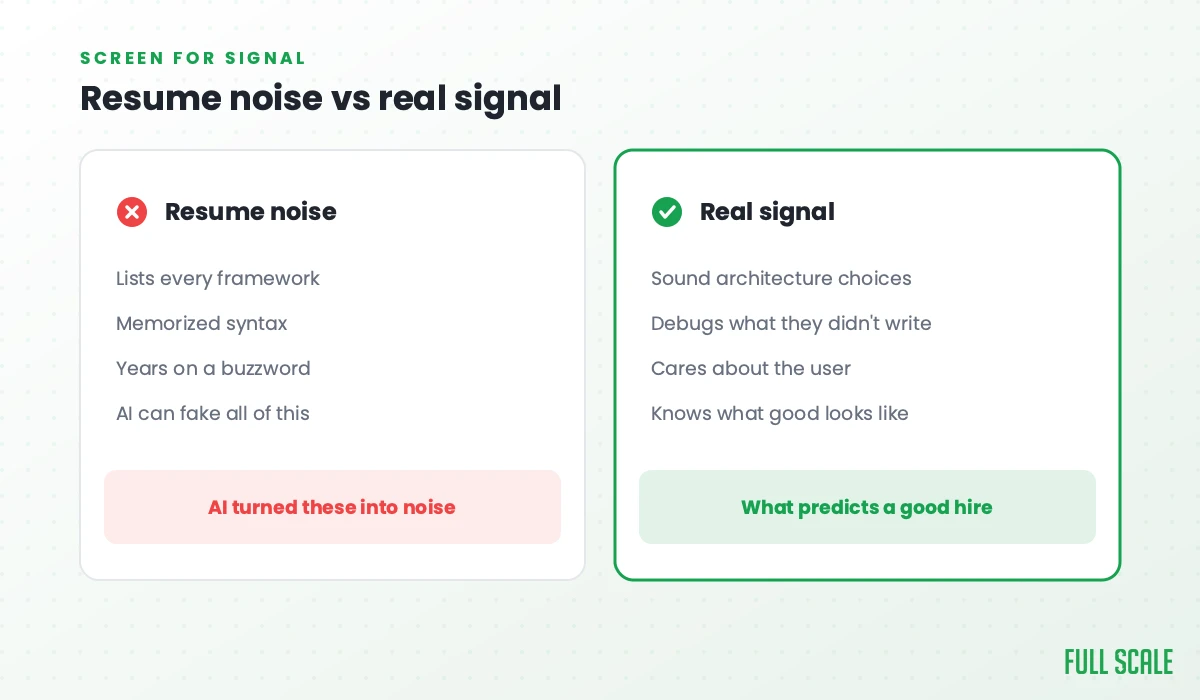
Here’s the uncomfortable part for a lot of hiring managers. Several of the skills people still screen hardest for are the ones AI now handles by default.
Writing boilerplate markup, converting a Figma file into components, wiring up a standard form, fixing a CSS quirk in Safari: a competent developer with a modern AI assistant does all of that in a fraction of the time it used to take, and does it well. Screening for raw coding speed in those areas is like hiring an accountant based on how fast they do long division.
What AI does not do is know when it’s wrong. Veracode’s 2025 research found that about 45% of AI-generated code shipped with a known security flaw, and bigger models didn’t fix it, so the gap is structural. In the Stack Overflow survey, 66% of developers said their top frustration with AI was code that’s “almost right, but not quite,” and 45% said they lose real time debugging what the AI handed them. The 2025 DORA report, from Google’s DevOps Research and Assessment team, put it well: AI amplifies what’s already there. A strong developer gets faster. A weak one ships their mistakes quicker.
You’re no longer hiring someone to write the code. You’re hiring someone to decide whether the code is right and to know what should have been built in the first place.
I said this on my podcast a while back and I still believe it: AI can probably engineer the code better than most of us, most of the time. The hard part is understanding what needs to be built and why. That judgment is the thing you’re paying for now.
The skills that actually predict a good front-end hire
When the mechanical part of the job gets automated, the human part is what’s left to compete on. I think it comes down to three things, and I wrote a whole book, Product Driven, about why they matter. I call them the three C’s: communication, curiosity, and courage.
Communication. A front-end developer sits between designers, back-end engineers, product managers, and the customer. The best ones ask good questions, write clearly, and say so when a requirement doesn’t make sense. This isn’t a soft nicety. The Bureau of Labor Statistics lists communication and problem-solving among the key qualities for web developers, and tellingly it doesn’t put any single language on that list. When a developer can’t explain why they built something a certain way, you’ve hired a pair of hands, not a teammate.
Curiosity. This is the one I tell our engineers will keep them safe through the AI shift. Stay curious about how the tools are changing and how you can use them, and you’ll adapt. Stop, and you won’t. Mohan Reddy, chief scientist at Cornerstone AI Labs, said it cleanly when he came on my podcast: “Always be curious. Always be learning.” A front-end developer who taught themselves the framework you use, in their own time, is showing you the trait that matters most.
Courage. This is the willingness to push back, to flag the design that won’t work, to say “this ticket is wrong” before sprint planning ends instead of after the feature ships. It only exists on teams where people feel safe speaking up, and it’s worth screening for because the developer who quietly builds the wrong thing is far more expensive than the one who argues with you in a planning meeting.
I’ll give you a real example of why I hire for trajectory and curiosity over a polished résumé. Years ago at VinSolutions I hired a guy named Brian Kellogg onto our support team. He was one of the best I’ve ever seen at diagnosing weird problems in the software. He climbed from support to level-two support to junior developer to senior developer, and then went on to co-found VinCue, an automotive software company I invested in early. I think VinCue is going to end up being a bigger exit for him than VinSolutions was for me. None of that was on a résumé when I hired him. The curiosity was.
For a deeper treatment of the non-technical side, we wrote a whole piece on the soft skills to look for in a software engineer. The short version: hire the human skills, because the technical ones are getting commoditized.
How to actually screen for these skills
This is the part no skills list will tell you, because those lists are written for the candidate. This one is written for you. Knowing what matters is useless if your interview can’t detect it, so here’s how I’d run it.
Stop trusting the résumé. A résumé is a list of claims, and in 2026 a lot of those claims are decorated by the same AI the candidate will use on the job. Krishna Oza, who built a hiring platform called GitHired, made the point bluntly on my podcast: résumés are full of fancy lines like “increased efficiency 30%,” and nobody can show you where. What he looks for instead is proof of work. If someone has been building and shipping real projects, that’s your signal. So ask to see what they’ve built and shipped, and put more weight on that than on anything in the bullet points.
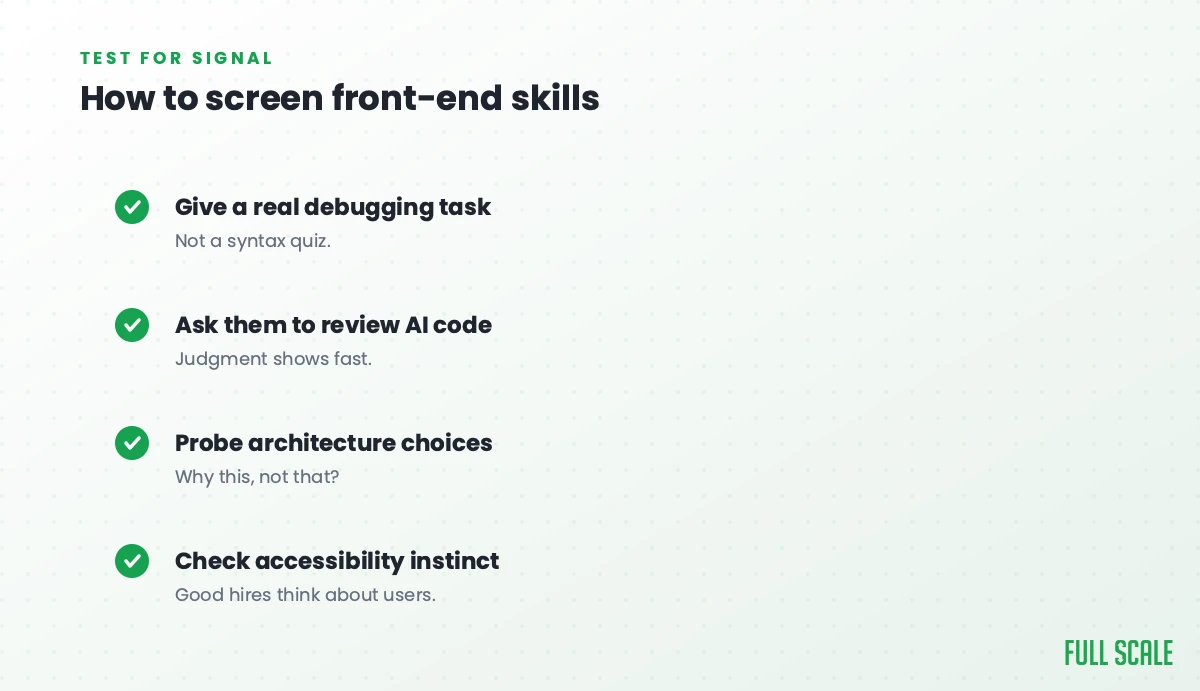
This doesn’t mean fundamentals stop mattering. It means you test for them differently. You’re not checking whether someone can type a layout from memory. You’re checking whether they can read code, spot what’s wrong with it, and explain what should have been built. A few concrete moves that work better than a quiz:
- Give them a real, messy problem. Hand them an actual bug from your backlog or a small pull request to review. How they reason through it tells you more than any algorithm puzzle.
- Watch how they use AI, don’t ban it. Let them code with their assistant and ask them to explain why they accepted or rejected what it suggested. That reveals judgment, the skill you’re actually buying.
- Check for accessibility unprompted. Ask them to build a small form and see if it works with a keyboard and a screen reader. The ones who do it without being told are the ones who think about users.
- Ask “why,” not just “how.” “Why did you choose that approach?” surfaces communication and courage in about thirty seconds.
We dug into this more in our guide on skills assessments for software developers, which has gotten more important now that résumés mean less.
The real cost of getting this wrong (and the cheapshoring trap)
A bad front-end hire is expensive in ways that don’t show up until later. There’s the recruiting cost: a staffing agency placement fee generally runs 20% to 25% of first-year salary. There’s the salary itself, which for a senior front-end developer in the US runs well into six figures. And there’s the hidden cost, which is everything that breaks while a developer who can’t communicate or won’t push back quietly ships the wrong things for six months.
That cost is exactly why so many companies go offshore, and exactly why so many of them get burned. They go looking for the cheapest developer they can find. I call this cheapshoring, and I wrote about why it backfires. When cost is the only reason you’re hiring, you buy the cheapest thing, which is a freelancer who disappears mid-sprint or a project shop that bills for ten and puts three on the work. Then you join the long line of people who tried offshore once, got burned, and swore it off.
Cost is a fine reason to hire globally. You can hire excellent developers for 50% to 70% less than US rates because of the cost of living, not because the talent is worse. But cost can’t be the only reason, or you’ll optimize for the cheap skills and skip the judgment that actually matters.
Where to find front-end developers who have these skills
Finding a developer who has the three C’s and the technical chops is hard. Recruiting them is its own skill, and it’s the part most companies underestimate. The best developers already have jobs. They’re not refreshing job boards. They have to be found and recruited away, which is why we run a team of full-time recruiters and lean on referrals from our own 350-plus engineers.
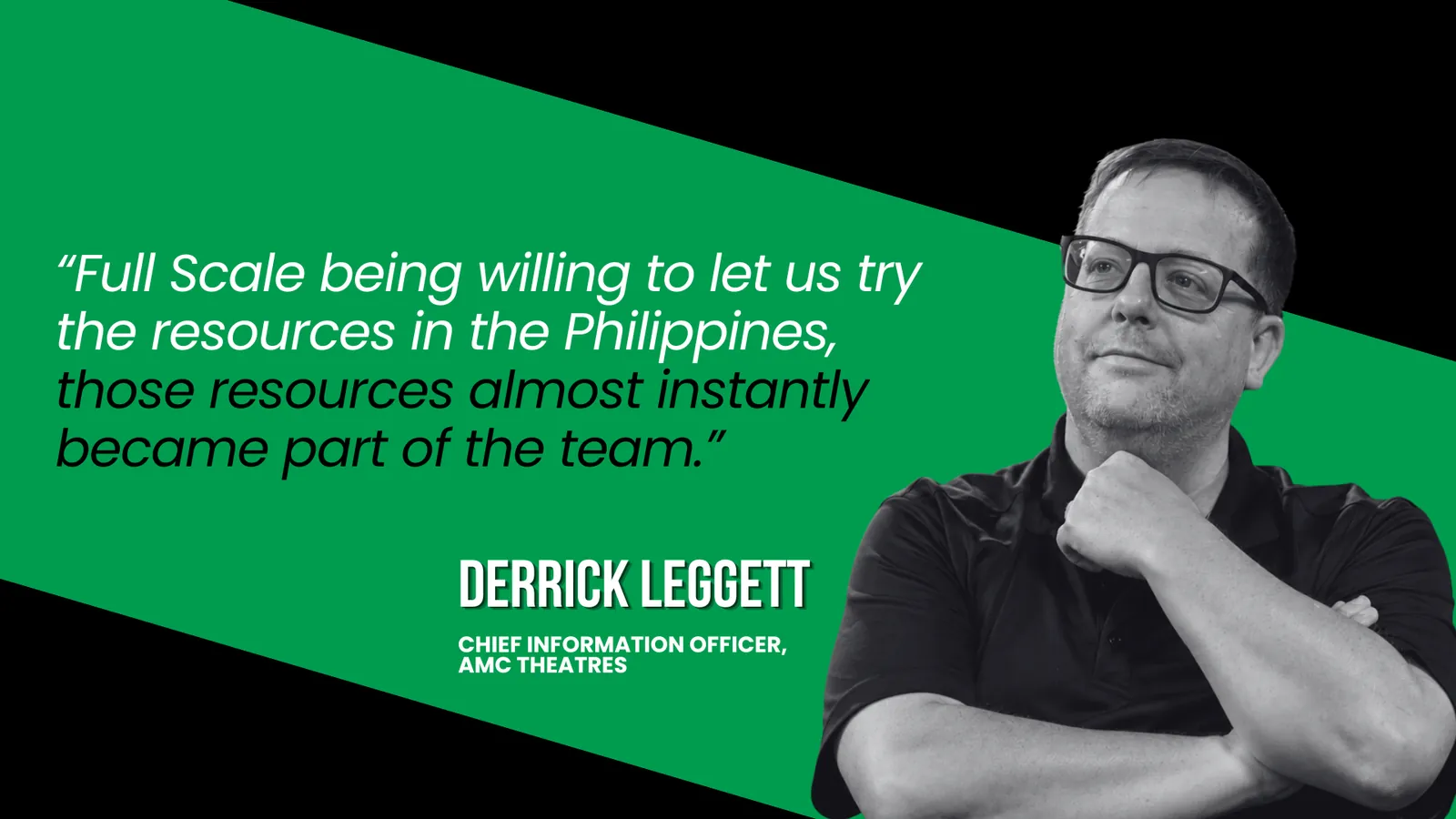
That’s the model that works: a partner who knows how to recruit, manage, and retain front-end developers, instead of a marketplace where you screen a hundred résumés yourself. It’s how AMC Theatres scaled its engineering team with developers in the Philippines who work as full members of the AMC team rather than contractors held at arm’s length. If you want help building that team, this is what Full Scale’s front-end developers are for, and it’s a flexible staff augmentation model where they join your team and your process.
Frequently asked questions
What skills does a front-end developer need in 2026?
Technically, a front-end developer still needs HTML, CSS, JavaScript (ideally TypeScript), a framework like React, version control, and a real grasp of testing and accessibility. But the skills that now predict success are communication, curiosity, and judgment, because AI handles much of the routine coding. Hire for the human skills and verify the technical ones.
What soft skills should I look for in a front-end developer?
Communication, curiosity, and courage. Can they explain their decisions and ask good questions? Do they teach themselves new tools without being told? Will they push back on a bad requirement before it ships? These predict performance better than any framework on a résumé.
Do front-end developers still need to know how to code if AI writes it?
Yes, more than ever, but for a different reason. AI generates code fast, and a lot of it is wrong. Veracode found about 45% of AI-generated code carries a known security flaw. You need a developer who understands the code well enough to know when the AI is wrong and what should have been built in the first place.
How do I tell a junior front-end developer from a senior one?
A junior developer executes a task that someone else has already defined. The senior developer is the one who figures out what the task should even be, sees what’s going to break before it does, and explains the tradeoffs to people who aren’t engineers. In the AI era that judgment gap is the whole difference, since both can now produce code quickly. We break down the levels in more detail in our guide to the difference between junior, mid-level, and senior developers.
Is it cheaper to hire a front-end developer offshore?
Often, yes. You can hire skilled offshore developers for 50% to 70% less than US rates. That savings comes from cost-of-living differences, and the talent is every bit as strong. The mistake is making cost the only factor. Hire for skill and fit first, treat the cost savings as a bonus, and work with a partner who can recruit and retain real talent.
The bottom line
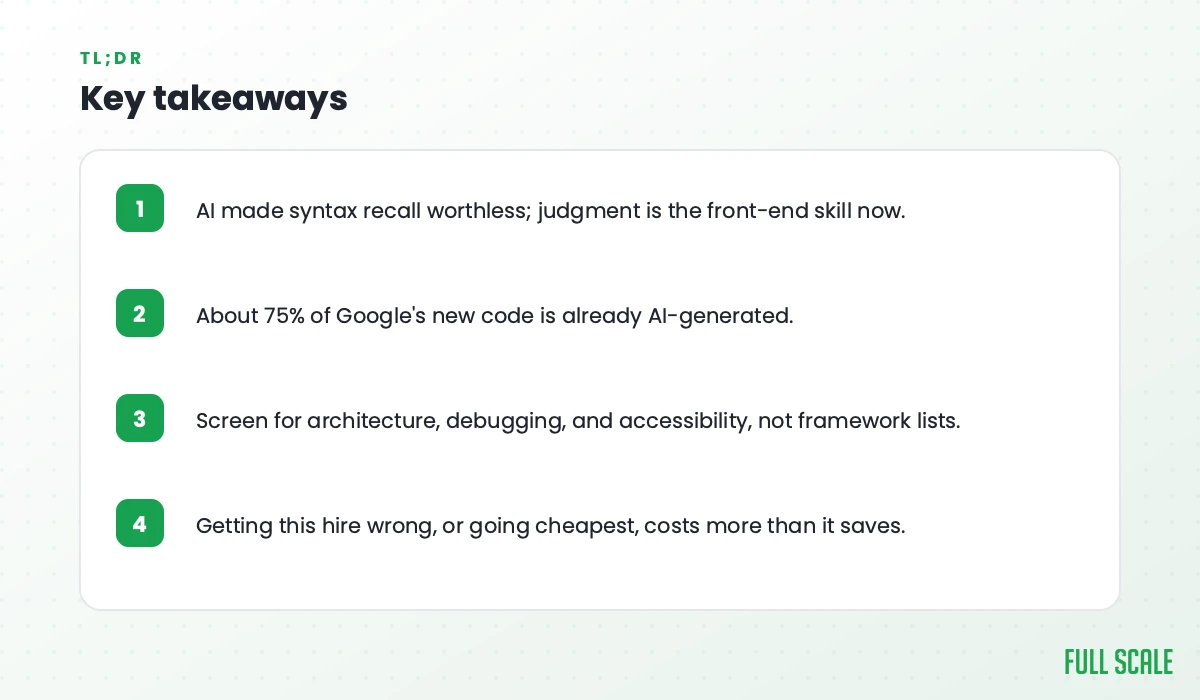
Knowing what a front-end developer is was step one, and it’s the easy step. Hiring the right one in a market where AI writes the code is the hard part, and it comes down to screening for judgment, curiosity, and communication instead of a list of technologies anyone can claim.
Do that well and you skip the part where you screen a hundred résumés to find five worth interviewing. Build your front-end team with Full Scale and we’ll handle the recruiting for you.